



Heterostructure-governed mechanisms for synergistic improvement of strength and conductivity in copper alloys
 0
0 Abstract
Traditional homogeneous copper alloys often exhibit a significant reduction in electrical conductivity upon enhancement of mechanical strength, creating a strength-conductivity trade-off. The development of heterostructured copper alloys through the introduction of non-uniform microstructural features, including grain size gradients, nano-twin distributions, and layered heterostructures, offers a novel strategy to overcome this limitation. This review systematically examines the design principles, preparation technologies, and performance regulation mechanisms of heterostructured copper alloys, with a focus on analyzing the research progress of three representative heterostructured systems: gradient structures, layered structures, and dual-phase structures. It is demonstrated that heterostructured copper alloys significantly improve strength and ductility through mechanisms such as Geometrically necessary dislocations-induced back-stress effects, heterogeneous deformation-induced hardening, and cross-scale synergistic interactions. Additionally, the synergy between heterogeneous grain size and precipitates enables an optimized balance between strength and electrical conductivity. In layered heterostructured systems, interfacial stress modulation and microcrack deflection mechanisms enhance fracture toughness and thermal conductivity. Furthermore, the synergistic interaction between two phases in dual-phase structures refines the strength-ductility balance of conventional materials and expands the potential for functionalized design. This review aims to elucidate the microscopic mechanisms underlying various high-strength, high-conductivity heterostructure strengthening strategies in copper alloys, provide theoretical support for multi-scale design and performance regulation of heterostructured systems, and facilitate their large-scale application in new energy technologies, electronic devices, and other fields.
Keywords
INTRODUCTION
Copper has been widely used in power transmission, aerospace engineering, electronic devices, and energy systems due to its exceptional electrical and thermal conductivity, as well as favorable workability[1-3]. However, the inherent low strength of pure copper significantly restricts its application in structural components requiring high mechanical performance. To overcome this limitation, copper alloy systems have been developed by adding elements such as zinc, tin, lead, manganese, cobalt, nickel, aluminum, and iron. These alloying strategies yield distinct copper-based materials such as brass (Cu-Zn alloys)[4], bronze (Cu-Sn alloys)[5], and cupronickel (Cu-Ni alloys)[6], which achieve significantly enhanced strength while maintaining adequate electrical conductivity. For instance, H62 duplex brass exhibits a tensile strength of up to
Heterostructured materials refer to those containing regions with distinct physical and mechanical properties. During plastic deformation, significant differences in flow stress between these regions induce plastic deformation incompatibility. Interactions between soft and hard domains generate hetero-deformation-induced (HDI) stress, producing HDI strain hardening that significantly enhances mechanical properties[12]. Traditional homogeneous copper alloys face an inherent trade-off between strength and electrical conductivity due to the conflict between strengthening mechanisms and electron transport pathways. Strengthening (e.g., via solid solution, precipitation, or grain refinement) introduces defects (solute atoms, non-coherent interfaces, or dislocations) that scatter conduction electrons, reducing conductivity[13]. Heterostructured materials overcome this trade-off through the construction of microstructural heterogeneities (e.g., nano precipitation regions, laminated phase interfaces, and gradient grain structures), which spatially decouple strengthening mechanisms from electron conduction[14]. These architectures feature high-density interfaces, including coherent twin and phase boundaries, which effectively block dislocation motion to enhance strength while maintaining continuous, low-defect pathways to ensure efficient electron transport[15]. This dual functionality allows for the simultaneous optimization of mechanical strength and electrical conductivity.
Heterostructured materials offer a novel solution to the strength-conductivity trade-off in copper alloys. Through non-uniform microstructural design, these materials achieve substantial improvements in strength and ductility without significantly reducing electrical conductivity. For instance, a Cu-Co heterostructured alloy fabricated by laser powder bed fusion (L-PBF) demonstrates remarkable synergistic effects between a gradient grain-size distribution and dual-phase nanoprecipitates, enhancing both strength and plasticity[16]. Alternatively, a heterostructured Cu-Cr alloy prepared through cold working followed by partial recrystallization annealing reveals a distinct mechanism: cold deformation induces high-strength but low-ductility nanocrystalline microstructures, whereas subsequent annealing breaks the strength-ductility trade-off by reducing dislocation density and forming micron-scale recrystallized grains. Notably, despite the overall reduction in dislocation density and grain coarsening after annealing, the presence of heterostructures maintains high strength (yield strength ≥ 350 MPa) through grain boundary strengthening and strain gradient effects, while increasing elongation to 18%, representing a 40% improvement compared to the as-deformed state[17]. This shows how heterostructures overcome traditional material limitations.
This paper systematically reviews advances in heterostructured copper alloys, clarifying their design principles and performance characteristics, and focuses on the design rationale and performance regulation mechanisms of representative heterostructure types. Following a logical progression from microstructural features to fabrication processes and performance mechanisms, this work supports multi-scale design and engineering applications of heterostructured copper alloys.
CHARACTERIZATION OF HETEROGENEOUS STRUCTURES
Types of heterogeneous structures
Heterostructured materials refer to microstructures formed through the deliberate assembly of regions (e.g., grains) with distinct mechanical properties, such as gradient structures[18-24]. In gradient-structured systems, grain size serves as the primary gradient variable, achieving a continuous cross-scale gradient distribution throughout the three-dimensional spatial configuration, ranging from nanograins to coarse grains[19]. The concept of gradient variables can be extended to other microstructural features, including chemical composition gradients[25], phase constituent gradients[26], twin density gradients[27], and dislocation cell gradients, which manifest as graded distributions in content, volume fraction, or density. In the presence of substructures such as nano-twins, nano-precipitates[28] or dislocation cells within the grains, irrespective of their distribution homogeneity, these structures can be regarded as heterogeneous, provided that they manifest characteristic heterogeneous plastic deformation (e.g., the formation of mechanical hysteresis loops[29]) during tensile loading and unloading.
Zhu et al. proposed the concept of heterostructure unit to describe microstructural domains with distinct mechanical properties in heterostructured materials, defined as a microstructural unit with common deformation characteristics such as plastic deformation mechanisms and strain hardening behaviors[30]. Defining these units provides a theoretical framework for heterostructure design: by modulating the types (e.g., grains, phase boundaries, substructures) and spatial configurations (e.g., gradient, lamellar, composite) of these units, the strength, ductility, and functional properties of materials can be systematically optimized.
As shown in Figure 1, heterostructures can be categorized into three types[18]: (1) primitive heterostructures, characterized by the ordered assembly of heterostructure units (e.g., trans-scale grain structures and dual-phase structures); (2) sub-primitive heterostructures, in which heterostructure units contain secondary constituents or substructures within their interiors (e.g., nanotwins, nano-precipitates, secondary phases, low-angle dislocation interfaces); and (3) composite heterostructures, representing a synergistic combination of the primitive and sub-primitive heterostructures.
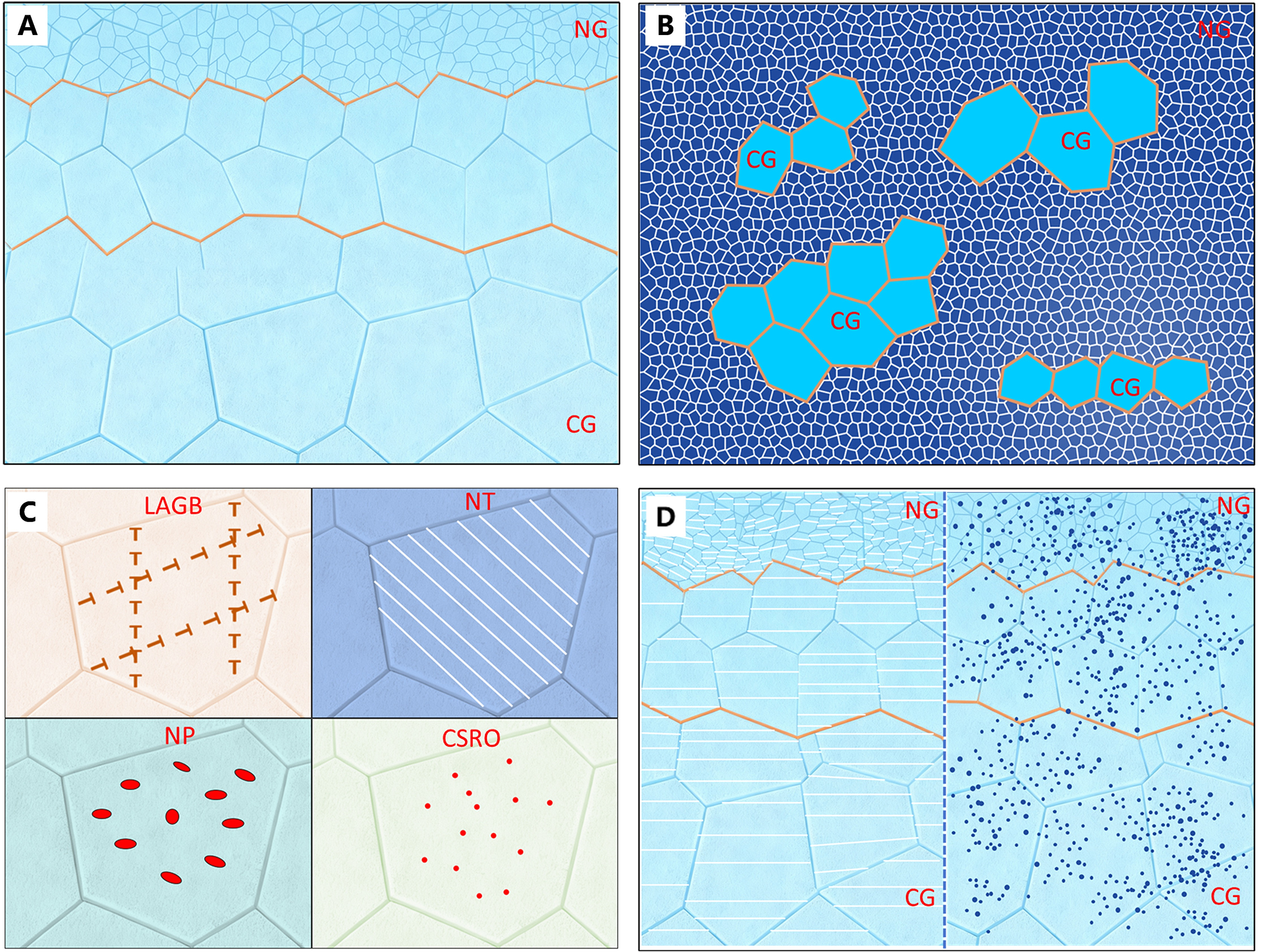
Figure 1. Heterostructures in metallic materials[18] (A and B) Primitive heterostructures, typical gradient structure (A) and lamellar structure (B), thick dull-red lines: hetero-zone boundaries; NG: nano-grain; CG: coarse grain. (C) Sub-primitive heterostructures with substructures with the low-angle grain boundary (LAGB), nano-twin (NT), nano-precipitate (NP), and chemical short-range order. (D) Composite heterostructures with dual gradients: dual-gradients in both grain size and nano-twin (left)/nano-precipitate (right). (Reprinted from Ref.[18], with permission from Acta Metallurgica Sinica).
Figure 1A and B illustrates two typical examples of primitive heterostructures: gradient and layered structures. In gradient structures, grain sizes transition continuously from nano-grained (NG) to coarse-grained (CG) regions throughout three-dimensional space[31]. In contrast, layered structures contain discontinuously stacked grains of different sizes (e.g., NG and CG domains). Both heterostructures share two fundamental characteristics: trans-scale grain distribution and long-range heterogeneous interfaces. The plastic incompatibility between adjacent grains at these interfaces induces geometrically necessary dislocations (GNDs)[32,33], which serve as a critical mechanism for heterogeneity-strengthening.
Figure 1C schematically illustrates a sub-primitive heterostructure with two distinct intragranular secondary constituents: engineered substructures (e.g., low-angle dislocation interfaces, nanotwins[34,35], and nano-precipitates[36]) and naturally occurring substructures (e.g., nanoscale chemical short-range/medium-range order in medium-/high-entropy alloys[37-39]). The latter, functioning as plasticity-stable ordered structures, exhibit similar mechanisms to nano-precipitates in impeding dislocation slip[40,41].
Figure 1D further illustrates a composite heterostructure, specifically multi-gradient synergistic heterogeneity: the left side displays a dual-gradient distribution of grain size and nanotwin density, while the right side exhibits a dual-gradient distribution of grain size and nano-precipitate phase density, demonstrating multi-scale coupling across primary structural units and substructural levels.
Mechanical properties of heterogeneous structures
Heterostructures exhibit mechanical behaviors distinctly different from conventional homogeneous microstructures, mainly manifested in two aspects: grain boundary-mediated plastic accommodation and HDI plastic deformation dominated by GNDs[30,42-46]. As illustrated in Figure 2A, a significant regional boundary disparity exists at the interface between the fine-grained hard zone and the CG soft zone[47]. A Frank-Read dislocation source located at point X emits GNDs with identical Burgers vectors toward the boundary, causing dislocation pile-ups ahead of the boundary[42,48]. The superposition of their stress fields generates long-range internal stresses that manifest as back stress in the soft region[47-49], thereby locally strengthening the material by impeding further emission from dislocation sources. Dislocation slip is the intrinsic mechanism for plastic strain generation; no dislocation has reached the interfacial regions and thus it retains zero plastic strain, while the dislocation source locations accumulate maximum plastic strain due to dense dislocation slip. This synergistic interaction between strain gradient distribution and back stress constitutes the unique HDI strengthening mechanism inherent to heterostructures[47,50]. As shown in
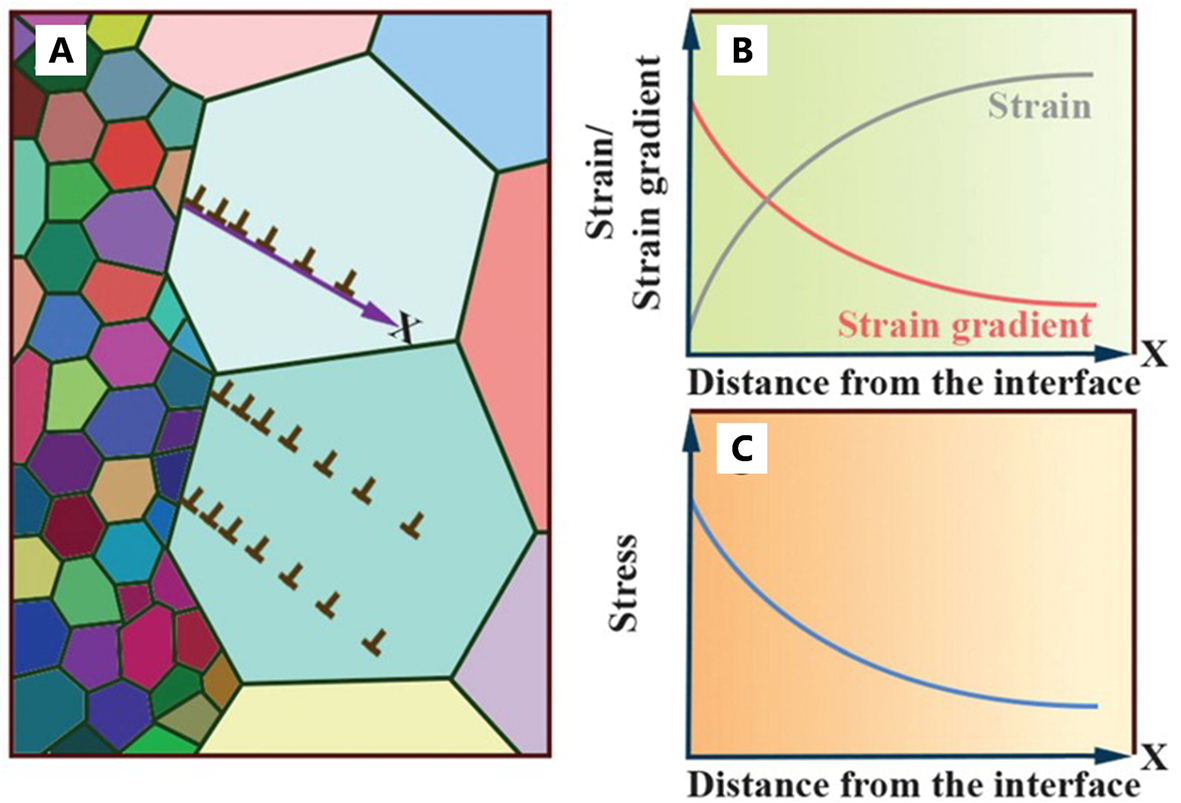
Figure 2. Mechanical behaviors of heterostructures[47] (A) Pile-ups of GNDs in front of a zone interface. GNDs emit from Frank-Read sources within coarse grains of the soft zone. (B) Plastic strain profile in front of the zone interface. (C) Strain gradient profile near the interface. (Quoted with permission from Wu et al.[47], under the CC BY license, http://creativecommons.org/licenses/by/4.0/).
Furthermore, GNDs dominate heterogeneous plastic deformation, creating a GND density gradient at the interface that was quantified via electron backscatter diffraction (EBSD). The strain gradient is accommodated by GND pile-ups near the interface, resulting in an increase in GND density variation with tensile strain[51], as shown in Figure 3A. The asynchronous elastic recovery in microregions under heterogeneous interface constraints leads to mechanical hysteresis with significant energy dissipation during cyclic loading, driven by the gradient dislocation configuration[29], as shown in Figure 3B. This behavior serves both as a distinctive plastic response of heterogeneous structures compared to homogeneous systems and as evidence of hard/soft phase interface-governed microscale elastoplastic decoupling. The underlying mechanism arises from energy barrier variations in hard/soft phase alternations under cyclic loading[29,52].
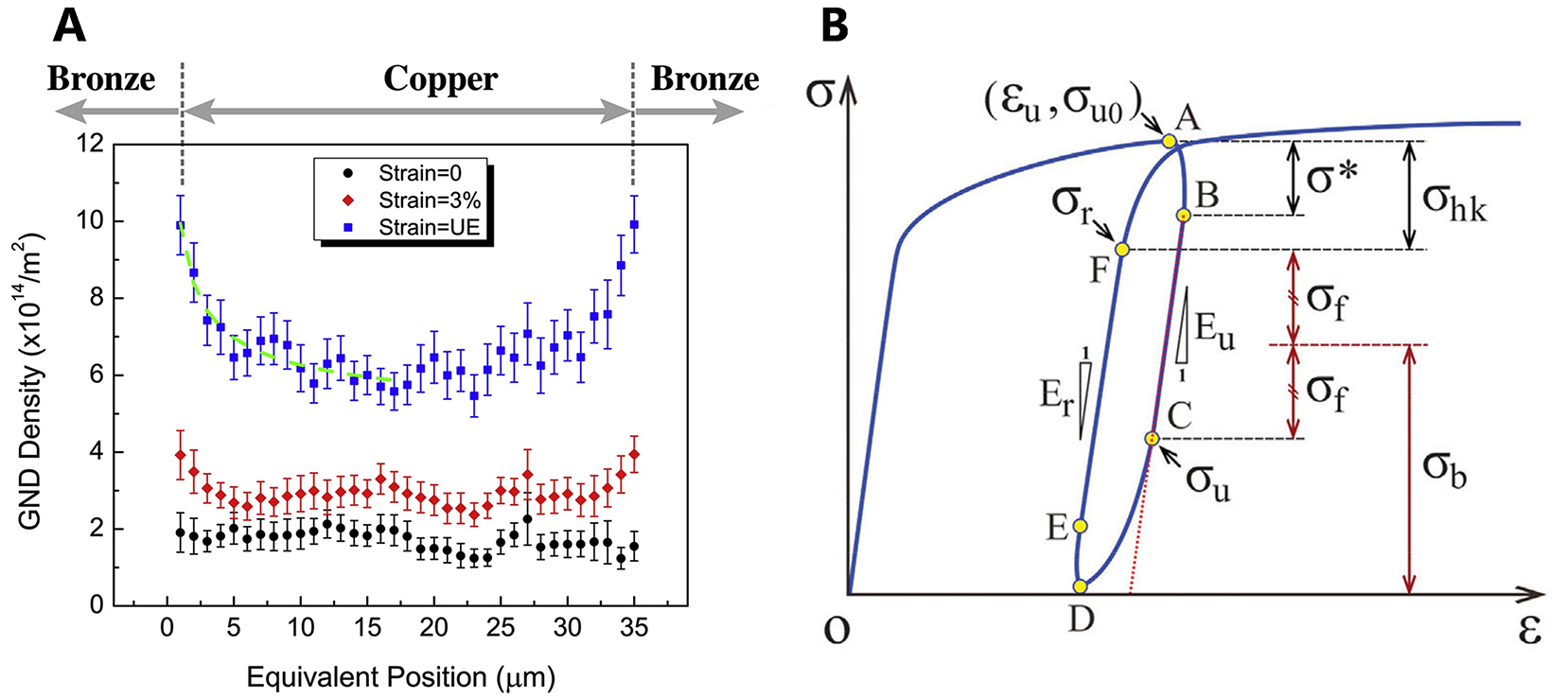
Figure 3. Plastic response of heterogeneous structures. (A) Density of GNDs in copper near the copper-bronze interfaces as measured using electron backscatter diffraction (EBSD)[51]. (Reprinted from Ref.[51], with permission from Elsevier). (B) The schematic of the unloading-reloading loop for defining the unload yielding σu, reload yielding σr, back stress σb and frictional stress σf, effective unloading Young’s modulus of Eu, and effective reloading Young’s modulus of Er[29]. (Quoted with permission from Yang et al.[29], under the CC BY license, http://creativecommons.org/licenses/by/4.0/).
This paper will focus on clarifying the microstructural mechanisms underlying mechanical strengthening induced by HDI stress and related mechanical behaviors in copper alloys with diverse heterogeneous systems. Furthermore, the strengthening mechanisms of functional properties, including electrical and thermal conductivity, will be analyzed in conjunction with microstructural characteristics.
HETEROGENEOUS STRUCTURES IN COPPER ALLOYS
Various heterostructured copper alloys have been reported, which can be classified based on their microstructural features into several typical categories, including gradient-structured materials[19], layer-structured materials[42,53], and dual-phase structured materials[54,55]. The fabrication of heterostructured copper alloy materials is primarily achieved through methods such as Surface Mechanical Attrition Treatment (SMAT)[19], electrochemical deposition[35], powder metallurgy[17], additive manufacturing[56], and rolling combined with annealing[57].
Gradient heterostructured copper alloys reduce stress concentration while maintaining high strength and ductility through grain size or compositional gradients (e.g., NG surface layers and CG cores), combining excellent fatigue resistance and wear performance[19]. Layered heterogeneous copper alloys (e.g., nanolaminated structures with alternating hard/soft layers) can enhance strength and strain-hardening capacity while preserving fracture toughness through interfacial boundaries and multiscale strengthening mechanisms. This makes them particularly suitable for applications requiring high strength-toughness synergy, wear resistance, or functional gradient demands (for example, heat sinks in electronic devices or marine equipment)[58]. Dual-phase heterostructured copper alloys achieve a balance between mechanical strength and electrical conductivity through synergistic phase interactions[59].
The comprehensive properties of heterostructured copper alloys exhibit significant enhancement compared to conventional homogeneous counterparts, with the microstructural features in heterostructures playing a critical role in achieving superior performance. The following sections will elaborate on representative heterostructured copper alloys by systematically analyzing their microstructural characteristics, fabrication processes, and underlying performance mechanisms.
Gradient heterostructured copper alloys
Gradient heterostructured copper alloys[16,19,60-65] refer to copper alloy materials exhibiting microstructural gradients, including variations in grain size, twin density, chemical composition, nanoprecipitate density, and phase volume fraction. Schematic illustrations of distinct gradient heterostructure types are presented in Figure 4[66].
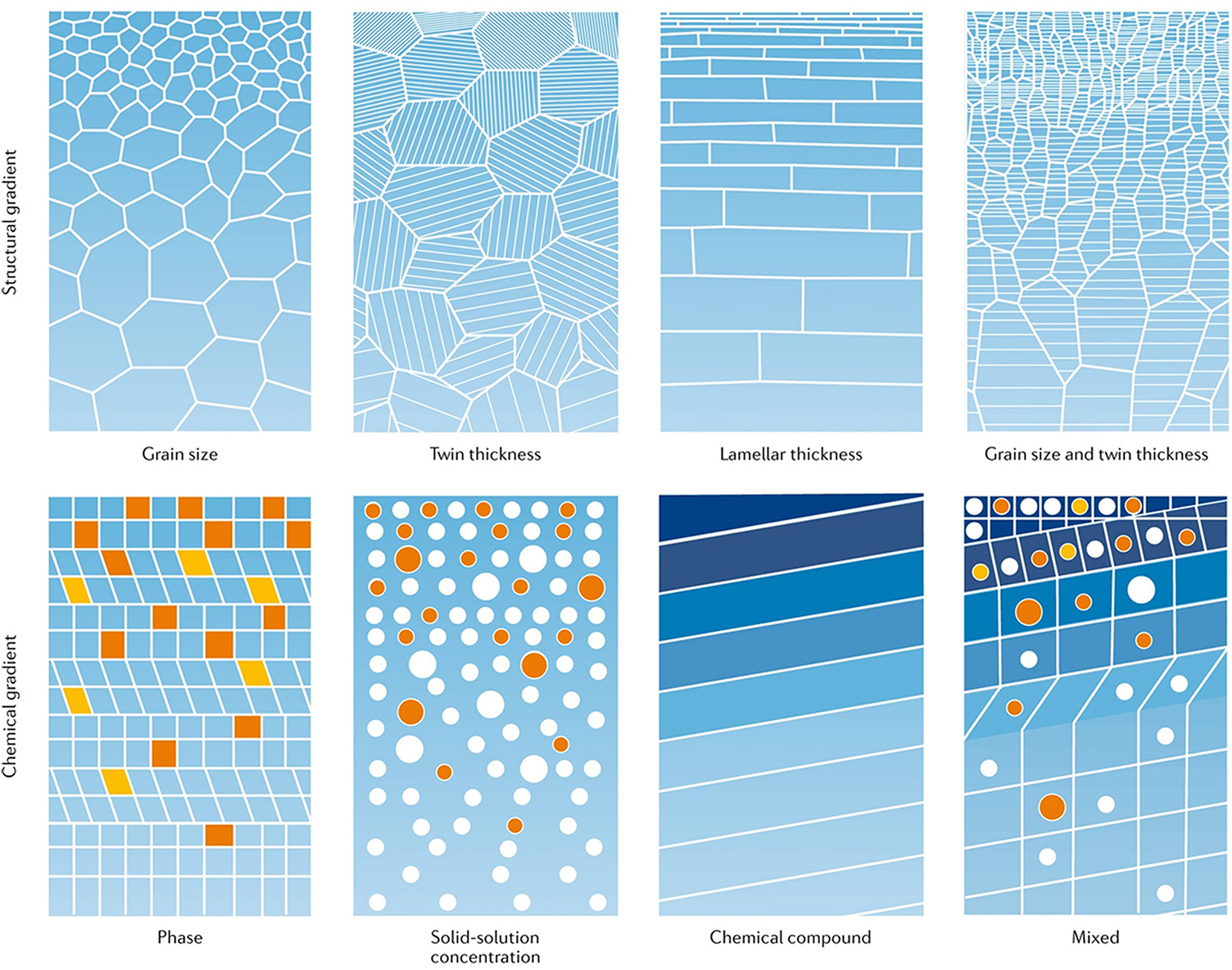
Figure 4. Types of structural and chemical gradients in typical gradient materials[66]. Structural gradients include variations in the grain size, twin size and lamellar thickness. Chemical gradients include graded distributions in the phase, solid-solution concentration and chemical components. Some materials can have mixed structural and chemical gradients. (Reprinted from Ref.[66], with permission from Springer Nature).
Currently, most gradient heterostructured copper alloys are achieved through the use of grain size gradients. Grain gradient heterostructured materials are typically achieved by surface mechanical grinding treatment (SMGT)[67]. This technique employs high-velocity hard spheres to repeatedly impact the material surface, forming nanocrystalline structures in the surface layer with an underlying gradient layer exhibiting gradually increasing grain sizes. The formation mechanism of such structures primarily involves the synergistic interaction between high-density dislocation accumulation and grain boundary migration during surface plastic deformation. Other processing methods for generating grain gradient structures include torsional straining[23,68-70], cyclic dynamic torsion[71], surface rotational rolling[72,73], single-roll angular rolling[74,75], rotary swaging[76-78], high pressure torsion[79], and electrochemical deposition[80], as illustrated in Figure 5.
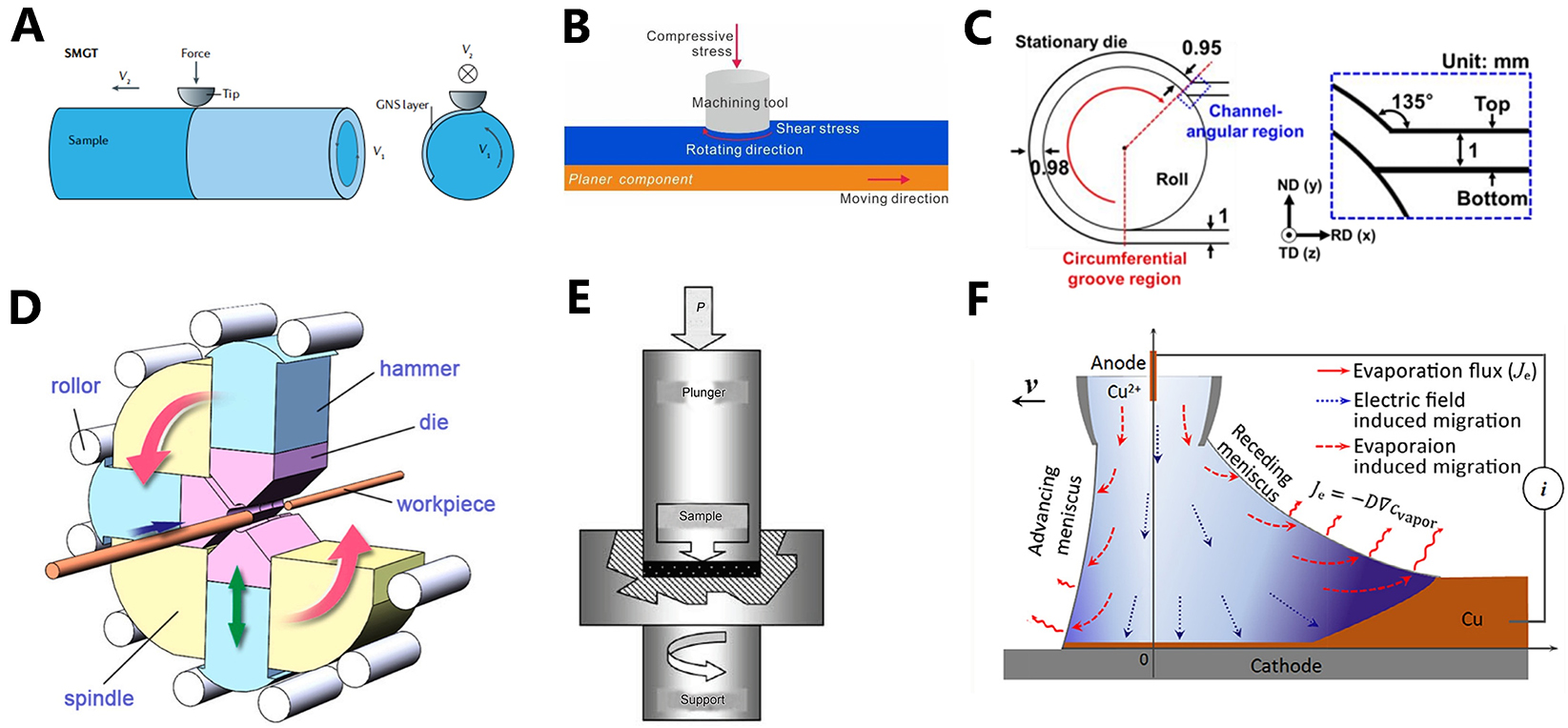
Figure 5. Processing methods for forming grain gradient structure. (A) SMGT[67]. (Reprinted from Ref.[67], with permission from Elsevier). (B) Surface rotational rolling[72]. (Reprinted from Ref.[72], with permission from Elsevier). (C) Single-roll angular rolling[74]. (Quoted with permission from Lee et al.[74], under the CC BY license, http://creativecommons.org/licenses/by/4.0/). (D) Rotary swaging[76]. (Reprinted from Ref.[76], with permission from Elsevier). (E) High-pressure torsion[79]. (Reprinted from Ref.[79], with permission from Elsevier). (F) Direct-current electrodeposition[80]. (Reprinted from Ref.[80], with permission from Elsevier).
Fang et al. fabricated gradient nanograined copper (GNG Cu) by SMGT method[19]. The gradient heterostructure avoided the brittleness observed in conventional nanocrystalline materials, achieving both high strength and high ductility. In GNG Cu, the nanograined layer gradually transitions from the surface into the CG copper matrix, forming a grain size gradient structure, as shown in Figure 6A. While maintaining the ductility of the original CG Cu, exhibiting 31% uniform elongation, the gradient nanograined (GNG)/CG specimen attains a yield strength of 129 MPa (compared with 63 MPa for CG Cu), approximately double that of the latter. This GNG Cu breaks the conventional strength-ductility trade-off characteristic of traditional nanocrystalline materials, as shown in Figure 6B. Mechanical characterization reveals that the significant mechanical property differences between the GNG layer and CG matrix generate gradients during tensile deformation, driving plastic deformation to propagate from the CG soft zone into the nanocrystalline hard zone, thereby inducing hetero-deformation behavior. Studies of microstructural mechanisms have demonstrated that GNG Cu exhibits a dual-mechanism synergistic effect during deformation: grain coarsening or dynamic recrystallization processes occur at the nanocrystalline scale[73], conventional dislocation slip mechanisms remain continuously activated in the CG regions, which has been observed using EBSD and transmission electron microscopy (TEM), as shown in Figure 6C-F. Among them, EBSD provides crystal orientation [such as Inverse pole figure (IPF)], grain size, grain boundary characteristics, and defect-related parameters (such as GNDs and grain boundaries), while TEM provides structural and compositional information from the micrometer to the atomic scale, thus enabling the study of alloy deformation mechanisms. This cross-scale deformation mechanism synergy effectively reconciles the requirements for strengthening and plasticity, ultimately achieving synergistically optimized high strength and high ductility, achieving 129 MPa yield strength with 31% uniform elongation.
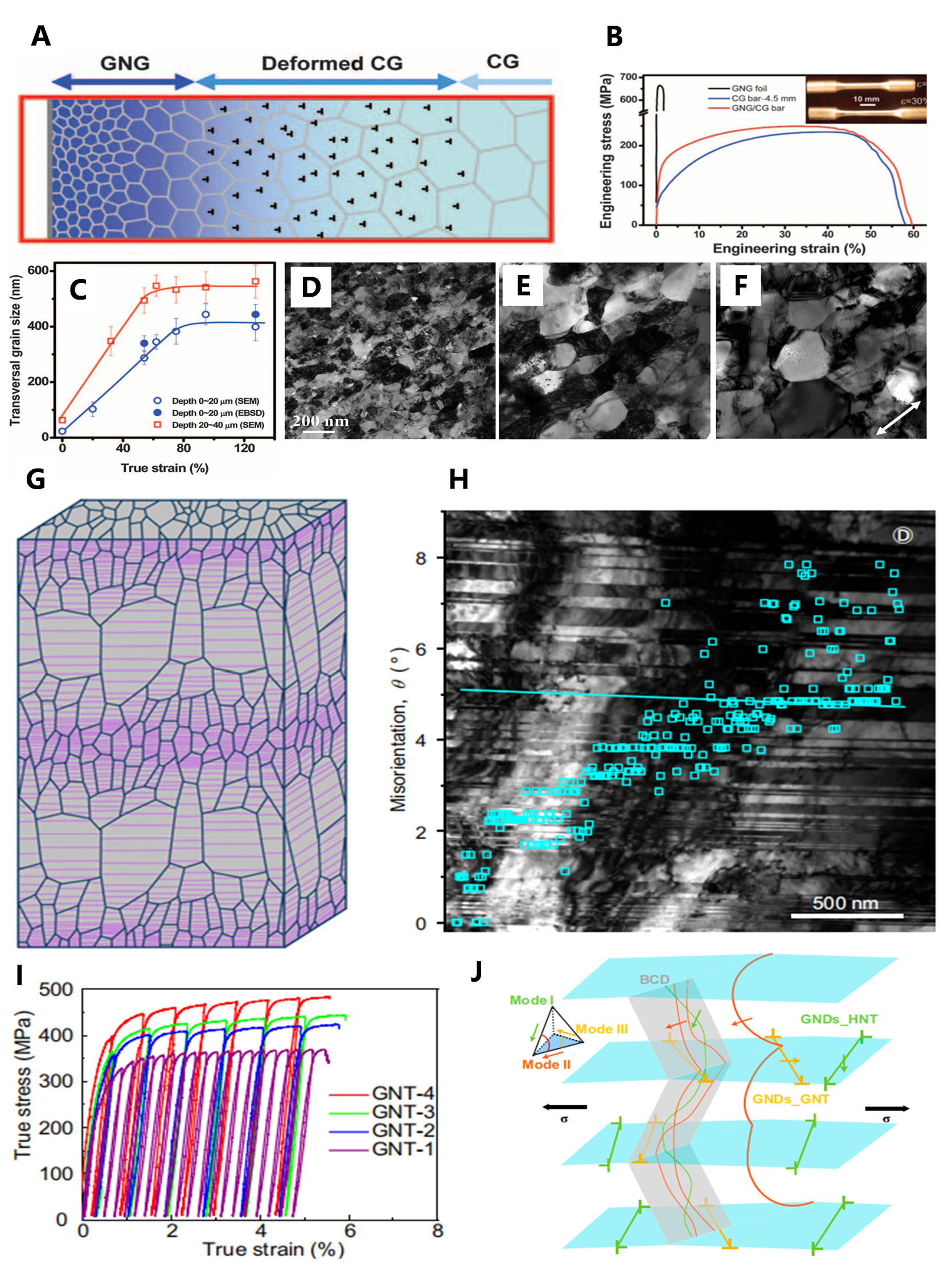
Figure 6. Deformation mechanisms in gradient nanostructured copper alloys, (A-F) GNG Cu alloy[19,73] (Reprinted from Ref.[19], with permission from American Association for the Advancement of Science; Reprinted from Ref.[73], with permission from Elsevier). (G-J) GNT Cu alloy[35]. (Quoted with permission from Cheng et al.[35], under the CC BY-NC-ND 4.0 license, https://creativecommons.org/licenses/by-nc-nd/4.0/). (A) GNG structure model. (B) Quasi-static tensile stress-strain curves: CG Cu, GNG/CG, and free-standing GNG foil[19]. (C) Average transversal grain size vs. tensile true strain: top layer (0-20 μm) and subsurface (20-40 μm) from EBSD. (D-F) TEM images of GNG Cu top surface: 5% (D), 15% (E), 25% (F) tensile strain at room temperature. (G) GNT model of copper. (H) TEM image of GNT, squares indicate local crystal orientation measurement points along solid line for GND density estimation. (I) Loading-unloading tensile curves for GNT samples. (J) Dislocation structures in gradient nanotwins under stress σ, Modes I, II, and III are represented by green, brown, and orange lines, respectively, and the corresponding Burgers vectors are shown on the Thompson tetrahedron. GNDs associated with HNT and GNT are denoted as GNDs_HNT and GNDs_GNT, respectively.
In recent years, gradient nanotwinned copper (GNT Cu) has been increasingly studied due to its breakthrough performance in synergistically enhancing strength and ductility. Cheng et al. precisely controlled twin thickness and its gradient distribution through electrodeposition, demonstrating that compared to samples with uniform twin thickness, gradient nanotwinning structures significantly improve mechanical properties[35]. The strengthening mechanism of GNT Cu, as shown in Figure 6G, originates from the back stress hardening effect induced by its nanotwin gradient structure. This additional strength is primarily driven by the inhomogeneous stress fields generated by GNDs, where bundles of concentrated dislocations (BCDs) serve as primary carriers, as shown in Figure 6H. These BCDs coordinate plastic strain gradients to regulate mechanical behavior. As the nanotwin gradient increases, the plastic strain gradient increases significantly, as shown in Figure 6I, leading to a stronger back stress hardening effect. In GNT systems, dislocation activities exhibit three typical modes: (1) dislocations slip along directions inclined to twin boundaries (hard mode I); (2) glissile dislocations are constrained by adjacent twin boundaries (hard mode II); (3) dislocations slip along twin boundaries, inducing detwinning (soft mode III). BCDs are a distinctive feature of the defect architecture in GNT Cu alloys, which feature both type-I and type-II dislocations. Type-II dislocations dominate with densities approximately one order of magnitude higher than type-I dislocations. This disparity arises because type-II dislocations dynamically accommodate strain gradients across varying twin spacings and ensure deformation compatibility between adjacent lamellae, preventing stress concentrations and enabling uniform deformation. In contrast, type-I dislocations play negligible roles in strain management. This unique dislocation configuration is exclusive to GNT systems. These BCDs, uniformly distributed within grains, not only produce significant strengthening through dislocation accumulation and interactions but also effectively suppress localized instability by promoting non-localized plastic deformation distribution, as shown in Figure 6J, ultimately achieving synergistically optimized high strength and ductility.
L-PBF enables high-performance copper alloy development by manufacturing complex geometries. Precise control of process parameters and alloy composition has produced copper-based alloys with Heterogeneous Grain Structure (HGS), enhancing mechanical properties and functional characteristics. Liu et al. incorporated cobalt (Co) submicron particles into pure copper powder and fabricated a Cu-Co alloy featuring a HGS using the L-PBF process, as shown in Figure 7A-C[16]. The study demonstrated that adjusting the Co content (2-8 wt.%) effectively controls the cooling rate and thermal gradient within the melt pool, inducing the formation of a HGS. When the Co addition exceeds its maximum solid solubility in copper (4.75 wt.%), equiaxed grains preferentially nucleate at the melt pool boundaries, while columnar grains are retained in the melt pool center, forming a bimodal grain structure characterized by the coexistence of equiaxed and columnar grains. This structural evolution mechanism originates from the semi-coherent interface (lattice mismatch ~2.07%) between CoO nanoparticles and the copper matrix, which significantly reduces the nucleation energy barrier and promotes heterogeneous nucleation. As the Co content increases, the average grain size in the melt pool boundary region further decreases. Figure 7C shows that the HGS Cu-Co alloy outperforms existing copper alloy systems in terms of strength-ductility synergy, highlighting its exceptional engineering application potential.
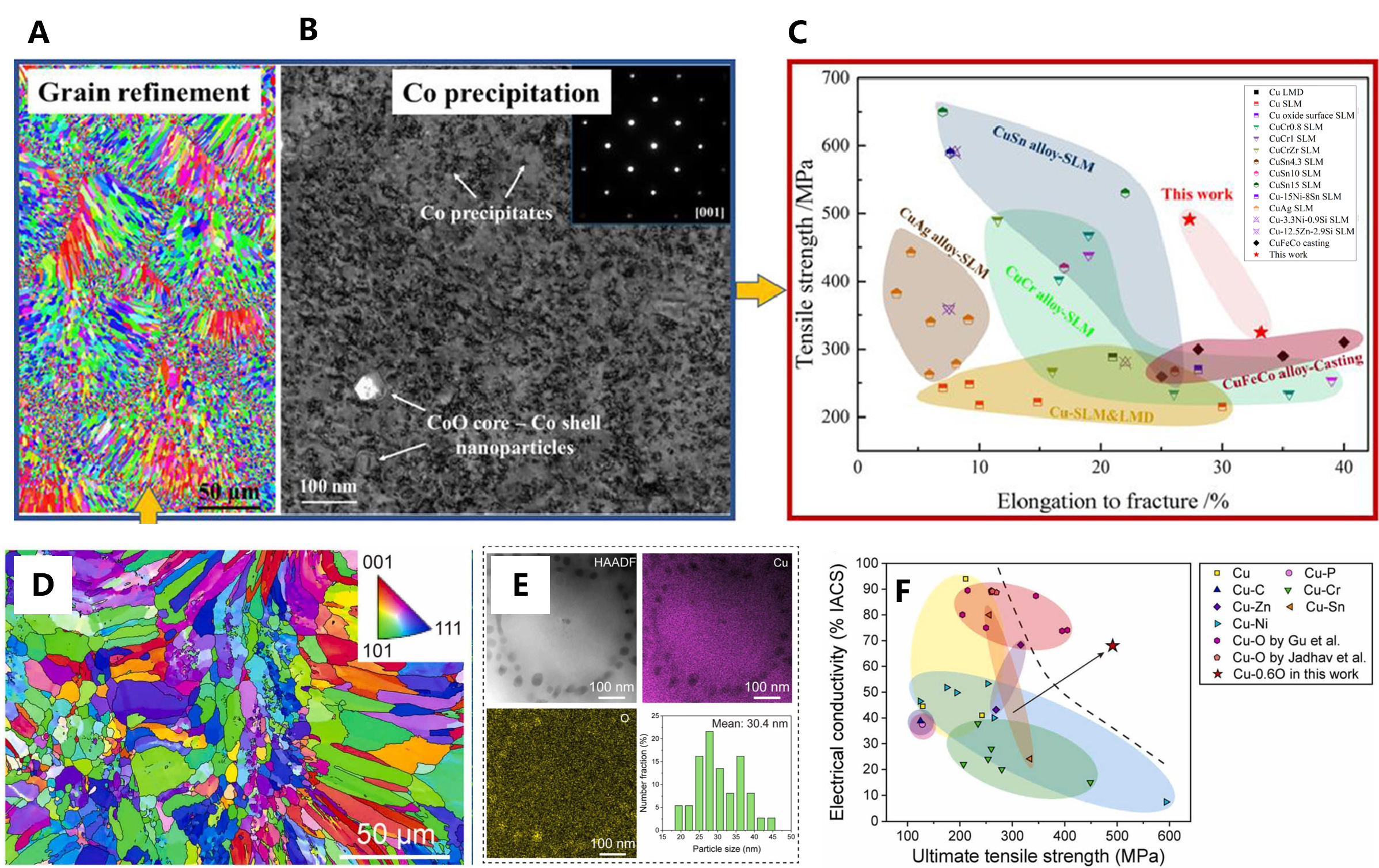
Figure 7. Grain structures and properties of the as-printed Cu alloy, (A-C) Cu-Co alloy[16] (Reprinted from Ref.[16], with permission from Elsevier); (D-F) Cu-0.6O alloy[81] (Reprinted from Ref.[81], with permission from Elsevier). (A) Inverse pole figure (IPF) maps of the L-PBF fabricated Cu-Co alloys. (B) Typical Bright-field TEM image of peak-aged sample, with selected area electron diffraction image inset. (C) Mechanical property comparison: L-PBF fabricated Cu alloy with 6 wt.% Co addition with previously published results. (D) IPF maps of the L-PBF fabricated Cu-0.6O alloy. (E) High-angle dark-field scanning transmission electron microscopy (HADDF-STEM) image and energy-dispersive spectrometry (EDS) mapping showing Cu2O nanoprecipitates at the cellular boundary. (F) The ultimate tensile strength and electrical conductivity of pure Cu and Cu alloys fabricated by L-PBF.
Liu et al. fabricated a high-strength, high-conductivity Cu-0.6O alloy using L-PBF. During the printing process, the alloy developed a unique cellular microstructure, whose morphology and dimensions were jointly regulated by the oxygen content in the melt pool and process parameters, as shown in Figure 7D[81]. The strengthening mechanism primarily arises from the obstruction of dislocation motion by ordered Cu2O nanoprecipitates, while the application of sustained long-range back stress promotes intracellular dislocation interactions, as observed using high-angle dark field-scanning transmission electron microscopy (HADDF-STEM) and energy-dispersive spectrometry (EDS) [Figure 7E]. Notably, the cellular structure provides free electrons with extended free paths, enabling high electrical conductivity (68.0% IACS) alongside enhanced strength, thereby resolving the inherent trade-off between mechanical strength and electrical conductivity in conventional copper alloys, as shown in Figure 7F. Oxide particles typically possess poor conductivity and exhibit significant lattice mismatch with the copper matrix. This leads to intensified electron scattering and a consequent deterioration in the electrical conductivity of the alloy. By controlling oxygen partial pressure[82], applying elemental doping[83,84], or regulating heat treatment processes such as the oxygen reduction reaction and oxygen evolution reaction[85], the oxide stoichiometry can be effectively tailored. Such optimization enhances the electrical conductivity of the oxide particles[86] and reduces lattice strain at the oxide/copper interface, thereby enabling a synergistic enhancement of both mechanical strength and electrical conductivity.
L-PBF technology achieves multi-scale copper alloy microstructure control, enabling performance optimization through two independent dimensions: grain morphology (heterogeneous grains/bimodal structure) and precipitate phase distribution (nanoprecipitates/cellular structure). This establishes a theoretical basis and technical pathway for novel copper alloys integrating high strength, high electrical conductivity, and enhanced work hardening capability.
Gradient-structured copper alloys achieve significant enhancement in mechanical and electrical properties through mechanisms such as grain size gradients, nanotwin gradients, and regulation of precipitate phase distribution. For example, GNG Cu exhibits elevated yield strength while maintaining high ductility via the synergistic mechanism of grain coarsening and dislocation slip. GNT Cu balances high strength and plasticity through the cooperative interaction of GNDs and bundle assemblies of ultrahigh-density dislocations. Multi-scale control of HGS and nanoprecipitates simultaneously addresses the strength-conductivity trade-off. Compared to conventional homogeneous copper alloys, gradient-structured alloys demonstrate distinct advantages in strength-ductility synergy and functional integration.
However, current challenges include insufficient process controllability (e.g., SMGT-induced damage, high parameter sensitivity in L-PBF), structural instability (gradient degradation under elevated temperatures/long-term service), and adaptability to extreme environments (high strain rates, corrosive media). Quantitative analysis of cross-scale deformation mechanisms also requires further study. Future research should integrate advanced characterization with computational simulations to optimize multi-dimensional gradient designs (e.g., synergistic regulation of grain-twin-precipitate architectures), develop high-entropy alloying and interface engineering strategies, and establish multi-physics field coupled models. These efforts will advance gradient heterogeneous-structured copper alloys towards high-performance and multifunctional applications.
Layered heterostructured copper alloys
Layered heterostructured structures, as composite systems formed by stacking two-dimensional metallic layers through well-defined and controllable interfaces, have emerged as ideal model systems for fundamental materials research[31,42,47]. Although their mechanical properties exhibit certain limitations compared to conventional heterostructured structures, the designability and tunability of interfacial features provide unique advantages for investigating structure-property relationships. Currently, the fabrication of lamellar heterogeneous copper alloys primarily relies on processes such as accumulative roll bonding (ARB), chemical vapor deposition (CVD), and powder metallurgy. These methods have enabled the development of diverse heterogeneous systems, including metal-metal (e.g., Cu-Nb[87,88], Cu-CuCrZr[89], Tungsten-Copper (W-Cu)[90]) and metal-two-dimensional material (e.g., Graphene (Gr)-Copper[91]) architectures. Schematic illustrations of representative heterogeneous configurations are shown in Figure 8.
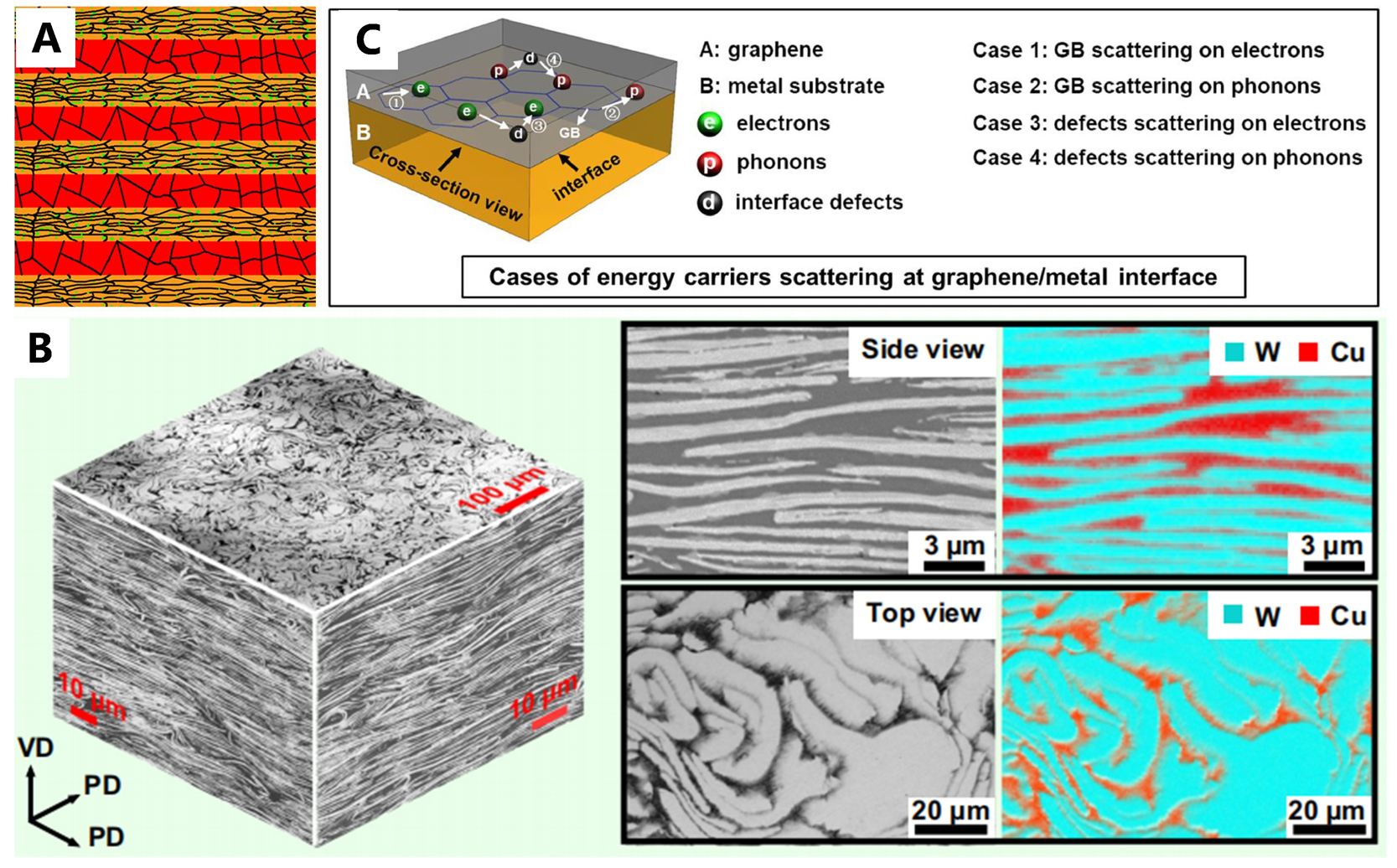
Figure 8. Types of copper alloys with layered heterogeneous structure. (A) Cu-CuCrZr[89] (Reprinted from Ref.[89], with permission from Elsevier). (B) W-Cu[90] (Quoted with permission from Han et al.[90], under the CC BY 4.0 license, http://creativecommons.org/licenses/by/4.0/). (C) Graphene-Copper[91] (Reprinted from Ref.[91], with permission from Elsevier).
In terms of fabrication technologies, the ARB technique has achieved synergistic construction of ultrafine grains (< 1 μm) and ultrathin lamellar structures (< 10 μm) through multi-pass rolling, enabling breakthroughs in systems such as Cu-Nb[87,88], Cu-CuCrZr[89], Cu-Ni[92], Cu-Al[93], and Cu-Ti[94]. This technique achieves continuous tunability of interlayer thickness and interfacial characteristics via an interface energy-driven grain boundary migration mechanism. For immiscible systems, Han et al. innovatively employed high-energy ball milling to prepare ultrathin W foils combined with electroplated copper coating, achieving crack-free interfacial bonding in W-Cu composites through Spark Plasma Sintering (SPS)[90]. The interfacial transition zone was confined to a submicron scale. Cao et al. precisely controlled the number of graphene layers (1-10) via CVD and constructed Gr/Cu/Gr multilayer heterostructures through hot pressing[95]. Processing methods for layered heterostructured copper alloys are illustrated in Figure 9.
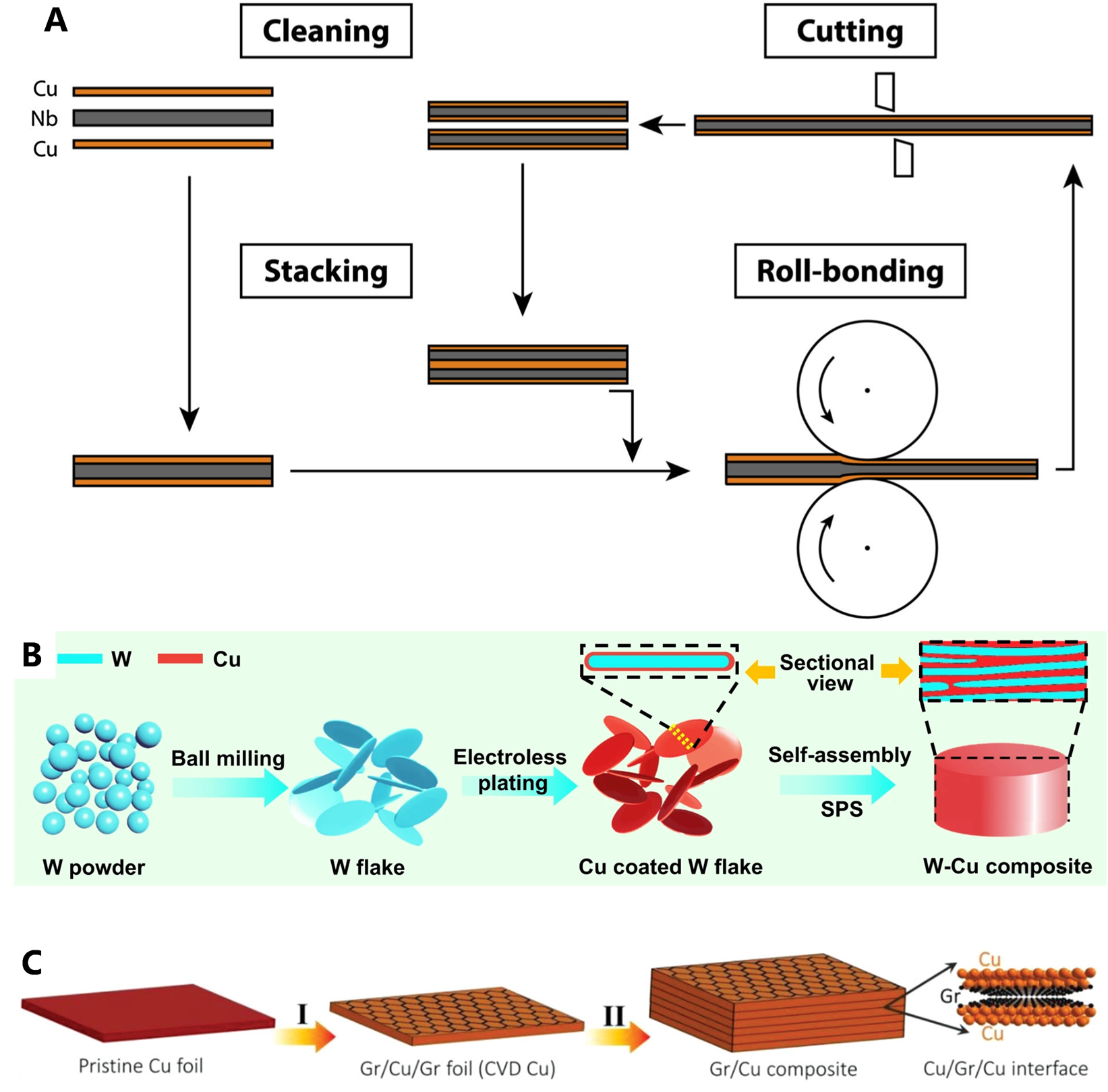
Figure 9. Processing methods for layered heterostructured copper alloys. (A) Schematic of ARB[87] (Reprinted from Ref.[87], with permission from Elsevier). (B) Schematic diagram of the design strategy for the W-Cu[90] (Quoted with permission from Han et al.[90], under the CC BY 4.0 license, http://creativecommons.org/licenses/by/4.0/). (C) Fabrication of Gr/Cu composites with aligned CVD graphene[95] (Reprinted from Ref.[95], with permission from John Wiley & Sons).
In terms of performance modulation mechanisms, the Heterogeneous Deformation Induction mechanism has emerged as a critical contributor to enhancing comprehensive properties. Taking Cu/Cu-Cr-Zr dual-heterogeneous layered materials as a representative example[89], the synergistic effects of grain size heterogeneity (CG Cu and nanolayered Cu-Cr-Zr) and precipitate heterogeneity (nanoscale Cr-enriched precipitates) enable simultaneous improvement in tensile strength (563.4 MPa) and uniform elongation (16.2%), as shown in Figure 10A-D. The coupled interaction between back stress effects induced by GNDs at interfaces and the Smith-Zener pinning mechanism enhances strength by over 40%, while maintaining an electrical conductivity of 92% IACS, as illustrated in Figure 10E.
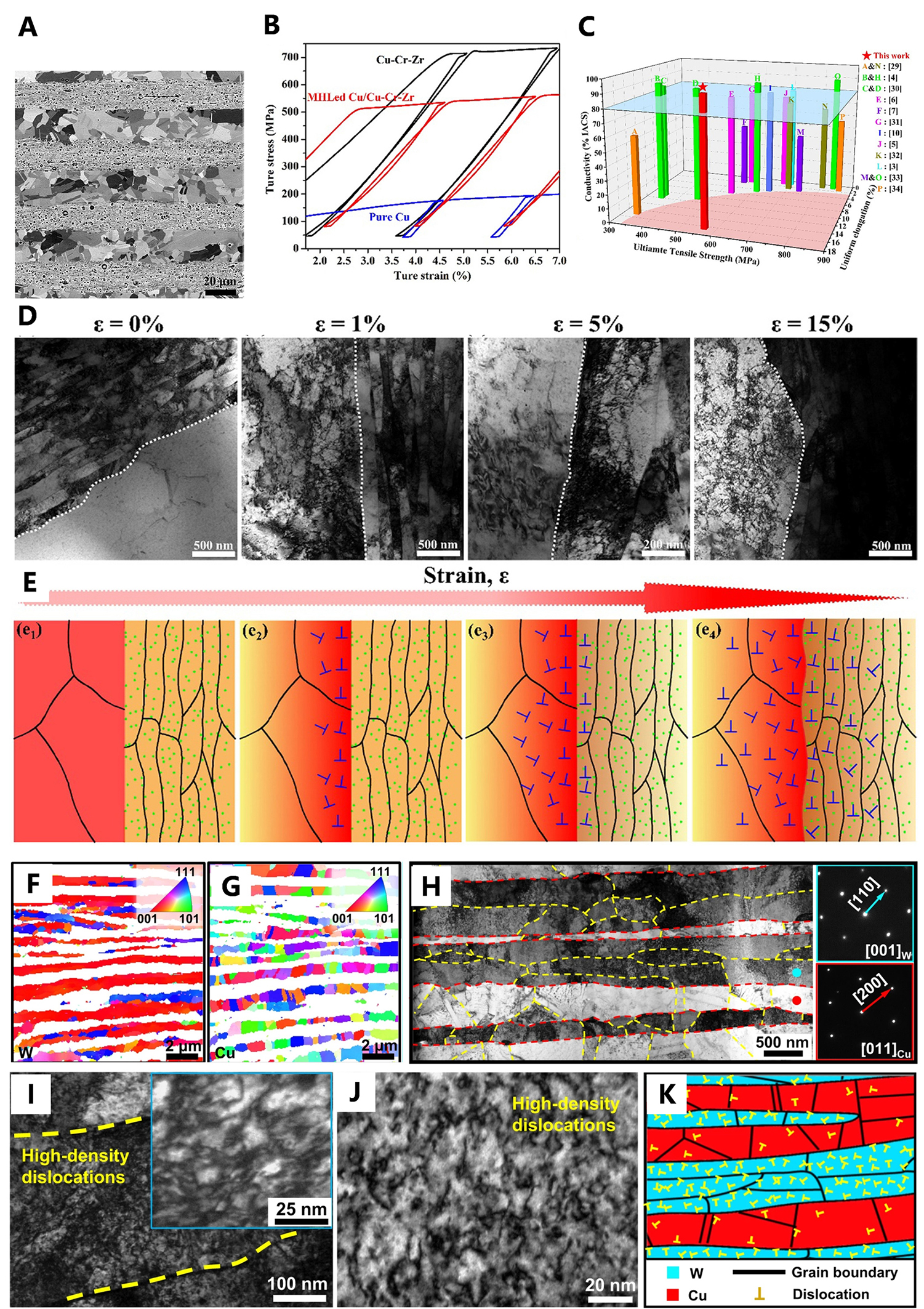
Figure 10. Layered structures and Properties of the Cu alloy ((A-E) Cu/CuCrZr[89] (Reprinted from Ref.[89], with permission from Elsevier); (F-K) W-Cu[90] (Quoted with permission from Han et al.[90], under the CC BY 4.0 license, http://creativecommons.org/licenses/by/4.0/). (A) Backscattered electrons image of the DHLed Cu/Cu-Cr-Zr laminated composite. (B) Hysteresis loops at selected cycle numbers for back stress measurements. (C) Comparison of overall properties including tensile strength, elongation and electrical conductivity of the Cu/Cu-Cr-Zr composite with other reported copper-alloys. (D) TEM images of Cu/Cu-Cr-Zr at different tensile strains. (E) Schematic depicting different deformation stages in the DHLed Cu/Cu-Cr-Zr composite. (F) EBSD IPF map of W phase in the as-prepared SAL W-Cu. (G) EBSD IPF map of W phase in the as-prepared SAL W-Cu. (H) Bright field TEM image showing the elongated W grains in the SAL W-Cu. (I) Bright field TEM image of the milled W flake containing dislocations. (J) Bright field TEM image of W phase in SAL W-Cu, showing high-density dislocations. (K) Schematic sketch of the SAL architecture in the as-prepared W-Cu composite.
In W-Cu composite systems, the HDI mechanism significantly enhances mechanical properties through multi-scale synergistic effects[90]. Taking self-assembled layered (SAL) W-Cu composites as a representative example, the core mechanisms are as follows: First, the W phase, with its high yield strength (~1,700 MPa), sustains a load 3.8 times greater than that of the Cu phase (450 MPa) during macroscopic yielding, generating intense localized stress gradients. Due to the significantly higher elastic modulus of W (411 GPa) compared to Cu (130 GPa), the Cu phase yields preferentially and generates abundant GNDs. These GNDs accumulate at the W/Cu interfaces, forming a long-range back stress field that effectively impedes dislocation motion, enhancing strength by over 200%. Second, when microcracks propagate along the W/Cu interfaces, their 45° deflection paths mitigate stress concentration. The high strength of the W phase suppresses primary crack initiation, while the alternating arrangement of ultrafine equiaxed Cu grains (718 nm) and <100>-oriented W lamellae (570 nm) form a gradient structure with an ultrahigh interface density (>106 m-1), significantly improving fracture strain to 14%, as shown in Figure 10F-K.
In terms of electrical conductivity, finite element simulations were conducted to investigate the conduction mechanisms of SAL W-Cu composites, elucidating the relationship between structural configuration and electrical conductivity[90]. The results demonstrate that, when interface scattering and defect effects are neglected, the electrical conductivity of SAL W-Cu along the parallel direction (PD) reaches 64.1% IACS, exceeding that of particulate-reinforced composites (60.5% IACS), thereby exhibiting the intrinsic high conductivity of the SAL architecture. Upon incorporating interface scattering, the electrical conductivity of particulate composites drops significantly, whereas the SAL structure, due to the alignment of electron flow with the interfaces, experiences substantially reduced interface scattering. Consequently, its electrical conductivity remains insensitive to interfacial resistivity, demonstrating superior stability. Experimentally measured electrical conductivity deviations are primarily attributed to W lamellae curvature and defects in W/Cu (e.g., dislocations, pores, and grain boundaries). Among these, pores and grain boundaries within the Cu phase are the dominant factors reducing electrical conductivity, followed by W-phase defects and lamellar curvature. Owing to the lower resistivity of Cu, current preferentially channels through the Cu phase, concentrating electron trajectories within the Cu layers. In summary, the SAL structure effectively enhances the composite's electrical conductivity by optimizing electron transport pathways and mitigating interface scattering, as shown in Figure 11A-D. Heterostructured copper alloys (e.g., gradient heterostructure, layered heterostructure) simultaneously enhance strength and electrical conductivity through optimizing interfacial coherence (minimizing electron scattering) and morphology (directing electron transport pathways)[96-100]. This strategy effectively resolves the fundamental strength-conductivity trade-off, exceeding the performance limits of conventional copper alloys.
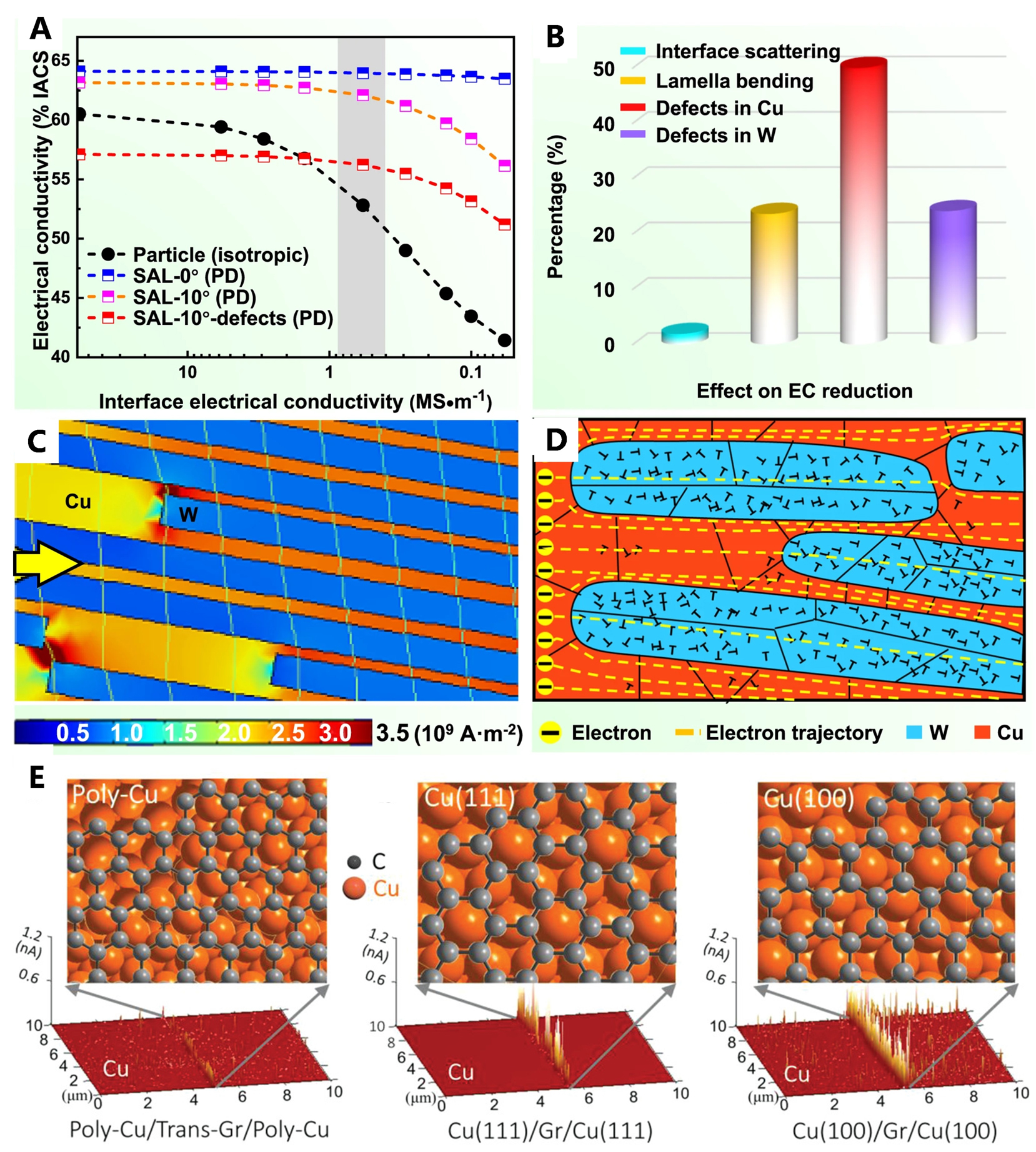
Figure 11. Conductivity mechanism analysis of copper alloys with layered heterogeneous structure. ((A-D) W-Cu[90] (Quoted with permission from Han et al.[90], under the CC BY 4.0 license, http://creativecommons.org/licenses/by/4.0/); (E) Gr/Cu[95] (Reprinted from Ref.[95], with permission from John Wiley & Sons)). (A) Evolution of electrical conductivity as a function of interfacial impedance for different models. “Particle” stands for the W particles reinforced W-Cu, “SAL” stands for SAL W-Cu with the angle representing the degree that W lamella deviates from the horizontal plane, and “defects” indicates voids, dislocations, and grain boundaries. (B) Effects of different factors on the reduction of electrical conductivity. (C) Distribution of the current density in the SAL W-Cu. The yellow arrow indicates the current direction. (D) Schematic illustration of the electron trajectories in the SAL W-Cu composite. (E) A comparison of current flow along the interface area in Gr/Cu composites with different matrices.
Gr/Cu composites achieve breakthroughs in overcoming the performance trade-off limits of conventional materials through interfacial electron doping effects[95]. These composites exhibit a carrier density of 4.3 × 1014 cm-2 and a mobility of 8 × 105 cm2/V·s, resulting in an in-plane electrical conductivity of 117% IACS, as shown in Figure 11E.
Previous studies have constructed multi-scale layered heterostructured copper alloys through processes such as ARB, SPS, and CVD. Based on mechanisms including HDI hardening, precipitation strengthening, and interfacial electron modulation, synergistic enhancement of strength, ductility, and electrical conductivity has been achieved. Compared to conventional homogeneous alloys, these materials maintain high electrical conductivity while exhibiting strength enhancement exceeding 30% and thermal conductivity improvement up to twice the baseline, thereby demonstrating significant performance advantages.
However, critical challenges remain in interfacial stability modulation, establishment of layer thickness-property quantitative correlations, and scalable fabrication:
(1) Uncontrolled effects of dynamic recrystallization on interfacial structures lead to fluctuations in interlayer bonding strength;
(2) Quantitative models for interface-dominated deformation mechanisms in ultrathin layers (< 100 nm) are still lacking;
(3) Accumulated damage to graphene layers during hot pressing restricts further enhancement of electrical conductivity.
Future research should integrate in situ electron microscopy observations with multiscale modeling to establish correlative models linking interfacial engineering parameters (misorientation angles, layer thickness ratios) to macroscopic properties. Additionally, interfacial passivation techniques based on atomic layer deposition must be developed to improve high-temperature stability. Furthermore, investigations into performance degradation mechanisms under extreme service conditions (e.g., high temperature/high irradiation) will provide theoretical foundations for the engineering applications of lamellar heterostructured copper alloys.
Dual-phase heterostructured copper alloys
Dual-phase structured materials, comprising two distinct phases with different compositions or crystallographic structures, optimize the balance between strength and ductility in conventional materials through synergistic interphase interactions while significantly enhancing the potential for functional design[42]. In copper alloys, the incorporation of secondary phase particles to form dual-phase heterogeneous architectures not only improves fundamental mechanical properties but also demonstrates superior performance in electrical conductivity, high-temperature stability, and wear resistance[101-103]. Based on the formation mechanisms and characteristics of the secondary phase, current dual-phase heterogeneous copper alloy systems are primarily categorized into precipitation-strengthened alloys (metal-based composites, e.g., CuCrZr[104-106], CuNiSi[107-110], CuTi[111-113], and high entropy alloy (HEA)/Cu[114,115]) and dispersion-strengthened composites (e.g., Cu-Al2O3[116-118], Cu-TiB2[119]), as shown in Figure 12. These systems exhibit significant differences in how their fabrication processes and microstructural characteristics influence material properties. Precipitation-strengthened alloys utilize heat treatment to induce the in-situ precipitation of nanoscale coherent phases (e.g., Cu5Zr in CuCrZr alloys, 2-50 nm in size[120]), generating high-density micro-heterogeneous interfaces that effectively impede dislocation motion while maintaining the continuity of electron transport pathways. In contrast, dispersion-strengthened composites incorporate exogenous hard particles (e.g., Al2O3 in Cu-Al2O3 systems, 5-100 nm in size[121]) through powder metallurgy techniques, establishing stable and spatially controlled heterogeneous microstructures that physically separate the reinforcing phases from the conductive matrix. Both systems achieve enhanced performance through precise modulation of micro-interfacial characteristics, synergistically optimizing mechanical strength and electrical conductivity in copper alloys.
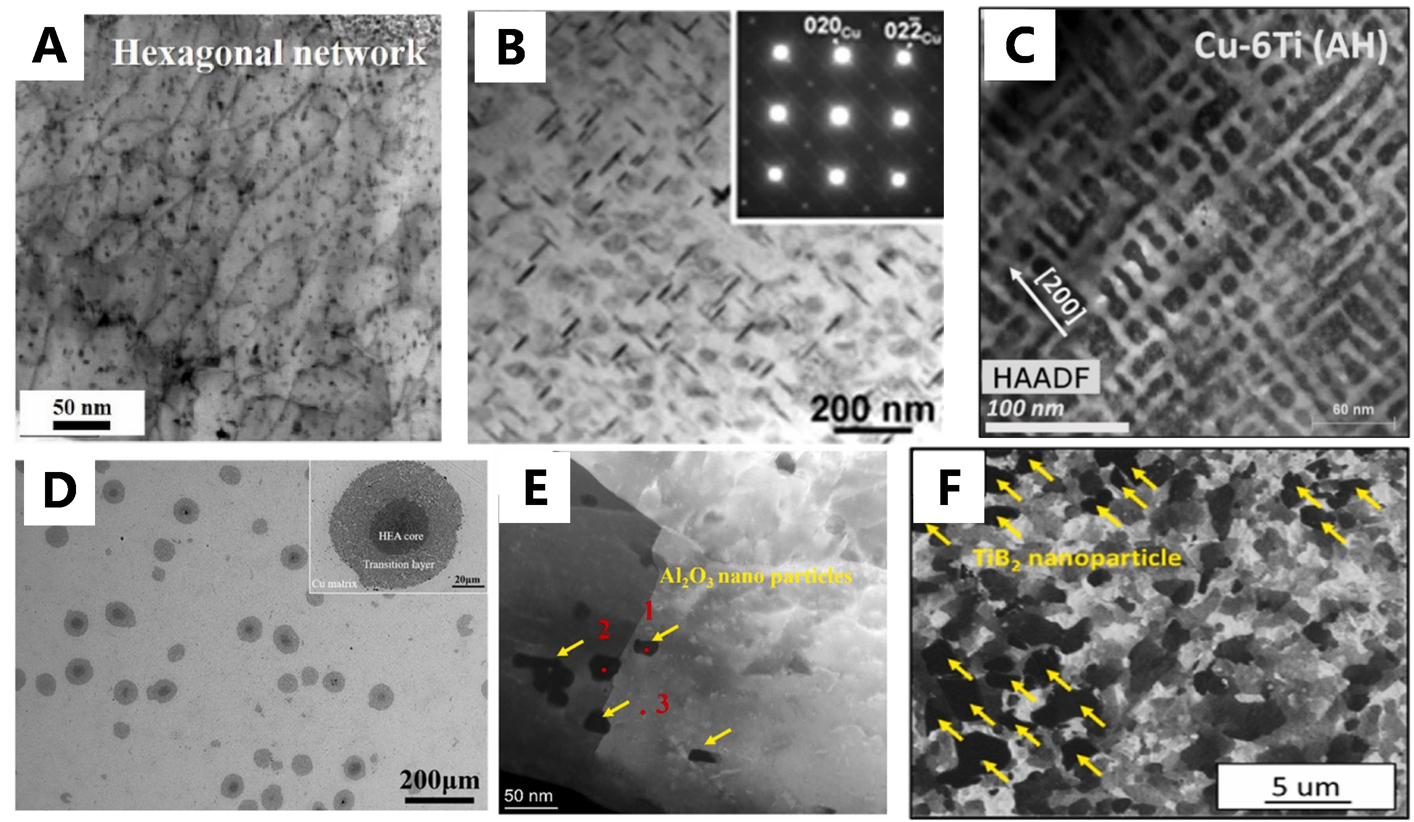
Figure 12. Types of dual-phase heterostructured copper alloys. (A) CuCrZr[104] (Reprinted from Ref.[104], with permission from Elsevier). (B) CuNiSi[110] (Quoted with permission from Han et al.[110], under the CC BY 4.0 license, http://creativecommons.org/licenses/by/4.0/). (C) CuTi[111] (Quoted with permission from Rouxel et al.[111], under the CC BY 4.0 license, http://creativecommons.org/licenses/by/4.0/). (D) HEA/Cu composite[114] (Reprinted from Ref.[114], with permission from Elsevier). (E) Cu-Al2O3[116] (Reprinted from Ref.[116], with permission from Elsevier). (F) Cu-TiB2[119] (Reprinted from Ref.[119], with permission from Elsevier).
Precipitation-strengthened copper alloys are typically fabricated through solution treatment with aging processes or synergistic cold deformation with aging protocols[111], as shown in Figure 13A. These alloys form nanoscale intermetallic compounds or carbides via solute dissolution and subsequent precipitation, where the reinforcing phases generally maintain coherent/semi-coherent interfaces with the Cu matrix. Property modulation is achieved through dislocation shearing mechanisms or the Orowan mechanism. For instance, CuCrZr alloys undergo melting-casting followed by high-temperature solution treatment, cold deformation, and medium-temperature aging to optimize precipitate size and distribution. CuNiSi alloys form Ni2Si precipitates after melting-casting, high-temperature solution treatment, and medium-temperature aging. Cu-Ti alloys similarly develop α-Cu4Ti precipitates through analogous processing. Additionally, high-entropy alloy particle-reinforced copper composites, as shown in Figure 13B, are typically synthesized via mechanical alloying or vacuum arc melting, with precipitate sizes predominantly in the nanometer range (100-500 nm), further expanding the controllability of precipitation strengthening[114].
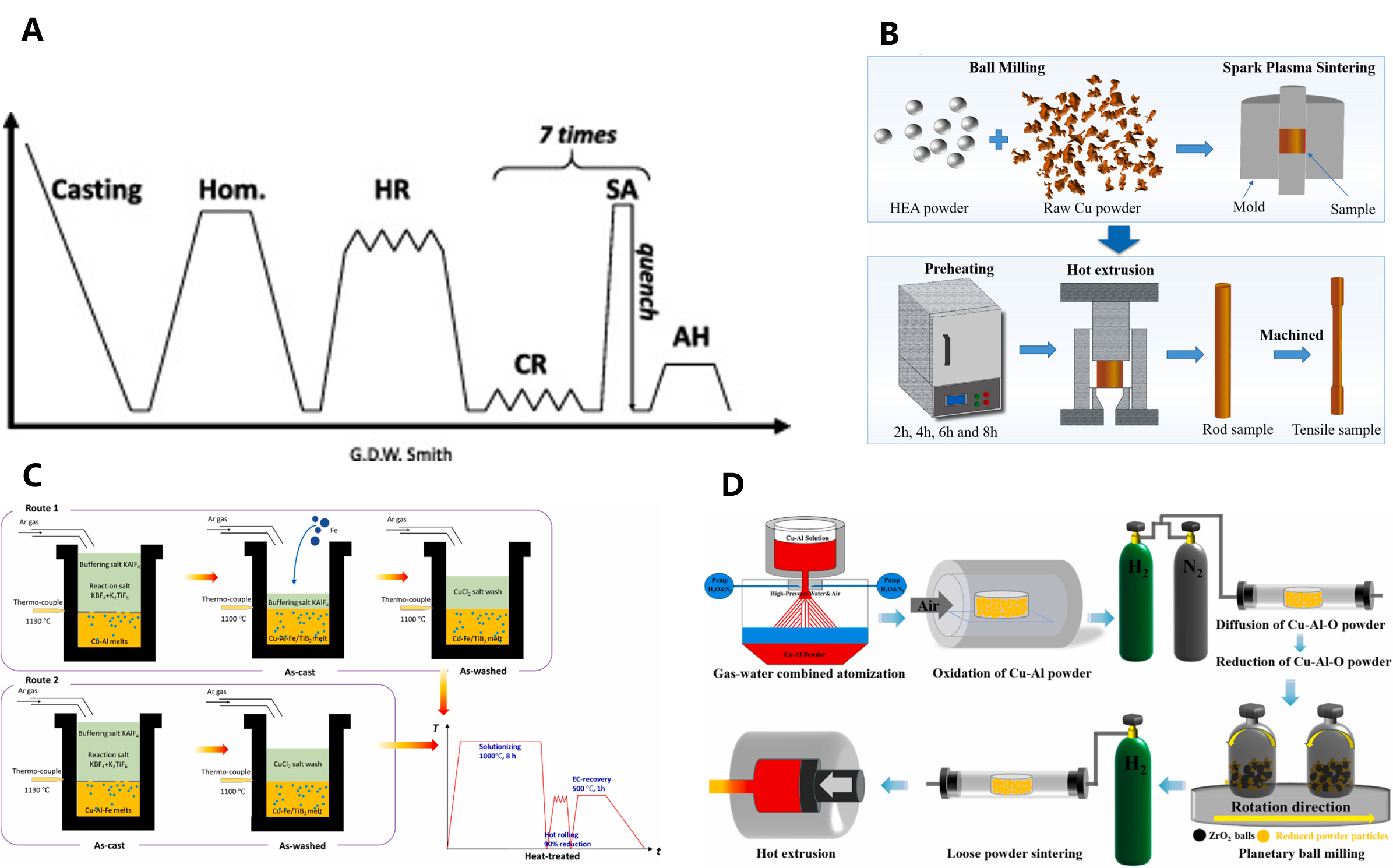
Figure 13. Schematic diagram of the preparation process of dual-phase heterostructured copper alloys. (A) Schematic diagram of precipitation strengthened copper alloy processing[111] (Quoted with permission from Rouxel et al.[111], under the CC BY 4.0 license, http://creativecommons.org/licenses/by/4.0/). (B) HEA/Cu composite[114] (Reprinted from Ref.[114], with permission from Elsevier). (C) Cu-TiB2[119] (Reprinted from Ref.[119], with permission from Elsevier). (D) Cu-Al2O3[122] (Reprinted from Ref.[122], with permission from Elsevier).
Dispersion-strengthened copper alloys are primarily fabricated through powder metallurgy or internal oxidation methods, as illustrated in Figure 13C and D[119,122]. These alloys utilize externally added hard particles (e.g., oxides, borides) or in situ generated non-deformable particles as reinforcing phases, which typically form incoherent interfaces with the matrix. Strengthening is achieved via the Orowan mechanism, which impedes dislocation motion. Typical processes include: Cu-Al2O3 alloys synthesized through high-temperature internal oxidation to generate Al2O3 particles, followed by SPS or hot pressing; Cu-TiB2 alloys fabricated via internal oxidation to introduce nanoscale TiB2 particles and subsequently consolidated through hot pressing for uniform distribution. These processes enable effective control over the size, distribution, and thermal stability of the secondary phase, thereby optimizing high-temperature performance and wear resistance.
The performance enhancement of dual-phase heterogeneous-structured copper alloys arises from interactions between the secondary phase and the matrix: precipitation-strengthened systems rely on dynamic strengthening mechanisms at coherent/semi-coherent interfaces, whereas dispersion-strengthened systems achieve property optimization through stable obstruction effects induced by incoherent particles. Future research needs further multi-scale microstructural cooperative design to overcome the classical trade-off among strength, toughness, and electrical conductivity, while expanding their application potential in aerospace and electronic device fields.
Fabrication methods for heterostructured copper alloys
The fabrication techniques for heterostructured copper alloys primarily include severe plastic deformation (SPD), electrochemical deposition, powder metallurgy, additive manufacturing, and deformation-coupled annealing. The following provides a concise overview of the key advantages and practical challenges associated with each technique, serving as a foundation for subsequent material design and process development.
SPD technology includes SMGT, torsional straining, cyclic dynamic torsion, surface rotary rolling, single-roll angular rolling, rotary forging, and high-pressure torsion. These methods significantly improve the strength, ductility, and electrical conductivity of copper alloys by creating multiscale heterogeneous structures. Yet, complex processing, high costs, and thermal instability currently limit their industrial scalability[123-126].
Electrodeposition is a widely adopted technique for fabricating thin metal films (e.g., GNT Cu). Its simplified system and cost-effective process - operating without vacuum requirements - enable precise tailoring of material properties through adjustable deposition parameters and electrolyte composition[127-130]. However, the practical implementation of nanotwinned copper in electronics remains limited by the absence of established wafer-scale uniformity and scalable manufacturing processes[131].
Additive manufacturing enables the rapid fabrication of complex copper components for electrical conduction and thermal management applications[132-134]. However, copper's inherent high thermal conductivity narrows the process window, induces defect-prone processing, and elevates equipment costs, thereby hindering large-scale industrial adoption[135,136].
Powder metallurgy is a widely adopted technique for producing heterostructured copper alloys (e.g., Gr/Cu and Cu-Ta composites) due to its versatility, simplicity, and scalability[137,138]. However, poor powder quality control - marked by impurities or a broad particle size distribution - hinders subsequent processing and directly reduces electrical conductivity[139].
Deformation combined with annealing enables the formation of multiscale heterogeneous microstructures that substantially enhance the strength, ductility, and electrical conductivity of copper alloys[140,141]. However, the stringent requirement for precise temperature and duration control during annealing often induces grain coarsening and performance inconsistencies, thereby limiting its industrial scalability.
Above methods enhance strength and conductivity through microstructural heterogeneity (interfaces, phases, gradients). SPD and deformation-annealing offer high potential but face industrial barriers; electrochemical deposition and powder metallurgy target thin films/bulk production; additive manufacturing enables complex geometries but requires overcoming copper's thermal challenges.
CONCLUSIONS AND PERSPECTIVES
Micro-scale heterogeneity achieved through nanoscale interfaces can maximize the exploitation of such property incompatibilities, thereby significantly enhancing overall performance[142]. While macroscopic heterogeneity such as coarse-layered composites suffers from electron scattering at oversized interfaces, microscopic heterogeneity spatially separates electron transport pathways along Cu-rich matrices from dislocation pinning sites at nanoscale interfaces[9]. This separation significantly enhances strength-conductivity synergy, outperforming macroscopic approaches and enabling concurrent mechanical-electrical optimization in metallic materials. This principle establishes microscopic heterogeneity as the superior strategy for concurrent mechanical and functional optimization in metallic materials.
Heterostructured copper alloys address performance limitations of conventional materials through microstructural heterogeneity, thereby offering solutions to the strength-conductivity trade-off. Gradient structures, characterized by graded distributions of grain size or substructures (e.g., nanotwins), enhance strength and ductility by integrating GNDs-induced back-stress effects with multi-scale deformation synergy. Layered heterogeneous materials (e.g., W-Cu composites, Gr/Cu composites) significantly improve fracture toughness, thermal conductivity, and electrical conductivity through interfacial stress field modulation, multi-scale strengthening mechanisms, and interfacial electron doping effects. Dual-phase structures optimize the balance between strength and ductility in conventional materials via interactions between constituent phases, while substantially expanding the potential for functional design.
Additionally, alloy compositional tuning alongside heterostructure modulation further optimizes property trade-offs. For instance, Cu-Co alloys fabricated via L-PBF achieve a balanced combination of strength and electrical conductivity through interactions between HGS and dual-phase precipitates. Cu-0.6O alloys maintain high electrical conductivity while enhancing strength through ordered Cu2O nanoscale precipitates and cellular structural design.
Despite their significant advantages in mechanical performance, functional design, and multi-scale tunability, heterogeneous copper alloys still face substantial challenges in practical engineering applications. Regarding process controllability and stability, high-precision fabrication techniques (e.g., atomic layer deposition-based interfacial passivation, dynamic recrystallization control) should be developed to improve heterostructure stability and reproducibility, particularly under high-temperature or long-term service conditions. For example, SMGT often introduces structural damage, and L-PBF is highly sensitive to process parameters, requiring optimized processing windows.
In cross-scale property modulation, in situ electron microscopy observations combined with multi-scale modeling (e.g., molecular dynamics, phase-field simulations) are required to establish quantitative correlations between microstructural parameters (defects, grain size, interfacial misorientation) and macroscopic properties. For instance, interface-dominated deformation mechanisms in ultrathin layers
Regarding extreme environment adaptability, systematic studies on performance degradation mechanisms under high strain rates, corrosive media, or irradiation environments are urgently needed. For example, W-Cu composites may encounter interfacial phase transitions during high-temperature operation, requiring interface-engineered designs for corrosion/irradiation-resistant heterostructures.
In multifunctional integration, the potential of heterostructures for applications in electromagnetic shielding, thermal management, or self-healing systems should be explored. For instance, interfacial electron modulation in Gr/Cu composites could extend to high-frequency electronic devices, while high-entropy alloying strategies (e.g., Cu-Co-Ni-Cr-Fe) may further expand material performance boundaries.
From a sustainability perspective, fabrication processes must be optimized to reduce energy consumption and costs, promoting scalable applications in emerging fields such as renewable energy (e.g., efficient thermal management components) and electronics (e.g., high-conductivity connectors). For example, eco-friendly upgrades to powder metallurgy and additive manufacturing technologies can minimize resource waste.
Microscopic heterostructure design concept is also applicable to other alloy systems (e.g., titanium alloys[143-145], aluminum alloys[146,147], high-entropy alloys[148,149] (e.g., CoCrFeMnNi HEA, CoCrFeNi HEA, etc.), etc.). This strategy achieves synergistic performance enhancement by incorporating micro-level heterogeneity: Ti-Mg heterostructured materials achieve synergistic strength-ductility optimization through interfacial effects induced by thermal expansion mismatch[150]; Heterostructured Al-aluminum nitride (AlN) nanocomposites achieve simultaneous enhancement of thermal stability and strength through nanoparticle-mediated grain boundary pinning[151]; Heterostructured CoCrFeMnNi HEA achieves enhanced strength-ductility synergy through gradient-induced synergistic hardening from microstructural regions[152]. The future extension of heterogeneous structure design beyond copper-based alloys to other material systems represents a critical pathway for overcoming the performance bottlenecks in a wide range of metallic materials.
DECLARATIONS
Authors’ contributions
Conceptualization, investigation, writing - original draft: Shen, J.; Xie, L.
Writing - review & editing, supervision, funding acquisition: Wang, H.; Lou, H.; Wu, Y.; Zhang, X.; Xie, L.; Lu, Z.
Availability of data and materials
Not applicable.
AI and AI-assisted tools statement
Not applicable.
Financial support and sponsorship
This work was supported by the National Science Fund for Distinguished Young Scholars (52225103), the National Natural Science Foundation of China (Nos. 52471002, 52201171, 52201172, 52322102, 12335017, 52271003), Chinalco Research Institute of Science and Technology Co., Ltd. (ZT2106, ZT2417), and the High-Level Talent Research Start-Up Project Funding of Henan Academy of Sciences (241827232).
Conflicts of interest
Wang, H. and Lou, H. are affiliated with the Chinalco Research Institute of Science and Technology Co., Ltd, while the other authors have declared that they have no conflicts of interest.
Ethical approval and consent to participate
Not applicable.
Consent for publication
Not applicable.
Copyright
© The Author(s) 2026.
REFERENCES
1. Fukamachi, K.; Kimura, M. Age-hardening structure and mechanism of Cu-3at%Ni-1.5 at%Si Corson alloy. Mater. Sci. Eng. A. 2022, 831, 142220.
2. Wang, Z.; Li, J.; Fan, Z.; et al. Effects of Co addition on the microstructure and properties of elastic Cu-Ni-Si-based alloys for electrical connectors. Materials 2021, 14, 1996.
3. Lu, L.; Shen, Y.; Chen, X.; Qian, L.; Lu, K. Ultrahigh strength and high electrical conductivity in copper. Science 2004, 304, 422-6.
4. Yakovtseva, O.; Mikhaylovskaya, A.; Pozdniakov, A.; Kotov, A.; Portnoy, V. Superplastic deformation behaviour of aluminium containing brasses. Mater. Sci. Eng. A. 2016, 674, 135-43.
5. Karthik, M.; Abhinav, J.; Shankar, K. V. Morphological and mechanical behaviour of Cu-Sn alloys - a review. Met. Mater. Int. 2021, 27, 1915-46.
6. Gao, X.; Wu, H. B.; Liu, M.; Zhang, Y. X.; Gao, F. Effect of deformation of multi-pass rolling on microstructure and properties of C71500 cupronickel alloy tube. Rare. Metal. Mat. Eng. 2021, 50, 3819-23.
7. Sun, L.; Li, X.; Li, C.; et al. Superior strength-ductility combination in dual-phase heterostructured H62 brass via gradient microstructures. J. Alloys. Compd. 2025, 1038, 182843.
8. Yan, Y.; Kou, S.; Yang, H.; et al. Ceramic particles reinforced copper matrix composites manufactured by advanced powder metallurgy: preparation, performance, and mechanisms. Int. J. Extrem. Manuf. 2023, 5, 032006.
9. Mao, Q.; Liu, Y.; Zhao, Y. A review on copper alloys with high strength and high electrical conductivity. J. Alloys. Compd. 2024, 990, 174456.
10. Hu, Z.; Jiang, Z.; Qiao, Z.; Wang, L.; Zhan, X.; Ma, Z. The well-balanced strength and conductivity in additively manufactured CuCrZr-Y2O3 composites by regulating multi-scale heterostructures. J. Manuf. Process. 2024, 131, 327-35.
11. Tang, X.; Chen, X.; Sun, F.; et al. A study on the mechanical and electrical properties of high-strength CuCrZr alloy fabricated using laser powder bed fusion. J. Alloys. Compd. 2022, 924, 166627.
12. Dong, X.; Gao, B.; Xiao, L.; et al. Heterostructured metallic structural materials: research methods, properties, and future perspectives. Adv. Funct. Mater. 2024, 34, 2410521.
13. Liu, Y.; Zhang, J.; Sun, Q.; et al. Laser powder bed fusion of copper matrix iron particle reinforced nanocomposite with high strength and high conductivity. J. Mater. Sci. Technol. 2023, 134, 50-9.
14. Bakhshaei, P.; Ataie, A.; Abdizadeh, H. Facile mechanical fabrication of Cu-Ni/CNT nanocomposite for improved microstructural, hardness, and electrical characteristics. Mater. Sci. Technol. 2024, 41, 1054-63.
15. Qi, L.; Wang, X.; Tian, W.; et al. Achieving excellent properties of Cu-2wt%Ag wire by annealing treatment and large deformation. Vacuum 2025, 239, 114362.
16. Liu, Y.; Zhang, J.; Tan, Q.; et al. Additive manufacturing of high strength copper alloy with heterogeneous grain structure through laser powder bed fusion. Acta. Mater. 2021, 220, 117311.
17. Li, S.; Luo, X.; Sun, Z.; et al. Construction of a dual heterogeneous lamella structure to improve the electrical conductivity and mechanical properties of Cu alloys. Mater. Lett. 2023, 338, 134016.
18. Wu, X. L.; Zhu, Y. T. Heterostructured metallic materials: plastic deformation and strain hardening. Acta. Metall. Sin. 2022, 58, 1349-59.
19. Fang, T. H.; Li, W. L.; Tao, N. R.; Lu, K. Revealing extraordinary intrinsic tensile plasticity in gradient nano-grained copper. Science 2011, 331, 1587-90.
20. Lu, K. Nanomaterials. Making strong nanomaterials ductile with gradients. Science 2014, 345, 1455-6.
21. Chen, A.; Li, D.; Zhang, J.; Song, H.; Lu, J. Make nanostructured metal exceptionally tough by introducing non-localized fracture behaviors. Scr. Mater. 2008, 59, 579-82.
22. Wu, X.; Jiang, P.; Chen, L.; Yuan, F.; Zhu, Y. T. Extraordinary strain hardening by gradient structure. Proc. Natl. Acad. Sci. USA. 2014, 111, 7197-201.
23. Shao, C.; Zhang, P.; Zhu, Y.; Zhang, Z.; Tian, Y.; Zhang, Z. Simultaneous improvement of strength and plasticity: Additional work-hardening from gradient microstructure. Acta. Mater. 2018, 145, 413-28.
24. Zeng, Z.; Li, X.; Xu, D.; Lu, L.; Gao, H.; Zhu, T. Gradient plasticity in gradient nano-grained metals. Extreme. Mechan. Lett. 2016, 8, 213-9.
25. Roumina, R.; Embury, J.; Bouaziz, O.; Zurob, H. Mechanical behavior of a compositionally graded 300M steel. Mater. Sci. Eng. A. 2013, 578, 140-9.
26. Pan, Q.; Zhang, L.; Feng, R.; et al. Gradient cell-structured high-entropy alloy with exceptional strength and ductility. Science 2021, 374, 984-9.
27. Cheng, Z.; Zhou, H.; Lu, Q.; Gao, H.; Lu, L. Extra strengthening and work hardening in gradient nanotwinned metals. Science 2018, 362, 559-67.
28. Du, X. H.; Li, W. P.; Chang, H. T.; et al. Dual heterogeneous structures lead to ultrahigh strength and uniform ductility in a Co-Cr-Ni medium-entropy alloy. Nat. Commun. 2020, 11, 2390.
29. Yang, M.; Pan, Y.; Yuan, F.; Zhu, Y.; Wu, X. Back stress strengthening and strain hardening in gradient structure. Mater. Res. Lett. 2016, 4, 145-51.
30. Zhu, Y.; Wu, X. Perspective on hetero-deformation induced (HDI) hardening and back stress. Mater. Res. Lett. 2019, 7, 393-8.
31. Wu, X.; Yang, M.; Yuan, F.; et al. Heterogeneous lamella structure unites ultrafine-grain strength with coarse-grain ductility. Proc. Natl. Acad. Sci. USA. 2015, 112, 14501-5.
32. Gao, H.; Huang, Y. Geometrically necessary dislocation and size-dependent plasticity. Scr. Mater. 2003, 48, 113-8.
33. Huang, Y.; Gao, H.; Nix, W.; Hutchinson, J. Mechanism-based strain gradient plasticity - II. analysis. J. Mech. Phys. Solids. 2000, 48, 99-128.
34. Wang, H.; Tao, N.; Lu, K. Strengthening an austenitic Fe-Mn steel using nanotwinned austenitic grains. Acta. Mater. 2012, 60, 4027-40.
35. Cheng, Z.; Bu, L.; Zhang, Y.; et al. Unraveling the origin of extra strengthening in gradient nanotwinned metals. Proc. Natl. Acad. Sci. USA. 2022, 119, 8.
36. Jiang, S.; Wang, H.; Wu, Y.; et al. Ultrastrong steel via minimal lattice misfit and high-density nanoprecipitation. Nature 2017, 544, 460-4.
37. Moniri, S.; Yang, Y.; Ding, J.; et al. Three-dimensional atomic structure and local chemical order of medium- and high-entropy nanoalloys. Nature 2023, 624, 564-9.
38. Wang, J.; Jiang, P.; Yuan, F.; Wu, X. Chemical medium-range order in a medium-entropy alloy. Nat. Commun. 2022, 13, 1021.
39. Lei, Z.; Liu, X.; Wu, Y.; et al. Enhanced strength and ductility in a high-entropy alloy via ordered oxygen complexes. Nature 2018, 563, 546-50.
40. Chen, X.; Wang, Q.; Cheng, Z.; et al. Direct observation of chemical short-range order in a medium-entropy alloy. Nature 2021, 592, 712-6.
41. Li, Q. J.; Sheng, H.; Ma, E. Strengthening in multi-principal element alloys with local-chemical-order roughened dislocation pathways. Nat. Commun. 2019, 10, 3563.
42. Zhu, Y.; Ameyama, K.; Anderson, P. M.; et al. Heterostructured materials: superior properties from hetero-zone interaction. Mater. Res. Lett. 2020, 9, 1-31.
43. Wu, X.; Zhu, Y.; Lu, K. Ductility and strain hardening in gradient and lamellar structured materials. Scr. Mater. 2020, 186, 321-5.
44. Wu, X.; Zhu, Y. Gradient and lamellar heterostructures for superior mechanical properties. MRS. Bull. 2021, 46, 244-9.
45. Li, J.; Zhang, Q.; Huang, R.; Li, X.; Gao, H. Towards understanding the structure-property relationships of heterogeneous-structured materials. Scr. Mater. 2020, 186, 304-11.
47. Wu, X.; Zhu, Y. Heterogeneous materials: a new class of materials with unprecedented mechanical properties. Mater. Res. Lett. 2017, 5, 527-32.
48. Mughrabi, H. On the role of strain gradients and long-range internal stresses in the composite model of crystal plasticity. Mater. Sci. Eng. A. 2001, 317, 171-80.
49. Levine, L. E.; Geantil, P.; Larson, B. C.; et al. Disordered long-range internal stresses in deformed copper and the mechanisms underlying plastic deformation. Acta. Mater. 2011, 59, 5803-11.
50. Zhou, H.; Huang, C.; Sha, X.; et al. In-situ observation of dislocation dynamics near heterostructured interfaces. Mater. Res. Lett. 2019, 7, 376-82.
51. Ma, X.; Huang, C.; Moering, J.; et al. Mechanical properties of copper/bronze laminates: role of interfaces. Acta. Mater. 2016, 116, 43-52.
52. Ma, E.; Wu, X. Tailoring heterogeneities in high-entropy alloys to promote strength-ductility synergy. Nat. Commun. 2019, 10, 5623.
53. Ma, J.; Zhou, Y.; He, W.; Jiang, B.; Liu, Q. Study on microstructures and mechanical properties of layered and layered-gradient Zr/Ti materials. Adv. Eng. Mater. 2021, 24, 2100805.
54. Shi, P.; Ren, W.; Zheng, T.; et al. Enhanced strength-ductility synergy in ultrafine-grained eutectic high-entropy alloys by inheriting microstructural lamellae. Nat. Commun. 2019, 10, 489.
55. Tang, J.; Chen, L.; Chen, Y.; Qian, L.; Que, B. Enhanced strength-ductility synergy of Al/Zn/Al laminated composite with unique interface and multi-modal heterogeneous microstructure. Mater. Charact. 2024, 207, 113535.
56. Wang, L.; Qu, S.; Fu, H.; et al. Additively manufactured copper alloy with heterogeneous nanoprecipitates-dislocation architecture for superior strength-ductility-conductivity synergy. Addit. Manuf. 2024, 84, 104100.
57. Liu, W.; Chen, X.; Ahmad, T.; et al. Microstructures and mechanical properties of Cu-Ti alloys with ultrahigh strength and high ductility by thermo-mechanical treatment. Mater. Sci. Eng. A. 2022, 835, 142672.
58. Cheng, Z.; Wan, T.; Lu, L. Interface strain gradient enabled high strength and hardening in laminated nanotwinned Cu. Acta. Mater. 2023, 256, 119138.
59. Yang, H.; Li, K.; Bu, Y.; et al. Nanoprecipitates induced dislocation pinning and multiplication strategy for designing high strength, plasticity and conductivity Cu alloys. Scr. Mater. 2021, 195, 113741.
60. Xu, L.; Huang, Z.; Shen, Q.; Chen, F. Effect of stacking fault energy on hetero-deformation in gradient nanograined Cu-Ni alloys. Mechan. Mater. 2024, 196, 105074.
61. Ye, S.; Liu, Z.; Feng, X.; et al. Heterostructure and multiple nano-phases achieve superior strength-ductility-conductivity synergy of laser additive manufacturing copper alloy. Virtual. Phys. Prototyp. 2024, 20, e2437467.
62. Lee, H.; Park, H.; Jung, J.; Amanov, A.; Kim, H. Multi-layered gradient structure manufactured by single-roll angular-rolling and ultrasonic nanocrystalline surface modification. Scr. Mater. 2020, 186, 52-6.
63. Chu, Z. Q.; Fan, Z.; Wei, W.; et al. Simultaneously enhancing strength, ductility, and electrical conductivity in Cu-1Cr-0.1Zr alloy by heterogeneous microstructure. Mater. Sci. Eng. A. 2024, 918, 147473.
64. Liu, H.; Gao, B.; Yang, Y.; et al. Strain hardening behavior and microstructure evolution of gradient-structured Cu-Al alloys with low stack fault energy. J. Mater. Res. Technol. 2022, 19, 220-9.
65. Ding, X.; Yang, Z.; Yang, Y.; Sun, R. Structural optimization strategies for improving the maximum strength of gradient nanotwinned metals. Mechan. Mater. 2024, 189, 104876.
66. Li, X.; Lu, L.; Li, J.; Zhang, X.; Gao, H. Mechanical properties and deformation mechanisms of gradient nanostructured metals and alloys. Nat. Rev. Mater. 2020, 5, 706-23.
67. Li, W.; Tao, N.; Lu, K. Fabrication of a gradient nano-micro-structured surface layer on bulk copper by means of a surface mechanical grinding treatment. Scr. Mater. 2008, 59, 546-9.
68. Shao, C.; Zhang, P.; Wang, X.; Wang, Q.; Zhang, Z. High-cycle fatigue behavior of TWIP steel with graded grains: breaking the rule of mixture. Mater. Res. Lett. 2018, 7, 26-32.
69. Cai, S.; Wan, J.; Hao, Y.; Koch, C. Dual gradient microstructure to simultaneously improve strength and electrical conductivity of aluminum wire. Mater. Sci. Eng. A. 2020, 783, 139308.
70. Yang, L.; Chen, Z.; Ma, X.; et al. Improvement of strength and ductility in a gradient structured Ni fabricated by severe torsion deformation. Mater. Sci. Eng. A. 2021, 826, 141980.
71. Chen, G.; Qiao, J.; Jiao, Z.; et al. Strength-ductility synergy of Al0.1CoCrFeNi high-entropy alloys with gradient hierarchical structures. Scr. Mater. 2019, 167, 95-100.
72. Ren, C.; Wang, Q.; Zhang, Z.; Yang, H.; Zhang, Z. Surface strengthening behaviors of pure Cu with heterogeneous microstructures. Mater. Sci. Eng. A. 2018, 727, 192-9.
73. Chen, W.; You, Z.; Tao, N.; Jin, Z.; Lu, L. Mechanically-induced grain coarsening in gradient nano-grained copper. Acta. Mater. 2017, 125, 255-64.
74. Lee, H. H.; Hwang, K. J.; Park, H. K.; Kim, H. S. Effect of processing route on microstructure and mechanical properties in single-roll angular-rolling. Materials 2020, 13, 2471.
75. Chen, L.; Cao, T.; Wei, R.; et al. Gradient structure design to strengthen carbon interstitial Fe40Mn40Co10Cr10 high entropy alloys. Mater. Sci. Eng. A. 2020, 772, 138661.
76. Mao, Q.; Liu, Y.; Zhao, Y. A review on mechanical properties and microstructure of ultrafine grained metals and alloys processed by rotary swaging. J. Alloys. Compd. 2022, 896, 163122.
77. Mao, Q.; Chen, X.; Li, J.; Zhao, Y. Nano-gradient materials prepared by rotary swaging. Nanomaterials 2021, 11, 2223.
78. Guo, F.; Wang, Y.; Wang, M.; et al. Hetero-deformation induced strengthening and toughening of pure iron with inverse and multi-gradient structures. Mater. Sci. Eng. A. 2020, 782, 139256.
79. Zhilyaev, A. P.; Langdon, T. G. Using high-pressure torsion for metal processing: fundamentals and applications. Prog. Mater. Sci. 2008, 53, 893-979.
80. Zhang, X.; Yuan, L.; Lei, Y.; et al. Electrochemical gradients driven 3D printing of nano-twinned copper structures by direct current dynamic meniscus confined electrodeposition. Appl. Mater. Today. 2021, 24, 101138.
81. Liu, Q.; Ren, C.; Song, Z.; et al. High-strength and high-conductivity additively manufactured Cu-O alloy enabled by cellular microstructure. Addit. Manuf. 2024, 88, 104244.
82. Pelatti, S.; Benedetti, S.; Ammirati, G.; et al. Niobium oxide films with variable stoichiometry: structure, morphology, and ultrafast dynamics. J. Phys. Chem. C. Nanomater. Interfaces. 2025, 129, 8206-14.
83. Pattanayak, M.; Hoque, M. N. F.; Ho, Y.; Li, W.; Fan, Z.; Bernussi, A. A. Ultrahigh tunability of resistive switching in strongly correlated functional oxide. Appl. Mater. Today. 2023, 30, 101642.
84. Naik, J. M.; Bulfin, B.; Triana, C. A.; Stoian, D. C.; Patzke, G. R. Cation-deficient Ce-substituted perovskite oxides with dual-redox active sites for thermochemical applications. ACS. Appl. Mater. Interfaces. 2023, 15, 806-17.
85. Diatta, A.; Colin, C. V.; Viennois, R.; et al. BaCoO2 with tetrahedral cobalt coordination: the missing element to understand energy storage and conversion applications in BaCoO3-δ-based materials. J. Am. Chem. Soc. 2024, 146, 15027-35.
86. Huang, T.; Liu, C.; Wang, J.; et al. Metallic aluminum suboxides with ultrahigh electrical conductivity at high pressure. Research 2022, 2022, 9798758.
87. Mara, N. A.; Beyerlein, I. J. Interface-dominant multilayers fabricated by severe plastic deformation: Stability under extreme conditions. Curr. Opin. Solid. State. Mat. Sci. 2015, 19, 265-76.
88. Liu, J.; Wu, Y.; Gao, H.; Kong, C.; Yu, H. Enhanced mechanical properties and thermal stability of accumulative roll-bonded Cu/Nb multilayer composites via cryorolling. Metall. Mater. Trans. A. 2022, 54, 16-22.
89. You, C.; Zeng, L.; Gao, R.; Zhang, X.; Wang, H. A dual heterogeneous laminated microstructure design for improving the mechanical properties and electrical conductivity of copper alloys. Mater. Charact. 2022, 187, 111878.
90. Han, T.; Hou, C.; Zhao, Z.; et al. Simultaneous enhancement of strength and conductivity via self-assembled lamellar architecture. Nat. Commun. 2024, 15, 1863.
91. Yang, K.; Li, Q.; Zhang, Q.; et al. Synergistically enhanced interface stability by graphene assisted copper surface reconstruction. Acta. Mater. 2022, 226, 117638.
92. Eslami, A. H.; Zebarjad, S. M.; Moshksar, M. M. Study on mechanical and magnetic properties of Cu/Ni multilayer composite fabricated by accumulative roll bonding process. Mater. Sci. Technol. 2013, 29, 1000-5.
93. Eizadjou, M.; Kazemitalachi, A.; Daneshmanesh, H.; Shakurshahabi, H.; Janghorban, K. Investigation of structure and mechanical properties of multi-layered Al/Cu composite produced by accumulative roll bonding (ARB) process. Compos. Sci. Technol. 2008, 68, 2003-9.
94. Jiang, S.; Jia, N.; Zhou, X.; Zhang, H.; He, T.; Zhao, X. Microstructure and mechanical properties of multilayered Cu/Ti composites fabricated by accumulative roll bonding. Mater. Trans. 2017, 58, 259-65.
95. Cao, M.; Xiong, D. B.; Yang, L.; et al. Ultrahigh electrical conductivity of graphene embedded in metals. Adv. Funct. Mater. 2019, 29, 1806792.
96. He, S.; Liu, B.; Zhao, T.; Zhang, X.; Wang, K.; Xiong, D. Electrical conductivity of graphene/copper composites at lattice scale. Comput. Mater. Sci. 2024, 245, 113314.
97. Jiang, B.; Liu, C.; Dai, B.; Pei, Z.; Liu, B.; Wang, Y. Improved strength-plasticity-conductivity of graphene/copper layered composites by vacuum hot rolling. J. Mater. Res. Technol. 2024, 31, 1991-2002.
98. Samal, A.; Kushwaha, A. K.; Das, D.; Sahoo, M. R.; Lanzillo, N. A.; Nayak, S. K. Thermal and electrical conductivity of copper‐graphene heterosystem: an effect of strain and thickness. Adv. Eng. Mater. 2023, 25, 2201192.
99. Lai, Z.; Mai, Y.; Song, H.; Mai, J.; Jie, X. Heterogeneous microstructure enables a synergy of strength, ductility and electrical conductivity in copper alloys. J. Alloys. Compd. 2022, 902, 163646.
100. Zheng, Y.; Niu, J.; Lu, Y.; et al. High strength and high conductivity pure copper prepared by ECAP-Conform combined with cryogenic rolling and recrystallization annealing. J. Mater. Res. Technol. 2025, 36, 3192-204.
101. Zhong, R.; Zhang, W.; Zhao, C.; Luo, Z.; Dong, H. Achieving an ultrastrong yet ductile copper alloy via microstructural heterogeneity with dense ordered nanoprecipitates. Mater. Res. Lett. 2025, 13, 875-84.
102. Zhang, X. H.; Yuan, H. X.; Huang, F.; et al. Enhanced strength-plasticity synergy of copper composites by designing uniformly dispersed yttria nanoparticles and a heterogeneous grain structure. Rare. Metals. 2024, 43, 6704-16.
103. Li, B.; Gao, Y.; Li, C.; et al. Microstructural characteristics, electrical conductivity and mechanical properties of Cu matrix composites reinforced with dual-phase borides. J. Mater. Res. Technol. 2025, 34, 1-14.
104. Ma, S.; Zhang, Q.; Fan, J.; et al. Excellent combination of strength, conductivity and ductility realized in a dilute Cu-Cr-Zr alloy by coherent nanoprecipitates. Mater. Sci. Eng. A. 2023, 885, 145614.
105. Han, J.; Wu, Y.; Zhao, K.; Liu, S.; Gao, T.; Liu, X. Effect of boron on aging strengthened phase and properties of Cu-Cr-Zr alloy. J. Mater. Res. Technol. 2022, 19, 532-41.
106. Hu, J.; Tian, Y.; Yu, H.; et al. Optimizing strength and electrical conductivity of Cu-Cr-Zr alloy by two-stage aging treatment. Mater. Lett. 2022, 315, 131937.
107. Xu, Z.; Shi, H.; Liu, S.; et al. Effect of aging temperature on microstructure and properties of cold-rolled Cu-Ni-Si alloy. Mater. Today. Commun. 2024, 40, 109438.
108. Liang, J.; Xie, G.; Liu, F.; Xue, W.; Wang, R.; Liu, X. Optimizing the overall performance of Cu-Ni-Si alloy via controlling nanometer-lamellar discontinuous precipitation structure. Int. J. Miner. Metall. Mate. 2025, 32, 915-24.
109. Jia, Y.; Pang, Y.; Yi, J.; Lei, Q.; Li, Z.; Xiao, Z. Effects of pre-aging on microstructure and properties of Cu-Ni-Si alloys. J. Alloys. Compd. 2023, 942, 169033.
110. Han, S. Z.; Lim, S. H.; Kim, S.; et al. Increasing strength and conductivity of Cu alloy through abnormal plastic deformation of an intermetallic compound. Sci. Rep. 2016, 6, 30907.
111. Rouxel, B.; Cayron, C.; Bornand, J.; Sanders, P.; Logé, R. E. Micro-addition of Fe in highly alloyed Cu-Ti alloys to improve both formability and strength. Mater. Des. 2022, 213, 110340.
112. Wei, H.; Wei, H. L.; Du, H. Y.; Wang, Q.; Zhou, C. Z. Mechanism of property enhancement of Cu-Ti alloys via microalloying with Cr and Mg elements. Trans. Nonferrous. Met. Soc. China. 2025, 35, 1233-48.
113. Tu, Y.; Wang, W.; Liu, X.; Feng, Q. The compositional homogenization control of Cu-Ti alloys prepared by accumulative roll bonding-deformation diffusion process. J. Alloys. Compd. 2022, 924, 166587.
114. Liu, Y.; Chen, J.; Li, Z.; Wang, X.; Zhang, P.; Liu, J. AlCoCrFeNi high entropy alloy reinforced Cu-based composite with high strength and ductility after hot extrusion. Vacuum 2021, 184, 109882.
115. Wu, J.; Tang, X.; Zhang, X.; et al. Realizing the combination of high strength and good ductility of Cu matrix composites with CrCoNi reinforcement particles and microlaminated structure. J. Alloys. Compd. 2021, 872, 159632.
116. Wang, S.; Xie, G.; Yang, J.; Liu, F.; Liu, X. Analysis of microstructure evolution and deformation mechanism of nano-oxides Al2O3 dispersion strengthened copper alloy during compression at room temperature. J. Alloys. Compd. 2023, 949, 169837.
117. Zhao, S.; Song, G.; Zhang, T. Microstructures, electrical and mechanical properties of an ODS-Cu alloy containing multi-scale complex oxides. Mater. Sci. Eng. A. 2024, 890, 145905.
118. Zhang, X.; Sun, G.; Zhang, P.; et al. Effects of interfacial coherency on the high-temperature strengthening in the dispersion-strengthened Cu matrix composite. Compos. Commun. 2025, 54, 102274.
119. Pan, S.; Zheng, T.; Yao, G.; Chi, Y.; De, Rosa. I.; Li, X. High-strength and high-conductivity in situ Cu-TiB2 nanocomposites. Mater. Sci. Eng. A. 2022, 831, 141952.
120. Li, Y.; Liu, S.; Yan, Q.; et al. Achieving high strength, high ductility and high conductivity of additively manufactured CuCrZr alloy via control of powder bed temperature. Mater. Sci. Eng. A. 2025, 930, 148114.
121. Guo, X.; Xu, G.; Li, S.; et al. Enhanced plastic deformation ability of copper matrix composites through synergistic strengthening of nano-Al2O3 and Cr particles. Mater. Sci. Eng. A. 2024, 910, 146886.
122. Li, Y.; Chen, C.; Sun, W.; et al. Synergistic enhancement of strength-ductility in ODS copper alloy by exploring heterogeneous structure. Mater. Sci. Eng. A. 2025, 931, 148194.
123. Edalati, K.; Ahmed, A. Q.; Akrami, S.; et al. Severe plastic deformation for producing superfunctional ultrafine-grained and heterostructured materials: an interdisciplinary review. J. Alloys. Compd. 2024, 1002, 174667.
124. Romero-Resendiz, L.; Naeem, M.; Zhu, Y. T. Heterostructured materials by severe plastic deformation: overview and perspectives. Mater. Trans. 2023, 64, 2346-60.
125. Edalati, K.; Horita, Z. Recent research trends in severe plastic deformation of metallic and non-metallic materials. Mater. Trans. 2025, 66, 450-61.
126. Hernández-escobar, D.; Kawasaki, M.; Boehlert, C. J. Metal hybrids processed by high-pressure torsion: synthesis, microstructure, mechanical properties and developing trends. Int. Mater. Rev. 2021, 67, 231-65.
127. Jin, X.; Wang, Z.; Hu, H.; Sun, K.; Liu, Y.; Liu, Y. Ultra-high conductive copper with micron-grain and nano-twin microstructures prepared by electrodeposition. J. Alloys. Compd. 2025, 1036, 181805.
128. Zhang, P.; Zhang, L.; Qu, X. Anomalous vertical twins with high (2 2 0) texture in direct current electroplating copper film. Appl. Surf. Sci. 2023, 638, 158102.
129. Su, G.; Gao, J.; Liu, X.; et al. High-efficiency and low-consumption preparation of ultra-thin and high-performance nanotwinned copper foils by high-gravity intensified direct current electrodeposition. Chem. Eng. Sci. 2024, 296, 120248.
130. Chen, K. X.; Gao, L. Y.; Li, Z.; Sun, R.; Liu, Z. Q. Research progress of electroplated nanotwinned copper in microelectronic packaging. Materials 2023, 16, 4614.
131. Park, S. W.; Eom, H. W.; Kim, M. J.; Kim, J. J. Electrodeposition of nano-twinned Cu and their applications in electronics. J. Electrochem. Soc. 2022, 169, 112503.
132. Tang, X.; Chen, X.; Sun, F.; Liu, P.; Zhou, H.; Fu, S. The current state of CuCrZr and CuCrNb alloys manufactured by additive manufacturing: a review. Mater. Des. 2022, 224, 111419.
133. Campagnoli M, Galati M, Saboori A. On the processability of copper components via powder-based additive manufacturing processes: potentials, challenges and feasible solutions. J. Manuf. Process. 2021, 72, 320-37.
134. Jadhav, S. D.; Goossens, L. R.; Kinds, Y.; Hooreweder, B. V.; Vanmeensel, K. Laser-based powder bed fusion additive manufacturing of pure copper. Addit. Manuf. 2021, 42, 101990.
135. Liu, Y.; Zhang, J.; Niu, R.; et al. Manufacturing of high strength and high conductivity copper with laser powder bed fusion. Nat. Commun. 2024, 15, 1283.
136. Bu, X.; Lei, Q.; Zhang, X.; et al. Effect of process parameters and heat treatment on the microstructure and properties of a Cu-Cr-Si alloy manufactured by laser powder bed fusion. Mater. Sci. Eng. A. 2025, 927, 147966.
137. Jiang, H.; Li, Y.; Jiang, L.; et al. High strength and high conductivity Cu-Ta composites fabricated by powder metallurgy. Mater. Today. Commun. 2024, 38, 108183.
138. Singh, K.; Khanna, V.; Chaudhary, V.; Jasrotia, R.; Prakash, C.; Al-Kahtani, A. A. Investigating the potential of powder metallurgy for fabricating graphene nanoplatelets reinforced copper nanocomposites. J. Mater. Res. Technol. 2024, 31, 1258-69.
139. Wang, Y.; Zhuo, L.; Yin, E. Progress, challenges and potentials/trends of tungsten-copper (W Cu) composites/pseudo-alloys: fabrication, regulation and application. Int. J. Refract. Met. Hard. Mat. 2021, 100, 105648.
140. Guo, J.; He, Q.; Mei, Q.; Huang, X.; Wu, G.; Mishin, O. Gradient microstructure, recrystallization and mechanical properties of copper processed by high pressure surface rolling. J. Mater. Sci. Technol. 2022, 126, 182-90.
141. Lin, H.; Tian, Y.; Sun, S.; Zhang, Z.; Zhang, Z. Tuning the mechanical properties of copper by changing deformation temperature and recrystallization fraction. Mater. Sci. Eng. A. 2022, 853, 143734.
142. Wang, J.; Misra, A. Plastic homogeneity in nanoscale heterostructured binary and multicomponent metallic eutectics: an overview. Curr. Opin. Solid. State. Mat. Sci. 2023, 27, 101055.
143. Zhu, K.; Huang, J.; Nie, W.; et al. Ultrahigh yield strength heterostructured titanium matrix composites by controlling the α/α′ precipitation sequence. J. Alloys. Compd. 2024, 1004, 175886.
144. Zhao, Y.; Wang, M.; Lei, Y.; Fan, Y.; Xue, A.; Lin, X. Fabrication of heterostructured Ti alloys with exceptional strength and ductility by direct laser deposition. J. Mater. Res. Technol. 2024, 28, 1597-610.
145. Mao, X.; Wang, L.; Sun, G.; Zhang, X.; Fu, Y.; Dong, L. Introducing β-Ti ductile-zones for enhancing both strength and ductility in heterostructured titanium alloy composites. Mater. Res. Lett. 2024, 13, 165-74.
146. Wu, R.; Choi, Y. T.; Wu, Q.; et al. Enhanced strength-ductility synergy in a gradient pseudo-precipitates heterostructured Al-2.5%Mg alloy: design, fabrication, and deformation mechanism. J. Mater. Sci. Technol. 2024, 196, 88-100.
147. Nie, J.; Chen, Y.; Song, L.; et al. Enhancing strength and ductility of Al-matrix composite via a dual-heterostructure strategy. Int. J. Plast. 2023, 171, 103825.
148. Shen, J.; Choi, Y. T.; Yang, J.; et al. Fabrication of spatially-variable heterostructured CoCrFeMnNi high entropy alloy by laser processing. Mater. Sci. Eng. A. 2024, 896, 146272.
149. Tung, S.; Hsu, T.; Zhu, Y.; Tsai, M. Recrystallized hard zone and resultant tri-modal microstructure produces superior mechanical properties in a single-phase heterostructured high-entropy alloy. Acta. Mater. 2024, 273, 119957.
150. Ai, W.; Lin, Y.; Chen, F. Microstructure and mechanical properties of Ti-Mg lightweight heterostructured materials. Mater. Sci. Eng. A. 2022, 850, 143560.
151. Nie, J. F.; Wu, Y. L.; Xie, K. W.; Liu, X. F. Microstructure and thermal stability of heterostructured Al-AlN nanocomposite. Acta. Metall. Sin. 2022, 58, 1497-1508.
Cite This Article
 Open Access
How to Cite
Download Citation
Export Citation File:
Type of Import
Tips on Downloading Citation
Citation Manager File Format
Type of Import
Direct Import: When the Direct Import option is selected (the default state), a dialogue box will give you the option to Save or Open the downloaded citation data. Choosing Open will either launch your citation manager or give you a choice of applications with which to use the metadata. The Save option saves the file locally for later use.
Indirect Import: When the Indirect Import option is selected, the metadata is displayed and may be copied and pasted as needed.
About This Article
Special Topic
Copyright

Data & Comments
Data
0










Comments
Comments must be written in English. Spam, offensive content, impersonation, and private information will not be permitted. If any comment is reported and identified as inappropriate content by OAE staff, the comment will be removed without notice. If you have any queries or need any help, please contact us at [email protected].