



fig10
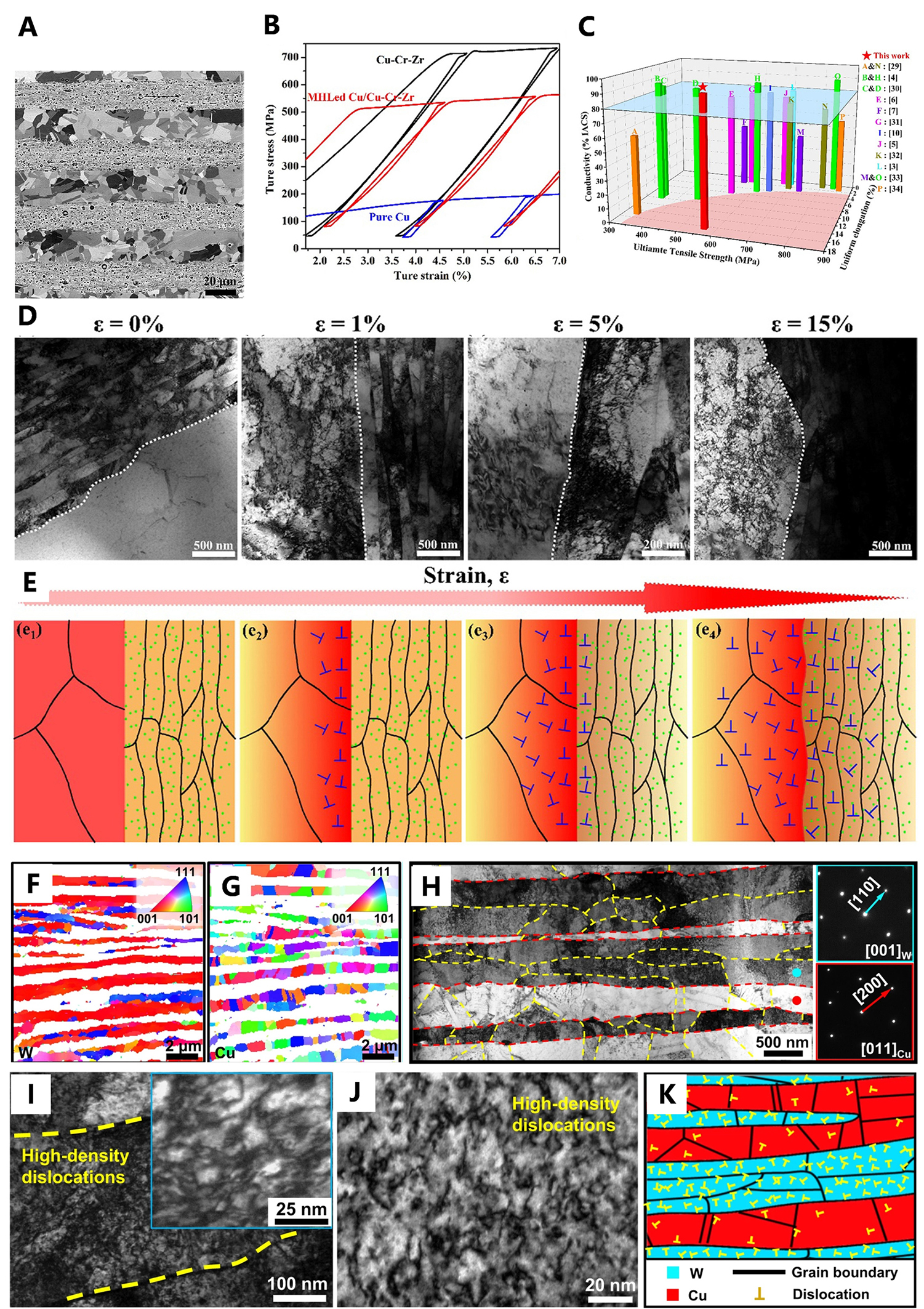
Figure 10. Layered structures and Properties of the Cu alloy ((A-E) Cu/CuCrZr[89] (Reprinted from Ref.[89], with permission from Elsevier); (F-K) W-Cu[90] (Quoted with permission from Han et al.[90], under the CC BY 4.0 license, http://creativecommons.org/licenses/by/4.0/). (A) Backscattered electrons image of the DHLed Cu/Cu-Cr-Zr laminated composite. (B) Hysteresis loops at selected cycle numbers for back stress measurements. (C) Comparison of overall properties including tensile strength, elongation and electrical conductivity of the Cu/Cu-Cr-Zr composite with other reported copper-alloys. (D) TEM images of Cu/Cu-Cr-Zr at different tensile strains. (E) Schematic depicting different deformation stages in the DHLed Cu/Cu-Cr-Zr composite. (F) EBSD IPF map of W phase in the as-prepared SAL W-Cu. (G) EBSD IPF map of W phase in the as-prepared SAL W-Cu. (H) Bright field TEM image showing the elongated W grains in the SAL W-Cu. (I) Bright field TEM image of the milled W flake containing dislocations. (J) Bright field TEM image of W phase in SAL W-Cu, showing high-density dislocations. (K) Schematic sketch of the SAL architecture in the as-prepared W-Cu composite.