



Emerging surgical optimization strategies for early-stage cervical cancer: insights from global evidence and Chinese research contributions
 0
0 
Abstract
Despite significant progress in prevention and screening, cervical cancer continues to pose a major global public health challenge, with surgical intervention remaining central to the clinical management of early-stage disease. However, conventional surgical approaches are frequently associated with substantial postoperative complications that adversely affect patients’ quality of life. This unmet clinical challenge has prompted extensive re-evaluations and innovations in surgical strategies worldwide over the past decade. This narrative review synthesizes high-quality evidence from landmark global clinical studies that support international guidelines and comprehensively summarizes and synthesizes pivotal insights from Chinese research teams, including data from domestic trials, real-world clinical practice, and novel technical developments. This review focuses on three principal directions for surgical optimization in early-stage cervical cancer: minimization of surgical trauma, individualization of the surgical resection range, and precision of lymph node assessment. Furthermore, we highlight the important complementary role of Chinese research in validating global surgical strategies in local populations, extending their application to subgroups, and refining technical adaptations to meet diverse patient needs. The limitations of the current research and the anticipated value of ongoing global and Chinese-led clinical trials are also discussed, as these are expected to further refine the diagnostic and therapeutic paradigms for early-stage cervical cancer. By integrating global evidence with the valuable contributions of Chinese researchers, this review aims to provide a comprehensive and integrated perspective on patient-centered surgical care; offer insights for the development of more precise, minimally invasive, and individualized surgical strategies; and ultimately contribute to improving the cure rates and outcomes for patients worldwide.
Keywords
INTRODUCTION
Cervical cancer ranks as the fourth most common malignancy among women worldwide, imposing a substantial global health burden[1]. While global efforts to promote screening and vaccination have made progress in reducing the disease burden in some regions, distinct epidemiological features, including variations in histological subtypes, age at onset, and treatment response, underscore the need for diverse research perspectives to inform evidence-based care. Chinese research teams have made significant contributions to global cervical cancer research, with studies focusing on validating global surgical strategies in local populations, exploring novel technical adaptations, and addressing unmet needs in patient-centered care. These contributions have provided global evidence and enriched the understanding of early-stage cervical cancer surgical management.
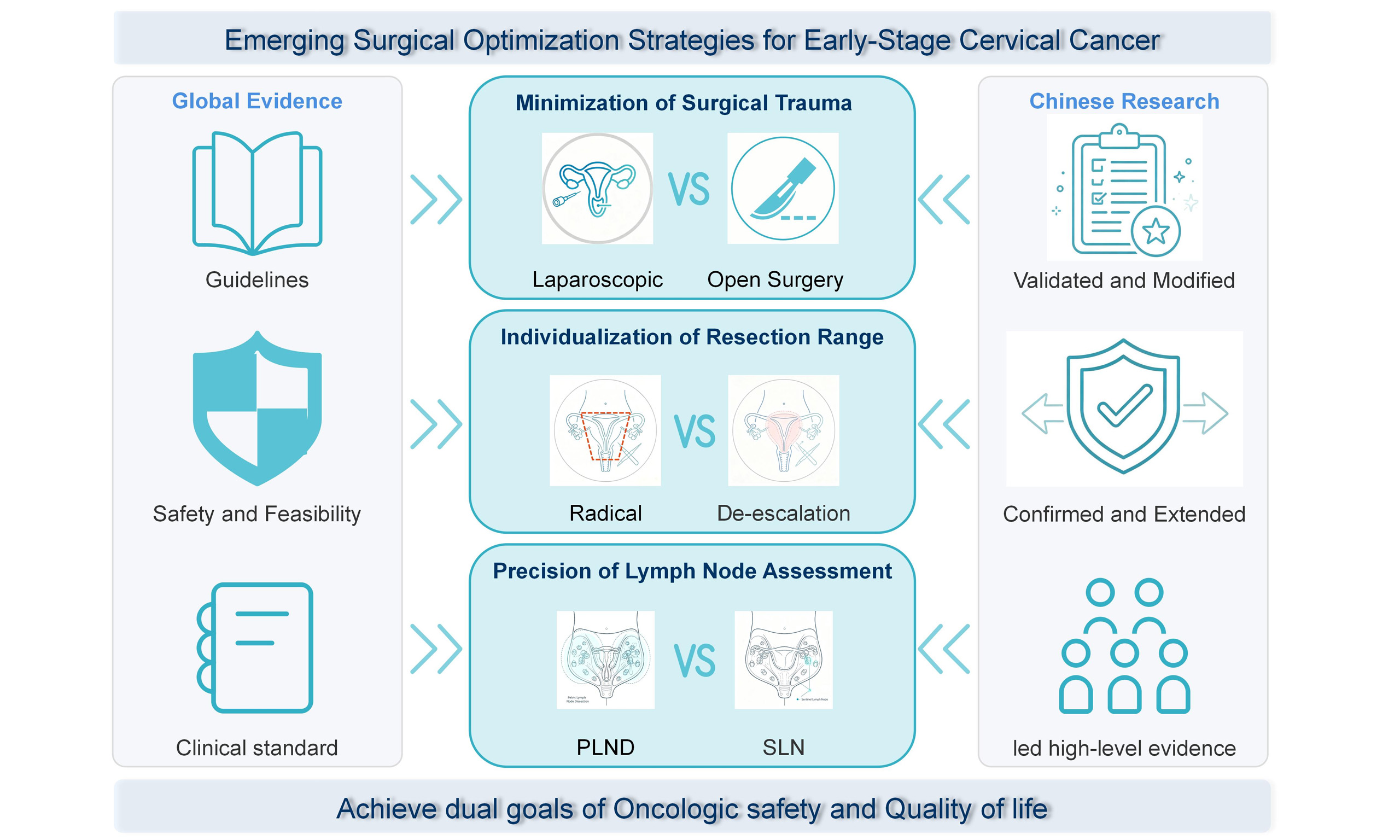
This narrative review comprehensively synthesizes key findings from high-impact global clinical trials that support international National Comprehensive Cancer Network (NCCN) guidelines and integrates valuable insights from Chinese research teams derived from domestic clinical trials and real-world practice experience. We focus on three critical dimensions of surgical optimization: trauma-minimizing approaches, de-escalation of surgical range, and precise lymph node assessment. We further emphasize the role of Chinese research in expanding global evidence, including the validation of optimized techniques, the exploration of novel adaptations, and subgroup analyses customized for diverse patient populations. The overall framework of surgical optimization strategies summarized in this review is visually presented in Figure 1, which outlines three core optimization directions and their shared clinical goals. Additionally, we identify unresolved questions that require continued global collaboration to resolve, ultimately contributing to enhanced outcomes and quality of life (QOL) for patients worldwide.
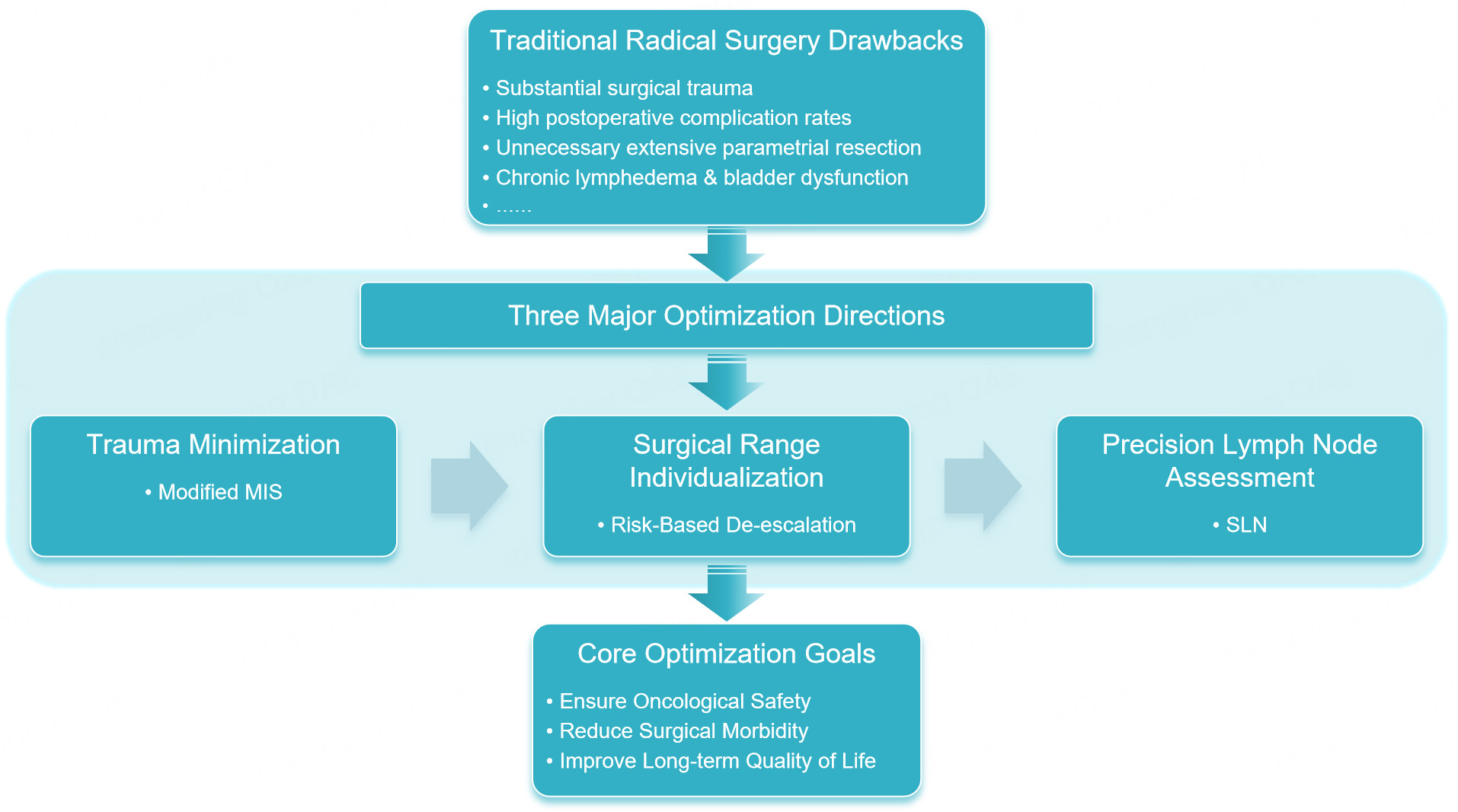
Figure 1. Overview of the integrated optimization framework for early cervical cancer surgery. Conventional radical surgery is hampered by substantial surgical trauma, excessive tissue resection, and lymphadenectomy-related adverse events. Three major optimization strategies have been developed, including modified minimally invasive surgery for trauma reduction, risk-based surgical de-escalation for an individualized resection range, and sentinel lymph node biopsy for precise nodal evaluation. The shared core objectives of all the optimized techniques are guaranteed oncological safety, reduced surgical morbidity, and improved long-term quality of life. MIS: Minimally invasive surgery; SLN: sentinel lymph node.
METHOD
This narrative review summarizes and integrates high-quality evidence from landmark global clinical studies and complementary insights from Chinese real-world research and clinical trials. Comprehensive literature searches were independently conducted across three major international databases, namely, PubMed, the Web of Science Core Collection, and Scopus, covering publications from January 2016 to March 2026. The search strategy included both MeSH terms and free-text keywords: “early-stage cervical cancer”, “surgical optimization”, “minimally invasive surgery”, “radical hysterectomy”, “sentinel lymph node biopsy”, “surgical de-escalation”, and “Chinese”. Eligible study types included authoritative clinical guidelines, landmark randomized controlled trials, high-quality systematic reviews and meta-analyses, and large-sample retrospective cohort studies focused on surgical optimization for early-stage cervical cancer. All the retrieved literature was screened according to the three core themes of this review: surgical trauma minimization, individualized surgical range de-escalation, and precise lymph node assessment. The reference lists of all the included articles were also manually screened to identify additional relevant studies, ensuring comprehensive evidence coverage. Studies focusing exclusively on radiotherapy, chemotherapy, basic experiments, or duplicate data were excluded.
STAGING DEFINITION AND RISK-STRATIFIED TREATMENT BASELINES
Staging criteria
There is no universal definition for early-stage cervical cancer. According to the 2009 International Federation of Gynecology and Obstetrics (FIGO) staging system, early-stage cervical cancer is categorized as tumors confined to the cervix with a maximum diameter of
Risk-stratified treatment baselines
Radical surgery remains the primary treatment modality for early-stage cervical cancer globally, with treatment selection guided by risk stratification and fertility preservation demands. (A) For stage IA1 patients without lymphovascular space invasion (LVSI), cervical conization or extrafascial hysterectomy (Querleu-Morrow type A) is recommended; (B) Stage IA1 patients with LVSI and stage IA2 patients are indicated for modified radical hysterectomy (type B) or simple trachelectomy (for preserving fertility), both of which are accompanied by pelvic lymph node evaluation; (C) Stages IB1, IB2, IIA1, and selected IB3/IIA2 patients require radical hysterectomy (type C) or abdominal radical trachelectomy (for fertility preservation), with pelvic and/or para-aortic lymphadenectomy or sampling. Tables 1 and 2 comprehensively summarize the standardized global surgical regimens recommended by the 2026 NCCN Guidelines, stratified according to the 2018 FIGO staging system, pathological risk profiles, and patients’ fertility preservation demands[5].
Surgical strategies for early-stage cervical cancer based on the 2026 NCCN guidelines for fertility-sparing
| FIGO stage (2018) | Pathological and clinical risk stratification | Recommended fertility-sparing surgical procedure |
| IA1 | Without LVSI | Cervical conization (cold-knife conization preferred) with negative surgical margin (> 1 mm) |
| IA2-IB1 (based on conization biopsy) | Meets all conservative surgery criteria: No LVSI; negative conization margin; squamous cell carcinoma (any grade) or usual-type endocervical adenocarcinoma (grade 1 or 2 only); Tumor size ≤ 2 cm; stromal invasion depth ≤ 10 mm in LEEP/conization specimen; No locoregional lesions on imaging (MRI recommended) | Cervical conization with negative surgical margin + SLN mapping or pelvic lymphadenectomy |
| IA1-IA2 | With LVSI | Cervical conization with negative surgical margin (> 1 mm) + SLN mapping or pelvic lymphadenectomy OR radical trachelectomy + SLN mapping or pelvic lymphadenectomy |
| IB1, partial IB2 | Does not meet conservative surgery criteria | Radical trachelectomy + SLN mapping or pelvic lymphadenectomy ± para-aortic lymphadenectomy |
Surgical strategies for early-stage cervical cancer based on the 2026 NCCN guidelines for non-fertility-sparing
| FIGO stage (2018) | Pathological and clinical risk stratification | Recommended non-fertility-sparing surgical procedure |
| IA1 without LVSI (based on conization) | Negative surgical margin | Type A extrafascial hysterectomy (Querleu-Morrow classification) |
| Atypical hyperplasia at margin | Type A extrafascial hysterectomy + SLN mapping or pelvic lymphadenectomy | |
| Carcinoma at margin | Type B modified radical hysterectomy + SLN mapping or pelvic lymphadenectomy | |
| IA1 with LVSI (based on conization) | Negative surgical margin | Type A extrafascial hysterectomy + SLN mapping or pelvic lymphadenectomy |
| Atypical hyperplasia at margin | Type A extrafascial hysterectomy + SLN mapping or pelvic lymphadenectomy | |
| Carcinoma at margin | Type B modified radical hysterectomy + SLN mapping or pelvic lymphadenectomy | |
| IA2-IB1 | Meets all conservative surgery criteria: conization biopsy; No LVSI; negative conization margin; squamous cell carcinoma (any grade), usual-type endocervical adenocarcinoma (grade 1 or 2), or adenosquamous carcinoma; tumor size ≤ 2 cm; stromal invasion depth < 10 mm in conization specimen. If conization is not performed, MRI must show < 50% cervical stromal invasion No metastatic lesions on imaging (MRI recommended) | Type A extrafascial hysterectomy + SLN mapping or pelvic lymphadenectomy |
| IB1 | Does not meet conservative surgery criteria | Type C1 radical hysterectomy + SLN mapping or pelvic lymphadenectomy ± para-aortic lymphadenectomy |
| IB2; IIA1 | All risks | Type C1 radical hysterectomy + SLN mapping or pelvic lymphadenectomy ± para-aortic lymphadenectomy |
GLOBAL CONSENSUS AND LANDMARK INTERNATIONAL CLINICAL EVIDENCE
Global understanding of minimally invasive surgery and the laparoscopic approach to cervical cancer trial paradigm shift
Open radical hysterectomy has long been associated with substantial perioperative morbidity globally, including high rates of lymphedema, bladder dysfunction, and sexual impairment. The development of minimally invasive surgery (MIS), such as laparoscopy and robot-assisted surgery, offered theoretical advantages, including improved intraoperative visualization, reduced blood loss, lower complication rates, faster recovery, and shorter hospital stays, leading to widespread adoption in tertiary centers globally prior to 2018.
The 2018 publication of the landmark Laparoscopic Approach to Cervical Cancer (LACC) trial results challenged this paradigm globally. This phase III randomized controlled trial compared MIS (laparoscopic or robotic) with open radical hysterectomy in patients with FIGO 2009 IA1 (with LVSI), IA2, or IB1 cervical cancer and demonstrated that MIS was associated with significantly inferior disease-free survival (DFS) and overall survival (OS): the 3-year DFS rate was 91.2% in the MIS group versus 97.1% in the open surgery group {hazard ratio [HR] = 3.74}, and the 4.5-year OS rate was 90.6% versus 96.2% (HR = 2.71, P = 0.007)[6]. Despite inherent limitations (including early termination, imprecise staging, and nonstandardized adjuvant treatment), the robust findings of this trial prompted critical reevaluation of the oncologic safety of MIS worldwide. In response, the 2020 NCCN guidelines revised their recommendations globally, establishing open surgery as the standard for radical hysterectomy and removing MIS as a recommended approach for type B or C1 hysterectomy[7].
Global evidence supporting surgical de-escalation for low-risk subgroups
Radical hysterectomy, which involves resection of the cervix (with or without the uterus), upper vagina, parametrium, and pelvic lymph nodes, has long been the global standard treatment for early-stage cervical cancer. While effective for local tumor control, this extensive procedure often causes significant morbidity due to damage to autonomic nerve fibers, leading to bladder, bowel, and sexual dysfunction. Retrospective studies worldwide have reported that fewer than 1% of patients with early-stage disease and favorable pathological features (e.g., tumors < 2 cm, invasion depth < 10 mm, and no pelvic nodal metastases) have parametrial involvement, suggesting that radical resection may be overly aggressive for low-risk patients[8].
Global trials have provided robust evidence for de-escalation in patients with low-risk early-stage cervical cancer. The ConCerv trial, a prospective single-arm multicenter study, evaluated conservative surgery (cervical conization alone or simple hysterectomy) in low-risk patients (FIGO 2009 IA2-IB1, tumor < 2 cm, no LVSI, invasion depth < 10 mm, negative conization margins) and reported a 2-year recurrence rate of 3.5% and demonstrated feasibility[9]. The Less Surgical Radicality for Early Stage Cervical Cancer (LESSER) trial, a phase II noninferiority study, randomized 40 patients with tumors ≤ 2 cm to simple hysterectomy or modified radical hysterectomy and reported no significant difference in 3-year DFS (95% vs. 100%, log-rank P = 0.30), confirming noninferiority[10].
The landmark Simple Hysterectomy and Pelvic Node Assessment (SHAPE) trial, a phase III randomized controlled trial, further validated de-escalation globally[11]. In a study of 700 low-risk patients (FIGO 2009 IA2-IB1, tumor ≤ 2 cm, limited stromal invasion), the 3-year pelvic recurrence rate was 2.17% in the radical group versus 2.52% in the simple hysterectomy group, with significantly lower urinary and sexual dysfunction in the simple hysterectomy group[12]. The international GOG0278 trial further supported the safety of nonradical surgery, reporting a 3-year recurrence-free survival rate of 94.8% and excellent QOL in patients who underwent cone biopsy or simple hysterectomy[13].
Global transition from systematic pelvic lymphadenectomy to sentinel lymph node biopsy
Pelvic lymphadenectomy (PLND) has been a cornerstone of early-stage cervical cancer surgery globally for more than a century, enabling precise staging and local/systemic disease control, but it is associated with substantial complications such as chronic lymphedema and lymphocyst formation, and most early-stage patients are node negative, making many PLND procedures unnecessary. Sentinel lymph node (SLN) biopsy, in which the first lymph nodes to drain the tumor, has emerged as a less invasive alternative globally. In recent decades, numerous global studies have validated the diagnostic accuracy of SLN biopsy in patients with cervical cancer. In 2011, the results of the Sentinel Node in Cervical Cancer (SENTICOL) trial, which was a prospective multicenter study aiming to assess the sensitivity and negative predictive value (NPV) of SLN biopsy, revealed that the detection rate was 97.8%, the sensitivity was 92.6%, and the NPV was 98.2%. Furthermore, when SLNs were identified bilaterally, the sensitivity reached 100%, confirming the reliability of SLN biopsy in such cases[14]. Similarly, in 2021, another national prospective trial, the Sentinel Node in Early Cervical Cancer (SENTIREC) study, investigated the accuracy of SLN mapping in tumors > 20 mm. A total of 245 women were enrolled. The SLN detection rate was 96.3% (82.0% bilateral), and among 103 patients with tumors > 20 mm, the nodal metastasis rate was 26.2%. The sensitivity of SLN mapping was 96.3%, and the NPV was 98.7%[15]. Additionally, patients who were exempt from lymphadenectomy after SLN biopsy have demonstrated favorable prognoses and fewer complications. In the SENTICOL-2 clinical trial, a total of 206 participants who were then randomly assigned to one of two treatment groups were recruited: the SLN biopsy-only group or the group receiving SLN biopsy in combination with systematic pelvic lymphadenectomy (SLN + PLND). The results of this study demonstrated that the incidence of lymphatic-related morbidity was markedly lower in the SLN-only group (31.4% of patients) than in the combined procedure group (51.5%), and the difference was statistically significant (P = 0.0046). Similarly, postoperative neurological symptoms were significantly less frequent among those in the SLN-only arm, with a rate of 7.8% versus 20.6% in the SLN + PLND group (P = 0.01). Importantly, despite the differences in complication rates, the 3-year recurrence-free survival did not significantly differ between the two cohorts, with rates of 92.0% for the SLN-only group and 94.4% for the SLN + PLND group[16]. Similarly, the SENTinel lymph node biopsy in cervIX cancer (SENTIX) trial, which prospectively evaluated the safety of SLN biopsy without PLND in early-stage cervical cancer, reported a 2-year recurrence rate of 6.1%, demonstrating noninferiority to the historical 7% recurrence rate in patients who underwent systematic PLND. The 3-year DFS and OS rates were 92.3% and 96.9%, respectively[17].
The RELEVANT-C (REporting patient-LEgitimated VAlues of lower limb lymphedema after seNTinel lymph node mapping versus comprehensive lymphadenectomy in Cervical cancer) study surveyed patients to compare the prevalence of self-reported lower extremity lymphedema and QOL after SLN mapping versus comprehensive lymphadenectomy (with or without SLN mapping) for early-stage cervical cancer. Among the 90 respondents, the prevalence of self-reported lower extremity lymphedema was 10.8% in the SLN mapping group and 43.4% in the lymphadenectomy group (P = 0.002). Patients with lymphedema reported significantly worse QOL than those without[18].
The evolutionary timeline of key global trials and complementary Chinese studies in this field is summarized in Figure 2.
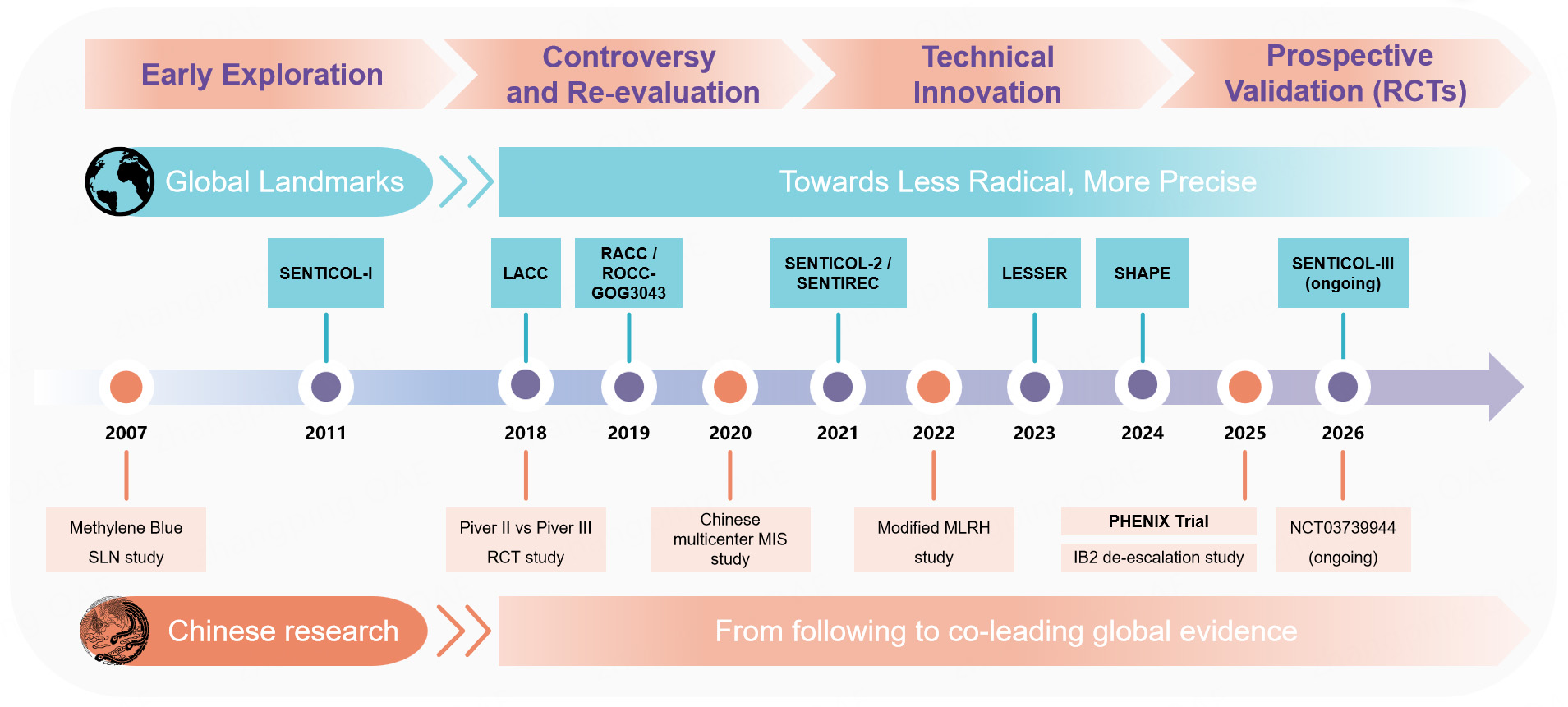
Figure 2. Timeline of key global and Chinese clinical trials and studies on the surgical management of early-stage cervical cancer. The upper panel shows major global trials that have shaped current guidelines, while the lower panel highlights Chinese contributions, including early tracer studies, multicenter retrospective validations, modified technique explorations, and recently published or ongoing randomized controlled trials. The trend lines illustrate the paradigm shift from maximal surgical resection to more precise, de-escalated, and patient-centered approaches and the evolving role of Chinese research from following to co-leading global evidence generation. SLN: Sentinel lymph node; MIS: minimally invasive surgery; RCT: randomized controlled trial; MLRH: modified laparoscopic radical hysterectomy; PHENIX: Sentinel lymph node biopsy versus pelvic lymphadenectomy in early-stage cervical cancer; LACC: laparoscopic approach to cervical cancer; RACC: robot-assisted approach to cervical cancer; ROCC: robotic versus open surgery for early-stage cervical cancer; LESSER: less surgical radicality for early stage cervical cancer; SHAPE: simple hysterectomy and pelvic node assessment; SENTICOL: sentinel node in cervical cancer; SENTIREC: sentinel node in early cervical cancer.
COMPLEMENTARY CLINICAL CONTRIBUTIONS FROM CHINESE RESEARCH TEAMS
Trauma minimization: domestic real-world verification and modified MIS techniques
Studies from China on MIS for early-stage cervical cancer follow a clear evolutionary trajectory that directly responds to global controversies. First, similar to the 2018 LACC trial, several large-scale multicenter retrospective studies from Chinese teams have already yielded consistent findings demonstrating poorer survival outcomes with MIS than with open laparotomy. Among them, a retrospective analysis of 1,065 early-stage cervical cancer patients who underwent radical hysterectomy (laparoscopic or open) between 2013 and 2016 was performed with 1:1 propensity score matching for further analysis. The results revealed that in the entire matched cohort (812 patients), the laparoscopic radical hysterectomy group had significantly shorter DFS (HR = 1.65; P = 0.048) than the open abdominal radical hysterectomy group did. In particular, in patients with a tumor size ≥ 2 cm, this difference was more prominent (HR = 1.93; P = 0.032)[19]. In addition, another study involving 3,252 patients also confirmed poorer survival outcomes with MIS than with open laparotomy in FIGO stage IB1 patients[20], collectively validating global concerns in Chinese populations. Second, factors such as CO2 pneumoperitoneum, uterine manipulators, tumor volume, surgeon experience, and procedural radicality may contribute to the inferior outcomes of MIS by promoting local tumor spread. Building on these hypotheses, investigators in China proposed multiple adaptations to optimize MIS techniques: avoiding uterine manipulators for tumor containment, cutting off the vagina after stapler closure, removing the uterus after vaginal pouch suture, and exploring gasless laparoscopy as a cost-effective alternative. Compared with open surgery, modified laparoscopic radical hysterectomy (MLRH) does not have a survival disadvantage in the treatment of early-stage cervical cancer. Notably, stratified analysis revealed that for patients with stage IB1 and middle 1/3 invasion, MLRH even shows a survival advantage[21]. Similarly, a recent study confirmed that MIS with modified tumor-free techniques even outperformed conventional laparoscopic radical hysterectomy (LRH)[22]. In addition, Zhao et al. further refined the technique of nerve plane-sparing LRH, which reduced neurogenic complications compared with those of LRH, balancing trauma minimization, oncologic safety, and QOL[23].
However, it should be noted that most of this evidence for modified MIS comes from retrospective single/multicenter cohorts without prospective Randomized Controlled Trial (RCT) validation. These studies mostly included Han Chinese women; thus, the results cannot be extrapolated to Western populations with different pathological profiles and surgical resource access. Nonrandom treatment allocation also creates selection bias that may lead to the overestimation of the survival benefits of revised techniques. Despite these drawbacks, domestic real-world data still offer complementary global evidence and show that tailored technical refinements may reduce the oncologic risks of traditional minimally invasive radical hysterectomy.
Range individualization: stratified de-escalation research expanding global trial boundaries
Investigators in China have made substantial contributions to the global evidence on surgical de-escalation, with targeted studies exploring reduced surgical radicality in Chinese patient cohorts that align with and complement global evidence. A study published in 2025 further validated the feasibility of de-escalation, which is consistent with international trials. A total of 5,144 early-stage patients (with a tumor size ≤ 2 cm and no lymph node/distant metastasis) were analyzed. After propensity score matching, no significant differences were found in cancer-specific survival (HR = 1.00; P = 0.985) or OS (HR = 0.90; P = 0.256) between the simple and radical hysterectomy groups, confirming that less radical surgery is a viable option for low-risk patients without compromising oncologic safety[24]. Beyond low-risk subgroups, research conducted in China has further extended de-escalation research to FIGO 2018 stage IB2 cervical cancer, a subgroup with relatively large tumors (2-4 cm) traditionally treated with type C radical hysterectomy, which was previously excluded from most global de-escalation trials. This multicenter retrospective study included 1308 IB2 patients who underwent type B (n = 840) or type C (n = 468) radical hysterectomy, with propensity score matching to balance baseline characteristics. The results revealed no significant differences in 5-year recurrence-free survival (RFS) (91.2% vs. 89.7%, P > 0.05) or OS (95.6 vs. 93.0%, P > 0.05) between the two groups, confirming that de-escalating surgical radicality from type C to type B does not compromise oncologic safety in this high-risk subgroup[25].
Prior to this, Chinese researchers explored de-escalation in different subgroups. A study comparing Piver Type II and Type III hysterectomy in low-risk IA2-IB1 patients (tumors < 2 cm) revealed no significant difference in 2-year DFS (100% vs. 97.9%, P > 0.05), whereas the Type II group had shorter surgical times (163 ± 18.8 min vs. 226 ± 16.4 min, P = 0.014), less blood loss (174 ± 27.7 mL vs. 268 ± 37.4 mL, P = 0.047), fewer complications and better QOL[26]. Another study in 2018 randomized 101 stage IA2-IB1 patients (tumors < 2 cm) to the Class I and III hysterectomy groups and reported no differences in recurrence rate or 5-year OS (93% vs. 91%, P > 0.05) but reported higher morbidity in the Class III group[27]. In addition, a study focusing on stage IA2 patients (440 cases) revealed similar 5-year DFS (89.25% vs. 91.14%, P = 0.562) and OS (95.71% vs. 94.76%, P = 0.482) between simple and radical hysterectomy, confirming the safety of de-escalation in this subgroup[28].
However, most domestic de-escalation analyses are retrospective and susceptible to selection bias, while relevant randomized controlled trials remain small-scale. Elderly Chinese patients exhibit distinct pathological risk characteristics, indicating that de-escalation protocols demand rigorous individualized risk screening before widespread routine use. Furthermore, no multiethnic cohorts have verified whether these stratified findings are applicable to non-Asian populations. Despite the above shortcomings, Chinese real-world data align with global trials to confirm the safety of reduced radical resection among low-risk patients and further expand de-escalation research to higher-risk IB2 subgroups, offering layered clinical evidence that enriches international guidelines.
Precision lymph node assessment: landmark domestic RCT evidence and SLN tracer optimization
Research groups in China have made significant contributions to its advancement, with the landmark global Sentinel lymph node biopsy versus pelvic lymphadenectomy in early-stage cervical cancer (PHENIX) trial, which was led by Chinese researchers, first confirming the superiority of SLN biopsy over PLND in early-stage cervical cancer[29]. This randomized trial enrolled 838 early-stage cervical cancer patients and revealed that compared with PLND, SLN biopsy achieved noninferior oncologic outcomes (e.g., similar DFS and OS) while significantly reducing postoperative lymph node-related complications. Similarly, a recently published prospective Chinese study by Wang et al. further validated these findings using carbon nanoparticle suspension (CNS), enrolling 208 FIGO 2018 stage IA2-IB1 patients and showing significantly fewer lymph-related complications (lower extremity lymphedema 3.8% vs. 19.2%, pelvic lymphoceles 18.3% vs. 43.3%) and comparable oncologic outcomes (98.2% vs. 95.2% DFS) with those of CNS-guided SLN biopsy[30]. Overall, SLN biopsy has become a superior minimally invasive alternative to PLND for early-stage cervical cancer.
Nearly 20 years ago, Chinese researchers began investigating cost-effective tracers for SLN biopsy, among which methylene blue has been recognized as a promising option owing to its favorable cost-effectiveness, excellent clinical accessibility, and high safety profile. An early study in 2007 confirmed the efficacy of methylene blue for SLN biopsy, with a 93.9% detection rate when 4 mL of the tracer was injected 60-90 min preoperatively[31]. Next, another study validated the accuracy of 99mTc phytate (94.1% detection rate, 100% sensitivity) for young patients requiring fertility preservation, with 5 of 15 patients conceiving postoperatively[32]. In 2019, Chinese researchers developed TMTP1 (a tumor metastasis-targeting peptide)-modified indocyanine green (ICG)-loaded micelles for targeted imaging of metastatic SLNs in vivo, achieving longer retention and specific accumulation in metastatic SLNs, laying a foundation for clinical transformation[33]. Subsequent Chinese studies have focused on two key directions: validating the CNS as a reliable SLN tracer and exploring the factors influencing SLN detection efficacy. For CNS validation, two studies provided robust evidence. Wang et al. enrolled 45 FIGO stage IB1-IIA1 patients, with 93.3% overall and 60.0% bilateral SLN detection rates, and further reported that elevated Body Mass Index (BMI) was a factor that reduced the bilateral detection rate (P = 0.015)[34]. Another prospective study involving 356 IA2-IIA2 patients revealed an overall SLN detection rate of 91.29%, which was significantly higher (97.75%) in patients with tumors
Nevertheless, these domestic investigations have several limitations. The landmark PHENIX trial excluded patients with tumors > 2 cm, restricting its direct clinical guidance for IB2 cohorts. Fluorescent ICG mapping requires costly dedicated laparoscopic devices that are inaccessible to primary care hospitals. Standardized nationwide pathological ultrastaging protocols for SLNs are lacking, leading to inconsistent detection rates of occult metastases across institutions. Additionally, long-term survival outcomes for patients with SLN micrometastases remain underreported. Despite the above drawbacks, domestic investigations have validated the clinical utility of various SLN tracers and identified key determinants of mapping performance, generating granular clinical data to facilitate the standardized optimization of SLN biopsy.
Representative domestic clinical studies are comprehensively summarized in Table 3, which summarizes the core information and major findings of Chinese research focusing on early cervical cancer surgical optimization. An overview of global evidence, Chinese contributions, and ongoing challenges across all three optimization domains is provided in Figure 3.
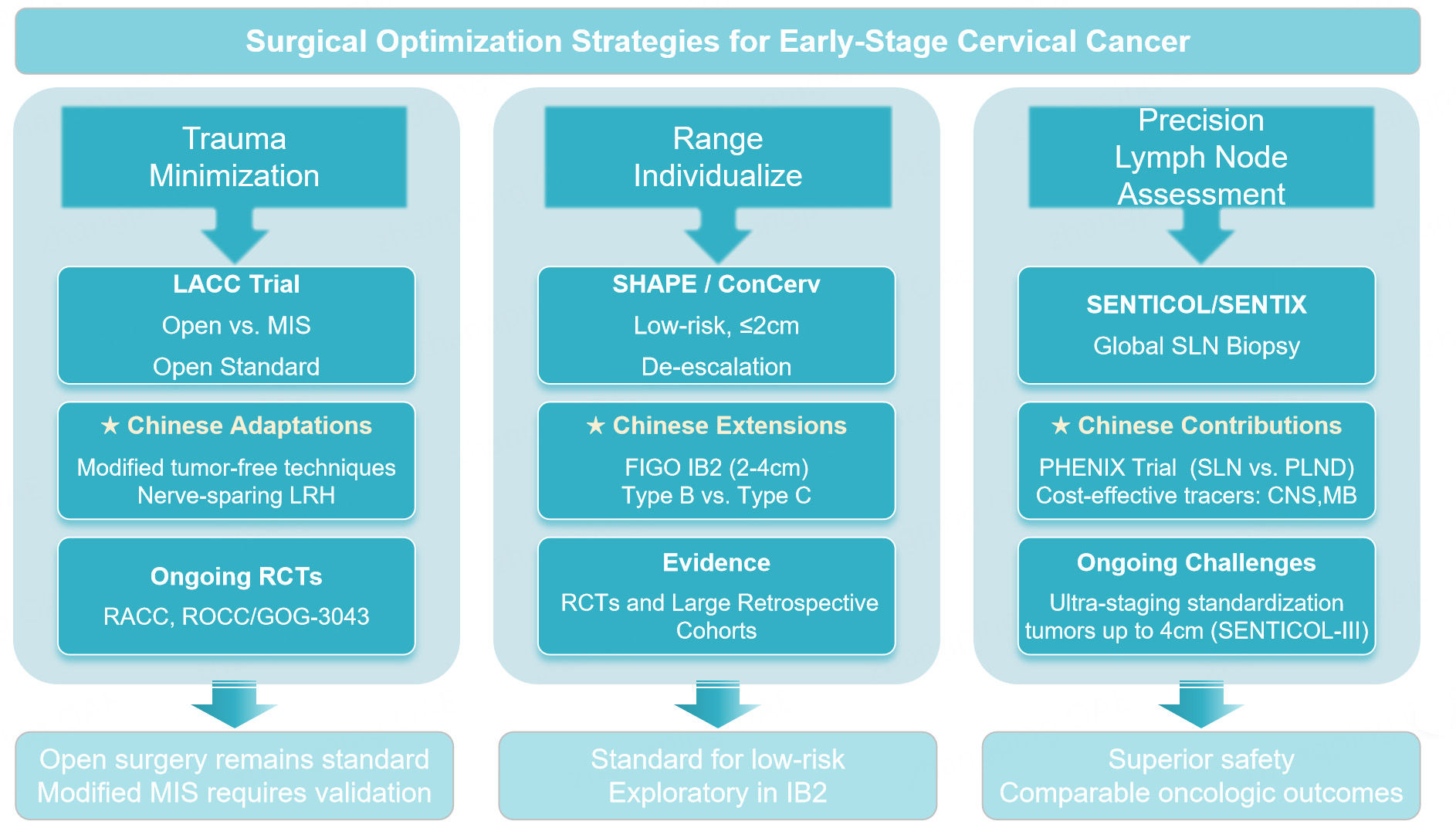
Figure 3. Schematic illustration of the three core directions of surgical optimization for early-stage cervical cancer. The diagram summarizes global evidence, Chinese research contributions, and ongoing challenges across three domains: trauma minimization, range individualization, and precision lymph node assessment. MIS: Minimally invasive surgery; LRH: laparoscopic radical hysterectomy; RCT: randomized controlled trial; SLN: sentinel lymph node; PLND: pelvic lymphadenectomy; CNS: carbon nanoparticle suspension; MB: methylene blue; LACC: Laparoscopic approach to cervical cancer; RACC: robot-assisted approach to cervical cancer; ROCC: robotic versus open surgery for early-stage cervical cancer; GOG: gynecologic oncology group; FIGO: international federation of gynecology and obstetrics; SHAPE: simple hysterectomy and pelvic node assessment; PHENIX: sentinel lymph node biopsy versus pelvic lymphadenectomy in early-stage cervical cancer; SENTICOL: sentinel node in cervical cancer.
Summary of Chinese research contributions
| Topic | Key studies | Design/sample | Main findings |
| MIS Optimization | Hu et al. (2020)[19] | Multicenter retrospective; n = 812 | Laparoscopic RH had shorter DFS vs. open (HR = 1.65) |
| Guo et al. (2020)[20] | Real-world multicenter, retrospective Laparotomy group (n = 813), MIS group (n = 2,439) | Poorer survival outcomes of MIS vs. open | |
| Li et al. (2022)[21] | Single-center retrospective RH group (n = 336), MLRH group (n = 302) | MLRH showed no survival disadvantage vs. open in selected cohort | |
| Zhao et al. (2020)[23] | Single-center retrospective Nerve plane-sparing LRH surgery (n = 263) LRH surgery (n = 352) | Nerve plane-sparing LRH had shorter length of operation, less intraoperative bleeding, more resected lymph nodes, and better postoperative bladder function vs. LRH group | |
| De-escalation | Fu et al. (2025)[25] | Multicenter retrospective, n = 1,308 type B (n = 840), type C (n = 468) | Type B is non-inferior to Type C in IB2 patients |
| Sun et al. (2018)[26] | Single-center RCT, n = 93 | Piver Type II vs. Type III: comparable DFS, fewer complications | |
| SLN Biopsy | Tu et al. (2025)[29] | Multicenter RCT, n = 838 SLN biopsy group (n = 420), PLND group (n = 418) | SLN biopsy is non-inferior to PLND, had fewer complications |
| Wang et al. (2026)[30] | Prospective, n = 208 SLN biopsy group (n = 104), PLND group (n = 104) | CNS-guided SLN biopsy reduced complications | |
| Yuan et al. (2007)[31] | Prospective, n = 77 | Methylene blue detection rate 93.9% | |
| Sun et al. (2023)[37] | Retrospective, n = 174 | Tumor size and deep stromal invasion might negatively influence the detection rate of SLN |
LIMITATIONS AND FUTURE DIRECTION
Current evidence supporting three core optimized surgical modalities for early-stage cervical cancer still has inherent limitations that restrict universal clinical generalization. Corresponding research priorities are proposed to fill existing knowledge gaps and refine individualized surgical paradigms.
Most real-world data concerning revised MIS techniques stem from single-center retrospective cohorts prone to selection bias, rendering such findings insufficiently generalizable to guide global routine practice. While the landmark LACC trial reshaped international guidelines by revealing inferior oncologic outcomes associated with conventional minimally invasive radical hysterectomy, contemporary debates focus excessively on simplistic comparisons between minimally invasive and open approaches rather than technical refinement. Large-scale prospective multicenter randomized controlled trials are therefore urgently needed to validate the long-term oncologic safety of tumor-free MIS modifications. Ongoing global trials (RACC, ROCC/GOG-3043)[38,39] and the China-led trial NCT03739944 are designed to fill this gap[40], with their mature results anticipated to provide high-level evidence. Future investigations should shift the research focus from direct surgical comparisons to iterative optimization of both open and laparoscopic procedures, prioritizing standardized tumor-free operative workflows to simultaneously guarantee oncologic safety and preserve patients’ long-term QOL.
Global landmark trials, including SHAPE and ConCerv, adopt highly stringent enrollment criteria, limiting de-escalation protocols to only a narrow subset of low-risk patients. Although Chinese retrospective cohorts have extended exploratory analyses to IB2 populations, these domestic studies are limited by small sample sizes, single-center designs and inherent selection bias. For elderly Chinese patients with cervical cancer, survival benefits should take precedence over reducing morbidity, leading to the broad off-label application of premature de-escalation without cross-population validation. In future research, multinational prospective stratified trials are needed to confirm the safety and efficacy of conservative surgery across broader patient subgroups, with special subgroup analyses tailored to elderly and intermediate-risk IB2 individuals to establish population-specific risk thresholds.
Despite the substantial progress in SLN biopsy for early-stage cervical cancer and the valuable contributions from Chinese and global research, several unresolved limitations and clinical challenges persist, restricting its standardized and widespread application in routine clinical practice. First, the feasibility and accuracy of pathological ultrastaging for SLNs remain controversial. Pathological ultrastaging, which involves serial sectioning and immunohistochemical staining of SLN specimens to detect micrometastases and isolated tumor cells, is considered a critical approach to improve staging precision. However, there is no global consensus on the standardized protocol for ultrastaging (e.g., section interval, number of sections, and immunohistochemical markers), leading to inconsistencies in the detection rates of occult metastases across different institutions and potential misclassification of patient risk stratification. Second, the application of ICG as a tracer for SLN biopsy relies heavily on fluorescence laparoscopy equipment, which poses significant challenges in terms of equipment accessibility and cost-effectiveness, particularly in primary hospitals and resource-limited regions. Third, the landmark PHENIX trial had strict inclusion criteria and excluded patients with larger tumor volumes (mostly enrolling FIGO IA2 to IB1 patients with small tumors), whereas previous Chinese studies have clearly demonstrated that tumor size is a key negative factor affecting SLN detection sensitivity and accuracy. To address this gap, the ongoing global SENTICOL-III trial[41] is specifically designed to evaluate the safety and efficacy of SLN biopsy in patients with cervical tumors up to 4 cm. Fourth, the false-negative rate (FNR) of SLN biopsy, although relatively low in well-selected patient cohorts, remains a critical concern, especially in patients with adverse pathological features such as LVSI, deep stromal invasion, and large tumor size. A small but nonnegligible FNR may result in understaging and omission of necessary adjuvant treatment, compromising oncologic safety. Fifth, the long-term oncologic outcomes of SLN biopsy, particularly in patients with detected micrometastases or isolated tumor cells, remain unclear. High-level evidence is insufficient to determine whether such patients require additional adjuvant therapy and whether the omission of adjuvant treatment affects long-term survival. Finally, the training and proficiency of surgeons in SLN biopsy techniques vary significantly across institutions, which directly affects SLN detection rates, bilateral detection rates, and FNRs. Standardized training programs for SLN biopsy are lacking in many regions, hindering the uniform application of this technique. In summary, while SLN biopsy has become a core component of precise lymph node assessment in early-stage cervical cancer, addressing the aforementioned limitations is essential for its further optimization and widespread clinical adoption. Continued collaboration between Chinese and global research teams will play a pivotal role in resolving these challenges and refining SLN biopsy as a patient-centered, minimally invasive staging strategy.
CONCLUSION
The surgical management of early-stage cervical cancer has undergone a paradigm shift toward personalized, patient-centered care that balances oncologic safety with QOL preservation. This review identifies three core optimization directions - trauma minimization, surgical range individualization, and precision lymph node assessment - in which Chinese research has complemented global evidence by validating strategies in local populations, extending findings to additional subgroups, and exploring cost-effective technical adaptations. While current evidence supports de-escalation in low-risk patients and SLN biopsy as an alternative to PLND, ongoing prospective trials are essential to validate modified MIS techniques and expand the applicability of conservative approaches. Continued global collaboration, integrating the strengths of diverse research communities, will be critical to refining surgical strategies and ultimately improving outcomes for patients worldwide.
DECLARATIONS
Authors’ contribution
Conceived the review, led literature search, drafted the manuscript, approved the final version, and received the research grants: Sun X
Participated in literature screening and data collation, assisted in manuscript drafting/revision: Wang S, Gao S
Availability of data and materials
Not applicable.
AI and AI-assisted tools statement
During the preparation of this manuscript, the AI tool Doubao (version 2.0, released 2024-05-15) was used solely for language editing. The tool did not influence the study design, data collection, analysis, interpretation, or the scientific content of the work. All authors take full responsibility for the accuracy, integrity, and final content of the manuscript.
Financial support and sponsorship
This work was supported by Jilin Province Health and Health Technology Capacity Enhancement Project (No. 2025WS-KA062) and National Cancer Center Climbing Fund Project (No. NCC202407002).
Conflict of interest
All authors declared that there are no conflicts of interest.
Ethics approval and consent to participate
Not applicable.
Consent for publication
Not applicable.
Copyright
© The Author(s) 2026.
REFERENCES
1. WHO. Cervical cancer. Available from: https://www.who.int/news-room/fact-sheets/detail/cervical-cancer [accessed 27 Jul 2026].
2. Pecorelli S, Zigliani L, Odicino F. Revised FIGO staging for carcinoma of the cervix. Int J Gynaecol Obstet. 2009;105:107-8.
3. Santía MC, Meschini T, Hsu HC, et al. Current updates on surgical management of patients with early-stage cervical cancer. Cancers. 2025;17:2259.
4. Bhatla N, Berek JS, Cuello Fredes M, et al. Revised FIGO staging for carcinoma of the cervix uteri. Int J Gynaecol Obstet. 2019;145:129-35.
5. National Comprehensive Cancer Network. NCCN clinical practice guidelines in oncology: cervical cancer, Version 2.2026. Plymouth Meeting, PA: National Comprehensive Cancer Network, Inc.; 2026. Available from: https://www.nccn.org/guidelines/guidelines-detail?category=1&id=1426 [accessed 27 Jul 2026].
6. Ramirez PT, Robledo KP, Frumovitz M, et al. LACC trial: final analysis on overall survival comparing open versus minimally invasive radical hysterectomy for early-stage cervical cancer. J Clin Oncol. 2024;42:2741-6.
7. Abu-Rustum NR, Yashar CM, Bean S, et al. NCCN guidelines insights: cervical cancer, version 1.2020. J Natl Compr Canc Netw. 2020;18:660-6.
8. Covens A, Rosen B, Murphy J, et al. How important is removal of the parametrium at surgery for carcinoma of the cervix? Gynecol Oncol. 2002;84:145-9.
9. Schmeler KM, Pareja R, Lopez Blanco A, et al. ConCerv: a prospective trial of conservative surgery for low-risk early-stage cervical cancer. Int J Gynecol Cancer. 2021;31:1317-25.
10. Carneiro VCG, Batista TP, Andrade MR, et al. Proof-of-concept randomized phase II non-inferiority trial of simple versus type B2 hysterectomy in early-stage cervical cancer ≤2 cm (LESSER). Int J Gynecol Cancer. 2023;33:498-503.
11. Plante M, Kwon JS, Ferguson S, et al. Simple versus radical hysterectomy in women with low-risk cervical cancer. N Engl J Med. 2024;390:819-29.
12. Ferguson SE, Brotto LA, Kwon J, et al. Sexual health and quality of life in patients with low-risk early-stage cervical cancer: results from GCIG/CCTG CX.5/SHAPE trial comparing simple versus radical hysterectomy. J Clin Oncol. 2025;43:167-79.
13. Carter J, Huang HQ, Monk BJ, et al. Evaluation of physical function and quality of life before and after nonradical surgical therapy for stage IA1 and IA2-IB1 cervical cancer (GOG-0278). Gynecol Oncol. 2025;195:50-8.
14. Lécuru F, Mathevet P, Querleu D, et al. Bilateral negative sentinel nodes accurately predict absence of lymph node metastasis in early cervical cancer: results of the SENTICOL study. J Clin Oncol. 2011;29:1686-91.
15. Sponholtz SE, Mogensen O, Hildebrandt MG, et al. Sentinel lymph node mapping in early-stage cervical cancer - a national prospective multicenter study (SENTIREC trial). Gynecol Oncol. 2021;162:546-54.
16. Mathevet P, Lécuru F, Uzan C, et al.; Senticol 2 group. Sentinel lymph node biopsy and morbidity outcomes in early cervical cancer: results of a multicentre randomised trial (SENTICOL-2). Eur J Cancer. 2021;148:307-15.
17. Cibula D, Kocian R, Plaikner A, et al. Sentinel lymph node mapping and intraoperative assessment in a prospective, international, multicentre, observational trial of patients with cervical cancer: the SENTIX trial. Eur J Cancer. 2020;137:69-80.
18. Miller KM, Liu C, Zhou Q, et al. RELEVANT-C study: patient-reported prevalence of lower extremity lymphedema after sentinel lymph node mapping vs lymphadenectomy after surgery for early-stage cervical cancer. Int J Gynecol Cancer. 2025;35:100063.
19. Hu TWY, Huang Y, Li N, Nie D, Li Z. Comparison of laparoscopic versus open radical hysterectomy in patients with early-stage cervical cancer: a multicenter study in China. Int J Gynecol Cancer. 2020;30:1143-50.
20. Guo C, Tang X, Meng Y, et al. Effect of the surgical approach on survival outcomes in patients undergoing radical hysterectomy for cervical cancer: a real-world multicenter study of a large Chinese cohort from 2006 to 2017. Cancer Med. 2020;9:5908-21.
21. Li X, Pei X, Li H, et al. Comparative single-center study between modified laparoscopic radical hysterectomy and open radical hysterectomy for early-stage cervical cancer. World J Surg Oncol. 2022;20:392.
22. Li Y, Zhao J, Ding X, et al. Oncologic outcomes of laparoscopic radical hysterectomy incorporating modified tumor-free techniques. Obstet Gynecol. 2025;145:134-43.
23. Zhao D, Li B, Wang Y, Liu S, Zhang Y, Yuan G. Clinical outcomes in early cervical cancer patients treated with nerve plane-sparing laparoscopic radical hysterectomy. J Minim Invasive Gynecol. 2020;27:687-96.
24. Pei K, Li D, Xi M. Simple Hysterectomy as a viable alternative to radical hysterectomy for early-stage cervical cancer: a population-based cohort study. Ann Surg Oncol. ;2025:9058-69.
25. Fu J, Li P, Yao J, et al. The potential for de-escalation radical surgery in women with stage IB2 cervical cancer (FIGO 2018): a multi-institutional experience of 63,926 cases over a 14-year period in China. BMC Surg. 2025;25:187.
26. Sun H, Cao D, Shen K, et al. Piver type II vs. type III hysterectomy in the treatment of early-stage cervical cancer: midterm follow-up results of a randomized controlled trial. Front Oncol. 2018;8:568.
27. Chen L, Zhang WN, Zhang SM, Gao Y, Zhang TH, Zhang P. Class I hysterectomy in stage Ia2-Ib1 cervical cancer. Wideochir Inne Tech Maloinwazyjne. 2018;13:494-500.
28. Liu Q, Xu Y, He Y, et al. Simple hysterectomy for patients with stage IA2 cervical cancer: a retrospective cohort study. Cancer Manag Res. 2021;13:7823-32.
29. Tu H, Huang H, Li Y, et al. Sentinel-lymph-node biopsy alone or with lymphadenectomy in cervical cancer. N Engl J Med. 2025;393:1463-74.
30. Wang K, Zhai Q, Xie Y, et al. Sentinel node mapping with carbon nanoparticles versus lymphadenectomy in early cervical cancer. Int J Gynecol Cancer. 2026;36:102881.
31. Yuan SH, Xiong Y, Wei M, et al. Sentinel lymph node detection using methylene blue in patients with early stage cervical cancer. Gynecol Oncol. 2007;106:147-52.
32. Du XL, Sheng XG, Jiang T, et al. Sentinel lymph node biopsy as guidance for radical trachelectomy in young patients with early stage cervical cancer. BMC Cancer. 2011;11:157.
33. Wei R, Jiang G, Lv M, et al. TMTP1-modified indocyanine green-loaded polymeric micelles for targeted imaging of cervical cancer and metastasis sentinel lymph node in vivo. Theranostics. 2019;9:7325-44.
34. Wang Y, Dan Z, Yuan G, et al. Detection of sentinel lymph node in laparoscopic surgery for uterine cervical cancer using carbon nanoparticles. J Surg Oncol. 2020;122:934-40.
35. Ya X, Qian W, Huiqing L, et al. Role of carbon nanoparticle suspension in sentinel lymph node biopsy for early-stage cervical cancer: a prospective study. BJOG. 2021;128:890-8.
36. Tu H, Wan T, Zhang X, et al. Potential risks in sentinel lymph node biopsy for cervical cancer: a single-institution pilot study. World J Surg Oncol. 2020;18:133.
37. Sun W, Chen X, Fu S, Huang X. Feasibility of sentinel lymph node mapping with carbon nanoparticles in cervical cancer: a retrospective study. Cancer Control. 2023;30:10732748231195716.
38. Leitao MM Jr, Bixel KL, Chase DM, et al. ROCC/GOG-3043: a randomized controlled trial of robotic versus open surgery for early-stage cervical cancer. Int J Gynecol Cancer. 2025;35:101760.
39. Falconer H, Palsdottir K, Stalberg K, et al. Robot-assisted approach to cervical cancer (RACC): an international multi-center, open-label randomized controlled trial. Int J Gynecol Cancer. 2019;29:1072-6.
40. Chao X, Wu M, Ma S, et al. Efficacy of different surgical approaches on survival outcomes in patients with early-stage cervical cancer: protocol for a multicentre longitudinal study in China. BMJ Open. 2020;10:e038020.
Cite This Article
 Open Access
How to Cite
Download Citation
Export Citation File:
Type of Import
Tips on Downloading Citation
Citation Manager File Format
Type of Import
Direct Import: When the Direct Import option is selected (the default state), a dialogue box will give you the option to Save or Open the downloaded citation data. Choosing Open will either launch your citation manager or give you a choice of applications with which to use the metadata. The Save option saves the file locally for later use.
Indirect Import: When the Indirect Import option is selected, the metadata is displayed and may be copied and pasted as needed.
About This Article
Copyright

Data & Comments
Data
0









Comments
Comments must be written in English. Spam, offensive content, impersonation, and private information will not be permitted. If any comment is reported and identified as inappropriate content by OAE staff, the comment will be removed without notice. If you have any queries or need any help, please contact us at [email protected].