



fig2
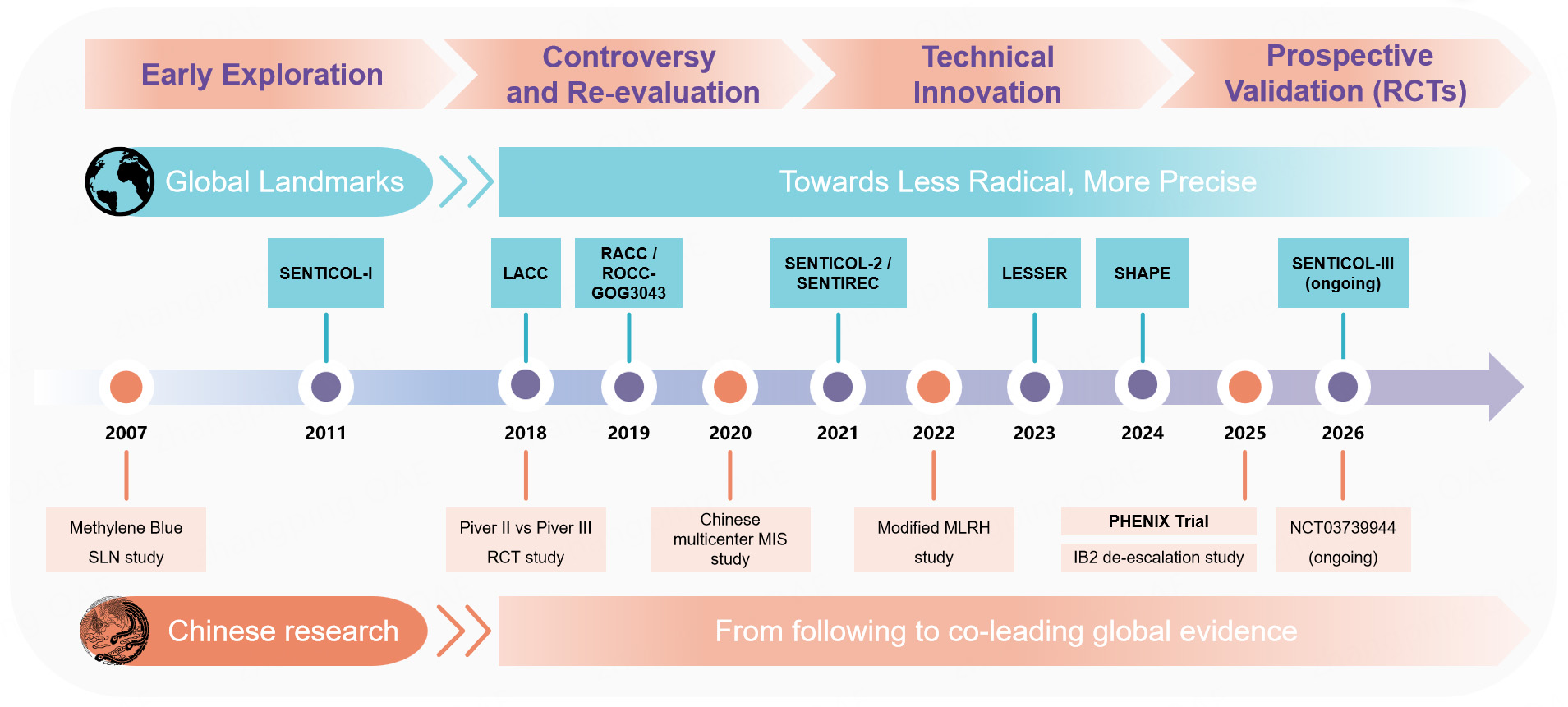
Figure 2. Timeline of key global and Chinese clinical trials and studies on the surgical management of early-stage cervical cancer. The upper panel shows major global trials that have shaped current guidelines, while the lower panel highlights Chinese contributions, including early tracer studies, multicenter retrospective validations, modified technique explorations, and recently published or ongoing randomized controlled trials. The trend lines illustrate the paradigm shift from maximal surgical resection to more precise, de-escalated, and patient-centered approaches and the evolving role of Chinese research from following to co-leading global evidence generation. SLN: Sentinel lymph node; MIS: minimally invasive surgery; RCT: randomized controlled trial; MLRH: modified laparoscopic radical hysterectomy; PHENIX: Sentinel lymph node biopsy versus pelvic lymphadenectomy in early-stage cervical cancer; LACC: laparoscopic approach to cervical cancer; RACC: robot-assisted approach to cervical cancer; ROCC: robotic versus open surgery for early-stage cervical cancer; LESSER: less surgical radicality for early stage cervical cancer; SHAPE: simple hysterectomy and pelvic node assessment; SENTICOL: sentinel node in cervical cancer; SENTIREC: sentinel node in early cervical cancer.