

Advances on triply periodic hyperbolic surface structures: from biological inspiration to artificial self-assembly
 0

Graphical Abstract
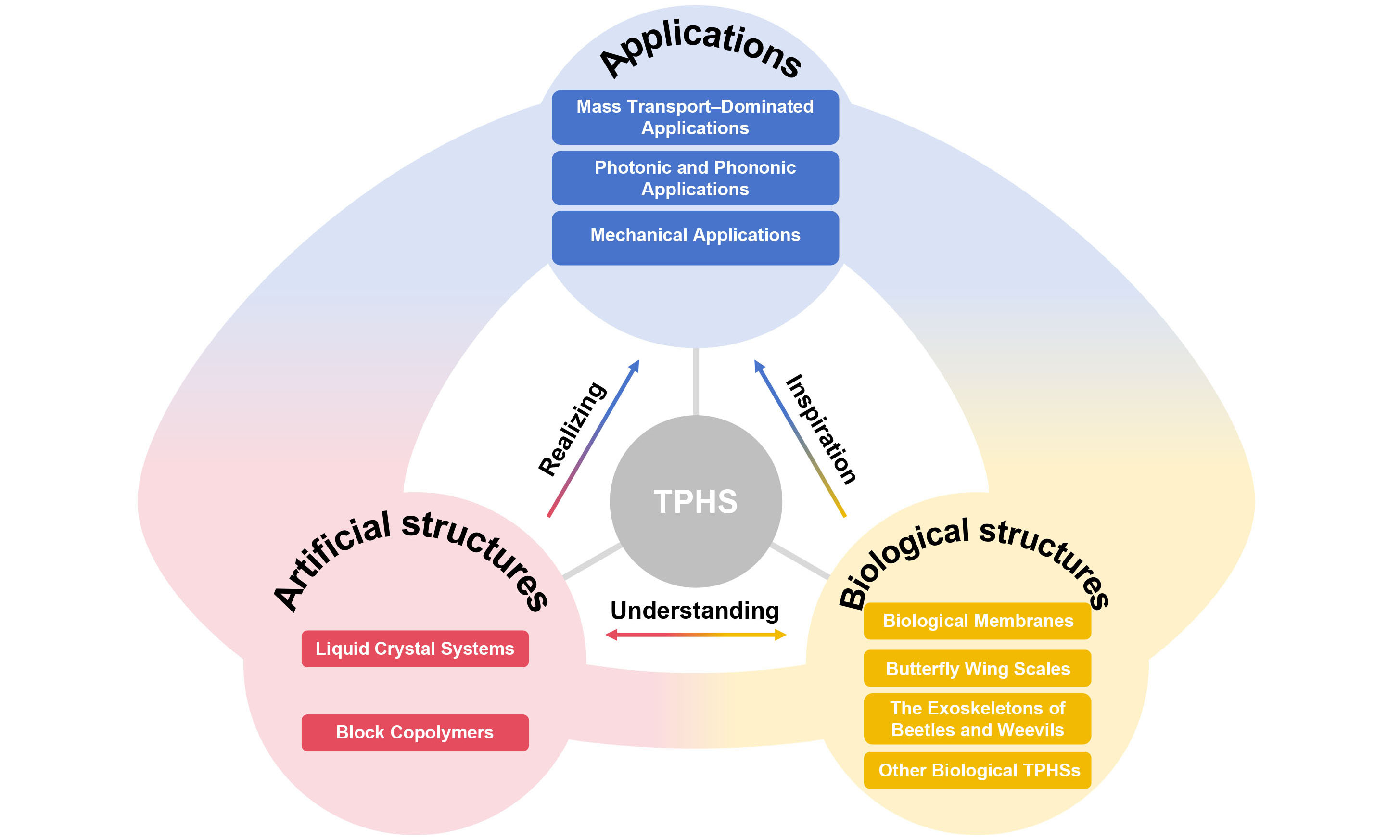
Abstract
Triply periodic hyperbolic surfaces (TPHSs) are a class of complex structures that extend periodically throughout three-dimensional space and possess smooth surfaces with non-positive Gaussian curvature. They appear in a wide range of natural systems, from cellular membranes to butterfly wing scales and beetle exoskeletons. Owing to their unique geometries and extraordinary properties, TPHSs have attracted extensive attention and research interest. Detailed structural characterizations of naturally occurring TPHSs have been performed, and a variety of artificial analogs have been fabricated by top-down physical methods and bottom-up chemical approaches. These efforts have deepened our understanding of TPHSs and broadened their application scope. This review discusses the progress on TPHSs in biological systems and their artificial synthesis, and it surveys current applications of these structures in fields such as photonics, energy storage and conversion, catalysis, sensing, thermal management and mechanical metamaterials. It thereby provides a new framework linking biological structures to artificial structures. Finally, this review concludes by outlining current challenges and proposing directions for future research.
Keywords


 Download PDF
INTRODUCTION
Triply periodic hyperbolic surfaces (TPHSs), characterized by their hyperbolic geometry, were introduced by mathematicians and have since evolved into an interdisciplinary field spanning mathematics, physics, chemistry, biology, and engineering. The earliest examples, discovered by Hermann Amandus Schwarz in 1865 and later by his student Edvard Rudolf Neovius in 1883 through solving the Plateau problem and its generalizations, were the Schwarz primitive (P), Schwarz diamond (D), Schwarz hexagonal (H), Schwarz crossed layers of parallels and Neovius (N) surfaces, which revealed triply periodic minimal surfaces (TPMSs) and established the field[1-4]. In 1970, NASA scientist Alan Schoen proposed twelve new TPMSs, among which the gyroid (G) surface has become the most celebrated[5].
TPHSs attract extensive attention owing to their unique geometry, including three-dimensional (3D) periodicity, interconnected channels, high specific surface areas, and most critically, non-positive Gaussian curvature[1,6-10]. Several reviews[1,6,11-19] have discussed their natural occurrences, artificial self-assembly and applications. Recent advances - symmetry-breaking synthesis, curvature-mediated transitions, kinetic control, data-driven structure prediction and curvature-specific functionality - call for a unified framework linking biological morphogenesis with artificial fabrication. This review addresses that gap.
This review first outlines the definition and classification of TPHSs. We then present their structural and functional diversity in natural systems and progress in uncovering their formation mechanisms. Next, we review bottom-up self-assembly based on liquid crystals and block copolymers for fabricating TPHS materials, followed by a summary of their applications [Figure 1]. Finally, we identify gaps between biological mechanisms, artificial design and practical applications, and provide an outlook on cross-scale fabrication and function-oriented design.
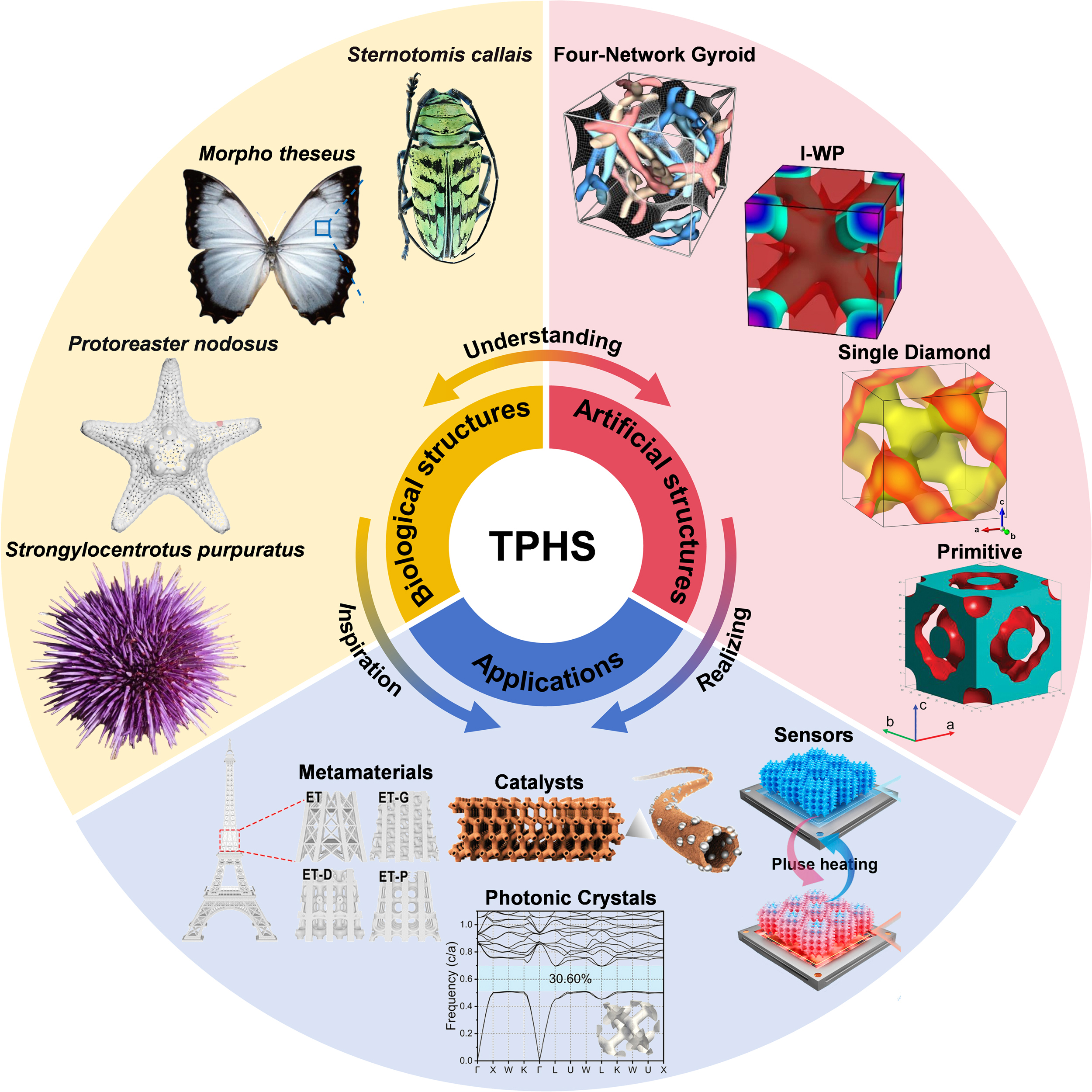
Figure 1. Schematic illustration of research progress on TPHSs in biological structural elucidation, artificial self-assembly systems and related applications. (Strongylocentrotus purpuratus) Reproduced under the terms of the CC BY-NC 3.0 License[20]. Copyright 2025, The Authors. (Protoreaster nodosus) Reproduced with permission[21]. Copyright 2022, The American Association for the Advancement of Science. (Morpho theseus) Reproduced under the terms of the CC BY 4.0 License[22]. Copyright 2023, The Authors. (Sternotomis callais) Reproduced with permission[23]. Copyright 2021, The Royal Society. (Four-Network Gyroid) Reproduced under the terms of the CC BY 4.0 License[24]. Copyright 2025, The Authors. (I-WP) Reproduced under the terms of the CC BY-NC 4.0 License[25]. Copyright 2020, The Authors. (Single Diamond) Reproduced under the terms of the CC BY-NC-ND 4.0 License[26]. Copyright 2024, The Authors. (Primitive) Reproduced with permission[27]. Copyright 2024, The American Association for the Advancement of Science. (Sensors) Reproduced under the terms of the CC BY-NC-ND 4.0 License[7]. Copyright 2026, The Authors. (Catalysts) Reproduced under the terms of the CC BY-NC 4.0 License[28]. Copyright 2024, The Authors. (Photonic Crystals) Reproduced with permission[29]. Copyright 2026, Wiley-VCH GmbH. (Metamaterials) Reproduced under the terms of the CC BY 4.0 License[30]. Copyright 2025, The Authors. TPHS: Triply periodic hyperbolic surface; I-WP: I-graph-Wrapped Package graph; ET: Eiffel Tower.
STRUCTURAL DESCRIPTIONS
Understanding these structures begins with curvature. The maximum and minimum normal curvatures at a point are the principal curvatures, denoted κ1 and κ2[31]. Their product is the Gaussian curvature, K, and their arithmetic mean is the mean curvature, H. When H is constant, the surface is a constant mean curvature (CMC) surface; for TPMSs, H(p) vanishes everywhere and K(p) ≤ 0[1,31], making TPMSs a special subclass of CMC surfaces. Structures formed by shifting TPMSs along their surface normals by a constant distance are called parallel surfaces[1]. These TPMSs partition space into interpenetrating labyrinthine domains; shifting a TPMS toward one side yields a CMC or parallel surface bounding one labyrinth and producing an unbalanced structure. The labyrinths can be abstracted into skeletal networks of nodes and struts (channel segments), facilitating structural identification[1,13]. Experimentally, self-assembly has produced a variety of these structures. TPMSs are intrinsically balanced and fabricated readily under thermodynamically favorable conditions, whereas CMC and parallel surfaces are typically obtained via reverse-micelle synthesis or kinetically controlled processes that trap them in thermodynamically nonequilibrium states. In this review, TPMSs, CMC surfaces and parallel surfaces are collectively termed TPHSs, characterized by three-dimensionally periodic and smooth surfaces with non-positive Gaussian curvature (saddle-shaped geometry).
The three most common TPMSs - G, D and P - possess the most uniform Gaussian curvature distributions[32]. The G surface with space group Ia
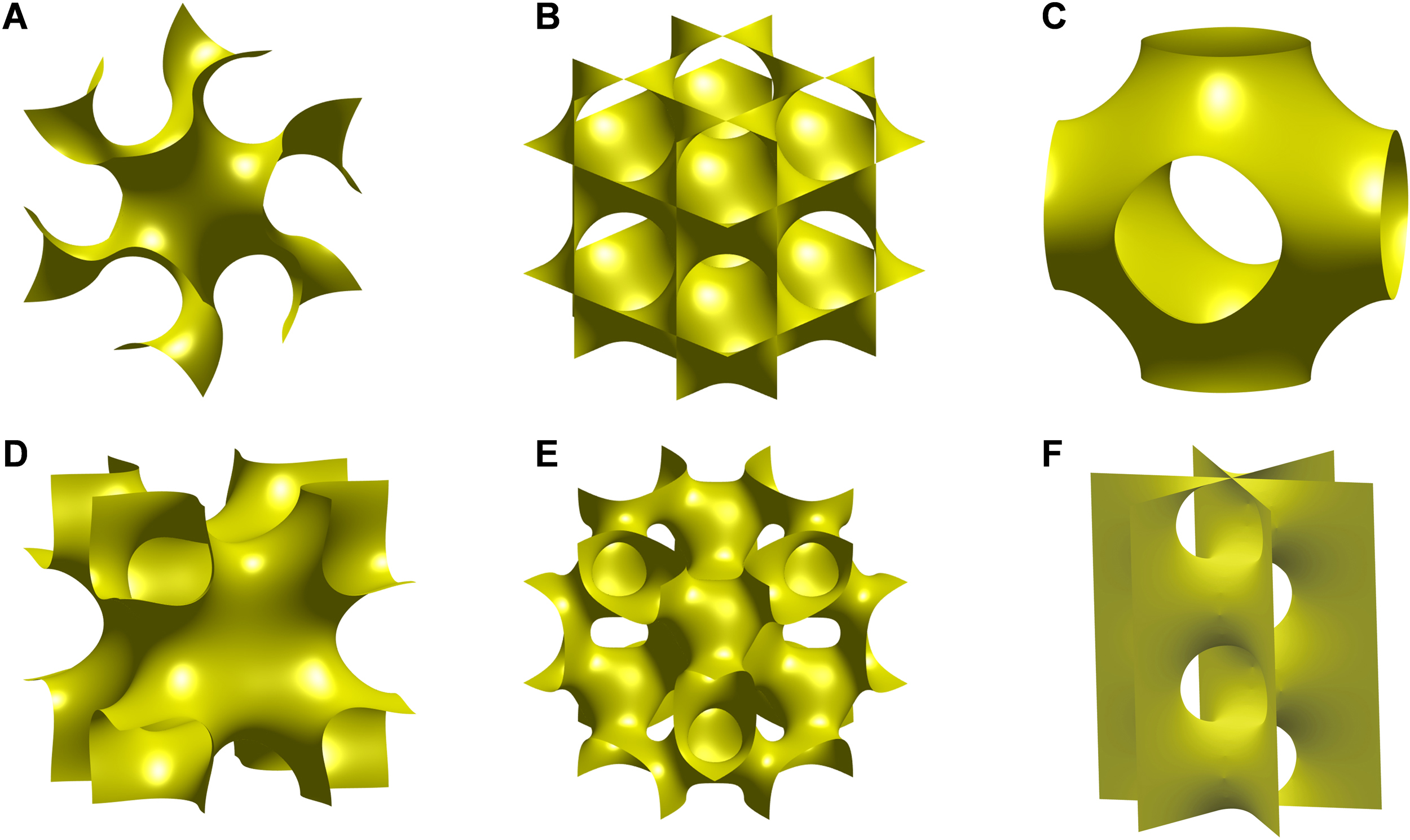
Figure 2. Schematic drawings of TPMSs: (A) G surface; (B) D surface; (C) P surface; (D) I-WP surface; (E) F-RD surface and (F) the branched hexagonal minimal surface. Panels (A-E) were created with MATLAB (R2026a, MathWorks) and panel (F) was created with Surface Evolver[33]. TPMS: Triply periodic minimal surface; I-WP: I-graph-Wrapped Package graph; F-RD: F-graph-Rhombic Dodecahedra graph.
The G, D and P surfaces can be interconverted by the theoretical Bonnet transformation, which preserves the intrinsic geometry but cannot occur in real systems because it would require thermodynamically forbidden interpenetration and reorganization. It therefore describes only the geometrical equivalence, not observable phase transitions[1,45]. Schröder-Turk et al. calculated the homogeneity of the three surfaces under different length normalizations[46]. For constant surface-to-volume ratio (V/A) or constant average distance function (
Among TPMSs, unbalanced members such as I-WP [Figure 2D] and F-RD [Figure 2E] divide space into two subspaces of unequal volume yet remain bicontinuous, each side forming an independently connected channel network with multiple connectivity[47]. The branched hexagonal minimal surface [Figure 2F] divides space into three independent subspaces, forming a tricontinuous structure[48,49]. The characteristics of these surfaces are summarized in Table 1.
Comparison of space groups, connectivity and volume fractions of one labyrinth of TPMSs
| Surfaces | Space groups | Connectivity | Volume fractions of one labyrinth |
| G | Ia | 3 | 0.5 |
| D | Pn | 4 | 0.5 |
| P | Im | 6 | 0.5 |
| I-WP | Im | 8 | 0.536[50] |
| F-RD | Fm | 12 | 0.532[50] |
| The branched hexagonal minimal surface | P63/mcm (No. 193)[48,49] | 3 | 0.333[48,49] |
TPHS STRUCTURES IN BIOLOGICAL SYSTEMS
Organisms have evolved diverse TPHS structures that serve distinct functions, regulating or influencing vital activities. Understanding these biological structures reveals the formation mechanisms of complex natural architectures and the intrinsic structure-function relationships, while providing biomimetic inspiration for the development of novel functional materials.
Biological membranes
Biological membranes, typically phospholipid bilayers, can fold into highly ordered cubic membranes, as observed in mitochondria. Pappas et al.[51] and Borysko et al.[52] were among the first to describe zigzag patterns in certain mitochondria of the giant amoeba Chaos carolinensis. Subsequently, Daniels et al.[53] systematically demonstrated that starvation induces the formation of these zigzag structures in amoeba mitochondria. Using electron tomography and computer simulations, Deng et al.[54,55] first confirmed that the inner mitochondrial membranes of starved Chaos carolinensis can form cubic membrane structures of the TPMSs, and correlated these 3D configurations with dietary status and cellular energy adaptation. Mitochondrial membranes in tree shrew photoreceptor cells can fold into multilamellar G-type cubic structures of 8-12 layers[56]. Bykowski et al. related the nanomorphology of prolamellar bodies (PLBs) to pigment composition and growth conditions in Arabidopsis thaliana[57] and demonstrated that PLB cubic membranes in etiolated angiosperm seedlings (including Arabidopsis thaliana, cucumber and maize) are predominantly of D-type structure rather than the hexagonal structure as previously thought[58]. These studies reveal that cubic membranes are widespread in protists, plants and animals, providing a foundation for understanding membrane structure-function relationships.
Butterfly wing scales
A striking manifestation of TPHSs is their vivid structural colors, most prominent in butterfly wing scales. Saranathan et al. used small-angle X-ray scattering (SAXS) to identify the SG structure in five butterfly species from the families Papilionidae and Lycaenidae[40]. Drawing an analogy to the self-assembly of ABC triblock copolymers, they proposed that a core-shell DG forms in which one network is the extracellular space surrounded by the plasma membrane; chitin is selectively deposited there, and after apoptosis, only the SG-structured chitin remains[40]. Early electron microscopy investigations have been instrumental in revealing the intricate photonic architectures in butterfly scales, laying the groundwork for later 3D structural elucidation[59-62]. Because two-dimensional (2D) projected images cannot prove the existence of both enantiomers, Schröder-Turk et al. performed 3D electron tomography on Callophrys rubi, confirming a structure approximating a parallel surface of SG with space group I4132[63]; both enantiomers were confirmed, with the LH structure dominant, indicating chiral preference during scale formation. In addition, Winter et al. found that these micron-scale domains exhibit preferred orientation[64]. Inoue et al. statistically analyzed the chirality of SG structures in Teinopalpus imperialis and Parides sesostris using Callophrys rubi as a control: the percentage of LH crystallites is 89% in Parides sesostris, higher than the 68% in Callophrys rubi, while Teinopalpus imperialis displays purely LH SG structures[65]. These findings reveal species-dependent chiral selection, but the underlying mechanisms still require further exploration.
Wilts et al.[66] observed that in the butterfly Erora opisena, SG crystallite sizes followed a gradient along the long axis and orientations were random relative to the scale normal. This distribution, together with the chiral imbalance, challenged the pre-folding model proposed by Saranathan et al.[40]: a single-crystal membrane cannot explain the random orientations, while a polycrystalline membrane cannot account for defect-free single crystals, and the LH and RH SG enantiomers should occur with roughly equal probability. They therefore proposed a co-folding model in which membrane folding and extracellular chitin deposition occur simultaneously; the molecular chirality of chitin may cause the chiral bias, while the tip-to-base crystallite-size gradient suggests a time-dependent assembly constituting a “time-frozen” sequence of developmental stages[66]. By controlling the developmental time points of the butterfly Parides sesostris [Figure 3A-F] for observation, Jessop et al.[67] fixed samples on day 13 (approximately 70% development) [Figure 3G] and day 15 (approximately 80% development) [Figure 3H and I], observing that the developing SG structure is not a homogeneous extrusion process, but a fibrous network of interwoven nanofibers ~ 25 nm in diameter; the number of fibers gradually increased and the fibers became more entangled near the lower lamina [Figure 3J-M]. This led to a two-stage model: scale cells first secrete and weave nanofibers into a preliminary network, which is then “smoothed” in later stages into the final solid SG; the specific smoothing mechanism remains unclear[67].
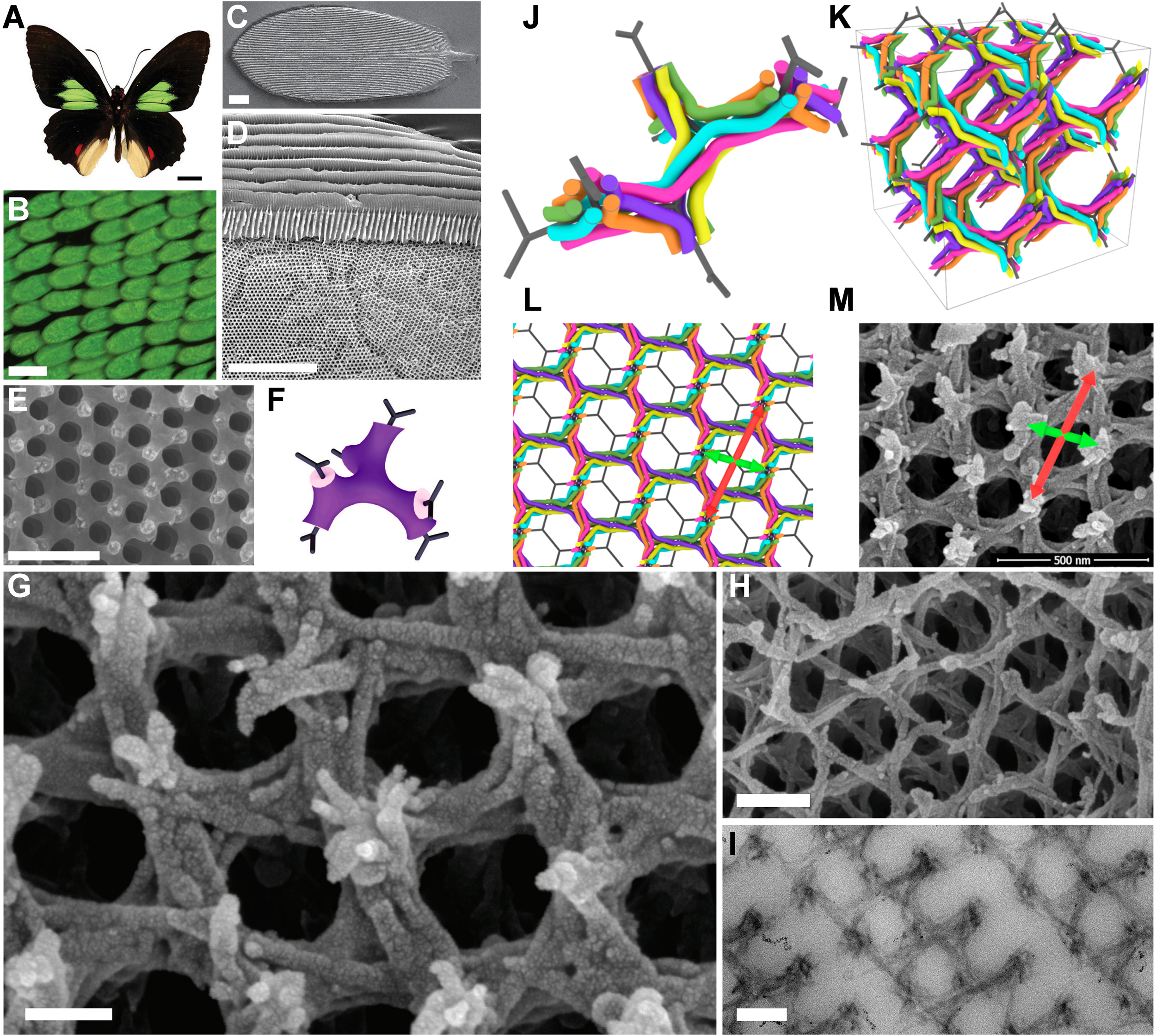
Figure 3. (A-F) SG structure within the green scales of mature Parides sesostris. (A) Photograph of a male Parides sesostris; (B) Light microscopy image of scales containing the SG structure; (C and D) Scanning electron microscopy (SEM) images of the scales; (E) High-magnification SEM image showing the smooth, homogeneous SG structure; (F) Idealized SG model with a chitin volume fraction of 0.35; (G-I) Electron microscopy images of the fibrillar SG structure in the wing scales of developing Parides sesostris pupae. As the pupation period is approximately 18 days, wing scale development was arrested by fixation on day 13 (G, 70% development) and day 15 (H and I, 80% development); (G) Adjacent to the lower lamina of the scale, showing approximately six fibers composing the SG; (H) Adjacent to the upper lamina of the scale, showing 2-3 fibers; (I) Transmission electron microscopy (TEM) image of a cross-section of a scale sampled from the same wing as that shown in (H); (J-M) Geometric model of six helical fibers woven around the SG network; (J) A small section of the model; (K) Approximately 23 unit cells; (L) The full six-fiber weave, with the model confined to a thin slice to simulate the finite observation depth of electron microscopy sections; (M) SEM image of the SG structure at 70% development in Parides sesostris, showing visual similarity to the model in (L). Scale bars: (A) 1 cm, (B) 100 μm, (C) 10 μm, (D) 5 μm, (E) 500 nm, (G) 100 nm, (H) and (I) 200 nm. This figure is reproduced under the terms of the CC BY-NC-ND 4.0 License[67]. Copyright 2025, The Authors. SG: Single gyroid.
The SG geometry endows butterfly wings with vivid structural colors. Although SG is a potential 3D photonic crystal with a complete bandgap (CBG), the low refractive index of chitin prevents a CBG. SG in Callophrys rubi exhibits orientation-dependent scattering, and the suppressed iridescence arises from spatial mixing of colors from crystals of multiple orientations[68]. In Erora opisena, SG domains correlate moderately with reflectance[69]. The scales of Morpho theseus contain a quasi-ordered tubular structure between a purely tubular state and the SG domain, possibly an early state of the G; color mixing makes the scales appear uniformly white[22]. Thayer et al. analyzed 312 scale structures from 286 butterfly species, finding that blue structural colors dominate while red is extremely rare; and that 3D photonic crystals (including SGs and inverse opals) show the most restricted color range of 440 to 560 nm[15]. These studies advance our understanding of structure-optical property relationships in butterfly scales, informing optical optimization and biomimetic design.
The exoskeletons of beetles and weevils
Coleoptera such as beetles and weevils are another major group that evolved TPHS structures. Bartl et al. discovered SD microdomains in the green scales of the weevil Lamprocyphus augustus; their multiple orientations enable effective reflection of light from different incident directions[70], highlighting the different optical structural preference between Lepidoptera and Coleoptera. Wilts et al. found that the elytron scales of Entimus imperialis are also composed of SD microdomains of different orientations[71]. Although individual microdomains reflect light highly directionally, the scales are densely arranged in concave pits; when light from the pit walls and different microdomains spatially overlaps, the reflectance peaks at ~ 540 nm. At close range, weevils distinguish shiny spot patterns for recognition and mating, while from a distance they blend into a green background, evading predators[71]. Wu et al. found that the colored and colorless domains of Entimus imperialis share the same SD structure. In the colorless domains, the air is replaced by SiO2, reducing the refractive index contrast with chitin and producing narrow bandgaps[72]. Saranathan et al. surveyed ~ 127 arthropod species and found TPHS structures other than SD in beetles, such as SG in Platyaplastes venustus and SP in the longhorn beetle Sternotomis pulchra; lineage-specific structure preferences may stem from differences in curvature regulation caused by variations in membrane-binding protein expression[73]. In 72 Pachyrhynchus weevil species, photonic structures range from long-range order to complete disorder[74] [Figure 4A]. Amorphous D structures can also open photonic bandgaps and produce structural colors[75]. The direct comparison of SD structure and its amorphous counterpart in the red and blue scales of Pachyrhynchus congestus mirabilis showed that blue scales lack long-range order yet still open a partial bandgap, demonstrating that long-range order is not necessary for producing structural color[76].
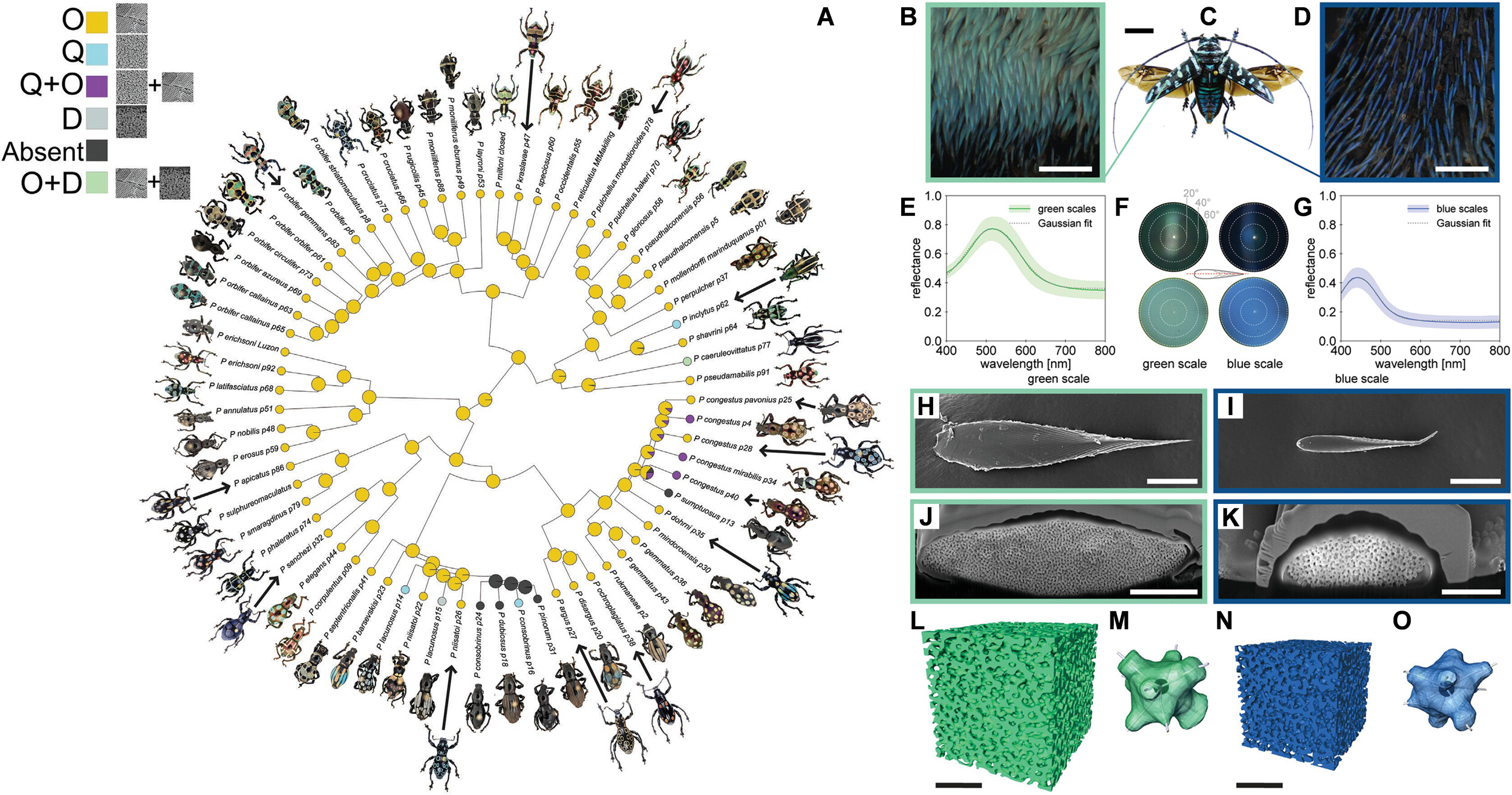
Figure 4. (A) Phylogenetic tree of weevils from the genus Pachyrhynchus, showing the evolutionary distribution of photonic crystal structure types within the scales of different species (O, Q, D denote Ordered, Quasi-ordered and Disordered, respectively). (A) Reproduced under the terms of the CC BY-NC 4.0 License[74]. Copyright 2022, The Authors; (B-O) Optical characterization and ultrastructural analysis of the colored scales of Sternotomis virescens. (B and D) Reflection light micrographs of green (B) and blue (D) scales. (C) Photograph of a male beetle. (E and G) In situ reflectance spectra of the green (E) and blue (G) scales; (F) K-space images of the two scale colors at 100× magnification. (H and I) SEM images showing the seed-like shape of individual green (H) and blue (I) scales. (J and K) Focused ion beam-SEM cross-sectional images showing that both the green (J) and blue (K) scales are amorphous networks surrounded by a thin-film cortex. (L and N) 3D reconstructed networks of the green (L) and blue (N) scales obtained from focused ion beam-SEM tomography. (M and O) A selected sub-unit from the networks of the green (M) and blue (O) scales. Scale bars: (B) and (D) 125 μm, (C) 1 cm, (H) and (I) 20 μm, (J) 5 μm, (K) 2 μm, (L) and (N) 1 μm. (B-O) Reproduced under the terms of the CC BY-NC 4.0 License[78]. Copyright 2023, The Authors. SEM: Scanning electron microscopy.
Besides the common G, D and P bio-optical structures, the I-WP surface was also discovered in Sternotomis callais[23]. This finding expanded the types of photonic crystals in biology while raising new questions about how cells selectively fill subspaces. For G, D and P structures, the two subspaces can be superimposed via inversion operations or translation, meaning that either can become the extracellular space for chitin filling and the cell does not distinguish them[23]. In contrast, the two subspaces of the I-WP structure have different volume fractions, and the cells always recognize the I-subspace as the extracellular space[23]. Currently, no specific mechanism has been proposed to explain this phenomenon. Bauernfeind et al. studied two longhorn beetle species from the tribe Sternotomini, elucidating how polycrystalline to quasi-disordered amorphous I-WP structures produce non-iridescent colors[77,78]. In the green and blue scales of Sternotomis virescens [Figure 4B-O], both amorphous I-WP structures have the same volume fraction, but the green-scale struts are longer and thicker (larger periodic size), shifting the reflected peak wavelength; the lack of long-range order causes isotropic scattering, meaning that short-range order provides the color while long-range disorder eliminates iridescence[78]. In Sternotomis amabilis sylvia, the green and orange scales correspond to polycrystalline and quasi-disordered I-WP structures, respectively; the flattened scale bases bear transparent distal fins with micrometer-scale ridges that suppress the iridescence of the polycrystalline structure, whereas the quasi-disordered network scatters intrinsically isotropically[77]. These structures have implications for photonic materials design.
Other biological TPHSs
SG structures formed by β-keratin were also discovered in the feathers of Chloropsis cochinchinensis sensu lato, showing weak iridescence and saturated blue-green structural colors, representing the first example of directly self-assembled SG crystals known to science[79]. Donnay et al. proposed that the interfaces between the organic matrix and inorganic crystals in echinoderm skeletons are TPMSs, which were the first examples reported in nature of periodic minimal surfaces[80]. Subsequently, TPHSs were confirmed in starfish (D)[21,81], sea urchins (SD and SP)[20,82,83] and crinoids (D)[84]; the D structure in the extinct crinoid Haplocrinites boitardi pushes the fossil record of TPHSs in biomineralized skeletons back to the Devonian. Unlike the optical roles in butterflies, beetles and birds, the TPHS structure in the knobby starfish Protoreaster nodosus primarily exhibits mechanical properties - high stiffness, high strength and high specific energy absorption[21,81,85]. Its skeleton contains a single-crystalline structure with precise crystallographic registration between the atomic-scale calcite and the micrometer-scale D microlattice. The {111} planes of the D microlattice are considered to undergo preferred failure under compression, yet lattice-level dislocations (density 100-1,200 cm-2) generate a “pinning” effect during damage-band propagation, deflecting and constraining the bands. Spatial variations in structural parameters (such as branch length/thickness) and the non-cleavage “conchoidal” fracture of biogenic calcite collectively enhance damage tolerance. The ossicles exhibit non-catastrophic stress plateaus and a specific energy absorption of up to 9.76 kJ·kg-1, outperforming many synthetic ceramic and even metallic foams[21]. These studies demonstrate that nature selects TPHSs for their multifunctional properties.
The formation of biological TPHSs reveals four regulatory principles that guide artificial self-assembly. First, chiral selection: butterfly species differ in chiral preference of scale crystallites[64,65]. In artificial systems, molecular chirality enables the chiral blocks to self-assemble into LH and RH SG networks[86,87]. Second, curvature regulation: biological membranes select G, D, P[54,55,73] or I-WP[23] surfaces through a balance among spontaneous curvature, lipid arrangement and the curvature regulation of membrane-binding proteins. Artificial systems tune spontaneous curvature and packing frustration via molecular architecture design[88-93], blending[94-99] and end-group chemistry[27,100]. Third, selective subspace filling: cells recognize and fill the I-subspace in Sternotomis callais[23], and chitin is selectively deposited in the extracellular space of butterfly wing scales[40]. Artificial systems achieve this by controlling nucleation-site density to fill one labyrinth of the D surface formed by block copolymers, yielding SD structure[26]. Fourth, dynamic remodeling: Parides sesostris forms a woven fibrillar network that later smooths into SG[67]; the random orientations and chiral bias in Erora opisena are explained by a co-folding model[66]. Artificial systems regulate this via kinetic pathways such as solvent evaporation rate[101-105], annealing history[106,107], precursor hydrolysis/condensation kinetics[26] and pathway-dependent phase transitions[107,108]. This mapping bridges biological structures and artificial self-assembly. The corresponding synthesis strategies are discussed below.
ARTIFICIAL FABRICATION
Researchers have fabricated TPHSs with controllable structures and functions using artificial methods, including top-down approaches such as additive manufacturing[109-117] and bottom-up strategies based on the self-assembly of block copolymers and liquid crystal systems. This section focuses on bottom-up self-assembly for the construction of TPHS materials.
Across the fabrication strategies below, the final TPHS structure is governed by the interplay of thermodynamic and kinetic control. Under thermodynamic control, the equilibrium phase minimizes the free energy under given molecular and compositional constraints[118,119]. Kinetic control determines which structure is actually accessed under realistic processing conditions, governing nucleation, growth pathways and intermediate states[120,121]. Because TPHS phases are often separated by small free-energy differences and are frequently metastable[122-125], kinetic factors can be decisive.
Liquid crystal systems
Liquid crystals combine the fluid properties of conventional liquids with the ordered characteristics of crystals and are widely regarded as the fourth state of matter[126-129]. They are classified into thermotropic and lyotropic types. Thermotropic liquid crystals undergo a temperature-driven transition from a disordered isotropic phase to an ordered anisotropic phase, as temperature changes alter intermolecular interactions and thus the degree of molecular order and alignment. Lyotropic liquid crystals form ordered mesophases when amphiphilic molecules are dissolved in a solvent at specific concentrations and self-assemble into aggregates or micelles, which further organize into ordered phases[130,131]. Through these two approaches, a rich variety of liquid crystalline phases, including TPHS structures, can be obtained[132-138].
Levelut et al. used time-resolved diffraction to confirm the DG structure in thermotropic liquid crystals[139], and Zeng et al. reported a triple-network tricontinuous phase based on the P surface[140]. Zeng et al. reported the first confirmed DD structure[141], the first SD structure[142], and the second single-network (SP) structure[143] in thermotropic liquid crystal systems. The I-WP[25] [Figure 5A-F] and a tetragonal gyroid with one network twisting synchronously while the other twists randomly[144] were also reported, enriching the library of soft matter self-assembled structures. Chen et al.[25], Cao et al.[138,144], Cai et al.[145] and Cao et al.[146] also systematically studied TPHS self-assembly in liquid crystal systems. Using resonant soft X-ray scattering, Cao et al. verified two distinct molecular packing modes in DG structures self-assembled from rodlike and taper-shaped molecules: orientation is smoothly transferred through junctions in anisotropic channels filled with aromatic cores, whereas it is mismatched and discontinuous at junctions in isotropic channels filled with alkyl chains[146]. Two intermediate phases (orthorhombic Fmmm and hexagonal P63/m) in the DD-DG transition of bolapolyphiles revealed a stepwise coordination-number change from 4 to 3[145]. An SP → DG → SD alternating single/double network sequence demonstrated that such phases can alternate with continuous changes in molecular structure (e.g., side-chain length), providing ideas for as-yet-unrealized SG-structured liquid crystals[147]. Tang et al. reported a four-network gyroid (4NG) with two networks per subspace, discovering a “supertwist” in which the double-helix twist direction opposes the subspace chirality [Figure 5G-O] - challenging the assumption that molecular orientational twist matches network chirality and providing new insight into chiral transfer in liquid crystals[24].
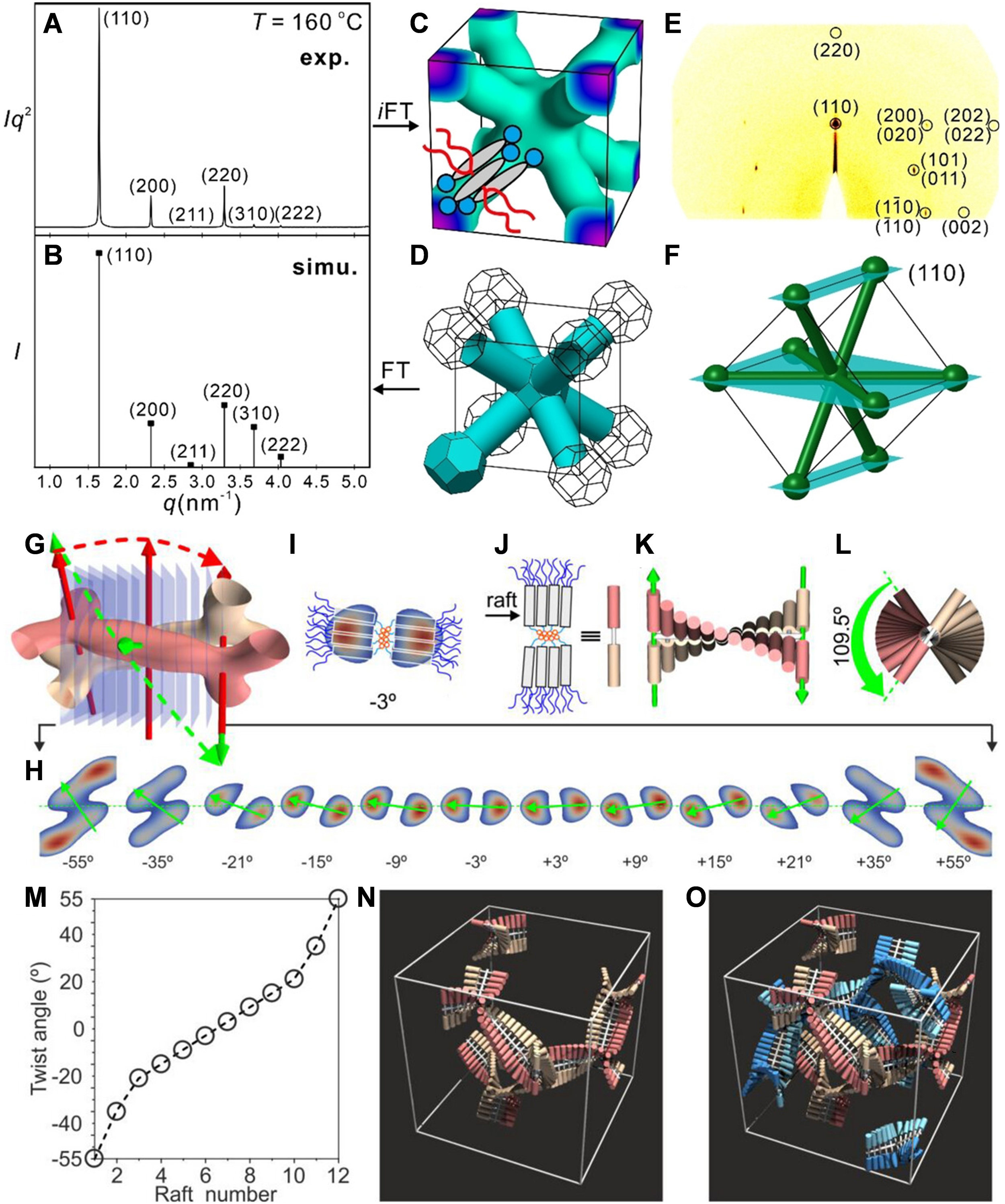
Figure 5. (A-F) SAXS/grazing-incidence SAXS (GISAXS) analysis and structural model of the body-centered cubic phase based on the I-WP minimal surface. (A and B) Experimental (A) and simulated (B) SAXS powder diffractograms; (C) Electron density map reconstructed from (A); (D) Geometric model used to calculate diffraction intensities; (E) Experimental GISAXS pattern, with the [110] axis perpendicular to the substrate; (F) Model of the infinite networks in an Im
Luzzati et al. first resolved a bicontinuous lyotropic G phase in divalent-cation soaps[148,149]. Templer et al. systematically investigated the effects of chain length, water content and temperature on the G, D, P and hexagonal phases in a homologous series of 2:1 (mol:mol) saturated fatty acid/phosphatidylcholine mixtures, determining the location and area of the molecular pivotal surface and providing geometric constraints for interfacial-bending energetics[150]. Tang et al. revealed the effects of temperature and pressure on the pivotal surface position in the G phase[151]. Vacklin et al.[152], Tang et al.[153], Shearman et al.[154], Tyler et al.[155], Barriga et al.[156] and Kulkarni et al.[157] explored the phase stability and lattice parameter modulation through packing frustration energy, lipid chain geometry, thermodynamic conditions and chemical/physical synergistic regulation[152-157]. Pressure-jump time-resolved SAXS and cryo-electron microscopy identified interlamellar attachments (ILAs) as a key intermediate in the lamellar to cubic transition[158,159]. Van ’t Hag et al. reviewed the influence of over 130 additives on bicontinuous cubic phases. These strategies overcome the compositional limitations of binary systems and facilitate membrane protein crystallization and drug delivery[160].
Lyotropic liquid crystal structures can be replicated by inorganic precursors, which may overcome soft-matter limitations and realize TPHS structures that are difficult to achieve in pure lyotropic liquid crystal systems. Gao et al. synthesized DD mesoporous silica AMS-10 using an anionic surfactant, an organosilane co-structure-directing agent and a silica precursor; adjusting the ionization degree of surfactant headgroup drove a structural evolution from tetragonal P42/mnm (cage type, AMS-9), cubic Fd
Block copolymers
Thanks to their highly flexible structural design, block copolymers enable ordered mesostructures through microphase separation driven by entropy and enthalpy. Block incompatibility is described by the Flory-Huggins interaction parameter χ, while χN (where N is the degree of polymerization) represents the driving force for microphase separation. The standard mean-field theory model of ideal symmetric diblock copolymer melts (f = 0.5) assumes incompressibility, Gaussian chain statistics, monodispersity, conformational symmetry, negligible fluctuations and a single composition-independent Flory-Huggins interaction parameter. When χN exceeds the critical value of 10.495, the system enters an ordered state[163-166]. However, in real experiments, fluctuations near the order-disorder transition shift the actual transition point from this mean-field prediction[167]. The phases can be controlled by composition, volume fraction and χN[121,168-171]. According to self-consistent field theory (SCFT) and experiments, the G phase in diblock copolymer melts is stable only within a narrow window between the lamellar and hexagonally packed cylindrical phases[172-174]. This window narrows with increasing segregation strength (χN) but can be significantly broadened by conformational asymmetry. G formation is kinetically sensitive to thermal history and annealing conditions - solvent casting or short-time high-temperature annealing tends to produce kinetically trapped metastable states rather than the equilibrium G phase[172-175].
In linear neat diblock copolymer systems, DG is consistently the thermodynamically favored network structure over DD and DP. This has been attributed to the higher node connectivity of DD and DP, which increases packing frustration and chain stretching. Using medial strong segregation (mSST) theory and SCFT, Dimitriyev et al. further attributed DG stability to its terminal-boundary geometry: the tubular medial surface of DG is a single twisted sheet without interior corners, allowing chain ends to spread over web-like surfaces and reducing the entropic penalty[124], whereas that of DD and DP possesses multiple leaves intersecting at abrupt angles, tilting and extending the chains and sharply varying the interfacial curvature[124]. They also pointed out that in conformationally symmetric linear diblock copolymers, cubic DD is not metastable but resides at a saddle point, enabling continuous transitions to DG or the T111 phase, whereas mSST and SCFT show that homopolymer doping or conformational asymmetry can render DD metastable - fundamentally revising the understanding of DD stability[125]. Lai et al., using polymeric SCFT, predicted that binary blends of homopolymer-like linear diblock copolymers (fA = 0.95) with gyroid-forming linear diblock copolymers stabilize metastable DD and P phases over a broader composition window through segregation toward node centers and local segregation[176]. Hou et al., using SCFT, first obtained DG, DD and DP simultaneously in pure AB-type block copolymers with the A′(A″B)5 miktoarm star architecture, which combines enhanced spontaneous curvature, combinatorial entropy and local segregation to satisfy the geometric requirements of these networks[88]. Single-network structures (SG, SD and SP) are harder to stabilize: in linear AB diblock copolymers, they are all metastable, tending to reduce domain sizes to maintain a CMC interface and thereby increasing interfacial area per unit volume and the enthalpic penalty[123]. Park et al. predicted that SG can be stabilized in H-shaped (BA)2A(AB)2 block copolymers when the A backbone and A arm block sizes are moderately asymmetric[93]. Xie et al.[89] and Cheng et al.[90] designed a B1AB2AB3 linear pentablock copolymer in which the middle B2 block pushes the longer B3 segment away from the interface via a loop configuration (rather than the previously believed bridging configuration), together with the shorter terminal B1 segment, relieving packing frustration in the matrix and achieving stable SG. Xie et al., using an inverse design algorithm based on the adjoint solution of sequence-SCFT with automatic differentiation and negative selection, calculated that forming the SG with the space group I213 (a lower symmetry variant of I4132) and the P-like cubic network with the space group P
Various processing strategies and molecular designs have stabilized different TPHS structures in pure block copolymer systems. Alward et al.[178], Thomas et al.[179] and Kinning et al.[180] first reported an ordered bicontinuous double-diamond (OBDD) phase in poly(styrene-isoprene) (PS-b-PI) star block copolymers. Hajduk et al. discovered another equilibrium phase in linear PS-b-PI, in which the minority component (PS) forms two three-fold-jointed networks, and the majority component (PI) serves as the G matrix[175]. Later calculations revealed that OBDD is metastable under the standard model of linear diblock copolymers[181,182], and it was subsequently revised as a G structure[183]. Susca et al. prepared large-size DG single-crystal thick films via evaporation-induced self-assembly (EISA), co-assembling poly(isoprene)-b-poly(styrene)-b-poly(dimethylaminoethylmethacrylate) (PI-b-PS-b-PDMAEMA) with poly(methyl vinyl silazane) (PMVS) to obtain single-crystal regions up to 14 mm2 and over 100 μm thick, pyrolyzable into mesoporous silicon (oxy)nitride monoliths[184]. Lin et al.[185] and Chu et al.[186-188] stabilized the DD phase using the helical conformations of stereoregular syndiotactic polypropylene (sPP) and isotactic polypropylene (iPP) chains, confirming that configurational regularity is the key to stabilization. Fourier transform infrared (FTIR) spectra revealed that the stabilization originates from stretching-induced helical segments at the nodes rather than ordered packing, with polydispersity acting synergistically[185,186]: a broad chain length distribution alleviates the entropic penalty of packing frustration, while helical conformations and the enthalpy of their associations further compensate it[185]. Adding homopolymer h-sPP broadens the stable temperature window of DD, but upon heating it transforms into a hexagonally packed cylindrical phase rather than DG, via the reorganization of four-arm nodes and end-fusion[95]. In non-stereoregular flexible systems, blending with homopolymers or polymers of different chain lengths is also an effective route to the DD phase[96-99,189].
All of the above-mentioned structures are balanced. To synthesize unbalanced single-network phases, especially analogs of the CMC surfaces found in nature, one strategy is to employ triblock copolymers to form an alternating G (GA) structure. Dolan et al. prepared GA thin films from polyisoprene-b-polystyrene-b-poly(ethylene oxide) (PI-b-PS-b-PEO) via solvent vapor annealing (SVA); in situ grazing-incidence SAXS (GISAXS) showed that SVA proceeds through eight distinct stages and that the ternary triblock copolymer exhibits strong robustness to SVA parameters, which is promising for large-area ordered structures[103]. Wang et al. employed two chiral triblock terpolymers, polyisoprene-b-polystyrene-b-poly(L-lactide) (PI-b-PS-b-PLLA) and polyisoprene-b-polystyrene-b-poly(D-lactide) (PI-b-PS-b-PDLA), achieving controlled network chirality in the GA phase: PLLA and PDLA form LH and RH SG networks, respectively, transferring chirality from the monomeric molecular configuration to the multichain domain morphology. The achiral control sample polyisoprene-b-polystyrene-b-poly(D,L-lactide) (PI-b-PS-b-PLA) formed an alternating diamond (DA) structure[86] [Figure 6A-N]. Another approach to achieving lower symmetry is to shift the networks. Hsueh et al. used the DG-forming PS-b-PLLA as a template[190]: after removing PLLA, silica precursors were infiltrated to obtain PS/SiO2 nanohybrids; thermal treatment above the PS glass-transition temperature rearranged the two SiO2 networks, and subsequent calcination released constraint, allowing more extensive random shifting that broke the inversion symmetry of DG and produced two incoherent SG networks[190].
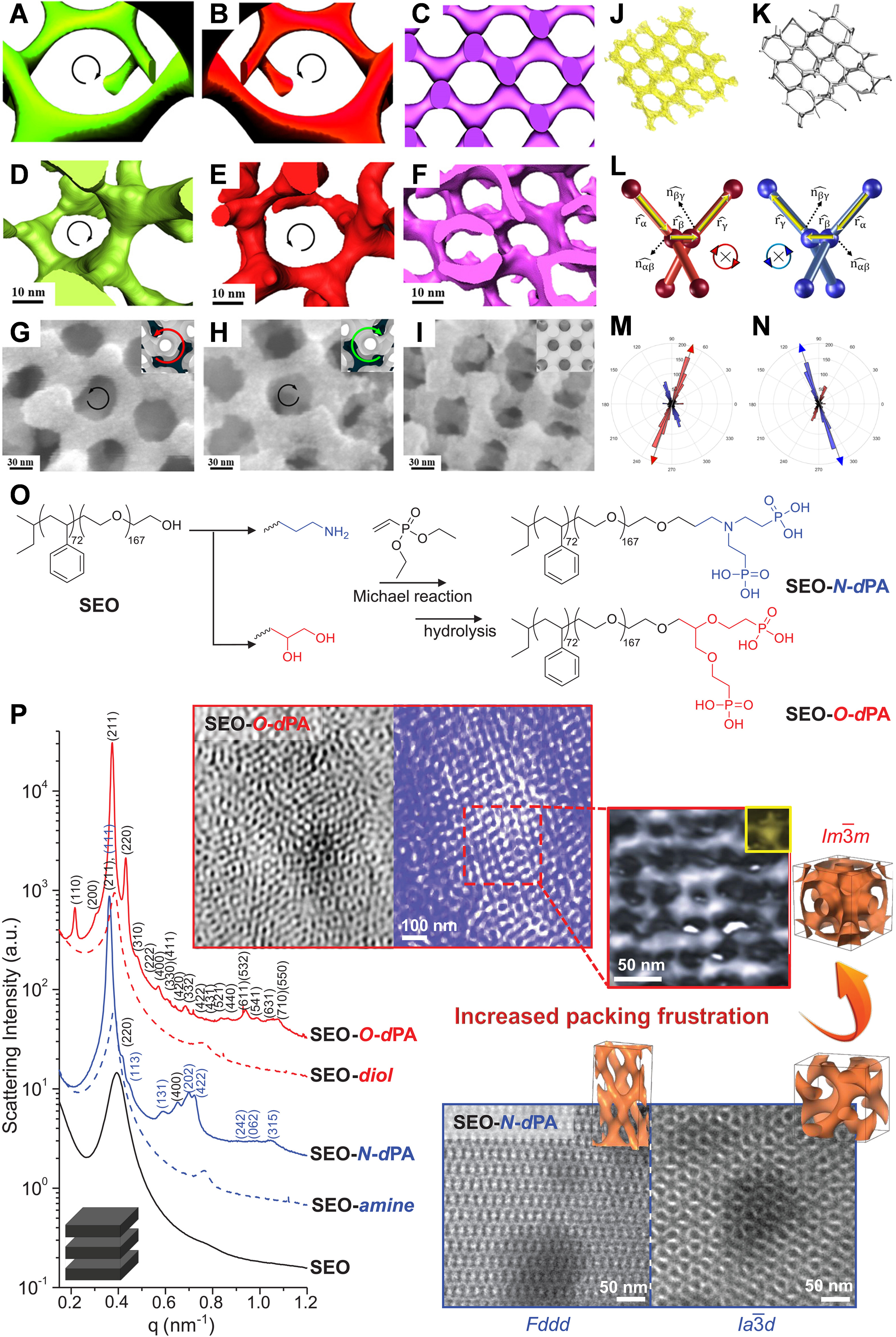
Figure 6. (A-F) 3D imaging of the PI network in self-assembled polylactide-based triblock terpolymers. Simulated images (A-C) and 3D reconstructions (D-F) from electron tomography of PI-b-PS-b-PLLA (A and D), PI-b-PS-b-PDLA (B and E) and PI-b-PS-b-PLA (C and F), respectively; (G-I) SEM images of the Ni network obtained by templating the polylactide network in PI-b-PS-b-PLLA (G), PI-b-PS-b-PDLA (H) and PI-b-PS-b-PLA (I), respectively; (J-N) Torsion angle analysis of the PI networks based on electron tomography. (J) Reconstructed image of the LH PI network in the GA phase of self-assembled PI-b-PS-b-PDLA. (K) Extracted skeleton of (J) by mesh contraction and pruning process. (L) The definition of torsion angle in the G networks for positive chirality (RH, red) and negative chirality (LH, blue). The yellow arrows indicate the vectors of three consecutive edges. (M and N) The polar histograms of torsion angle distribution for the PI network in PI-b-PS-b-PLLA (M) and PI-b-PS-b-PDLA (N). The red and blue arrows indicate the torsion angles for ideal G networks formed by PI. (A-N) Reproduced under the terms of the CC BY-NC 4.0 License[86]. Copyright 2020, The Authors; (O and P) Stabilization of different network structures using di-end-functionalized block copolymers. (O) Synthetic routes for the preparation of SEOs having diphosphonic acid (dPA) end groups. (P) SAXS profiles of end-functionalized SEOs measured at 25 °C; the dotted SAXS profiles show the morphologies of the end-functionalized block copolymer intermediates. Bright-field TEM images of SEOs-N-dPA are shown (bottom insets), and tomography images along with a captured TEM image of SEOs-O-dPA are shown (top insets). (O and P) Reproduced with permission[27]. Copyright 2024, The American Association for the Advancement of Science. SEO: polystyrene-b-poly(ethylene oxide); SEO-O-dPA: dPA-ended SEOs (ether linker); SEO-N-dPA: dPA-ended SEOs (amine linker); PI-b-PS-b-PLLA: polyisoprene-b-polystyrene-b-poly(L-lactide); PI-b-PS-b-PDLA: polyisoprene-b-polystyrene-b-poly(D-lactide); PI-b-PS-b-PLA: polyisoprene-b-polystyrene-b-poly(D,L-lactide); G: gyroid; PI: polyisoprene; SAXS: small-angle X-ray scattering; TEM: transmission electron microscopy; 3D: three-dimensional.
Compared with G, synthesizing D and P surfaces is considerably more challenging. La et al.[91], Ha et al.[92] and An et al.[191] demonstrated that tuning the molecular design of branched block copolymers and the hydrophilic/hydrophobic molecular-weight ratio can drive the packing parameter above unity, enabling direct self-assembly of G, D and P cubosomes in dilute solution: the bulky branched hydrophilic block limits hydrophobic-chain stretching, increasing the packing parameter. Building on this, cosolvent regulation and blending enable precise, continuous tuning of the P → D → hexagonal phase transitions[91,92,94,191-193]. Lin et al. also achieved D and P cubosomes using a linear polystyrene-b-poly(ethylene oxide) (PS-b-PEO, SEO) diblock copolymer in a dioxane/dimethylformamide mixed solvent at a high initial concentration, where water addition drives self-assembly through hydrophobic interactions of PS chains, and the high initial concentration and high hydrophobic volume fraction synergistically elevate the packing parameter[102]. Lee et al. reported the first thermodynamically stable P structure in pure block copolymers: introducing diphosphonic acid linked via an ether bond at the PEO terminus of SEO regulates end-group hydrogen bonding [Figure 6O], inducing “medial packing” in which PEO chain ends aggregate at the microdomain center rather than undergoing skeletal aggregation, alleviating the higher packing frustration of P relative to DD. During cooling after annealing, PEO crystallization merges two three-arm nodes into one six-arm node. If the interaction is too strong (e.g., electrostatic interactions from amine-linked diphosphonic acid), the PEO ends cannot form medial packing or adjust to curvature requirements, preserving the initial curvature[27] [Figure 6P].
Introducing inorganic precursors into the solution self-assembly of block copolymers significantly enhances the structural diversity and properties of TPHS materials. Wiesner has made pioneering contributions to this field. Finnefrock et al.[194,195] and Toombes et al.[196] utilized poly(isoprene-b-ethylene oxide) (PI-b-PEO) with (3-glycidyloxypropyl)-trimethoxysilane (GLYMO) and aluminum sec-butoxide to prepare mesoporous aluminosilicates via solvent casting-induced self-assembly. After symmetry breaking was taken into account, the true structure was a DG severely distorted by uniaxial contraction. Inorganic precursors can also yield SG materials: they co-assemble with the triblock terpolymer into a GA structure, are selectively enriched within one block, and after calcination leave one set of inorganic networks[197,198]. Han et al. first directly prepared SDD-structured macroporous silica using a triblock copolymer template [poly(tert-butyl acrylate)-b-polystyrene-b-poly(ethylene oxide) (PtBA-b-PS-b-PEO)] and tetraethyl orthosilicate (TEOS), which exhibited structural color but no CBG, owing to the low refractive index of silica[43]. Replacing the inorganic source with titanium diisopropoxide bis(acetylacetonate) (TIA) and using a dinonylphenyl end-capped polyethylene glycol-b-polystyrene (DNPE-PEO-b-PS) template yielded SDD-structured titania whose high dielectric contrast was calculated to open a CBG[42]. In these co-assembly systems, epitaxial intergrowth relationships between SDD and SG, SDP and SDD, and lamellar and SDD structures were observed[41,199,200], and a transition from a 2D cylindrical phase through SG to SDD was found, with SG as a metastable intermediate phase resembling the growth of SG in butterfly wing scales rather than a node-rearrangement transition (no five-fold junctions during the cylinder-to-G transition were observed)[201,202]. Before 2021, SD self-assembly had been reported only in thermotropic liquid crystals[142]. Sheng et al. achieved the first direct SD synthesis in block copolymers using a triblock copolymer [poly(ethylene oxide)-b-polystyrene-b-poly(L-lactide) (PEO-b-PS-b-PLLA)] with TEOS and explored its epitaxial intergrowth relationships with DD and SG, and the curvature-driven transition[203]. DD and SD share crystallographic directions (such as
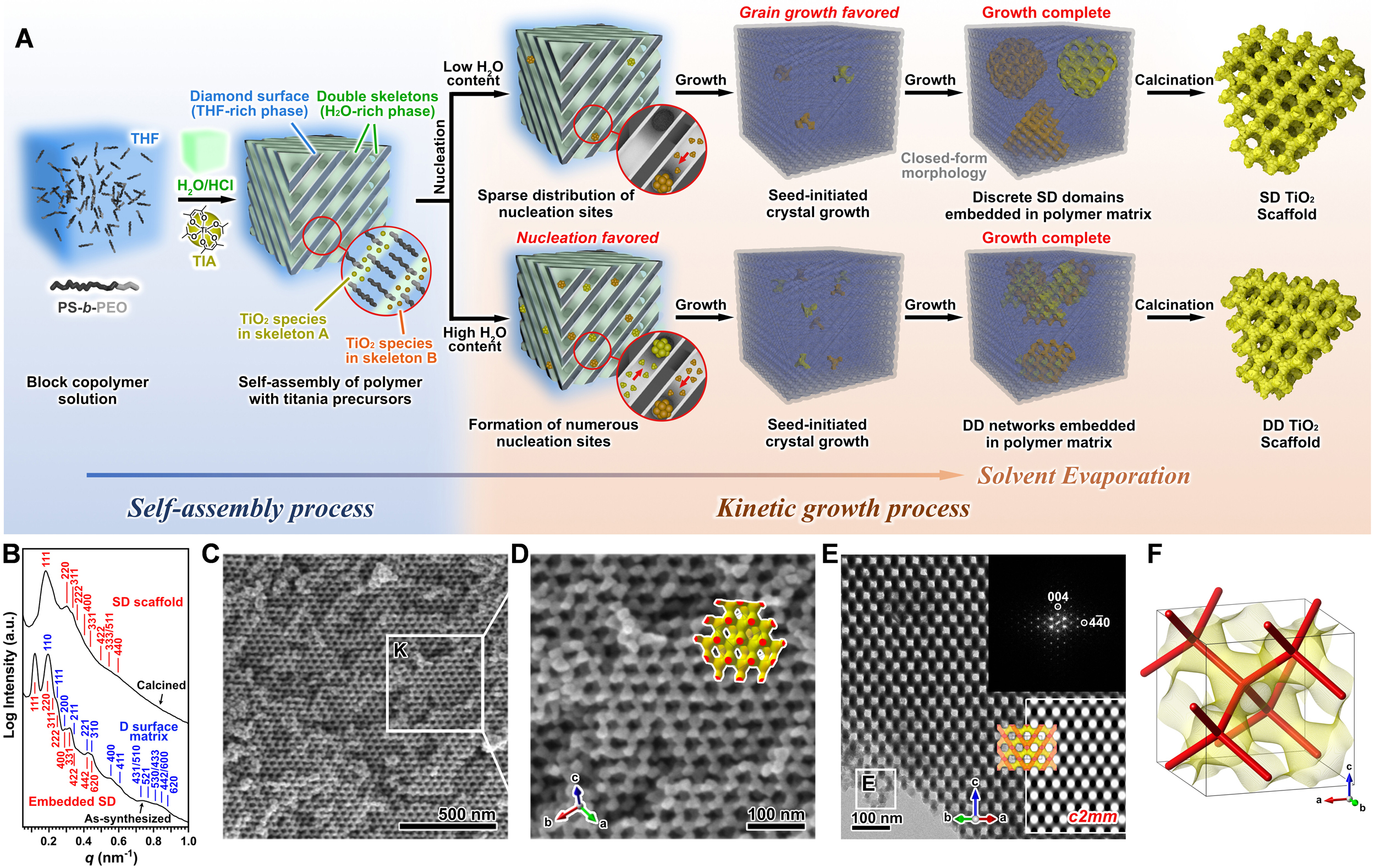
Figure 7. Synthetic strategy and characterization of the SD-structured titania scaffold. (A) The SD-structured titania scaffold was synthesized under dual thermodynamic and kinetic control; by controlling the number of nucleation sites, either DD or SD structures can be formed; (B) SAXS patterns of the as-synthesized and calcined samples; (C and D) Low- and high-magnification SEM images of the calcined SD taken from the {111} plane; (E) TEM image along the [110] direction and the corresponding Fourier diffractogram; (F) The stick model superimposed on the reconstructed volume shows the diamond network with four-fold connectivity. This figure is reproduced under the terms of the CC BY-NC-ND 4.0 License[26]. Copyright 2024, The Authors. THF: tetrahydrofuran; SD: single diamond; DD: double diamond; PS-b-PEO: polystyrene-b-poly(ethylene oxide); SAXS: small-angle X-ray scattering; TEM: transmission electron microscopy.
Karpov et al.[204] and Djeghdi et al.[205] used polyisoprene-b-polystyrene-b-poly(glycidyl methacrylate) (PI-b-PS-b-PGMA) to form the DA structure and prepared the corresponding SD by selectively removing the PI networks and backfilling the voids with gold. Using ptychographic X-ray computed tomography (PXCT), they reconstructed the 3D gold network; three orthogonal slices matched the theoretical SD model, and vertical shrinkage during film drying made the actual unit cell approximately monoclinic rather than cubic. Defects with topological charges of +1/2 (comet-like) and -1/2 (trefoil-like) were identified at the boundaries between two mismatched grains and at the intersection of three grains, respectively[204]. They originated from inter-grain strain, emerged simultaneously, and jointly balanced the topological charge and strain, maintaining long-range order through local disorder. This study demonstrates that topology-driven self-assembly is an important mechanism for structure formation in soft matter, connecting the topological physics of biological and synthetic systems[204-206].
Cooperative self-assembly of small-molecule surfactants with amphiphilic block copolymers introduces competing electrostatic condensation and volumetric expansion, offering high flexibility for material design and curvature control. For instance, adding stearyltrimethylammonium bromide to the self-assembly of polystyrene-b-poly(acrylic acid) (PS-b-PAA) produced saddle-shaped hierarchical lamellar phases [Figure 8A-D3], providing direct evidence for the lamellar-to-bicontinuous phase (cubic G) evolutionary pathway[207]. The saddle-shaped lamella exhibits predominantly negative Gaussian curvature (98% of the surface) and near-zero mean curvature [Figure 8E-H3], yet retains lamellar stacking, revealing the intermediate phase between lamellar and hyperbolic geometries. Lower cationic surfactant additions introduced an unexpected shifted tG phase: although the cationic surfactant attracts and compresses the PAA chains (reducing the interfacial curvature), the insertion of surfactant micelles into the PAA microdomains increases the hydrophilic block volume (volumetric expansion effect), increasing the interfacial curvature. The balance between these two effects thermodynamically drives the formation of the unique shifted tG structure[208].
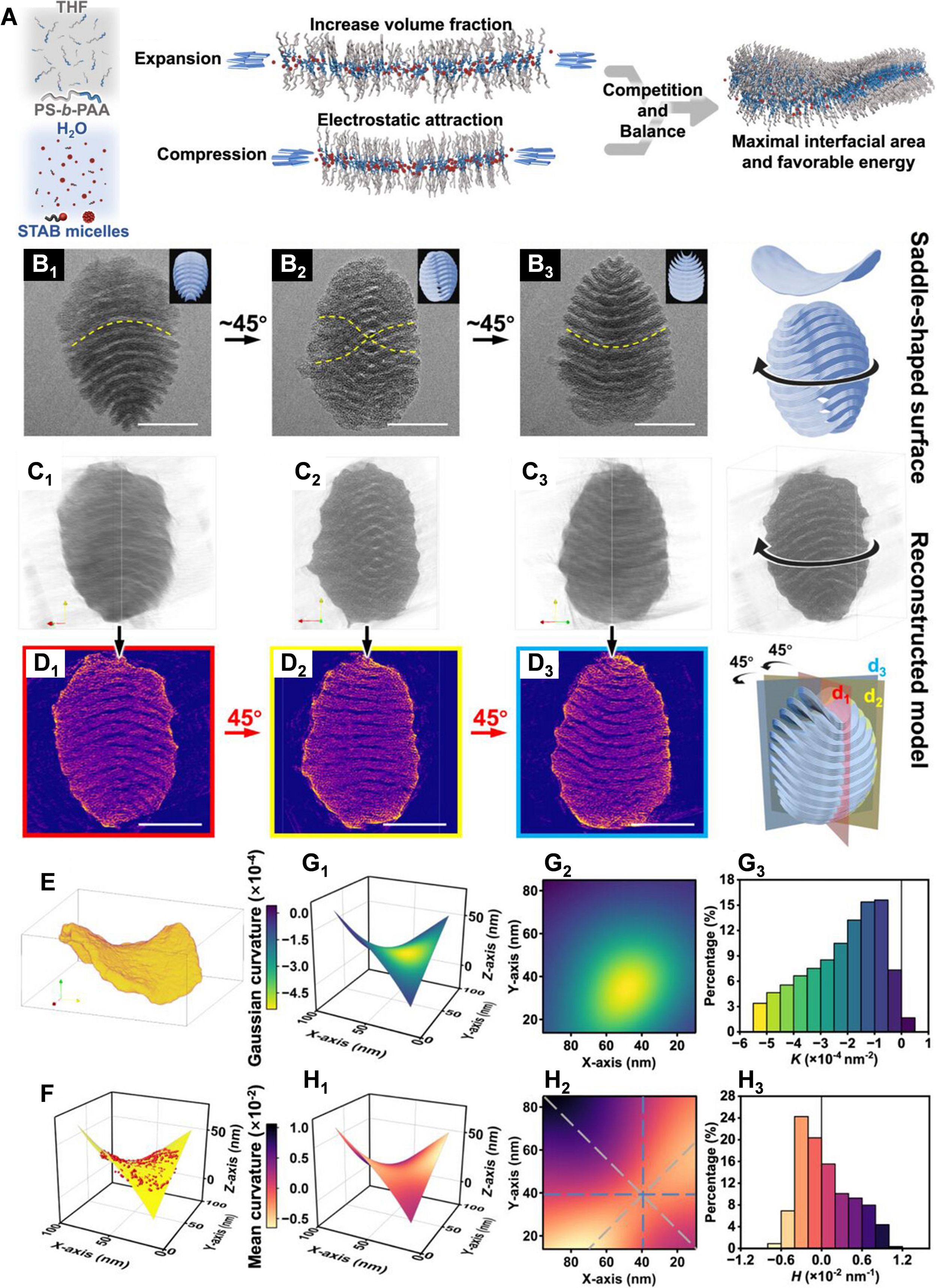
Figure 8. (A) Schematic diagram of the saddle-shaped structure formed by the competition and balance between the electrostatic screening and volume expansion effects; (B1-B3) TEM images of the saddle-shaped lamellar phase with secondary multilayer structure. The images were observed from different tilting directions along the long axis of the pupa-like nanoparticles. The corresponding structure model indicates the tilting directions; (C1-C3) Different viewpoints of the reconstruction model generated from the 2D TEM image series. The directions of the viewpoints are coincident with those in (B1-B3); (D1-D3) The corresponding central longitudinal sections obtained from different cross-section directions of the reconstructed model; (E) The single lamella segmented from the reconstructed model; (F) The point cloud extracted from the single lamella and the corresponding fitting surface; (G1-H3) The color-coded distributions of K (G1) and H (H1) on the saddle surface, their corresponding planar projections (G2 and H2) and histograms of K (G3) and H (H3), respectively. Scale bars: (B1-B3) and (D1-D3) 100 nm. This figure is reproduced with permission[207]. Copyright 2025, Wiley-VCH GmbH. THF: Tetrahydrofuran; PS-b-PAA: polystyrene-b-poly(acrylic acid); STAB: stearyltrimethylammonium bromide; TEM: transmission electron microscopy; 2D: two-dimensional.
For increasingly complex self-assembly systems, data-driven approaches offer new possibilities for phase behavior prediction. For architecturally complex miktoarm star block copolymers (PEO-s-PS2), numerous factors influence their self-assembled structures, making manual structure-parameter analysis difficult. Cui et al. constructed a multilayer perceptron (MLP) that learned the self-assembly behavior of PEO-s-PS2 from 802 experimental data points, successfully predicting multi-dimensional synthesis-field diagrams including hyperbolic surface structures[209]. The shape of PEO-s-PS2 resembles that of phospholipid molecules, and its phase behavior provides an ideal model for understanding biological membrane formation[209]. While this data-driven approach enables phase prediction, it does not by itself establish causal mechanisms, which still require independent experimental and theoretical validation[210-212]. Overall, these studies reveal the epitaxial intergrowth transition among TPHS structures, discover various low-symmetry shifted structures (SDD, SDP and shifted tG) and single-network structures (SG, SD). They further combine thermodynamic control with kinetic and curvature regulation and deep learning to achieve phase behavior prediction in complex self-assembly systems.
APPLICATIONS OF TPHS-BASED MATERIALS
TPHS structural materials have been widely applied in fields such as energy storage and conversion[8,213-216], catalysis[217-223], sensors[7,224-230] and others[231-234]. Their functional advantages share three interrelated structural origins. Connectivity and topology effects: the three-dimensionally interconnected channels and bicontinuous topology allow two non-intersecting labyrinths to accommodate different fluids, reactants or functional components and provide continuous mass transport pathways[6,13,235,236] and a periodic topological basis for wave propagation[237,238]; surface area and pore size effects: the high specific surface area provides abundant active sites, while the tunable mesopore size determines molecular accessibility[239,240], loading capacity[215], and diffusion kinetics[214,215,239]; curvature-specific effects: non-positive Gaussian curvature generates saddle-shaped surfaces, influencing stress distribution (experimental and computational)[30,241-243], defect density (experimental and proposed)[244], the interfacial microenvironment and reaction free energy (computational)[11,245], thereby regulating the mechanical properties and ion adsorption behavior.
Mass transport-dominated applications
The TPHS phases formed by curved lipid bilayers feature two non-intersecting aqueous channels, enabling partitioned drug loading: hydrophilic drugs reside in the aqueous channels, lipophilic drugs in the lipid bilayer, and amphiphilic drugs at the lipid-water interface. Cubosome encapsulation efficiencies can exceed 90% for both small molecules and macromolecules, owing to their extensive internal surface area and tunable lipid composition. The thermodynamic stability of cubosomes preserves structural integrity under physiological conditions. Depending on the formulation, drug release from cubosomes may follow zero-order kinetics or Higuchi diffusion-controlled models, and can be modulated through lipid composition, surface modification or responsive moieties[17,18,236]. Jennings et al. constructed a library of 96 lipidoids comprising 8 hydrophilic polyamines and 12 hydrophobic acrylates[246]. They demonstrated two applications: stimuli-responsive thin films formed by interfacial protonation-driven self-assembly that undergo reversible DG ↔ lamellar phase transitions induced by acid, and colloidally stable cubosomes produced by solvent evaporation that retain the internal DG structure and exhibit enhanced membrane fusion, enabling efficient genetic material delivery[246]. Chen et al. developed a cubosome-based transdermal system co-loaded with doxorubicin (DOX) and indocyanine green (ICG) (DOX-ICG-cubo) for chemo-photothermal melanoma therapy[247]. The DD-structured cubosomes had a particle size of ~ 101.90 nm and encapsulation efficiencies exceeding 90% for both DOX and ICG, with favorable physiological stability, pH/thermo-dual-responsive release and robust photothermal stability. This system showed synergistic cytotoxicity against B16F10 melanoma cells upon laser irradiation (drug-interaction coefficient < 1) and increased DOX skin permeation to 923.89 ng/cm2 (enhanced 1.95 times by microneedle pretreatment). In a B16F10 tumor-bearing mouse model, DOX-ICG-cubo gel combined with 808 nm laser irradiation achieved a 97.59% tumor inhibition rate (complete elimination in 3 of 6 mice), outperforming chemotherapy alone (81.41%) and photothermal therapy alone (92.92%), with no obvious toxicity to major organs[247].
TPHS structures feature a 3D continuous and highly ordered pore channel network, which facilitates mass transfer and diffusion of reactants/products and inhibits pore blockage. Their high specific surface area and curved geometry expose more active sites, while the large mesopore size helps expel gas bubbles, synergistically enhancing catalytic activity, selectivity and stability[13,217,248-251]. Wang et al. utilized crystalline ordered mesoporous boron phosphate (BPO4) with an SDD structure as a solid acid catalyst[218]. In the acetalization of furfural with methanol, it achieved > 70% conversion at room temperature within 24 h, with 99.9% selectivity to 2-(dimethoxymethyl)furan, and was reused for 5 cycles without significant loss of activity [Figure 9]. In propane oxidative dehydrogenation, the SDD-structured BPO4 exhibited higher reaction rates and olefin yields than ordered macroporous BPO4, reaching 8.70 golefin·gcat-1·h-1 at 540 °C with olefin selectivity above 90%[218]. Li et al. used SDD-structured SiO2 as a hard template for vacuum high-temperature melamine polymerization followed by SiO2 etching, to replicate an inverse-phased SDD-structured mesoporous graphitic carbon nitride (g-C3N4)[217]. Under visible light (λ > 400 nm), it exhibited excellent photocatalytic water splitting with a hydrogen-evolution rate of 6,831 μmol·g-1·h-1 - 5 times that of the DG structure and 16 times that of the nonporous control sample, with 90% activity retained after 4 cycles, attributed to enhanced mass transport, bubble release and charge transfer[217]. In electrocatalysis, nitrogen-doped hollow G carbon-Pt (HGC-Pt) catalysts exhibited an electrochemically active surface area 3.6 times that of solid carbon counterparts and a mass activity 2.7 times that of commercial Pt/C, owing to enhanced mass transport and reactant accessibility from the hollow structure[28].
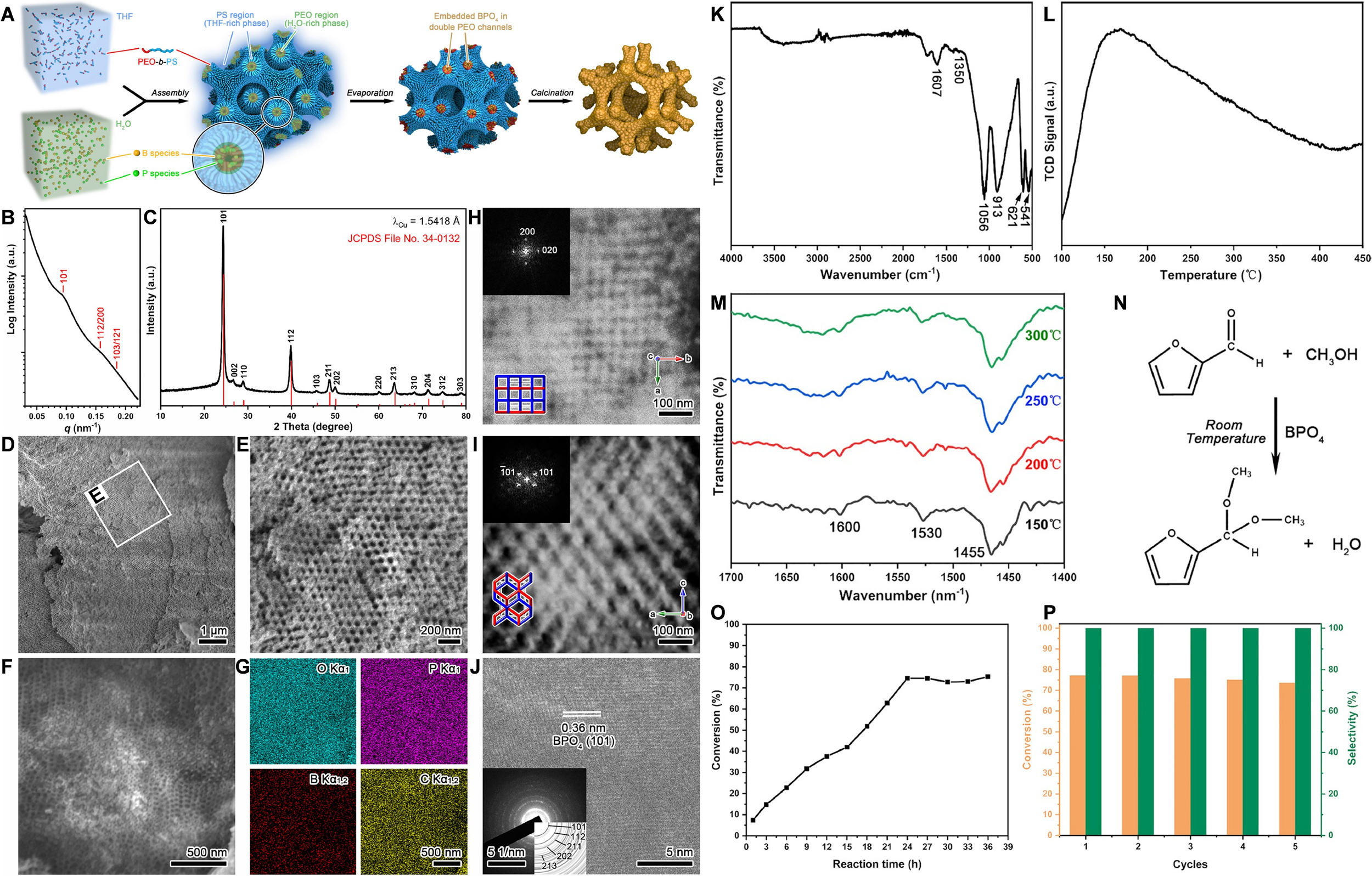
Figure 9. (A) Schematic drawing of the synthetic strategy of crystalline SDD BPO4 scaffold; (B-M) Characterizations of crystalline SDD BPO4 scaffold. (B) SAXS pattern. (C) Wide-angle XRD pattern. (D) Low-magnification SEM image. (E) High-magnification SEM image as shown in the white box in (D). (F and G) EDS mapping. (H and I) STEM images and the corresponding Fourier diffractograms of SDD BPO4 scaffold taken from the [001] and [010] directions, respectively. (J) High-resolution TEM (HRTEM) image of SDD BPO4 scaffold corresponding to the (101) plane of BPO4. The inset shows the selected area electron diffraction with the polycrystalline ring pattern. (K) FTIR spectrum. (L) Temperature-programmed desorption of ammonia profile. (M) Pyridine-adsorption FTIR spectrum; (N) Catalytic acetalization of furfural and methanol to 2-(dimethoxymethyl)furan; (O) Effect of reaction time on the acetalization; (P) Reusability tests of SDD BPO4 for the acetalization. This figure is reproduced with permission[218]. Copyright 2024, Science China Press. THF: Tetrahydrofuran; PEO-b-PS: poly(ethylene oxide)-b-polystyrene; PEO: poly(ethylene oxide); SDD: shifted double diamond; SAXS: small-angle X-ray scattering; XRD: X-ray diffraction; SEM: scanning electron microscopy; STEM: scanning transmission electron microscopy; FTIR: Fourier transform infrared; EDS: energy dispersive X-ray spectroscopy.
Li et al. also introduced ordered bicontinuous mesostructures into covalent organic frameworks (COFs) and metal-organic frameworks (MOFs) using TPHS structures templated from block copolymer self-assembly[240]. Filling MOF precursors into DP-structured cubosome templates, followed by coordination and template removal, yielded SP-structured MOFs (SP-MOFs), including SP-ZIF-8, SP-ZIF-67 and SP-HKUST-1. When SP-ZIF-8 was used as a bioreactor, the trypsin loading reached 325 μg·mg-1, achieving 37% sequence coverage and 45 matched peptides in digestion of bovine serum albumin (BSA) within 30 min - significantly outperforming free enzyme and conventional ZIF-8 - while maintaining high activity after 5 cycles[240]. The ordered bicontinuous structure also enhances light utilization through multiple reflections. Using SDD-structured silica as a hard template, Liu et al. synthesized SDD-COFs with hierarchical pore structures, overcoming the pore-blockage limitation of microporous or small-mesoporous COFs[239]. Benefiting from enhanced mass transport, improved light utilization and promoted photogenerated carrier separation, SDD-COFs performed excellently in visible-light-driven photocatalytic NO removal. A vinylene-linked COF (SDD-COF-3) achieved a NO conversion rate of 51.4%, far exceeding its non-mesoporous counterpart and the classical photocatalyst g-C3N4, with excellent cycling stability. This provides a strategy for improving the accessibility of internal active sites in COFs and developing efficient photocatalysts[239].
The periodic channels of TPHSs enhance light harvesting through multiple reflections. The interconnected channels and frameworks reduce ion/electron charge-transfer resistance, markedly improving electrode reaction kinetics. The saddle-shaped non-positive-Gaussian-curvature surface lowers the free energy of catalytic intermediates (density functional theory), and enhances the interfacial electric field, promoting ion adsorption (finite element simulations). The highly symmetric periodic structure also alleviates charge-discharge mechanical stress, extending device cycle life[11,13,252]. Tang et al.[214,244], Xiang et al.[215], and Li et al.[253] explored electrochemical energy storage using DP-structured cubosomes from SEOs as templates, which have one set of open channels and another enclosed by the copolymer bilayer. Filling the open channels with various precursors and removing the template yields SP-structured bicontinuous mesoporous materials. An SP polypyrrole (SP-PPy) network served as the cathode host for Na-I2 batteries: the bicontinuous structure facilitates iodine loading and electrolyte infiltration, and positively charged polaron/bipolaron groups adsorb polyiodide ions (I3-) through electrostatic interactions, suppressing the I3- shuttle effect. This cathode achieved a record-high specific capacity of 235 mA·h·g-1 at 0.5 C[215]. SP-PBA, a sodium-ion cathode from slow crystallization of Prussian blue analogs (PBAs) via HCl vapor diffusion, showed enhanced sodium-ion diffusion kinetics and uniform stress distribution during Na+ intercalation, achieving 79.3% capacity retention after 3,000 charge-discharge cycles[214]. Polymerization of 3-aminophenol with formaldehyde within the open channels, followed by argon pyrolysis, produced SP-structured hard carbon (SP-HC) as a sodium-ion anode. Its saddle-shaped curvature increased carbon-framework defect density [observed by high-resolution TEM (HRTEM), Raman spectroscopy, X-ray diffraction (XRD), X-ray photoelectron spectroscopy and electron paramagnetic resonance; proposed based on these results], providing more Na+ adsorption sites, while the expanded 4.0 Å interlayer spacing enabled nearly barrier-free Na+ intercalation. SP-HC achieved a capacity of 172 mA·h·g-1 at 10 A·g-1 (full charge within 1 minute) and maintained a capacity of 80 mA·h·g-1 after 100,000 cycles, a record for hard-carbon sodium-ion anodes[244]. A marine-sponge-inspired carbonaceous sulfur host (bimeso-CoNC) featuring an SP structure and Co-N4 single-atom sites was synthesized by filling the template with a Co-doped ZIF-8 precursor and pyrolyzing under argon. Its mesoporous channels (~ 31 nm) ensured rapid Li+ transport and high sulfur loading, while the Co-N4 single-atom sites suppressed the polysulfide shuttle effect and accelerated sulfur conversion. The bimeso-CoNC/S cathode maintained 570 mA·h·g-1 at 6 C and an areal capacity of 11.6 mA·h·cm-2 at 13.5 mg·cm-2, with only 0.039% capacity decay per cycle over 1,200 cycles[253].
Werner et al. departed from conventional layered lithium-ion battery architectures by sequentially constructing three spatially continuous functional components separated by an electrolyte layer[254]. An oligomeric phenol-formaldehyde resol (the carbon precursor for the anode) was co-assembled with PI-b-PS-b-PEO into a core-shell DG structure. After inert calcination, a gyroidal carbon framework remained. Poly(phenylene oxide) (PPO) was electropolymerized onto the carbon as a solid-state electrolyte, and a sulfur/poly(3,4-ethylenedioxythiophene) (PEDOT) composite was infiltrated as the cathode, forming a complete lithium-ion battery whose areal capacity is theoretically 4,700 times that of a planar thin-film battery with the same critical dimensions[254]. Digital light processing (DLP) 3D printing was used to fabricate a monolithic G-structured solid oxide cell, eliminating the metallic interconnects and seals that typically account for over 75% of stack weight. Its specific power and volumetric power density exceeded 1 W·g-1 and 3 W·cm-3, respectively (nearly an order of magnitude above planar stacks), with excellent stability during hundreds of hours of operation, reversible cycling, and thermal cycling - a new pathway for weight/volume-sensitive applications such as aerospace and portable power[255].
Owing to pore channels that enable rapid mass transport and full utilization of active sites, TPHS structures are also widely employed in sensors to enhance signal response[7,224-226,256]. Pang et al. utilized the P structure as the mechanical scaffold of a triboelectric nanogenerator (TENG), designing a linear thickness gradient that forms three layers of different wall thicknesses along the z-axis[225]. The P structure serves as the positive triboelectric layer and supporting scaffold, and its layer-by-layer compression deformation endows the device with three distinguishable electrical signal modes corresponding to long-distance, medium-distance and emergency braking states, so the braking condition can be identified in real time from the output voltage peak and duration - a novel sensing solution for autonomous-driving braking safety[225]. Inspired by the periodic porous membrane and breathing of the mammalian respiratory system, Chen et al. synthesized DP-structured cubosome templates from SEO, impregnated them with SnCl4·5H2O solution, and calcined the products to obtain SP-structured mesoporous SnO2, which was deposited onto microelectromechanical systems (MEMS) chips as the sensing layer[7] [Figure 10A]. At low temperatures, gas is adsorbed onto the SnO2 surface; upon rapid heating, the reaction rate increases sharply while gas diffusion lags, dropping the surface gas concentration to the reaction equilibrium concentration and determining the overshoot-peak amplitude. SnO2 is an n-type semiconductor, and surface-adsorbed oxygen extracts electrons from the conduction band to form an electron depletion layer (high resistance). When reducing gases react with the adsorbed oxygen, electrons are released back to the conduction band, thinning the depletion layer and decreasing the resistance (increasing current). Different gases exhibit distinct current change magnitudes and rates due to differences in transferred-electron number and reaction activation energies [Figure 10B-D]. Pulse heating combined with a convolutional neural network identified six types of gases from the shapes of the overshoot peaks with 99.8% accuracy[7] [Figure 10E].
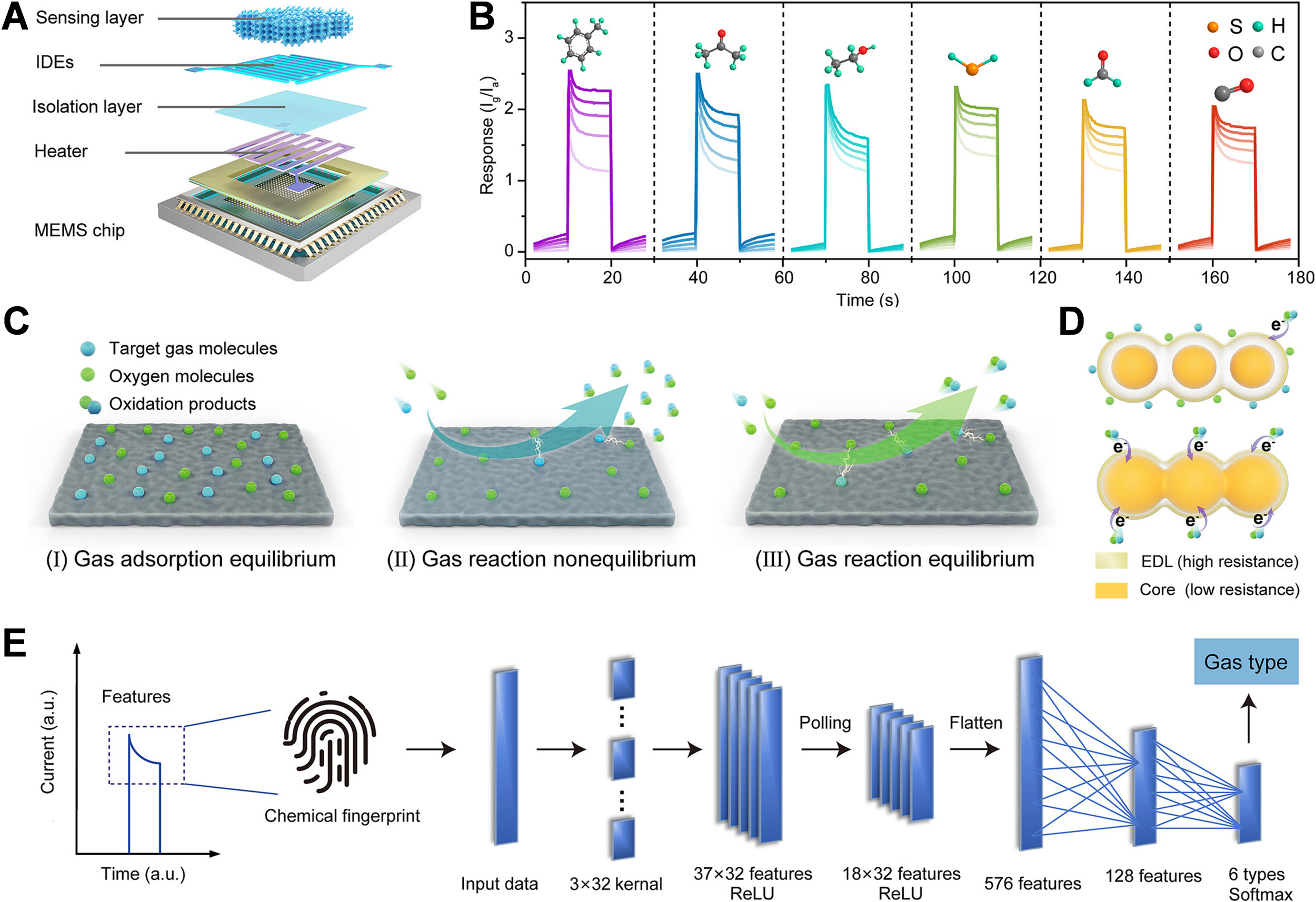
Figure 10. Gas sensor based on SP-structured SnO2. (A) Schematic illustration of the sensor structure; (B) Single-cycle response curves of six representative gases under pulse heating; (C) Surface states of the metal oxide semiconductor during the gas sensing test; (D) Sensing mechanism toward gas molecules; (E) Extraction of overshoot peak data and gas recognition based on a convolutional neural network model. This figure is reproduced under the terms of the CC BY-NC-ND 4.0 License[7]. Copyright 2026, The Authors. IDE: interdigitated electrode; MEMS: microelectromechanical systems; EDL: electron depletion layer; SP: single primitive.
TPHS structures are advantageous for integrated compact heat exchange and catalytic reforming owing to their extremely high specific surface area, the boundary layer disruption effect of their complex internal channels and two mutually interconnected channels that can separately accommodate the heat-supplying and reacting fluids - making TPHSs an ideal platform combining compactness, efficiency and design flexibility in thermo-fluid-reaction multi-physics coupled systems[235,257-260]. Zhao et al. embedded the G structure into the cooling tube of a metal hydride hydrogen storage reactor to enhance heat dissipation[261]. Computational fluid dynamics simulations showed that the tortuous channels disturb the cooling fluid, inducing repeated flow impingement, flow-direction alterations and vortex formation, thereby generating turbulence without specialized processes. The solid-G reactor reduced the time to reach 1.2 wt.% hydrogen storage capacity by 23.40% and the peak average bed temperature rise by 9.49% relative to the conventional reactor[261]. Chen et al. compared serpentine channels with G, D and I-WP cold plates for electronic chip cooling[262]. The D structure performed best: under a heat flux of 140 W·cm-2, the maximum chip-surface temperature was reduced by 14.73 °C compared to the serpentine channel, owing to its larger heat transfer surface area and stronger secondary flows. They then designed a graded D structure with the unit cell size varying linearly along the height direction. Its equivalent convective heat transfer coefficient was 8.10%-10.30% higher than that of the uniform structure, with only a 3.81% higher pressure drop. With pumping power below 2 W, heat dissipation reached 256.9 W·cm-2, an overall improvement of 3.58%-6.24%[262].
Photonic and phononic applications
Materials with TPHS structures possess a 3D periodic distribution of the dielectric constant that enables a photonic bandgap analogous to the electronic bandgap in semiconductors, forbidding light propagation within specific frequency ranges - the core mechanism of photonic crystals[263-265]. Certain TPHS structures, such as SG and SD, can open CBGs or wide-angle photonic bandgaps when the dielectric contrast and fill fraction are appropriate. When intrinsically chiral (e.g., SG), the structure manipulates the polarization state of light, while dielectric contrast and fill fraction allow control of its dispersion. The bandgap position and width are tailored by adjusting structural parameters such as volume fraction, unit cell size, and network shift[1,266,267]. These properties are fundamentally enabled by the geometric topology of TPHSs, which dictates how electromagnetic waves are scattered, dispersed and polarized.
The SD structure has been called the “holy grail” of photonic crystals[26]. Bandgap calculations on shifted tG structures indicate that such distortions also provide an effective route to photonic bandgaps[208]. Cui et al. combined Fourier analysis with deep learning to explore photonic bandgaps across six space groups, confirming the superiority of SD and SG while discovering that the lcs topology with space group Ia
The generation and characteristics of phononic bandgaps depend on intrinsic material properties (including density and component volume fractions), and are significantly influenced by structural parameters such as symmetry, connectivity and geometric configuration[280-285]. Periodic minimal surfaces have recently been introduced into acoustic/elastic wave manipulation. Integrating acoustic metamaterial design with topological concepts provides a new pathway for lightweight and multifunctional acoustic devices[237,286]. Wu et al.[287] combined the micro-perforated plate (MPP) with a TPHS sandwich structure and investigated its sound transmission loss and absorption. Experiments and simulations demonstrate that MPPs provide significant sound-absorption capability within specific bands, while improving sound insulation through enhanced acoustic energy dissipation[287]. Further optimization of the G-type MPP-TPHS sandwich structure reveals that non-uniform perforation broadens the absorption bandwidth and improves overall acoustic performance, guiding the design of lightweight sandwich structures integrating load-bearing with sound insulation and absorption[287]. Among the 16 bicontinuous cubic network structures, the I-WP structure was identified as the champion phononic bandgap structure with the largest complete phononic bandgap (width 0.41) at its optimal volume fraction and strut thickness for a bismuth telluride network in an epoxy matrix, by finite difference frequency domain calculations[237]. Chen et al. designed and experimentally validated a 3D I-WP acoustic crystal, achieving a double-zero index, where the normalized effective mass density and effective compressibility simultaneously equal zero[286]. Exciting a four-fold degenerate cone formed by the degeneracy of one monopolar mode and three dipolar modes at the Dirac point frequency produces acoustic void behavior. Experiments confirmed that the acoustic crystal maintains a planar wavefront in a 90° bent waveguide and achieves acoustic cloaking when an internal obstacle is introduced[286].
Mechanical applications
TPHSs attract significant attention in mechanical metamaterials for their lightweight nature and outstanding mechanical properties. The non-positive-Gaussian-curvature regions distribute loads and reduce stress concentrations, enhancing load-bearing capacity (supported by both experimental and computational studies). Under impact or compression, their lattices undergo significant deformation, absorbing and dissipating substantial energy. Because sheet-based TPHS structures exhibit relatively homogeneous stress distributions, their fatigue performance generally exceeds that of conventional lattices at equivalent porosity and under well-controlled printing conditions, whereas printing defects and internal porosity can introduce local stress concentrations and degrade this advantage. Their geometry and mechanical properties can be tailored by adjusting the parameters of their governing structural equations[288-295]. Zhang et al. systematically investigated the mechanical properties of 3D-printed TPHS structures, proposing a transition from finite regulation of known TPHSs to the infinite design capability of arbitrary TPHSs[30,241-243]. Inspired by crystal twinning, they introduced twin boundaries into G and D structures. Blocking stress transfer paths and introducing structural symmetry transformed the shear bands from wide and irregular distributions into symmetric ones, avoiding catastrophic failure at low strains in D[243]. In G structures, the chirality and number of SG networks significantly affect mechanical properties: racemic structures exhibited peak-stress improvements of up to 51.14% over homochiral structures, because the alternating LH/RH networks create alternating and opposing stress transfer paths, leading to more uniform stress distribution[241]. Eight bifurcating TPHS structures with non-cubic symmetry generally outperformed the classical G, D and P structures: tD-tDelta-L (loaded along the left side of tD-tDelta) showed a 26.5% improvement over D-[100] (loaded along the [100] direction of D), and tP-oPa-L (loaded along the left side of tP-oPa) showed a 41% improvement over P-[100] (loaded along the [100] direction of P). The bifurcating structures maintained minimal-surface characteristics under non-cubic deformation, exhibiting more flexible deformation adaptability[242]. They also proposed a free modeling method based on Fourier synthesis that constructs arbitrary periodic smooth surfaces by superimposing Fourier components corresponding to different Bragg reflections [Figure 11A and B], overcoming the limited scope of conventional level-set equations. It achieved an 86.21% increase in peak stress for a Fourier-designed P-derived structure (N-c111-0.478) over the conventional P surface (N-c100-fit) [Figure 11C-E] and a 98.02% improvement in energy absorption through optimized wall thickness distribution (P-position2) over the uniform P structure (P-uniform) [Figure 11F-K], and enabled non-equilibrium TPHS structures assembled via mortise-tenon joints[30]. These works establish a paradigm for TPHS mechanical metamaterials, transitioning from finite structures to infinite possibilities.
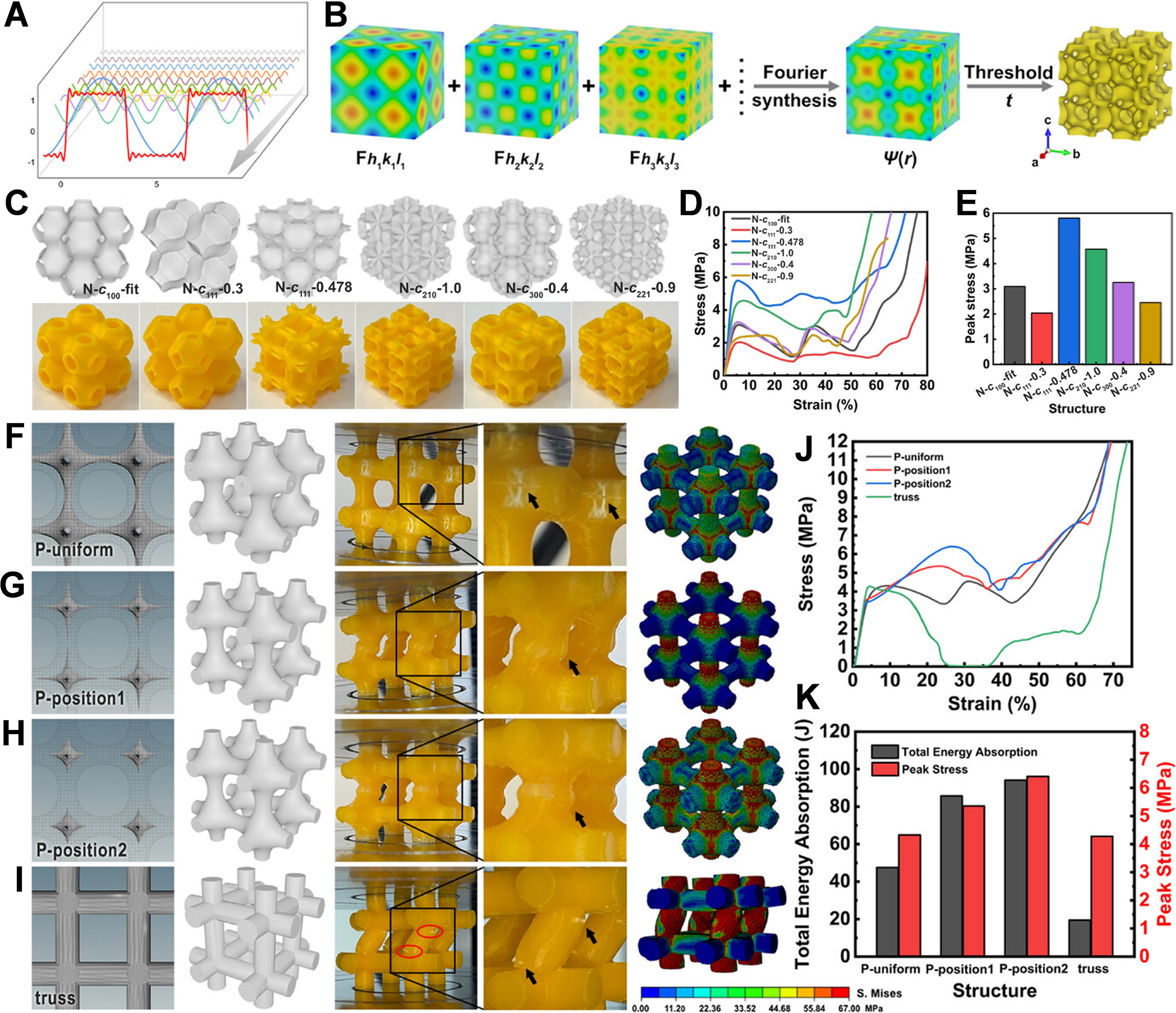
Figure 11. (A) Schematic drawing of the principle of Fourier synthesis; (B) Construction of TPHS structures; (C) Various structures were constructed based on Pm
CONCLUSION AND OUTLOOK
This review covers TPHSs in biological systems, artificial self-assembly, and applications. In biological systems, the focus is on the analytical methods and formation mechanisms of TPHS structures in organisms such as butterflies and beetles. In artificial self-assembly, starting from liquid crystals and block copolymers, and following the trajectory from classical bicontinuous to single-network, symmetry-broken and high-genus topologies, this review summarizes the theoretical predictions and experimental advances in bottom-up fabrication of TPHS materials. In applications, functional advantages are summarized across multiple fields, centered on connectivity/topology, surface-area and pore-size and curvature-specific effects. Although significant progress has been made, several shortcomings remain.
(i) The structural diversity of artificial systems remains inferior to that of nature. SG and SD structures have been fabricated through self-assembly of block copolymers or liquid crystals and template methods. However, limitations remain, including limited structural tunability, relatively small unit cell parameters, and insufficient long-range order - leaving a considerable gap relative to natural counterparts. This disparity stems from our limited understanding of how organisms construct precise TPHS architectures across molecular, cellular and tissue scales. Specifically, the chiral selection of SG, the “smoothing” process in butterfly wing scales and the selective filling of I-WP subspaces by cells in beetles remain unresolved. Combining biology, 3D electron tomography and in vitro reconstruction models holds promise for revealing how nature achieves precise TPHS construction and for providing new self-assembly pathways. Stabilizing structures not yet achieved in artificial systems may require more sophisticated molecular design and modulation of packing frustration. Only by deeply understanding local curvature regulation, spatially selective filling, and kinetic pathway control can we provide design concepts that transcend existing paradigms.
(ii) A deeper mechanistic understanding is essential for rational design of TPHS structures. In block copolymer self-assembly, limited theoretical predictive capability and intermediate-state characterization constitute critical bottlenecks. Most existing simulations struggle to address structural evolution under complex experimental conditions involving hydrolysis and condensation of inorganic precursors, multi-component cooperative assembly and kinetic pathway dependence. Moreover, predictions of metastable phases such as SG, SD and symmetry-broken structures often rely on specific molecular design assumptions and lack general theoretical guidance, making inverse design from target structures to synthesis parameters still unattainable. Although in situ characterization has advanced (e.g., cryo-electron microscopy, time-resolved SAXS), real-time capture of intermediate states remains constrained by spatiotemporal resolution and sample preparation difficulties, resulting in substantial loss of kinetic pathway information. This dual limitation prevents establishing a complete evolutionary pathway from initial conditions to final structures, seriously hindering the upgrade of TPHS materials from empirical trial-and-error to rational design.
(iii) The chemical effects of non-positive Gaussian curvature remain largely unexplored. In physical applications, TPHS materials leverage their intrinsic geometric topological features, whereas in chemical applications such as catalysis and drug delivery, their advantages derive mainly from the high specific surface area, pore size, and three-dimensionally interconnected channels that provide superior mass transport. However, how the non-positive-Gaussian-curvature surface itself influences the microenvironment of chemical reactions, molecular adsorption and diffusion, the spatial distribution of active sites, and their performance remains insufficiently investigated. Future research should unravel the structure-activity relationship between the curvature geometry of TPHSs and chemical functionality, providing a new dimension for functional material design. In addition, most TPHS-based functional materials remain at the proof-of-concept stage; their long-term stability and compatibility with existing micro- and nanofabrication processes must be addressed to promote their practical application.
DECLARATIONS
Authors’ contributions
Writing-original draft: Ye, S.
Writing-review & editing: Han, L.
Availability of data and materials
Not applicable.
AI and AI-assisted tools statement
During the preparation of this manuscript, the AI tool DeepSeek (version V4-Flash, released 2026-04-24) was used solely for language editing. The tool did not influence the study design, data collection, analysis, interpretation, or the scientific content of the work. All authors take full responsibility for the accuracy, integrity, and final content of the manuscript.
Financial support and sponsorship
This work was supported by the National Natural Science Foundation of China (No. 22425303) and the Fundamental Research Funds for the Central Universities.
Conflicts of interest
Han, L. is an Associate Editor of the journal Micro Nano Science. Han, L. was not involved in any steps of editorial processing, notably including reviewer selection, manuscript handling, and decision-making, while the other author has declared no conflicts of interest.
Ethical approval and consent to participate
Not applicable.
Consent for publication
Not applicable.
Copyright
© The Author(s) 2026.
REFERENCES
1. Han, L.; Che, S. An overview of materials with triply periodic minimal surfaces and related geometry: from biological structures to self-assembled systems. Adv. Mater. 2018, 30, e1705708.
2. Emmer, M. Architecture and mathematics: soap bubbles and soap films. In: Williams K, Ostwald MJ, editors. Architecture and mathematics from antiquity to the future. Cham: Springer International Publishing; 2015. pp. 449-58.
4. Neovius, E. R. Bestimmung zweier speciellen periodischen Minimalflächen, auf welchen unendlich viele gerade Linien und unendlich viele ebene geodätische Linien liegen; Frenckell: Helsingfors, 1883. (in German). https://resolver.sub.uni-goettingen.de/purl?PPN591417707.
5. Schoen, A. H. Infinite periodic minimal surfaces without self-intersections; NASA Technical Note NASA TN D-5541; National Aeronautics and Space Administration: Washington, D.C., 1970. https://ntrs.nasa.gov/citations/19700020472.
6. Xiang, L.; Li, Q.; Li, C.; Yang, Q.; Xu, F.; Mai, Y. Block copolymer self-assembly directed synthesis of porous materials with ordered bicontinuous structures and their potential applications. Adv. Mater. 2023, 35, e2207684.
7. Chen, K.; Deng, Y.; Hu, T.; et al. Bioinspired periodic mesoporous tin oxides enable steady nonequilibrium chemical sensing for enhanced gas discrimination. Proc. Natl. Acad. Sci. U. S. A. 2026, 123, e2531153123.
8. Sheng, Q.; Li, Q.; Xiang, L.; Huang, T.; Mai, Y.; Han, L. Double diamond structured bicontinuous mesoporous titania templated by a block copolymer for anode material of lithium-ion battery. Nano Res. 2021, 14, 992-7.
9. Mall, A. P.; Bhandarkar, V. V.; Mandaloi, G.; Tandon, P. An overview of design and development of biomimetic bone scaffolds using heterogeneous TPMS lattice structures. Arch. Comput. Methods Eng. 2025, 32, 2429-56.
10. Liao, Y.; Liu, Y.; Ren, L.; et al. Nature-inspired bicontinuous-topology 3D-printed TPMS solar interfacial evaporator. Chem. Eng. J. 2026, 536, 176094.
11. Xiang, L.; Tang, C.; Xu, Z.; Xu, F.; Li, C.; Mai, Y. Functional porous cubosomes: synthesis and applications in energy storage and conversion. Acc. Mater. Res. 2025, 6, 939-51.
12. Sheng, Q.; Mao, W.; Han, L.; Che, S. Fabrication of photonic bandgap materials by shifting double frameworks. Chemistry 2018, 24, 17389-96.
13. Li, C.; Li, Q.; Kaneti, Y. V.; Hou, D.; Yamauchi, Y.; Mai, Y. Self-assembly of block copolymers towards mesoporous materials for energy storage and conversion systems. Chem. Soc. Rev. 2020, 49, 4681-736.
14. Cui, C.; Deng, Y.; Han, L. Bicontinuous cubic phases in biological and artificial self-assembled systems. Sci. China Mater. 2020, 63, 686-702.
15. Thayer, R. C.; Patel, N. H. A meta-analysis of butterfly structural colors: their color range, distribution and biological production. J. Exp. Biol. 2023, 226, jeb245940.
16. Ban, M.; Kim, S.; Lee, J. Polymer cubosome-templated bicontinuous materials: design principles, synthesis, and energy-environmental applications. Mater. Today 2026, 97, 103338.
17. Ranjith, M.; Khandke, S. A.; Niha, R.; Ansari, S.; Tamilnila, S. Bicontinuous cubic phase lipid nanoparticles cubosomes: formulation, characterization, and therapeutic applications. J. Drug Deliv. Ther. 2026, 16, 173-81.
18. Bhatt, A. H.; Patel, H. P.; Patel, P. R.; et al. Cubosomes in non-oral drug delivery: advancing precision therapeutics from bench to bedside. Int. J. Pharm. 2025, 684, 126108.
19. Barriga, H. M. G.; Holme, M. N.; Stevens, M. M. Cubosomes: the next generation of smart lipid nanoparticles? Angew. Chem. Int. Ed. Engl. 2019, 58, 2958-78.
20. Seidel, R.; Handrich, K.; Albéric, M.; et al. Comparative structural analysis of stereom polymorphs in the sea urchin test. Faraday Discuss. 2025, 261, 340-58.
21. Yang, T.; Chen, H.; Jia, Z.; et al. A damage-tolerant, dual-scale, single-crystalline microlattice in the knobby starfish, Protoreaster nodosus. Science 2022, 375, 647-52.
22. Zhao, X.; Xiong, Y.; Wang, W.; Zhang, W.; Zhang, D. Achieving structural white inspired by quasiordered microstructures in Morpho theseus. NPG Asia Mater. 2023, 15, 463.
23. Kobayashi, Y.; Ohnuki, R.; Yoshioka, S. Discovery of I-WP minimal-surface-based photonic crystal in the scale of a longhorn beetle. J. R. Soc. Interface 2021, 18, 20210505.
24. Tang, Y.; Xue, Y. N.; Yang, S. G.; et al. Gyroid Labyrinth of supertwisted double helices in a liquid crystal polymer. Angew. Chem. Int. Ed. Engl. 2026, 65, e22314.
25. Chen, C.; Poppe, M.; Poppe, S.; Tschierske, C.; Liu, F. Liquid organic frameworks: a liquid crystalline 8-connected network with body-centered cubic symmetry. Angew. Chem. Int. Ed. Engl. 2020, 59, 20820-5.
26. Wang, C.; Cui, C.; Deng, Q.; et al. Construction of the single-diamond-structured titania scaffold-recreation of the holy grail photonic structure. Proc. Natl. Acad. Sci. U. S. A. 2024, 121, e2318072121.
27. Lee, H.; Kwon, S.; Min, J.; et al. Thermodynamically stable plumber’s nightmare structures in block copolymers. Science 2024, 383, 70-6.
28. Lee, G. H.; Choi, S.; Yang, H.; et al. Self-assembled hollow gyroids with bicontinuous mesostructures: a highly robust electrocatalyst fixation platform. Adv. Mater. 2025, 37, e2412525.
29. Cui, C.; Wei, G.; Saba, M.; Cao, Y.; Han, L. Deep learning-assisted Fourier analysis for high-efficiency structural design: a case study on three-dimensional photonic crystals enumeration. Small 2026, 22, e11158.
30. Zhang, Y.; Zhang, J.; Zhou, Z.; et al. Multi-mechanical regulation of 3D printed triply periodic hyperbolic surfaces via fourier synthesis-based free modeling. Adv. Sci. (Weinh). 2025, 12, e70028.
31. Schamberger, B.; Ziege, R.; Anselme, K.; et al. Curvature in biological systems: its quantification, emergence, and implications across the Scales. Adv. Mater. 2023, 35, e2206110.
32. Himmelmann, M.; Pedersen, M. C.; Klatt, M. A.; Schönhöfer, P. W. A.; Evans, M. E.; Schröder-Turk, G. E. Amorphous bicontinuous minimal surface models and the superior Gaussian curvature uniformity of diamond, primitive and gyroid surfaces. P. Roy. Soc. A-Math. Phy. 2026, 482, 20250275.
34. Huse, D. A.; Leibler, S. Phase behaviour of an ensemble of nonintersecting random fluid films. J. Phys. France 1988, 49, 605-21.
35. Grosse-Brauckmann, K. Triply periodic minimal and constant mean curvature surfaces. Interface Focus 2012, 2, 582-8.
37. Maldovan, M.; Urbas, A. M.; Yufa, N.; Carter, W. C.; Thomas, E. L. Photonic properties of bicontinuous cubic microphases. Phys. Rev. B 2002, 65.
38. Saba, M.; Wilts, B. D.; Hielscher, J.; Schröder-Turk, G. E. Absence of circular polarisation in reflections of butterfly wing scales with chiral gyroid structure. Mater. Today: Proc. 2014, 1, 193-208.
40. Saranathan, V.; Osuji, C. O.; Mochrie, S. G.; et al. Structure, function, and self-assembly of single network gyroid (I4132) photonic crystals in butterfly wing scales. Proc. Natl. Acad. Sci. U. S. A. 2010, 107, 11676-81.
41. Mao, W.; Cao, X.; Sheng, Q.; Han, L.; Che, S. Silica scaffold with shifted “plumber’s nightmare” networks and their interconversion into diamond networks. Angew. Chem. Int. Ed. Engl. 2017, 56, 10670-5.
42. Li, H.; Liu, Y.; Cao, X.; Han, L.; Jiang, C.; Che, S. A shifted double-diamond titania scaffold. Angew. Chem. Int. Ed. Engl. 2017, 56, 806-11.
43. Han, L.; Xu, D.; Liu, Y.; et al. Synthesis and characterization of macroporous photonic structure that consists of azimuthally shifted double-diamond silica frameworks. Chem. Mater. 2014, 26, 7020-8.
44. Hsueh, H. Y.; Ho, R. M. Bicontinuous ceramics with high surface area from block copolymer templates. Langmuir 2012, 28, 8518-29.
45. Andersson, S.; Hyde, S. T.; Larsson, K.; Lidin, S. Minimal surfaces and structures: from inorganic and metal crystals to cell membranes and biopolymers. Chem. Rev. 1988, 88, 221-42.
46. Schröder-Turk, G. E.; Fogden, A.; Hyde, S. T. Bicontinuous geometries and molecular self-assembly: comparison of local curvature and global packing variations in genus-three cubic, tetragonal and rhombohedral surfaces. Eur. Phys. J. B. 2006, 54, 509-24.
47. Anderson, D. M.; Davis, H. T.; Scriven, L. E.; Nitsche, J. C. C. Periodic surfaces of prescribed mean curvature. In: Prigogine I, Rice SA, editors. Advances in chemical physics. Wiley; 1990. pp. 337-96.
48. Han, Y.; Zhang, D.; Chng, L. L.; et al. A tri-continuous mesoporous material with a silica pore wall following a hexagonal minimal surface. Nat. Chem. 2009, 1, 123-7.
49. Hyde, S.; Schröder, G. Novel surfactant mesostructural topologies: between lamellae and columnar (hexagonal) forms. Curr Opin Colloid In 2003, 8, 5-14.
50. Schwarz, U. S.; Gompper, G. Stability of bicontinuous cubic phases in ternary amphiphilic systems with spontaneous curvature. J. Chem. Phys. 2000, 112, 3792-802.
51. Pappas, G. D.; Brandt, P. W. Mitochondria. I. fine structure of the complex patterns in the mitochondria of Pelomyxa carolinensis Wilson (Chaos chaos L.). J. Biophys. Cytol. 1959, 6, 85-90.
52. Borysko, E.; Roslansky, J. Methods for correlated optical and electron microscopic studies of amoebae*. Ann. N. Y. Acad. Sci. 1959, 78, 432-47.
53. Daniels, E. W.; Breyer, E. P. Starvation effects on the ultrastructure of amoeba mitochondria. Z. Zellforsch. Mikrosk. Anat. 1968, 91, 159-69.
54. Deng, Y.; Marko, M.; Buttle, K. F.; Leith, A.; Mieczkowski, M.; Mannella, C. A. Cubic membrane structure in amoeba (Chaos carolinensis) mitochondria determined by electron microscopic tomography. J. Struct. Biol. 1999, 127, 231-9.
55. Deng, Y.; Mieczkowski, M. Three-dimensional periodic cubic membrane structure in the mitochondria of amoebae Chaos carolinensis. Protoplasma 1998, 203, 16-25.
56. Almsherqi, Z.; Margadant, F.; Deng, Y. A look through ‘lens’ cubic mitochondria. Interface Focus 2012, 2, 539-45.
57. Bykowski, M.; Mazur, R.; Buszewicz, D.; Szach, J.; Mostowska, A.; Kowalewska, Ł. Spatial nano-morphology of the prolamellar body in etiolated Arabidopsis thaliana plants with disturbed pigment and polyprenol composition. Front. Cell Dev. Biol. 2020, 8, 586628.
58. Hain, T. M.; Bykowski, M.; Saba, M.; Evans, M. E.; Schröder-Turk, G. E.; Kowalewska, Ł. SPIRE-a software tool for bicontinuous phase recognition: application for plastid cubic membranes. Plant Physiol. 2022, 188, 81-96.
59. Michielsen, K.; De Raedt, H.; Stavenga, D. G. Reflectivity of the gyroid biophotonic crystals in the ventral wing scales of the Green Hairstreak butterfly, Callophrys rubi. J. R. Soc. Interface 2010, 7, 765-71.
60. Michielsen, K.; Stavenga, D. G. Gyroid cuticular structures in butterfly wing scales: biological photonic crystals. J. R. Soc. Interface 2008, 5, 85-94.
61. Argyros, A.; Manos, S.; Large, M. C.; McKenzie, D. R.; Cox, G. C.; Dwarte, D. M. Electron tomography and computer visualisation of a three-dimensional ‘photonic’ crystal in a butterfly wing-scale. Micron 2002, 33, 483-7.
62. Prum, R. O.; Quinn, T.; Torres, R. H. Anatomically diverse butterfly scales all produce structural colours by coherent scattering. J. Exp. Biol. 2006, 209, 748-65.
63. Schröder-Turk, G. E.; Wickham, S.; Averdunk, H.; et al. The chiral structure of porous chitin within the wing-scales of Callophrys rubi. J. Struct. Biol. 2011, 174, 290-5.
64. Winter, B.; Butz, B.; Dieker, C.; Schröder-Turk, G. E.; Mecke, K.; Spiecker, E. Coexistence of both gyroid chiralities in individual butterfly wing scales of Callophrys rubi. Proc. Natl. Acad. Sci. U. S. A. 2015, 112, 12911-6.
65. Inoue, M.; Saito, K.; Aoyama, H.; Inoue, H.; Ohnuki, R.; Yoshioka, S. Study on the chirality of gyroid photonic crystals in butterfly wing scales. Sci. Rep. 2025, 15, 20968.
66. Wilts, B. D.; Apeleo Zubiri, B.; Klatt, M. A.; et al. Butterfly gyroid nanostructures as a time-frozen glimpse of intracellular membrane development. Sci. Adv. 2017, 3, e1603119.
67. Jessop, A. L.; Clode, P. L.; Saunders, M.; et al. Hierarchical woven fibrillar structures in developing single gyroids in butterflies. Proc. Natl. Acad. Sci. U. S. A. 2025, 122, e2507297122.
68. Corkery, R. W.; Tyrode, E. C. On the colour of wing scales in butterflies: iridescence and preferred orientation of single gyroid photonic crystals. Interface Focus 2017, 7, 20160154.
69. Jessop, A. L.; Pirih, P.; Wang, L.; et al. Elucidating nanostructural organization and photonic properties of butterfly wing scales using hyperspectral microscopy. J. R. Soc. Interface 2024, 21, 20240185.
70. Galusha, J. W.; Richey, L. R.; Gardner, J. S.; Cha, J. N.; Bartl, M. H. Discovery of a diamond-based photonic crystal structure in beetle scales. Phys. Rev. E Stat. Nonlin. Soft Matter Phys. 2008, 77, 050904.
71. Wilts, B. D.; Michielsen, K.; Kuipers, J.; De, Raedt. H.; Stavenga, D. G. Brilliant camouflage: photonic crystals in the diamond weevil, Entimus imperialis. Proc. Biol. Sci. 2012, 279, 2524-30.
72. Wu, X.; Erbe, A.; Raabe, D.; Fabritius, H. Extreme optical properties tuned through phase substitution in a structurally optimized biological photonic polycrystal. Adv. Funct. Mater. 2013, 23, 3615-20.
73. Saranathan, V.; Seago, A. E.; Sandy, A.; et al. Structural diversity of arthropod biophotonic nanostructures spans amphiphilic phase-space. Nano Lett. 2015, 15, 3735-42.
74. Parisotto, A.; Steiner, U.; Cabras, A. A.; Van Dam, M. H.; Wilts, B. D. Pachyrhynchus weevils use 3D photonic crystals with varying degrees of order to create diverse and brilliant displays. Small 2022, 18, e2200592.
75. Edagawa, K.; Kanoko, S.; Notomi, M. Photonic amorphous diamond structure with a 3D photonic band gap. Phys. Rev. Lett. 2008, 100, 013901.
76. Djeghdi, K.; Steiner, U.; Wilts, B. D. 3D Tomographic analysis of the order-disorder interplay in the Pachyrhynchus congestus mirabilis weevil. Adv. Sci. (Weinh). 2022, 9, e2202145.
77. Bauernfeind, V.; Saranathan, V.; Djeghdi, K.; et al. Not only a matter of disorder in I-WP minimal surface-based photonic networks: diffusive structural color in Sternotomis amabilis longhorn beetles. Mater. Today Adv. 2024, 23, 100524.
78. Bauernfeind, V.; Djeghdi, K.; Gunkel, I.; Steiner, U.; Wilts, B. D. Photonic amorphous I-WP-like networks create angle-independent colors in Sternotomis virescens Longhorn beetles. Adv. Funct. Mater. 2024, 34, 2302720.
79. Saranathan, V.; Narayanan, S.; Sandy, A.; Dufresne, E. R.; Prum, R. O. Evolution of single gyroid photonic crystals in bird feathers. Proc. Natl. Acad. Sci. U. S. A. 2021, 118, e2101357118.
80. Donnay, G.; Pawson, D. L. X-ray diffraction studies of echinoderm plates. Science 1969, 166, 1147-50.
82. Jessop, A. L.; Millsteed, A. J.; Kirkensgaard, J. J. K.; Shaw, J.; Clode, P. L.; Schröder-Turk, G. E. Composite material in the sea urchin Cidaris rugosa: ordered and disordered micrometre-scale bicontinuous geometries. J. R. Soc. Interface 2024, 21, 20230597.
83. Nissen, H. U. Crystal orientation and plate structure in echinoid skeletal units. Science 1969, 166, 1150-2.
84. Gorzelak, P.; Kołbuk, D.; Stolarski, J.; et al. A Devonian crinoid with a diamond microlattice. Proc. Biol. Sci. 2023, 290, 20230092.
85. Guo, X.; Li, X.; Wang, E.; Fuh, J. Y.; Lu, W. F.; Zhai, W. Bioinspired hierarchical diamond triply periodic minimal surface lattices with high energy absorption and damage tolerance. Addit. Manuf. 2023, 76, 103792.
86. Wang, H. F.; Chiu, P. T.; Yang, C. Y.; et al. Networks with controlled chirality via self-assembly of chiral triblock terpolymers. Sci. Adv. 2020, 6, eabc3644.
87. Yang, K. C.; Reddy, A.; Tsai, H. W.; Zhao, W.; Grason, G. M.; Ho, R. M. Breaking mirror symmetry of double gyroids via self-assembly of chiral block copolymers. ACS Macro Lett. 2022, 11, 930-4.
88. Hou, L.; Xu, Z.; Dong, Q.; Shi, A.; Li, W. Stabilizing DG, DD, and DP Bicontinuous network phases in pure AB-type block copolymers beyond relieving packing frustration. Macromolecules 2024, 57, 2165-75.
89. Xie, Q.; Qiang, Y.; Li, W. Single gyroid self-assembled by linear BABAB pentablock copolymer. ACS Macro Lett. 2022, 11, 205-9.
90. Cheng, Y.; Xu, Z.; Li, W. Understand the relative stability of single-gyroid to double-gyroid in AB-type block copolymer: chain packing and geometric analysis. Macromolecules 2024, 57, 9167-80.
91. La, Y.; Park, C.; Shin, T. J.; Joo, S. H.; Kang, S.; Kim, K. T. Colloidal inverse bicontinuous cubic membranes of block copolymers with tunable surface functional groups. Nat. Chem. 2014, 6, 534-41.
92. Ha, S.; La, Y.; Kim, K. T. Polymer cubosomes: infinite cubic mazes and possibilities. Acc. Chem. Res. 2020, 53, 620-31.
93. Park, S. J.; Bates, F. S.; Dorfman, K. D. Single gyroid in H-shaped block copolymers. Phys. Rev. Mater. 2023, 7.
94. Cho, A.; La, Y.; Jeoung, S.; et al. Mix-and-match assembly of block copolymer blends in solution. Macromolecules 2017, 50, 3234-43.
95. Chu, C.; Pei, R.; Chen, H. Order-order transition from ordered bicontinuous double diamond to hexagonally packed cylinders in stereoregular diblock copolymer/homopolymer blends. Macromolecules 2018, 51, 8493-500.
96. Takagi, H.; Yamamoto, K.; Okamoto, S. Ordered-bicontinuous-double-diamond structure in block copolymer/homopolymer blends. EPL 2015, 110, 48003.
97. Takagi, W.; Suzuki, J.; Aoyama, Y.; Mihira, T.; Takano, A.; Matsushita, Y. Bicontinuous double-diamond structures formed in ternary blends of ab diblock copolymers with block chains of different lengths. Macromolecules 2019, 52, 6633-40.
98. Takagi, H.; Yamamoto, K. Effect of block copolymer composition and homopolymer molecular weight on ordered bicontinuous double-diamond structures in binary blends of polystyrene-polyisoprene block copolymer and polyisoprene homopolymer. Macromolecules 2021, 54, 5136-43.
99. Wang, X.; Feng, Y.; Lu, S.; Feng, X.; Wang, G.; Li, W. SCFT-guided experimental fabrication of double-diamond structures in A1B/A2B block copolymer binary blends. Macromolecules 2025, 58, 9776-85.
100. Duan, C.; Wang, Z. G. End-functionalized ions promote stability of highly frustrated phases in diblock copolymers. Proc. Natl. Acad. Sci. U. S. A. 2026, 123, e2621115123.
101. Hendeniya, N.; Chittick, C.; Hillery, K.; Abtahi, S.; Mosher, C.; Chang, B. Revealing the kinetic phase behavior of block copolymer complexes using solvent vapor absorption-desorption isotherms. ACS Appl. Mater. Interfaces 2024, 16, 18144-53.
102. Lin, Z.; Liu, S.; Mao, W.; et al. Tunable self-assembly of diblock copolymers into colloidal particles with triply periodic minimal surfaces. Angew. Chem. Int. Ed. Engl. 2017, 56, 7135-40.
103. Dolan, J. A.; Korzeb, K.; Dehmel, R.; et al. Controlling self-assembly in gyroid terpolymer films by solvent vapor annealing. Small 2018, 14, e1802401.
104. Chang, C.; Chen, Y.; Ho, R. Metastable network phases from controlled self-assembly of high- χ block copolymers. Phys. Rev. Mater. 2024, 8, 030301.
105. Yeh, S. L.; Chang, C. Y.; Ho, R. M. Reticulation of block copolymer nanostructures from perforation. ACS Appl. Mater. Interfaces 2025, 17, 12676-85.
106. Jacobs, A. G.; Liedel, C.; Peng, H.; et al. Kinetics of block copolymer phase segregation during sub-millisecond transient thermal annealing. Macromolecules 2016, 49, 6462-70.
107. Luan, J.; Wang, D.; Kok, N. P.; Moslehi, N.; Voets, I. K.; Wilson, D. A. Dynamic pathways in energy landscapes guiding supramolecular Janus dendrimer self-assemblies between lamellar and cubic architectures. Nat. Commun. 2025, 16, 8075.
108. Deng, Q.; Liu, Y.; Cao, Y.; Han, L. Formation of a silica scaffold with a hyperbolic surface structure as a time-frozen glimpse by ultraviolet curing. Interface Focus 2026, 16, 20250091.
109. Feng, J.; Fu, J.; Yao, X.; He, Y. Triply periodic minimal surface (TPMS) porous structures: from multi-scale design, precise additive manufacturing to multidisciplinary applications. Int. J. Extrem. Manuf. 2022, 4, 022001.
110. Koroľ, M.; Töröková, M.; Tkáč, J. Triply periodic minimal surface (TPMS) cellular structures: modeling, manufacturing, and application perspectives - a review. J. Compos. Sci. 2026, 10, 439.
111. Lee, H.; Lee, D. H.; Hyun, J.; et al. Development and prospects of zirconia 3D printing for artificial prosthesis applications. Chem. Rev. 2026, 126, 8203-33.
112. Pflaum, M.; Barbian, K. P.; Neuhaus, F.; et al. From fiber bundles to architected membranes: triply periodic minimal surface architectures for biohybrid artificial lungs. Adv. Mater. 2026, 38, e74361.
113. Wang, Y.; Lei, Y.; Cui, R.; et al. A genus-tuning design on minimal surfaces for open-cell mechanical metamaterials. Int. J. Mech. Sci. 2026, 313, 111304.
114. Nuhu, A. A.; Elmoghazy, Y. H.; Al Mahmoud, Z.; Petrů, J.; Sahmani, S.; Safaei, B. TPMS-based hyperboloidal primitive architectured structures with a novel hybridization method. Int. J. Mech. Sci. 2026, 312, 111206.
115. Daynes, S. Isotropic cellular structure design strategies based on triply periodic minimal surfaces. Addit. Manuf. 2024, 81, 104010.
116. Fu, J.; Ding, J.; Zhang, L.; Qu, S.; Song, X.; Fu, M. Development of conformal shell lattices via laser powder bed fusion and unraveling their mechanical responses via modeling and experiments. Addit. Manuf. 2023, 62, 103406.
117. Jin, Y.; Zou, S.; Pan, B.; Li, G.; Shao, L.; Du, J. Biomechanical properties of cylindrical and twisted triply periodic minimal surface scaffolds fabricated by laser powder bed fusion. Addit. Manuf. 2022, 56, 102899.
118. Perna, I.; Ferraro, R.; Coppola, S.; Caserta, S. Phase separation in block copolymer systems: From thermodynamics to industrial applications. Adv. Colloid Interface Sci. 2026, 352, 103841.
119. Hümöller, J. M.; Oviedo, O. A. Exploring liquid crystal properties through the two-phase thermodynamic model: structural, dynamic, and thermodynamic properties. J. Chem. Theory Comput. 2025, 21, 2219-34.
120. Meng, Z.; Wang, S.; Xu, G.; Qiu, S.; Xu, X. Recent advances: kinetically controlled chiral matters for soft assembly, motion and optoelectronics. Laser Photonics Rev. 2025, 19, 2401754.
121. Fielden, S. D. P. Kinetically controlled and nonequilibrium assembly of block copolymers in solution. J. Am. Chem. Soc. 2024, 146, 18781-96.
122. Xu, Z.; Dong, Q.; Li, W. Architectural design of block copolymers. Macromolecules 2024, 57, 1869-84.
123. Chen, P.; Mahanthappa, M. K.; Dorfman, K. D. Stability of cubic single network phases in diblock copolymer melts. J. Polym. Sci. 2022, 60, 2543-52.
124. Dimitriyev, M. S.; Reddy, A.; Grason, G. M. Medial packing, frustration, and competing network phases in strongly segregated block copolymers. Macromolecules 2023, 56, 7184-202.
125. Dimitriyev, M. S.; Greenvall, B. R.; Mathew, R.; Grason, G. M. Not even metastable: cubic double-diamond in diblock copolymer melts. ACS Macro Lett. 2025, 14, 1291-8.
126. Wang, L.; Urbas, A. M.; Li, Q. Nature-inspired emerging chiral liquid crystal nanostructures: from molecular self-assembly to DNA mesophase and nanocolloids. Adv. Mater. 2020, 32, e1801335.
127. Bisoyi, H. K.; Li, Q. Light-directing chiral liquid crystal nanostructures: from 1D to 3D. Acc. Chem. Res. 2014, 47, 3184-95.
128. Wang, Y.; Singh, G.; Agra-Kooijman, D. M.; et al. Room temperature heliconical twist-bend nematic liquid crystal. CrystEngComm 2015, 17, 2778-82.
129. Ma, L. L.; Li, C. Y.; Pan, J. T.; et al. Self-assembled liquid crystal architectures for soft matter photonics. Light Sci. Appl. 2022, 11, 270.
130. Prakash, J.; Chandran, A.; Biradar, A. M. Scientific developments of liquid crystal-based optical memory: a review. Rep. Prog. Phys. 2017, 80, 016601.
131. Govindan, I.; Paul, A.; Rama, A.; et al. Mesogenic architectures for advanced drug delivery: interrogating lyotropic and thermotropic liquid crystals. AAPS PharmSciTech. 2024, 26, 6.
132. Shan, X.; Luo, L.; Yu, Z.; You, J. Recent advances in versatile inverse lyotropic liquid crystals. J. Control. Release 2022, 348, 1-21.
133. Zhai, J.; Sarkar, S.; Tran, N.; Pandiancherri, S.; Greaves, T. L.; Drummond, C. J. Tuning nanostructured lyotropic liquid crystalline mesophases in lipid nanoparticles with protic ionic liquids. J. Phys. Chem. Lett. 2021, 12, 399-404.
134. Mezzenga, R.; Seddon, J. M.; Drummond, C. J.; Boyd, B. J.; Schröder-Turk, G. E.; Sagalowicz, L. Nature-inspired design and application of lipidic lyotropic liquid crystals. Adv. Mater. 2019, 31, e1900818.
135. Liang, B.; Cheng, Y.; Liu, X.; et al. Chiral liquid crystals based on pillararene and supramolecular self-assembly-induced chirality amplification. Sci. China Chem. 2024, 67, 3373-81.
136. Shimomura, Y.; Tokita, M.; Kawamura, A.; Watanabe, J.; Konishi, G. Fluorinated poly(pentylene 4,4′-bibenzoate)s with low isotropization temperatures and unique phase transition behavior. Macromolecules 2023, 56, 5152-61.
137. Che, A.; Zellmann-Parrotta, C. O.; Sarkar, D.; et al. Cyclodextrin-based liquid crystals: a novel approach to promote the formation of thermotropic cubic mesophases and their potential applications as electrolytes. Carbohydr. Polym. 2025, 359, 123587.
138. Cao, Y.; Tschierske, C.; Liu, F. Structural complexity, network formation and spontaneous chirality in soft-matter self-assembly. Acc. Chem. Res. 2026, 59, 1983-96.
139. Levelut, A.; Clerc, M. Structural investigations on ‘smectic D’ and related mesophases. Liq. Cryst. 1998, 24, 105-16.
140. Zeng, X.; Ungar, G.; Impéror-Clerc, M. A triple-network tricontinuous cubic liquid crystal. Nat. Mater. 2005, 4, 562-7.
141. Zeng, X.; Prehm, M.; Ungar, G.; Tschierske, C.; Liu, F. Formation of a double diamond cubic phase by thermotropic liquid crystalline self-assembly of bundled bolaamphiphiles. Angew. Chem. Int. Ed. Engl. 2016, 55, 8324-7.
142. Zeng, X.; Poppe, S.; Lehmann, A.; et al. A self-assembled bicontinuous cubic phase with a single-diamond network. Angew. Chem. Int. Ed. Engl. 2019, 58, 7375-9.
143. Poppe, S.; Cheng, X.; Chen, C.; et al. Liquid organic frameworks: the single-network “plumber’s nightmare” bicontinuous cubic liquid crystal. J. Am. Chem. Soc. 2020, 142, 3296-300.
144. Cao, Y.; Alaasar, M.; Zhang, L.; Zhu, C.; Tschierske, C.; Liu, F. Supramolecular meso-trick: ambidextrous mirror symmetry breaking in a liquid crystalline network with tetragonal symmetry. J. Am. Chem. Soc. 2022, 144, 6936-45.
145. Cai, X.; Hauche, S.; Poppe, S.; et al. Network phases with multiple-junction geometries at the gyroid-diamond transition. J. Am. Chem. Soc. 2023, 145, 1000-10.
146. Cao, Y.; Alaasar, M.; Nallapaneni, A.; et al. Molecular packing in double gyroid cubic phases revealed via resonant soft X-ray scattering. Phys. Rev. Lett. 2020, 125, 027801.
147. Poppe, S.; Chen, C.; Wagner, M.; Cao, Y.; Liu, F.; Tschierske, C. A series of three liquid crystalline cubic phases with an alternating sequence of single- and double-network structures. Chem. Commun. (Camb) 2025, 61, 18629-32.
149. Luzzati, V.; Tardieu, A.; Gulik-Krzywicki, T. Polymorphism of lipids. Nature 1968, 217, 1028-30.
150. Templer, R. H.; Seddon, J. M.; Warrender, N. A.; et al. Inverse bicontinuous cubic phases in 2:1 fatty acid/phosphatidylcholine mixtures. The effects of chain length, hydration, and temperature. J. Phys. Chem. B. 1998, 102, 7251-61.
151. Tang, T. Y.; Seddon, A. M.; Jeworrek, C.; et al. The effects of pressure and temperature on the energetics and pivotal surface in a monoacylglycerol/water gyroid inverse bicontinuous cubic phase. Soft Matter 2014, 10, 3009-15.
152. Vacklin, H.; Khoo, B. J.; Madan, K. H.; Seddon, J. M.; Templer, R. H. The bending elasticity of 1-monoolein upon relief of packing stress. Langmuir 2000, 16, 4741-8.
153. Tang, T. Y.; Brooks, N. J.; Jeworrek, C.; et al. Hydrostatic pressure effects on the lamellar to gyroid cubic phase transition of monolinolein at limited hydration. Langmuir 2012, 28, 13018-24.
154. Shearman, G. C.; Khoo, B. J.; Motherwell, M. L.; et al. Calculations of and evidence for chain packing stress in inverse lyotropic bicontinuous cubic phases. Langmuir 2007, 23, 7276-85.
155. Tyler, A. I.; Barriga, H. M.; Parsons, E. S.; et al. Electrostatic swelling of bicontinuous cubic lipid phases. Soft Matter 2015, 11, 3279-86.
156. Barriga, H. M.; Tyler, A. I.; McCarthy, N. L.; et al. Temperature and pressure tuneable swollen bicontinuous cubic phases approaching nature’s length scales. Soft Matter 2015, 11, 600-7.
157. Kulkarni, C. V.; Tang, T.; Seddon, A. M.; Seddon, J. M.; Ces, O.; Templer, R. H. Engineering bicontinuous cubic structures at the nanoscale - the role of chain splay. Soft Matter 2010, 6, 3191.
158. Tang, T. Y.; Brooks, N. J.; Ces, O.; Seddon, J. M.; Templer, R. H. Structural studies of the lamellar to bicontinuous gyroid cubic (
159. Tran, N.; Zhai, J.; Conn, C. E.; Mulet, X.; Waddington, L. J.; Drummond, C. J. Direct visualization of the structural transformation between the lyotropic liquid crystalline lamellar and bicontinuous cubic mesophase. J. Phys. Chem. Lett. 2018, 9, 3397-402.
160. Van ’t Hag, N.; Gras, S. L.; Conn, C. E.; Drummond, C. J. Lyotropic liquid crystal engineering moving beyond binary compositional space - ordered nanostructured amphiphile self-assembly materials by design. Chem. Soc. Rev. 2017, 46, 2705-31.
161. Gao, C.; Sakamoto, Y.; Sakamoto, K.; Terasaki, O.; Che, S. Synthesis and characterization of mesoporous silica AMS-10 with bicontinuous cubic Pn
162. Sorenson, G. P.; Schmitt, A. K.; Mahanthappa, M. K. Discovery of a tetracontinuous, aqueous lyotropic network phase with unusual 3D-hexagonal symmetry. Soft Matter 2014, 10, 8229-35.
163. Angelopoulou, P. P.; Moutsios, I.; Manesi, G.; Ivanov, D. A.; Sakellariou, G.; Avgeropoulos, A. Designing high χ copolymer materials for nanotechnology applications: a systematic bulk vs. thin films approach. Prog. Polym. Sci. 2022, 135, 101625.
164. Matsen, M. W.; Bates, F. S. Unifying weak- and strong-segregation block copolymer theories. Macromolecules 1996, 29, 1091-8.
165. Leibler, L. Theory of microphase separation in block copolymers. Macromolecules 1980, 13, 1602-17.
166. Olvera de la Cruz, M. Theory of microphase separation in block copolymer solutions. J. Chem. Phys. 1989, 90, 1995-2002.
167. Bates, F. S.; Fredrickson, G. H. Block copolymer thermodynamics: theory and experiment. Annu. Rev. Phys. Chem. 1990, 41, 525-57.
168. Zhang, B.; Zheng, C.; Bates, F. S.; Lodge, T. P. Self-assembly of charged diblock copolymers with reduced backbone polarity. ACS Appl. Polym. Mater. 2023, 5, 2223-9.
169. Russell, S. T.; Bae, S.; Subramanian, A.; et al. Priming self-assembly pathways by stacking block copolymers. Nat. Commun. 2022, 13, 6947.
170. Bates, F. S.; Fredrickson, G. H. Block copolymers- designer soft materials. Phys. Today 1999, 52, 32-8.
171. Wong, C. K.; Qiang, X.; Müller, A. H.; Gröschel, A. H. Self-assembly of block copolymers into internally ordered microparticles. Prog. Polym. Sci. 2020, 102, 101211.
172. Khandpur, A. K.; Foerster, S.; Bates, F. S.; et al. Polyisoprene-polystyrene diblock copolymer phase diagram near the order-disorder transition. Macromolecules 1995, 28, 8796-806.
173. Matsen, M. W.; Schick, M. Stable and unstable phases of a diblock copolymer melt. Phys. Rev. Lett. 1994, 72, 2660-3.
174. Cochran, E. W.; Garcia-Cervera, C. J.; Fredrickson, G. H. Stability of the gyroid phase in diblock copolymers at strong segregation. Macromolecules 2006, 39, 2449-51.
175. Hajduk, D. A.; Harper, P. E.; Gruner, S. M.; et al. The gyroid: a new equilibrium morphology in weakly segregated diblock copolymers. Macromolecules 1994, 27, 4063-75.
176. Lai, C. T.; Shi, A. Binary blends of diblock copolymers: an effective route to novel bicontinuous phases. Macromol. Theor. Simul. 2021, 30, 2100019.
177. Xie, O.; Cohen, A. E.; Bazant, M. Z.; Olsen, B. D. Learning nature’s assembly language with polymers. Proc. Natl. Acad. Sci. U. S. A. 2026, 123, e2519094123.
178. Alward, D. B.; Kinning, D. J.; Thomas, E. L.; Fetters, L. J. Effect of arm number and arm molecular weight on the solid-state morphology of poly(styrene-isoprene) star block copolymers. Macromolecules 1986, 19, 215-24.
179. Thomas, E. L.; Alward, D. B.; Kinning, D. J.; Martin, D. C.; Handlin, D. L.; Fetters, L. J. Ordered bicontinuous double-diamond structure of star block copolymers: a new equilibrium microdomain morphology. Macromolecules 1986, 19, 2197-202.
180. Kinning, D. J.; Thomas, E. L.; Alward, D. B.; Fetters, L. J.; Handlin, D. L. Sharpness of the functionality-induced structural transition in poly(styrene-isoprene) star block copolymers. Macromolecules 1986, 19, 1288-90.
181. Likhtman, A. E.; Semenov, A. N. Stability of the OBDD structure for diblock copolymer melts in the strong segregation limit. Macromolecules 1994, 27, 3103-6.
182. Olmsted, P. D.; Milner, S. T. Strong-segregation theory of bicontinuous phases in block copolymers. Phys. Rev. Lett. 1995, 74, 829.
183. Hajduk, D. A.; Harper, P. E.; Gruner, S. M.; Honeker, C. C.; Thomas, E. L.; Fetters, L. J. A reevaluation of bicontinuous cubic phases in starblock copolymers. Macromolecules 1995, 28, 2570-3.
184. Susca, E. M.; Beaucage, P. A.; Thedford, R. P.; et al. Preparation of macroscopic block-copolymer-based gyroidal mesoscale single crystals by solvent evaporation. Adv. Mater. 2019, 31, e1902565.
185. Lin, C.; Higuchi, T.; Chen, H.; Tsai, J.; Jinnai, H.; Hashimoto, T. Stabilizing the ordered bicontinuous double diamond structure of diblock copolymer by configurational regularity. Macromolecules 2018, 51, 4049-58.
186. Chu, C.; Lin, W.; Tsai, J.; et al. Order-order transition between equilibrium ordered bicontinuous nanostructures of double diamond and double gyroid in stereoregular block copolymer. Macromolecules 2012, 45, 2471-7.
187. Chu, C. Y.; Jiang, X.; Jinnai, H.; et al. Real-space evidence of the equilibrium ordered bicontinuous double diamond structure of a diblock copolymer. Soft Matter 2015, 11, 1871-6.
188. Chu, C. Y.; Jiang, X.; Jinnai, H.; et al. Correction: real-space evidence of the equilibrium ordered bicontinuous double diamond structure of a diblock copolymer. Soft Matter 2015, 11, 4142.
189. Winey, K. I.; Thomas, E. L.; Fetters, L. J. The ordered bicontinuous double-diamond morphology in diblock copolymer/homopolymer blends. Macromolecules 1992, 25, 422-8.
190. Hsueh, H. Y.; Ling, Y. C.; Wang, H. F.; et al. Shifting networks to achieve subgroup symmetry properties. Adv. Mater. 2014, 26, 3225-9.
191. An, T. H.; La, Y.; Cho, A.; et al. Solution self-assembly of block copolymers containing a branched hydrophilic block into inverse bicontinuous cubic mesophases. ACS Nano 2015, 9, 3084-96.
192. Cho, A.; La, Y.; Shin, T. J.; Park, C.; Kim, K. T. Structural requirements of block copolymers for self-assembly into inverse bicontinuous cubic mesophases in solution. Macromolecules 2016, 49, 4510-9.
193. La, Y.; An, T. H.; Shin, T. J.; Park, C.; Kim, K. T. A morphological transition of inverse mesophases of a branched-linear block copolymer guided by using cosolvents. Angew. Chem. Int. Ed. Engl. 2015, 54, 10483-7.
194. Finnefrock, A. C.; Ulrich, R.; Du, Chesne. A.; et al. Metal oxide containing mesoporous silica with bicontinuous “plumber’s nightmare” morphology from a block copolymer-hybrid mesophase. Angew. Chem. Int. Ed. 2001, 40, 1207-11. https://onlinelibrary.wiley.com/doi/abs/10.1002/1521-3773%2820010401%2940%3A7%3C1207%3A%3AAID-ANIE1207%3E3.0.CO%3B2-S.
195. Finnefrock, A. C.; Ulrich, R.; Toombes, G. E.; Gruner, S. M.; Wiesner, U. The plumber’s nightmare: a new morphology in block copolymer-ceramic nanocomposites and mesoporous aluminosilicates. J. Am. Chem. Soc. 2003, 125, 13084-93.
196. Toombes, G. E. S.; Finnefrock, A. C.; Tate, M. W.; Ulrich, R.; Wiesner, U.; Gruner, S. M. A re-evaluation of the morphology of a bicontinuous block copolymer-ceramic material. Macromolecules 2007, 40, 8974-82.
197. Robbins, S. W.; Beaucage, P. A.; Sai, H.; et al. Block copolymer self-assembly-directed synthesis of mesoporous gyroidal superconductors. Sci. Adv. 2016, 2, e1501119.
198. Robbins, S. W.; Sai, H.; DiSalvo, F. J.; Gruner, S. M.; Wiesner, U. Monolithic gyroidal mesoporous mixed titanium-niobium nitrides. ACS Nano 2014, 8, 8217-23.
199. Cao, X.; Xu, D.; Yao, Y.; Han, L.; Terasaki, O.; Che, S. Interconversion of triply periodic constant mean curvature surface structures: from double diamond to single gyroid. Chem. Mater. 2016, 28, 3691-702.
200. Bao, C.; Chen, H.; Che, S.; Han, L. Direct imaging of the structural transition and interconversion of macroporous bicontinuous diamond-surface structure. Microporous Mesoporous Mater. 2021, 320, 111084.
201. Bao, C.; Che, S.; Han, L. Discovery of single gyroid structure in self-assembly of block copolymer with inorganic precursors. J. Hazard. Mater. 2021, 402, 123538.
202. Matsen, M. W. Cylinder↔gyroid epitaxial transitions in complex polymeric liquids. Phys. Rev. Lett. 1998, 80, 4470-3.
203. Sheng, Q.; Chen, H.; Mao, W.; Cui, C.; Che, S.; Han, L. Self-assembly of single-diamond-surface networks. Angew. Chem. Int. Ed. Engl. 2021, 60, 15236-42.
204. Karpov, D.; Djeghdi, K.; Holler, M.; et al. High-resolution three-dimensional imaging of topological textures in nanoscale single-diamond networks. Nat. Nanotechnol. 2024, 19, 1499-506.
205. Djeghdi, K.; Karpov, D.; Abdollahi, S. N.; et al. Block copolymer-directed single-diamond hybrid structures derived from X-ray nanotomography. ACS Nano 2024, 18, 26503-13.
206. Guillamat, P.; Mirza, W.; Bal, P. K.; et al. Guidance of cellular nematic elastomers into shape-programmable living surfaces. Science 2026, 392, 317-23.
207. Wang, S.; Li, Y.; Yang, B.; et al. Evolution of curvatures between lamellar and bicontinuous phases: formation of saddle-shaped hierarchical lamellar structures in binary self-assembly system. Small 2026, 22, e08085.
208. Wang, S.; Chen, H.; Zhong, T.; et al. Tetragonal gyroid structure from symmetry manipulation: a brand-new member of the gyroid surface family. Chem 2024, 10, 1406-24.
209. Cui, C.; Cao, Y.; Han, L. Deep-learning-assisted understanding of the self-assembly of miktoarm star block copolymers. ACS Nano 2025, 19, 11427-39.
210. Fronzi, M.; Stampfl, C.; Traversa, E. From atoms to systems: machine learning in the clean energy materials revolution. Mater. Renew. Sustain. Energy 2026, 15, 374.
211. Saleh, G.; Manna, L. The predictive power of chemical bonding analysis in materials: a perspective on optoelectronic properties. J. Am. Chem. Soc. 2025, 147, 46705-19.
212. Shuang, F.; Wei, Z.; Liu, K.; Gao, W.; Dey, P. Universal machine learning interatomic potentials poised to supplant DFT in modeling general defects in metals and random alloys. Mach. Learn.: Sci. Technol. 2025, 6, 030501.
213. Su, L.; Lu, F.; Li, Y.; et al. Gyroid liquid crystals as quasi-solid-state electrolytes toward ultrastable zinc batteries. ACS Nano 2024, 18, 7633-43.
214. Tang, C.; Lu, W.; Zhang, Y.; et al. Toward ultrahigh rate and cycling performance of cathode materials of sodium ion battery by introducing a bicontinuous porous structure. Adv. Mater. 2024, 36, e2402005.
215. Xiang, L.; Yuan, S.; Wang, F.; et al. Porous polymer cubosomes with ordered single primitive bicontinuous architecture and their sodium-iodine batteries. J. Am. Chem. Soc. 2022, 144, 15497-508.
216. Reyes, C. F.; Ha, S.; Kim, K. T. Synthesis and applications of polymer cubosomes and hexosomes. J. Polym. Sci. 2023, 61, 1196-213.
217. Li, Q.; Chen, C.; Li, C.; et al. Ordered bicontinuous mesoporous polymeric semiconductor photocatalyst. ACS Nano 2020, 14, 13652-62.
218. Wang, C.; Lu, W.; Wang, J.; Che, S.; Lu, A.; Han, L. Synthesis of ordered mesoporous crystalline boron phosphate scaffold with double diamond surface structure. Sci. China Chem. 2025, 68, 590-600.
219. Moore, W.; Shoji, S.; Tsaur, L.; et al. Asymmetric porous catalyst structures for low-temperature photocatalytic dry reforming of methane. ACS Nano 2025, 19, 23817-28.
220. Cherevan, A. S.; Robbins, S.; Dieterle, D.; Gebhardt, P.; Wiesner, U.; Eder, D. Ordered gyroidal tantalum oxide photocatalysts: eliminating diffusion limitations and tuning surface barriers. Nanoscale 2016, 8, 16694-701.
221. Li, W.; Ding, J.; Chen, X.; Wang, Y.; Song, X.; Zhang, S. A 3D-printed CuNi alloy catalyst with a triply periodic minimal surface for the reverse water-gas shift reaction. J. Mater. Chem. A 2023, 12, 314-20.
222. Asmat, H.; Paul, P.; Mclaren, F.; et al. Electrified reformer for syngas production - additive manufacturing of coated microchannel monolithic reactor. Appl. Catal. B Environ. 2025, 361, 124640.
223. Guo, Z. W.; Chen, C. C.; Huang, Y. T.; Fuh, Y. K. Self-powered fire alarm system based on Ti3C2Tx MXene/PVP/piezoelectric fibers multilayers embedded with additively manufactured TPMS spacers with tunable stiffness. Chem. Eng. J. 2025, 503, 158423.
224. Noroozi, R.; Quiquero, D.; Huang, Y. Y. S.; Shi, H. H. Hierarchical multi-material architectures with gradient design for dynamic-range flexible tactile sensing. Adv. Mater. Technol. 2026, e02632.
225. Pang, Y.; Zhu, X.; Liu, S.; Lee, C. A natural gradient biological-enabled multimodal triboelectric nanogenerator for driving safety monitoring. ACS Nano 2023, 17, 21878-92.
226. Imanian, M. E.; Kardan-Halvaei, M.; Nasrollahi, F.; Imanian, A.; Montazerian, H.; Nasrollahi, V. 3D printed flexible wearable sensors based on triply periodic minimal surface structures for biomonitoring applications. Smart Mater. Struct. 2023, 32, 015015.
227. Moeinnia, H.; Ganzert, C.; Schubert, L.; Kim, W. S. Streamlined custom manufacturing for optimized 3D printed prostheses through 3D pressure mapping. Biosens. Bioelectron. 2026, 302, 118560.
228. Li, Z.; Feng, D.; Li, B.; et al. Ultra-wide range, high sensitivity piezoresistive sensor based on triple periodic minimum surface construction. Small 2023, 19, e2301378.
229. Han, J.; Li, Z.; Kong, S.; Tang, S.; Feng, D.; Li, B. Wide-response-range and high-sensitivity piezoresistive sensors with triple periodic minimal surface (TPMS) structures for wearable human-computer interaction systems. Compos. Part. B-Eng. 2024, 287, 111840.
230. Han, J.; Li, Z.; Kong, S.; et al. Enhanced sensitivity and broadband response in porous triple periodic minimal surface piezoresistive sensors for telemedicine applications. Chem. Eng. J. 2024, 500, 156989.
231. Tang, C.; Zhu, J.; Wu, X.; Peng, Q.; Wang, X. Experimental investigation on multi-factor optimization of triply periodic minimal surface structured micro-generators via response surface methodology. Energy 2026, 361, 142181.
232. Zhao, P.; Zhang, Y.; Qiao, Z. Research progress of 3D-printed anti-infective bone tissue engineering scaffolds based on triply periodic minimal surface structures. APL Bioeng 2026, 10, 021506.
233. Ramírez-Solana, D.; Sangiorgio, V.; Redondo, J.; Gulzari, M. Sound diffusion properties of triply periodic minimal surfaces using three-dimensional FDTD simulations. Appl. Math. Model. 2026, 157, 116867.
234. Roohani, I.; Entezari, A.; Zreiqat, H. Liquid crystal display technique (LCD) for high resolution 3D printing of triply periodic minimal surface lattices bioceramics. Addit. Manuf. 2023, 74, 103720.
235. Papkov, V.; Tartakovsky, L.; Pashchenko, D. Triply periodic minimal surfaces as catalyst carriers of compact reformers for hydrogen production and storage systems: recent advances and future perspectives. Renew. Sustain. Energy Rev. 2026, 237, 117070.
236. Karami, Z.; Hamidi, M. Cubosomes: remarkable drug delivery potential. Drug Discov. Today 2016, 21, 789-801.
237. Hur, K.; Hennig, R. G.; Wiesner, U. Exploring periodic bicontinuous cubic network structures with complete phononic bandgaps. J. Phys. Chem. C 2017, 121, 22347-52.
238. Flavell, W.; Neophytou, A.; Demetriadou, A.; Albrecht, T.; Chakrabarti, D. Programmed self-assembly of single colloidal gyroids for chiral photonic crystals. Adv. Mater. 2023, 35, e2211197.
239. Liu, Y.; Zhou, Q.; Yu, H.; et al. Increasing the accessibility of internal catalytic sites in covalent organic frameworks by introducing a bicontinuous mesostructure. Angew. Chem. Int. Ed. Engl. 2024, 63, e202400985.
240. Li, C.; Pan, Y.; Xiao, T.; et al. Metal organic framework cubosomes. Angew. Chem. Int. Ed. Engl. 2023, 62, e202215985.
241. Zhang, Y.; Zhang, J.; Yang, W.; Che, S.; Cao, Y.; Han, L. Chirality manipulation of 3D printed gyroidal scaffolds towards mechanical properties enhancement. Addit. Manuf. 2024, 96, 104551.
242. Zhang, Y.; Zhang, J.; Chen, X.; et al. Mechanical properties of 3D-printed polymeric cellular structures based on bifurcating triply periodic minimal surfaces. Adv. Eng. Mater. 2025, 27, 2402507.
243. Zhang, Y.; Zhang, J.; Zhao, X.; et al. Mechanical behaviors regulation of triply periodic minimal surface structures with crystal twinning. Addit. Manuf. 2022, 58, 103036.
244. Tang, C.; Zhang, W.; Zhang, Y.; et al. Bicontinuous structure mediated microstructural engineering of hard carbon for enhanced sodium storage. Adv. Mater. 2026, 38, e11632.
245. Liu, C.; Yoshio, M. Topology-controlled proton transport in thermotropic liquid-crystalline acid-base complexes. Chem. Mater. 2026, 38, 10106-17.
246. Jennings, J.; Pabst, G. Multiple routes to bicontinuous cubic liquid crystal phases discovered by high-throughput self-assembly screening of multi-tail lipidoids. Small 2023, 19, e2206747.
247. Chen, Z.; Huang, Q.; Song, Y.; et al. Cubosomes-assisted transdermal delivery of doxorubicin and indocyanine green for chemo-photothermal combination therapy of melanoma. Biomed. Pharmacother. 2023, 166, 115316.
248. Kibsgaard, J.; Chen, Z.; Reinecke, B. N.; Jaramillo, T. F. Engineering the surface structure of MoS2 to preferentially expose active edge sites for electrocatalysis. Nat. Mater. 2012, 11, 963-9.
249. Morey, M.; Davidson, A.; Stucky, G. Silica-based, cubic mesostructures: synthesis, characterization and relevance for catalysis. J. Porous Mater. 1998, 5, 195-204.
250. Niu, T.; Li, R.; Chen, X.; et al. Revealing the underlying mechanisms in performance enhancement of shellular lattice electrodes during anion exchange membrane water electrolysis process. Adv. Sci. (Weinh). 2026, e77317.
251. Liao, N.; Zhao, J.; Luo, J. 3D-printed metal electrodes with enhanced bubble removal for efficient water electrolysis. Nano Lett. 2025, 25, 9551-9.
252. Crossland, E. J.; Kamperman, M.; Nedelcu, M.; et al. A bicontinuous double gyroid hybrid solar cell. Nano Lett. 2009, 9, 2807-12.
253. Li, Y.; Zhang, M.; Xu, Z.; et al. Biomimetic porous carbon of marine sponge for high performance cathode of Li-S battery. Adv. Mater. 2026, 38, e73073.
254. Werner, J. G.; Rodríguez-Calero, G. G.; Abruña, H. D.; Wiesner, U. Block copolymer derived 3-D interpenetrating multifunctional gyroidal nanohybrids for electrical energy storage. Energy. Environ. Sci. 2018, 11, 1261-70.
255. Zhou, Z.; Lalwani, A. R.; Sun, X.; et al. Monolithic gyroidal solid oxide cells by additive manufacturing. Nat. Energy 2025, 10, 962-70.
256. Xie, W.; Huang, X.; Zhu, C.; et al. A versatile synthesis platform based on polymer cubosomes for a library of highly ordered nanoporous metal oxides particles. Adv. Mater. 2024, 36, e2313920.
257. Alzoubi, M. A.; Al-Ketan, O.; Muthusamy, J.; Sasmito, A. P.; Poncet, S. Mixing performance of T-shape micromixers equipped with 3D printed gyroid matrices: a numerical evaluation. Results Eng. 2023, 17, 100811.
258. Tang, W.; Zhou, H.; Zeng, Y.; et al. Analysis on the convective heat transfer process and performance evaluation of triply periodic minimal surface (TPMS) based on diamond, gyroid and Iwp. Int. J. Heat Mass Transfer. 2023, 201, 123642.
259. Wang, H.; Zheng, S.; Liu, G.; et al. Influences of the flow rate and fluid volume in air-kerosene cross-flow heat exchangers using gyroid-typed triply periodic minimal surfaces. Appl. Therm. Eng. 2025, 263, 125336.
260. Wang, H.; Zhao, C.; Liu, W.; Liu, Z.; Bian, H.; Zhang, K. Advances in triply periodic minimal surface structures for thermal management systems: A comprehensive review. Appl. Therm. Eng. 2025, 279, 127481.
261. Zhao, R.; Yuan, K.; Deng, J.; et al. Enhanced hydrogen storage performance by incorporating triply periodic minimal surface into metal hydride reactor. Renew. Energy 2026, 270, 125896.
262. Chen, J.; Liu, X.; Li, Y.; et al. Numerical and experimental investigation of TPMS-structured cold plates for electronic device cooling. Appl. Energy 2025, 401, 126745.
263. Li, S.; Zhang, H.; Ma, S.; et al. Fundamentals, classification of photonic crystals and their applications in textiles: a review. Adv. Fiber Mater. 2026, 8, 1759-803.
264. Meng, Z.; Miao, S.; Liu, Y.; et al. Photonic crystal-based structural color switches. Mater. Horiz. 2025, 12, 8380-408.
265. Li, P.; Wu, J.; Chen, K.; Dong, J.; Hu, Y. Advances in the fabrication of multiple stopband photonic crystal microparticles. CrystEngComm 2025, 27, 4796-809.
266. Lv, J.; Gao, X.; Tang, Z. Bioinspired chiral photonic crystals. Sci. China Mater. 2025, 68, 979-97.
267. Dolan, J. A.; Wilts, B. D.; Vignolini, S.; Baumberg, J. J.; Steiner, U.; Wilkinson, T. D. Optical properties of gyroid structured materials: from photonic crystals to metamaterials. Adv. Opt. Mater. 2015, 3, 12-32.
268. Zhang, W.; Min, J.; Wang, H.; et al. Printing of 3D photonic crystals in titania with complete bandgap across the visible spectrum. Nat. Nanotechnol. 2024, 19, 1813-20.
269. Jo, S.; Park, H.; Lee, J.; et al. Visible photonic bandgap configured by non-affine block copolymer gyroid. Adv. Opt. Mater. 2026, 14, e02817.
270. Vignolini, S.; Yufa, N. A.; Cunha, P. S.; et al. A 3D optical metamaterial made by self-assembly. Adv. Mater. 2012, 24, OP23-7.
271. Park, H.; Jo, S.; Kang, B.; et al. Block copolymer gyroids for nanophotonics: significance of lattice transformations. Nanophotonics 2022, 11, 2583-615.
273. Lu, L.; Fu, L.; Joannopoulos, J. D.; Soljačić, M. Weyl points and line nodes in gyroid photonic crystals. Nat. Photon. 2013, 7, 294-9.
274. Fang, C.; Lu, L.; Liu, J.; Fu, L. Topological semimetals with helicoid surface states. Nat. Phys. 2016, 12, 936-41.
275. Lu, L.; Wang, Z.; Ye, D.; et al. TOPOLOGICAL MATTER. Experimental observation of Weyl points. Science 2015, 349, 622-4.
276. Liu, B.; Johnson, S. G.; Joannopoulos, J. D.; Lu, L. Generalized gilat-raubenheimer method for density-of-states calculation in photonic crystals. J. Opt. 2018, 20, 044005.
277. Lu, L.; Gao, H.; Wang, Z. Topological one-way fiber of second Chern number. Nat. Commun. 2018, 9, 5384.
279. Kim, H.; Cheng, H.; Lu, L.; Murakami, S. Theoretical analysis of glide-Z2 magnetic topological photonic crystals. Opt. Express 2021, 29, 31164-78.
280. Sam, S.; Say, S.; Sang, L.; Nakatsugawa, H. Nanostructuring thermoelectric materials using phononic crystals and reduction in lattice thermal conductivity. Next Energy 2026, 11, 100550.
281. Guo, L.; Zhao, S.; Guo, Z.; Zhang, Y.; Yang, J.; Kitipornchai, S. Phase transition-based tunable phononic crystals and metamaterials: a review. Thin-Walled Struct. 2026, 218, 113984.
282. Bahrami, A.; Motaei, F. A review of phononic-crystal-based energy harvesters. Prog. Energy 2025, 7, 012002.
283. Wu, B.; Jiang, W.; Jiang, J.; et al. Wave manipulation in intelligent metamaterials: recent progress and prospects. Adv. Funct. Mater. 2024, 34, 2316745.
284. He, Y.; Wu, Y.; Qin, Y.; et al. Research on the control method of Bragg bandgap characteristics of phononic crystal beams based on Cantor fractals. J. Phys. D: Appl. Phys. 2026, 59, 015301.
285. Wang, Y.; Li, D. Design of a defect containing bi-material nested structure phononic crystal with adjustable band gap. Appl. Acoust. 2025, 240, 110930.
286. Chen, Y.; Liang, S.; Lan, Z.; Gu, Z.; Su, Z.; Zhu, J. A triply periodic minimal surface-based acoustic crystal with double-zero index. Mater. Horiz. 2026, 13, 6428-33.
287. Wu, Y.; Qi, X.; Sun, L.; Wang, B.; Wang, P.; Li, W. Acoustic performance of micro-perforated plate sandwich structure based on triply periodic minimal surfaces. Mater. Today Commun. 2025, 49, 114249.
288. Chen, X.; Sun, G.; Zhu, J.; Kang, W.; Shang, D.; Deng, Z. Influence of structural parameters on mechanical properties of triply periodic minimal surface structure. Metals 2023, 13, 285.
289. Chatzigeorgiou, C.; Piotrowski, B.; Chemisky, Y.; Laheurte, P.; Meraghni, F. Numerical investigation of the effective mechanical properties and local stress distributions of TPMS-based and strut-based lattices for biomedical applications. J. Mech. Behav. Biomed. Mater. 2022, 126, 105025.
290. Barber, H.; Kelly, C. N.; Nelson, K.; Gall, K. Compressive anisotropy of sheet and strut based porous Ti-6Al-4V scaffolds. J. Mech. Behav. Biomed. Mater. 2021, 115, 104243.
291. Zhang, L.; Feih, S.; Daynes, S.; et al. Energy absorption characteristics of metallic triply periodic minimal surface sheet structures under compressive loading. Addit. Manuf. 2018, 23, 505-15.
292. Vijayavenkataraman, S.; Zhang, L.; Zhang, S.; Fuh, J. Y. H.; Lu, W. Triply periodic minimal surfaces sheet scaffolds for tissue engineering applications: an optimization approach toward biomimetic scaffold design. ACS Appl. Bio. Mater. 2018, 1, 259-69.
293. Al-Ketan, O.; Rowshan, R.; Abu Al-Rub, R. K. Topology-mechanical property relationship of 3D printed strut, skeletal, and sheet based periodic metallic cellular materials. Addit. Manuf. 2018, 19, 167-83.
294. Maskery, I.; Aboulkhair, N.; Aremu, A.; Tuck, C.; Ashcroft, I. Compressive failure modes and energy absorption in additively manufactured double gyroid lattices. Addit. Manuf. 2017, 16, 24-9.
Cite This Article
 Open Access
How to Cite
Ye, S.; Han, L. Advances on triply periodic hyperbolic surface structures: from biological inspiration to artificial self-assembly. Micro Nano Sci. 2026, 1, 17. https://dx.doi.org/10.20517/mns.2026.09
Download Citation
If you have the appropriate software installed, you can download article citation data to the citation manager of your choice. Simply select your manager software from the list below and click on download.
Export Citation File
Type of Import
Tips on Downloading Citation
Citation Manager File Format
Type of Import
Direct Import: When the Direct Import option is selected (the default state), a dialogue box will give you the option to Save or Open the downloaded citation data. Choosing Open will either launch your citation manager or give you a choice of applications with which to use the metadata. The Save option saves the file locally for later use.
Indirect Import: When the Indirect Import option is selected, the metadata is displayed and may be copied and pasted as needed.
About This Article
Copyright

Data & Comments
Data
0








Comments
Comments must be written in English. Spam, offensive content, impersonation, and private information will not be permitted. If any comment is reported and identified as inappropriate content by OAE staff, the comment will be removed without notice. If you have any queries or need any help, please contact us at [email protected].