


Ni-doped CoTe with optimized p-band center for boosting polysulfide conversion kinetics in lithium-sulfur batteries
 0
0 Abstract
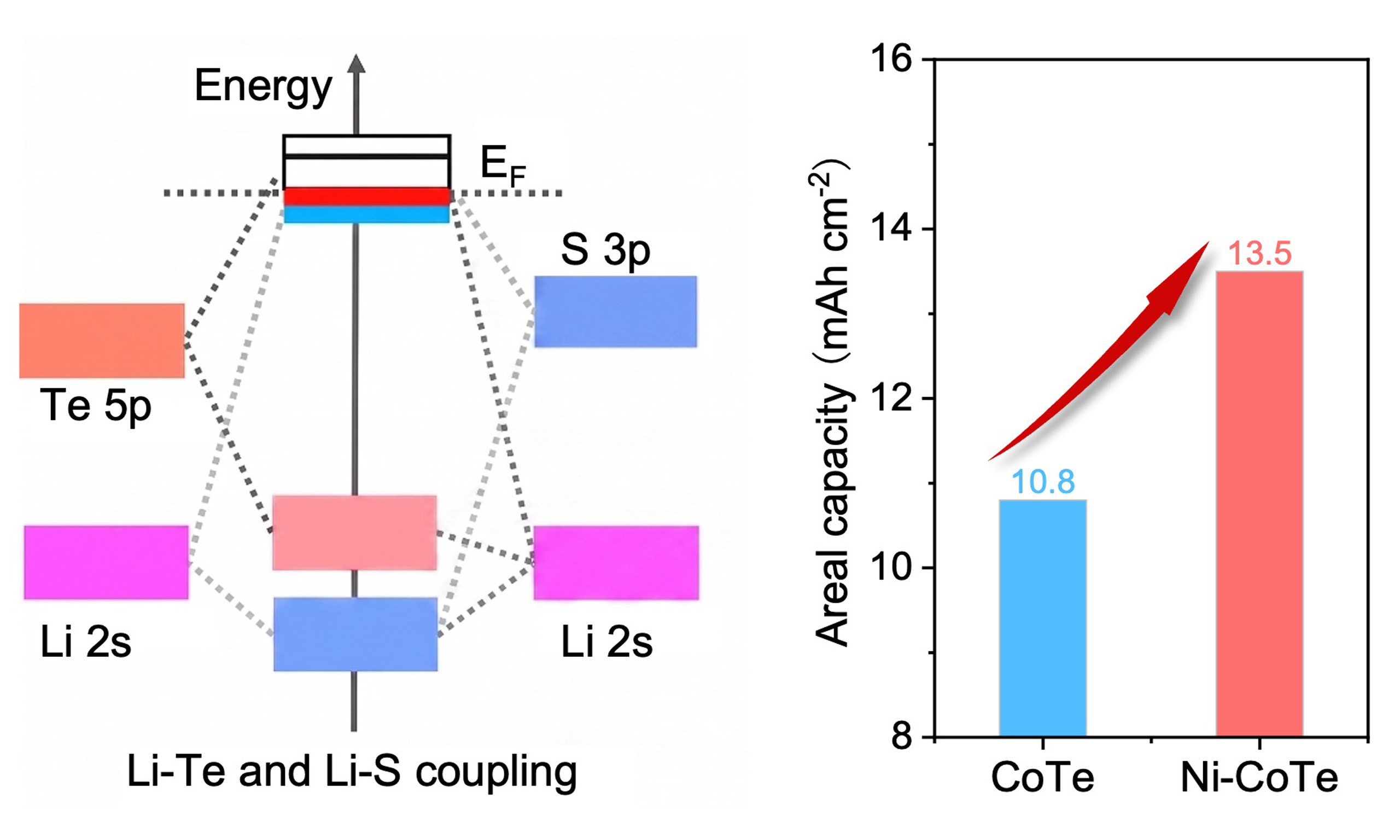
Developing an effective electrocatalyst to regulate the kinetics of the sulfur redox reaction is essential for inhibiting polysulfide shuttling in Li-S batteries. Here, the electronic structure of CoTe, modulated by cation doping, is systematically investigated to elucidate how orbital hybridization optimizes sulfur redox electrocatalysis. Among the cation-doped CoTe compounds, the introduction of Ni dopants results in the most significant shift of the p-band center of CoTe (Ni-CoTe) towards the Fermi energy level, which facilitates the formation of numerous Te vacancies on the CoTe surface. This structural configuration endows CoTe with a multitude of active sites that bind polysulfide intermediates, lowering the activation energy (Ea) of the sulfur reduction reaction, specifically reducing the Ea for the conversion of lithium polysulfides to Li2S from 0.73 eV to 0.65 eV. As a result, the Li-S battery with Ni-CoTe catalyst delivers exceptional cyclability, with a low-capacity decay of 0.049% per cycle over 1,000 cycles at 2.0 C. Moreover, an initial areal capacity of 13.5 mAh cm-2 at 0.02 C is achieved with a high sulfur loading (10.0 mg cm-2) and a low electrolyte-to-sulfur ratio (5.0 µL mg-1). These findings will provide fundamental insights into orbital-level catalyst design principles for advanced sulfur electrochemistry.
Keywords
INTRODUCTION
Lithium-sulfur (Li-S) batteries with high energy density (2,600 Wh kg-1) and abundant sulfur resources are regarded as a highly promising option for future energy storage systems[1-3]. However, the intrinsically slow conversion kinetics from soluble intermediate lithium polysulfides (LiPSs, also denoted as Li2Sn, 4 ≤ n ≤ 8) to the charge/discharge products lead to the accumulation of LiPSs in organic electrolytes and their migration between electrodes under concentration gradients, commonly referred to as the “shuttle effect”[4-8]. This phenomenon is the main factor behind poor sulfur utilization and rapid capacity degradation, thus impeding the practical applications of Li-S batteries[9-11].
Extensive efforts have focused on addressing the challenges discussed above through strategies such as sulfur host design and separator modification[12-14]. However, these approaches are inherently passive, as they fail to effectively inhibit the dissolution and accumulation of LiPS[15,16]. In the consecutive sulfur reduction reaction (SRR) process, the increased activation energy required for the conversion from liquid LiPSs to solid discharge products results in the accumulation of LiPSs, thereby serving as the primary driver of the shuttle effect[17-19]. Therefore, the efficient electrocatalytic conversion of LiPSs is considered a proactive strategy for suppressing shuttle effects. Recently, a study on the p-charge descriptor as a predictor of SRR activity demonstrated that increasing the p-charge of p-block metal sulfides significantly optimized SRR kinetics[6]. This finding underscores the potential to enhance battery performance by designing heterogeneous catalysts with tailored p-band centers, which can be achieved through atom doping.
Two-dimensional transition metal tellurides (2D-TMTs), have garnered significant attention for their remarkable catalytic activity, particularly in terms of their adjustable p-band centers[20-22]. This has led to extensive research into their potential use as catalysts in Li-S batteries. For instance, cobalt telluride (CoTe) has been demonstrated to possess abundant catalytic active sites, enabling efficient capture of polysulfides and acceleration of their conversion[23,24]. However, the environmental susceptibility of TMTs, along with deficiencies in interactions with LiPSs, presents notable obstacles to their electrocatalytic performance, thereby constraining their application in Li-S batteries[20,25,26]. Cation-doping has demonstrated considerable promise in enhancing the catalytic activity of 2D transition metal chalcogenides through the augmentation of vacancies and the adjustment of the electronic structures, specifically the p-band centers[27,28].
EXPERIMENTAL
Materials
Carbon nanotube (99.9%) was purchased from Aladdin. CoCl2·6H2O (99%), NiCl2·6H2O (99%), NaH2PO2·2H2O (99%), Na3C6H5O7·2H2O (99%), and NaOH (98%) were purchased from InnoChem. Sulfur powder (99.5%) and ethanol (AR) were purchased from Kermel. Polyvinylidene fluoride (PVDF), polytetrafluoroethylene (PTFE), and the commercial membrane (Celgard 2500) were purchased from Canrd Technology Co. Ltd. Reduced graphene oxide (99.9%) was purchased from Carmery. The Li2S6 electrolyte (0.2 M) and Li2S8 electrolyte (0.2 M) were sourced from DODOCHEM. Deionized water was produced in-house.
Synthesis of Ni-Co
Nickel-cobalt (Ni-Co) nanosheets were synthesized via a typical hydrothermal method. In a standard procedure, Na3C6H5O7·2H2O (10 mmol), CoCl2·6H2O (2 mmol), NiCl2·6H2O (0.5 mmol), and NaH2PO2·2H2O (10 mmol) were dissolved in 80 mL of deionized water under magnetic stirring at 400 rpm and room temperature (~25 oC). The total time for complete dissolution is about 10 min. Subsequently, 10 mL of NaOH solution (10 M) was added dropwise, yielding final precursor concentrations of 22.22 mM Co2+ and 5.56 mM Ni2+. After 10 min of stirring, the mixture was hydrothermally treated in a sealed 100 mL Teflon-lined autoclave at 150 °C for 24 h and then naturally cooled to room temperature. The resulting grey precipitate was collected by centrifugation, washed repeatedly with ethanol and deionized water, and dried under vacuum at 60 °C for 5 h. Co nanosheets were synthesized under identical conditions, but without adding NiCl2·6H2O.
Synthesis of Ni-CoTe and CoTe
Ni-CoTe was synthesized by placing Ni-Co and Te powder (in a mass ratio of 1:3) into separate quartz boats. The boats were positioned in the first and second temperature zones of a quartz tube furnace. A mixed gas of Ar/H2 (volume ratio 9:1) was introduced into the tube. The tube was ramped to 200 °C at 5 °C·min-1 and subsequently annealed at this temperature for 4 h to yield Ni-CoTe. CoTe was prepared following the same procedure.
Preparation of Ni-CoTe interlayer
The Ni-CoTe interlayer was fabricated using a straightforward surface coating technique. Typically, a composite consisting of 70 wt.% Ni-CoTe, 20 wt.% Gr, and 10 wt.% PVDF was homogenized in N-methyl-2-pyrrolidone (NMP) via vigorous mechanical stirring to yield a well-dispersed slurry. The slurry was coated onto a clean Celgard 2500 separator and subsequently vacuum-dried at 55 °C for 8 h. After that, the separator was punched into 16-mm-diameter circular pieces. The areal loading of the interlayer was approximately 0.34 mg cm-2. The CoTe and Gr interlayers were synthesized using the same method.
Synthesis of carbon nanotubes/sulfur cathodes
The carbon nanotubes/sulfur (CNTs/S) composite was synthesized using a simple melt-diffusion method. Specifically, CNTs and sulfur were combined in a mass ratio of 3:7, ground evenly, and then annealed at
Synthesis of freestanding high sulfur-loaded cathodes
The composite was obtained by mixing CNT/S, CNTs, and PTFE in ethanol, using a weight ratio of 80:15:5. The ethanol was subsequently evaporated using a dryer until the mixture achieved a consistency similar to silly putty. The resultant slurry was then rolled into a thin sheet and subsequently cut into 10 mm diameter circular electrodes. These electrodes were dried at 55 °C for 12 h.
Materials characterization
The composition of the products was analyzed using X-ray diffraction (XRD) (Bruker D8 ADVANCE, Bruker AXS GmbH, Germany) and Raman spectroscopy (LabRAM Odyssey, HORIBA France SAS, France). The chemical composition and valence states of the elements were examined by X-ray photoelectron spectroscopy (XPS) (SCIENTIFIC ESCALAB 250Xi, Thermo Fisher Scientific, USA). The microstructure and distribution of the materials were observed with a field emission scanning electron microscopy (SEM) (JSM-7001F, JEOL Ltd., Japan). Transmission electron microscopy (FEI Tecnai G2 F20, FEI Company, USA) was used to further observe nanoscale size, shape, and structure, as well as any potential crystal defects. Electron paramagnetic resonance (Bruker EMX PLUS, Bruker BioSpin GmbH, Germany) spectroscopy was employed to detect the formation of Te vacancies, with the magnetic field set between 2,000 and 5,000 G and a scan rate of 10 G s-1.
Electrochemical measurements
Battery fabrication was carried out inside an argon-purged glove box, employing a conventional Li-S electrolyte solution and Li foil as the counter electrode. The battery performance was characterized by galvanostatic cycling with the Neware test system (Neware Technology Limited, China) within the voltage range of 1.7-2.7 V, by cyclic voltammetry (CV) with the Ivium workstation (Ivium Technologies B.V., Netherlands), and by electrochemical impedance spectroscopy (EIS) with the DH7000C workstation (Jiangsu Donghua Analytical Instrument Co., Ltd., China) over a frequency range of 0.1 Hz to 104 Hz.
H-type glass cells penetration experiment and Li2S6 adsorption test
An H-type glass cell (5 mL) was employed to evaluate the polysulfide blocking capability of different modified separators. The cell consisted of two chambers separated by the modified separator. The left chamber was filled with a 20 mM Li2S6 solution (in LiTFSI electrolyte), while the right chamber contained pure LiTFSI electrolyte without polysulfides. The color change or concentration variation of the solution in the right chamber was monitored after different standing durations inside an argon-filled glovebox.
The adsorption capability of the different modified separators for polysulfides was further characterized using ultraviolet-visible (UV-vis) absorption spectroscopy. The UV-vis spectra were recorded to analyze the absorption intensity of the Li2S6 solution before and after adsorption, enabling quantitative evaluation of polysulfide removal efficiency.
Measurement for the deposition of Li2S
The battery was constructed with Ni-CoTe or CoTe composites deposited onto 10-mm-diameter carbon paper as the cathode and Li foil as the anode. 20 µL of 0.2 M Li2S8 solution was used as the catholyte, and
In situ Raman spectroscopy
A Li-S battery incorporating a quartz window for in situ Raman spectroscopy analysis at a 532 nm laser wavelength was assembled using Ni-CoTe or CoTe as the interlayer. The battery was evaluated at 0.2 C.
Density functional theory calculations
All density functional theory (DFT) computations were carried out with the Vienna Ab-initio Simulation Package (VASP) code, while the exchange-correlation functional was described via the generalized gradient approximation (GGA) using the Perdew-Burke-Ernzerhof (PBE) parametrization. The (103) crystal surface of CoTe was selected for its low surface energy and structural stability. The surface slab was constructed comprising 24 Co and 24 Te atoms, using the optimized bulk lattice constants. A vacuum layer of 15 Å was applied along the surface-normal direction to eliminate periodic interactions. Structural relaxations were performed using a 2 × 2 × 1 Monkhorst-Pack k-point mesh and a 300 eV plane-wave cutoff. Convergence thresholds were set to 10-5 eV for total energy and 0.01 eV Å-1 for the maximum atomic force.
The adsorption energy ∆Ead was calculated as[29]:
In which the symbols E(surf + ad), Esurf, and Ead denote the energies of the LiPS-adsorbed surface, the clean substrate, and the free LiPSs, respectively.
The Gibbs free energy is evaluated via the following equation[29]:
RESULTS AND DISCUSSION
Theoretical analyses and structural modulations for catalyst design
Interfacial interactions involving surface adsorption and charge transfer in Li-S batteries critically impact the sulfur conversion process[30,31]. Thus, regulating interfacial interactions at the substrate surface is essential for sulfur redox reactions[32,33]. In analogy to the d-band center theory for metals, the p-band center of nonmetallic anions is a key descriptor that significantly influences the adsorption energy of reaction intermediates, similar to how the d-band center affects proton adsorption in electrocatalysis[29,34].
To investigate the relationship between the Te p-band electronic structure and sulfur redox kinetics, a series of M-CoTe (M= V, Mn, Fe, Ni, Cu, Zn) compounds were designed to regulate the Te electronic structure. The calculated projected density of states (PDOS) in Figure 1A shows that the Te p-band center exhibits the most significant upward shift toward the Fermi energy level (EF) upon Ni doping, which strengthens interfacial electronic interactions by modulating the Li-Te orbital coupling, thereby optimizing the adsorption strength between M-CoTe and LiPSs. Simultaneously, the d-band center of the Co site shifts toward the EF upon Ni doping, from -2.937 eV in pure CoTe to -2.858 eV in Ni-CoTe, which tunes the occupancy of the antibonding orbitals between Co and LiPSs, adjusting the adsorption strength to an optimal level [Supplementary Figure 1]. The strategy of concurrently regulating Co d-band and Te p-band through Ni doping prevents excessive binding of reaction intermediates, thus preserving the availability of active catalytic sites[35]. Furthermore, the adsorption configurations of *S8 and Li2Sx (x = 1, 2, 4, 6, 8) on Ni-CoTe suggest that the Co, Ni, and Te sites form Co-S, Ni-S, and Li-Te bonds with the S and Li atoms in the polysulfides, whereas only Co-S and Li-Te bonds are observed on the CoTe catalyst [Supplementary Figures 2 and 3]. The adsorption energies of *S8, *Li2S8, *Li2S6, *Li2S4, *Li2S2, and *Li2S on the Ni-CoTe surface are -0.95, -1.54, -1.49, -1.84, -2.08, and -3.01 eV, respectively, which are higher than those on the CoTe surface [Figure 1B]. The enhanced adsorption of LiPSs on Ni-CoTe significantly optimized the sulfur redox kinetics.
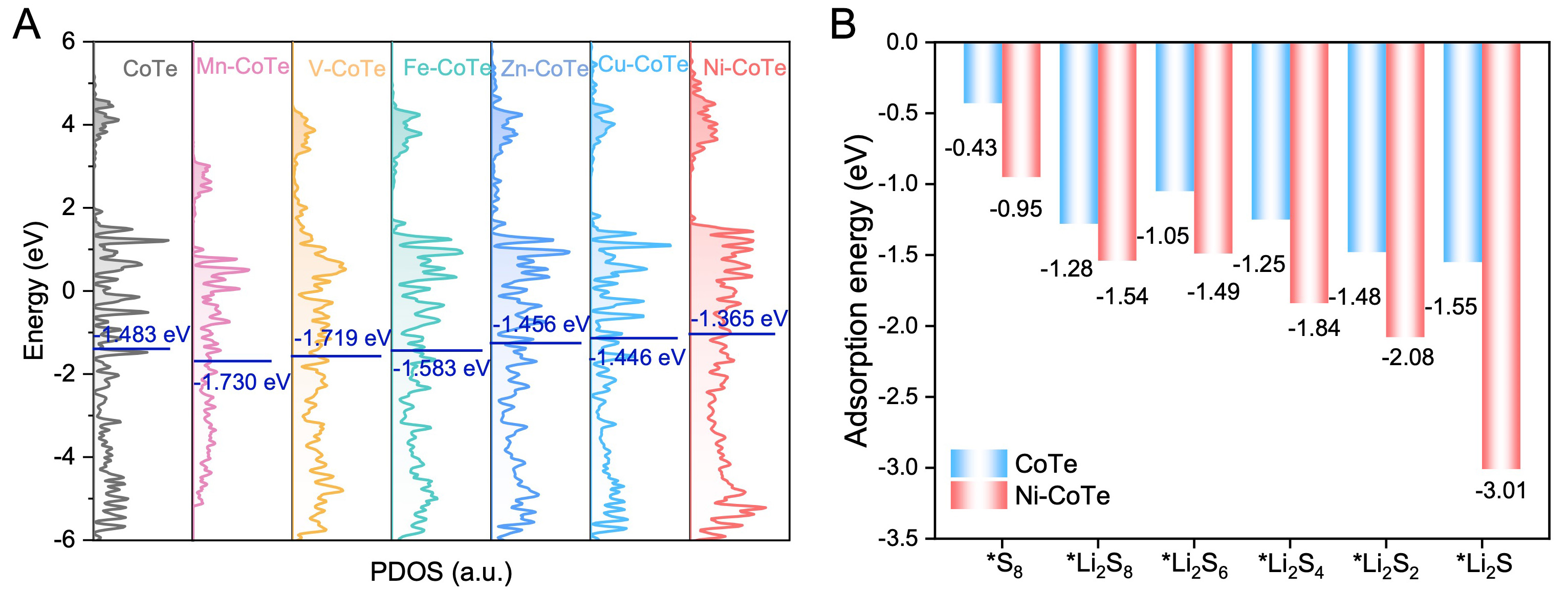
Figure 1. (A) p-band center of M-CoTe relative to the Fermi level; (B) Adsorption energy for *Li2Sx (x = 1, 2, 4, 6, 8) and *S8 on the Ni-CoTe and CoTe catalyst. PDOS: Projected density of states.
Materials characterization
Ni-CoTe nanosheets were synthesized through a hydrothermal method, followed by a chemical vapor deposition (CVD) step, with detailed preparation protocols provided in Supplementary Figure 4. For comparative purposes, CoTe and V-CoTe nanosheets were synthesized using the same procedure. SEM images reveal that the initial Ni-Co nanosheets exhibit a hexagonal structure [Supplementary Figure 5]. Subsequent SEM analyses [Figure 2A] confirm that the nanosheets retain their hexagonal morphology after the CVD treatment. The high-resolution TEM (HRTEM) image of Ni-CoTe [Figure 2B] and its inverse fast-Fourier-transform (IFFT) pattern [Figure 2C] present a clear crystalline structure, with a lattice spacing of 0.158 nm corresponding to the (103) facet of CoTe. XRD confirmed the successful synthesis and crystal phase of the as-prepared Ni-CoTe. As shown in Figure 2D, the predominant signals match well with the characteristic peaks of CoTe (PDF#34-0402), consistent with the HRTEM results. The clear diffraction peaks indicate good crystallinity, with peaks at 31.3º, 42.3º, 46.6º, and 58.2° corresponding to the (101), (102), (110), and (103) planes of orthorhombic CoTe. It is worth noting that introducing a small amount of Ni into CoTe slightly shifted the main XRD peak without creating new phases, indicating successful intercalation into the crystal lattice[36].
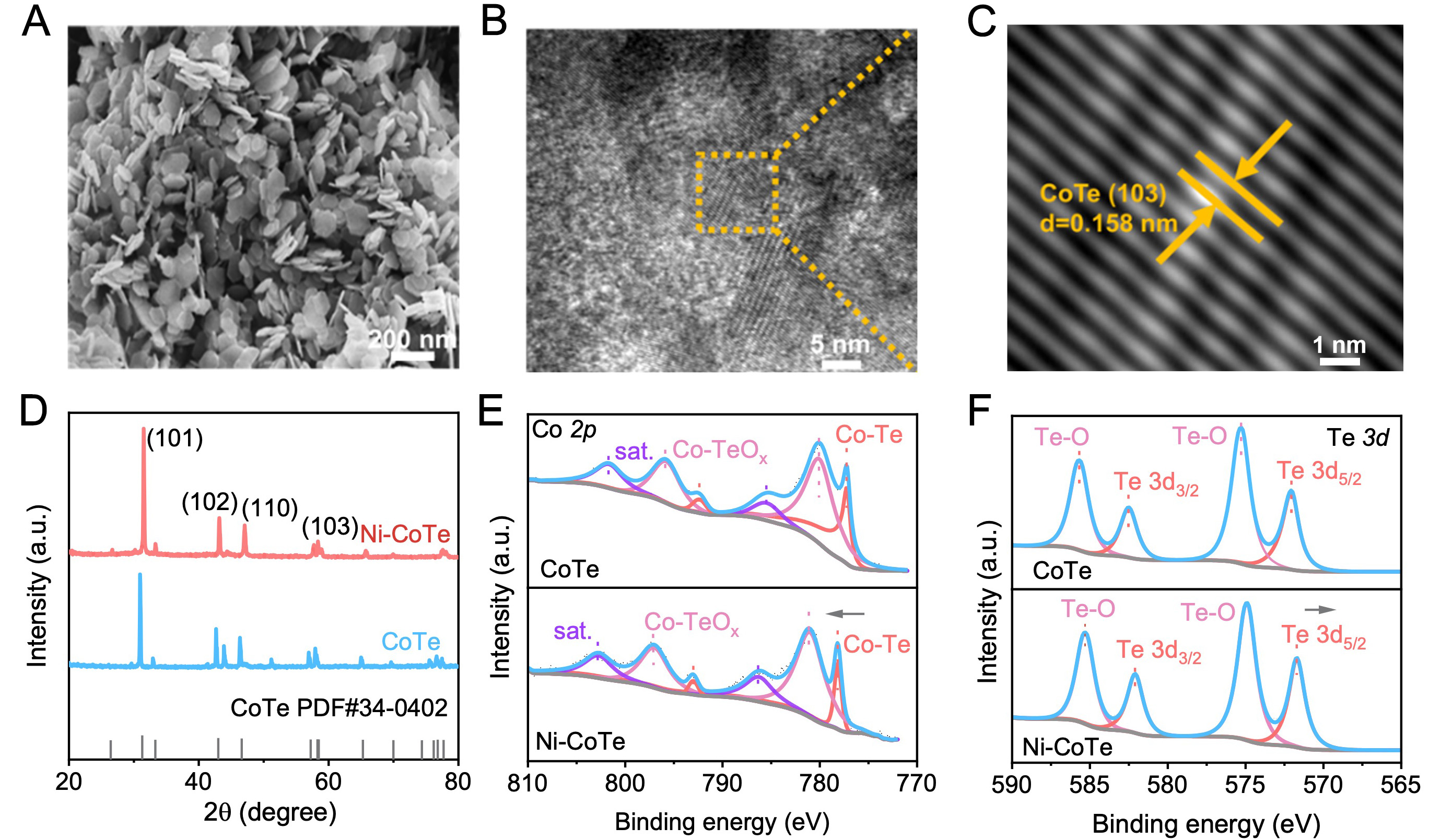
Figure 2. (A) Scanning electron microscopy (SEM) image of the Ni-CoTe catalyst; (B) High-resolution transmission electron microscopy (HRTEM); (C) Inverse fast Fourier-transform (IFFT) lattice images of Ni-CoTe; (D) X-ray diffraction (XRD) patterns of CoTe and Ni-CoTe; (E) X-ray photoelectron spectroscopy (XPS) spectra of Co 2p and (F) Te 3d for the Ni-CoTe and CoTe catalysts.
XPS was then employed to analyze the composition, elemental valence states, and electron transfer in Ni-CoTe [Figure 2E and F, Supplementary Figure 6]. The Ni-CoTe spectra exhibit Co 2p peaks that are shifted by +0.8 eV to higher binding energy in comparison to those in CoTe, while the Te 3d spectra demonstrate a slight downshift of -0.4 eV to lower binding energy. These alterations in binding energy indicate substantial electronic coupling between Ni and CoTe, suggesting electron transfer from Ni to Te and modifying the electronic structure of CoTe, further corroborating the successful incorporation of Ni into CoTe[37]. Furthermore, in contrast to the flat Electron paramagnetic resonance (EPR) signal observed in CoTe, the Ni-CoTe sample exhibited
Catalytic activity
Li-S batteries were assembled using CNTs/S cathodes and different interlayers [Ni-CoTe, V-CoTe, or CoTe-modified polypropylene (PP) separators] with lithium foil as the reference anode. The rate performance of the three batteries was systematically compared [Supplementary Figure 8]. The Ni-CoTe battery consistently achieved the highest capacities at all rates and displayed a reduced overpotential (ΔE = 151.5 mV) compared with the V-CoTe (177.9 mV) and CoTe (173.6 mV) batteries. This experimental trend corroborates the theoretical prediction that the doping of Ni causes Te p-band center to exhibit the most significant upward shift, which significantly optimizes the sulfur redox kinetics. Based on the theoretical calculations and electrochemical results, this study investigates the catalytic activity of Ni-CoTe for sulfur redox electrocatalysis in the subsequent discussion.
The catalytic activity of the as-prepared Ni-CoTe nanosheets was evaluated by performing three consecutive CV measurements on the Ni-CoTe, CoTe, and Gr electrodes [Supplementary Figure 9]. The nearly identical CV plots for the three batteries indicate reversible electrochemical properties. Figure 3A shows the first-cycle CV plots for the three batteries. In the SRR process, two cathodic peaks at ≈2.30 V (C1) and 2.05 V (C2) indicate the conversion of S8 to soluble Li2Sn and then to Li2S. During the sulfur evolution reaction, two anodic peaks at ≈2.30 V (A1) and 2.36 V (A2) correspond to the conversion of Li2S back to Li2Sn, and finally to S8. Notably, the Ni-CoTe battery exhibited the highest current response and largest peak areas for both cathodic and anodic peaks, suggesting enhanced electrochemical reaction kinetics[39]. This enhancement is attributed to Ni doping-induced Te vacancies and the regulation of the p-band center of CoTe.
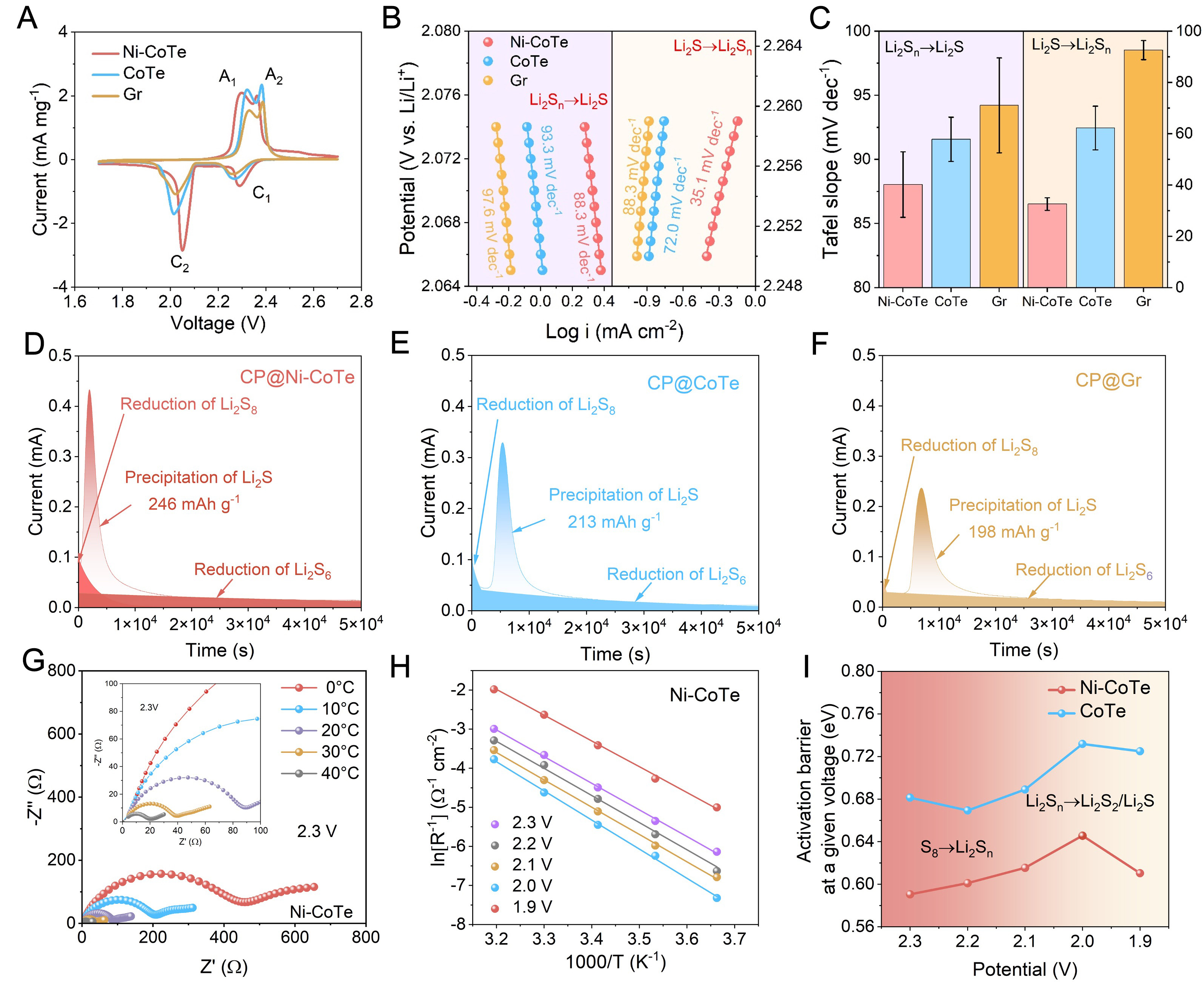
Figure 3. (A) The first cycle of CV profiles for batteries with different catalysts at a scan rate of 0.1 mV s-1; (B) Tafel slopes derived from the CV profiles in (A); (C) Tafel slopes of Ni-CoTe, CoTe, and Gr derived from three CV cycles. The error bars represent the standard deviation (cycle-to-cycle variation) of the Tafel slopes calculated from three consecutive CV cycles; (D-F) Potentiostatic discharge profiles at 2.05 V; (G) Temperature-dependent EIS spectra of the Ni-CoTe cell at 2.3 V; (H) Corresponding Arrhenius plots derived from (G); (I) Discharge activation barriers of Ni-CoTe and CoTe cells calculated from (H). EIS: Electrochemical impedance spectroscopy; CV: cyclic voltammetry.
Tafel slopes obtained from CV curves were further fitted to confirm the high electrocatalytic activity of the Ni-CoTe catalysts [Figure 3B and Supplementary Figure 10]. The Ni-CoTe battery exhibited a lower Tafel slope than the CoTe and Gr batteries in both the reduction (Li2Sn → Li2S) and the oxidation (Li2S → soluble Li2Sn) processes. To evaluate the reproducibility and reliability of the Tafel slope analysis, the average Tafel slopes from the three cycles are shown in Figure 3C alongside the cycle-to-cycle variation represented by error bars. The less-than-4% bias indicated by these bars confirms the strong reliability of the measured data. The reduction in Tafel slopes observed for both the oxidation and reduction processes in the Ni-CoTe battery confirms its bidirectional catalytic capability toward LiPS conversion[40,41].
Li2S precipitation/dissolution tests were further employed to assess the liquid-solid and solid-liquid conversion efficiency facilitated by the Ni-CoTe catalyst[42]. Coin cells were assembled utilizing CP@Ni-CoTe, CP@CoTe, and CP@Gr (where Ni-CoTe nanosheets, CoTe nanosheets, or graphene were loaded onto carbon fiber paper, respectively denoted as CP@Ni-CoTe, CP@CoTe, and CP@Gr) as cathodes, lithium foil as the anode, and a Li2S8/tetraglyme solution as the catholyte. The Li2S precipitation capacity was quantitatively determined based on Faraday’s law [Supplementary Figure 11]. As shown in Figure 3D-F and Supplementary Figure 12, the CP@Ni-CoTe cathode demonstrated the highest capacity of 246 mAh g-1 and the earliest nucleation time (1947 s). Furthermore, in contrast to the pronounced Li2S aggregation observed on the CP@CoTe and CP@Gr electrodes, SEM images in Supplementary Figure 13 show a uniform Li2S deposition on the CP@Ni-CoTe electrode. This finding provides direct evidence for the accelerated conversion of LiPSs to Li2S enhanced by the Ni-CoTe catalyst[17]. Additionally, the CP@Ni-CoTe electrode demonstrated the highest Li2S dissolution capacity and the earliest onset of Li2S dissolution, relative to those of the CP@CoTe and CP@Gr electrodes [Supplementary Figure 14]. These results confirm that the Ni-CoTe nanosheets function as bidirectional catalysts, accelerating both the reduction of LiPSs and the oxidation of Li2S[43].
The SRR kinetics (Ea) at a given voltage were experimentally determined by fitting the charge transfer resistance (Rct), measured at different temperatures using EIS, to the Arrhenius equation [Figure 3G and H, Supplementary Figures 15-17][44,45]. To ensure voltage stability during the specified redox reaction, the battery was initially discharged to a preset potential and subsequently maintained at that level via chronoamperometric control. Following this, EIS measurements were carried out across a range of temperatures, with the thermal environment precisely controlled by a variable-temperature thermotank. As shown in Figure 3I, the Ni-CoTe battery exhibited a lower Ea of 0.59 eV, in contrast to the CoTe battery
Electrochemical performances
The rate performance of Li-S batteries was compared at rates ranging from 0.2 to 5.0 C (1 C = 1,675 mA g-1) to evaluate the sulfur redox chemistry [Figure 4A] under conditions of an areal sulfur loading of
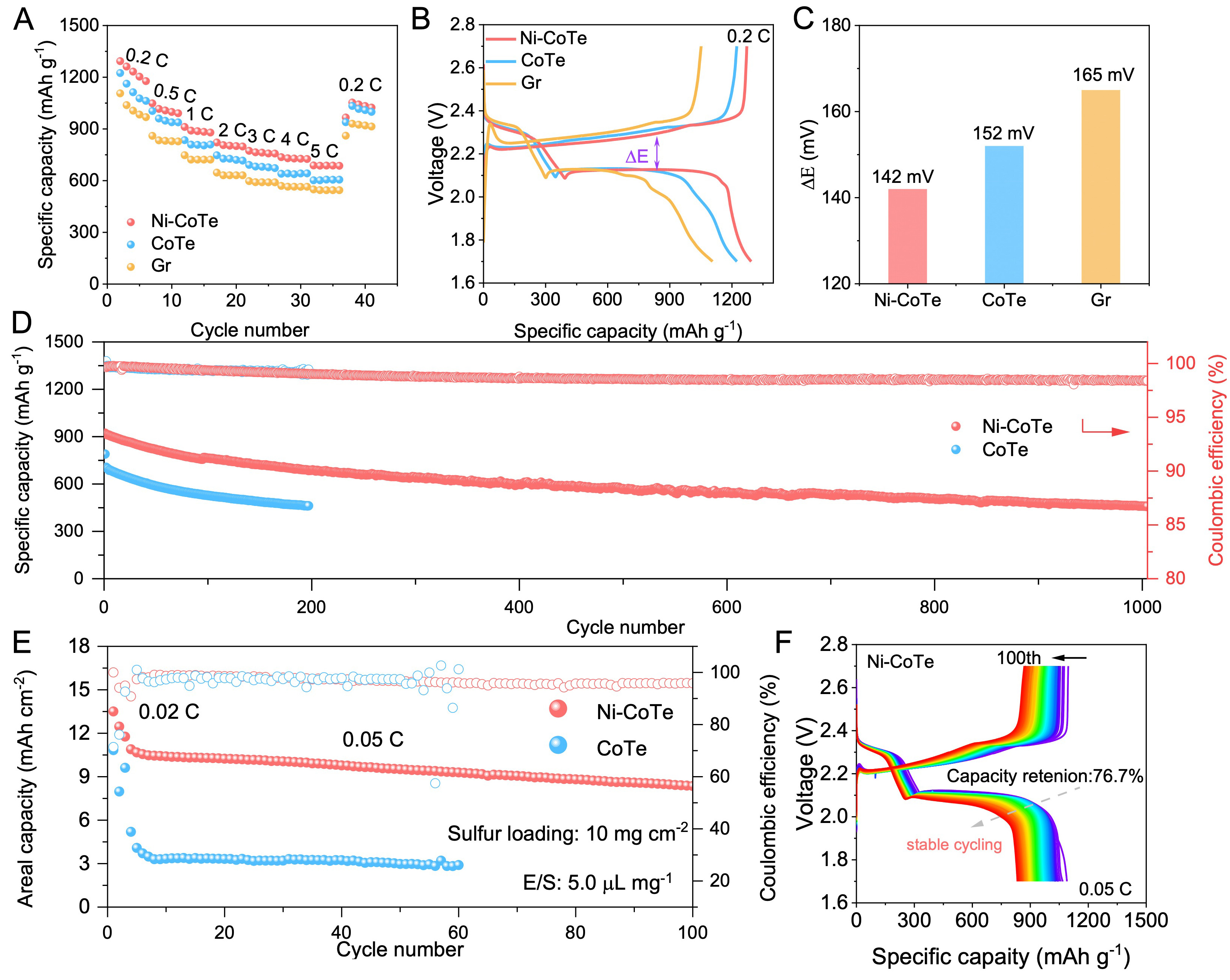
Figure 4. (A) Rate performance; (B) Initial charge-discharge curves of the three batteries at 0.2 C; (C) Plateau-voltage-derived overpotentials at 0.2 C; (D) Cycling performance at 2.0 C; (E) Cycling performance of Ni-CoTe and CoTe batteries with high sulfur loadings; (F) Charge-discharge profiles of the Ni-CoTe battery over 100 cycles at 0.05 C.
The overpotential (∆E) of the Ni-CoTe battery, calculated from the first-cycle charge/discharge plateaus, was 142 mV, notably lower than the values for the CoTe (152 mV) and Gr (165 mV) batteries [Figure 4B and C]. Furthermore, the differential plots corresponding to the charge/discharge profiles of Ni-CoTe, CoTe, and Gr batteries have been analyzed [Supplementary Figure 18], further revealing that the Ni-CoTe battery exhibits a lower overpotential compared to the CoTe battery and the Gr battery. The lower overpotential suggests that the electrochemical kinetics are more favorable with the Ni-CoTe catalyst[48]. Besides, the shuttle constant (ks) obtained from the charge/discharge profiles is much lower for the Ni-CoTe battery (0.054 h-1) than that for the CoTe (0.070 h-1) and Gr (0.126 h-1) batteries [Supplementary Figures 19 and 20], which indicates that the shuttle effect was effectively inhibited with the Ni-CoTe catalyst, enhancing the utilization of sulfur[6].
To directly assess the impact of catalysis on battery lifespan, cycling performance at 2.0 C was compared. As shown in Figure 4D, the Ni-CoTe battery achieved a high initial specific capacity of 921.9 mAh g-1 at 2.0 C, with capacity retention reflected in a low decay rate of 0.049 % per cycle over 1,000 cycles. Notably, this long-term stability test was conducted under conditions of low-sulfur loading (0.88 mg cm-2) and excess electrolyte (20 μL on the cathode side), which were intentionally chosen to evaluate the intrinsic catalytic activity of the Ni-CoTe catalyst. In sharp contrast, the CoTe battery suffered from rapid capacity fading, declining to 461.8 mAh g-1 with a decay rate of 0.21% per cycle after 200 cycles. Furthermore, the Ni-CoTe battery exhibited more stable Coulombic efficiency than the CoTe battery, indicating that polysulfide shuttling was significantly suppressed. It is widely considered that both the increase in areal sulfur loading and the decrease in electrolyte dosage are essential for the prospective application of Li-S batteries. Therefore, batteries with a sulfur loading as high as 10.0 mg cm-2 and an E/S ratio of only 5.0 µL mg-1 were constructed. As shown in Figure 4E, with an initial capacity of 1,350.5 mAh g-1 (13.5 mAh cm-2) at 0.02 C, the Ni-CoTe battery also showed a high areal capacity of 10.9 mAh cm-2 when tested at 0.05 C. Moreover, a capacity of 8.36 mAh cm-2 was maintained over 100 cycles, affording a retention of 76.7%; the initial capacity and its retention capability at 0.05 C were much superior to those of the CoTe battery, indicating improved sulfur utilization with the Ni-CoTe catalyst. The electrochemical performance surpassed most high-sulfur-loaded Li-S batteries reported in previous literature [Supplementary Table 1], demonstrating promising prospects for practical application[40,48-56]. Furthermore, compared with the CoTe battery, the Ni-CoTe battery exhibited stable discharge-charge plateaus and Coulombic efficiency during cycling under such a high sulfur mass loading, confirming the high catalytic activity of the Ni-CoTe catalyst in promoting polysulfide conversion [Figure 4E and F, Supplementary Figure 21].
The inhibition of polysulfide shuttling
To further verify that the shuttle effect was inhibited with the Ni-CoTe catalyst, an in situ Raman test was performed during cycling at 0.2 C. A Li-S battery was assembled using a polypropylene separator modified with Ni-CoTe or CoTe catalyst, a quartz window, and a small aperture in the lithium anode, allowing confocal Raman signals to be captured at the separator/lithium interfaces [Figure 5A-F][57,58]. When using the CoTe-modified separator, characteristic Raman peaks at 218 and 472 cm-1, assigned to S82-, were observed around 2.5 V, indicating the liberation and migration of high-order LiPSs from the conductive substrate toward the lithium anode[48]. As discharge proceeded, the S82- peaks diminished, while peaks at 398 and
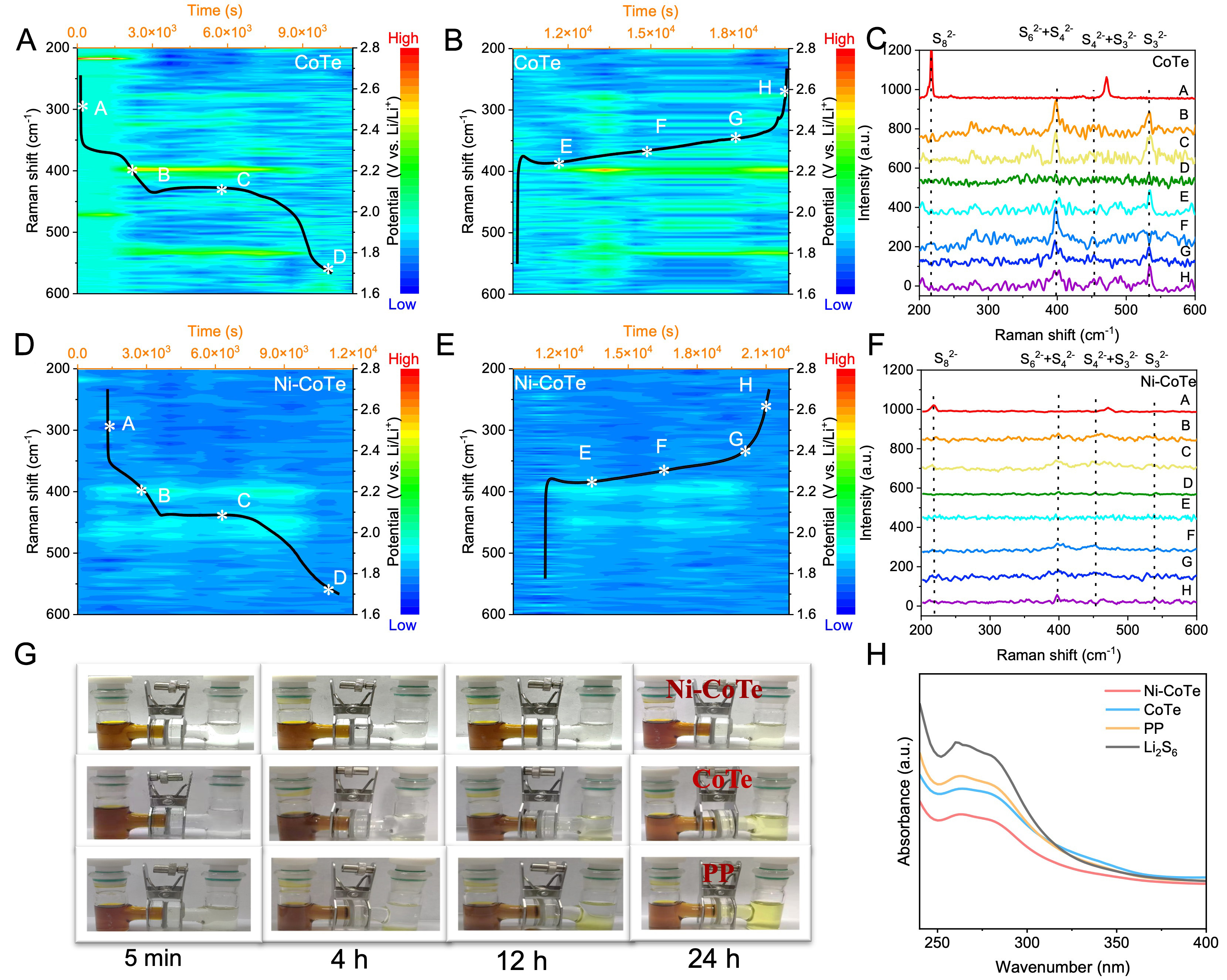
Figure 5. Time-resolved Raman spectra of Li-S batteries during discharge and charge at 0.2 C, with (A-C) CoTe and (D-F) Ni-CoTe coated separators. The black curves on the contour maps show the galvanostatic voltage profiles, with white stars A-H indicating the electrochemical states for the representative Raman spectra. (A-D )and (E-H) denote selected states during discharge and charge, respectively. The corresponding Raman spectra for states A-H are presented in (C) for the CoTe battery and in (F) for the Ni-CoTe battery; (G) Polysulfide permeation in H-type cells using Ni-CoTe-coated, CoTe-coated, and uncoated PP separators; (H) UV-vis spectra of the blank-side electrolytes after 24 h for the three configurations. UV-vis: Ultraviolet-visible.
To further investigate suppression of polysulfide shuttling, H-shaped electrolytic cells were assembled, with Ni-CoTe-coated, CoTe-coated, and uncoated separators positioned between two electrolytes. As shown in Figure 5G-H, the left chamber contained 5 mL of 20 mM Li2S6 solution, while the right chamber held 5 mL of blank electrolyte, and the two compartments were separated by either a Ni-CoTe-coated, CoTe-coated, or uncoated separator. Experiments conducted with uncoated separators revealed significant Li2S6 permeation within 4 h, whereas both the Ni-CoTe and CoTe separators kept the right chamber colorless. After 12 h of standing, the uncoated separator caused the solution in the right chamber to turn yellow. In contrast, the CoTe separator allowed only a limited amount of Li2S6 to cross over this period, resulting in a faint yellow, while the Ni-CoTe separator maintained the right chamber almost colorless. This result indicates that both CoTe and Ni-CoTe coatings significantly suppress LiPS permeation compared to the uncoated PP separator, with Ni-CoTe providing substantially superior suppression. Extending the standing time to 24 h resulted in nearly identical coloration on both sides of the cell with an uncoated PP separator, while the CoTe-coated separator gave rise to a light yellow in the right chamber. By sharp contrast, the right chamber exhibited a considerably paler shade when the Ni-CoTe separator was employed. The Li2S6 concentration in the right-chamber electrolyte was monitored via ultraviolet-visible (UV/Vis) spectroscopy. As shown in Figure 5H, after 24 h, the S62- peak intensity at 265 nm for the solution exposed to the Ni-CoTe separator was lower than that for the solution exposed to the CoTe separator and the uncoated PP separator. These results confirm that Ni-CoTe possesses a strong adsorption capacity for LiPSs, thereby effectively suppressing the polysulfide shuttling.
Recently, novel electrolytes such as sparingly solvating electrolytes (SSEs) have shown great promise in preventing polysulfide shuttling but faced challenges in catalyzing sulfur conversion[60]. The Ni-CoTe catalyst, with its abundant Te vacancies and optimized p-band center, provided strong adsorption sites that facilitate the direct capture and subsequent conversion of LiPSs at the catalyst surface. Therefore, the combined effect of SSEs and Ni-CoTe is anticipated to significantly improve battery performance, particularly under practical conditions of high sulfur loading and lean electrolyte.
CONCLUSION
In summary, we have successfully designed and synthesized a Ni-CoTe electrocatalyst to optimize the sulfur redox kinetics for inhibiting polysulfide shuttling. Experimental and theoretical results consistently showed that Ni doping introduced Te vacancies, which elevated the p-band center. This enhancement strengthened the chemical interaction with LiPSs, reducing the activation energy of the RDS for the SRR from 0.73 eV to 0.65 eV and promoting Li2S nucleation. Consequently, the Ni-CoTe battery demonstrated durable cycling performance at 2.0 C for 1,000 cycles, corresponding to a decay rate as low as 0.049% per cycle. Moreover, under the conditions of 10.0 mg cm-2 sulfur and E/S of 5.0 µL mg-1, the Ni-CoTe battery delivered an areal capacity of 8.36 mAh cm-2 upon 100 cycles at 0.05 C. This work demonstrates an electronic structure regulation strategy to enhance the catalytic activity of transition-metal tellurides for high-performance Li-S batteries.
DECLARATIONS
Authors’ contributions
Contributed equally to this work: Qie, J.; Sun, H.; Geng, S.
Designed the research, supervised experiments, and edited the paper: Wei, J.; Dai, S.; Chen, K.; Hua, W.; Zhou, Z.
Carried out the experiments, analyzed the electrochemical data and wrote the paper: Qie, J.; Sun, H.
Contributed to the DFT calculations and discussion on the electronic properties of the catalysts: Geng, S.; Liu, T.
Characterized the materials and analyzed the results: Qie, J.; Sun, H.; Geng, S.; Shang, Y.; Huang, Q.
All authors discussed the results and commented on the paper.
Availability of data and materials
The data supporting the findings of this study are available within this Article and its Supplementary Materials. Further data are available from the corresponding authors upon request.
AI and AI-assisted tools statement
Not applicable.
Financial support and sponsorship
This work was financially supported by the National Natural Science Foundation of China (Nos. 22309042, 22579046, 52272038, 22308086), the Natural Science Foundation of Henan (262300421041), and Program for Science and Technology Innovation Talents in University of Henan Province (26HASTIT003).
Conflicts of interest
All authors declared that there are no conflicts of interest.
Ethical approval and consent to participate
Not applicable.
Consent for Publication
Not applicable.
Copyright
© The Author(s) 2026.
Supplementary Materials
REFERENCES
1. Zhou, S.; Shi, J.; Liu, S.; et al. Visualizing interfacial collective reaction behaviour of Li-S batteries. Nature 2023, 621, 75-81.
2. Manthiram, A.; Chung, S. H.; Zu, C. Lithium-sulfur batteries: progress and prospects. Adv. Mater. 2015, 27, 1980-2006.
3. Zhou, T.; Lv, W.; Li, J.; et al. Twinborn TiO2-TiN heterostructures enabling smooth trapping-diffusion-conversion of polysulfides towards ultralong life lithium-sulfur batteries. Energy. Environ. Sci. 2017, 10, 1694-703.
4. Sun, Y.; Wang, J.; Shang, T.; et al. Counting d-orbital vacancies of transition-metal catalysts for the sulfur reduction reaction. Angew. Chem. Int. Ed. 2023, 62, e202306791.
5. Peng, L.; Shang, T.; Han, J.; et al. Nonpoisoned metal catalysts enabled by concave carbon confinement for durable sulfur conversion in batteries. Energy. Environ. Sci. 2026, 19, 982-94.
6. Hua, W.; Shang, T.; Li, H.; et al. Optimizing the p charge of S in p-block metal sulfides for sulfur reduction electrocatalysis. Nat. Catal. 2023, 6, 174-84.
7. Geng, C.; Lei, Y.; Shi, J.; et al. Ionic liquids anchored on carbon synchronize ion-electron transport in liquid- and solid-state sulfur batteries. ACS. Energy. Lett. 2025, 10, 5956-64.
8. Liu, R.; Wei, Z.; Peng, L.; et al. Establishing reaction networks in the 16-electron sulfur reduction reaction. Nature 2024, 626, 98-104.
9. Peng, L.; Geng, C.; He, Y.; et al. Surface charge-modulated electric-double-layer structure on Pt catalyst for efficient and durable sulfur reaction in Li-S batteries. Angew. Chem. Int. Ed. 2026, 65, e23287.
10. Hu, Z.; Geng, C.; Shi, J.; et al. Breaking Li+ diffusion limits in practical Li-S batteries via electrolyte-dispersible Li+-reservoir catalysts. J. Am. Chem. Soc. 2025, 147, 41924-33.
11. Yu, T.; Xiao, R.; Tang, P.; et al. Breaking insulating barriers in solid-phase conversion reactions with dual-atom catalysts for high-energy lithium batteries. Nat. Catal. 2026, 9, 460-70.
12. Wu, Z.; Liu, M.; He, W.; et al. Unveiling the autocatalytic growth of Li2S crystals at the solid-liquid interface in lithium-sulfur batteries. Nat. Commun. 2024, 15, 9535.
13. Bonilla, Á.; Gentile, A.; Ferrara, C.; et al. Dual role of Ti3C2Tx MXene in Li-S batteries: cathode additive and separator modifier for enhanced performance. Adv. Funct. Mater. 2026, 36, e19742.
14. Chen, X.; Jiang, H.; Liu, J.; et al. Covalent organic frameworks and their derivatives for applications in high-performance lithium-sulfur batteries. Adv. Funct. Mater. 2025, 35, 2421697.
15. Jiang, Y.; Liao, Y.; Yu, J.; et al. Multi-effect ionic liquid additives achieve high cycle stability lithium-sulfur batteries by constructing an electrostatic shielding layer and eliminating ‘dead sulfur’. Adv. Funct. Mater. 2025, 35, 2500077.
16. Peng, L.; Han, J.; Cao, Y.; et al. Metal-halide gelated MXene and its use as a bifunctional sulfur host stabilizing both cathode and anode for practical lithium-sulfur batteries. Adv. Funct. Mater. 2024, 34, 2310508.
17. Jiang, Q.; Xu, H.; Ye, X.; et al. Breaking the rate limiting barrier in lithium||sulfur batteries via spin state engineering. Nat. Commun. 2026, 17, 4466.
18. Dong, Y.; Cai, D.; Li, T.; et al. Sulfur reduction catalyst design inspired by elemental periodic expansion concept for lithium-sulfur batteries. ACS. Nano. 2022, 16, 6414-25.
19. Jiang, M.; Shi, J.; Wang, J.; et al. Optimizing f-d hybridization descriptor in rare-earth oxides for efficient sulfur catalysis in all solid-state lithium-sulfur batteries. Adv. Mater. 2026, 38, e20011.
20. Li, S.; Yang, H.; Tong, H.; et al. Orbital-tailoring strategy via dual-defect engineering in P-FeTe2-x@NC synergizes polysulfide adsorption-conversion for lithium-sulfur batteries. Adv. Mater. 2025, 37, e11910.
21. Hua, W.; Li, H.; Hu, Z.; et al. Phase engineering of 2D telluride crystals for sulfur catalysis in batteries. Adv. Energy. Mater. 2026, 16, 2501963.
22. Gong, Q.; Yang, D.; Yang, H.; et al. Cobalt ditelluride meets tellurium vacancy: an efficient catalyst as a multifunctional polysulfide mediator toward robust lithium-sulfur batteries. ACS. Nano. 2024, 18, 28382-93.
23. Yang, Z.; Yan, R.; Han, J.; et al. Oxygen bridges of CoTe2/Co-O-NC enhancing adsorption-catalysis of polysulfide for stable lithium-sulfur batteries. Adv. Funct. Mater. 2025, 35, 2417834.
24. Li, Q.; Liang, Z.; Huang, Y.; et al. Tailoring self-catalytic N-Co bonds into heterostructure architectures: deciphering polytellurides conversion mechanism toward ultralong-lifespan potassium ion storage. Adv. Mater. 2025, 37, e2502894.
25. Zhu, Y.; Wang, M.; Ci, H.; Ding, Y.; Gao, X.; Sun, J. Decorating vertically oriented graphene arrays with Co-doped NiTe2 toward Al-current-collector-free Li-S batteries. Renewables 2023, 1, 582-9.
26. Bi, W.; Li, C.; Yang, D.; et al. MOF-derived ultrathin carbon nanosheets integrated with telluride nanoparticles: synergistic polysulfide adsorption and catalytic sites for enhanced sulfur redox reactions. Energy. Environ. Sci. 2025, 18, 1929-40.
27. Shen, Z.; Jin, X.; Tian, J.; et al. Cation-doped ZnS catalysts for polysulfide conversion in lithium-sulfur batteries. Nat. Catal. 2022, 5, 555-63.
28. He, C.; Yu, S.; Gao, X.; et al. Synergistic dual-gradient architecture and vacancy-engineered catalytic interfaces via p-band modulation for high-reversibility lithium-sulfur batteries. Adv. Funct. Mater. 2026, 36, e13418.
29. Wang, W.; Wang, X.; Yang, H.; et al. Design rules for anion-doped catalysts revealed by p-p-s orbital coupling in Li-S chemistry. Nat. Commun. 2025, 16, 10895.
30. Hu, Z.; Geng, C.; Shi, J.; et al. In situ welding ionic conductive breakpoints for highly reversible all-solid-state lithium-sulfur batteries. J. Am. Chem. Soc. 2024, 146, 34023-32.
31. Li, Q.; Xie, C.; Jiang, X.; et al. Catalytic solder fuses solid-solid interfaces for all-solid-state lithium-sulfur batteries. Adv. Mater. 2025, 37, e2507308.
32. Yang, J. L.; Xu, H.; Xiao, T.; et al. High-dimensional strain unlocks fast polysulfide redox kinetics for lithium-sulfur batteries. Nat. Commun. 2025, 16, 8910.
33. Deelen TW, Hernández Mejía C, de Jong KP. Control of metal-support interactions in heterogeneous catalysts to enhance activity and selectivity. Nat. Catal. 2019, 2, 955-70.
34. Lao, Z.; Han, Z.; Ma, J.; et al. Band structure engineering and orbital orientation control constructing dual active sites for efficient sulfur redox reaction. Adv. Mater. 2024, 36, e2309024.
35. Wang, Y.; Liu, D.; Wang, H.; et al. Unified electronic-geometric descriptor deciphers peroxymonosulfate activation using Fe-based dual-atom catalysts. Nat. Commun. 2025, 16, 10491.
36. Wang, W.; Wang, X.; Shan, J.; et al. Atomic-level design rules of metal-cation-doped catalysts: manipulating electron affinity/ionic radius of doped cations for accelerating sulfur redox kinetics in Li-S batteries. Energy. Environ. Sci. 2023, 16, 2669-83.
37. Yi, M.; Lv, S.; Chu, L.; et al. Ionic-liquid-assisted synthesis of NiTe/CoTe heterostructure with Te vacancies in N, P, and F Co-doped hollow carbon nanorods for efficient alkaline hydrogen evolution and high-performance flexible supercapacitors. Rare. Metals. 2026, 45, e70118.
38. Wu, X.; Xie, R.; Cai, D.; et al. Engineering defect-rich bimetallic telluride with dense heterointerfaces for high-performance lithium-sulfur batteries. Adv. Funct. Mater. 2024, 34, 2315012.
39. Li, P.; Luo, Z.; Chen, Z.; et al. Hyaluronic acid with double helix ion channels for efficient electrolyte retention and polysulfide regulation in lean-electrolyte lithium-sulfur batteries. Adv. Mater. 2025, 37, e11272.
40. Jiang, X.; Qu, W.; Ye, R.; et al. A band-matching descriptor breaks scaling relations for sulfur electrocatalysts. J. Am. Chem. Soc. 2026, 148, 19048-60.
41. Na, F.; Li, X.; Wang, J.; et al. Immobilizing single atom on high-entropy oxides as separator regulators for catalyzing low-temperature lithium-sulfur battery. Energy. Storage. Mater. 2025, 78, 104228.
42. Mao, Y.; Zhang, Y.; Su, M.; et al. Synergetic insights into Nb single atoms and lithiophilic support for high-efficiency sulfur catalysis in Li-S batteries. Energy. Environ. Sci. 2025, 18, 8631-44.
43. Huang, Y.; Li, J.; Zhang, Y.; et al. Energizing robust sulfur/lithium electrochemistry via nanoscale-asymmetric-size synergism. J. Am. Chem. Soc. 2025, 147, 4752-65.
44. Han, Z.; Gao, R.; Wang, T.; et al. Machine-learning-assisted design of a binary descriptor to decipher electronic and structural effects on sulfur reduction kinetics. Nat. Catal. 2023, 6, 1073-86.
45. Zhao, Y.; Geng, C.; Wang, L.; et al. Engineering catalytic defects via molecular imprinting for high energy Li-S pouch cells. Natl. Sci. Rev. 2024, 11, nwae190.
46. Zhu, X.; Wang, W.; Dou, W.; et al. Directional catalysis of sulfur at highly ordered triple-phase interfaces in all-solid-state lithium-sulfur batteries. Adv. Mater. 2026, 38, e22483.
47. Zhang, Y.; Li, X.; Wang, Y.; et al. Edge-delocalized electron effect on self-expediating desolvation kinetics for low-temperature Li-S batteries. Adv. Funct. Mater. 2025, 35, 2508225.
48. Cheng, Z.; Wu, P.; Dong, W. X.; et al. Biomimetic gradient-porous carbon enables sustainable high-loading lithium-sulfur batteries by regulating polysulfide chemistry. Angew. Chem. Int. Ed. 2026, 65, e5836599.
49. Li, Z.; Liu, R.; Chen, Q.; Wen, M.; Huang, X.; Yue, Q. Two-dimensional mesoporous tungsten oxynitride/carbon nanosheets: enabling high-performance lithium-sulfur batteries. Angew. Chem. Int. Ed. 2026, 65, e9899225.
50. Zhao, W.; Mao, Y.; Zhang, W.; et al. Nanoheterocrystal catalysts designed by multiple reactivity descriptors for accelerated redox kinetics in Li-S batteries. ACS. Nano. 2026, 20, 8659-70.
51. Zhu, R.; Wu, Z.; He, C.; et al. Electronegative Co-WO2 interface with Li+ pump effects for efficient polysulfide conversion in high-performance Li-sulfur batteries. ACS. Nano. 2025, 19, 23479-89.
52. Tian, J.; Yang, Z.; Xiao, T.; et al. Oxygen bridge-induced spin-state engineering enables solvation-barrier-free sulfur redox kinetics in lithium-sulfur batteries. Angew. Chem. Int. Ed. 2026, , e4944842.
53. Kong, Y.; Wang, L.; Mamoor, M.; et al. Co/Mon invigorated bilateral kinetics modulation for advanced lithium-sulfur batteries. Adv. Mater. 2024, 36, e2310143.
54. He, Y.; Xiong, D.; Chen, M.; et al. Modulating ion-dipole and dipole-dipole interactions for stable wide-temperature-range lithium–sulfur batteries enabled by quantum-dot catalysts. Angew. Chem. Int. Ed. 2025, 137, e202512168.
55. Wang, B.; Wang, L.; Ding, D.; et al. Zinc-assisted cobalt ditelluride polyhedra inducing lattice strain to endow efficient adsorption-catalysis for high-energy lithium-sulfur batteries. Adv. Mater. 2022, 34, e2204403.
56. Liu, L.; Cui, H.; Shen, J.; et al. Synergistic interface engineering of heterojunction and oxygen vacancies in multiphase cobalt oxide/graphene composite host for high-performance lithium-sulfur batteries. Adv. Energy. Mater. 2026, 16, e06549.
57. Deng, D. R.; Xiong, H. J.; Luo, Y. L.; et al. Accelerating the rate-determining steps of sulfur conversion reaction for lithium-sulfur batteries working at an ultrawide temperature range. Adv. Mater. 2024, 36, e2406135.
58. Lin, Y.; Wang, J.; Zhang, X.; et al. Single atom-particle tandem catalysis enables enhanced desolvation kinetics for low-temperature Li-S batteries. Adv. Funct. Mater. 2025, 35, 2501496.
59. Zeng, Q.; Xu, L.; Li, G.; et al. Integrating sub-nano catalysts into metal-organic framework toward pore-confined polysulfides conversion in lithium-sulfur batteries. Adv. Funct. Mater. 2023, 33, 2304619.
Cite This Article
 Open Access
How to Cite
Download Citation
Export Citation File:
Type of Import
Tips on Downloading Citation
Citation Manager File Format
Type of Import
Direct Import: When the Direct Import option is selected (the default state), a dialogue box will give you the option to Save or Open the downloaded citation data. Choosing Open will either launch your citation manager or give you a choice of applications with which to use the metadata. The Save option saves the file locally for later use.
Indirect Import: When the Indirect Import option is selected, the metadata is displayed and may be copied and pasted as needed.
About This Article
Copyright

Data & Comments
Data
0











Comments
Comments must be written in English. Spam, offensive content, impersonation, and private information will not be permitted. If any comment is reported and identified as inappropriate content by OAE staff, the comment will be removed without notice. If you have any queries or need any help, please contact us at [email protected].