

fig2
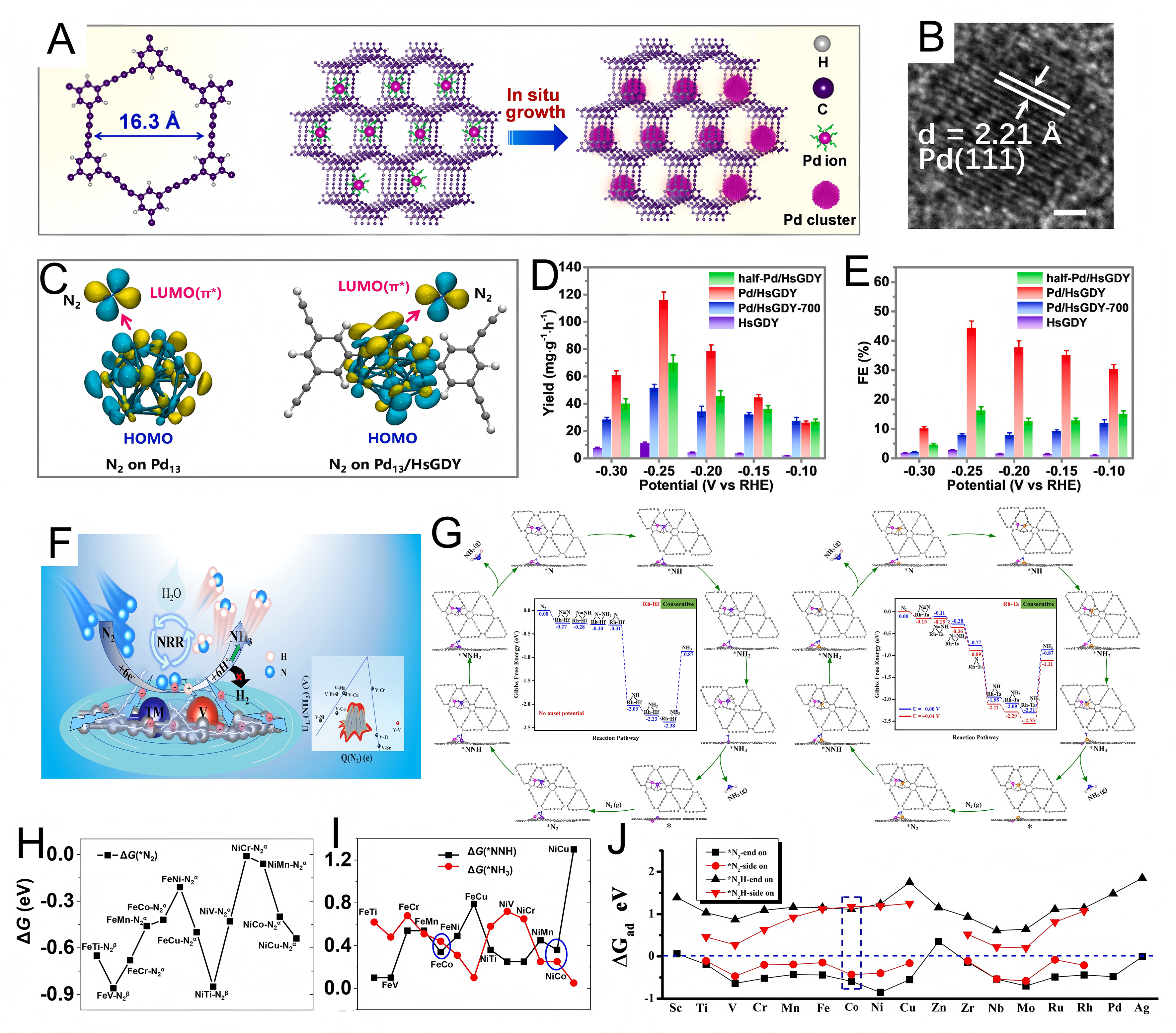
Figure 2. (A) The structural feature of HsGDY, along with a schematic depiction of the preparation route for Pd/HsGDY; (B) HRTEM of Pd/HsGDY; (C) N2 adsorption on Pd13 and Pd13/HsGDY; pink arrows denote electron-transfer direction; (D and E) NH3 yields and FEs for the catalysts[78]; (A-E) are reprinted with permission from reference[78]. Copyright 2021 Elsevier; (F) Dual-atom catalysts composed of V and 3d TMs have enhanced NRR activity because they modulate charge transfer[143]. Reprinted with permission from reference[143]. Copyright 2025 The Royal Society of Chemistry; (G) Gibbs free-energy profiles and intermediate geometries along optimal routes on Rh-Hf@GDY and Rh-Ta@GDY at zero (blue) and onset (red) potentials, respectively[144]. Reprinted with permission from reference[144]. Reproduced under the CC BY license; (H) Free-energy changes for the best N2 adsorption on tested catalysts (ΔG(N2)), with N2α and N2β representing end-on and side-on adsorption; (I) ΔG(NNH) and ΔG(*NH3) correspond to the first and last proton-electron pair transfers to N2 (forming NNH) and NH2 (forming NH3), respectively[145]; (H and I) are reprinted with permission from reference[145]. Copyright 2020 Science Press and Dalian Institute of Chemical Physics, Chinese Academy of Sciences. Published by Elsevier B.V. and Science Press; (J) Adsorption energies of N2 and N2H in the end-on and side-on patterns on TM-Co3@GDY[146]. Reprinted with permission from reference[146]. Copyright 2021 American Chemical Society. LUMO: Lowest unoccupied molecular orbital; HOMO: highest occupied molecular orbital; HsGDY: hydrogen-substituted graphdiyne; RHE: reversible hydrogen electrode; FEs: Faraday efficiencies; TMs: Sc, Ti, V, Cr, Mn, Fe, Co, Ni, Cu, Zn, Zr, Nb, Mo, Ru, Rh, Pd, and Ag, toxic/radioactive elements were excluded in this study; NRR: nitrogen reduction reaction; NNH: *NNH free radical; HRTEM: high-resolution transmission electron microscopy.