




fig4
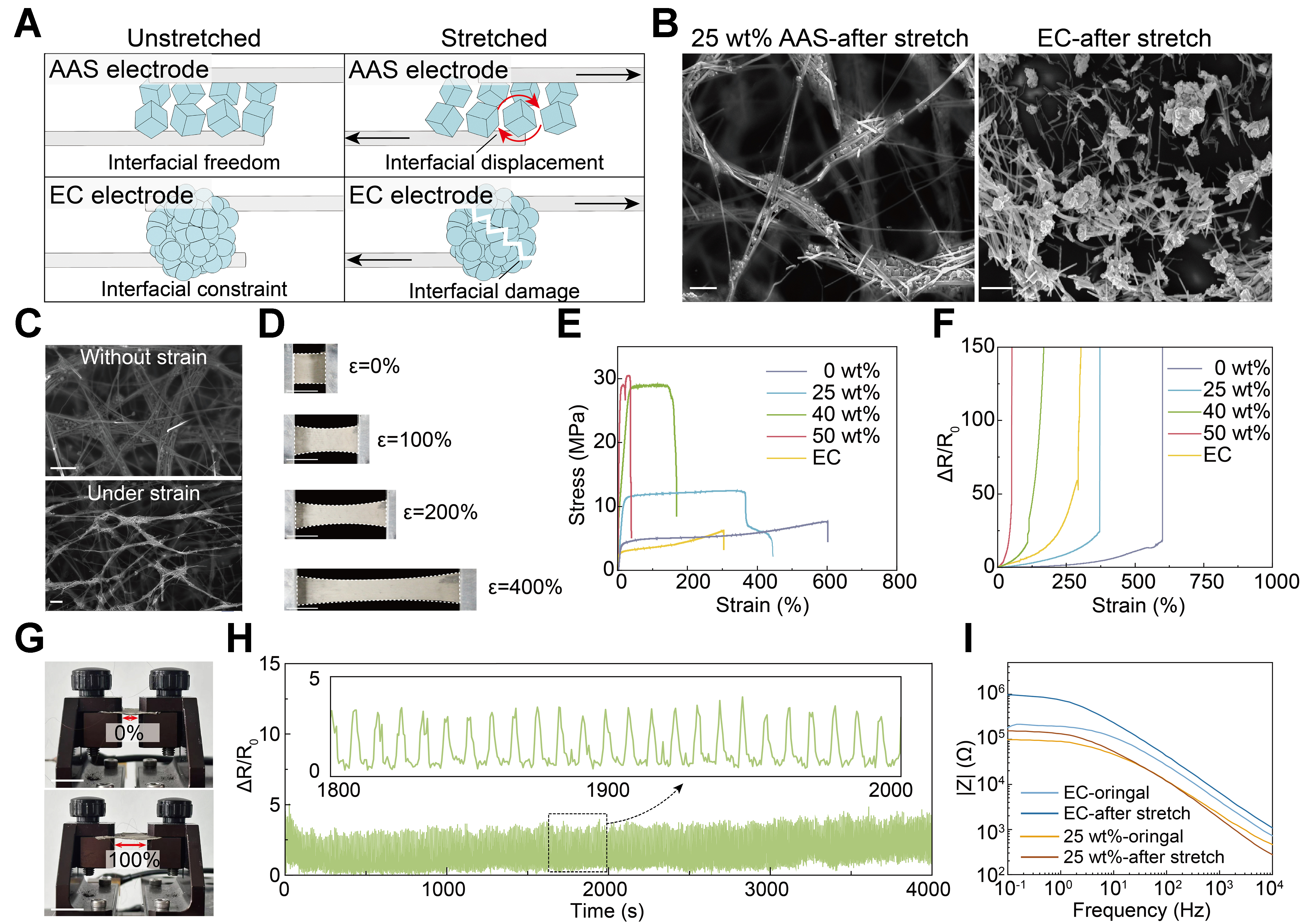
Figure 4. Mechanical and electromechanical performance of the AAS electrode. (A) Schematic illustration of the deformation mechanisms of AAS and EC electrodes under stretching bias; (B) SEM images of the 25 wt% AAS electrode and the EC electrode after stretching. Scale bars: 1 μm; (C) SEM images of the AAS electrode network without strain and under applied strain. Scale bars: 2 μm; (D) Photographs of the electrode under different tensile strains. Scale bars: 1 cm; (E) Stress-strain curves of the AS, AAS electrodes with different filler contents and the EC electrode; (F) Relative resistance change (ΔR/R0) as a function of strain for the different electrodes; (G) Photographs of the experimental setup for cyclic stretching tests of the AAS electrode at 100% strain. During testing, the electrode was connected to an external source meter via copper wires to record resistance in real time. Scale bars: 1 cm; (H) ΔR/R0 of AAS electrode during cyclic stretching at 100% strain. The inset shows a magnified view highlighting the periodic changes in resistance of the AAS electrode during cyclic stretching; (I) Impedance spectra of 25 wt% AAS electrode and EC electrode before and after cyclic stretching. AAS: AgNWs/AgCl/SEBS [AgNWs: silver nanowires, SEBS: poly(styrene-ethylene-butylene-styrene)]; EC: electrochemically chlorinated; SEM: scanning electron microscope; AS: AgNWs/SEBS.