




fig4
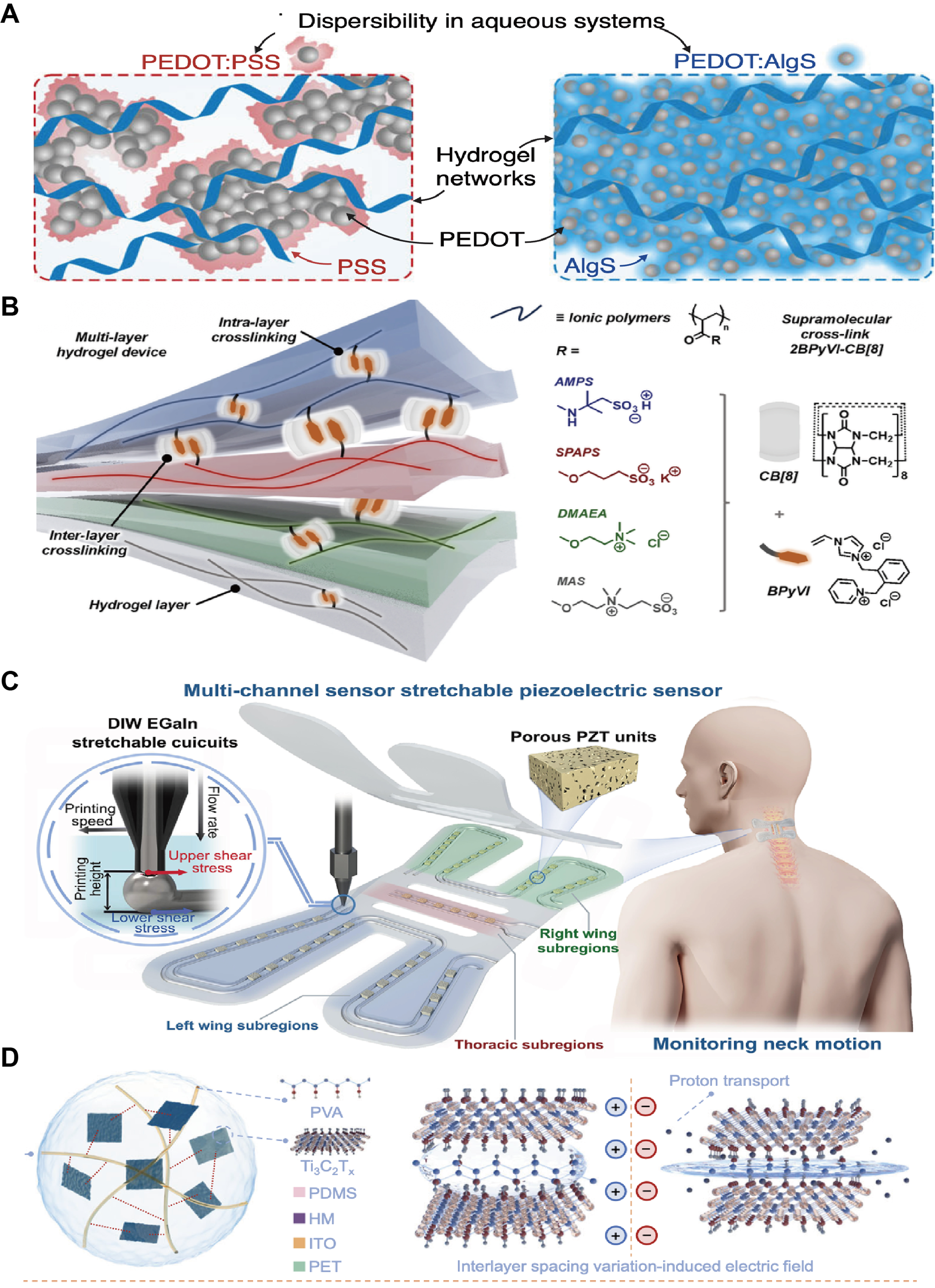
Figure 4. Representative material platforms for conductive and interfacial layers in organ-specific bioelectronics. (A) Hydrophilic-dopant-engineered PEDOT systems for degradable hydrogel bioelectronics[101]. Copyright © 2025, published by Springer Nature; (B) Supramolecular poly(ionic) networks enabling stretchable conductive hydrogels[24]. Copyright © 2024, the American Association for the Advancement of Science; (C) Topology-optimized stretchable piezoelectric sensors enabled by direct-ink-written liquid-metal circuits[128]. Copyright © 2026, WILEY-VCH Verlag GmbH & Co. KGaA; (D) Biomimetic microstructure-enabled piezoionic mechanoreceptors for ultrasensitive multimodal sensing and object recognition[150]. Copyright © 2025, published by Springer Nature. PEDOT: Poly(3,4-ethylenedioxythiophene); PSS: poly(styrenesulfonate); AMPS: 2-acrylamido-2-methyl-1-propanesulfonic acid; SPAPS: 3-sulfopropyl acrylate potassium salt; DMAEA: [2-(methacryloyloxy) ethyl] trimethylammonium chloride; MAS: [2-(methacryloyloxy)ethyl]dimethyl-(3-sulfopropyl)ammonium hydroxide; DIW: direct-ink-written; EGaIn: eutectic gallium–indium; PZT: porous lead zirconate titanate; PVA: polyvinyl alcohol; PDMS: polydimethylsiloxane; HM: hydrogel microneedles; ITO: indium tin oxide; PET: polyethylene terephthalate.