




fig4
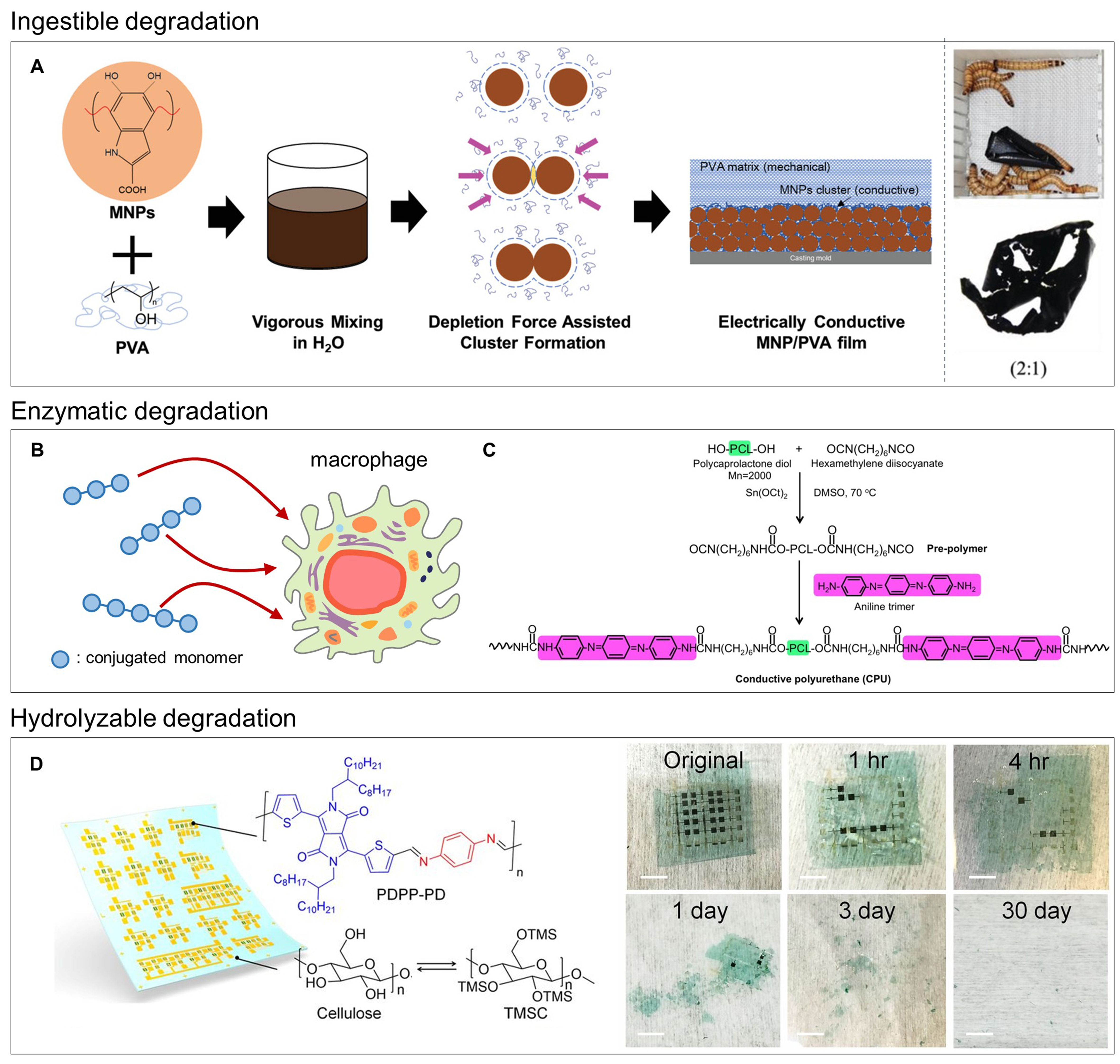
Figure 4. Fully degradable strategies for conductive polymer-based electronics. (A) Schematic illustration of ingestion-driven degradable MNP/PVA composite film fabrication by dispersing squid-ink-derived MNPs in a PVA solution, followed by depletion force-assisted MNP clustering. The photographs on the right show the degradation test setup and the extent of biodegradation of an MNP/PVA film (mass ratio = 2:1) after 12 h. Reproduced with permission from Ref.[85]. Copyright 2019, John Wiley & Sons; (B) Schematic illustration of macrophage-mediated degradation of conjugated oligomers; (C) Schematic illustration of the two-step polyaddition synthesis of biodegradable conductive polyurethane using PCL, HDI, and aniline trimer. Reproduced with permission from Ref.[30]. Copyright 2016, John Wiley & Sons; (D) Schematic illustration of a flexible device based on disintegrable semiconducting polymers [p(DPP-PPD)] featuring acid-hydrolyzable imine linkages on an ultrathin biodegradable cellulose substrate. The photographs on the right show the flexible device at various stages of disintegration, demonstrating the degradation process in a pH 4.6 buffer solution containing 1 mg/mL cellulase (scale bars: 5 mm). Reproduced with permission from Ref.[31]. Copyright 2017, National Academy of Sciences. MNP: Melanin nanoparticle; PVA: poly(vinyl alcohol); PCL: polycaprolactone; HDI: hexamethylene diisocyanate; P(DPP-PPD): poly(diketopyrrolopyrrole–p-phenyldiamine); DMSO: dimethyl sulfoxide; TMS: trimethylsilyl; TMSC: trimethylsilyl-functionalized cellulose.