



fig3
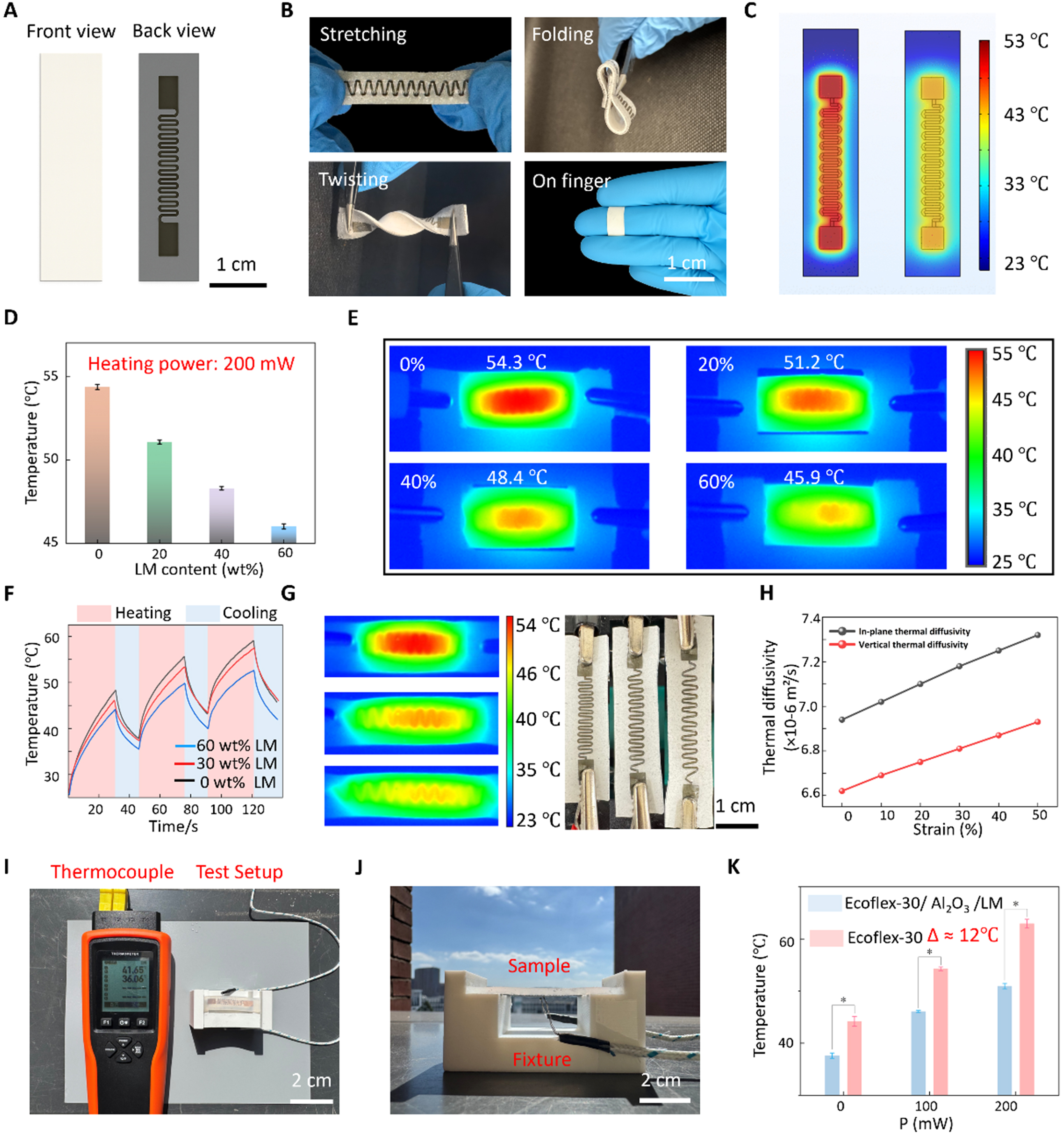
Figure 3. Device integration and cooling performance. (A) Front-and back-side photographs of SPCI integrated with a serpentine resistive heater; (B) Photographs showing conformal and robust attachment of SPCI-serpentine circuit assembly under stretching, folding, twisting, and on-hand mounting conditions; (C) Temperature distributions of serpentine circuits encapsulated with Ecoflex-30 (left) and with SPCI containing a 60 wt% LM (right); (D) Cooling performance of serpentine circuits with different LM mass fractions under a heating power of 200 mW; (E) Infrared thermography images of the serpentine circuit corresponding to (D); (F) Transient temperature profiles of serpentine circuits with different LM mass fractions under pulsed heating at 200 mW; (G) Infrared thermography images of the serpentine circuit under tensile deformation (top: original length, 3.0 cm; middle: stretched to 3.75 cm; bottom: stretched to 4.5 cm). The corresponding optical images under each tensile state are shown on the right; (H) Calculated equivalent thermal diffusivity coefficient; (I) and (J) Schematic illustration of the outdoor temperature-measurement setup (Cooling performance during 14 October, 11:00-13:00, Shenzhen, China); (K) Outdoor cooling performance of the serpentine circuit under different heating powers. Photographed by the authors. SPCI: Stretchable passive cooling interface; LM: liquid metal.