
fig6
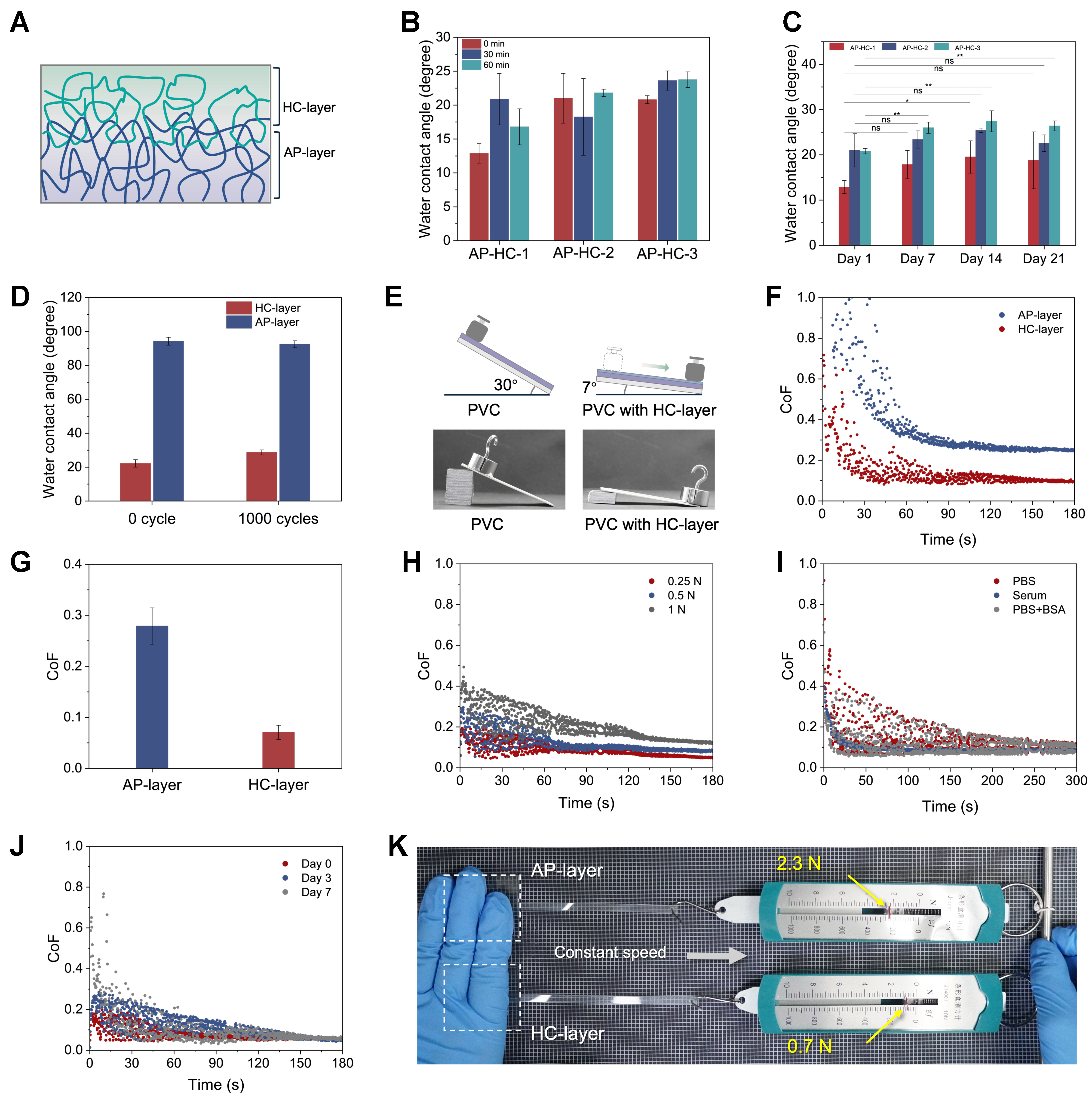
Figure 6. Interfacial stability and hydrated lubrication of the AP-HC bilayer hydrogel. (A) Schematic illustration of the interfacial integration mechanism between the adhesive layer and the hydrophilic lubricating layer in AP-HC; (B) Water contact angles of the hydrophilic lubricating layer after ultrasonic treatment for 0, 30, and 60 min; (C) Evolution of the water contact angle of the hydrophilic lubricating layer during immersion in deionized water for 21 days; (D) Water contact angles of the upper and lower surfaces of AP-HC-2 before and after 1,000 stretching cycles at a strain of 200%; (E) Schematic illustration of the friction test for bare PVC and PVC coated with AP-HC-2; (F and G) Time-dependent COF curves and corresponding average COF values of the AP layer and HC layer of AP-HC-2; (H) Lubrication performance curves of the AP-HC-2 surface measured under different normal loads; (I) Lubrication performance curves of the AP-HC-2 surface measured in different media at 37 °C, including PBS, serum, and PBS containing BSA; (J) Lubrication performance curves of the AP-HC-2 surface after immersion in water for 0, 3, and 7 days; (K) Demonstration of the low-friction behavior of the hydrophilic surface of AP-HC (a PVC strip was clamped between the functional sides or the adhesive sides of two AP-HC pieces and then pulled in the same direction using a spring dynamometer; the functional side exhibited lower friction, indicating better lubricating performance). Data are presented as mean ± SD (n = 3 independent samples). **P < 0.01, *P < 0.05; ns, not significant. PVC: Polyvinyl chloride; COF: coefficient of friction; PBS: phosphate-buffered saline; BSA: bovine serum albumin; SD: standard deviation.