

fig3
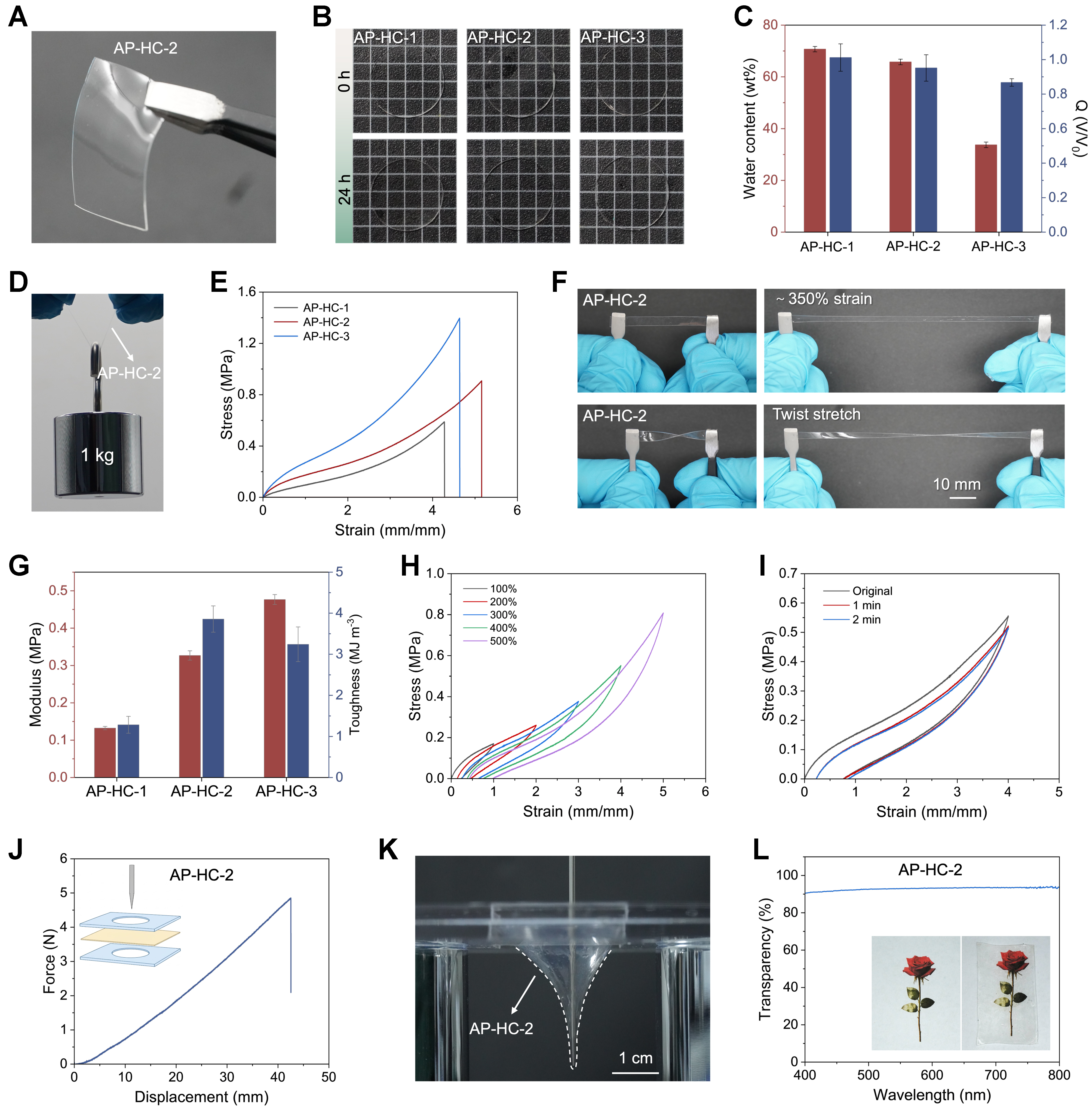
Figure 3. Mechanical performance and water stability of the AP-HC bilayer hydrogel. (A) Photograph of AP-HC; (B) Photographs of AP-HC after immersion in water for 0 and 24 h, showing anti-swelling capability and structural integrity; (C) Water content and swelling ratio of the AP-HC hydrogels (Q = Vt/V0 is defined as the volumetric swelling ratio, where V0 and Vt represent the initial hydrogel volume and the volume after immersion, respectively. A value of Q > 1 indicates swelling, whereas Q < 1 indicates volume shrinkage); (D) Photograph showing that AP-HC can lift a 1 kg weight; (E) Tensile stress-strain curves of hydrogels with different compositions; (F) Photograph demonstrating the high stretchability of AP-HC; (G) Young’s modulus and toughness of the hydrogels; (H) Cyclic loading–unloading curves of AP-HC-2 at increasing strains (100%-500%) without resting intervals; (I) Self-recovery curves of AP-HC-2 at 400% strain with 1 and 2 min recovery intervals; (J and K) Puncture resistance profiles and demonstration of structural integrity against sharp objects; (L) UV-vis transmittance spectra and optical transparency of AP-HC. Data are presented as mean ± SD (n = 3 independent samples). UV: Ultraviolet; SD: standard deviation.