

fig1
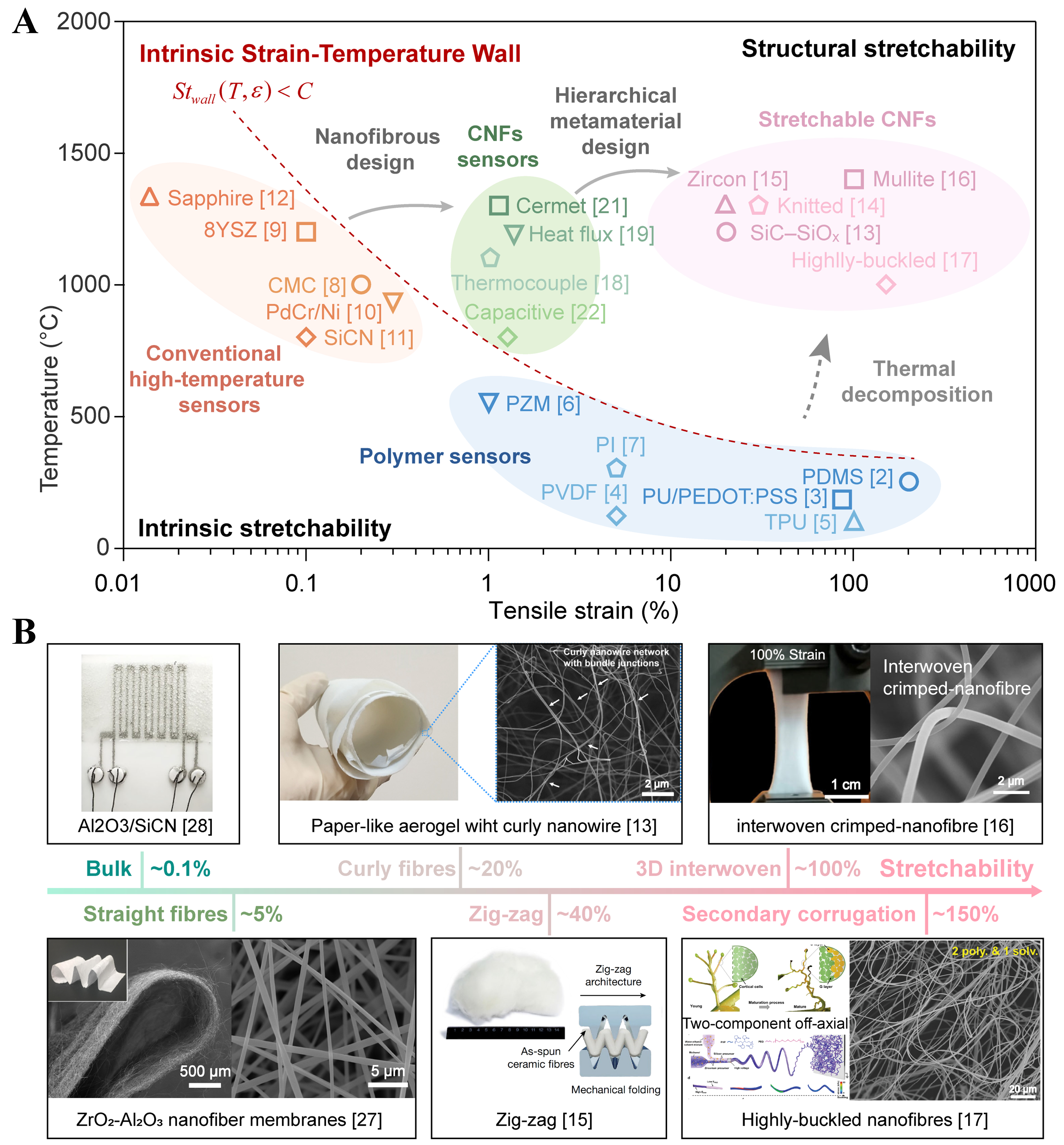
Figure 1. Materials for flexible high-temperature electronics. (A) The intrinsic strain-temperature limitation of sensor materials. Data points were collected from previous reports (Refs.[2-19,21,22,27,28]); (B) Evolution of thermo-mechanically robust ceramic nanofibrous platforms. Reprinted with permission from Ref.[13]. Copyright © 2021, American Chemical Society. Adapted from Ref.[15]. CC BY 4.0. Adapted from Ref.[16]. CC BY 4.0. Reprinted from Ref.[17]. © 2024 Wiley‐VCH GmbH. Reprinted with permission from Ref.[27]. Copyright © 2020, American Chemical Society. Reprinted from Ref.[28]. © 2026 Wiley‐VCH GmbH. CNFs: Carbon nanofibers; PZM: polyacrylonitrile/Zn(Ac)2/multi-walled carbon nanotube; PI: polyimide; PVDF: poly(vinylidene fluoride); PU: polyurethane; PEDOT:PSS: poly(3,4-ethylenedioxythiophene):poly(styrenesulfonate); TPU: thermoplastic polyurethane; PDMS: polydimethylsiloxane.