
fig4
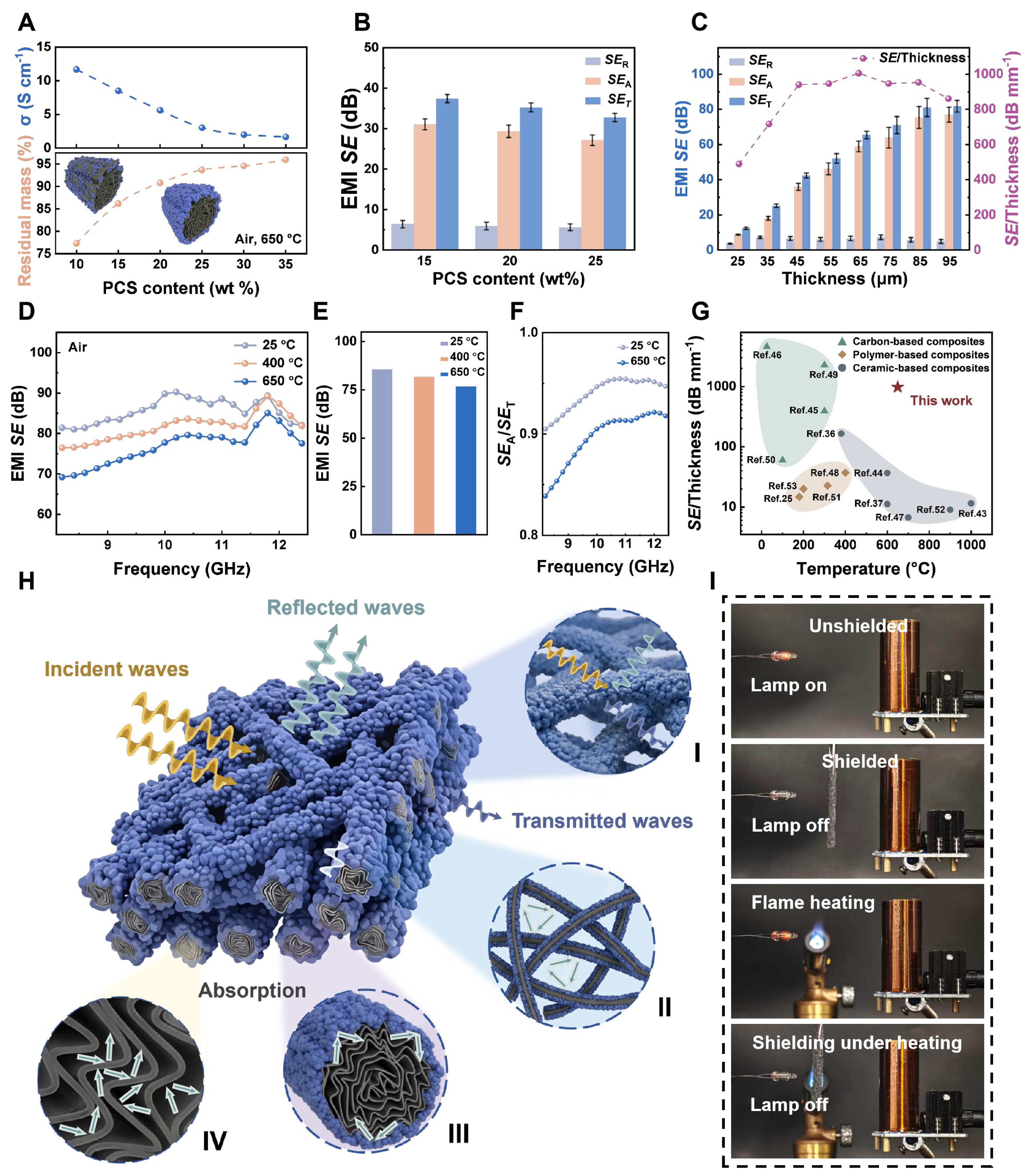
Figure 4. EMI shielding retention of G@SiC NFF after oxidative heating. (A) Electrical conductivity and residual mass of G@SiC NFFs as a function of PCS content after oxidation in air at 650 °C; (B) X-band total shielding effectiveness, absorption contribution, and reflection contribution of G@SiC NFFs derived from precursor formulations with different PCS contents, measured at a fixed thickness of 40 μm; (C) Thickness-dependent shielding effectiveness and thickness-normalized shielding effectiveness of G@SiC NFF; (D) Frequency-dependent SET before and after oxidative heating at 400 and 650 °C; (E) Average SET after oxidative heating at different temperatures; (F) Frequency-dependent SEA/SET ratio showing the retained absorption-dominated shielding mode before and after oxidative heating; (G) Comparison of G@SiC NFF with representative high-temperature EMI shielding materials; (H) Schematic illustration of the EMI shielding mechanism in the hierarchical G@SiC NFF; (I) Visual demonstration of shielding stability under exposure to an alcohol-torch flame at approximately 1,100 °C. Error bars in (B) and (C) represent SD from three independently measured 5 cm × 5 cm films for electromagnetic shielding measurements. All photographs in (I) were taken by the authors. EMI: Electromagnetic interference; G@SiC NFF: graphene@silicon carbide nanofiber fabric; PCS: polycarbosilane; SD: standard deviation.