
fig3

Flexible and oxidation-resistant graphene@SiC nanofiber fabrics

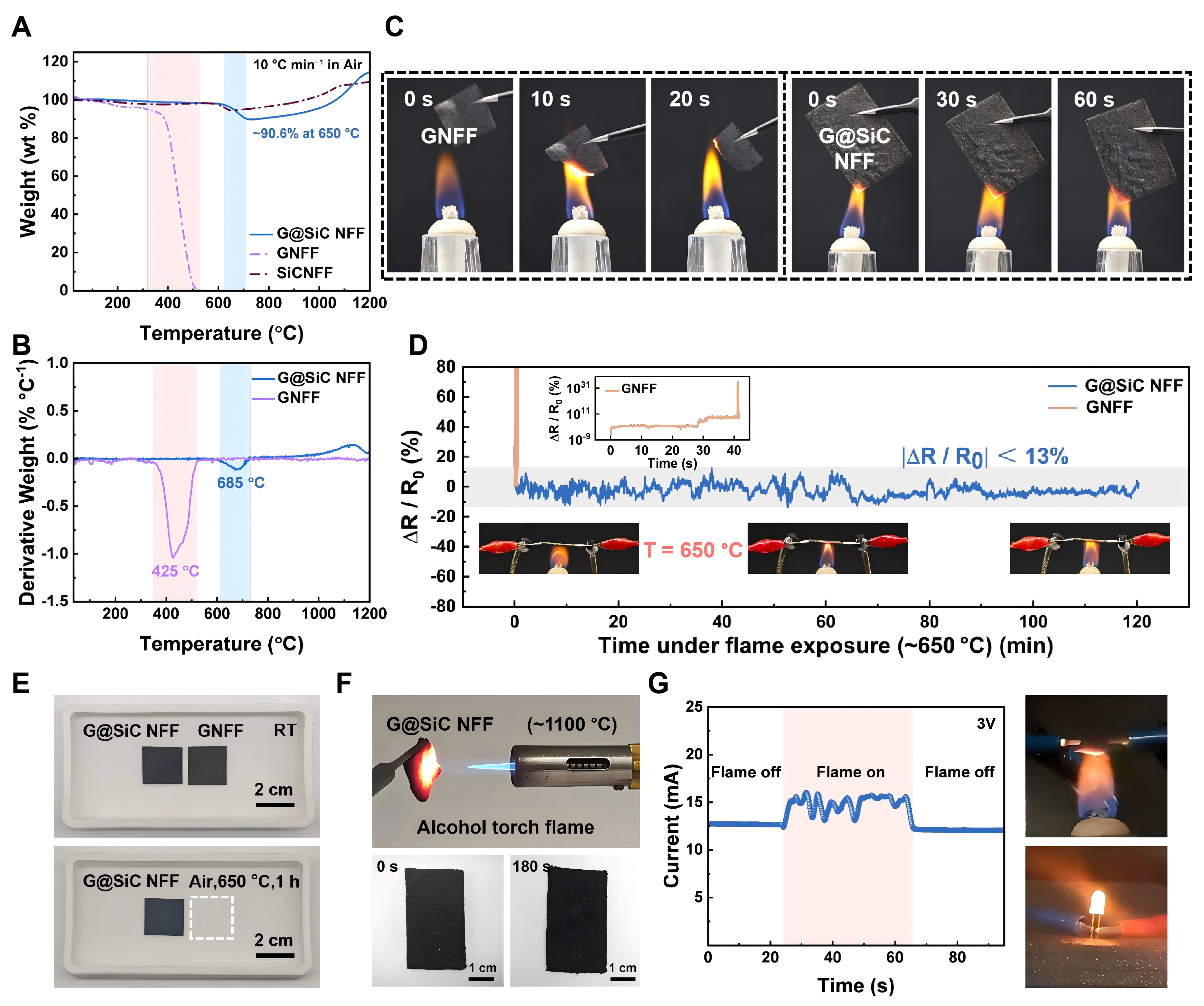
Figure 3. Thermo-oxidative stability and flame-tolerant electrical transport in G@SiC NFFs. (A) TGA profiles of GNFF, G@SiC NFF, and SiCNFF in an air atmosphere; (B) DTG profiles corresponding to (A); (C) Sequential photographs comparing the structural evolution of GNFF and G@SiC NFF under direct exposure to an alcohol-lamp flame; (D) Normalized resistance change of GNFF and G@SiC NFF during exposure to an alcohol-lamp flame (~650 °C); (E) Photographs of GNFF and G@SiC NFF before and after thermal annealing in air at 650 °C for 1 h; (F) Thermal shock testing of G@SiC NFF using an alcohol-torch flame (~1,100 °C) for 180 s; (G) Real-time current response and a series LED circuit utilizing G@SiC NFF as the conductive element, withstanding continuous exposure to an alcohol-lamp flame. All photographs in (C), (E), (F), and (G) were taken by the authors. G@SiC NFFs: Graphene@silicon carbide nanofiber fabrics; TGA: thermogravimetric analysis; GNFF: graphene nanofiber fabric; SiCNFF: silicon carbide nanofiber fabric; DTG: derivative thermogravimetric; LED: light-emitting diode; RT: room temperature.