
fig2
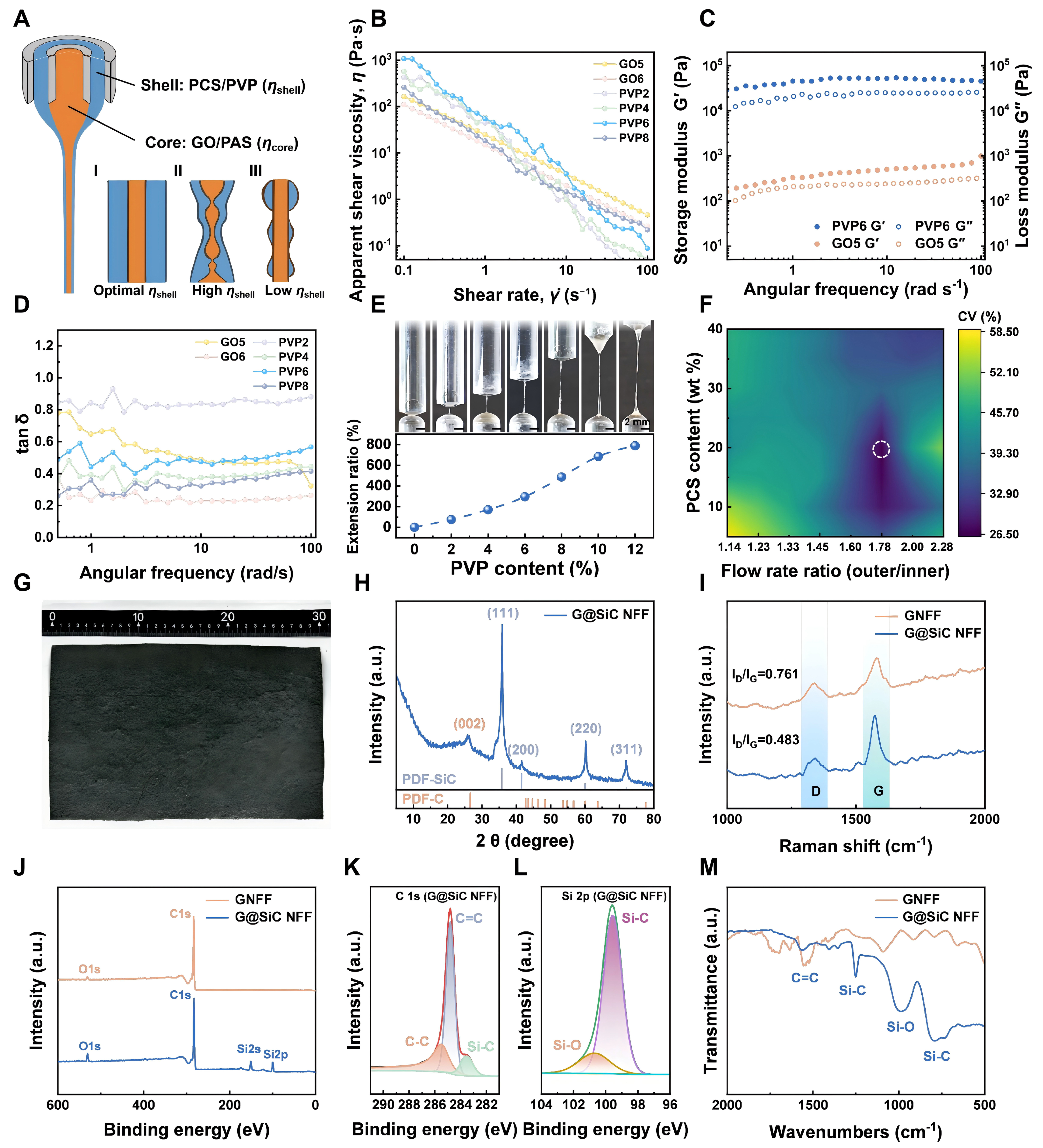
Figure 2. Rheological design and chemical evolution of G@SiC NFFs. (A) Schematic of coaxial flow configurations and jet states governed by core-shell rheological matching: I, stable core-shell jet; II, viscoelastic mismatch-induced jet instability; III, incomplete shell confinement with partial core exposure; (B) Shear-rate-dependent apparent viscosity of core and shell precursor solutions; (C) Frequency-dependent storage and loss moduli of representative precursor solutions; (D) Loss tangent (tanδ) of representative precursor solutions, indicating the viscoelastic balance; (E) Photographs and extension-ratio analysis showing the drawability of precursor solution; (F) Spinnability map as a function of PCS concentration and outer/inner flow-rate ratio. The white circle indicates the optimized spinning condition; (G) Photograph of a large-area freestanding G@SiC NFF; (H) XRD pattern of G@SiC NFF; (I) Raman spectra and (J) XPS survey of GNFF and G@SiC NFF; (K and L) High-resolution C 1s and Si 2p XPS spectra resolving C–C/C=C, C–O, Si–C, and Si-O bonding components; (M) FTIR spectra of GNFF and G@SiC NFF. G@SiC NFFs: Graphene@silicon carbide nanofiber fabrics; PCS: polycarbosilane; XRD: X-ray diffraction; XPS: X-ray photoelectron spectroscopy; GNFF: graphene nanofiber fabric; FTIR: Fourier-transform infrared spectroscopy; PVP: polyvinylpyrrolidone; GO: graphene oxide; PAS: polyacrylate.