

fig5
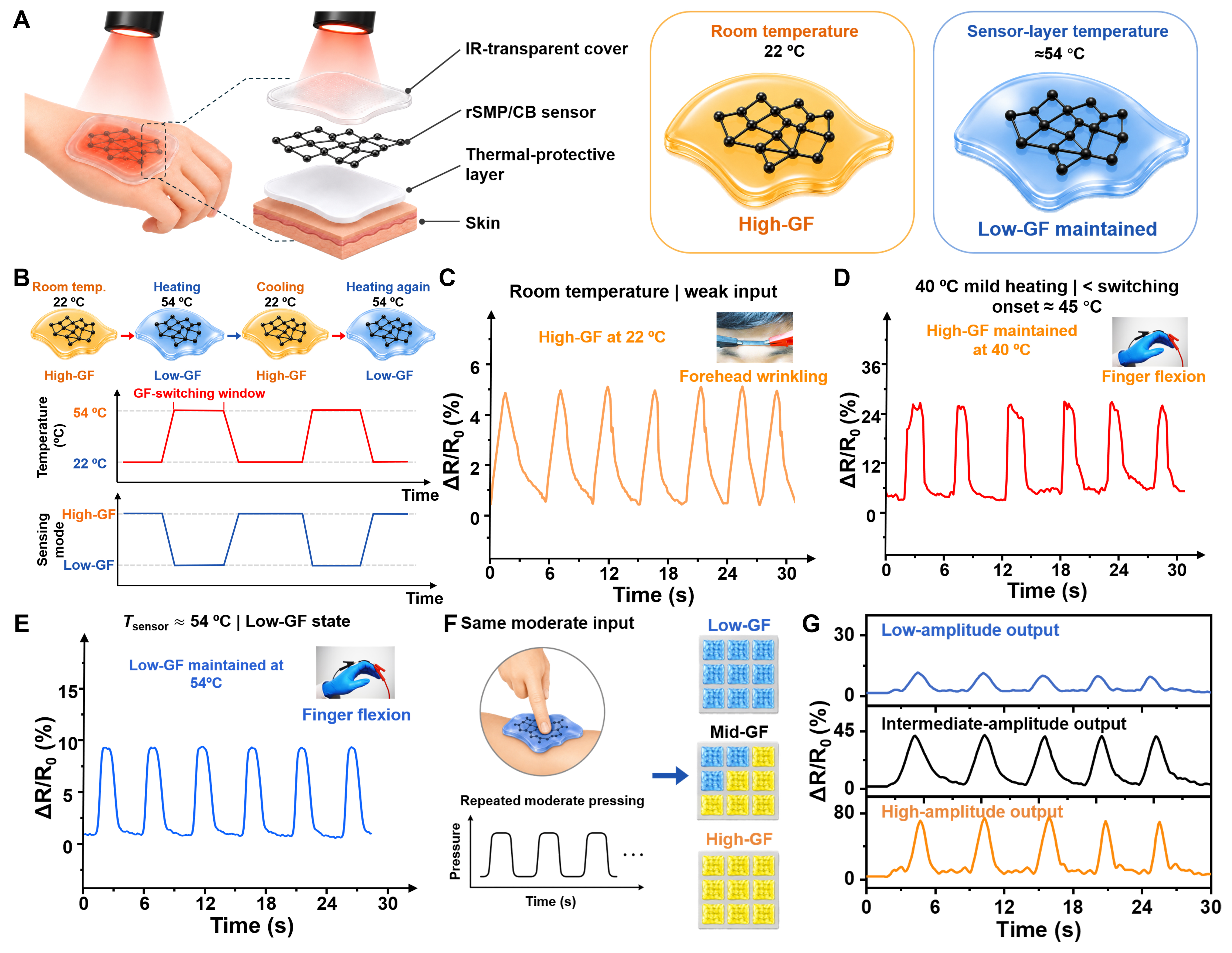
Figure 5. Thermal-state-controlled sensing-window matching under simulated photothermal/thermal elevation conditions. (A) Schematic of the layered skin-mounted configuration. For the approximately 54 °C active sensor-layer condition, a cured 404A/404B silicone-resin separation layer with a thickness of approximately 3 mm was positioned between the rSMP/CB sensing layer and the participant’s skin to prevent direct contact with the heated sensing layer. The stated temperature refers to the active sensing layer rather than the skin-side interface; (B) Reversible thermal switching of the GF state during repeated heating–cooling cycles; (C) High-GF readout of weak forehead-wrinkling deformation at 22 °C; (D) High-GF response maintained at 40 °C, below the GF-switching threshold, showing that mild heating does not trigger the low-GF state; (E) Low-GF finger-flexion readout with the active rSMP/CB sensing layer maintained at approximately 54 °C and separated from the skin by the 3 mm silicone-resin layer; (F) Pressing-induced normal-contact input used to evaluate contact-signal window matching; (G) Representative resistance responses of low-, intermediate-, and high-effective-GF arrays under the same nominal contact-input protocol. The coded arrays produce progressively increasing output amplitudes from the low- to intermediate- and high-effective-GF states. The photographs in (C-E) were taken by the authors during the reported experiments. rSMP: Reversible shape-memory polymer; CB: carbon black; GF: gauge factor.