

fig4
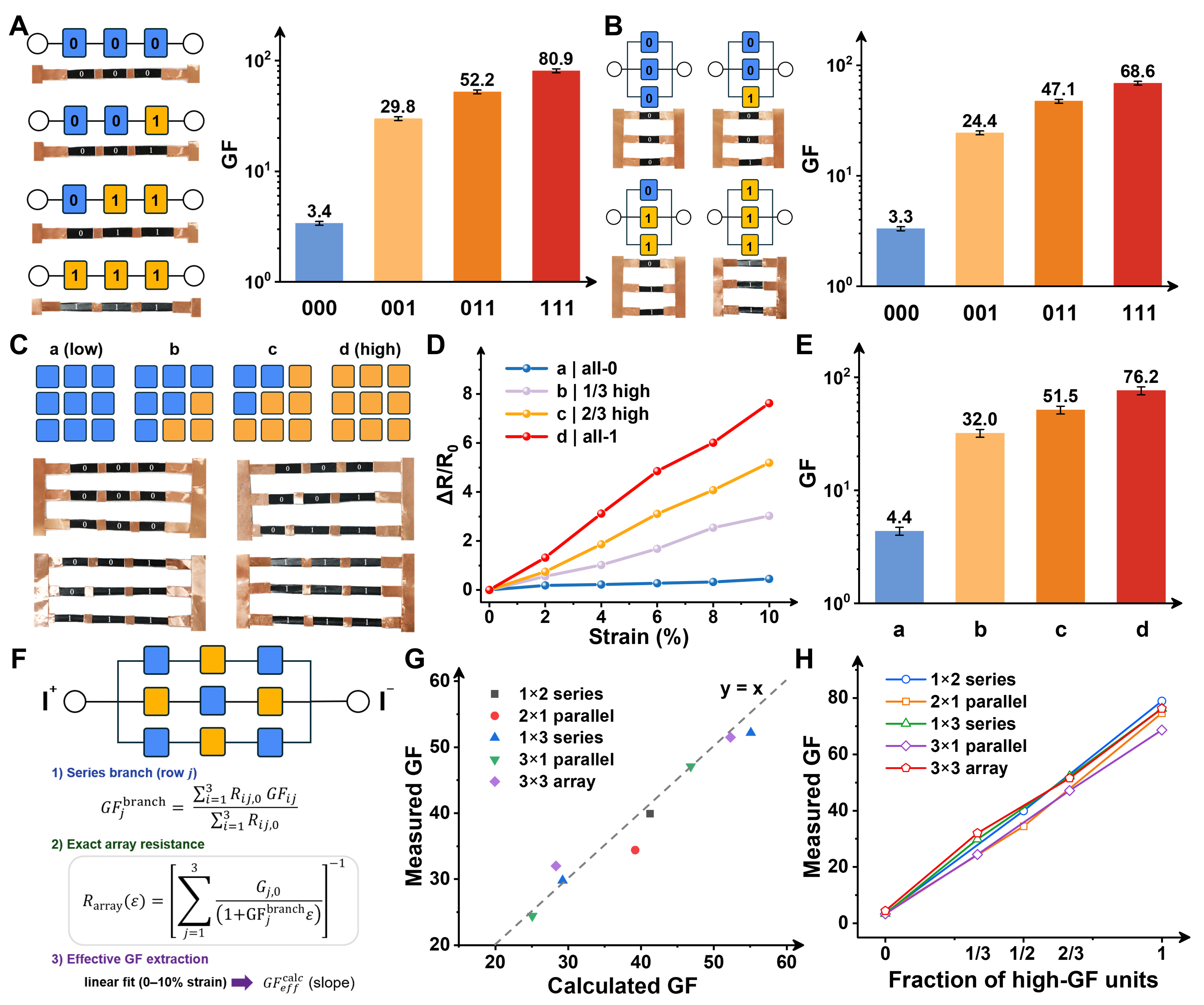
Figure 4. Scalable GF-bit array coding and model-rationalized effective GF outputs. (A) Coding configurations and extracted effective GF values of 1 × 3 series-connected GF-bit arrays; (B) Coding configurations and extracted effective GF values of 3 × 1 parallel-connected GF-bit arrays; (C) Four representative 3 × 3 coding states, with blue denoting the low-GF state (0) and orange denoting the high-GF state (1). Reading each row from left to right and the rows from top to bottom, states a-d are 000/000/000, 000/001/011, 001/011/111, and 111/111/111, respectively. These states contain 0, 3, 6, and 9 high-GF units out of 9; (D and E) Corresponding resistance-strain responses and measured array-level effective GF values of 4.4 (a, all-0), 32.0 (b, 1/3 high-GF), 51.5 (c, 2/3 high-GF), and 76.2 (d, all-1), respectively. Each row contains three units in series, and the three rows are connected in parallel; (F) Finite-strain circuit model based on the fitted unit-level GF values, measured initial resistances, and exact series/parallel circuit relations; (G) Comparison between the circuit-model calculations and measured effective GF values for different array configurations; (H) Measured effective GF as a function of the fraction of high-GF units, showing binary-to-multilevel gain coding across series, parallel, and 3 × 3 arrays. The measured GF values are presented as the mean ± SD (n = 3 independently prepared arrays). GF: Gauge factor; SD: standard deviation.