



fig3
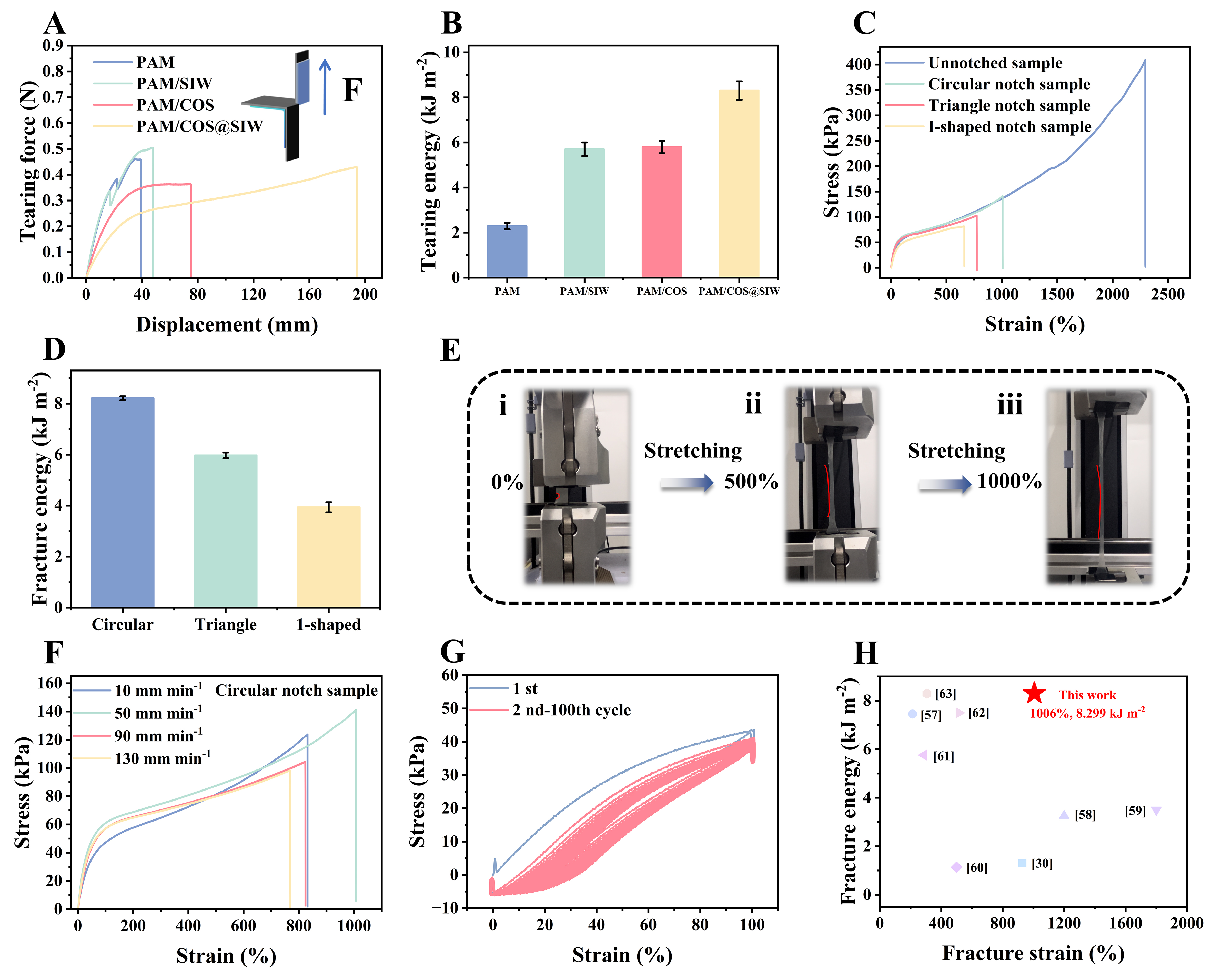
Figure 3. (A) Tearing curves (tearing force vs. displacement) and (B) the corresponding tearing energies of PAM, PAM/SIW, PAM/COS, and PAM/COS@SIW hydrogels. Data are presented as mean values ± SD, n = 3 independent samples; (C) Stress - strain curves and (D) the corresponding fracture energies of the PAM/COS@SIW hydrogel with different notch types: unnotch, circular notch, triangular notch, and 1-shaped notch. Data are presented as mean values ± SD, n = 3 independent samples; (E) Optical images of the PAM/COS@SIW hydrogel with a circular notch stretched to 500% and 1,000% strains. All optical photographs were taken by the authors using personal mobile devices; (F) Stress - strain curves of the PAM/COS@SIW hydrogel with a circular notch under four different strain rates; (G) Successive loading - unloading curves of the PAM/COS@SIW hydrogel with a single-edge notch under a fixed strain of 100% for 100 cycles; (H) Comparison of the fracture energy and fracture strain of the present hydrogel with those of previously reported hydrogel systems. PAM: Polyacrylamide; SIW: silicotungstic acid; COS: chitosan oligosaccharide; SD: standard deviation.