
fig2
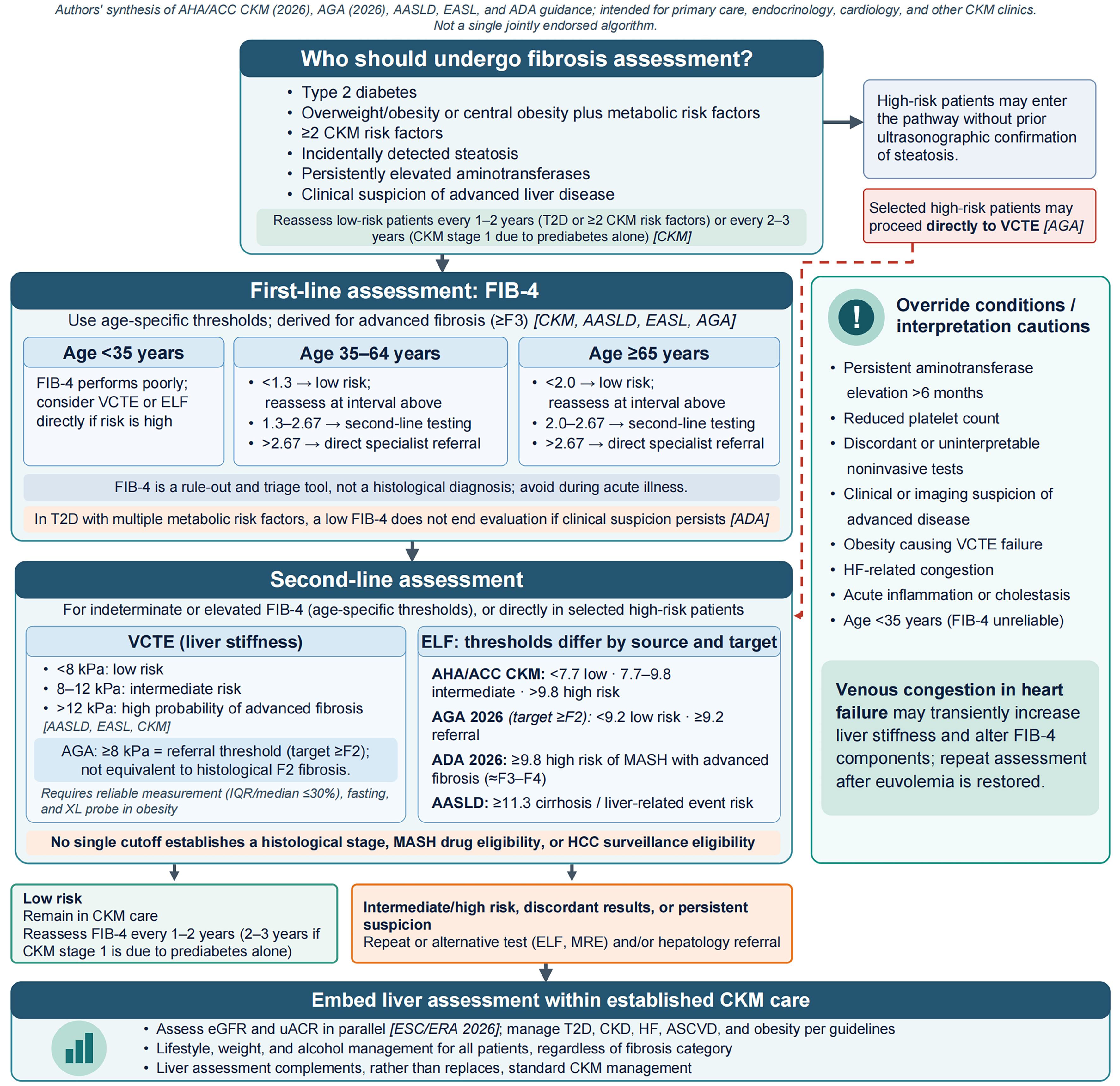
Figure 2. Guideline-synthesized pathway for liver fibrosis assessment within integrated CKM care. Patients at increased risk of clinically significant (≥ F2) or advanced (≥ F3) liver fibrosis, including those with T2D, obesity or central adiposity with additional metabolic risk factors, multiple CKM risk factors, incidentally detected steatosis, persistently elevated aminotransferases, or clinical suspicion of advanced liver disease, may undergo staged fibrosis assessment. FIB-4 is used primarily as a first-line rule-out and triage test rather than as a diagnostic test and should be avoided during acute illness. In adults aged 35-64 years, FIB-4 values < 1.3 generally support low-risk follow-up, values of 1.3-2.67 prompt second-line assessment, and values > 2.67 support specialist referral. In adults aged 65 years or older, the corresponding lower threshold for second-line assessment is 2.0, whereas the high-risk threshold remains 2.67. Low-risk patients should be reassessed every 1-2 years, or every 2-3 years when CKM stage 1 is attributable to prediabetes alone (AHA/ACC CKM). In T2D with multiple metabolic risk factors, a low FIB-4 does not end evaluation if clinical suspicion persists (ADA). FIB-4 performs poorly below age 35 years, and selected high-risk patients may proceed directly to VCTE (AGA; dashed red line). Second-line testing may include VCTE or ELF, with thresholds interpreted according to their source and target condition: for VCTE, < 8, 8-12, and > 12 kPa indicate low, intermediate, and high probability of advanced fibrosis (AASLD, EASL, AHA/ACC CKM), with ≥ 8 kPa as the AGA referral threshold for ≥ F2 and with reliable measurement required (IQR/median ≤ 30%, fasting, and an XL probe in obesity); for ELF, < 7.7, 7.7-9.8, and > 9.8 (AHA/ACC CKM), ≥ 9.8 as high risk of advanced fibrosis (ADA), < 9.2 and ≥ 9.2 as the AGA low-risk and referral boundary, and ≥ 11.3 for cirrhosis and liver-related event risk (AASLD). No single threshold establishes a histological stage, eligibility for MASH pharmacotherapy, or eligibility for HCC surveillance. Low-risk patients remain in CKM care with risk-factor management, whereas intermediate- or high-risk, discordant, or persistently suspicious results warrant repeat or alternative testing (ELF or MRE) and/or hepatology referral. Persistent aminotransferase elevation, thrombocytopenia, discordant or uninterpretable noninvasive tests, clinical suspicion of advanced disease, obesity causing VCTE failure, or age < 35 years may override nominally low-risk results or limit test interpretation. Heart failure-related venous congestion, acute inflammation, and cholestasis may transiently increase liver stiffness and should be considered when interpreting elastography; in congestion, assessment should be repeated after euvolemia is restored. Liver fibrosis assessment should be embedded within, rather than replace, established CKM evaluation and treatment, including parallel assessment of kidney function and albuminuria (ESC/ERA), guideline-directed management of T2D, CKD, HF, ASCVD, and obesity, and lifestyle, weight, and alcohol management for all patients regardless of fibrosis category. This pathway integrates contemporary society recommendations for implementation across primary care, endocrinology, cardiology, and multidisciplinary CKM clinics. AASLD: American Association for the Study of Liver Diseases; ACC: American College of Cardiology; ADA: American Diabetes Association; AGA: American Gastroenterological Association; AHA: American Heart Association; ASCVD: atherosclerotic cardiovascular disease; CKD: chronic kidney disease; CKM: cardiovascular-kidney-metabolic; EASL: European Association for the Study of the Liver; eGFR: estimated glomerular filtration rate; ELF: enhanced liver fibrosis; ERA: European Renal Association; ESC: European Society of Cardiology; FIB-4: Fibrosis-4 index; HF: heart failure; HCC: hepatocellular carcinoma; IQR: interquartile range; MASH: metabolic dysfunction-associated steatohepatitis; MRE: magnetic resonance elastography; T2D: type 2 diabetes; uACR: urinary albumin-to-creatinine ratio; VCTE: vibration-controlled transient elastography.