

fig3
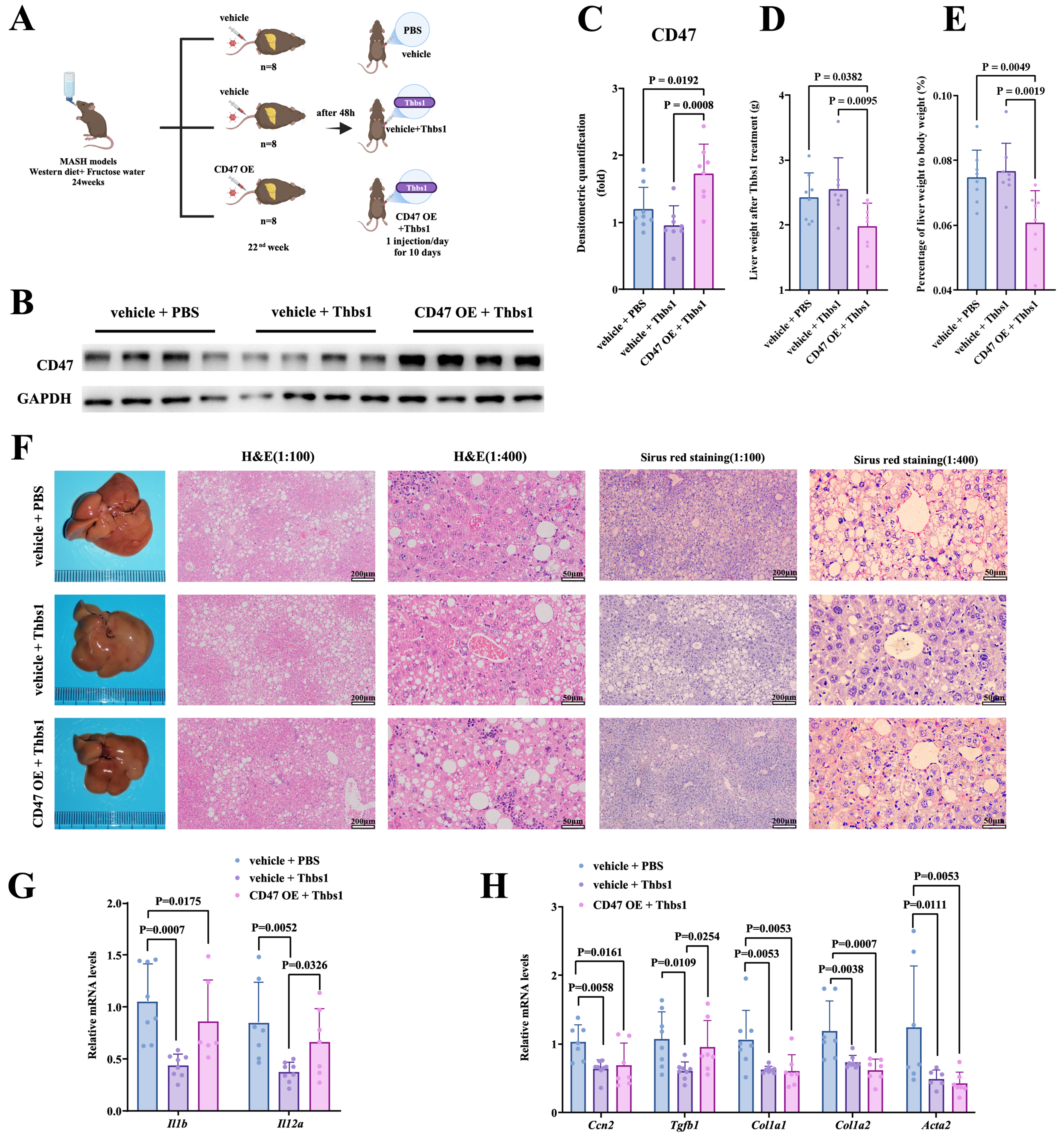
Figure 3. Liver-specific CD47 OE attenuated the effects of Thbs1 in diet-induced MASH mice. (A) Experimental design to verify the modulatory effects of Thbs1 and its correlation with CD47; (B and C) Western blot and quantification of CD47 OE; (D and E) Post-intervention liver weight and liver:body weight ratio across groups; (F) Representative gross liver morphology, H&E staining (scale bars = 200 μm for 1:100 and 50 μm for 1:400), and Sirius Red staining (scale bars = 200 μm for 1:100 and 50 μm for 1:400); (G and H) Post-intervention hepatic mRNA expression of inflammatory factors (Il-1b, Il-12α, and Cd14) and fibrosis markers (Ccn2, Tgfb1, Col1a1, Col1a2, and Acta2). Data are presented as mean ± SD. For in vivo experiments, n = 8 mice per group were initially included; after outlier exclusion using ROUT (Q = 5%), 6-8 samples per group were used for statistical analysis. Statistical differences among multiple groups were analyzed using one-way ANOVA followed by Tukey’s multiple comparisons test. P < 0.05 was considered statistically significant. ANOVA: Analysis of variance; CD47: cluster of differentiation 47; H&E: hematoxylin and eosin; MASH: metabolic dysfunction-associated steatohepatitis; mRNA: messenger RNA; OE: overexpression; ROUT: robust regression and outlier removal; SD: standard deviation; Thbs1: thrombospondin-1; Il1β: interleukin-1β; Il12α: interleukin-12α; Ccn2: cellular communication network factor 2; Tgfb1: transforming growth factor-β1; Col1a1: collagen type I alpha 1 chain; Col1a2: collagen type I alpha 2 chain; Acta2: actin alpha 2.