

fig4
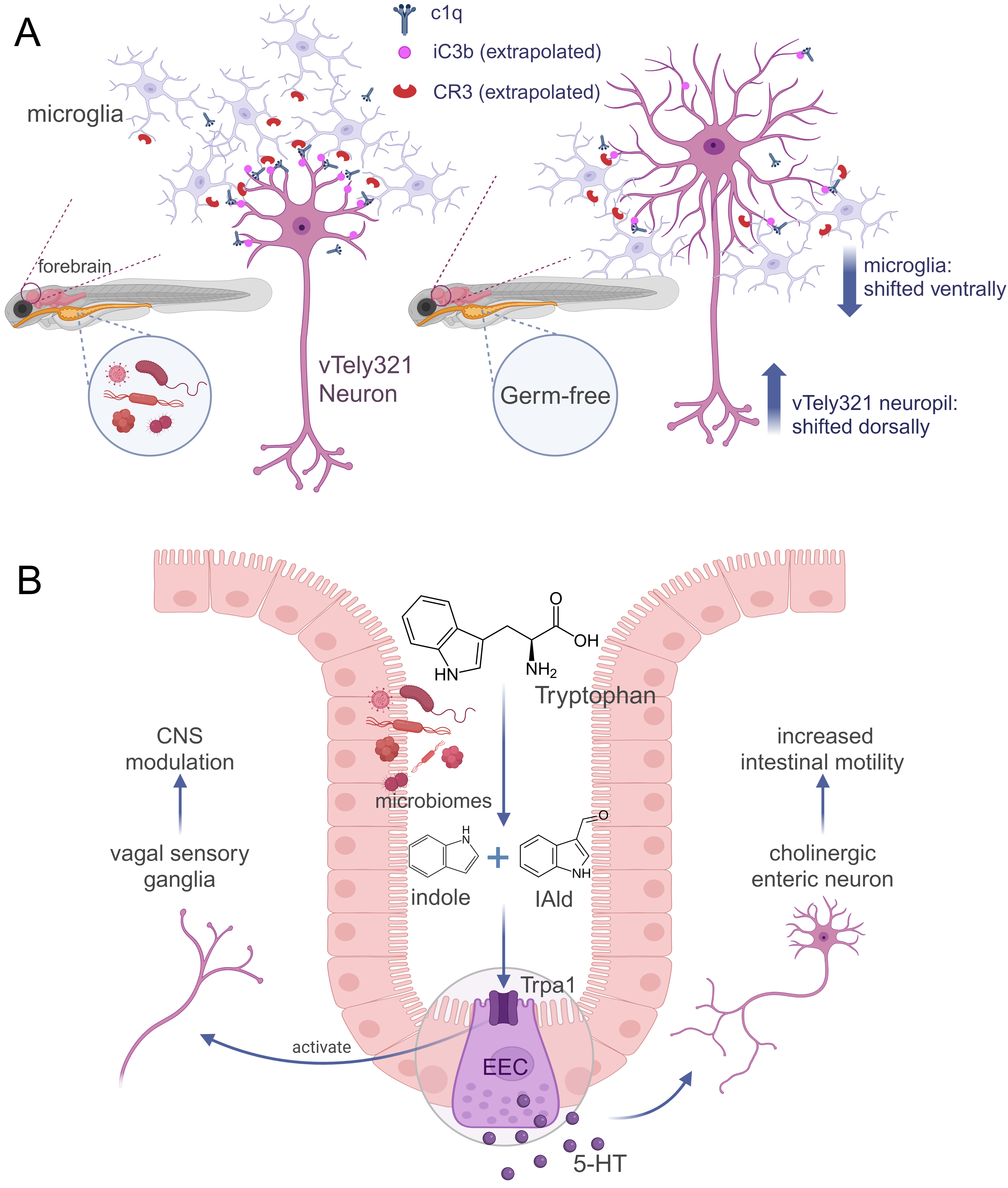
Figure 4. Microbiota regulates neural circuits. (A) Microbiota directs microglial remodeling of the vTely321 circuit through complement-associated mechanisms. In colonized larvae, forebrain microglia are more abundant and correctly positioned, and the microbiota promotes expression of complement pathway genes, including c1q. In zebrafish, c1q is required for normal vTely321 neurite density, and the complement pathway is implicated in microglial neurite remodeling. Downstream of c1q, the molecular recognition of iC3b-opsonized synapses by microglial CR3 has been demonstrated in mice but has not yet been directly validated in zebrafish and is therefore presented as an extrapolation. In GF larvae, microglia are reduced and shifted ventrally, the vTely321 neuropil is shifted dorsally, and arbors are exuberant (greater total length and branching depth with higher distal complexity); microglial c1q is decreased; (B) Microbial tryptophan catabolites engage the intestinal EEC-Trpa1 pathway to couple gut signaling to the enteric nervous system (ENS) and vagal pathways. Luminal tryptophan, from diet or microbial synthesis, is converted by gut bacteria into indole and indole-3-carboxaldehyde (IAld). Indole and IAld activate Trpa1 on intestinal enteroendocrine cells, triggering 5-HT release. The 5-HT signal drives the local enteric circuit, including cholinergic enteric neurons, and promotes intestinal motility. In parallel, bacterial tryptophan catabolites activate vagal sensory ganglia via EEC-Trpa1 signaling, linking epithelial chemosensation to a gut-brain afferent pathway. C1q: Complement component 1q; C3b: complement component 3 fragment b; CNS: central nervous system; CR3: complement receptor 3; iC3b: inactivated C3b; vTely321: y321-labeled ventral telencephalic neuron population; EEC: enteroendocrine cell; ENS: enteric nervous system; IAld: indole-3-carboxaldehyde; 5-HT: serotonin; Trpa1: transient receptor potential ankyrin 1. Created in BioRender. Li, Y. (2026) https://BioRender.com/8aylsv4.