
fig1
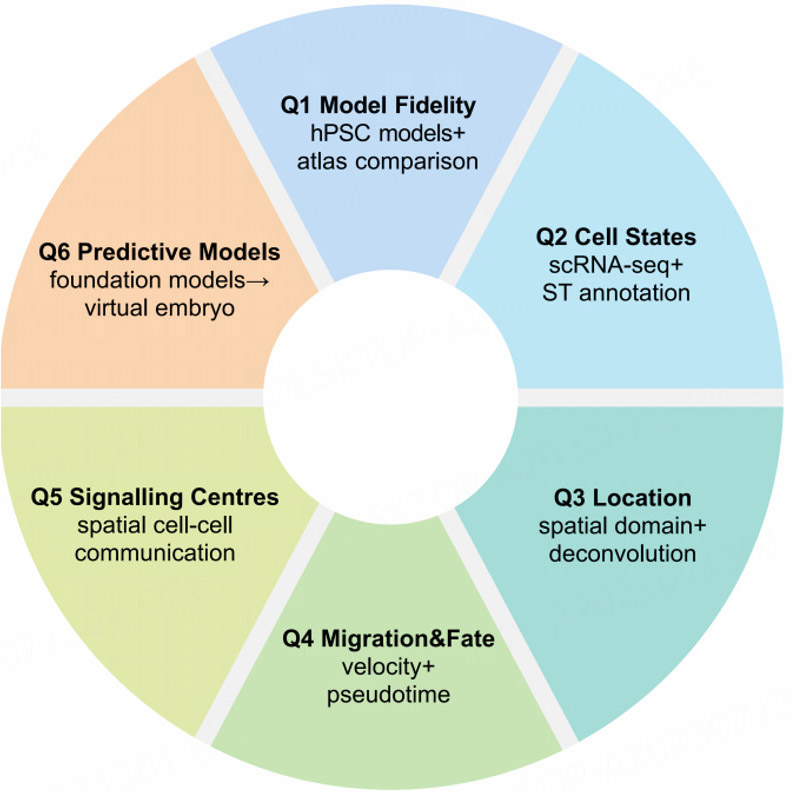
Figure 1. Conceptual roadmap linking the six guiding biological questions of this Review to the spatiotemporal multi-omics technologies and analytical approaches that address them. Q1, model fidelity: benchmarking the fidelity of stem-cell-based embryo models against in vivo human atlases through integrated multi-omics comparisons. Q2, cell states: identifying the cell types and states that arise during early embryogenesis by single-cell and multimodal profiling, with spatial annotation where applicable. Q3, tissue architecture: resolving spatial organization through ST, cell-type deconvolution and spatial-domain identification. Q4, directional transitions: inferring how cells migrate and change fate over time by trajectory inference, RNA velocity and three-dimensional reconstruction. Q5, signalling centres: dissecting local signalling centres through ligand-receptor inference and spatial signalling analysis. Q6, predictive models: moving from descriptive maps toward predictive models through multimodal integration, foundation models and perturbation prediction.