
fig4
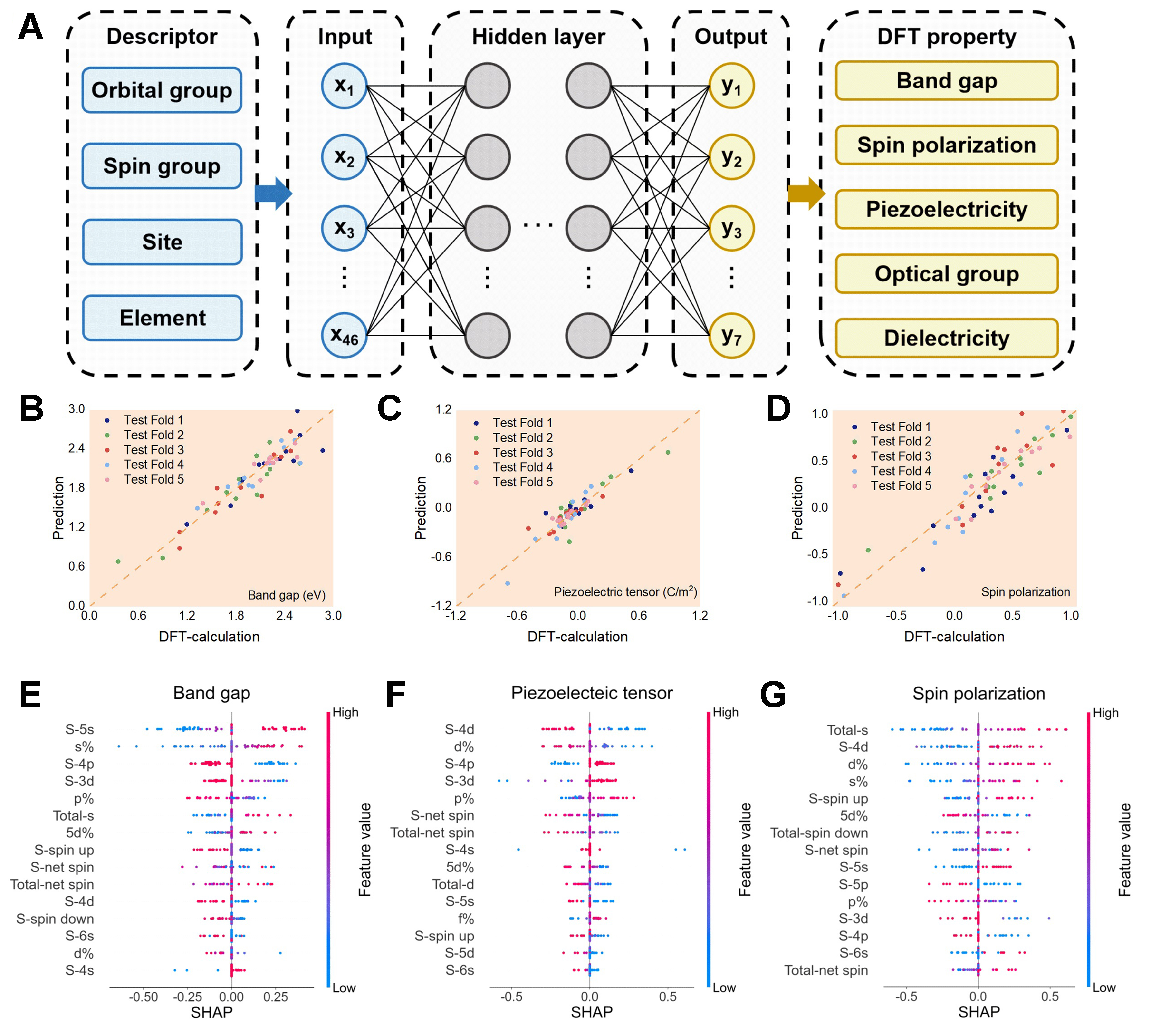
Figure 4. Machine learning framework and feature interpretation for predicting the properties of BiFeO3-based materials: (A) Schematic illustration of the machine learning workflow for predicting material properties based on orbital, spin, site, and elemental descriptors; (B) Comparison between the predicted and DFT-calculated band gaps obtained by five-fold cross-validation; (C) Comparison between the predicted and DFT-calculated piezoelectric tensors obtained by five-fold cross-validation; (D) Comparison between the predicted and DFT-calculated spin polarizations obtained by five-fold cross-validation; (E) SHAP summary plot illustrating the feature importance for band gap prediction; (F) SHAP summary plot illustrating the feature importance for piezoelectric tensor prediction; (G) SHAP summary plot illustrating the feature importance for spin polarization prediction. DFT: Density functional theory; SHAP: SHapley Additive exPlanations.