

fig4
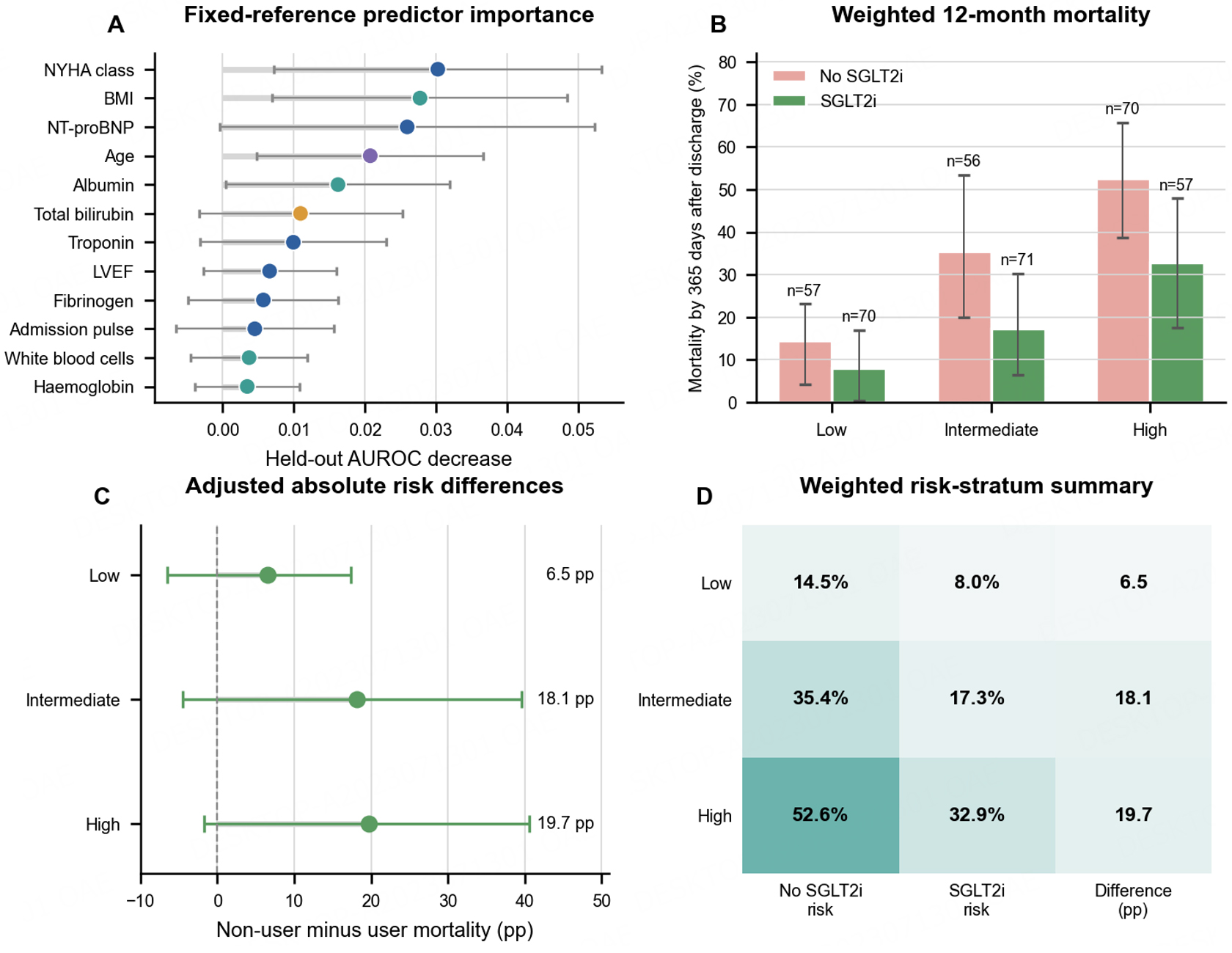
Figure 4. Fixed-reference predictor importance and adjusted SGLT2i-associated 12-month mortality differences. (A) Permutation importance in held-out folds of the fixed gradient-boosting reference: mean AUROC decrease after shuffling each predictor, with one-standard-deviation error bars calculated from 50 fold-by-shuffle values per predictor (five held-out folds, with ten shuffles per fold). (B) Overlap-weighted Kaplan-Meier mortality through 365 days after discharge among SGLT2i users and non-users in the 381-patient treatment cohort. Labels give original group sizes, not effective sample sizes; error bars are bootstrap 95% confidence intervals. Each fixed-reference out-of-sample-score tertile contains 127 patients. (C) Adjusted non-user minus user mortality differences in percentage points, with bootstrap 95% confidence intervals; the dashed line denotes zero. (D) The same weighted mortality and risk-difference point estimates as a numerical summary. Propensity models were fitted overall and within strata; confidence intervals use 1,000 treatment-stratified patient bootstrap samples with propensity refitting and fixed risk scores and strata. The analyses describe observational associations. NYHA: New York Heart Association; pp: percentage points; BMI: body mass index; LVEF: left ventricular ejection fraction; NT-proBNP: N-terminal pro-B-type natriuretic peptide; AUROC: area under the receiver operating characteristic curve; SGLT2i: sodium-glucose cotransporter 2 inhibitor.