

Microenvironments engineering on covalent organic framework nanofluidics for high flux and ion selectivity
 0
0 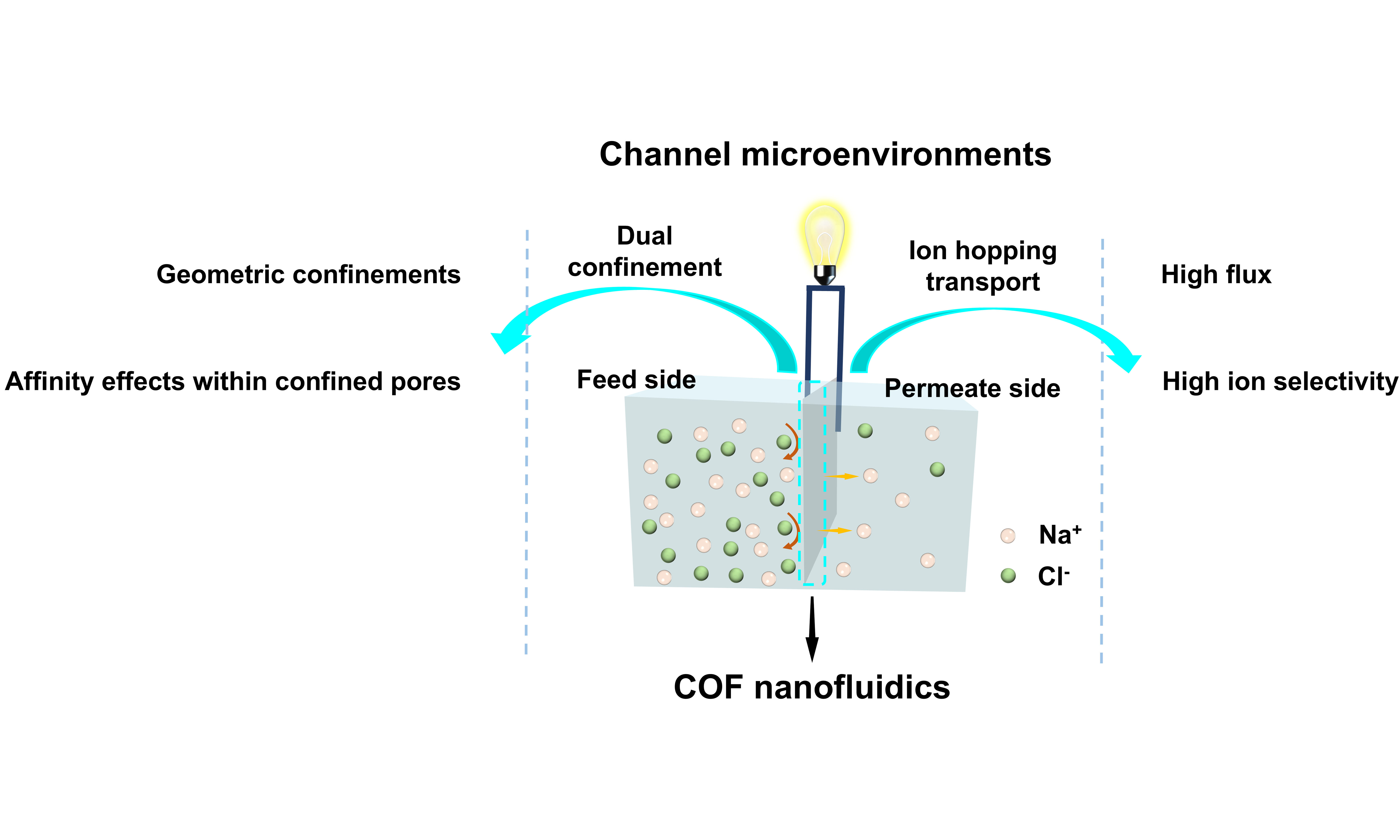


 Download PDF
Artificial nanofluidic channels can achieve ion transport performance analogous to biological ion channels[1]. However, inferior pore geometry, insufficient surface charge and inadequate functionalization restrict their practical performance[2,3]. Covalent organic frameworks (COFs) serve as tunable platforms for nanofluidic optimization, although relevant research remains preliminary. Recently, the Wen group realized integrated geometric and affinity dual confinement via precise COF channel microenvironment engineering. This progress represents an important paradigm shift from single-parameter optimization to multi-dimensional collaborative regulation and propels the development of biomimetic nanofluidic technology by achieving concurrent high flux and selectivity[4]. This highlight reviews these innovations and analyzes existing challenges and prospects of this strategy.
KEY INNOVATIONS OF DUAL-CONFINEMENT STRATEGY
Single-parameter optimization has attained limited progress and cannot resolve the inherent permeability–selectivity trade-off. The Wen group thus proposed a paradigm shift toward multi-dimensional collaborative regulation. Geometric confinement is realized by controlling the length of the construction linkers (0.58-1.22 nm), resulting in customized nanochannel diameters within the range of 2.52-3.71 nm. Affinity effects within confined pores are investigated by adjusting the density of sulfonate groups (0 to 2 groups per linker) on the amino monomer linkers[4]. The surface charge density can be continuously controlled from -0.13 to -0.79 μC·cm-2, suppressing hydration-driven lattice expansion while maximizing the Donnan repulsion effect (i.e., electrostatic repulsion of same-numbered ions by fixed charges).
Samples were denoted as COF-SxLy (Sx represents sulfonation degree, x takes 0, 1, or 2. Ly represents the length of the linker, where L1 is 0.58 nm, L2 is 0.97 nm, and L3 is 1.22 nm). Among them, COF-S1L2 possesses a 3.11 nm channel, closely matching the 3.1 nm electric double layer (EDL) thickness in 0.1 M KCl. This EDL overlap creates cation-enriched and anion-excluded regions, establishing the geometric foundation for highly selective ion transport. Precise modulation of channel size and interfacial interactions achieves synergistic geometric confinement and surface affinity effects. Tuning linker sizes optimizes ion permeation flux, while adjusting functional group density greatly elevates ion selectivity. Dual-confinement optimization elevates COF-S1L2 ion flux from 1.93 × 10¹⁴ to 5.12 × 10¹⁴ ions·s-1 and cation selectivity from 0.80 to 0.95, which is 2.5-fold and 4-fold higher than the unoptimized system, respectively. This excellent performance originates from synergistic pore structure confinement and interfacial affinity modulation.
Molecular dynamics (MD) simulations and experiments confirm that the impressive performance originates from cation hopping. In COF-S1L2, Na+ bears a transport barrier of -13.1 kJ·mol-1, whereas Cl- has a repulsion barrier of 11.8 kJ·mol-1. This significant energy difference leads to high Na+/Cl- selectivity[4]. The activation energy for ion transport is only 14.4 kJ·mol-1 (the minimum energy required for ions to cross the transport barrier), verifying cation transport through rapid hopping instead of traditional diffusion. This mechanism is further validated by the Na+ diffusion coefficient of 1.74 × 10⁻⁵ cm2·s-1, consistent with its high-flux feature. Accordingly, full EDL overlap reduces the transport barrier and supports ion hopping within confined channels. The overall framework is illustrated in Figure 1.
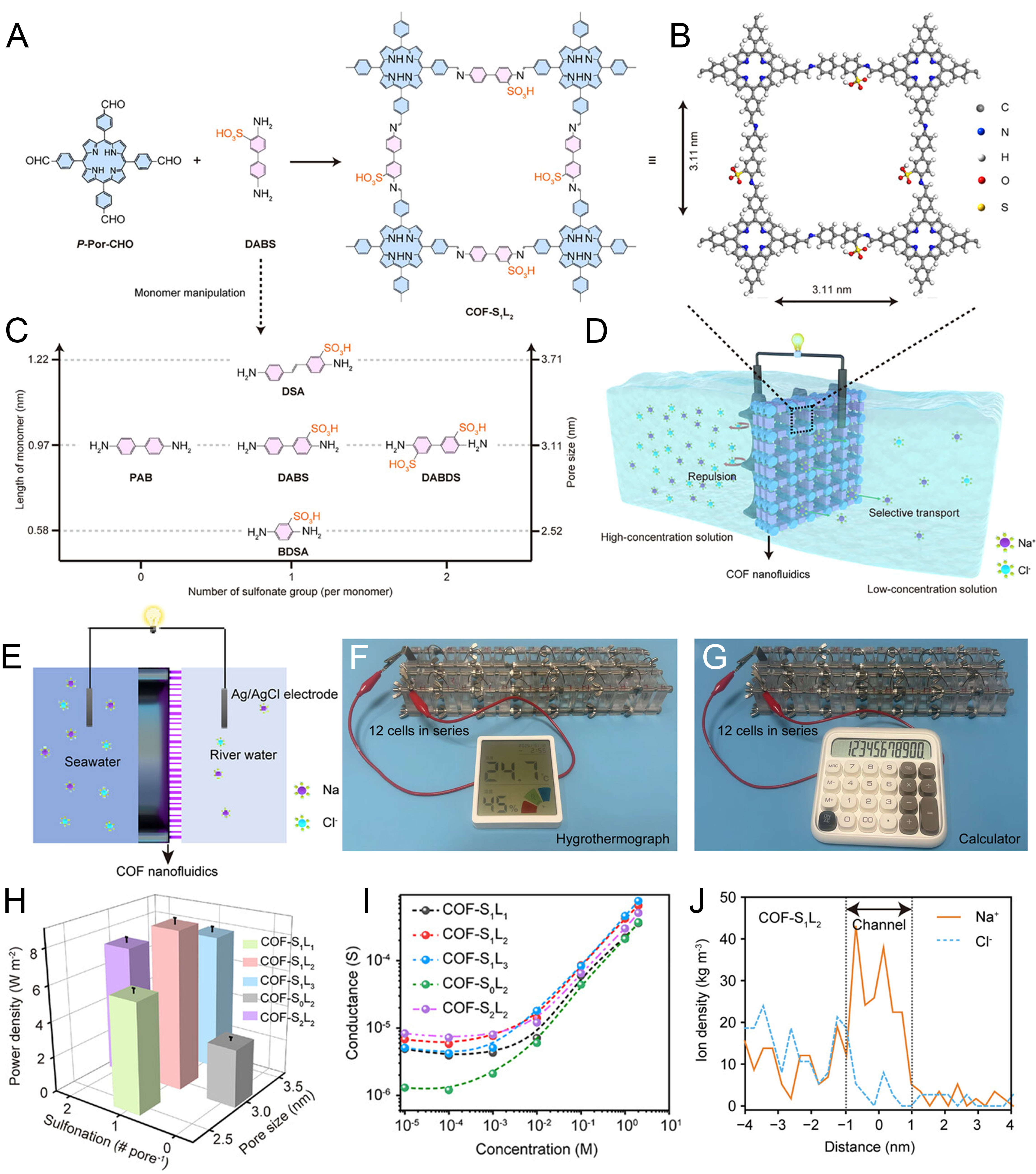
Figure 1. Molecular design of dual-confinement COF-based nanofluidics for high-performance osmotic energy conversion; (A) Synthetic strategy and schematic of dual-confinement COF nanofluidics; (B) MD-simulated structure of COF-S1L2 nanofluidics; (C) Design of diamino monomers with tunable lengths and sulfonation degrees for constructing COF-S1L1, COF-S1L3, COF-S0L2, and COF-S2L2 nanofluidics; (D) Schematic of osmotic energy conversion in engineered dual-confinement COF nanofluidics with high-flux ion-selective transport; (E) Schematic of the osmotic energy generation setup on COF nanofluidics; (F) Self-sustaining digital hygrothermograph powered by COF nanofluidics batteries; (G) Continuous operation of an electronic calculator driven by COF-S1L2 nanofluidics energy conversion batteries; (H) Output power density of COF nanofluidics with tunable pore sizes and sulfonation degrees. Error bars denote SD, n = 3; (I) Ionic conductance of COF nanofluidics versus electrolyte concentration; (J) Density curves of Na+/Cl- ions versus distance in COF nanofluidics. This figure is reproduced[4] with permission. Copyright 2026, John Wiley and Sons. COF: Covalent organic framework; MD: Molecular dynamics; p-Por-CHO: 5,10,15,20-tetrakis(4-benzaldehyde)porphyrin; DABS: 4,4′-diamino[1,1′-biphenyl]-3-sulphonic acid; PAB: 4,4′-diaminobiphenyl; DABDS: 4,4′-diamino-3,3′-biphenyldisulfonic acid; BDSA: 2,5-Diaminobenzenesulfonic acid; DSA: 4,4′-Diamino-2,2′-stilbenedisulfonic acid.
CRITICAL LIMITATIONS OF THE DUAL-CONFINEMENT STRATEGY
COF nanofluidics prepared from dual confinement with controlled microenvironments show great industrial potential because of excellent ion flux and selectivity. Nevertheless, several key issues need to be addressed to bridge the gap between scientific exploration and engineering practicality. The first bottleneck lies in scaling up nanosheet films into large-area membranes, as massive production easily triggers edge effects, local defects, and uneven interlayer stacking, resulting in significant performance degradation[5]. In addition, lab-scale stability tests (48 h acid-base soaking and 30 days cycling) are insufficient for practical applications. Real seawater environments demand systematic evaluation of imine bond stability against organic pollution, microbial adhesion, and long-term electrochemical stress. Investigations into charge attenuation and sulfonic acid group detachment also help to evaluate actual service lifespan. Current MD simulations adopt an ideal single electrolyte and a simplified four-layer model. Advanced simulations should incorporate multi-ions competitive transport, hydrated ion rearrangement, and interfacial polarization. Systematic exploration of multivalent ions such as Ca2+ and Mg2+ inside dual-confinement channels is also essential[6]. In summary, dual-confinement COF nanofluidics still confront practical obstacles including large-scale preparation, long-term stability, simulation optimization, and cost control.
COMPARISON WITH STATE-OF-THE-ART NANOFLUIDIC MEMBRANES
Dual-confinement COF exhibits competitive performance versus other nanofluidic membranes. Traditional anodic aluminum oxide (AAO) suffers from weak selectivity owing to low pore density and poor charge regulation[7]. Conventional two-dimensional nanoporous membranes (MoS2/BNC) feature low transport resistance yet suffer from irregular pores and poor repeatability[8]. Metal-organic frameworks (MOFs) films possess tailorable pores but suffer from weak aqueous stability that limits long-term durability[9]. Furthermore, COF-S1L2 was compared with reported single-regulated COF membranes. TpDB HPAN and PyPa-SO3H/SANF COFs deliver power densities of 5.34 and 9.6 W·m-2 in seawater–freshwater systems, respectively [10, 11]. The dual-confinement COF-S1L2 achieves 8.59 W·m-2 and peaks at 11.3 W·m-2 in natural water, surpassing most comparable COF osmotic energy membranes. Its low ion-transport activation energy (14.4 kJ·mol-1) facilitates cation hopping along sulfonate sites rather than conventional diffusion, reducing transport resistance for efficient high-flux ion conduction. In contrast, COF-S1L2 exhibits superior chemical stability because of its network structure via covalent-bond connections. Even after soaking in methanol, room-temperature water (25 °C), ethanol, acetone, boiling water (100 °C), and 0.01 mol·L-1 NaOH aqueous solutions for 48 h, the residual mass percentage still exceeds 80% [4]. Dual-confinement design resolves the permeability-selectivity trade-off common to polymers and inorganic films. Further work is needed to establish robust design strategies and scalable fabrication routes for large-area, defect-free COF membranes with orderly stacking, drawing lessons from mature nanofluidic systems.
FUTURE CHALLENGES AND PROSPECTS
Future study is expected to bring dual-confinement COF nanofluidics closer to industrialization while facing challenges and opportunities below. In terms of large-scale film fabrication, it is necessary to develop a fault-tolerant roll-to-roll manufacturing process paired with in-situ orientation control and machine learning optimization. As for long-term stability, specialized seawater testing for organic pollution and microbial corrosion is essential, and the anti-hydrolysis ability of imine bonds should be enhanced through cross-linking modification. Long-term monitoring of surface charge density and sulfonic acid group retention over months is required. Regarding multi-ion selectivity, it is necessary to develop non-equilibrium thermodynamic models that integrate concentration gradients and electric fields to predict multi-ion transport. In terms of exclusive characterization, in-situ transmission electron microscopy and X-ray scattering are recommended to dynamically observe ion hopping, EDL evolution, and hydration ion dynamics, linking mechanism insights to performance optimization.
DECLARATIONS
Authors’ contributions
Conceptualization and writing: Li, X.; Zhang, Y.
Supervision: Zhang, Y.
Critical revision of the manuscript: Li, X.; Zhang, Y.
Availability of data and materials
Not applicable.
AI and AI-assisted tools statement
Not applicable.
Financial support and sponsorship
This work was supported by the Fundamental Research Funds for the Central Universities.
Conflicts of interest
All authors declare that there are no conflicts of interest.
Ethical approval and consent to participate
Not applicable.
Consent for publication
Not applicable.
Copyright
© The Author(s) 2026.
REFERENCES
1. Wang, N.; Xin, W.; He, Y.; et al. Cascade-heterostructured nanofluidics for photo-enhanced upscaling osmotic energy generation. Adv. Mater. 2026, 38, e19133.
2. Gouaux, E.; Mackinnon, R. Principles of selective ion transport in channels and pumps. Science 2005, 310, 1461-5.
3. Guo, J.; Liu, T.; Xin, W.; et al. Biomimetic dual asymmetric MXene-based nanofluidics for advancing osmotic power generation. J. Am. Chem. Soc. 2025, 147, 36329-38.
4. Fu, L.; Cai, J.; Yan, Z.; et al. Tailoring the microenvironments of dual-confinement COF nanofluidics for high-throughput and selective ion transport. Adv. Funct. Mater. 2026, 36, e30378.
5. Ling, H.; Wang, Q.; Yan, Z.; et al. High-efficiency ion transport in ultrathin 3D covalent organic framework nanofluidics. Angew. Chem. Int. Ed. Engl. 2025, 64, e202423073.
6. Wen, H.; Wang, J.; Dai, Z.; et al. Ultrathin azine covalent organic framework membrane for highly-efficient nanofluidic osmotic energy generator. Small 2025, 21, e2410140.
7. Chen, M.; Yang, K.; Wang, J.; Sun, H.; Xia, X.; Wang, C. In situ growth of imine-bridged anion-selective COF/AAO membrane for ion current rectification and nanofluidic osmotic energy conversion. Adv. Funct. Mater. 2023, 33, 2302427.
8. Wang, X.; Wang, Z.; Xue, Z.; et al. A subnano-confinement in robust MoS2-based membranes for high-performance osmotic energy conversion. Energy. Environ. Sci. 2024, 17, 6225-33.
9. Lin, W.; Huang, T.; Bai, C.; et al. Novel ultrastable 2D MOF/MXene nanofluidic membrane with ultralow resistance for highly efficient osmotic power harvesting. Nano. Energy. 2024, 128, 109924.
10. Zhang, C.; Xiao, T.; He, J.; et al. Room-temperature synthesis of a COFs membrane via LBL self-assembly strategy for energy harvesting. Small 2023, 19, e2301512.
Cite This Article
 Open Access
How to Cite
Download Citation
If you have the appropriate software installed, you can download article citation data to the citation manager of your choice. Simply select your manager software from the list below and click on download.
Export Citation File
Type of Import
Tips on Downloading Citation
Citation Manager File Format
Type of Import
Direct Import: When the Direct Import option is selected (the default state), a dialogue box will give you the option to Save or Open the downloaded citation data. Choosing Open will either launch your citation manager or give you a choice of applications with which to use the metadata. The Save option saves the file locally for later use.
Indirect Import: When the Indirect Import option is selected, the metadata is displayed and may be copied and pasted as needed.
About This Article
Copyright

Data & Comments
Data
0








Comments
Comments must be written in English. Spam, offensive content, impersonation, and private information will not be permitted. If any comment is reported and identified as inappropriate content by OAE staff, the comment will be removed without notice. If you have any queries or need any help, please contact us at [email protected].