

fig11
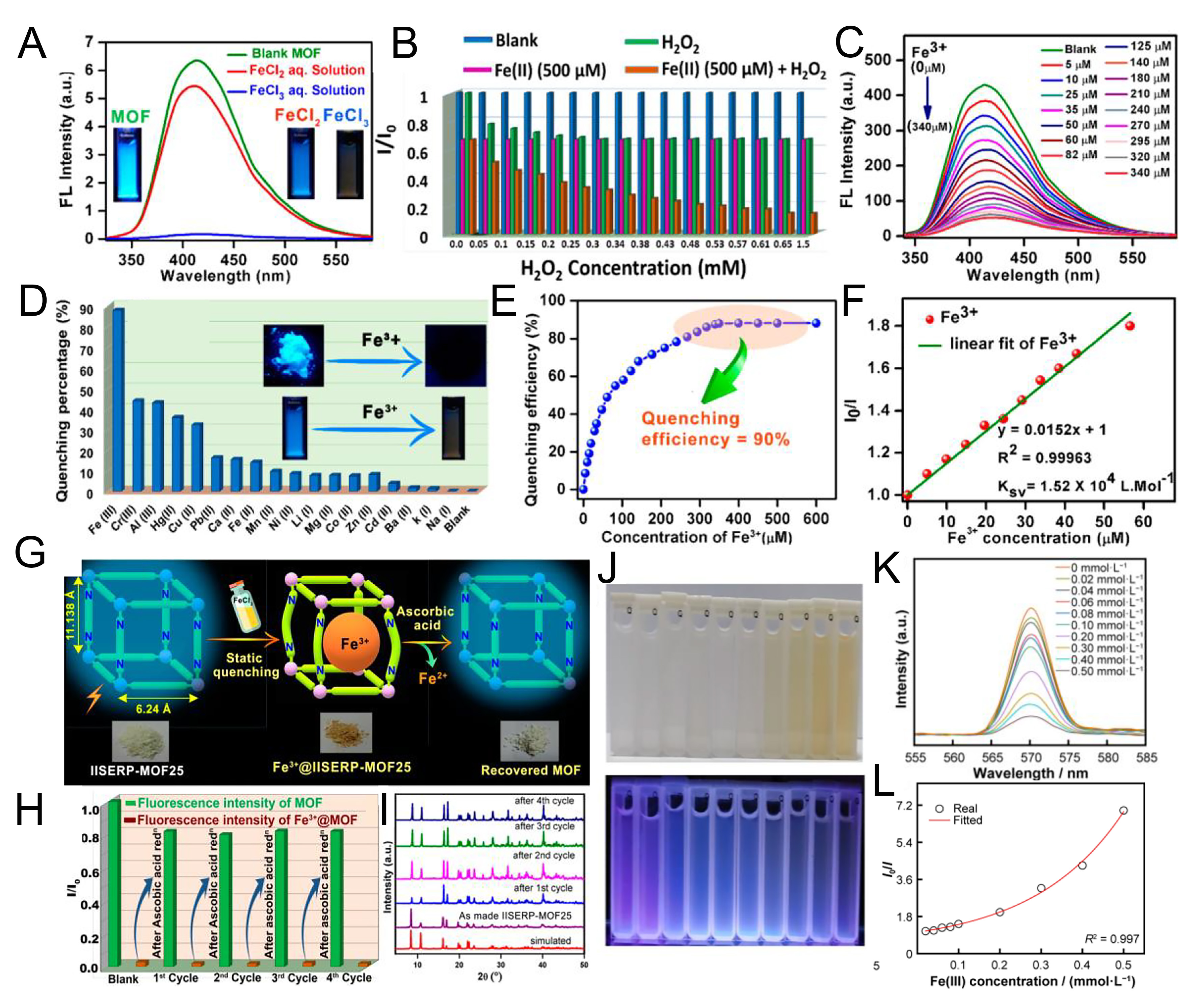
Figure 11. PET-derived MOF-based fluorescent sensors for Fe3+ detection. (A) Solution-state fluorescence spectra of IISERP-MOF25 in the absence and presence of Fe2+ or Fe3+; (B) Relative fluorescence intensity of IISERP-MOF25 after the addition of different amounts of peroxide, Fe2+, or both Fe2+ and peroxide, leading to the in situ generation of Fe3+; (C) Fluorescence quenching efficiency in FeCl3 solutions with different concentrations; (D) Solid-state and solution-state fluorescence quenching of IISERP-MOF25 by Fe3+ ions in the presence of different metal ions, including Fe2+; excitation was performed at 300 nm, and emission was monitored at 413 nm; (E) Quenching efficiency toward Fe3+ ions; (F) Color change of activated IISERP-MOF25 from colorless to brown after soaking in 0.33 mM FeCl3 solution, together with the Stern-Volmer plot at low Fe3+ concentrations; (G) Proposed mechanism of static fluorescence quenching of IISERP-MOF25 through ground-state nonfluorescent complex formation with Lewis-acidic Fe3+ ions. The MOF has pore-window dimensions of 11.138 Å × 6.24 Å, allowing the accommodation of Fe3+, whereas weaker interaction with Fe2+ is attributed to its larger size and possible leaching; (H) Representative diagrams for fluorescence recovery studies and fluorescence intensities after four recycling runs; (I) PXRD patterns of the MOF after each ascorbic acid reduction step; (J) Photographs of La-MOF suspensions in the presence of Fe3+ at concentrations of 0, 0.02, 0.04, 0.06, 0.08, 0.10, 0.20, 0.30, 0.40, and 0.50 mmol·L-1 under natural light and UV light; (k) Fluorescence spectra of La-MOF solution with various Fe3+ concentrations; (L) Plots of relative fluorescence intensity of La-MOF solution with various Fe3+ concentrations. (A-I) are adapted with permission from reference[290]. Copyright 2019, American Chemical Society. (J-L) are adapted with permission from reference[146]. Copyright 2024, The Author(s). MOF: Metal-organic framework; PET: polyethylene terephthalate; PXRD: powder X-ray diffraction.

