

fig1
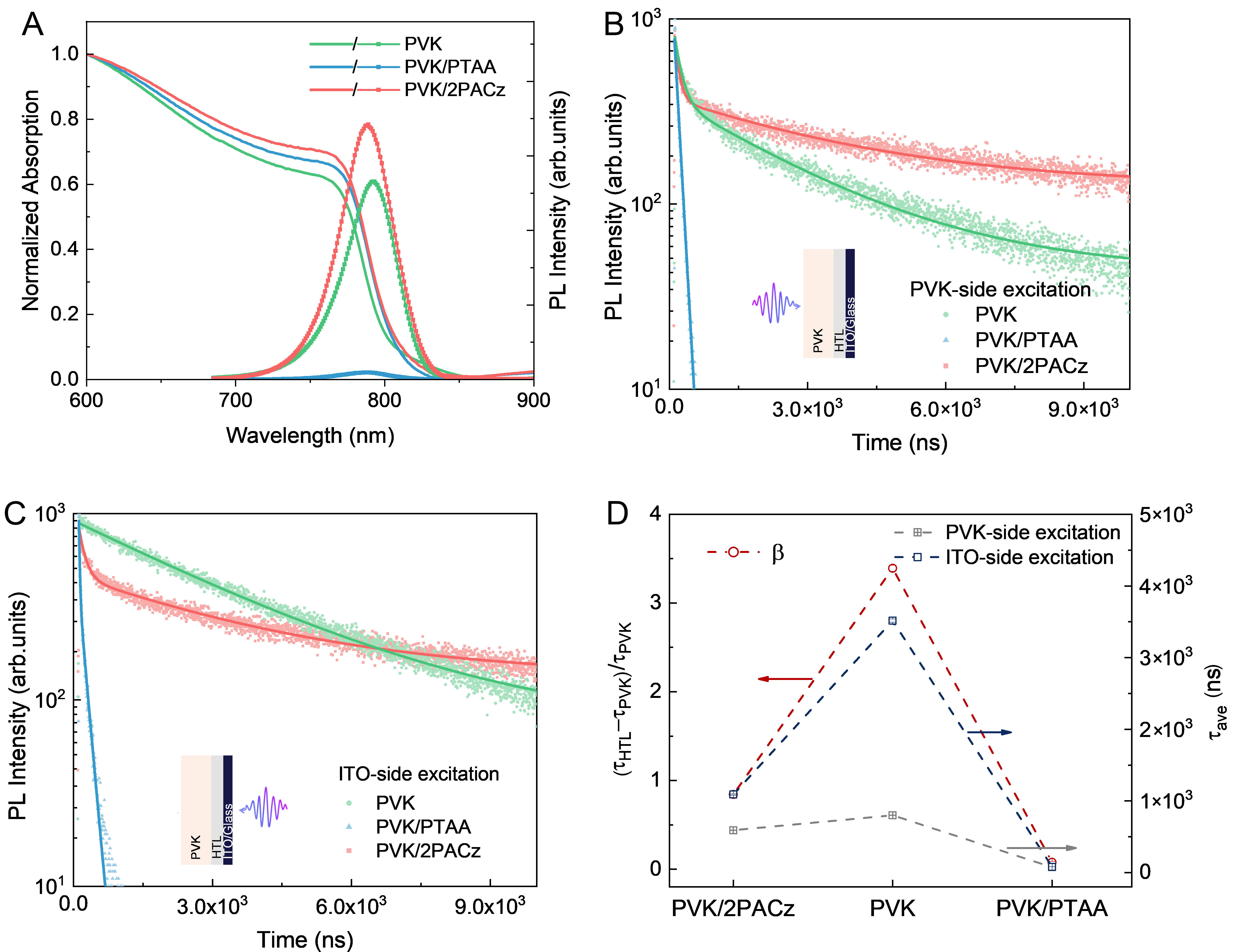
Figure 1. Spectral and photoluminescence characterization. (A) Normalized steady-state absorption spectra (solid lines) and PL spectra (dots and solid lines) of pristine PVK, PVK/PTAA and PVK/2-PACz films. Green: PVK; blue: PVK/PTAA; red: PVK/2-PACz; (B and C) TRPL decay curves monitored at 787 nm under 468 nm excitation (fluence = 0.76 μJ/cm2), measured from the PVK side (B) and the ITO side (C). Insets: schematic measurement configurations. Green squares: PVK; blue squares: PVK/PTAA; red squares: PVK/2-PACz. Solid lines represent exponential fits; (D) Comparison of TRPL lifetimes for the three sample sets under different excitation geometries. Gray squares: excitation from the PVK side; blue squares: excitation from the ITO side; red circles: difference factor . PVK: Pristine perovskite; PTAA: Poly[bis(4-phenyl)(2,4,6-triMethylphenyl)aMine]; 2-PACz: [2-(9H-carbazol-9-yl)ethyl]phosphonic acid; PL: photoluminescence; ITO: indium tin oxide; TRPL: time-resolved photoluminescence.

