
fig5
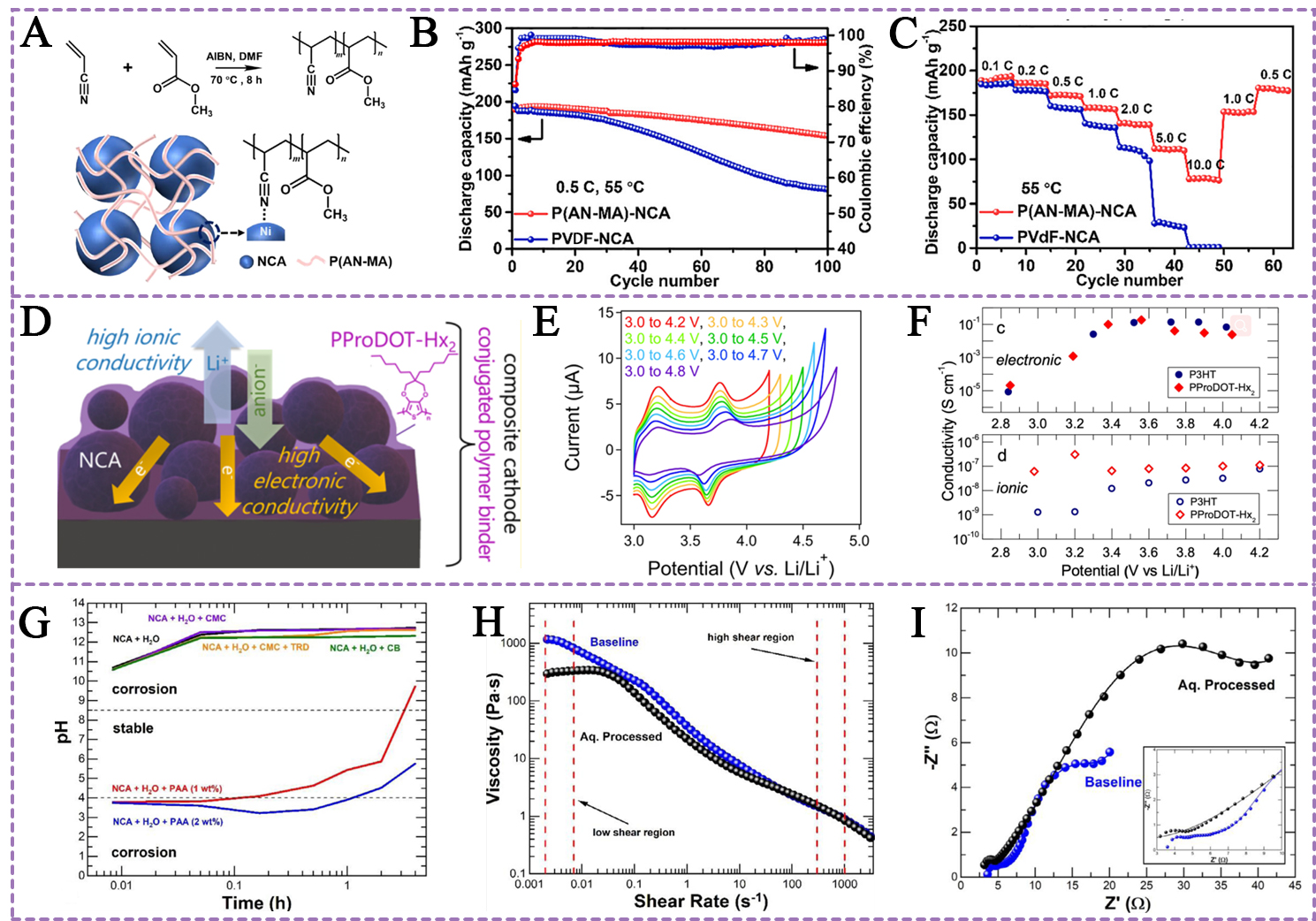
Figure 5. (A) Schematic illustration of P(AN-MA) copolymer binder and the interaction between P(AN-MA) binder and NCA material; (B) Long-term cycling performance and (C) rate capability of NCA cathode based on P(AN-MA) and PVDF binders; (A-C) are reprinted with permission from Ref.[80], Copyright © 2021, Elsevier; (D) The sketch map of NCA cathode with PProDOT-Hx2 binder; (E) CV curves of PProDOT-Hx2 film at various potential intervals; (F) Electronic and ionic conductivities of P3HT and PProDOT-Hx2 binders; (D-F) are reprinted with permission from Ref.[98], Copyright © 2020, American Chemical Society; (G) The pH of NCA-binder samples in water; (H) Viscosity profile of baseline and aqueous-processed slurries; (I) Nyquist plot of NCA cathodes with different binders after 100 cycles; (G-I) are reprinted with permission from Ref.[43], Copyright © 2021, Elsevier. AIBN: Azodiisobutyronitrile; DMF: N, N-dimethylformamide; NCA: LiNixCoyAl1-x-yO2, (x ≥ 0.8); P(AN-MA): poly (acrylonitrile-co-methyl acrylate); PVDF: Poly(vinylidene fluoride); PProDOT-Hx2: dihexyl-substituted poly(3,4-propylenedioxythiophene); P3HT: poly(3-hexylthiophene).

