


In-situ construction of artificial interface layer using sodiophilic Bi2S3 nanowires for dendritic-free sodium-metal batteries
 0
0 
Abstract
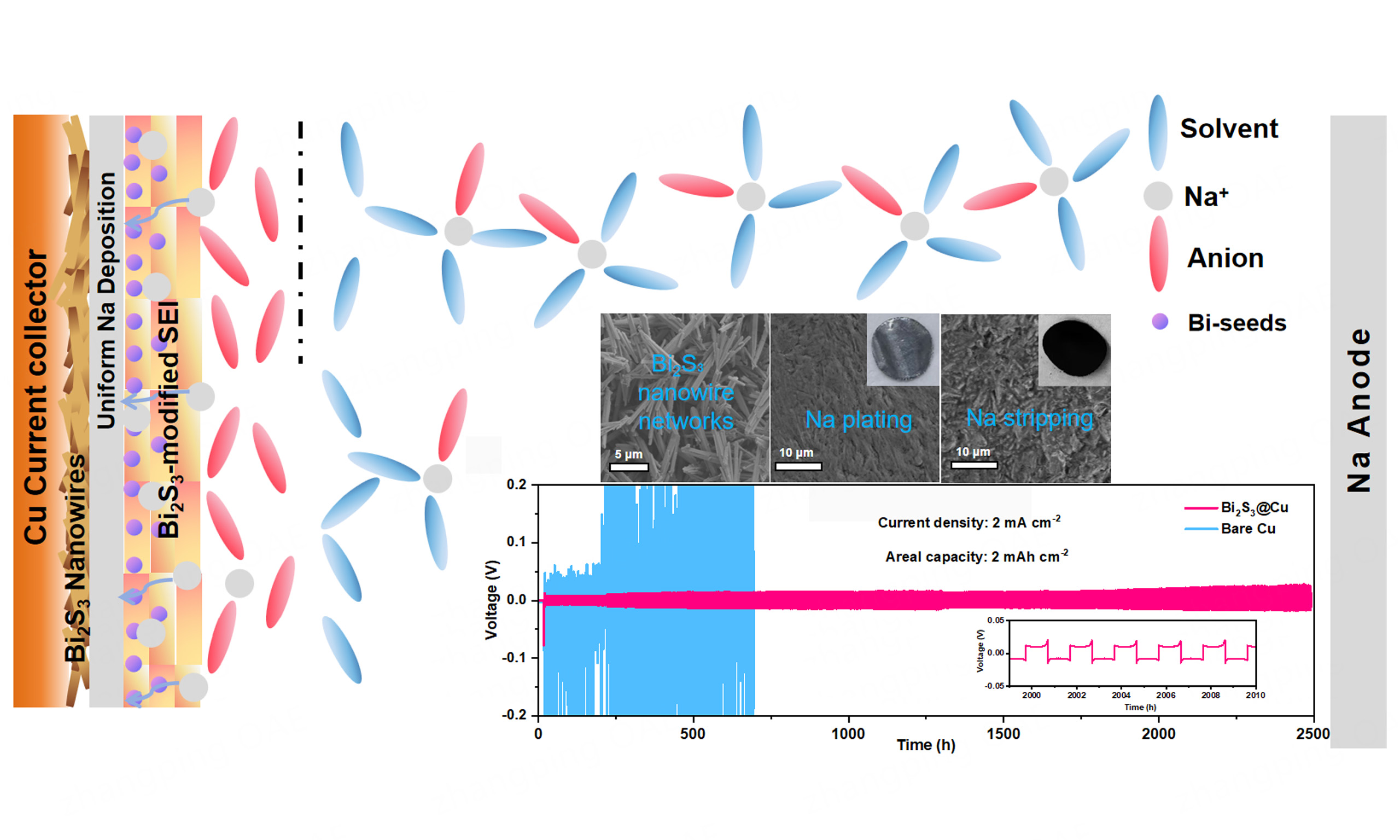
Sodium metal anodes possess low redox potential and high theoretical capacity, yet they face the challenges of uncontrolled dendritic growth and unstable solid-electrolyte interphase (SEI). Herein, we report a straightforward synthesis of Bi2S3 nanowires, which are engineered as a sodiophilic artificial interface layer to facilitate uniform and dendrite-free Na plating-stripping. Density functional theory (DFT) calculations and experimental characterizations confirm that Bi2S3 with high Na+ adsorption energy undergoes a sequential in-situ conversion-alloying reaction with Na+, forming sodiophilic Na3Bi alloy nucleation sites and a highly Na+-conductive Na2S matrix. This composite interface synergistically lowers the Na nucleation energy barrier and accelerates Na+ diffusion kinetics, effectively suppressing dendritic Na growth. Besides, Bi2S3 displays a stronger affinity of PF6 anions, facilitating the formation of NaF-rich SEI film with highly stable interface. Benefiting from these advantages, the Na/Bi2S3@Cu symmetric cell displays an extraordinary cycling lifespan of over 2,500 h at 2 mA cm-2 and 2 mAh cm-2, accompanied by an ultralow overpotential of 15 mV and a negligible interfacial resistance of 7.8 Ω even after 1,350 cycles. When paired with a commercial Na3V2(PO4)3/C cathode, the Na/Bi2S3 anode delivers superior long-term cycling stability and high-rate capability with capacity retention of 70% after 2,500 cycles at 10 C. This work provides an effective strategy for constructing stable sodiophilic interfaces for sodium metal anodes, which offers new fundamental insights for achieving high-performance sodium metal batteries.
Keywords
INTRODUCTION
The energy crisis and environmental pollution have spurred the global pursuit of renewable energy sources (ex., solar and wind), but their intermittent and fluctuating natures calls for the development of low-cost large-scale energy storage technologies to ensure reliable energy supply[1-3]. Lithium-ion batteries (LIBs) have been widely applied in portable electronics and electric vehicles owing to their exceptional energy/power density and long cycling life[4-6]. Nevertheless, the scarcity of lithium resources severely limit their large-scale application, creating an urgent demand for alternative battery systems based on earth-abundant elements[7]. Alternatively, sodium metal batteries (SMBs) have emerged as a promising candidate, thanks to the ubiquitous availability, low cost, and wide distribution of sodium resources[8-10]. Moreover, sodium metal anodes (SMAs) exhibit analogous physical and chemical properties to lithium metal, including a high specific capacity (1,166 mAh g-1 in theory) and a low redox potential [-2.71 V vs. Standard Hydrogen Electrode (SHE)], making them ideal for fabricating high-energy-density SMBs[11-13]. Despite these inherent advantages, the practical application of SMBs is limited by intractable challenges associated with SMAs, such as uncontrolled dendritic Na growth and the continuous destruction-construction of the solid-electrolyte interphase (SEI) film during repeated plating/stripping cycles[14-17]. These issues lead to low Coulombic efficiency (CE), rapid capacity fading, severe electrolyte consumption, and even safety hazards such as short circuits, which have become the primary bottlenecks hindering the commercialization of SMBs.
To address the above drawbacks of SMAs, extensive strategies have been explored, including the construction of artificial SEI layers[18], optimization of electrolyte compositions and additives[19], modification of current collectors[20,21], and the development of all-solid-state electrolytes[22-24]. Among these approaches, modifying copper current collectors with sodiophilic materials to in-situ form stable artificial SEI films has garnered tremendous attention, as it directly regulates Na nucleation and deposition behavior at the electrode/electrolyte interface, effectively suppressing dendrite growth and stabilizing SEI formation[25-27]. Various sodiophilic metallic materials and their compounds have been explored for current collector modification, as they can form reversible Na-based alloys via alloying-dealloying reactions, which effectively lower the Na nucleation energy barrier and induce uniform Na deposition[25,27,28]. For instance, flexible 3D carbon nanofiber frameworks anchored with Sb nanoparticles or encapsulated with ultrafine Sb2S3 nanoparticles have been demonstrated to enable stable Na plating/stripping for over 1,000 h and 2,800 h, respectively, by in-situ forming sodiophilic Na3Sb sites and high Na+-conductive Na2S matrices[25,27]. Additionally, CeF3@N-doped carbon and Na-Sn alloy-based porous carbon composites have been developed to construct NaF-rich SEI layers[10,26], achieving ultra-long cycling stability for SMAs under various test conditions. These studies confirm that the rational design of sodiophilic interfaces with both preferential nucleation sites and high ion-conductive matrices is the key to realizing dendrite-free Na deposition.
Bismuth (Bi) and its derivatives have attracted increasing interest as sodiophilic modifiers due to their strong Na adsorption affinity and reversible Na-Bi alloying behavior[29-31]. However, most reported Bi-based modifiers rely on metallic Bi nanoparticles or Bi/carbon composites, while Bi chalcogenides (e.g., Bi2S3) have rarely been explored as precursors for in-situ constructing composite sodiophilic interfaces. Bi2S3 possesses a unique layered crystal structure and inherent sodiophilicity, and its electrochemical reaction with Na+ can theoretically generate both Na-Bi alloy nucleation sites and Na2S ion-conductive matrices- two key components for stabilizing SMAs- via a one-step conversion-alloying process. Furthermore, the nanostructured design of Bi2S3 (e.g., nanowires) could provide a porous framework to accommodate the volume change during Na plating/stripping.
Herein, we report the solvothermal synthesis of one-dimensional Bi2S3 nanowires and their application as a sodiophilic artificial interface layer on Cu current collectors for high-stability SMAs. The Bi2S3 nanowires undergo in-situ electrochemical conversion-alloying with Na+ to form a composite interface consisting of sodiophilic Na3Bi alloy sites and highly Na+-diffusive Na2S matrices, which is further covered by a NaF-rich artificial SEI film. Density functional theory (DFT) calculations reveal that Bi2S3 and its electrochemical derivatives exhibit much higher Na+ adsorption energies than bare Cu, while Na2S possesses a significantly higher Na+ diffusion coefficient than conventional SEI components (Na2O, NaF). Consequently, the construction of Bi2S3 nanowire layer efficiently reduced the Na nucleation energy barrier, accelerated Na+ diffusion kinetics and provided sufficient space to buffer volume expansion during Na plating/stripping. Thus, the Na/Bi2S3@Cu symmetric cell achieves a long lifespan of over 2,500 h with an ultralow overpotential of 15 mV at 2 mA cm-2 and 2 mAh cm-2. When pairing with commercial Na3V2(PO4)3/C (NVP/C) cathode, the SMB full-cells also exhibit excellent cycling performance and high-rate capability. This work not only develops a simple strategy for constructing stable sodiophilic interfaces for SMAs, but also provides new fundamental insights for the design of chalcogenide-based precursors for in-situ forming composite artificial SEI layers, paving the way for the development of high-performance SMBs.
EXPERIMENTAL
Materials synthesis
Bi2S3 nanowires were prepared via solvothermal method. In a typical synthesis, 1 mmol bismuth chloride (BiCl3, Macklin) and 1.5 mmol thiourea (CH4N2S, Sigma-Aldrich) were completely dissolved in 40 mL ethylene glycol (C2H6O2, Alfa Aesar) under magnetic stirring, which were then sealed and reacted in a
Materials characterizations
X-ray diffraction (XRD) patterns of the products were recorded on a Bruker D2 Phaser diffractometer (Bruker, Germany). The microstructures of the products were characterized by scanning electron microscope (SEM, FEI Company Quanta 250F; FEI, USA) and transmission electron microscope (TEM, JEOL JEM-200; JEOL, Japan). High-Angle Annular Dark-Field Scanning Transmission Electron Microscopy (HAADF-STEM) images and Energy Dispersive X-ray Spectroscopy (EDS) maps were also taken on the JEM-200 TEM instrument (JEOL, Japan). X-ray photoelectron spectroscopy (XPS) was performed on a Thermo Fisher ESCALAB 250Xi instrument (Thermo Fisher Scientific, USA). Time-of-Flight Secondary Ion Mass Spectrometry (TOF-SIMS) was carried out on an ION-TOF instrument (ION-TOF GmbH, Germany).
Electrochemical measurements
All the cells were fabricated/disassembled in an Ar-filled glovebox. The Bi2S3 nanowires were deposited onto Cu substrate by casting a slurry, which was consisting of Bi2S3 and Polyvinylidene fluoride (PVDF) (HSV900, Arkema) in the ratio of 9:1 in N-methyl-2 pyrrolidinone (NMP, Macklin), and the as-prepared Bi2S3@Cu substrate was dried at 60 °C overnight. The loading amount of Bi2S3 on Cu foils is approximately 3 mg cm-2. For fabrication of Na metal anodes, certain amount of Na was galvanostatically plated onto the bare Cu and Bi2S3@Cu substrates in asymmetrical cells at various current densities (1.0-10 mA cm-2), thus producing Na pre-deposited Cu or
For the full cell assembly, the cathode electrodes were fabricated by casting the well-mixed slurry, which is consisting of commercial Na3V2(PO4)3/C (NVP/C), Super P, and PVDF with weight ratio of 8:1:1 in NMP, using Al foil as current collector. The cathode electrodes were cut into a disk shape with Ø of 12 mm and a loading amount of ~2.0 mg cm-2. Whatman glass microfiber membrane was employed as the separator. The Na/Bi2S3@Cu with pre-deposition capacity of 3 mAh cm-2 was used as the anode, while the electrolyte was identical to that for the symmetric cells. The injection amounts of the electrolyte for symmetric cells and full cells were 40 and 80 μL, respectively. Galvanostatic discharge/charge (GCD) tests were performed using a NEWARE BTS in 2.5-3.8 V. Cyclic voltammetry (CV, 0.01-2.5 V) and electrochemical impedance spectroscopy (EIS, 0.01-10 MHz) were measured on CHI600 electrochemical workstation.
Calculation method
Vienna Ab initio Simulation Package (VASP), which is based on the DFT, was employed to perform first-principles calculations. The electron-ion interactions were described using the Projector Augmented Wave (PAW) method. The valence electronic configurations of the elements considered were Bi (6s2 6p3),
RESULTS AND DISCUSSION
Figure 1A shows the SEM image of the as-synthesized Bi2S3 product via solvothermal method, which exhibits well-defined one-dimensional nanowire-like morphology with lengths up to tens of micrometers. Moreover, the nanowires tend to hierarchically bundle at one end. Figure 1B shows the TEM image of a single Bi2S3 nanowire with inset showing the Selected Area Electron Diffraction (SAED) pattern, revealing its single-crystalline structure. As shown in the High-Resolution Transmission Electron Microscopy (HRTEM) image [Figure 1C], two sets of lattice fringes with interplanar distances of 0.8 nm and 0.4 nm can be clearly observed, which can be correspondingly indexed to the (101) and (20-2) crystallographic planes of Bi2S3[32]. In addition, the angle between (101) and (20-2) is measured as about 90°, which is consistent with the SAED pattern analysis. Figure 1D displays the HAADF-STEM image of a bundle of Bi2S3 nanowires which are apparently rooted together at one end. Furthermore, the corresponding EDS analysis shows that the elemental maps for Bi and S are well overlapped within the nanowires [Figure 1E and F], confirming the homogeneous elemental distribution, uniform stoichiometry, and high phase purity of the as-synthesized Bi2S3 nanowires.
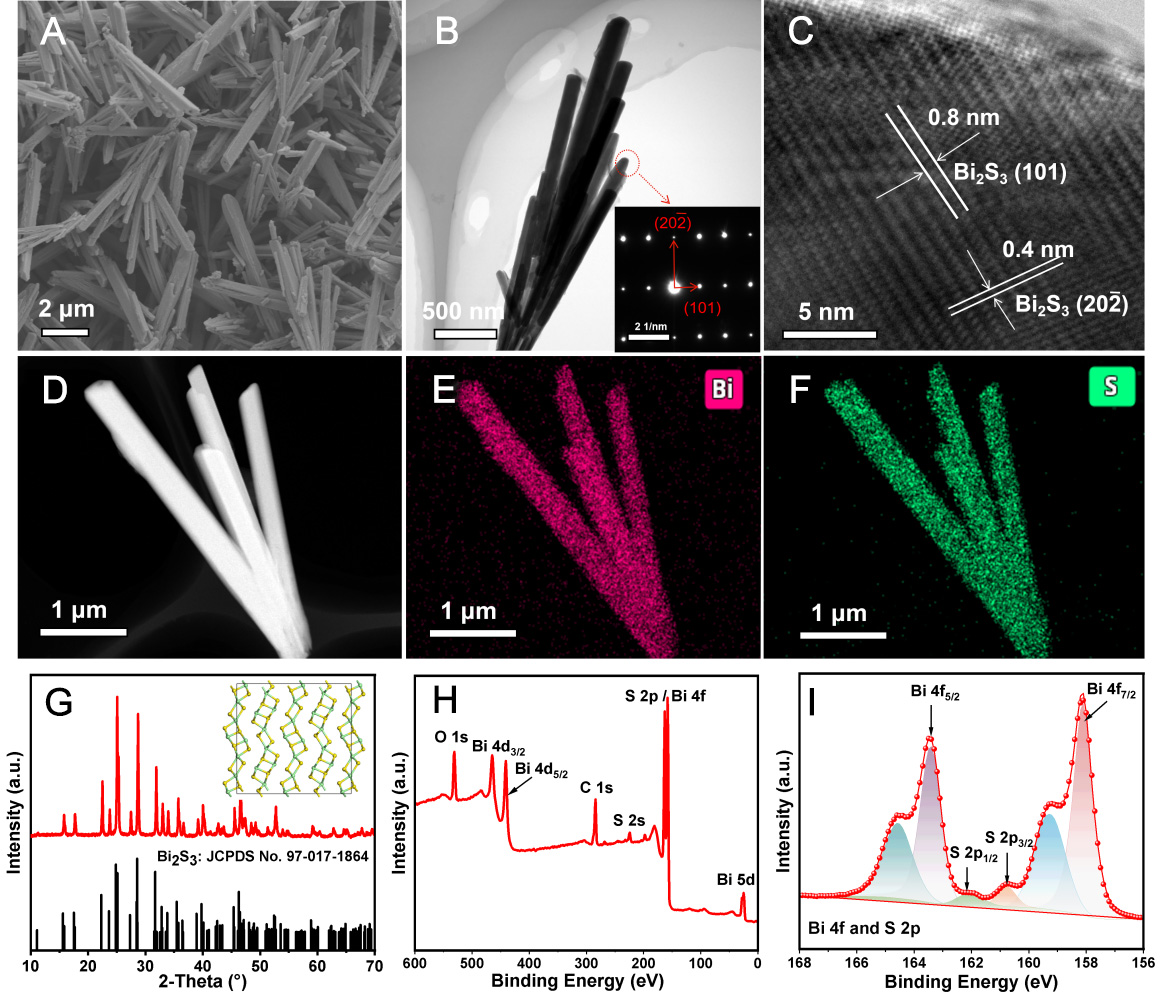
Figure 1. (A) SEM image, (B) TEM image with SAED pattern, and (C) HRTEM image of Bi2S3 nanowires; (D) HAADF-STEM image and
Figure 1G presents the XRD pattern of the Bi2S3 product, where all the diffraction peaks can be well indexed to the orthorhombic phase of Bi2S3 (JCPDS No.97-017-1864) with high purity[32]. The inset of Figure 1G schematically illustrates the supercell structure of Bi2S3, which consists of tightly bound ribbons extending along the (011) direction[33], and this is consistent with the HRTEM analysis [Figure 1C]. Figure 1H presents the survey XPS spectrum of the Bi2S3 product, where characteristic peaks of Bi and S elements are apparently observed. Additionally, O 1s and C 1s signals are present, which are likely attributed to surface adsorption of atmospheric species. Figure 1I displays the XPS spectrum of Bi 4f along with S 2p, in which two pairs of strong doublet peaks locate at 164.6/159.2 eV and 163.5/158.1 eV, corresponding to the Bi 4f5/2/Bi 4f7/2 with the chemical state of Bi3+ in the Bi-S and Bi-O, respectively. In addition, two minor peaks located at 161.9 eV and 160.7 eV are assigned to S 2p1/2 and S 2p3/2, respectively, suggesting the presence of S2- species[34]. Moreover, the high-resolution S 2s XPS spectrum exhibits a peak at 225.6 eV [Supplementary Figure 1], further confirming the sulfide state in the Bi2S3 nanowires. The coexistence of bismuth and sulfur spectral features confirms the successful formation of Bi-S bonds within the synthesized product.
Figure 2A shows the CV profile of the Bi2S3 electrode in the first cycle, highlighting its characteristic sodiation and desodiation behavior. In the cathodic scan, three distinct reduction peaks locate at approximately 1.00, 0.63 and 0.44 V, which are consistent with the voltage plateaus in the galvanostatic discharge profile [Figure 2B]. The minor peak at 1.00 V is related to the Na+ intercalation into the Bi2S3 lattice (Bi2S3 + Na+ + e- → NaBiS2), while the strong peak at 0.63 V corresponds the reduction of NaBiS2 into metallic Bi (NaBiS2 + Na+ + e- → Bi + Na2S). Furthermore, the sharp peak at 0.44 V is assigned to the alloying reaction (Bi + Na+ + e- → Na3Bi)[34]. In the anodic scan, two distinct peaks locate at 0.61 V and 0.76 V, which correspond to the dealloying of Na3Bi and the oxidation of metallic Bi, respectively.
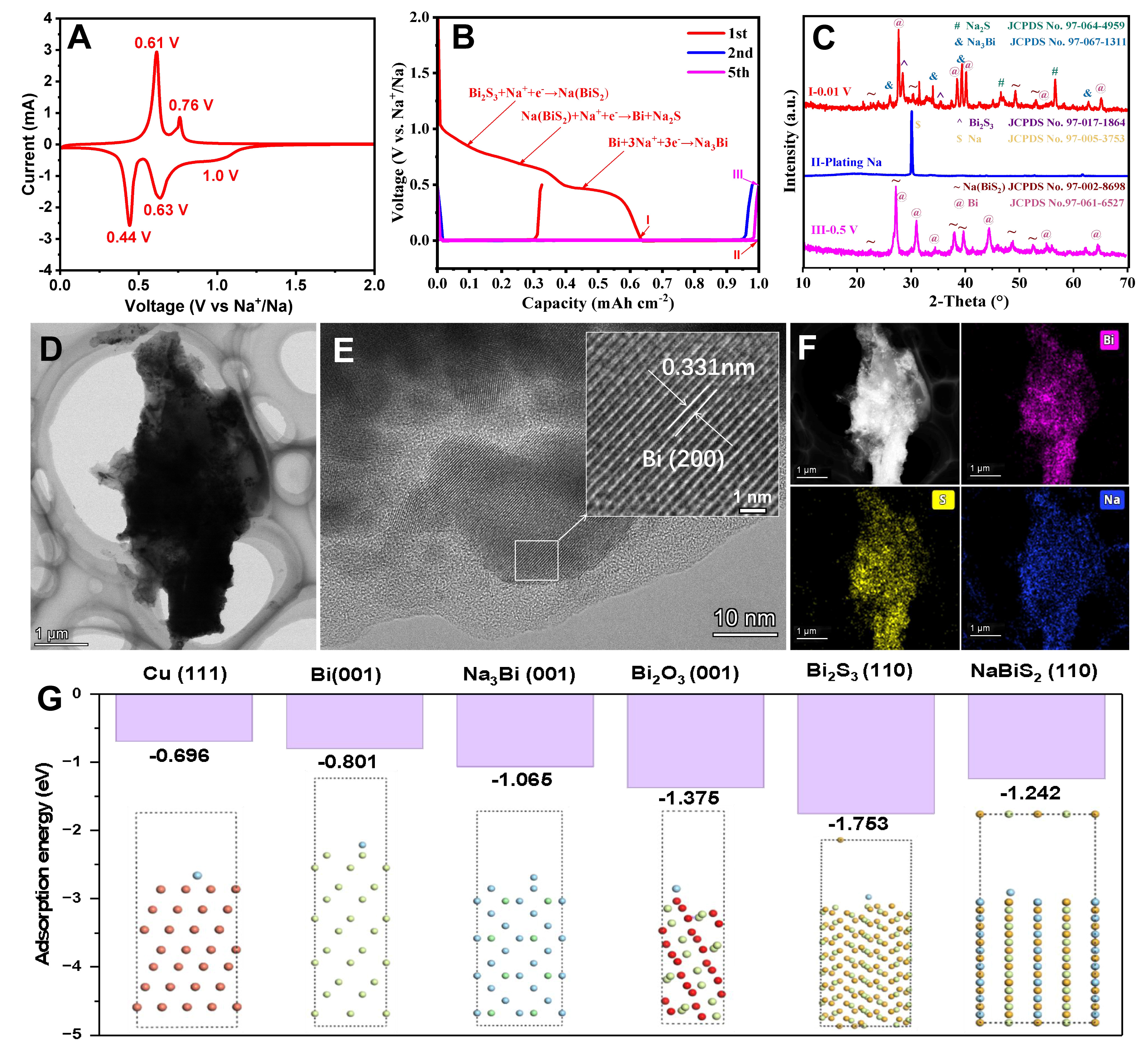
Figure 2. (A) Initial CV curve and (B) GCD curves of Bi2S3; (C) XRD patterns of the discharged Bi2S3 electrodes at different states; (D) TEM image and (E) HRTEM image of sodiated Bi2S3 at initially discharged to 0.5 V, and (F) HAADF-STEM image with corresponding EDS maps of Bi/S/Na elements; (G) Sodium adsorption energies on Cu (111), Bi (001), Na3Bi (001), Bi2O3 (001), Bi2S3 (110) and NaBiS2 (110) surfaces, where more negative values imply stronger adsorption. CV: Cyclic voltammetry; GCD: Galvanostatic discharge; XRD: X-ray diffraction; TEM: transmission electron microscope; HRTEM: high-resolution transmission electron microscopy; HAADF-STEM: high-resolution transmission electron microscopy; EDS: energy dispersive X-ray spectroscopy.
To further elucidate the structural evolution upon sodiation, ex-situ XRD analyses were conducted on the cycled Bi2S3 electrodes at different states. When initially discharging to 0.01 V, Bi2S3 was electrochemically reduced into Bi and then Na3Bi alloy, accompanied by the final formation of Na2S, which was confirmed by the XRD pattern (Figure 2C, pattern I). At this state of 0.01 V, the diffraction peaks for Bi2S3 almost disappeared, while new peaks emerge that match with cubic Na2S (JCPDS No. 97-064-4959), metallic Bi (JCPDS No. 97-006-4704), Na3Bi alloy (JCPDS No. 97-067-1311) and cubic NaBiS2 (JCPDS No. 97-002-8698). Further after plating a capacity of 1 mAh cm-2, only XRD pattern for Na metal appears, suggesting the Na deposition on top of the Bi2S3-derived substrate. When initially stripped and charged to
Figure 2G reveals the sodium adsorption energies on Cu (111), Bi (001), Na3Bi (001), Bi2O3 (001), Bi2S3 (110) and NaBiS2 (110) surfaces. The calculated adsorption energies are negative, indicating that these adsorptions are exothermic processes. The equivalent values are -1.753, -1.242, -1.375, -1.065 and -0.801 eV for Bi2S3 (110), NaBiS2 (110), Bi2O3 (001), Na3Bi (001) and Bi (001), respectively, which are more negative than of Cu (111) (-0.696 eV), suggesting the stronger adsorption and higher interfacial binding energies on the Bi-based substrates. Thus, the Bi2S3 surfaces are highly sodiophilic with greater affinity ability to anchor Na+ ions, as compared to metallic Bi and its alloy or oxide counterparts, which are critical for the uniform Na nucleation and subsequent plating. Additionally, Bi2S3 upon sodiation would produce NaBiS2, metallic Bi and finally Na-Bi alloy sequentially, which also show more sodiophilic ability than that for bare Cu substrate, leading to the reduction of the energy barrier for Na nucleation. In order to study the Na+ diffusion behavior with different sodium-based compounds, the diffusion coefficients of Na2O, Na2S, and NaF were calculated via DFT calculation (see details in supporting information) and compared in Supplementary Figure 2 and Supplementary Table 1. The findings indicate that the diffusion coefficient of Na2S (7.120 × 10⁻⁹ cm-2/s) is much higher than those of Na2O (5.551 × 10⁻¹⁰ cm-2/s) and NaF (1.548 × 10⁻¹⁰ cm-2/s), suggesting the type of anions has a pronounced affection on the diffusion behaviors of sodium-based compounds, as the anionic structural properties greatly affect the lattice density and ion mobility. Importantly, due to the much higher diffusion coefficient of Na2S[25], it could effectively alleviate the volume expansion of Na-Bi alloying and facilitate the homogeneous distribution of sodium ion flux[35].
To evaluate the reversibility of sodium plating/stripping during cycling, asymmetric cells were fabricated using Bi2S3@Cu (or Cu) foils as sodium plating substrates and bare Na foil as counter electrode. As illustrated in Figure 3A, the sodium plating on Bi2S3@Cu exhibits a lower nucleation overpotential of only 7 mV than that for the Cu electrode (43 mV) at 1 mA cm-2. The small overpotential can be attributed to the highly sodiophilic nature of Bi2S3 and its derivates (ex., Bi and Na-Bi alloy) with higher adsorption energies, which facilitate the uniform sodium nucleation and enhance homogeneous sodium deposition, and this is supported by the DFT calculations [Figure 2G]. Figure 3B compares the Coulombic efficiencies (CEs) of the Na plating/stripping on Bi2S3@Cu and Cu substrates upon cycling at 5 mA cm-2 with 1 mAh cm-2, and CE as a critical indicator reveals the electrochemical stability, which is defined as a capacity ratio of sodium stripping to plating in each cycle. Apparently, the sodium plating/stripping on the Bi2S3@Cu electrode demonstrates highly stable CEs with values of up to 99.9% during 1,000 cycles, indicating the extremely high reversibility of the sodium plating/stripping process. In contrast, the bare Cu electrode exhibits significant CE variations and loses functionality after tens of cycles, which have been attributed to unstable SEI formation and mossy Na deposition[36].
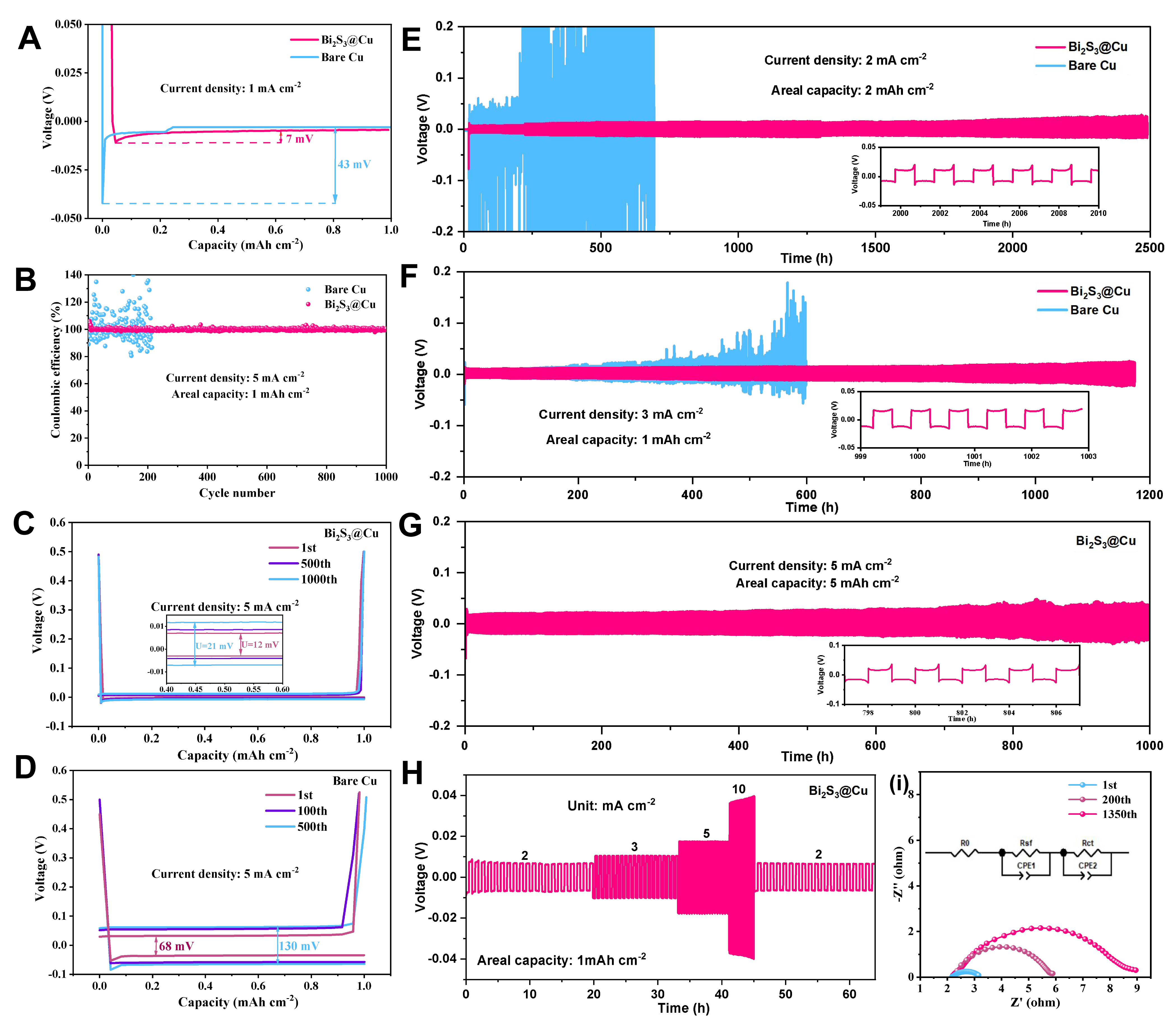
Figure 3. (A) Galvanostatic Na plating profiles on the bare Cu and Bi2S3@Cu substrates at 1 mA cm-2; (B) Comparison of CEs upon Na plating/stripping cycling on the Cu and Bi2S3@Cu substrates at 5 mA cm-2 and 1 mAh cm-2; (C and D) Voltage-capacity curves of sodium plating/stripping processes on Bi2S3@Cu substrate (C) and Cu substrate (D) at 5 mA cm-2; (E-G) Voltage-time profiles of symmetric cells of Na/Bi2S3@Cu and Na@Cu electrodes at (E) 2 mA cm-2 and 2 mAh cm-2, (F) 3 mA cm-2 and 1 mAh cm-2, and (G) 5 mA cm-2 and
Figure 3C displays the voltage-capacity profiles of the sodium plating/stripping on the Bi2S3@Cu electrode, which are highly overlapped with voltage hysteresis increasing only slightly from 21 mV in the first cycle to 42 mV after 1,000 cycles at 5 mA cm-2 and 1 mAh cm-2. In comparison, the Na plating/stripping on bare Cu substrates displays larger voltage hysteresis, escalating from 68 mV (1st cycle) to 130 mV (500th cycle) under the same condition [Figure 3D], along with inferior cycling stability. These results confirm that the construction of sodiophilic Bi2S3 buffering layer on Cu substrate significantly enhances the reversibility of sodium plating/stripping, which efficiently suppress the interfacial side reactions and uncontrolled dendrite growth.
To evaluate the efficacy of Bi2S3 in suppressing sodium dendrite growth, symmetric cells were assembled using two identical electrodes. As depicted in Figure 3E, the Na/Bi2S3@Cu-based symmetric cell demonstrates exceptional long-term sodium plating/stripping stability with a lifespan of 2,500 h and a low overpotential of 15 mV at 2 mA cm-2 and 2 mAh cm-2. In contrast, the bare Na@Cu-based symmetric cell exhibits unstable sodium plating/stripping behavior, with the overpotential abruptly exceeding 0.5 V after 260 h, indicating severe polarization under identical current conditions. Even at 3 mA cm-2 and 1 mAh cm-2 [Figure 3F], the Na/Bi2S3@Cu-based symmetric cell still achieved a long stable lifespan of over 1,200 h with a small overpotential of 21 mV. Comparatively, the bare Na@Cu-based symmetrical cell displays apparent voltage variations with gradually increased overpotentials, and a steep increase after around 600 h. It’s noteworthy that the voltage-time profiles of Na/Bi2S3@Cu-based symmetric cells at various cycles exhibit well-approximated square waves [Figure 3F], indicating the suppression of sodium dendrite growth and interfacial side reactions[37]. By comparison, the bare Na@Cu-based cell shows highly irregular voltage-time curves, suggesting the formation of disordered sodium dendrites and the continuous SEI breaking/repairing, which would lead to unnecessary electrolyte consumption and finally result in battery failure.
Figure 3G depicts the voltage-time profiles of the Na/Bi2S3@Cu-based symmetric cells at 5 mA cm-2 and
Figure 4A schematically illustrates the different Na plating behaviors on the bare Cu and Bi2S3@Cu substrates. It’s well recognized that the coarse surface of bare Cu substrate usually leads to the random sodium nucleation and non-uniform deposition with un-avoided dendrite formation[38,39]. In contrast, owing to the high adsorption energy of Bi2S3, the sodium ions are anchored and readily reacted with Bi2S3 in the initial plating stage, forming sodiophilic Bi and Na-Bi grains which were embedded into the Na2S matrices with high sodium ion diffusivity. These sodiophilic grains thus facilitate the homogeneous sodium nucleation and subsequent uniform dendrite-free sodium deposition, which were verified by the ex-situ SEM analysis. Figure 4B shows the SEM image of Na-plated Cu substrate with areal capacity of 1 mAh cm-2 at
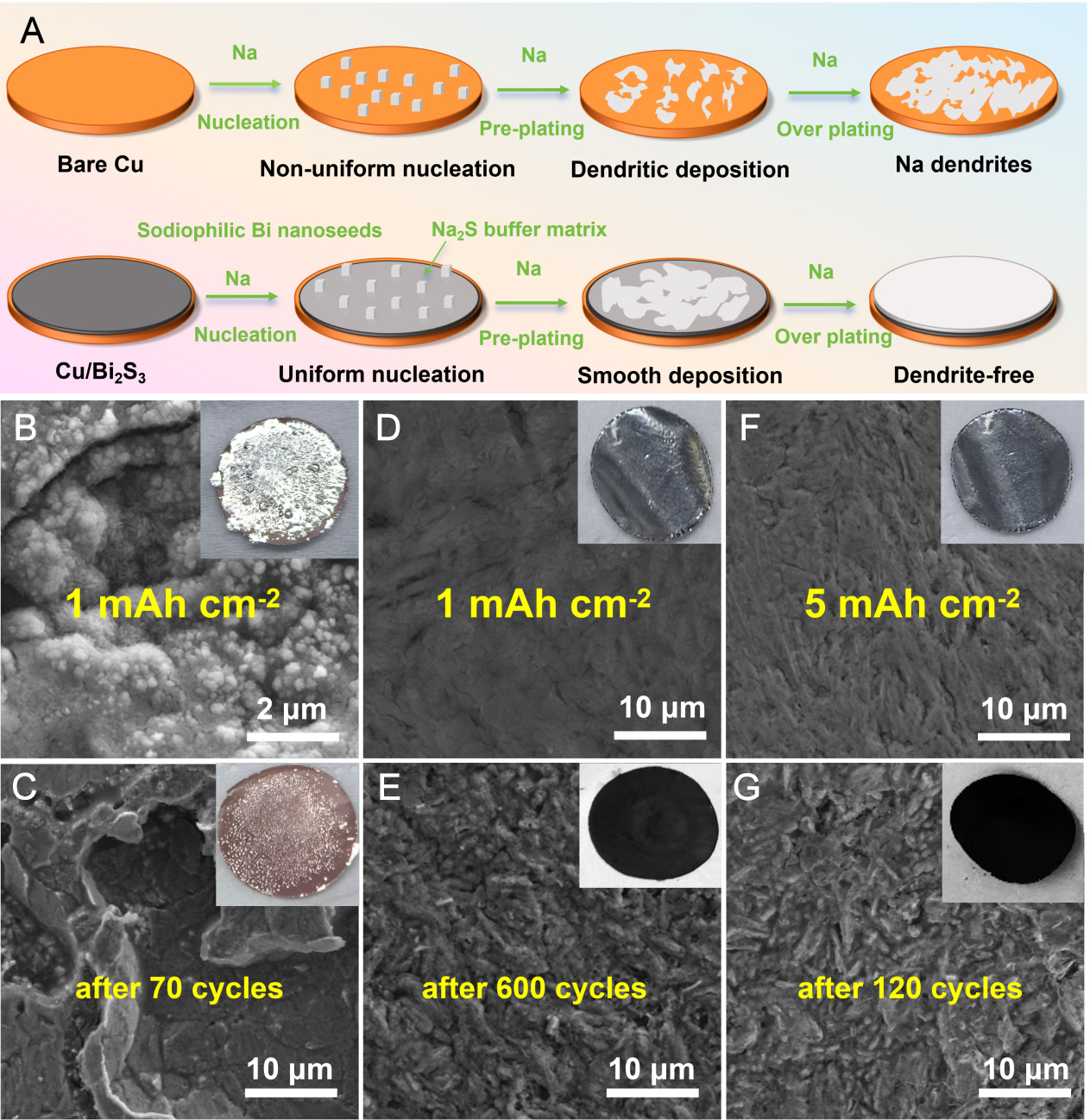
Figure 4. (A) Scheme illustrating the distinct Na plating behaviors on bare Cu and Bi2S3@Cu substrates; (B and C) Ex-situ SEM images of the bare Cu substrate after Na plating (B) and stripping (C) at 1 mA cm-2 with 1 mAh cm-2 after 70 cycles; (D-G) Ex-situ SEM images of the Bi2S3@Cu substrate after Na plating (D and F) and stripping (E and G) at 1 mA cm-2 with 1 mAh cm-2 (D and E) after 600 cycles and at
Supplementary Figure 4 reveals that the pristine Bi2S3 nanowires are coated onto the Cu substrate, forming porous nanowire networks, within which the volume can efficiently accommodate the expansion after Na deposition. Consequently, with Bi2S3 nanowire networks as an artificial buffering layer, the Bi2S3@Cu effectively achieve the uniform Na plating/stripping [Figure 4D-G]. Figure 4D shows the SEM image of Na-plated Bi2S3@Cu after 600 cycles at 1 mA cm-2 and 1 mAh cm-2, where no Na-dendrite can be observed, and photo of the electrode displays uniform silver-like Na metal layer with smooth surface. Even at a higher areal capacity of 5 mAh cm-2 after 120 cycles [Figure 4F], both SEM image and electrode photo reveal the uniform Na depositon without dendrite formation. Oppositely, after complete Na-stripping, the photos of the desodiated Bi2S3@Cu electrodes display dark in color, and no silver-like “dead Na” appears. Interestingly, the cycled Bi2S3 nanowires still retain the 1D morphology [Figure 4E and G], but their volumes are expanded owing to the volume changes after repeated sodiation/desodiation cycling. Remarkably, no mossy or dead Na are observed in the Bi2S3@Cu electrode even upon long-term plating/stripping cycling, suggesting Bi2S3 effectively inhibits the sodium dendrite formation.
Moreover, in-situ optical microscopy was further applied to dynamically observe the sodium plating/stripping process on the bare Cu and Bi2S3@Cu substrates in asymmetric batteries. As shown in Supplementary Figure 5A-D, upon plating at 1 mA cm-2 for 60 min, the cross-section of Bi2S3@Cu maintains flat topography throughout the cycling process, indicating no apparent dendrite generation and the superior dendrite inhibition effect of Bi2S3 layer. But for bare Cu substrate, localized bright spots can be apparently observed after about 15 min of plating [Supplementary Figure 5E-H], suggesting the formation of sodium bulks and dendrites, and this can be explained by the tip discharge effect due to the inhomogeneous electric field on the surface[40]. Such sharp contrast further highlight the critical role of Bi2S3 in enabling the homogenous deposition of sodium and good inhibition of dendrite growth[41].
To investigate the composition and chemical situations of the Bi2S3 induced artificial interface layer, ex-situ TOF-SIMS analysis was performed on the Na-stripped Bi2S3@Cu after 10 cycles [Figure 5A], revealing the presence of broken inorganic fragments (ex., NaF-, NaO-, NaS-, NaBiS2-, etc.) and organic derivatives (C2HO-, arising from the decomposition of solvent molecules). As revealed by the 3D-mapping images with in-depth profiling along z-axis, NaF- and NaO- species are well distributed within the SEI layer, while C2HO- mainly presents in the surface region. In contrast, Bi/S-related species (ex., NaS-, NaBiS2-) predominantly exist in the inner region, indicating the SEI layer is rich in inorganic species, which are covered on the sodiophilic Bi2S3-related derivates. Consequently, the Bi2S3-induced artificial SEI layer with uniform distribution of different inorganic phases facilitates the well-distributed Na+ infiltration at the same rate, thus leading to the uniform Na deposition[26,42,43].
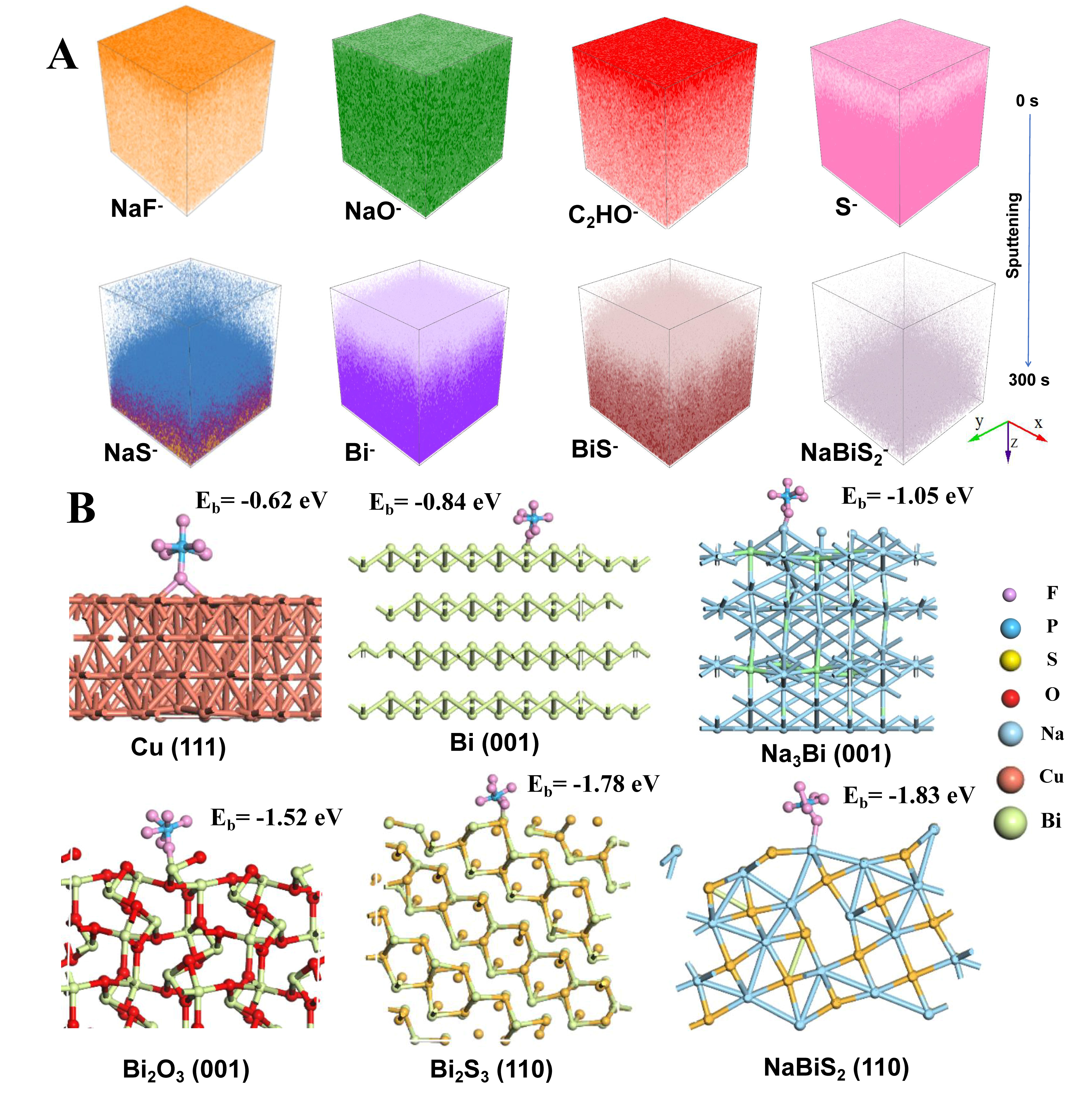
Figure 5. (A) 3D-mapping images of different secondary ion fragments of the Na-stripped Bi2S3@Cu after 10 cycles at 0.5 mA cm-2 and
To investigate the interactions of PF6 anion with different substrates, DFT simulations were performed to calculate the binding energies (Eb) of PF6 anion on various substrates. It’s worth noting that the high binding energies between the substrate and anion would facilitate the dissociation of sodium salt, thus releasing more free Na+ ions for active charge transfer[10]. Moreover, the confined anion migration would increase the Na+ ion transport number and enhance ionic conductivity, thereby leading to the enhanced migration kinetics. The computational results reveal that Bi2S3 and NaBiS2 demonstrate higher binding energies of -1.78 eV and -1.83 eV than metallic substrates, suggesting a more pronounced affinity with PF6 [Figure 5B]. On one hand, the strong interaction leads to the surface accumulation of anions and affects the solvation structure, thus avoiding the direct contact between solvent molecules and Na metal. On the other hand, the confined anion migration prolongs the duration of Na+ nucleation stage, thereby allowing the refined grain nucleation and homogeneous Na deposition. Moreover, the strong binding with PF6 anion would contribute to the construction of stable NaF-rich SEI, which thus suppresses the hazardous side reactions. Remarkably as revealed by the TOF-SIMS results, the significant content of NaF on the surface corroborate the calculation results. In addition, to investigate the stability of the artificial SEI layer, XPS analyses were performed on the Na-stripped Bi2S3@Cu electrode after 1 and 10 cycles [Supplementary Figure 6]. Note that the electrolyte of 1M NaPF6 in DIGLYNE contains C, Na, O, F and P, which are the primary components of SEI layer, as confirmed by the XPS results. It’s noteworthy that there is no significant variation of Na-F, Na-O, C-O and P-F bonds for the electrodes after 1 and 10 cycles, implying the high structure stability of the artificial SEI layer. However, in the S 2p XPS spectra, the S 2p peak is quite weak after 1 cycle and disappears after 10 cycles, suggesting Na2S exists in the inner part, which is in agreement with the TOF-SIMS analysis.
To further demonstrate the efficacy of Na/Bi2S3 anode in practical application, full cells were constructed by paring with commercial NVP/C cathode (inset of Figure 6A). Figure 6A compares the cycling performances of the NVP/C‖Na/Bi2S3 and NVP/C‖Na full cells at 1 C (1 C = 117 mAh g-1), and the NVP/C‖Na/Bi2S3 exhibits a higher specific capacity of 80 mAh g-1 with a higher retention of 84.5% after 300 cycles at 1 C, as compared with NVP/C‖Na cell using Na metal as anode (72 mAh g-1 with 80.0% retention). Figure 6B depicts the rate performances of both cells at different rates ranging from 2 C to 10 C, and NVP/C‖Na/Bi2S3 shows higher capacities under different rates than those for NVP/C‖Na, suggesting the better rate capability after intruding Bi2S3. Remarkably, NVP/C‖Na/Bi2S3 delivered a high specific capacity of 75.7 mAh g-1 even at 10 C (while 60.8 mAh g-1 for NVP/C‖Na), which can return to original value (88.3 mAh g-1) after shifting back to
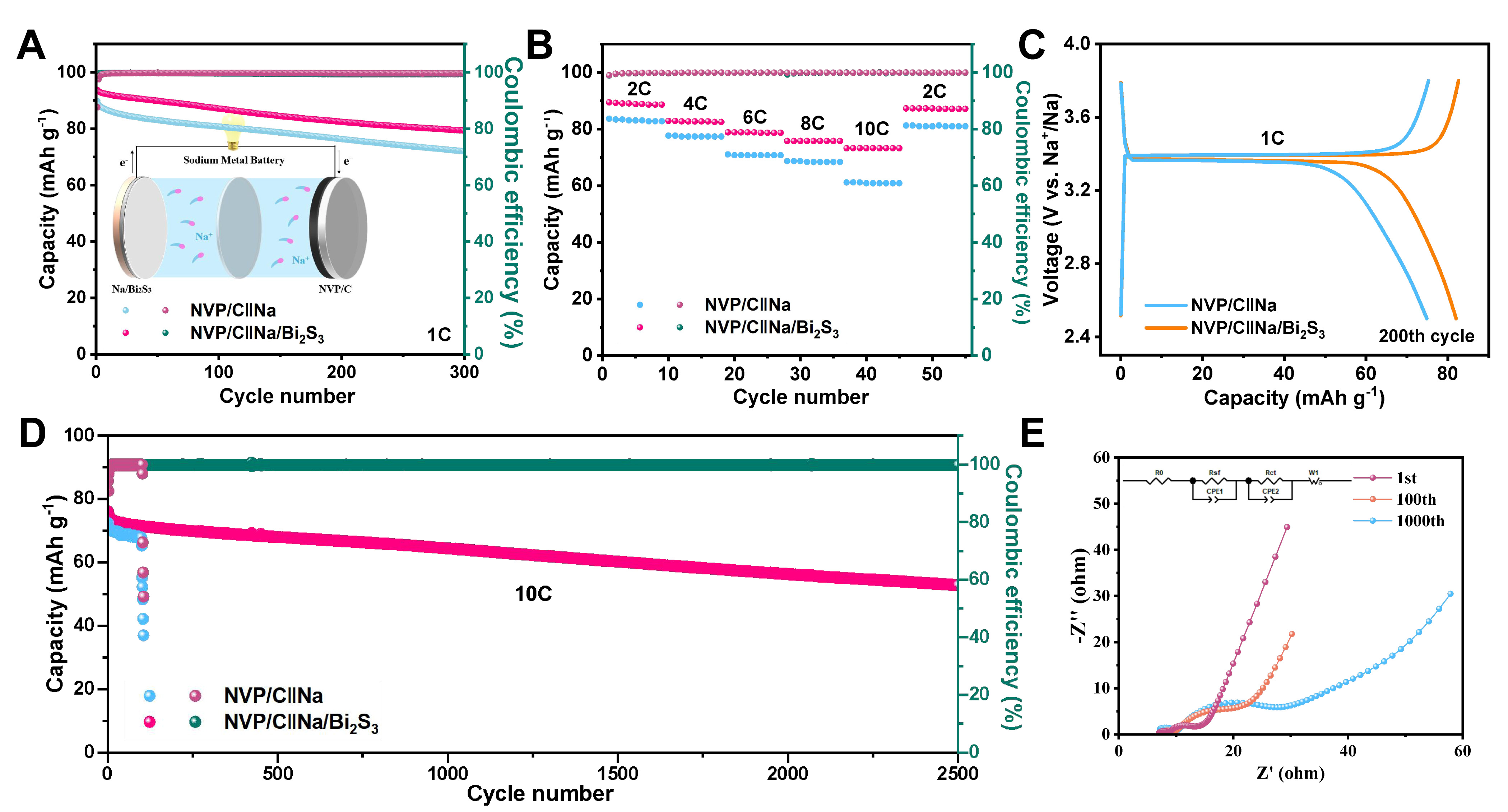
Figure 6. (A) Cycling performances at 1 C, (B) rate performances at different rates, (C) GCD profiles at 1 C, and (D) high-rate cycling performances at 10 C for the the NVP/C‖Na/Bi2S3 and NVP/C‖Na full cells; (E) Nyquist plots of the NVP/C‖Na/Bi2S3 full cells after different cycles with inset showing the corresponding equivalent circuit diagram. GCD: Galvanostatic discharge; NVP/C: Na3V2(PO4)3/C.
Figure 6D displays the long-term cycling stability of both full cells at a high rate of 10 C, the NVP/C‖Na/Bi2S3 full cell can survive for 2,500 cycles, delivering a capacity retention of 70% with a capacity decay rate of 0.012% per cycle. In contrast, the NVP/C‖Na full cell shows a rapid capacity fading with 37.2 mAh g-1 and 51% retention after 250 cycles under the same conditions. In addition, EIS was utilized to investigate the reaction kinetics of both kinds of full cells. As revealed by the Nyquist plots [Figure 6E], NVP/C‖Na/Bi2S3 displays a lower charge-transfer resistance (Rct) of about 5 Ω than that of NVP/C‖Na (18 Ω, Supplementary Figure 8). Even after cycling at a high rate of 10 C, the Rct remains at low values of 13 Ω after 100 cycles and 24 Ω after 1,000 cycles. Contrarily, the NVP/C‖Na cell showed a fast increased Rct of 89 Ω after only 250 cycles. Such difference reveals that the bare Na anode undergoes great interfacial degradation upon cycling, probably because of thick SEI formation arising from the dendrite growth and inactive Na formation. These observations further reveal that the construction of Bi2S3 protective layer greatly contributed to the homogeneous and stable Na plating behavior, which finally enhanced the reaction kinetics and electrochemical performance of SMBs.
CONCLUSIONS
In summary, we have demonstrated the fabrication of Bi2S3 nanowires via a facile solvothermal route and their application as sodiophilic protective layers, which efficiently induced the uniform dendrite-free Na deposition. The Bi2S3 nanowires with higher Na adsorption energy underwent conversion-alloying reactions forming sodiophilic Na-Bi alloy sites and highly Na+-diffusive Na2S matrice, which synergistically lowered the Na nucleation barrier and enhanced Na+ transfer kinetics, thus inhibiting the Na dendrite growth. Consequently, the Na/Bi2S3-based symmetric cell displayed exceptional long-term cycling stability upon repeated plating/stripping cycling (2,500 h with small voltage hysteresis of 15 mV at 2 mA cm-2 and
DECLARATIONS
Acknowledgments
The authors thank Ms Yan Liang at the Instrumental Analysis Center of Xian Jiaotong University for help with TOF-SIMS analysis.
Authors’ contributions
Paper writing and experimental, data analysis: Li, J. (Jiazhe Li); Li, J. (Jiyi Li)
DFT calculation and review: Li, J. (Jiyi Li); Cao, D.
Normal analyses: Qiao, Y.; Ji, X.; Xue, W.; Xu, G.; Sun, H.; Han, X.
Core idea, data analysis, and supervision: Wang, H.
Availability of data and materials
The original data in this study are included in the article/Supplementary Materials. Further inquiries can be directed to the corresponding author(s).
AI and AI-assisted tools statement
During the preparation of this manuscript, the AI tool Grammarly Free (version Grammarly Inc., browser extension, accessed 2026-02) was used solely for language editing. The tool did not influence the study design, data collection, analysis, interpretation, or the scientific content of the work. All authors take full responsibility for the accuracy, integrity, and final content of the manuscript.
Financial support and sponsorship
The authors gratefully acknowledged the High-level Talent Research Start-up Project Funding of Henan Academy of Sciences (20251831004), Key Industrial Chain Technology Breakthrough Cluster Project of Xi’an City (25ZDLJQ00024), the Key Research and the Development Program of Shaanxi (2023QCY-LL-18), and the Innovation Capability Support Plan Project in Shaanxi Province (2024RS-CXTD-22).
Conflicts of interest
All authors declared that there are no conflicts of interest.
Ethical approval and consent to participate
Not applicable.
Consent for publication
Not applicable.
Copyright
© The Author(s) 2026.
Supplementary Materials
REFERENCES
2. Lukatskaya, M. R.; Dunn, B.; Gogotsi, Y. Multidimensional materials and device architectures for future hybrid energy storage. Nat. Commun. 2016, 7, 12647.
3. Yang, Z.; Zhang, J.; Kintner-Meyer, M. C.; et al. Electrochemical energy storage for green grid. Chem. Rev. 2011, 111, 3577-613.
4. Xu, K. Electrolytes and interphases in Li-ion batteries and beyond. Chem. Rev. 2014, 114, 11503-618.
5. Quilty, C. D.; Wu, D.; Li, W.; et al. Electron and ion transport in lithium and lithium-ion battery negative and positive composite electrodes. Chem. Rev. , 2023, 1327-63.
6. Wang, H.; Yang, X.; Wu, Q.; et al. Encapsulating silica/antimony into porous electrospun carbon nanofibers with robust structure stability for high-efficiency lithium storage. ACS. Nano. 2018, 12, 3406-16.
7. Goodenough, J. B.; Kim, Y. Challenges for rechargeable Li batteries. Chem. Mater. 2010, 22, 587-603.
8. Ruan, J.; Hu, J.; Li, Q.; et al. Current collector interphase design for high-energy and stable anode-less sodium batteries. Nat. Sustain. 2025, 8, 530-41.
9. Chai, W.; Qiao, Y.; Wang, Z.; et al. HKUST-1 derived CuSx@C nanocomposites with TiO2 coating and rich sulfur vacancies for excellent high-rate long-life sodium-ion batteries. J. Power. Sources. 2026, 665, 239009.
10. Liu, P.; Miao, L.; Sun, Z.; Chen, X.; Jiao, L. Sodiophilic substrate induces NaF-rich solid electrolyte interface for dendrite-free sodium metal anode. Adv. Mater. 2024, 36, e2406058.
11. Yu, Y.; Xu, S.; Yang, Y.; et al. Highly sodiophilic heterostructures toward dendrite-free sodium metal batteries. Adv. Funct. Mater. 2024, 34, 2401914.
12. Rui, X.; Zhang, X.; Xu, S.; et al. A low-temperature sodium-ion full battery: superb kinetics and cycling stability. Adv. Funct. Mater. 2021, 31, 2009458.
13. Huang, F.; Xu, P.; Fang, G.; Liang, S. In-depth understanding of interfacial Na+ Behaviors in sodium metal anode: migration, desolvation, and deposition. Adv. Mater. 2024, 36, e2405310.
14. Gao, W.; Lu, Y.; Tan, X.; et al. Sodiophilic design for sodium-metal batteries: progress and prospects. Energy. Environ. Sci. 2025, 18, 1630-57.
15. Shi, D.; Lv, X.; Yang, Y.; et al. NaBix/NaVyOz hybrid interfacial layer enables stable and dendrite-free sodium anodes. Small 2024, 20, e2402206.
16. Damircheli, R.; Hoang, B.; Ferrari, V. C.; Lin, C. Highly uniform nitride-rich artificial solid electrolyte interphase enabled by nano-silicon nitride for superior performance in advanced sodium metal batteries. J. Mater. Chem. A. 2024, 12, 31949-58.
17. Moorthy, M.; Thangavel, R.; An, S. Y.; Anilkumar, A.; Han, D.; Lee, Y. S. Recent trends in artificial SEI layers for controlling dendrite formation and enhancing cycle life: toward stable and durable sodium metal batteries. Small 2025, 21, e2502974.
18. Yin, H.; Cao, Y.; Wang, Y.; et al. Artificial solid electrolyte interphase for sodium metal batteries: mechanistic insights and design strategies. Energy. Environ. Mater. 2025, 8, e70077.
19. Sun, H.; Zhu, G.; Xu, X.; et al. A safe and non-flammable sodium metal battery based on an ionic liquid electrolyte. Nat. Commun. 2019, 10, 3302.
20. Wu, Y.; Zhu, J.; Ni, J.; Li, L. Liquid metal-modified 3D Cu foam for dendrite-free sodium plating. Small 2024, 20, e2405357.
21. Chen, R.; Lu, X.; He, Q.; et al. Sb2S3 nanorod hierarchies enabling homogeneous sodium deposition for dendrite-free sodium-metal batteries. ACS. Appl. Energy. Mater. 2022, 5, 10952-60.
22. Hu, C.; Qi, J.; Zhang, Y.; et al. Room-temperature all-solid-state sodium battery based on bulk interfacial superionic conductor. Nano. Lett. 2021, 21, 10354-60.
23. Chen, C.; Yao, W.; Tang, Y. Emerging solutions to enable the efficient use of sodium metal anodes: progress and perspectives. Adv. Funct. Mater. 2024, 34, 2310833.
24. Chen, Q.; He, H.; Hou, Z.; et al. Building an artificial solid electrolyte interphase with high-uniformity and fast ion diffusion for ultralong-life sodium metal anodes. J. Mater. Chem. A. 2020, 8, 16232-7.
25. Lu, X.; Chen, R.; Shen, S.; et al. Spatially confined in situ formed sodiophilic-conductive network for high-performance sodium metal batteries. Nano. Lett. 2024, 24, 5490-7.
26. Xu, P.; Huang, F.; Liu, Z.; Guo, S.; Liang, S.; Fang, G. In situ construction of NaF-rich solid electrolyte interphase with metallic Ce sites for stable anode-free sodium metal batteries. Angew. Chem. Int. Ed. 2025, 64, e202515566.
27. Li, Z.; Qin, H.; Tian, W.; et al. 3D Sb-based composite framework with gradient sodiophilicity for ultrastable sodium metal anodes. Adv. Funct. Mater. 2024, 34, 2301554.
28. Li, Z.; Miao, L.; Lin, G.; et al. Na (100)-textured electrode embedded with Sb-doped SnO2 nanoparticles for dendrite-free sodium metal batteries. Adv. Energy. Mater. 2024, 14, 2402284.
29. Yang, G.; Li, N.; Sun, C. High-performance sodium metal batteries with sodium-bismuth alloy anode. ACS. Appl. Energy. Mater. 2020, 3, 12607-12.
30. Su, D.; Dou, S.; Wang, G. Bismuth: a new anode for the Na-ion battery. Nano. Energy. 2015, 12, 88-95.
31. Zhou, S.; Sun, Z.; Zhang, J.; et al. Single-atom engineering for synergistic nucleation and interfacial regulation enabling durable anode-free sodium metal batteries. Adv. Mater. 2026, 38, e13154.
32. Kyono, A.; Kimata, M. Structural variations induced by difference of the inert pair effect in the stibnite-bismuthinite solid solution series (Sb,Bi)2S3. Am. Mineral. 2004, 89, 932-40.
33. Li, Y.; Huang, L.; Li, B.; et al. Co-nucleus 1D/2D heterostructures with Bi2S3 nanowire and MoS2 monolayer: one-step growth and defect-induced formation mechanism. ACS. Nano. 2016, 10, 8938-46.
34. Yu, H.; Zhao, Y.; Zhang, J.; et al. Coordination regulation strategy in fabricating Bi2S3@CNFs composites with uniform dispersion for robust sodium storage. Inorg. Chem. 2024, 63, 21441-9.
35. Yuan, M.; Wang, H.; Xu, T.; et al. Unlocking the ultrafast deposition kinetics within Bi-tailored core-shell structured carbon nanofibers for highly efficient and ultrastable sodium metal batteries. Angew. Chem. Int. Ed. 2025, 64, e202417930.
36. Zhu, X.; Wang, Y.; Wang, W.; et al. Stable sodium metal anodes enabled by an in-situ generated mixed-ion/electron-conducting interface. Chem. Eng. J. 2022, 446, 136917.
37. Ma, M.; Lu, Y.; Yan, Z.; Chen, J. In situ synthesis of a bismuth layer on a sodium metal anode for fast interfacial transport in sodium-oxygen batteries. Batteries. Supercaps. 2019, 2, 663-7.
38. Moorthy, M.; Thangavel, R.; Ganesan, B. K.; et al. Ultra-high areal capacity, ultra-long life, dendrite-free sodium metal anode enabled by antimony-based Na-ion conducting artificial SEI layers. Chem. Eng. J. 2024, 498, 155234.
39. Dai, J.; Wang, H.; Zhang, R.; et al. Co-sputtering strategy to construct robust sodiophilic interfaces for anode-less sodium metal batteries. Chem. Commun. 2024, 60, 11120-3.
40. Arab, J.; Mishra, D. K.; Kannojia, H. K.; Adhale, P.; Dixit, P. Fabrication of multiple through-holes in non-conductive materials by electrochemical discharge machining for RF MEMS packaging. J. Mater. Process. Technol. 2019, 271, 542-53.
41. Sun, B.; Li, P.; Zhang, J.; et al. Dendrite-free sodium-metal anodes for high-energy sodium-metal batteries. Adv. Mater. 2018, 30, 1801334.
42. He, G.; Xiao, Y.; Zhang, T.; et al. Localized solvent-anchored carboxylate ester electrolyte enables wide temperature and fast charging sodium metal batteries. Adv. Mater. 2026, 38, e23324.
Cite This Article
 Open Access
How to Cite
Download Citation
Export Citation File:
Type of Import
Tips on Downloading Citation
Citation Manager File Format
Type of Import
Direct Import: When the Direct Import option is selected (the default state), a dialogue box will give you the option to Save or Open the downloaded citation data. Choosing Open will either launch your citation manager or give you a choice of applications with which to use the metadata. The Save option saves the file locally for later use.
Indirect Import: When the Indirect Import option is selected, the metadata is displayed and may be copied and pasted as needed.
About This Article
Special Topic
Copyright

Data & Comments
Data
0











Comments
Comments must be written in English. Spam, offensive content, impersonation, and private information will not be permitted. If any comment is reported and identified as inappropriate content by OAE staff, the comment will be removed without notice. If you have any queries or need any help, please contact us at [email protected].