

fig5
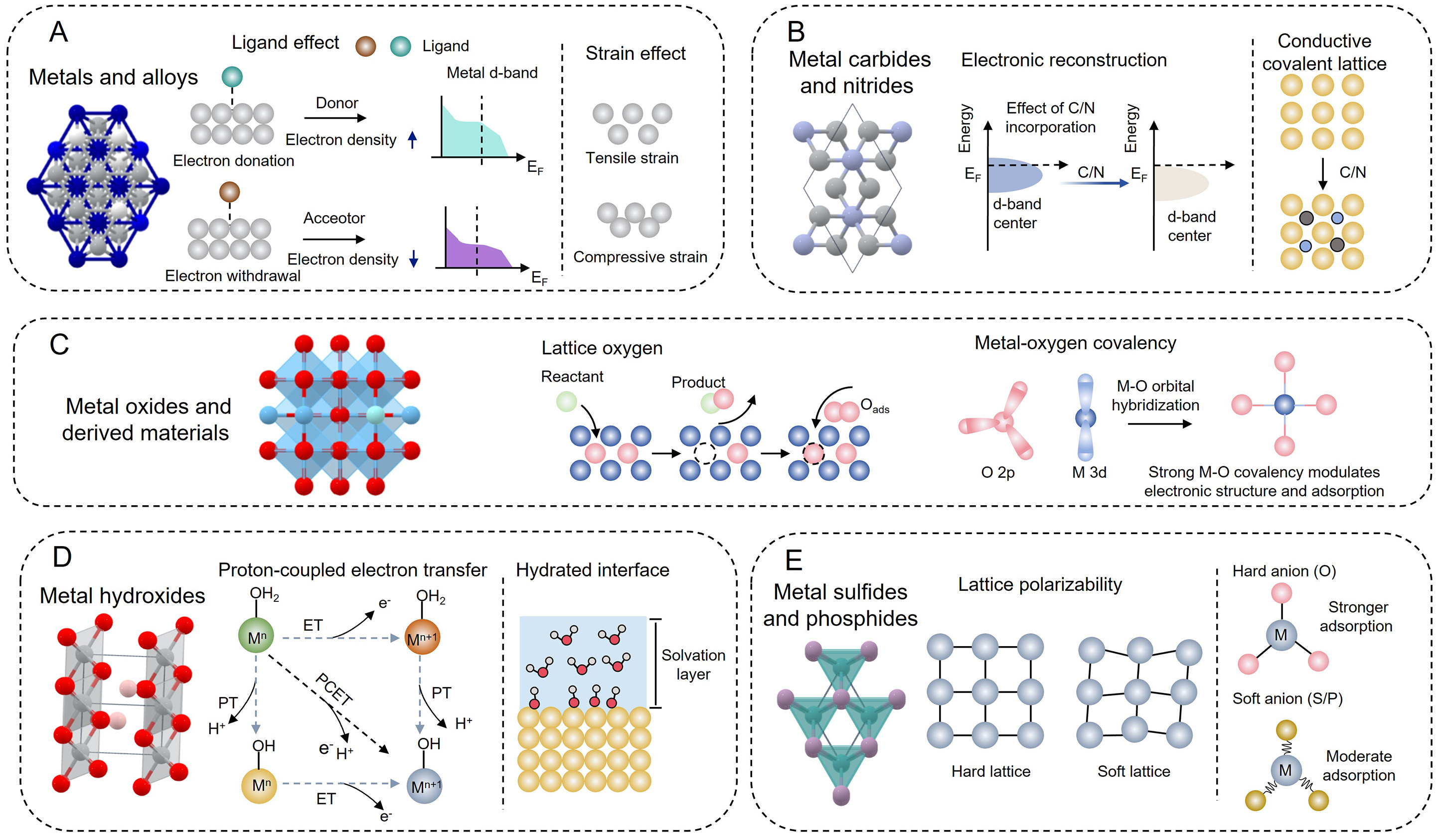
Figure 5. Schematic overview of representative catalyst materials and structure-performance relationships for two-electron electrocatalysis. (A) Metals and alloys, illustrating the ligand effect and strain effect on the metal d-band. (B) Metal carbides and nitrides, showing electronic reconstruction via C/N incorporation and the formation of a conductive covalent lattice. (C) Metal oxides and derived materials, highlighting the role of lattice oxygen and metal-oxygen covalency. (D) Metal hydroxides, depicting proton-coupled electron transfer mechanisms and the hydrated interfacial solvation layer. (E) Metal sulfides and phosphides, emphasizing lattice polarizability and the impact of anion type on adsorption strength.