

Synergistic electrolyte engineering to enhance cycle stability of sodium ion batteries at high rates and elevated temperatures
 0
0  ,
, Graphical Abstract
Abstract
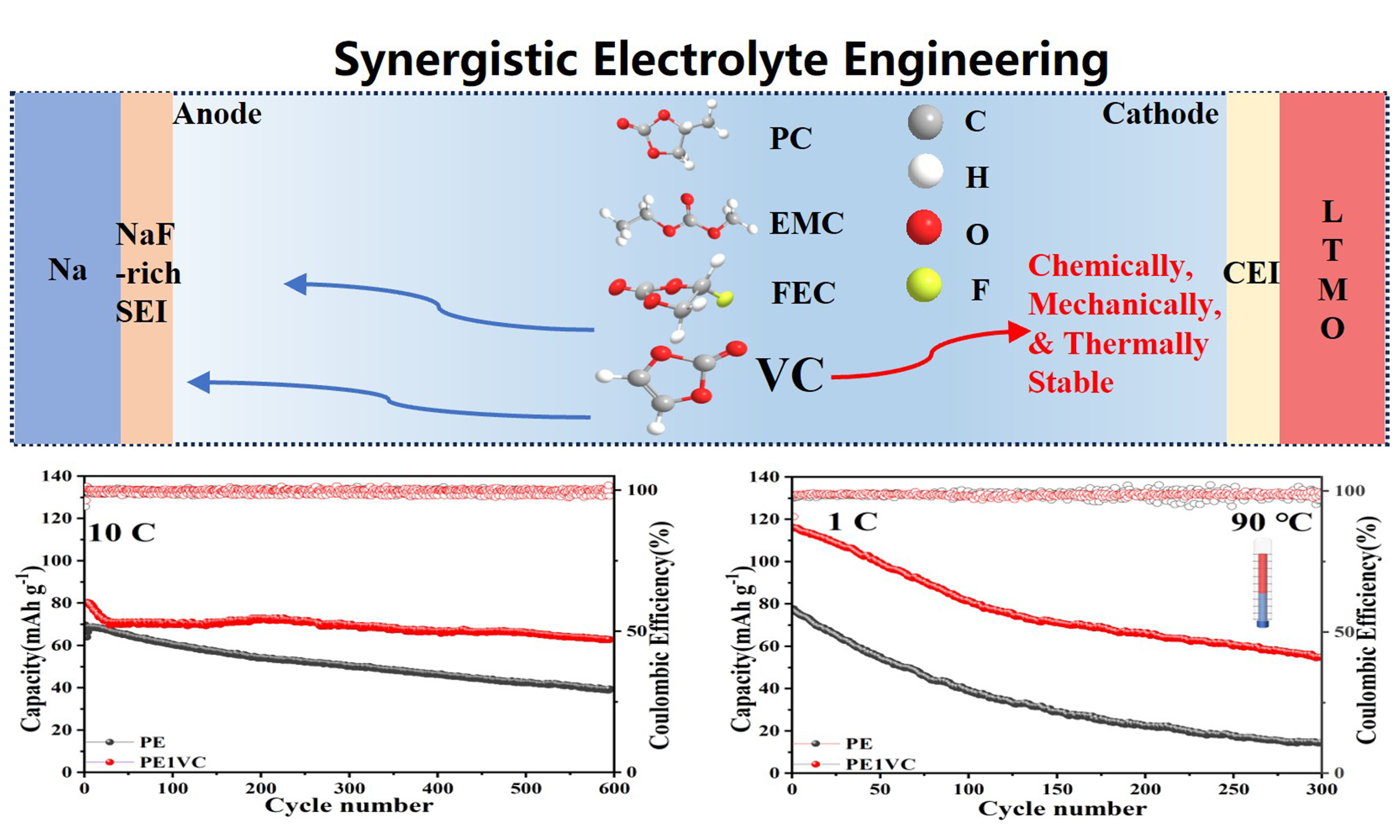
Layered transition metal oxide (LTMO)-based sodium-ion batteries (SIBs) are prime candidates for outdoor stationary energy storage systems; however, their application is limited by rapid capacity decay under high-rate and elevated-temperature conditions. Herein, we propose a synergistic electrolyte engineering strategy based on a binary solvent system comprising propylene carbonate (PC) and ethyl methyl carbonate (EMC), supplemented with the film-forming electrolyte additives fluoroethylene carbonate (FEC) and vinylene carbonate (VC). The mixed electrolyte has been shown to enable the in situ formation of chemically stable, thermally resistant, and mechanically robust films on the LTMO cathode. The distinct functional roles of VC, FEC, PC, and EMC are systematically elucidated. Consequently, this synergistic electrolyte strategy enables LTMO-based SIBs to achieve outstanding cycle stability at high rates and elevated temperatures. Specifically, the LTMO-based SIBs delivered an initial capacity of 80 mAh g-1 at 10 C (from the long-term cycling test), retained
Keywords


 Download PDF
INTRODUCTION
The global transition toward renewable energy has intensified the need for cost-effective, safe, and large-scale energy storage systems (ESSs)[1,2]. Sodium-ion batteries (SIBs) have emerged as a compelling alternative to lithium-ion batteries, largely due to the natural abundance and low cost of sodium resources[3,4]. Among various cathode candidates, layered transition-metal oxides (LTMOs, where TM = Mn, Fe, Ni, Co, Ti, V, etc.) have attracted particular attention for commercial applications due to their low cost and simplified synthesis routes[5,6]. However, the widespread adoption of LTMOs is hindered by rapid capacity loss during charge/discharge cycling, largely due to pronounced instability at the electrode-electrolyte interface[7,8].
To overcome this limitation, modifications to the bulk phase and the interfacial film have been widely reported, including elemental doping[9], cationic or anionic redox optimization[10], and artificial interfacial films (e.g., Al2O3 or NaPO3)[11,12]. Besides, the electrolyte composition plays a decisive role in determining the interfacial stability of SIBs. A rational combination of solvents and functional additives in sodium electrolytes can not only facilitate ion transport but also enable in situ modulation of stable interfacial films on both sodium anodes and LTMO cathodes, thereby achieving excellent rate capability and cycling stability simultaneously[13,14].
Cyclic propylene carbonate (PC) is widely used as a baseline solvent in SIBs because of its high dielectric constant (64.4) and low cost, which together facilitate efficient salt dissociation and promote commercial viability. However, PC is prone to decomposition at the sodium anode, producing gases via an open-ring reaction[8]. To mitigate this issue, linear carbonates with complementary properties, such as ethylene carbonate (EC)[15], dimethyl carbonate (DMC)[16], and ethyl methyl carbonate (EMC)[17], are commonly used to form binary solvent systems. EMC has a low viscosity but a low dielectric constant. Therefore, combining PC and EMC can create a complementary solvent system that balances ionic dissociation and transport kinetics[18]. Moreover, forming robust interfacial films on both electrodes is essential for suppressing parasitic reactions. Fluoroethylene carbonate (FEC) is currently the most prevalent additive used to form a sodium fluoride (NaF)-rich solid electrolyte interphase (SEI) film on the sodium anode[19]. The cathode electrolyte interphase (CEI) film also requires careful regulation to further improve cycling stability. Various anhydride-based electrolyte additives have been reported to modify the CEI and suppress side reactions on LTMO cathodes[20]. Despite considerable efforts to modify the electrolytes of LTMO-based SIBs, their cycling stability at high rates and elevated temperatures remains inadequate, significantly limiting their applications in outdoor stationary conditions.
The energy and power densities of batteries depend on multiple electrolyte parameters, including viscosity, salt dissociation, ionic conductivity, and electrochemical window[21]. Cycle stability is closely tied to the electrode/electrolyte interfaces formed at both the anode and cathode[22]. Each solvent or additive has unique physicochemical properties, yet no single component can meet all design specifications. Thus, a synergistic electrolyte engineering approach that rationally combines solvents and additives is necessary. Under aggressive practical conditions, such as high rates and elevated temperatures, the CEI on LTMO cathodes tends to undergo chemical dissolution[23], mechanical fracture[24], and thermal decomposition[25]. Consequently, the LTMO cathodes are exposed to electrolyte solvents and attacked by decomposition byproducts. Hence, there is an urgent need to develop a synergistic electrolyte system capable of forming a CEI film with high chemical, mechanical, and thermal robustness, thereby improving cycling stability at high rates and elevated temperatures.
In this work, we demonstrate that a mixed solvent of PC/EMC/FEC modified with vinylene carbonate (VC) effectively enhances the performance of a widely reported LTMO (Na(NiFeMn)1/3O2, NFM). By combining electrochemical impedance analysis, kinetic studies, and density functional theory (DFT) calculations, we confirmed the formation of a CEI film exhibiting high chemical, mechanical, and thermal robustness. This synergistic electrolyte engineering yields markedly improved cycling stability at high rates (5 C and 10 C) and at an elevated temperature (90 °C). Overall, this study presents a simple, scalable, and cost-effective strategy to optimize cycling stability at high rates and elevated temperatures, paving the way for the practical deployment of LTMO-based SIBs in grid-scale, industrial, and residential ESSs.
EXPERIMENTAL
Materials and agents
The study employs the following chemicals: Anhydrous sodium carbonate (Na2CO3, AR, Sinopharm Chemical Reagent Co. Ltd.), tannic acid (TA, C76H52O46, 98%, Shanghai Macklin Biochemical Co. Ltd.), nickel-iron-manganese ternary hydroxide ((NiFeMn)1/3(OH)2, battery grade, Zhejiang Huayou Cobalt Co. Ltd.), polyvinylidene fluoride (PVDF, AR, Sinopharm Chemical Reagent Co. Ltd.), N-methyl-2-pyrrolidone (NMP, C5H9NO, AR, Shanghai Aladdin Biochemical Technology Co. Ltd.), anhydrous ethanol (AR, Sinopharm Chemical Reagent Co. Ltd.), VC (C3H2O3, 99%, Shanghai Aladdin Biochemical Technology Co. Ltd.), conductive carbon black (C, battery grade, Timcal Graphite & Carbon), aluminum foil (battery grade, Shenzhen Tianchenghe), coin cell case (CR2032, Shenzhen Kejing Star), and glass fiber separator (GF/D, Whatman). All agents were used without further purification. The electrolyte consisted of sodium perchlorate (NaClO4), a PC/EMC solvent mixture, and the FEC additive in a volume ratio of 50:48:2; it was purchased from Duoduo Chemical Technology Co. Ltd. and denoted as PE.
Preparation of O3-type Na(NiFeMn)1/3O2@CTA-4 electrode
The O3-type Na(NiFeMn)1/3O2@CTA-4 (NFM@CTA-4) was synthesized following our previously reported method[26]. The pristine O3-type NFM was prepared via high-temperature solid-state reaction. (NiFeMn)1/3(OH)2 and Na2CO3 were mixed in a molar ratio of 2:1.05. After grinding, the mixture was preheated at 500 °C for 3 h and then calcined at 900 °C for 12 h to obtain NFM. The as-obtained NFM was then ultrasonically dispersed in ethanol, followed by the addition of TA (4 wt%). The mixture was stirred at 80 °C until complete dissolution. The resulting solution was evaporated and dried under vacuum at 60 °C for 12 h. Finally, the product was calcined at 700 °C for 3 h under a nitrogen atmosphere (Kejing, OTF-1200X-II, China) to finish the carbon coating, yielding NFM@CTA-4. The electrodes were prepared by weighing the active material, conductive carbon black, and PVDF at a mass ratio of 8:1:1, using NMP as the solvent. Then, the suspension was cast onto aluminum foil using a doctor blade with a fixed gap of 100 µm, followed by vacuum drying at 80 °C for 12 h. The mass loading of NFM@CTA-4 on cathodes was around 2 mg cm-2.
Preparation of electrolytes
Electrolyte preparation was carried out in an argon glovebox (MIKROUNA, Super, China, H2O < 0.1 ppm, O2 < 0.1 ppm). The PE electrolyte (10 mL) was mixed with VC additive at volume ratios of 99:1, 98:2, and 96:4, respectively. The mixtures were thoroughly shaken and allowed to stand until complete dissolution, yielding electrolytes denoted as PE1VC, PE2VC, and PE4VC, respectively.
Characterization and measurement
Scanning electron microscopy (SEM, ZEISS Sigma 360, GER) coupled with energy dispersive spectroscopy (EDS, OXFORD ULTIM MAX 100, UK) was used to characterize the microstructure of the samples. X-ray photoelectron spectroscopy (XPS, Thermo Scientific K-Alpha+, USA) was used to characterize the composition of CEI films. The CR2032 coin cells were assembled with a working electrode, sodium metal foil, glass fiber separator, and 100 μL electrolytes (PE, PE1VC, PE2VC, and PE4VC) in an argon glovebox
Theoretical calculations
The Gaussian 16 package was used to optimize the geometric structures of PC, EMC, FEC, and VC molecules. The values of the highest occupied molecular orbital (HOMO) and the lowest unoccupied molecular orbital (LUMO) energies were calculated using DFT with the B3LYP/6-311+G (d) functional/basis set. The electrostatic potential (ESP) maps were obtained by further calculating on Gaussian checkpoint files.
RESULT AND DISCUSSION
Theoretical calculation and SEI characterization
LTMOs for SIBs commonly suffer from severe interfacial side reactions. Carbon coating modification and electrolyte engineering are effective strategies to suppress these detrimental reactions. In our previous work, a carbon-coated NFM@CTA-4 cathode was synthesized, delivering 108.6 mAh g-1 at 1 C, with a capacity retention of 73.5% after 300 cycles[26]. In this study, we utilize the previously reported high-performance NFM@CTA-4 as the cathode and propose a synergistic electrolyte engineering strategy to further enhance the cycling stability of LTMO-based SIBs.
To predict the binding sites of Na+ with electrolyte solvents/additives at the molecular level, the ESP distributions of PC, EMC, FEC, and VC were simulated. Positively charged Na+ preferentially bind to the negatively charged sites of solvents/additives. As shown in Figure 1A, all four molecules exhibit the most negative ESP values around the C=O groups, indicating that Na+ ions primarily coordinate with solvents/additives via these groups. Subsequently, the binding energies of Na+ with the electrolyte components were calculated. The binding energy between a solvent and Na+ reflects the strength of their coordination. Higher coordination strength facilitates the dissociation of NaClO4 salt and the formation of solvated structures; however, it can conversely hinder desolvation at the electrode-electrolyte interface. As shown in Figure 1B, the binding energy between PC and Na+ is -139.9 kJ mol-1, indicating stronger coordination with Na+. However, this also results in a higher desolvation energy barrier, which is unfavorable for rate capability. In contrast, the binding energy between EMC and Na+ is -110.9 kJ mol-1, indicating weaker coordination with Na+. As a result, the solvation structure loosens, reducing the Na+ desolvation energy. Therefore, the combination of PC and EMC can enhance the rate capability by modulating the overall coordination strength. Meanwhile, the binding energies of VC (-115.8 kJ mol-1) and FEC (-120.6 kJ mol-1) fall between those of PC and EMC, striking an optimal balance that facilitates both salt dissociation and interfacial desolvation.
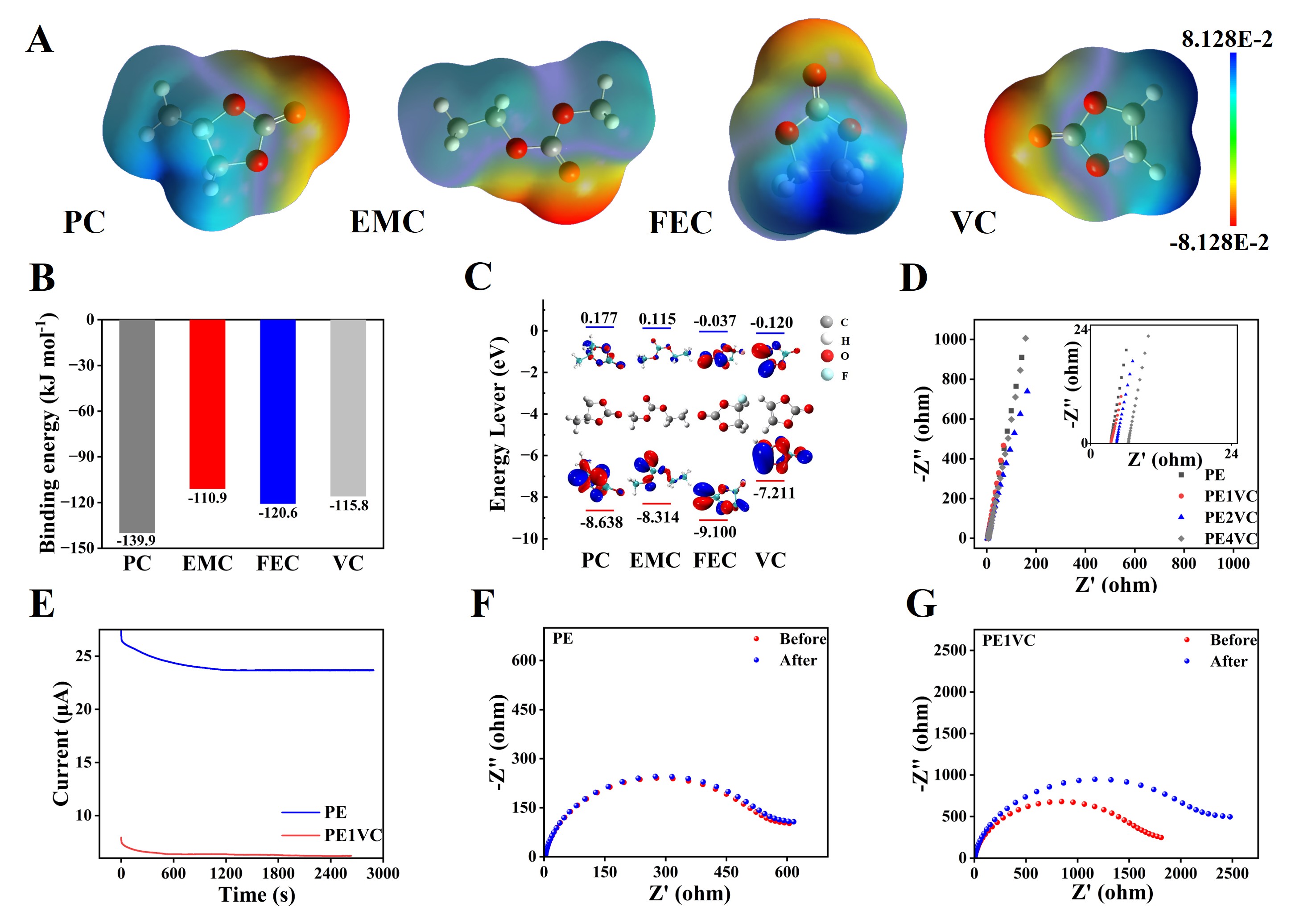
Figure 1. (A) ESP image of PC, EMC, FEC and VC; (B) Binding energies of PC, EMC, FEC and VC with Na+; (C) HOMO and LUMO energy levels of PC, EMC, FEC and VC; (D) EIS of four electrolytes, with the enlarged view in the inset; (E) Chronoamperometric curves of the Na||Na cells with PE and PE1VC electrolytes, respectively; (F and G) EIS of the Na||Na cells before and after the chronoamperometric test with PE and PE1VC electrolytes, respectively.
To assess the rationale for using FEC and VC as film-forming electrolyte additives, the HOMO and LUMO energy levels of the electrolyte components were calculated, and the results are shown in Figure 1C. These frontier orbitals govern the redox reactivity of electrolyte components, thereby determining the formation of SEI and CEI films[27]. The SEI and CEI are critical to the capacity, rate capability, and cycling stability of sodium anodes and LTMOs, respectively, and thus dictate the performance of half-cells. FEC, with a low LUMO energy level (-0.037 eV), preferentially undergoes reduction to form a NaF-rich SEI that effectively passivates the sodium anode. Meanwhile, among the four components, VC exhibits both the lowest LUMO energy level (-0.120 eV) and the highest HOMO energy level (-7.211 eV). Therefore, it can be preferentially oxidized and reduced during electrochemical reactions, promoting the formation of both SEI and CEI films that protect the anodes and cathodes from corrosion caused by electrolyte decomposition byproducts.
To investigate interfacial charge transfer, EIS measurements were conducted on Na||Na symmetric cells. From the EIS spectra in Figure 1D and the inset, the electrolyte resistances (Re) were determined from the high-frequency intercept on the Z' axis. Notably, compared with PE2VC and PE4VC, PE and PE1VC exhibit lower Re values, indicating lower bulk electrolyte resistance. The Na||Na symmetric cells using PE2VC and PE4VC electrolytes exhibit higher Re than those using PE and PE1VC electrolytes. The elevated Re observed for PE2VC and PE4VC is attributed to the electrically insulating nature of VC. To further elucidate the influence of the VC additive on Na+ transport, the Na+ transference numbers of PE and PE1VC were subsequently calculated via the chronoamperometric curves [Figure 1E], as well as the EIS before and after the chronoamperometric test [Figure 1F and G]. The Na+ transference number was calculated using:
where ΔV is the applied polarization voltage (20 mV), I0 and ISS are the initial and steady-state currents, respectively, and R0 and RSS are the initial and steady-state resistances of the passivation films on the Na electrode, respectively[28]. The resistance values were determined from the diameters of the semicircles in Figure 1F and G. The Na+ transference numbers were calculated to be 0.63 for PE and 0.90 for PE1VC. Furthermore, a high Na+ transference number can effectively suppress concentration polarization, thereby enhancing rate capability. These results indicate that PE1VC strikes an optimal balance between bulk ionic conductivity and the Na+ transference number.
To gain further insight into electrolyte properties, electrochemical measurements were conducted on Na||Na symmetric cells with PE and PE1VC electrolytes at a current density of 2 mA cm-2
Electrochemical performance
To clarify the influence of the VC additive on the electrochemical Na+ storage performance, GCD tests were conducted at various current rates using half-cells assembled with four distinct electrolytes: PE, PE1VC, PE2VC, and PE4VC. As shown in Figure 2A-D, the charge profiles of all four samples at 1 C display a dominant plateau at around 3.3 V, corresponding to the Ni2+/Ni3+ oxidation. The discharge profile consists primarily of a plateau near 2.5 V, which is associated with a two-phase transition reaction, and a sloping region near 3.0 to 4.0 V attributable to a solid-solution reaction. A sudden voltage surge was observed at the beginning of charging at 5 C. This surge is attributed to the superposition of instantaneous ohmic and activation polarizations induced by the abrupt transition from low-rate to high-rate operation. Specifically, the current step induces an immediate voltage jump governed by ohmic resistance, while the electrode interfaces require additional overpotential to drive the suddenly accelerated electrochemical reaction kinetics at high current[29].
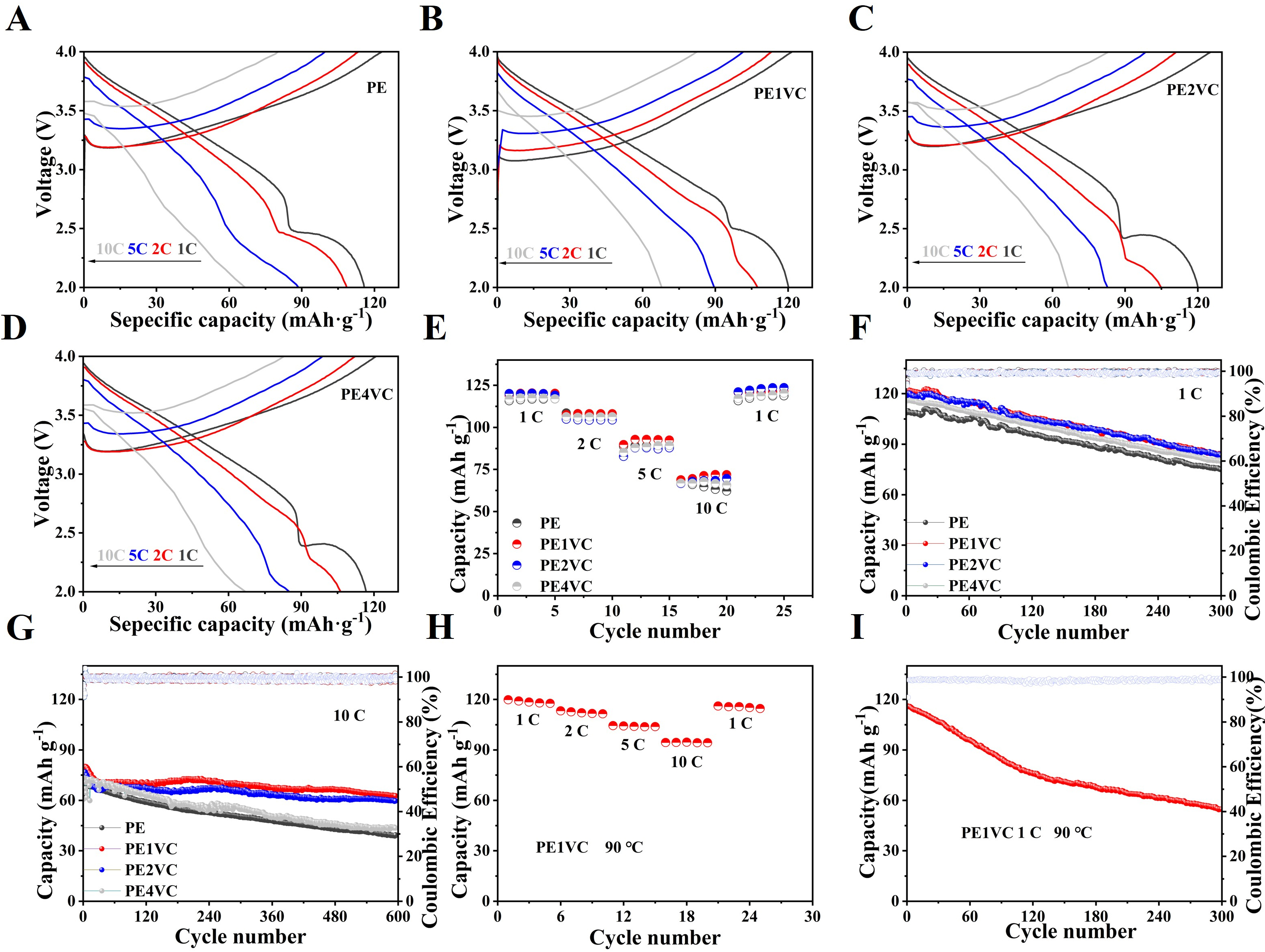
Figure 2. GCD of half-cells with (A) PE, (B) PE1VC, (C) PE2VC and (D) PE4VC electrolytes at different rates; (E) Rate capability of the NFM@CTA-4||Na half-cells with the four electrolytes; Cycling performance of the NFM@CTA-4||Na half-cells with the four electrolytes at (F) 1 C and (G) 10 C; (H) Rate capability and (I) Cycling performance of the NFM@CTA-4||Na half-cells with PE1VC at 90 °C. Solid spheres indicate cycling capacity and hollow spheres indicate Coulombic efficiency.
As shown in Figure 2E, the cell with the PE1VC electrolyte delivers an initial discharge specific capacity of 120.2 mAh g-1 at 1 C (1 C = 150 mA g-1), whereas those with PE, PE2VC, and PE4VC electrolytes deliver 115.8, 120.1, and 116.8 mAh g-1, respectively. Moreover, PE1VC exhibits superior rate capability at high rates, delivering the highest discharge specific capacities of 89.8 mAh g-1 at 5 C and 68.9 mAh g-1 at 10 C. This behavior can be attributed to the rapid formation of a stable SEI film with a high Na+ transference number, which ensures fast Na+ transport kinetics and excellent stability (discussed above). In addition, VC facilitates the formation of a thermally stable and mechanically robust CEI film, which protects the cathode from corrosion (discussed later).
As shown in Figure 2F, the Coulombic efficiencies of all four samples are nearly 100%. After 300 cycles at
To evaluate electrochemical performance at elevated temperatures, rate capability and cycling stability were evaluated at 90 °C. As shown in Figure 2H, PE1VC delivers high specific capacities of 104.48 mAh g-1 at 5 C and 94.4 mAh g-1 at 10 C. The enhanced capacities at 90 °C, compared with those at 25 °C, result from reduced electrolyte viscosity, improved sodium salt dissociation, and accelerated electrode kinetics. Although the rate capability is enhanced, the elevated temperature simultaneously accelerates side reactions and structural degradation of the electrode material, thereby compromising cycling stability. After 300 cycles at 90 °C, the discharge specific capacity of PE1VC drops to 54.8 mAh g-1, corresponding to a capacity retention of 47.24% [Figure 2I]. In contrast, PE exhibits much poorer cycling stability under the same conditions, retaining only 14.5 mAh g-1 (18.68% retention) [Supplementary Figure 3]. Additionally, the button cells with PE and PE1VC electrolytes exhibited no pressure-induced rupture during or after cycling at 90 °C and retained their original structural integrity.
The boiling point of VC (162 °C) lies between those of PC (241.7 °C) and EMC (109 °C). Owing to its relatively high boiling point, VC remains thermally stable at typical operating temperatures (≤ 90 °C), thereby ensuring sustained electrochemical performance[30]. Furthermore, among the electrolyte components, VC exhibits the lowest LUMO energy level and the highest HOMO energy level, indicating its thermodynamic tendency to undergo preferential reduction at the anode and preferential oxidation at the cathode. Thus, the VC additive contributes to the rapid formation of SEI films on the Na foils and CEI films on the cathodes. Specifically, during charging, it facilitates cleavage of the C=C bond and the subsequent ring-opening reactions of VC, leading to the formation of poly-VC and other oligomeric/polymeric species that constitute the CEI. These species coalesce into a protective film on the cathode surface, thereby effectively shielding the NFM@CTA-4 active material from corrosive byproducts generated during electrolyte decomposition[31-33]. Besides, CEI and SEI films formed in the presence of VC usually exhibit enhanced thermal stability[34,35].
The enhanced cycling stability observed at room temperature, at high rates, and at 90 °C is attributed to the rapid formation of stable SEI films on Na foils and CEI films on NFM@CTA-4 cathodes, enabled by the VC additive. On the one hand, VC exhibits the lowest LUMO energy level among the mixed electrolytes, so it can be preferentially reduced, thereby facilitating the formation of a robust, ionically conductive SEI film. On the other hand, VC possesses a higher HOMO energy level than the others (FEC, PC, EMC), facilitating its preferential oxidation at the cathode interface and driving the in situ formation of a CEI film that combines chemical inertness, thermal resilience, and mechanical integrity with fast Na+ transport kinetics. The CEI film can protect cathodes from electrolyte-induced corrosion, mitigate side reactions, and suppress cracking and pulverization, as will be discussed later.
Electrochemical kinetics
To investigate electrode redox reactions, CV measurements were conducted on NFM@CTA-4 cathodes with PE, PE1VC, PE2VC, and PE4VC electrolytes. The CV profiles of the first three cycles are shown in
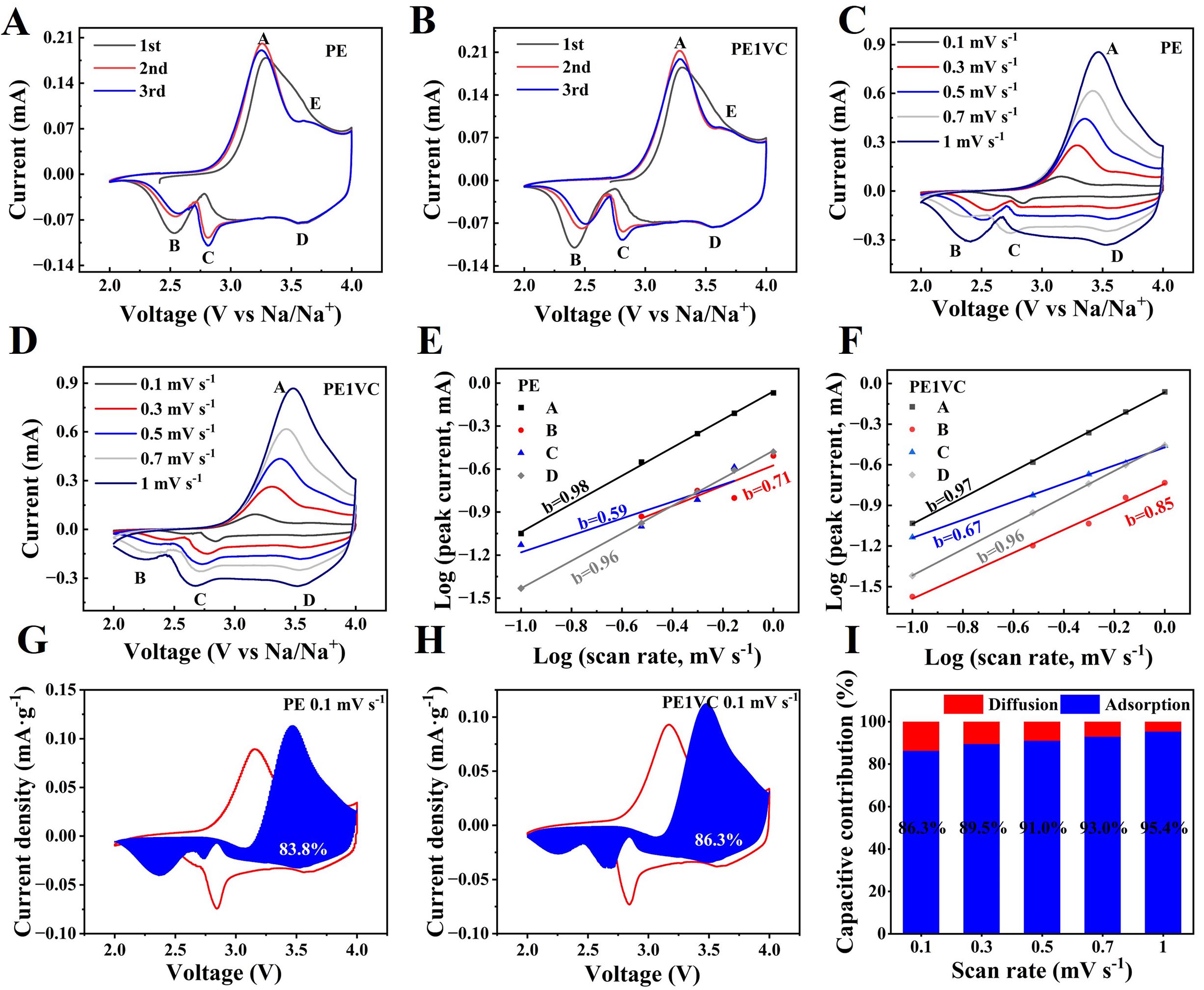
Figure 3. CV profiles of the first three cycles of the half-cells with (A) PE and (B) PE1VC electrolytes at 0.2 mV s-1; CV curves of the half-cells with (C) PE and (D) PE1VC electrolytes at different scanning rates from 0.1 to 1 mV s-1; Plots of log (i) vs. log (v) of the half-cells with (E) PE and (F) PE1VC electrolytes; CV curves of the half-cells with (G) PE and (H) PE1VC at 0.1 mV s-1 with the adsorption-controlled part highlighted in blue; (I) Adsorption and diffusion contributions of the half-cell with PE1VC.
To further elucidate the electrode reaction kinetics in the presence of the VC additive, CV curves were recorded at scan rates ranging from 0.1~1 mV s-1. As shown in Figure 3C and D (PE and PE1VC) and
Where i is the peak current and v is the scan rate. The b-value was extracted from the slope of the log i versus log v plot via least-squares linear regression. The value of b provides insight into the charge-storage mechanism: b ≈ 0.5 indicates diffusion-controlled behavior, while b ≈ 1 suggests adsorption-controlled behavior[38]. Based on the peak currents in Figure 3C and D, the b-values of the four peaks are calculated to be 0.98, 0.71, 0.59, and 0.96 for PE, and 0.97, 0.85, 0.67, and 0.96 for PE1VC, respectively [Figure 3E and F]. Most b-values are close to 1, indicating that adsorption-controlled charge-transfer processes dominate the electrode reactions. Notably, the PE1VC electrolyte exhibits relatively higher b-values (averaging 0.86) than PE, PE2VC, and PE4VC [Supplementary Figures 8 and 9], suggesting faster Na+ transfer under high-rate and high-capacity conditions at high current. This observation is consistent with the superior rate stability of PE1VC. This trend also indicates that PE and PE1VC electrolytes promote faster redox reaction kinetics. The relatively sluggish reaction kinetics observed for PE2VC and PE4VC arise primarily from the electrically insulating nature of VC. An additional contributing factor is their higher charge transfer resistance (Rct) compared to those of PE and PE1VC, as quantified by EIS and discussed later.
Based on the CV profiles, the adsorption-controlled contribution (k1v) and the diffusion-controlled contribution (k2v1/2) for PE and PE1VC were quantitatively determined using:
Where i is the current at a given potential V, v is the scan rate, k1v is the current component from the adsorption contribution, and k2v1/2 is the current component from the diffusion contribution[39]. Consequently, the adsorption-controlled current component (isurf = k1v) was determined at each potential point. The total capacitive contribution (represented by the blue-shaded area in Figure 3G and H) was then quantified by integrating isurf across the voltage window and normalizing it against the total charge of the measured CV curve. At a scan rate of 0.1 mV s-1, the adsorption-controlled contributions are 83.84% for PE and 86.25% for PE1VC. As shown in Figure 3I, the adsorption-controlled contributions of PE1VC are 86.3%, 89.5%, 91.0%, 93.0%, and 95.4% as the scan rate rises from 0.1 to 1 mV s-1, whereas those of PE show a fluctuating trend [Supplementary Figure 10]. The consistently high and progressively increasing adsorption-controlled contribution observed for PE1VC indicates that the VC additive promotes Na+ transport kinetics and improves electrochemical reversibility. This is a major reason for the good rate capability and cycling stability.
EIS analysis and surface characterization
To further investigate the influence of the VC additive on CEI film formation, EIS was conducted on NFM@CTA-4||Na half-cells assembled with the four electrolytes [Figure 4A-D]. The simulated impedance spectra exhibit excellent agreement with the experimental EIS data, validating the proposed equivalent circuit model [Supplementary Figure 11]. The corresponding extracted impedances under different conditions are listed in Table 1. The electrolyte resistance (Re) values of PE, PE1VC, PE2VC, and PE4VC remained similar across different tested conditions (the pristine state, after 3 cycles at 1 C, after 300 cycles at 1 C, and after 600 cycles at 10 C). The surface film resistance (Rsf) of the cell with the PE electrolyte increased markedly from 760.3 to 4,884 Ω after 3 cycles at 1 C, and then decreased to 948 Ω after 300 cycles. This is likely attributed to the initial formation and subsequent decomposition of an unstable CEI. Although its Rct decreased continuously, remarkable capacity decays were observed during charge-discharge cycling, reflecting that the evolving structure facilitates charge transfer yet compromises Na+ storage capacity mainly due to irreversible structural reconstructions within the electrode[40]. In contrast, the incorporation of VC fundamentally alters the interfacial evolution. All VC-containing systems display a progressive increase in Rsf during cycling at 1 C up to 300 cycles, yet the growth rate is highly concentration-dependent. Specifically, for the cell with PE1VC, Rsf increased slightly from 2,312 to 2,950 Ω after 3 cycles at 1 C and remained relatively stable over 300 cycles, while Rct decreased from 69,817 to 18,229 Ω after 3 cycles and remained nearly unchanged thereafter. The initial decrease is attributed to interfacial activation[41]. After that, the almost unchanged Rct indicates that an optimal amount of VC promotes the formation of a stable and highly ionically conductive CEI film on the cathode, thereby resulting in significantly smaller impedance changes during cycling with PE1VC than with PE. By comparison, the cells with PE2VC and PE4VC electrolytes also exhibited an initial decrease in Rct after 3 cycles but showed a progressive increase after 300 cycles. This demonstrates that excessive VC triggers over-polymerization within the CEI, thereby hindering Na+ transport kinetics and underscoring the critical trade-off between interfacial passivation and ionic conductivity. Notably, EIS measurements of the four half-cells after 600 cycles at a high rate of 10 C [Figure 4D] reveal substantially lower Rct and Rsf values compared to those recorded after 300 cycles at 1 C [Figure 4C and Table 1]. This demonstrates that the NFM@CTA-4 cathode material, paired with the PC/EMC/FEC-based electrolyte, exhibits superior interfacial kinetics and stability under high-rate operation, consistent with its excellent rate capability and markedly enhanced cycling stability at 10 C relative to 1 C [Figure 2E-G].
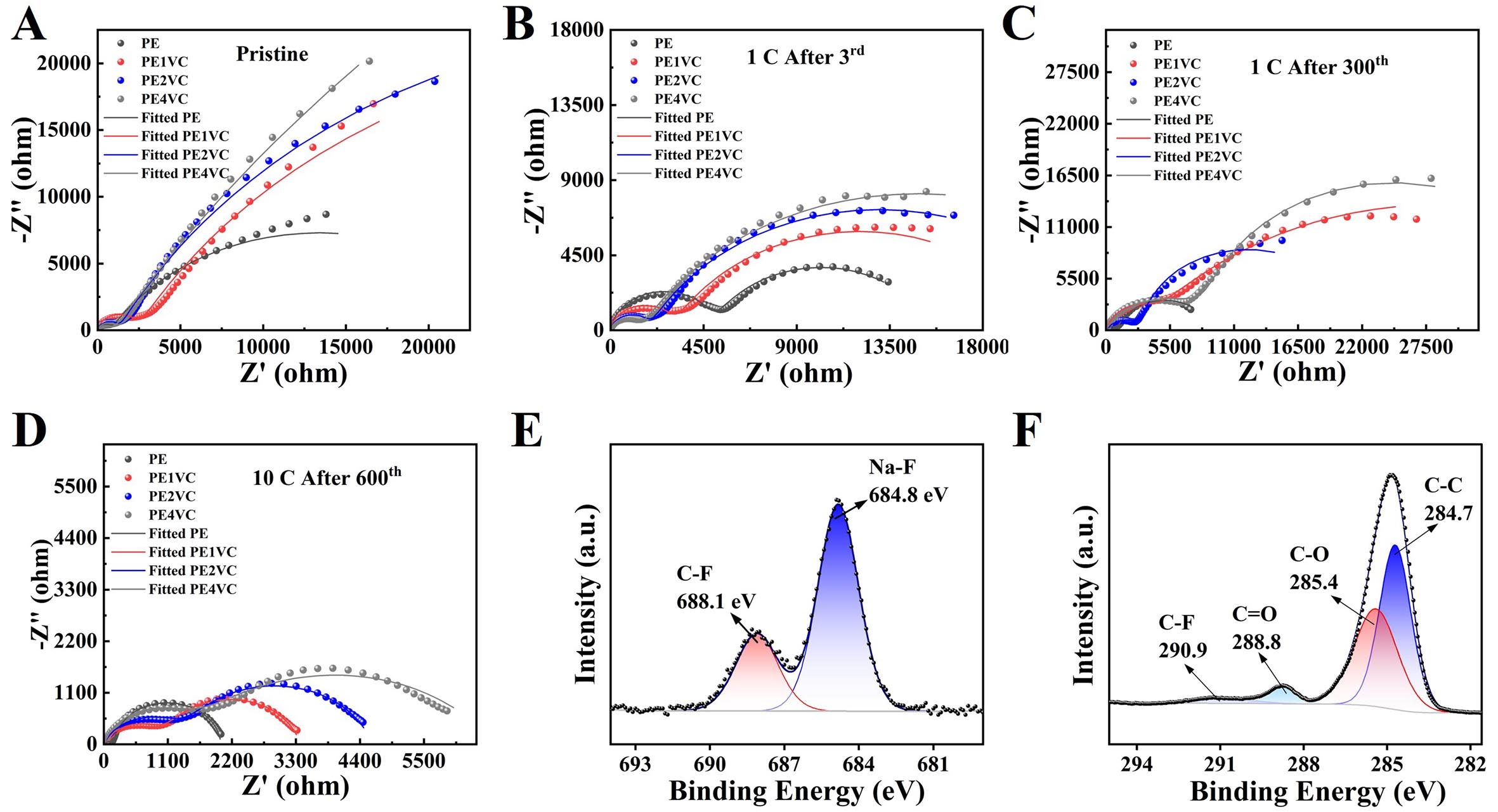
Figure 4. EIS and fitting curves of the half-cells with four electrolytes at different tested conditions, including (A) pristine state, (B) after 3 cycles at 1 C, (C) after 300 cycles at 1 C, and (D) after 600 cycles at 10 C; XPS high-resolution spectra of (E) F 1s and (F) C 1s of the NFM@CTA-4 cathode cycled in PE1VC for 3 cycles at 1 C.
EIS fitting data of four samples at different tested conditions (the pristine state, after 3 cycles at 1 C, after 300 cycles at 1 C, and after 600 cycles at 10 C)
| PE (Ω) | PE1VC (Ω) | PE2VC (Ω) | PE4VC (Ω) | ||
| Re | 3.41 | 3.65 | 3.38 | 4.836 | |
| Pristine | Rsf | 760.3 | 2,312 | 1,207 | 970.7 |
| Rct | 25,275 | 69,817 | 72,872 | 181,460 | |
| 1 C After | Re | 3.90 | 3.89 | 6.07 | 3.78 |
| 3rd | Rsf | 4,884 | 2,950 | 1,805 | 1,417 |
| Rct | 10,642 | 18,229 | 22,408 | 26,893 | |
| 1 C After | Re | 6.58 | 6.04 | 4.99 | 4.85 |
| 300th | Rsf | 948 | 3,198 | 8,981 | 2,989 |
| Rct | 8,195 | 18,063 | 32,013 | 51,262 | |
| 10 C After | Re | 4.44 | 5.19 | 5.20 | 5.74 |
| 600th | Rsf | 184.1 | 1,060 | 1,369 | 1,393 |
| Rct | 1819 | 2,302 | 3,236 | 5,417 |
To elucidate the role of VC in modulating the composition and interfacial stability of the CEI on the NFM@CTA-4 cathode, XPS analysis was performed on the cathode sample in PE1VC cycled for 3 cycles at
To directly visualize the impact of the VC additive on the mechanical stability of the CEI film, SEM characterization was performed on the cathodes of the half-cells with PE and PE1VC electrolytes after 300 cycles at 10 C. As shown in Figure 5A-C, the NFM@CTA-4 particles in the PE electrolyte exhibit degraded morphological regularity, with visible surface cracks, indicative of severe structural degradation. In contrast, the cathode cycled in the PE1VC electrolyte [Figure 5D-F] demonstrates substantially improved structural integrity, with virtually no surface cracks and a more uniform, densely packed particle distribution. This observation suggests that the VC additive enables the formation of a mechanically robust CEI film that effectively preserves the structural integrity of the cathode particles. Such a robust CEI film not only promotes homogeneous and stable electrode reactions but also suppresses electrolyte decomposition. Additionally, the EDS [Figure 5G-J] and quantitative elemental analyses
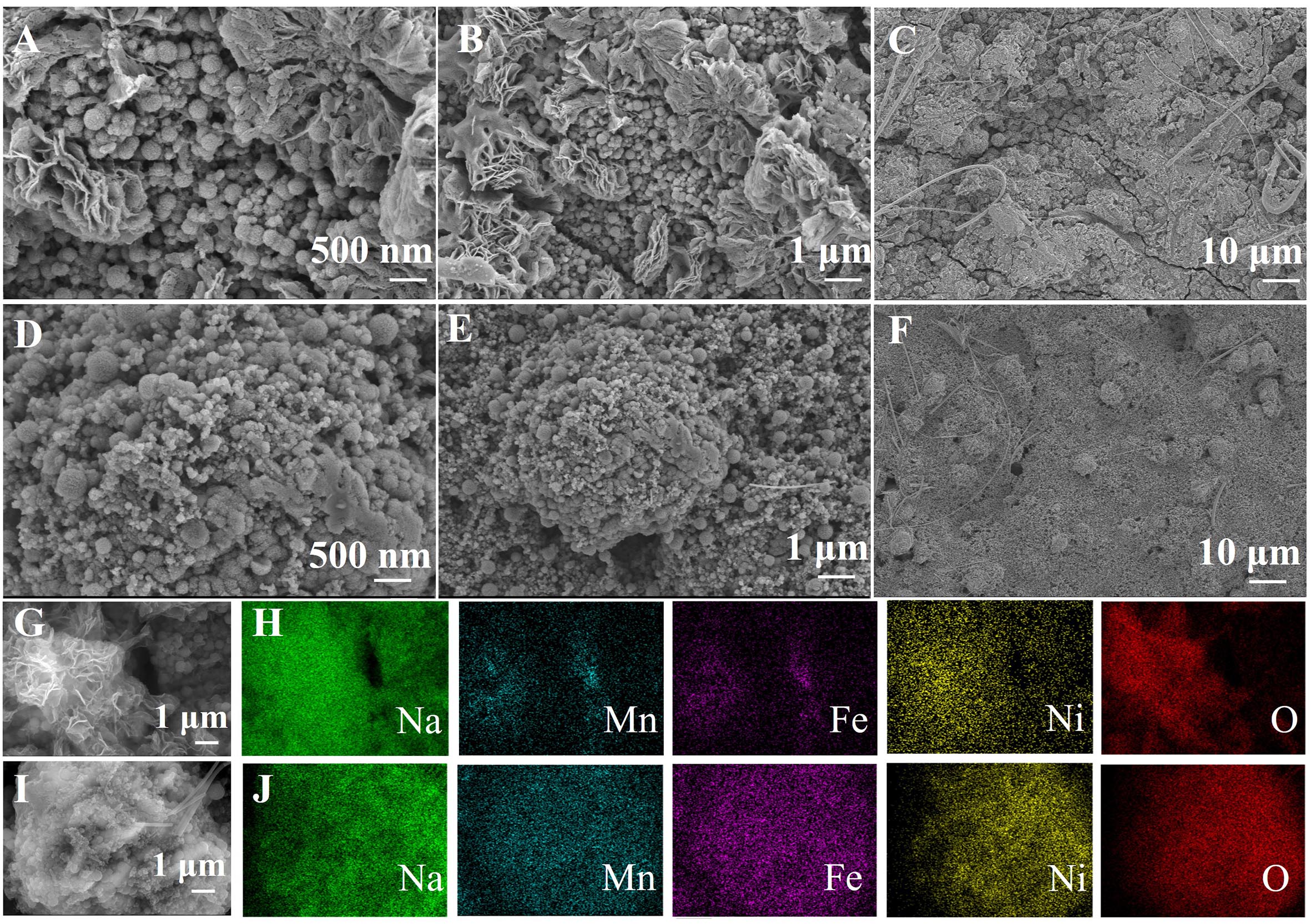
Figure 5. SEM images of the NFM@CTA-4 cathode after 300 cycles at 10 C in PE (A-C) and PE1VC (D-F). SEM images and corresponding EDS elemental mappings of the cycled cathodes in PE (G and H) and PE1VC (I and J) (scale bars in G-J: 1 μm).
This study demonstrates that the synergistic electrolyte strategy effectively enhances electrochemical performance in Na-metal half-cells. Admittedly, Na-metal half-cells face substantial challenges in practice, including continuous electrolyte decomposition, dendritic sodium deposition, and anodic overpotential drift[44]. In contrast, full cells based on relatively stable anodes (e.g., hard carbon) offer significantly improved interfacial stability and suppressed parasitic side reactions[45], offering greater promise for practical implementation. Thus, future investigations should extend this synergistic electrolyte engineering strategy to full-cell configurations, particularly under industrially representative conditions, such as high areal loadings of active materials.
CONCLUSION
This work proposed a synergistic electrolyte engineering strategy based on a PC/EMC/FEC/VC system to enhance the cycling stability of the LTMO-based SIBs under high-rate and elevated-temperature conditions. The PC/EMC binary solvent optimizes Na+ solvation energy, and the FEC additive facilitates the formation of a stable, ionically conductive SEI film on the Na anode, collectively improving rate capability and cycling stability. Additionally, the VC additive, with its lower LUMO and higher HOMO energy levels, promotes the rapid formation of a CEI film that is chemically, thermally, and mechanically robust. Consequently, the NFM@CTA-4||Na half-cells delivered an initial capacity of 80 mAh g-1 at 10 C (from the long-term cycling test) and maintained 62.7 mAh g-1 (78.4 % retention) after 600 cycles at 10 C. It showed 94.4 mAh g-1 at 10 C and maintained 54.8 mAh g-1 after 300 cycles at 1 C at 90 °C. This scientific synergistic electrolyte design provides critical guidance for developing high-stability LTMO-based SIBs, accelerating their practical deployment for outdoor stationary energy storage.
DECLARATIONS
Authors’ contributions
Methodology, investigation, formal analysis, data visualization, and writing-original draft: Zhao, Z.;
Formal analysis and investigation: Wang, X.; Cai, Y.
Review, supervision, and funding acquisition: Zhao, Z.; Lu, J.; Chen, W.
Availability of data and materials
The original contributions presented in this study are included in the article/Supplementary Materials.
AI and AI-assisted tools statement
Not applicable.
Financial support and sponsorship
This work was supported by the HJ Program Research Funding Support from the National Natural Science Foundation of China [Grant No. 24210005-N]; Zhejiang Provincial Natural Science Foundation of China [Grant No. LQN26B030009]; Science Foundation of Zhejiang Sci-Tech University [Grant Nos. 23212091-Y and 24212217-Y]; the “Pioneer” and “Leading Goose” R&D Program of Zhejiang Province of China [No. 2024C01056].
Conflicts of interest
Zhao, Z. and Lu, J. are Guest Editors of the Special Issue “High-Safety Rechargeable Batteries: Material, Interface, Mechanism, and Performance” in Energy Materials and were not involved in any steps of the editorial process, including reviewer selection, manuscript handling, or decision-making, while the other authors have declared that they have no conflicts of interest.
Ethical approval and consent to participate
Not applicable.
Consent for publication
Not applicable.
Copyright
© The Author(s) 2026.
Supplementary Materials
REFERENCES
1. Zhao, Z.; Hou, N.; Hong, Z.; Ming, S.; Lu, J.; Chen, W. Kinetic insights for high-rate and low-temperature ammonium-ion batteries/supercapacitors. Energy. Storage. Materi. 2025, 81, 104539.
2. Ortiz-Vitoriano, N.; Drewett, N. E.; Gonzalo, E.; Rojo, T. High performance manganese-based layered oxide cathodes: overcoming the challenges of sodium ion batteries. Energy. Environ. Sci. 2017, 10, 1051-74.
3. Kubota, K.; Komaba, S. Review—practical issues and future perspective for Na-ion batteries. J. Electrochem. Soc. 2015, 162, A2538-50.
4. Weldegebrieal, G. K.; Tangthuam, P.; Lao-Ian, W.; et al. Sodium-ion batteries: from conventional to anode-free configurations: materials, mechanisms, and future prospects. J. Energy. Storage. 2025, 135, 118386.
5. Liu, Q.; Hu, Z.; Chen, M.; et al. The cathode choice for commercialization of sodium-ion batteries: layered transition metal oxides versus prussian blue analogs. Adv. Funct. Mater. 2020, 30, 1909530.
6. Liu, Q.; Hu, Z.; Chen, M.; et al. Recent progress of layered transition metal oxide cathodes for sodium-ion batteries. Small 2019, 15, 1805381.
7. Dai, P.; Shi, C.; Huang, Z.; et al. A new film-forming electrolyte additive in enhancing the interface of layered cathode and cycling life of sodium ion batteries. Energy. Storage. Mater. 2023, 56, 551-61.
8. Wang, J.; Zhu, Y.; Su, Y.; et al. Routes to high-performance layered oxide cathodes for sodium-ion batteries. Chem. Soc. Rev. 2024, 53, 4230-301.
9. Zhou, L.; Wang, H.; Cao, L.; et al. Synergetic phase transition suppression and air-stability engineering in layered cathode materials for sodium ion batteries. Chem. Eng. J. 2025, 526, 170700.
10. Takada, K.; Yamada, Y.; Watanabe, E.; et al. Unusual passivation ability of superconcentrated electrolytes toward hard carbon negative electrodes in sodium-ion batteries. ACS. Appl. Mater. Interfaces. 2017, 9, 33802-9.
11. Lu, H.; Chen, X.; Jia, Y.; et al. Engineering Al2O3 atomic layer deposition: enhanced hard carbon-electrolyte interface towards practical sodium ion batteries. Nano. Energy. 2019, 64, 103903.
12. Jo, J. H.; Choi, J. U.; Konarov, A.; et al. Sodium-ion batteries: building effective layered cathode materials with long-term cycling by modifying the surface via sodium phosphate. Adv. Funct. Mater. 2018, 28, 1705968.
13. Lin, Y.; Jin, X.; Gao, S.; et al. Improved interface construction on anode and cathode for Na-ion batteries using ultralow-concentration electrolyte containing dual-additives. Chem. A. Eur. J. 2024, 30, e202303741.
14. Jayakumar, R.; Chak, C. M.; Shipitsyn, V.; et al. Ethylene sulfate-enabled stable interphases in fluorinated ether electrolytes for high-performance sodium-ion batteries. J. Power. Sources. 2026, 662, 238753.
15. Ponrouch, A.; Marchante, E.; Courty, M.; Tarascon, J.; Palacín, M. R. In search of an optimized electrolyte for Na-ion batteries. Energy. Environ. Sci. 2012, 5, 8572.
16. Wang, S.; Zhang, J.; Hua, W.; et al. Solvation-enhanced electrolyte on layered oxide cathode tailoring even and stable CEI for durable sodium storage. Carb. Neutr. 2023, 2, 20.
17. Zhou, Z.; Qian, Y.; Gao, J.; et al. A nonflammable carbonate-phosphate hybrid electrolyte enabling high-temperature sodium-ion full batteries. Energy. Storage. Mater. 2026, 89, 105229.
18. Li, Q.; Jiao, S.; Luo, L.; et al. Wide-temperature electrolytes for lithium-ion batteries. ACS. Appl. Mater. Interfaces. 2017, 9, 18826-35.
19. Fu, J.; Li, S.; Luo, C.; et al. Design principles for fluoroethylene carbonate additive-electrode compatibility in nanoporous sugarcane bagasse-based hard carbon sodium ion anodes. J. Mater. Chem. A. 2026, 14, 10929-39.
20. Huang, J.; Liu, J.; He, J.; et al. Optimizing electrode/electrolyte interphases and Li-ion flux/solvation for lithium-metal batteries with qua-functional heptafluorobutyric anhydride. Angew. Chem. Int. Ed. 2021, 60, 20717-22.
21. Tiwari, R.; Kumar, D.; Verma, D. K.; et al. Fundamental chemical and physical properties of electrolytes in energy storage devices: a review. J. Energy. Storage. 2024, 81, 110361.
22. Bouguern, M. D.; M R, A. K.; Zaghib, K. The critical role of interfaces in advanced Li-ion battery technology: a comprehensive review. J. Power. Sources. 2024, 623, 235457.
23. Chang, M.; Cheng, F.; Zhang, W.; et al. Antioxidant layer enables chemically stable cathode-electrolyte interface towards durable and safe Li-ion batteries. Energy. Storage. Mater. 2023, 61, 102872.
24. Wu, D.; Zhu, C.; Wang, H.; et al. Mechanically and thermally stable cathode electrolyte interphase enables high-temperature, high-voltage Li||LiCoO2 batteries. Angew. Chem. Int. Ed. 2024, 63, e202315608.
25. Cheng, H.; He, Y. Temperature-dependent evolution of the CEI on graphite electrodes and its impact on dual-ion battery performance. Chem. Phys. Lett. 2026, 889, 142711.
26. Yang, Z.; Liu, F.; Yu, T.; et al. Performance improvement of O3-type Na(NiFeMn)1/3O2 cathodes by tannic acid-derived carbon coating. J. Electroanal. Chem. 2025, 990, 119182.
27. Goodenough, J.; Kim, Y. Challenges for rechargeable batteries. J. Power. Sources. 2011, 196, 6688-94.
28. Kondou, S.; Sakashita, Y.; Morinaga, A.; et al. Concentrated nonaqueous polyelectrolyte solutions: high Na-ion transference number and surface-tethered polyanion layer for sodium-metal batteries. ACS. Appl. Mater. Interfaces. 2023, 15, 11741-55.
29. Xia, B.; Ye, B.; Cao, J. Polarization voltage characterization of lithium-ion batteries based on a lumped diffusion model and joint parameter estimation algorithm. Energies 2022, 15, 1150.
30. Adebanjo, I. T.; Eko, J.; Agbeyegbe, A. G.; et al. A comprehensive review of lithium-ion battery components degradation and operational considerations: a safety perspective. Energy. Adv. 2025, 4, 820-77.
31. Dai, H.; Gomes, L.; Maxwell, D.; et al. Exploring the role of an electrolyte additive in suppressing surface reconstruction of a Ni-rich NMC cathode at ultrahigh voltage via enhanced in situ and operando characterization methods. ACS. Appl. Mater. Interfaces. 2024, 16, 8639-54.
32. Shi, J.; Ding, L.; Wan, Y.; et al. Achieving long-cycling sodium-ion full cells in ether-based electrolyte with vinylene carbonate additive. J. Energy. Chem. 2021, 57, 650-5.
33. Kubot, M.; Balke, L.; Scholz, J.; et al. High-voltage instability of vinylene carbonate (VC): impact of formed poly-VC on interphases and toxicity. Adv. Sci. 2023, 11, 2305282.
34. Lee, W. J.; Prasanna, K.; Jo, Y. N.; Kim, K. J.; Kim, H. S.; Lee, C. W. Depth profile studies on nickel rich cathode material surfaces after cycling with an electrolyte containing vinylene carbonate at elevated temperature. Phys. Chem. Chem. Phys. 2014, 16, 17062-71.
35. Ota, H.; Sakata, Y.; Inoue, A.; Yamaguchi, S. Analysis of vinylene carbonate derived SEI layers on graphite anode. J. Electrochem. Soc. 2004, 151, A1659.
36. Yu, Y.; Ning, D.; Li, Q.; et al. Revealing the anionic redox chemistry in O3-type layered oxide cathode for sodium-ion batteries. Energy. Storage. Mater. 2021, 38, 130-40.
37. Liu, K.; Tan, S.; Moon, J.; et al. Insights into the enhanced cycle and rate performances of the F-substituted P2-type oxide cathodes for sodium-ion batteries. Adv. Energy. Mater. 2020, 10, 2000135.
38. Li, H.; Ma, Q.; Yuan, Y.; et al. Mesoporous N,S-rich carbon hollow nanospheres controllably prepared from poly(2-aminothiazole) with ultrafast and highly durable potassium storage. Adv. Funct. Mater. 2023, 34, 2301987.
39. Ghasemiahangarani, P.; Farhan, G.; Del, Mundo. D.; Schoetz, T. Charge storage mechanisms in batteries and capacitors: a perspective of the electrochemical interface. Adv. Energy. Mater. 2024, 15, 2404704.
40. Eum, D.; Kim, B.; Song, J.; et al. Coupling structural evolution and oxygen-redox electrochemistry in layered transition metal oxides. Nat. Mater. 2022, 21, 664-72.
41. Yu, R.; Wang, C.; Duan, H.; et al. Manipulating charge-transfer kinetics of lithium-rich layered oxide cathodes in halide all-solid-state batteries. Adv. Mater. 2022, 35, 2207234.
42. Lee, Y.; Lee, J.; Kim, H.; Kang, K.; Choi, N. Highly stable linear carbonate-containing electrolytes with fluoroethylene carbonate for high-performance cathodes in sodium-ion batteries. J. Power. Sources. 2016, 320, 49-58.
43. Chen, G.; Ya, Y.; Li, Y.; et al. Stabilizing high-voltage operation of layered oxide cathodes through ionic interdiffusion-triggered surface reinforcement for sodium-ion batteries. J. Energy. Chem. 2026, 116, 409-20.
44. Singla, A.; Naik, K. G.; Vishnugopi, B. S.; Mukherjee, P. P. Heterogeneous solid electrolyte interphase interactions dictate interface instability in sodium metal electrodes. Adv. Sci. 2024, 11, 2404887.
Cite This Article
 Open Access
How to Cite
Download Citation
If you have the appropriate software installed, you can download article citation data to the citation manager of your choice. Simply select your manager software from the list below and click on download.
Export Citation File
Type of Import
Tips on Downloading Citation
Citation Manager File Format
Type of Import
Direct Import: When the Direct Import option is selected (the default state), a dialogue box will give you the option to Save or Open the downloaded citation data. Choosing Open will either launch your citation manager or give you a choice of applications with which to use the metadata. The Save option saves the file locally for later use.
Indirect Import: When the Indirect Import option is selected, the metadata is displayed and may be copied and pasted as needed.
About This Article
Special Topic
Copyright

Data & Comments
Data
0











Comments
Comments must be written in English. Spam, offensive content, impersonation, and private information will not be permitted. If any comment is reported and identified as inappropriate content by OAE staff, the comment will be removed without notice. If you have any queries or need any help, please contact us at [email protected].