



fig2
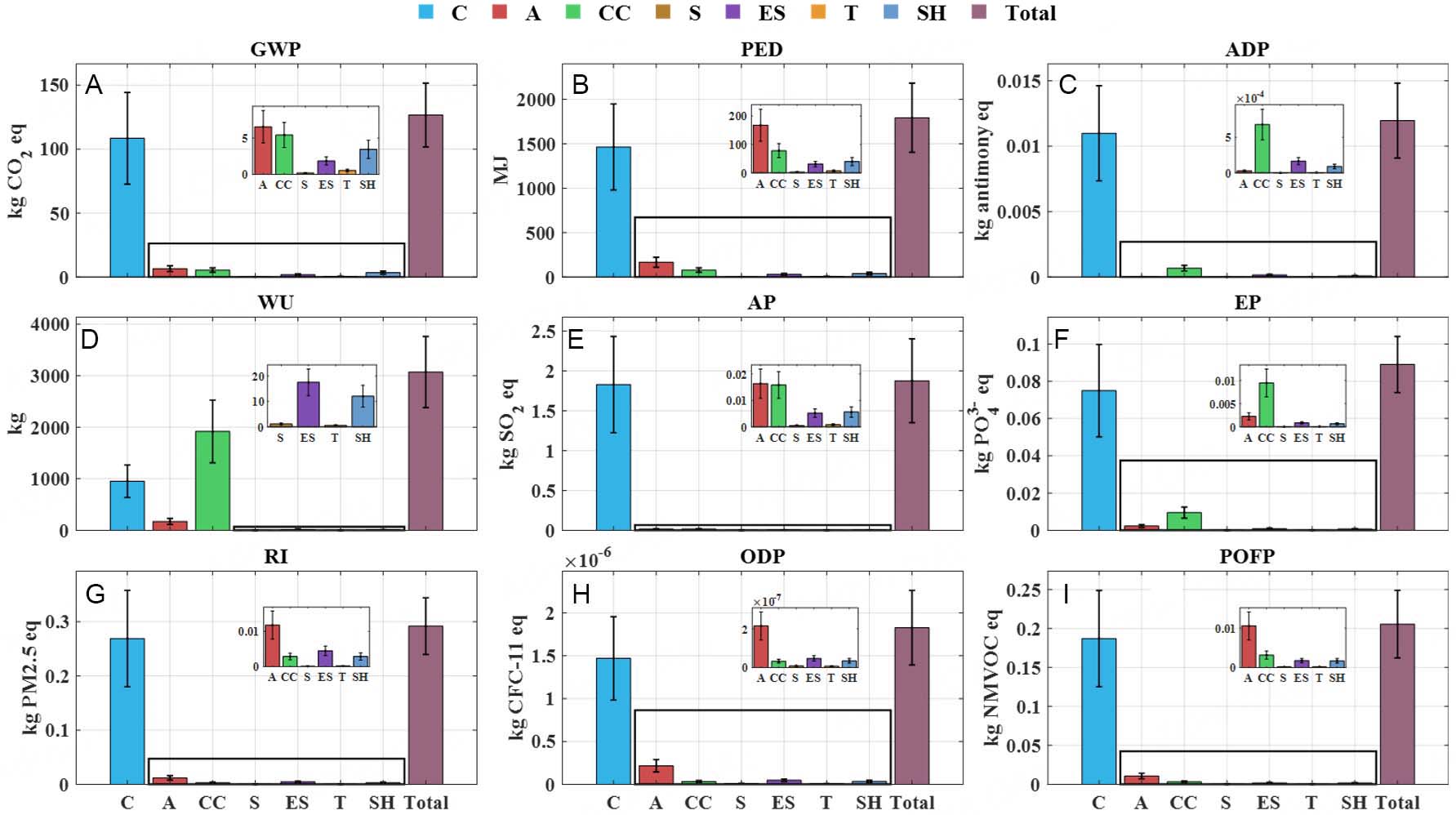
Figure 2. Results of environmental impacts in the raw material acquisition stage of SSSB. (A) Global warming potential (GWP), (B) primary energy demand (PED), (C) abiotic depletion potential (ADP), (D) water use (WU), (E) acidification potential (AP), (F) eutrophication potential (EP), (G) respirable particulate formation potential (RI), (H) ozone depletion potential (ODP), (I) photochemical ozone formation potential (POFP). Each subgraph quantifies the single environmental burden corresponding to cathode (C), anode (A), current collector (CC), separator (S), electrolyte solvent (ES), tab (T), and shell (SH), and visually compares the differentiated contribution of various battery raw material components to multiple environmental damage categories. Abbreviations: cathode (C); anode (A); current collector (CC); separator (S); electrolyte solvent (ES); tab (T); shell (SH). Error bars represent percentage uncertainty intervals of domestic industrial LCI data automatically output by eFootprint software, which originates from multi-weighted evaluation on Chinese battery manufacturers’ environmental impact assessment reports and only accounts for background inventory calculation uncertainty.