



Volume 6, Issue 2 (2026) – 25 articles
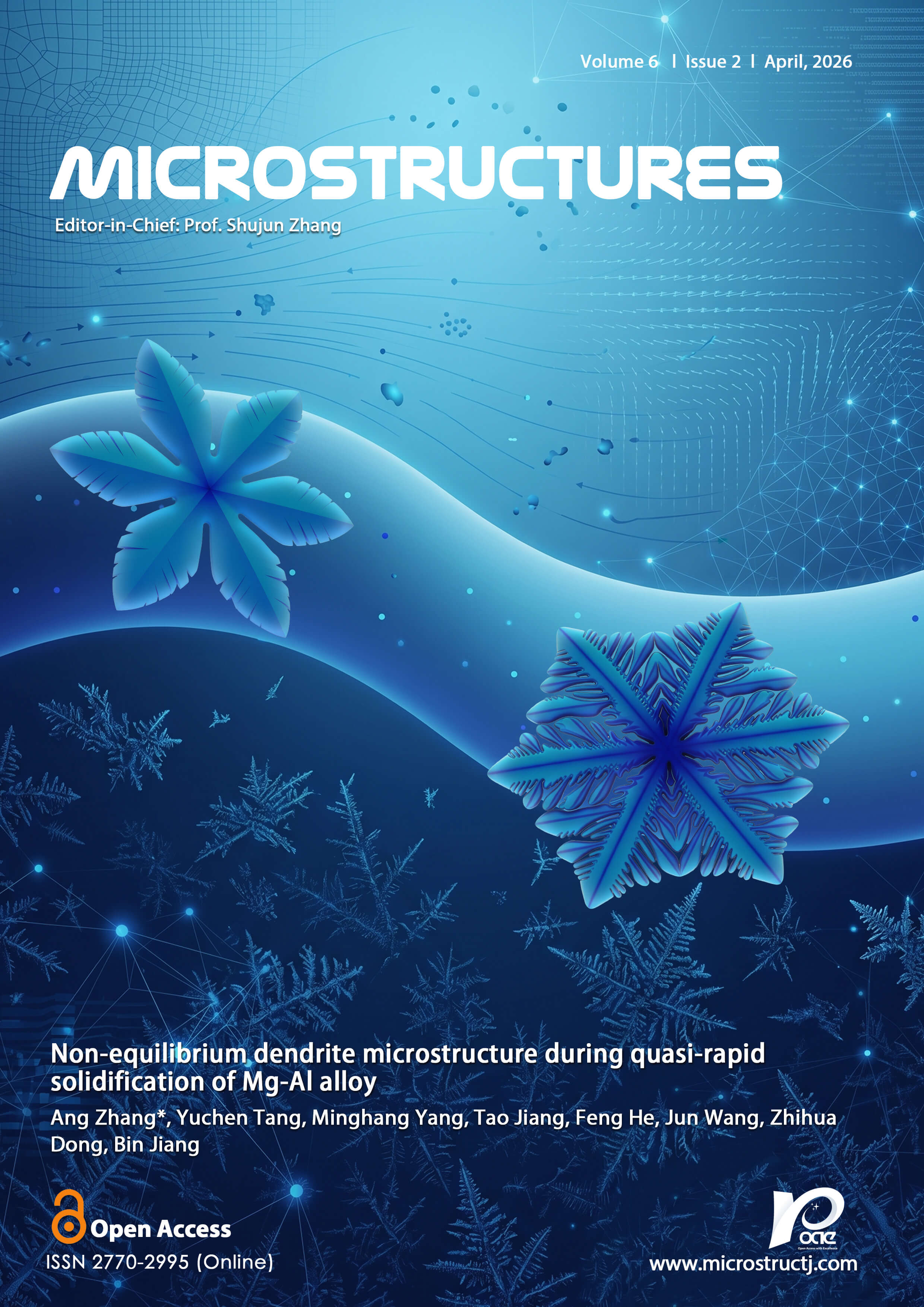
Cover Picture: The non-equilibrium dendrite growth of Mg-6wt.%Al alloy during quasi-rapid solidification is studied by combining phase-field simulations and comparative experiments (furnace/air/water cooling: 0.07/2.9/181 K/s). The kinetic behavior of the solid-liquid interface is characterized, and the solute trapping-drag competition is emphasized. The effects of undercooling (28-36 K), cooling rate, and orientation angle (0-π/6) on dendrite morphological evolution are systematically explored, and the laws governing the morphological transition of the interface front are analyzed according to the condition criterion of interface transition. The experimental primary dendrite arm spacing decreases from ~45 ± 4.2 μm (0.07 K/s) to ~5.5 ± 0.7 μm (181 K/s), matching the phase-field simulations (relative error less than 9%). The solid-phase Al concentration rises from 2.6 ± 0.22 wt.% to 5.4 ± 0.26 wt.% experimentally, consistent with the simulated trends. The simulated critical value for planar-to-cellular transition (1.2 × 10⁹ K·s/m2) is lower than the theoretical value (1.48 × 10¹⁰ K·s/m2) due to solute drag. The analysis of the partial drag condition is extended by integrating thermodynamics and kinetics. The limitation of the current model in capturing the intermediate partial drag state and potential future direction to address this are discussed. Through combining with the experimental results under different cooling rates, the simulation results are further interpreted and validated in both quantitative and qualitative way. This research provides theoretical basis for the regulation of magnesium alloy microstructures under quasi-rapid solidification such as industrial die-casting process.
view this paper 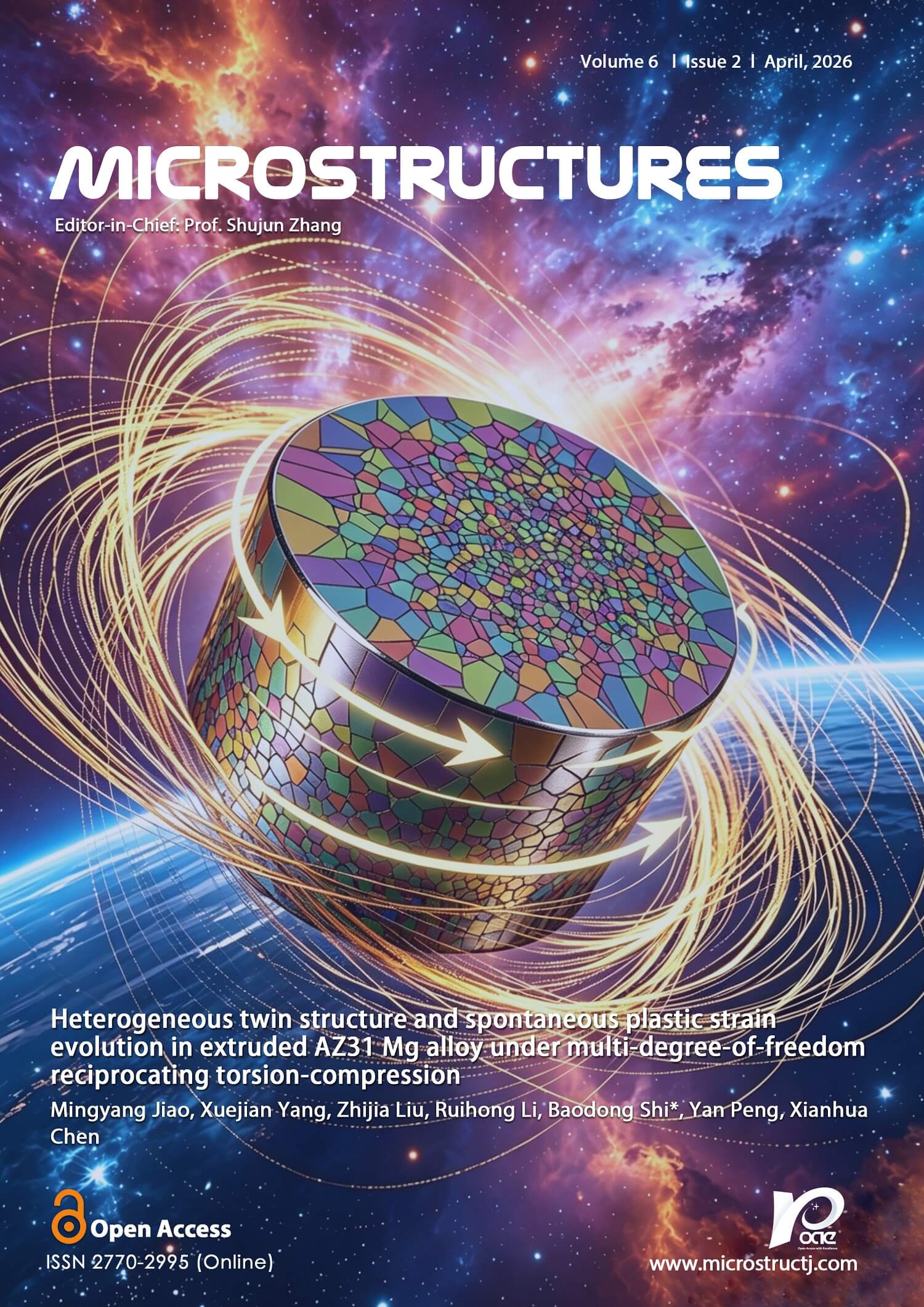
Back Cover Picture: The microstructural evolution and mechanical responses under multi-degree-of-freedom reciprocating torsion-compression deformations remain to be fully elucidated, particularly regarding the Swift and inverse Swift effects and their physical mechanisms, which constrain the design and formability of textured Mg alloys. Therefore, the multi-degree-of-freedom reciprocating pre-torsional-compressive loadings along extrusion direction (ED) were specifically designed. The twinning behaviours and the radial distribution of twin structures were systematically analysed. The driving mechanisms of the Swift and subsequent inverse Swift effects were discussed. Results demonstrated that free end torsion (FET) deformation induced radially linear-gradient twinning structure, while reverse FET (RFET) loading triggered FET twins detwinning and extensive {10
view this paper