


Volume 5, Issue 11 (2025) – 10 articles
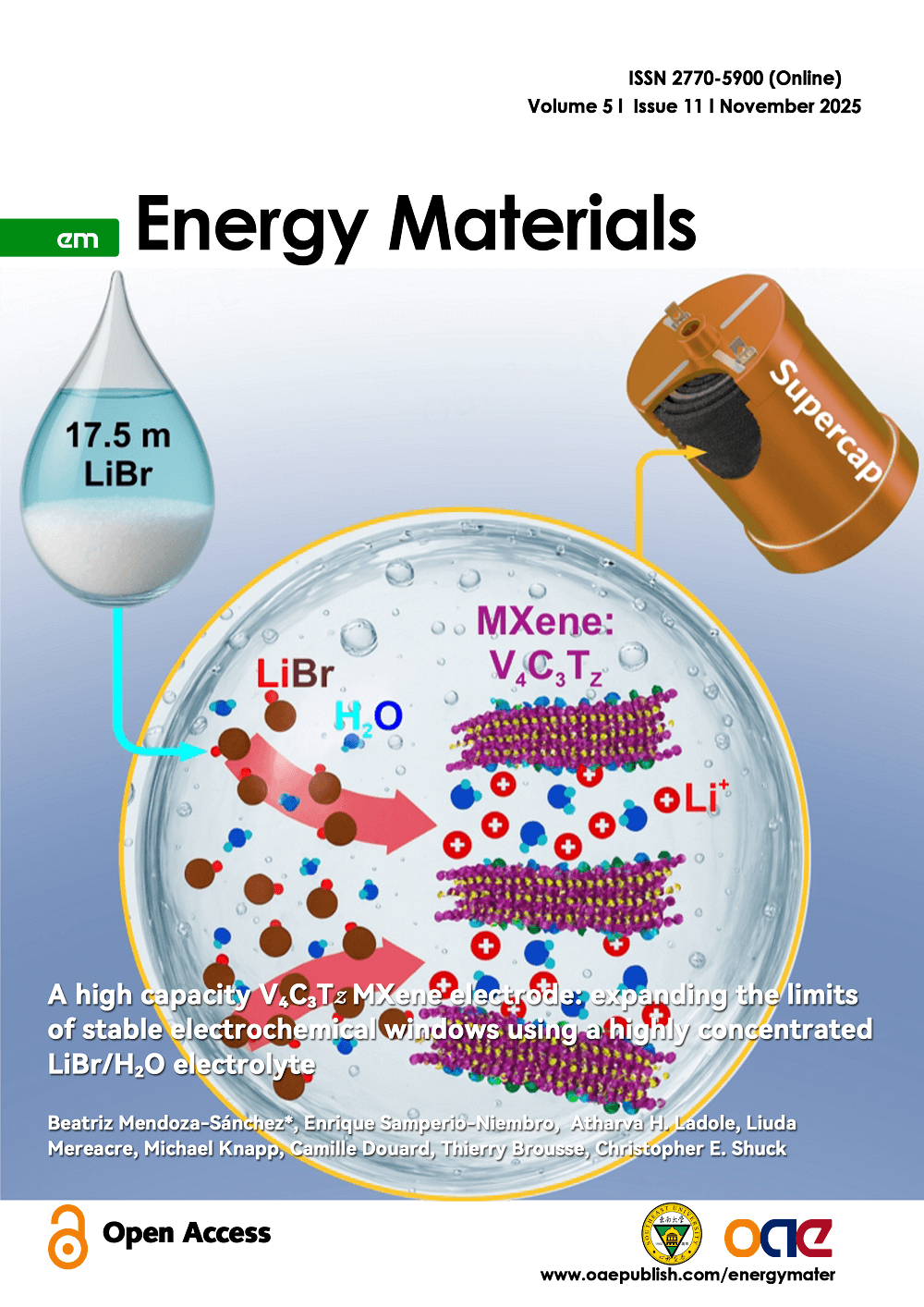
The use of highly concentrated electrolytes to enlarge the operational electrochemical window of MXenes is a strategy to enhance their energy density. Here, we demonstrate that V4C3Tz can operate in a -0.7 to 0.8 V vs. Ag electrochemical window in a 17.5 m LiBr/H2O electrolyte achieving a high capacity/capacitance of 237.1 C g-1/745.5 C cm-3/158 F g-1, electrode energy density of 49.4 Wh kg-1/155.3 mWh cm-3, and a high cycling stability up to 10,000 cycles. This performance is superior to previously reported MXenes, including Ti3C2Tz and Ti2CTz tested in water-in-salt electrolytes and hydrate melts. We demonstrate the key role of electrolyte concentration in maximizing the electrochemically stable window. Electrolyte formulations in the low-concentration (5 m, 7.5 m and 10 m) and high-concentration (12.5 m, 15 m, 17.5 m, and 19 m) regimes were investigated. The best performance balance of capacity, capacity retention, Coulombic efficiency and cycling stability was achieved in the 17.5 m electrolyte. Electrochemical methods showed that this electrolyte formulation enabled the stabilization of the electrode against the hydrogen evolution reaction and oxidation processes at negative and positive potentials vs. Ag, respectively, where an interfacial film at the electrode-electrolyte interface, confirmed by electrochemical impedance spectroscopy, played a key role. Physical properties of the electrolyte were correlated to electrode performance. Importantly, this optimum performance was achieved without reaching the electrolyte concentration at the LiBr solubility limit at room temperature (19 m), which undermines rate performance and brings other operational issues.