



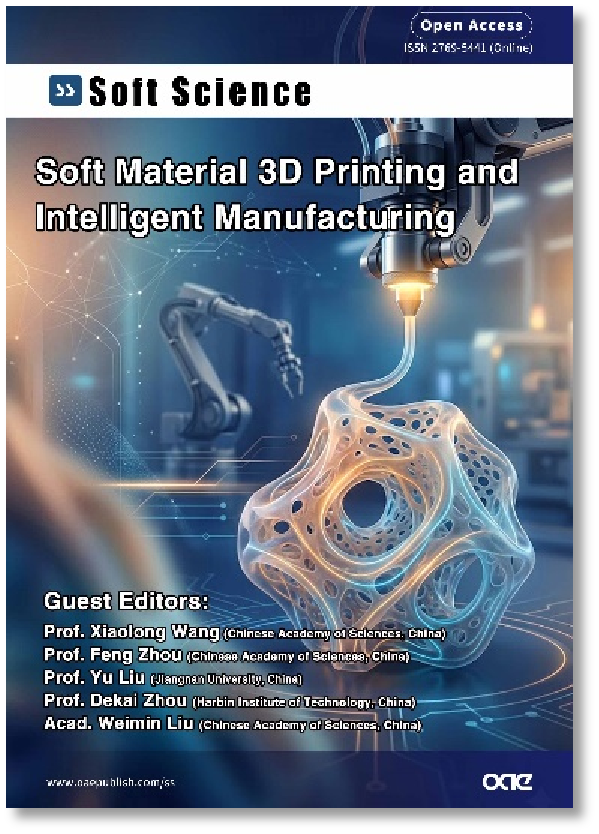
Topic: Soft Material 3D Printing and Intelligent Manufacturing
Guest Editors
Special Topic Introduction
Soft materials have emerged as a cornerstone of next-generation engineering systems, owing to their unique ability to undergo large deformations, adapt to environments, and integrate diverse functionalities. This Special Issue aims to capture the forefront of research in advanced soft materials, with a particular emphasis on manufacturing and engineering, including 3D/4D printing, high-resolution gradient printing, and micro/nano fabrication, applied to hydrogels, polyurethane, silicone rubber, and liquid crystal elastomers.
Beyond fabrication, this Issue highlights design principles and strategies for achieving extreme mechanical properties, such as ultra-stretchability, toughness, non-reciprocal behavior, fatigue resistance, and impact resistance. Bioinspired and biomimetic approaches featuring interfacial or architectural designs are also explored for applications in bio-lubrication, adhesion, drag reduction, and shock absorption.
Stimuli-responsive and adaptive soft materials that react to temperature, pH, light, electric fields, and magnetic fields are featured, enabling innovations in smart valves, artificial muscles, and reconfigurable surfaces. In parallel, multifunctional soft composites and hybrid systems, integrating soft matrices with nanomaterials such as MXenes, graphene, and liquid metals, demonstrate combined electrical, thermal, magnetic, or optical functions for soft actuators, robotics, flexible sensors, and wearable electronics.
Finally, this Issue highlights how AI and machine learning are transforming fields such as property prediction, inverse design, high-throughput screening, microstructure reconstruction, process–structure–property mapping, simulation, and experimental guidance. Collectively, these contributions aspire to inspire new frontiers in soft material science and engineering.
Key areas of interest include but are not limited to:
● Advanced manufacturing of soft materials, particularly additive manufacturing techniques such as 3D/4D printing, high-resolution gradientprinting, and micro/nano fabrication methods applied to hydrogels, polyurethane, silicone rubber, and liquid crystal elastomers;
● Design principles and fabricationstrategies for mechanically innovative soft materials, including ultra-stretchable, tough, non-reciprocal, fatigue-resistant, and impact-resistant, to achieve extreme mechanical properties;
● Bioinspired and biomimetic soft materials featuring interfacial or architectural designs for applications in bio-lubrication, adhesion, drag reduction, and shock absorption;
● Stimuli-responsive and adaptive soft materials that respond to external stimulisuch as temperature, pH, light, electric, and magnetic fields, enabling applications in smart valves, artificial muscles, or reconfigurable surfaces;
● Multifunctional soft composites and hybrid systems integrate soft matrices with nanomaterials such as MXenes, graphene, and liquid metals to achieve combined electrical, thermal, magnetic, or optical functions for advanced applications including soft actuators, soft robotics, flexible sensors, and wearable electronics;
● AI and machine learning enable soft material design by accelerating property prediction, reverse design, high-throughput screening, microstructure reconstruction, process–structure–property mapping, simulation, and experimental guidance.
Keywords
Soft Materials Engineering; Advanced Manufacturing; Biomimetic Architectures; Extreme Mechanics; Functional Applications;
Submission Deadline
Submission Information
For Author Instructions, please refer to https://www.oaepublish.com/ss/author_instructions
For Online Submission, please login at https://www.oaecenter.com/login?JournalId=ss&IssueId=ss26042910451
Submission Deadline: 31 Aug 2026
Contacts: Mirra Du, Assistant Editor, [email protected]