



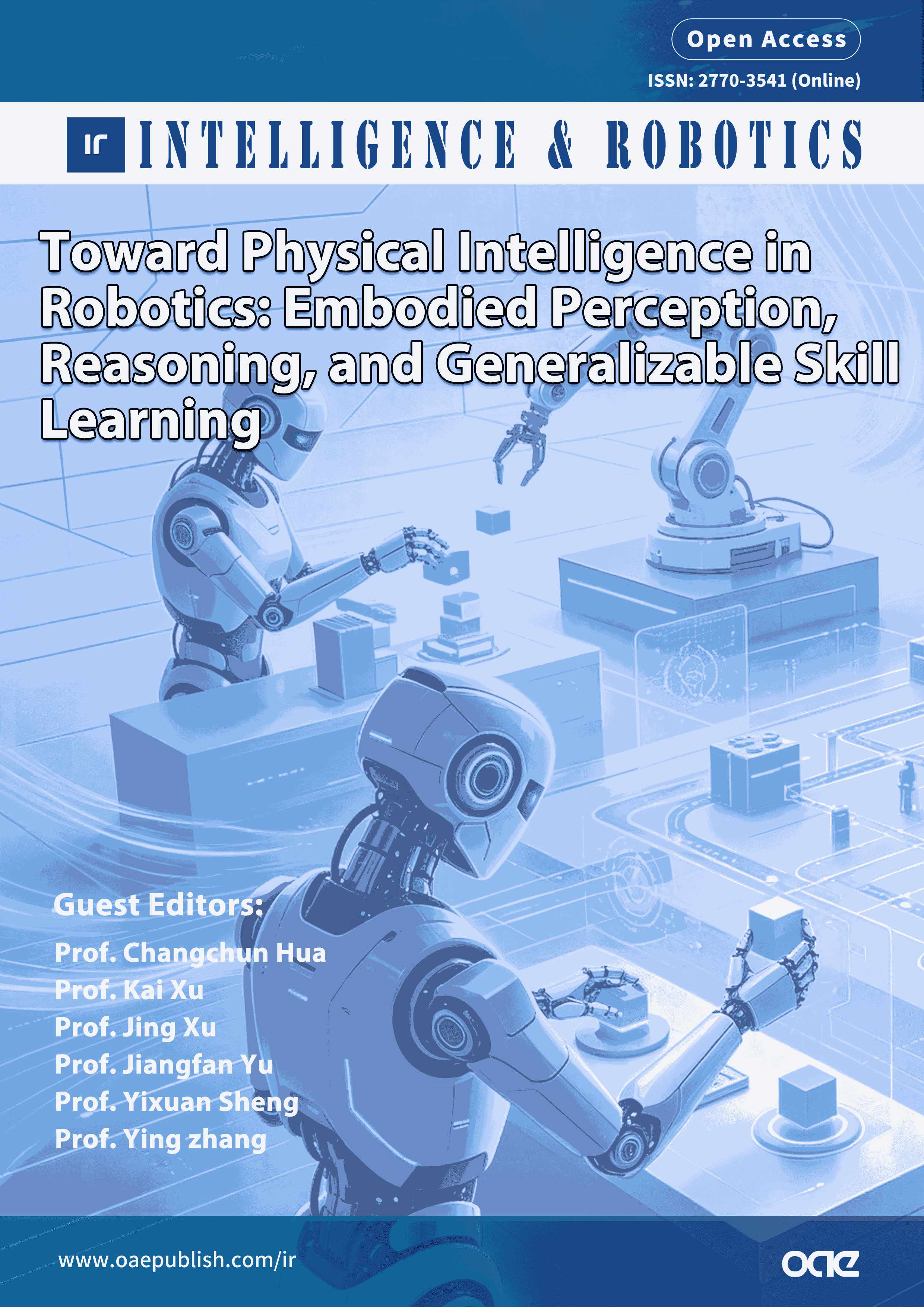
Topic: Toward Physical Intelligence in Robotics: Embodied Perception, Reasoning, and Generalizable Skill Learning
Guest Editors
Special Topic Introduction
Recent advances in artificial intelligence, foundation models, embodied intelligence, and robot learning are driving a paradigm shift in robotics—from task-specific automation toward physical intelligence. Unlike conventional robotic systems that primarily rely on predefined rules, handcrafted pipelines, and structured environments, physically intelligent robots are expected to perceive complex environments, understand contextual information, reason about goals and actions, acquire transferable skills, and adapt autonomously to dynamic real-world settings.
Physical intelligence is emerging as a new paradigm for autonomous robotics, aiming to seamlessly integrate perception, cognition, learning, and action. Achieving this vision requires tightly coupling embodied perception, reasoning, and generalizable skill learning, enabling robots to understand, interact with, and adapt to the physical world beyond narrowly defined tasks.
Recent breakthroughs in vision-language models (VLMs), vision-language-action (VLA) models, world models, reinforcement learning, imitation learning, and large-scale robot learning have significantly accelerated progress toward physical intelligence. Nevertheless, substantial challenges remain in integrating perception with action, connecting reasoning with control, achieving robust skill generalization, and ensuring reliable deployment in open-world environments.
This Special Topic aims to bring together researchers from robotics, embodied intelligence, machine learning, computer vision, cognitive science, and related disciplines to advance the theoretical foundations and enabling technologies of physical intelligence in robotics. We welcome original research articles and review papers addressing embodied perception, reasoning, generalizable skill learning, and their integration into autonomous robotic systems operating in complex real-world environments.
Topics of interest include, but are not limited to:
● Embodied perception and active environmental understanding;
● Multimodal perception, sensor fusion, and scene understanding;
● Foundation models, large language models, VLMs, and VLA models for robotics;
● World models and embodied reasoning;
● Context-aware decision-making and long-horizon planning;
● Generalizable skill learning, skill composition, and skill transfer;
● Reinforcement learning, imitation learning, and self-supervised robot learning;
● Lifelong learning and continual adaptation;
● Autonomous manipulation and mobile manipulation;
● Dexterous manipulation and whole-body control;
● Humanoid robots and embodied robotic agents;
● Human-robot interaction and collaborative intelligence;
● Intelligent robots, smart equipment, and autonomous unmanned systems;
● Multi-robot systems and collaborative autonomy;
● Sim-to-real transfer and real-world deployment;
● Safe, trustworthy, and explainable robotic intelligence;
● Applications of physical intelligence in manufacturing, logistics, healthcare, agriculture, and service robotics.
Keywords
Physical intelligence, embodied intelligence, embodied perception; robot learning, generalizable skill learning, foundation models for robotics, large language models, vision-language models, world models, autonomous robotics, humanoid robots, smart equipment, autonomous systems, lifelong learning
Submission Deadline
Submission Information
For Author Instructions, please refer to https://www.oaepublish.com/ir/author_instructions
For Online Submission, please login at https://www.oaecenter.com/login?JournalId=ir&IssueId=ir26061710501
Submission Deadline: 20 Jun 2027
Contacts: Jenny Wang, Science Editor, [email protected]