



Wearable PANI@CoFe2O4 organohydroges for strain sensing, EMI shielding and thermal insulation
 0
0 Abstract
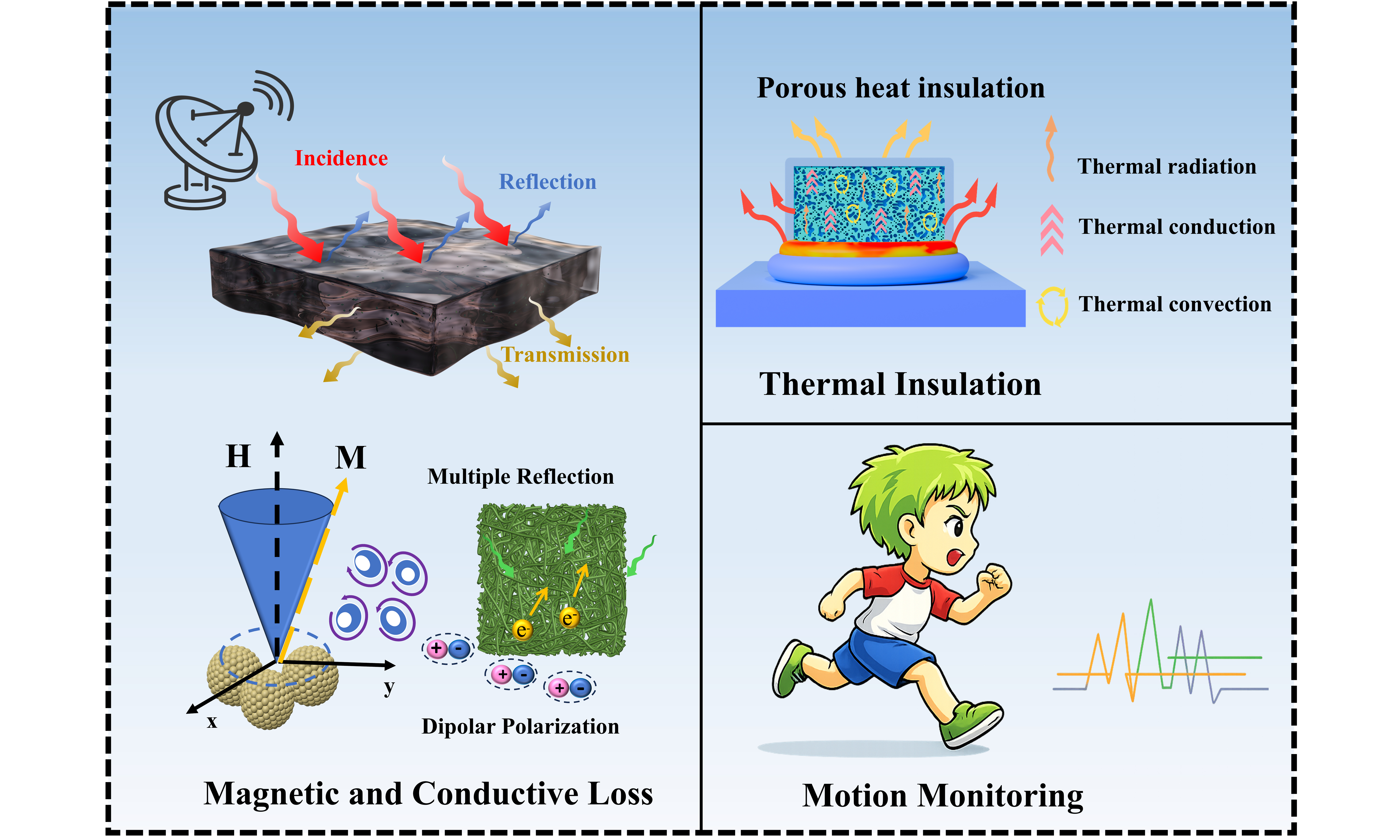
With the rapid escalation of electromagnetic pollution and electromagnetic interference, conventional EMI shielding materials can no longer satisfy the integrated requirements of next-generation flexible electronic devices and information terminals for mechanical deformability, wearable adaptability, and real-time signal monitoring. In this work, a multifunctional polyacrylamide/glycerol (PG)/P@CoFe (PAM/Gly/PANI@CoFe2O4) composite organohydrogel sensor with synergistic electromagnetic dissipation was fabricated through a hydrothermal-assisted one-pot strategy. CoFe2O4 magnetic nanoparticles were first synthesized via an ethylene glycol-assisted solvothermal route. Subsequently, the surface-active sites of CoFe2O4 were utilized to induce aniline polymerization, yielding conductive-magnetic polyaniline (PANI)@CoFe2O4 composite nanoparticles. Mechanical characterization demonstrated that the resulting organohydrogel exhibited excellent compressive properties, while the incorporation of glycerol effectively suppressed water evaporation and enhanced water-retention capability. Electromagnetic measurements revealed that, at a PANI@CoFe2O4 loading of 4 wt.%, the 4 mm-thick hydrogel achieved an electrical conductivity of 0.55 ± 0.01 S/m and an average electromagnetic interference shielding effectiveness (EMI SE) of 50.27 ± 2.51 dB in the X-band. In addition, the hydrogel exhibited excellent thermal iInsulation performance. More importantly, its outstanding adhesion and rapid stimuli-responsive behavior enabled favorable human–machine interactive strain-sensing performance with good compatibility. This work provides an effective strategy for the development of integrated, robust multifunctional materials that simultaneously combine flexible sensing, electromagnetic shielding, and thermal insulation.
Highlights
1. A multifunctional PG/P@CoFe organohydrogel was fabricated via a hydrothermal-assisted one-pot strategy.
2. In situ polymerized PANI uniformly coated CoFe2O4, forming a stable conductive-magnetic synergistic network.
3. The organohydrogel exhibited high-sensitivity strain sensing together with favorable infrared stealth performance.
4. Absorption-dominated EMI shielding is achieved with an average SE of 50.27 dB in the X-band.
Keywords
INTRODUCTION
With the rapid development of 5G communications, artificial intelligence, and aerospace technologies, the problems of electromagnetic pollution and electromagnetic interference have become increasingly serious, threatening the stable operation of precision electronic devices and raising potential concerns for human health[1-4]. Conventional electromagnetic shielding materials are primarily designed to attenuate incident electromagnetic waves. however, they are increasingly unable to satisfy the growing demand for lightweight design, flexibility, and multifunctional integration required by emerging applications such as internet-connected devices, wearable electronics, and health monitoring systems[5-7]. As electronic devices become increasingly miniaturized and sophisticated, and as their application scenarios become more complex, the development of EMI shielding materials must evolve toward multifunctional integration[8-10]. Owing to their lightweight nature, mechanical softness, inherent adhesiveness, and excellent compatibility with functional fillers, hydrogels have emerged as highly promising candidates for this purpose[11-13]. Through rational engineering of the polymeric network and precise regulation of functional fillers, their physicochemical properties and application-specific functionalities can be effectively tailored. By incorporating various conductive fillers, such as conductive polymers, carbon nanotubes, graphene, and metal-based materials, the electrical conductivity of hydrogels can be effectively regulated[14,15]. This unique combination has made hydrogels highly attractive for applications in flexible electronics, energy storage and sensing, while also offering a new framework for the development of multifunctional and integrated electromagnetic shielding materials. However, a critical challenge remains. Most conductive fillers exhibit poor dispersibility in hydrogel precursor solutions and tend to aggregate or sediment. Therefore, the rational selection and surface modification of functional fillers are crucial for constructing high-performance composite hydrogels.
Among various conducting polymers, polyaniline (PANI) has attracted extensive attention owing to its tunable oxidation states, high electrical conductivity, and capability for in situ polymerization in aqueous media[16]. However, pristine PANI exhibits strong hydrophobicity and limited hydrophilicity, resulting in poor solubility and unsatisfactory dispersibility in aqueous systems. In acidic media, protonation of the PANI molecular chains can markedly improve both its dispersibility and electrical conductivity[17,18]. Nevertheless, excessively high electrical conductivity can easily lead to discontinuous conductive pathways and a limited number of interfacial polarization sites, resulting in unsatisfactory electromagnetic wave attenuation performance[19]. Therefore, it is necessary to introduce other components to alleviate issues such as insufficient interfacial polarization. CoFe2O4 is a typical spinel-structured magnetic material and a ferrite that possesses high magnetic anisotropy, considerable magnetostrictive properties, and strong electromagnetic loss capability[20,21]. CoFe2O4 exhibits excellent thermochemical stability, enabling it to maintain its structural integrity without significant decomposition even under acidic, oxidizing, or high-temperature conditions[22-24]. Unfortunately, its electrical conductivity is inferior compared with that of many metal-based materials[25,26]. It is predominantly employed as a magnetic loss component rather than a highly conductive material in electromagnetic shielding and microwave absorption applications. Wang et al.[5] prepared the MXene/CoFe2O4 multifunctional hydrogel via a rapid gelation method, which not only addressed the issue of filler agglomeration but also improved the electrical conductivity of the hydrogel. The average EMI SE of this hydrogel in the X-band reaches 54.21 dB. Zhou et al.[27] prepared Fe3O4@RGO by a hydrothermal method, which resolved the problems of Fe3O4 precipitation and RGO stacking. They also fabricated the Fe3O4@RGO/PAM conductive hydrogel, whose maximum EMI SE is 27.1 dB. Diao et al.[11] optimized MXene layers via covalent organic frameworks (COFs) and successfully prepared MXene@COF heterostructured hydrogels, preventing MXene nanosheets from aggregation and self-stacking through the outer layer. The average EMI SE of this hydrogel is 32.01 dB. Thus, we can effectively overcome their respective defects by compounding PANI conductive materials and CoFe2O4 magnetic materials: On the one hand, the magnetic particles contribute magnetic loss mechanisms such as natural resonance and eddy current loss[20,28,29]. On the other hand, the interfaces between CoFe2O4 and PANI can induce dipole polarization and interfacial polarization, thereby enabling a synergistic multi-mechanism attenuation of electromagnetic waves[30,31]. More importantly, the integration of the conductive PANI network with magnetic CoFe2O4 nanoparticles facilitates the construction of a composite network that simultaneously exhibits dielectric and magnetic loss characteristics, thereby optimizing impedance matching and enhancing the overall microwave absorption efficiency. In addition, polyacrylamide (PAM), as a hydrophilic polymer network material, possesses excellent flexibility and a controllable porous structure, making it an ideal matrix for constructing composite hydrogels[32-34]. The incorporation of glycerol (Gly) not only significantly enhances the mechanical toughness and water-retention capability of the hydrogel, but also promotes internal energy dissipation and stabilizes the conductive network through hydrogen-bond interactions.
In this work, we successfully synthesized CoFe2O4 magnetic nanoparticles via a hydrothermal method. Owing to the abundant surface metal active sites (Co2+ and Fe3+), surface hydroxyl groups (-OH), and oxygen vacancies, the nanoparticles exhibit a strong adsorption capability toward aniline[35]. The lone-pair electrons on the amino group of aniline can coordinate with Co2+ and Fe+, enriching aniline at the CoFe2O4 surface and facilitating subsequent in situ oxidative polymerization. This interfacial coordination is the key to constructing conductive-magnetic PANI@CoFe2O4 composite nanoparticles. Based on this mechanism, the homogeneous incorporation of PANI@CoFe2O4 into the polyacrylamide/glycerol (PG) (PAM/Gly) matrix enables the construction of a hierarchical conductive–magnetic synergistic network, thereby endowing the hydrogel with integrated EMI shielding, thermal insulation, and flexible strain-sensing properties.
EXPERIMENTAL SECTION
Experimental materials
Cobalt(II) chloride hexahydrate (CoCl2·6H2O, reagent grade, 99.9%, molecular weight 291.03), ferric chloride hexahydrate (FeCl3·6H2O, analytically pure, 99%, molecular weight 270.30), acrylamide (AM, analytically pure, 99.0%, molecular weight 71.08), ammonium persulfate (APS, analytically pure, 98%, molecular weight 228.20), N,N′-methylenebisacrylamide (MBA, 99%, molecular weight 154.17), sodium hydroxide (NaOH, analytically pure, 96.0%, molecular weight 40.00) were all purchased from Shanghai Aladdin Biochemical Technology Co., Ltd. Aniline (AN, ≥ 99.5%, molecular weight 93.13), hydrochloric acid (HCl, 36.5-38.0 wt.%, molecular weight 36.46) and ethylene glycol (EG, analytically pure, ≥ 98%, molecular weight 62.07) were purchased from Chongqing Chuandong Chemical Co., Ltd. Glycerol (Gly, analytically pure, ≥ 99.0%, molecular weight 92.09) was purchased from Xilong Scientific Co., Ltd.
Preparation of conductive and magnetic PANI@CoFe2O4 nanoparticles
Take a certain mass of CoCl2·6H2O and FeCl3·6H2O and dissolve them sequentially in 45 mL of ethylene glycol to form solution a. Then dissolve NaOH in 50 mL of ethylene glycol to form solution b. Slowly add a to b while stirring magnetically in a 50 °C water bath for 2 h; Next, react it in a reactor at 200 °C for 8 h. After centrifugation, washing, and drying, CoFe2O4 magnetic particles are obtained.
Disperse CoFe2O4 nanoparticles in 75 mL of deionized water, then add 0.1 mL of AN and stir for 20 min. Adjust the pH to 1 using HCl, then add the initiator APS. The mixture was stirred at 0-4 °C for 6 h, followed by centrifugation, washing, and drying to obtain PANI@CoFe2O4 conductive magnetic nanoparticles.
Preparation of PG/P@CoFe hydrogel
A specified amount of PANI@CoFe2O4 was dispersed in 100 mL of deionized water and uniformly homogenized by mechanical stirring. Subsequently, 8 g of acrylamide (AM), 1.9 mL of glycerol (Gly), and 0.08 g of N,N′-methylenebisacrylamide (MBA) were sequentially introduced into the PANI@CoFe2O4 dispersion and thoroughly mixed. The polymerization initiator, ammonium persulfate (APS, 0.195 g), was then added to the mixture, and the resulting solution was transferred into a custom-designed mold for gelation. The obtained hydrogel was designated as X-PG/P@CoFe, where PG denotes the PAM/Gly network, and X indicates the weight percentage (%) of PANI@CoFe2O4 filler incorporated into the hydrogel.
Characterization and measurements
Sample microstructures were examined by scanning electron microscopy (SEM, ZEISS Sigma 300, Carl Zeiss AG). Chemical composition was analyzed via Fourier transform infrared spectroscopy (FT-IR, Nicolet iS50, Thermo Fisher Scientific) and X-ray photoelectron spectroscopy (XPS, Thermo Scientific K-Alpha, Thermo Fisher Scientific), and crystal structures were determined by X-ray diffraction (XRD, Rigaku Ultima IV, Suzhou Dehe Scientific Instrument Co., Ltd). Thermal behavior of the hydrogels was assessed using differential scanning calorimetry (DSC, Q10, TA Instruments), while compressive properties were measured with an electronic universal testing machine (GB/T 1041-2008, CMT6104,Mettler Industrial Systems (China) Co., Ltd.). Water absorption (Q) and retention (W) capacities were quantified according to Equations (1) and (2)[11].
Here, mt denotes the weight of the sample in its original state, m0 denotes the weight of the sample in a dry state; wt denotes the mass measured after exposure to air for t h, and w0 denotes the mass immediately upon reaching swelling equilibrium. Using a flexible strain sensor for sensitivity performance testing, the sensitivity coefficient (GF) is defined as the relative change in resistance [expressed as (R-R0)/R0, where R0 and R represent the initial and real-time resistance] divided by the strain (ε). The electrical conductivity of the samples was determined using a standard four-probe resistance tester (FT-331). Using a vector network analyzer (N5225B, Keysight, Malaysia), the scattering parameters (S11, S12, S21, and S22), along with the complex permittivity and complex susceptibility used for analyzing EMI shielding characteristics. EMI shielding performance, including total SET, reflected SER, and absorbed SEA, as well as the coefficients for reflectance (R), absorptance (A), and transmittance (T), is calculated using the following Equations (3) to (8)[36,37].
Statistical analysis
Normality was assessed using the Shapiro-Wilk test prior to parametric analysis. Given the small sample size (n = 3), the data were considered approximately normally distributed. Descriptive statistics were calculated for all datasets. Quantitative data are expressed as mean ± standard deviation (SD). Comparisons between two groups were performed using an unpaired two-tailed t-test. Statistical significance was defined as P < 0.05. All statistical calculations were performed using Origin 2021.
RESULTS AND DISCUSSION
Synthesis mechanism and microstructure of PANI@CoFe2O4 and PG hydrogels
As illustrated in Figure 1A, ethylene glycol promoted the nucleation and crystal growth of CoFe2O4 and facilitated the formation of the spinel phase. The abundant surface metal-active sites of CoFe2O4 can coordinate with the amino nitrogen of aniline, thereby enriching aniline at the particle interface and favoring subsequent interfacial oxidative polymerization. Upon initiation by APS, aniline polymerized to form PANI, which coated the CoFe2O4 surface to yield the PANI@CoFe2O4 composite. Subsequently, as shown in Figure 1B, the composite was introduced into the Gly/PAM precursor solution and underwent in situ gelation, resulting in the formation of the PANI@CoFe2O4 hydrogel.
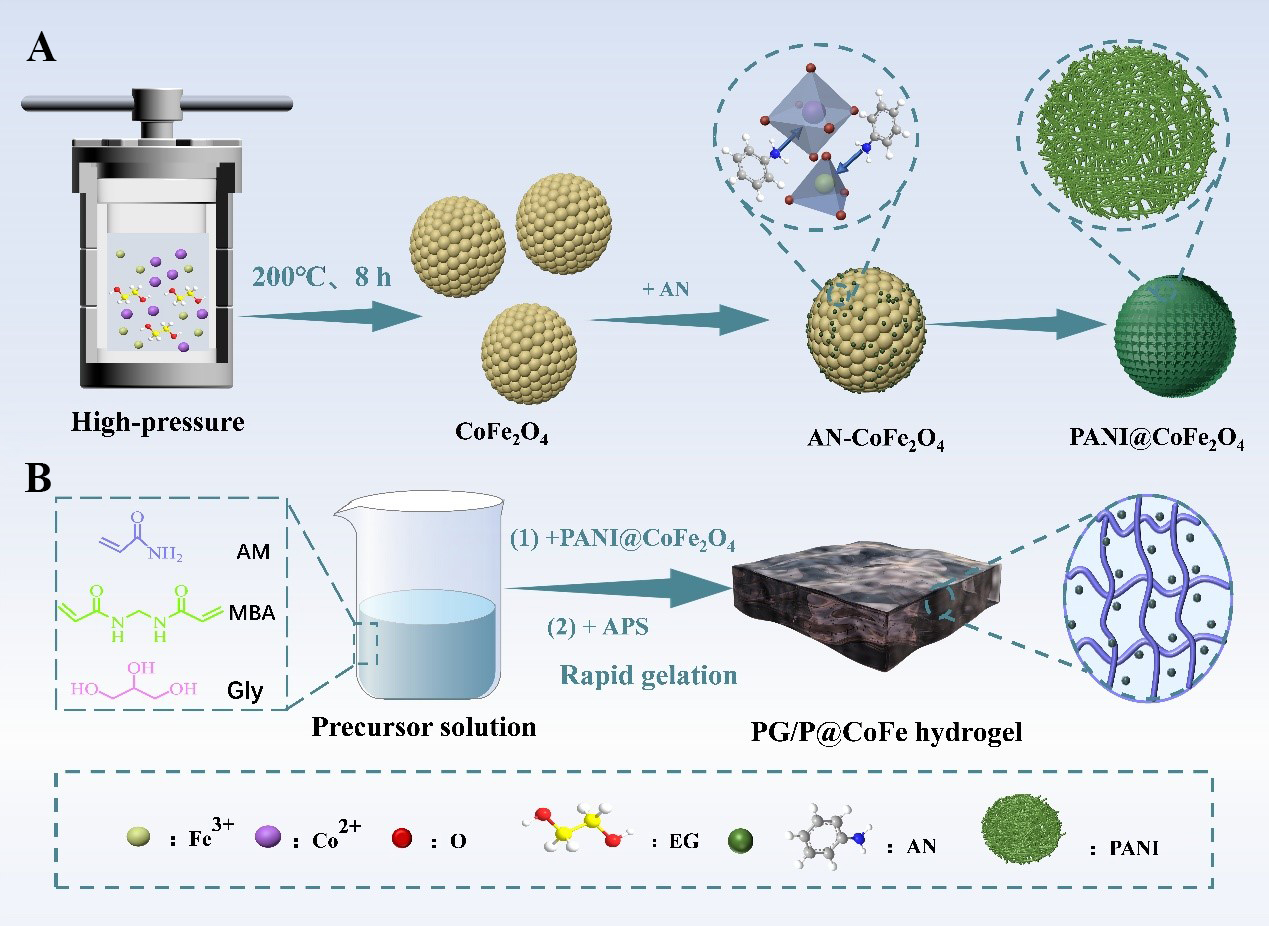
Figure 1. Preparation flowchart of the PG/P@CoFe hydrogel. PG: Polyacrylamide/glycerol; EG: Ethylene glycol; AN: Aniline; PANI: Polyaniline; MBA: N,N′-methylenebisacrylamide; Gly: Glycerol; AM: acrylamide; APS: ammonium persulfate.
As shown in Figure 2A, the CoFe2O4 synthesized in ethylene glycol exhibits a relatively uniform spherical morphology. After compositing with PANI in the aqueous phase [Figure 2B and C], the CoFe2O4 particles were clearly encapsulated by a PANI coating layer. EDS elemental mapping and energy-dispersive spectroscopy analysis [Supplementary Figure 1] further confirmed the homogeneous distribution of C, N, Fe, and Co throughout the composite. Figure 2D-F shows the scanning electron microscopy image of the PG hydrogel, which exhibits a well-defined three-dimensional porous structure. When CoFe2O4 is introduced into the PG hydrogel, the pore structure of the hydrogel is disrupted [Figure 2E]. This phenomenon may be attributed to the aggregation and deposition of CoFe2O4 particles, which interact strongly with the polymer matrix. Such interactions lead to a tighter packing of the polymer chains, thereby reducing the size of the pore structures[38,39]. In contrast, when PANI@CoFe2O4 is incorporated, the pore structure becomes more abundant [Figure 2F]. The FTIR spectrum [Figure 2G] shows that the in situ polymerized PANI under acidic conditions exhibits a stretching vibration of the C=C bond at 1,604 cm-1, a stretching vibration of the C-N bond at 1,498 cm-1, and bending vibrations of the C-H bonds in the aromatic ring at 1,365 cm-1 and 775 cm-1, as well as out-of-plane bending vibrations[40,41]. For CoFe2O4, the stretching vibration peaks of the Fe-O bonds appear at 419 cm-1 and 1,070 cm-1, while the stretching vibration of the Co-O bond is observed at 596 cm-1[42-44]. For the PANI@CoFe2O4 composite material, the characteristic peaks at 1,070 cm-1 and 596 cm-1 remain, indicating that the Fe-O and Co-O bonds are still present in the composite. Additionally, the peaks corresponding to PANI can also be observed, indicating the successful integration of PANI with CoFe2O4. Meanwhile, at the same time, as shown in Figure 2H, the diffraction peaks corresponding to each crystal face in the spinel structure perfectly match those in the standard card (No. 22-1086)[45], confirming the successful synthesis of the CoFe2O4 spinel structure. PG organohydroges were prepared using glycerol (Gly) and acrylamide (AM) as matrix components. This process involves the free-radical polymerization of AM at 60 °C to form PAM[46]. As shown in Supplementary Figure 2, PANI reduces the aggregation or sedimentation of CoFe2O4, enabling its uniform dispersion within the hydrogel, which helps promote the formation and stability of the hydrogel pore structure. In addition, FT-IR analysis of the PG hydrogel [Figure 2I] showed characteristic bands at 2,934, 1,415, and 1,037 cm-1, corresponding to C-H stretching, O-H bending, and C-O stretching vibrations of glycerol, respectively[47], confirming the successful construction of the PG hydrogel.
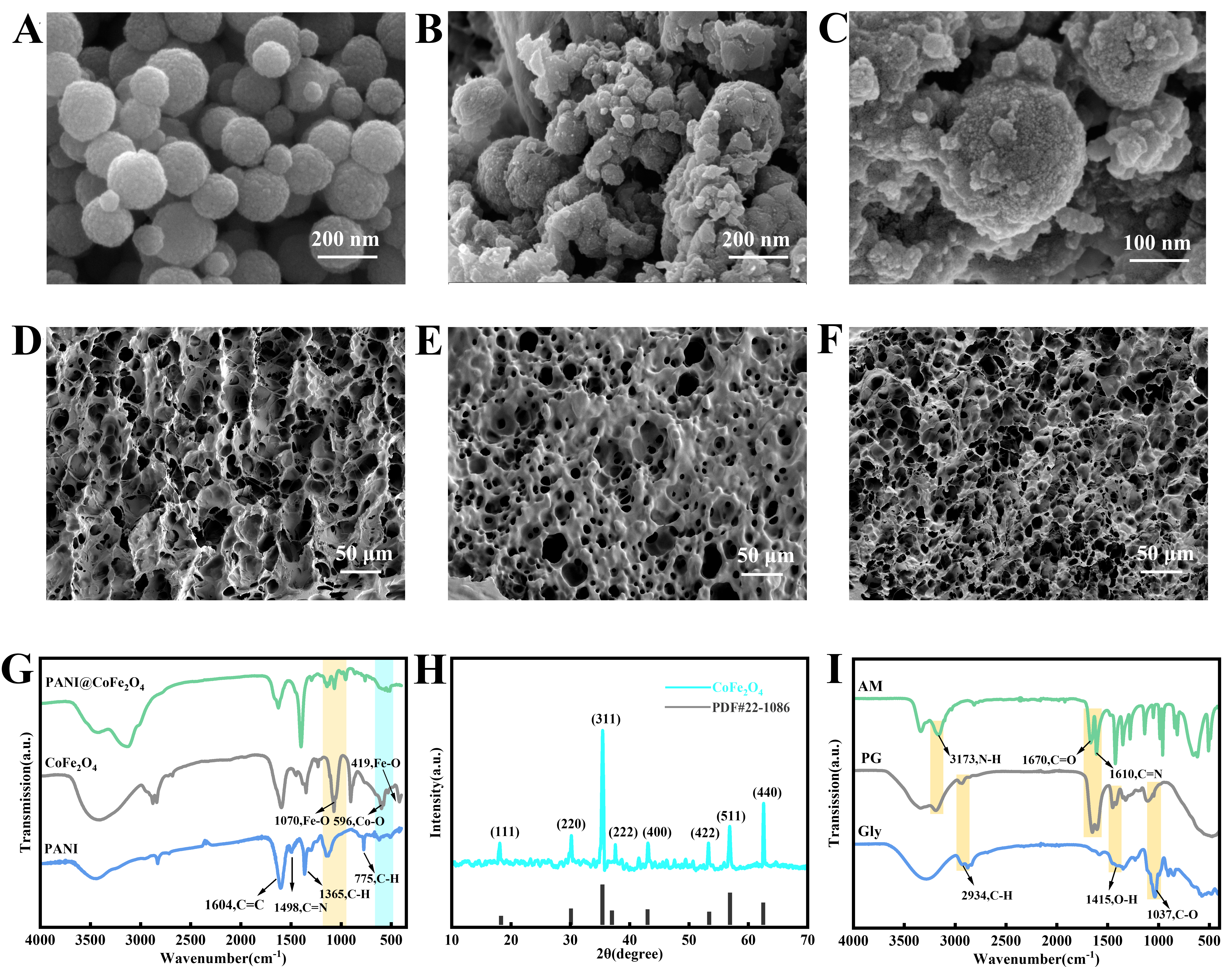
Figure 2. Microstructure and spectroscopic characterization of PANI@CoFe2O4 and PG-based hydrogels; (A) SEM images of CoFe2O4; (B and C) SEM images of PANI@CoFe2O4; (D-F) SEM images of PG, 4-PG/PANI, and 4-PG/P@CoFe; (G) FTIR spectra of PANI, CoFe2O4, and PANI@CoFe2O4; (H) XRD pattern of CoFe2O4; (I) FTIR spectrum of the PG hydrogel. AM: Acrylamide; PG: polyacrylamide/glycerol; SEM: scanning electron microscopy; FTIR: Fourier transform infrared; XRD: X-ray diffraction.
XPS analysis [Figure 3A] confirmed that spinel CoFe2O4 mainly consists of Co, Fe, and O, with no detectable impurities other than adventitious carbon. The high-resolution XPS spectra of Co 2p, Fe 2p, and O 1s are shown in Figure 3B-D. In Figure 3B, the two principal peaks at 780.5 and 796.6 eV are assigned to Co 2p3/2 and Co 2p1/2, respectively. The peaks at 780.2 and 796.1 eV correspond to Co+, whereas those at 778.8 and 794.2 eV are attributed to Co2[48,49]. The spectrum of Fe2p [Figure 3C] shows characteristic peaks at binding energies of 711.0 eV and 724.7 eV, corresponding to Fe 2p3/2 and Fe 2p1/2. The peaks at 710.9 eV and 724.1 eV are attributed to Fe3+, while the peaks at 713.7 eV and 726.7 eV correspond to Fe2+[48,50]. The O 1s XPS spectrum exhibits three characteristic peaks [Figure 3D]. The peak at 530.5 eV corresponds to the metal-oxygen bonds, while the peak at 531.6 eV is assigned to defect oxygen. The peak at 533.0 eV arises from adsorbed water molecules on the surface of CoFe2O4[50,51]. When coated with PANI, as shown in Figure 3E, it is evident that the PANI@CoFe2O4 composite nanoparticles contain an additional N element. The N 1s spectrum [Figure 3F] shows three peaks at binding energies of 399.2 eV, 399.7 eV, and 400.6 eV, which are attributed to imine nitrogen (=N-), amine nitrogen (-NH-), and protonated nitrogen (-N+-)[52]. The binding energies of Co, Fe, and O in PANI@CoFe2O4 do not exhibit significant shifts [Figure 3G-I], suggesting that no new covalent bonds were formed between PANI and CoFe2O4 and that the two components were mainly integrated through interfacial interactions.
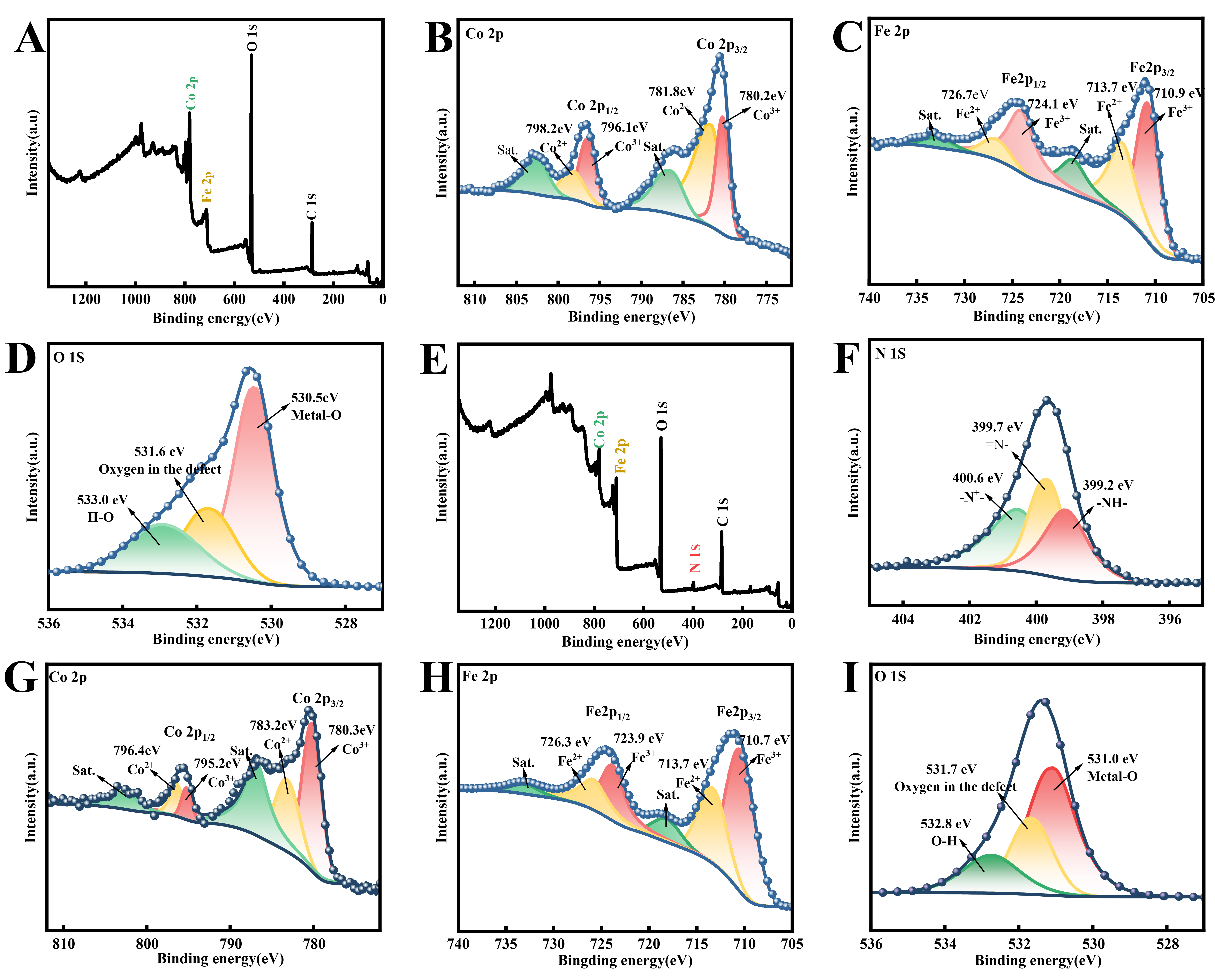
Figure 3. XPS characterization of CoFe2O4 and PANI@CoFe2O4. (A-D) Survey, Co 2p, Fe 2p, and O 1s spectra of CoFe2O4; (E-I) Survey, N 1s, Co 2p, Fe 2p, and O 1s spectra of PANI@CoFe2O4. XPS: X-ray photoelectron spectroscopy; PANI: polyaniline.
Physical properties of the hydrogel
The melting and crystallization behaviors of the hydrogels were investigated by differential scanning calorimetry. As shown in Figure 4A and B, the incorporation of functional fillers induced slight variations in the melting and crystallization behaviors of the hydrogel, which can be attributed to their influence on the microcrystalline domains and chain packing of the polymer network. In terms of mechanical performance, PANI@CoFe2O4 acted as a multifunctional reinforcing filler, enhancing the mechanical properties of the organohydrogel through multiple interactions and structural effects. As shown in Figure 4C and D, the mechanical properties of the hydrogel were improved after incorporation of functional fillers. Among the samples investigated, the compressive strength (679.8 ± 13.60, n = 3) and modulus (1,258.9 ± 25.18, n = 3) of 4-PG/PANI hydrogel were significantly higher than those of PG hydrogel (376.3 ± 7.53 and 813.6 ± 16.27, n = 3, unpaired t-test, P < 0.0001, conformed to a normal distribution). Although both PANI and CoFe2O4 contributed to mechanical reinforcement, their strengthening mechanisms were different. The N- and O-containing functional groups on the PANI chains formed reversible physical crosslinking sites with the organohydrogel matrix, which helped maintain the integrity of the network under small deformation and partially dissociated or slid under large deformation to dissipate energy[19,53], thereby improving the elongation at break and toughness. In contrast, CoFe2O4 possesses a rigid structure with a mechanical modulus much higher than that of the soft polymer network. When uniformly dispersed within the hydrogel network, it can effectively bear and distribute external forces, thereby reducing local stress concentrations[54]. However, CoFe2O4 exhibits poor dispersibility within the hydrogel. Therefore, we introduced PANI onto its surface to overcome this limitation. When 4% PANI@CoFe2O4 filler is incorporated, the organohydrogel 4-PG/P@CoFe achieves a compressive strength (644.7 ± 25.89, n = 3) and modulus (1,076 ± 31.53, n = 3) that are significantly higher than those of PG hydrogel (376.3 ± 7.53 and 813.6 ± 16.27, n = 3, unpaired t-test, P < 0.0001, conformed to a normal distribution).The hydrogel’s 3D cross-linked network structure not only endows it with excellent mechanical properties, such as toughness, elasticity, and fatigue resistance, but also ensures its outstanding water absorption and water retention capabilities. The storage of water molecules within its three-dimensional porous structure generally determines the stability of the hydrogel. Accordingly, the water retention capacity and water absorption performance of the glycerol-water binary system was quantitatively evaluated. Figure 4E demonstrates that the incorporation of glycerol exerts a significant enhancing effect on water retention capability. Under the same conditions, the hydrogel without glycerol exhibits a faster water loss rate than the glycerol-containing hydrogel. After 15 days of incubation under room temperature conditions, the water retention rate increases from 63.4 ± 0.75% to 77.1 ± 0.91%. Regarding the water absorption performance [Figure 4F], it can be observed that the hydrogel without glycerol exhibits a faster water uptake rate, indicating that water molecules permeate more rapidly in the glycerol-free system. Figure 4G shows a schematic diagram of the molecular chains moving relative to each other when the hydrogel is loaded. This further demonstrates that glycerol hinders the diffusion of water molecules. Therefore, the PG hydrogel can maintain its initial state and excellent performance over a longer period. Compared with conventional hydrogels, this improvement ensures the long-term preservation of structural integrity and functional performance. The surface of the PG/P@CoFe hydrogel contains abundant polar functional groups, enabling strong interfacial adhesion to various substrates, including biological tissues, inorganic glass, and plastics [Figure 4H]. Such robust adhesion provides a solid foundation for the integration of wearable sensors.
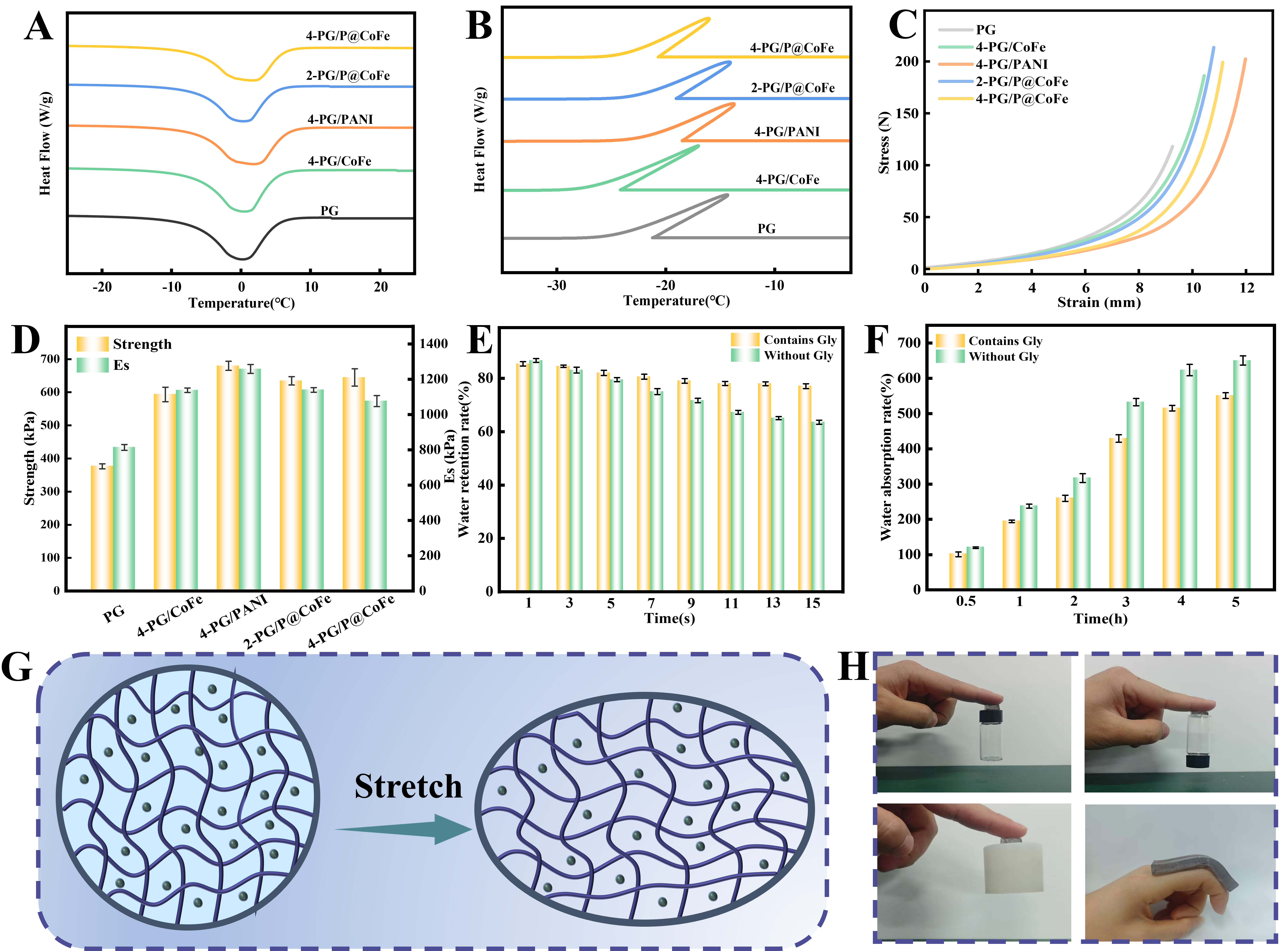
Figure 4. Physical properties of the hydrogels. (A and B) Crystallization and crystallization curves of the hydrogel; (C) Compression curve of hydrogel; (D) Compression strength and compression modulus of the hydrogel; (E and F) Effect of Gly on the water retention and water absorption rates of the hydrogel; (G) Schematic of the semi-interpenetrating network changes of the hydrogel during stretching; (H) Images of the hydrogel’s adhesion to different objects. Data are presented as mean ± SD (n = 3); error bars represent standard deviation. All photos in the figure were taken by the author during the experiment. PG: Polyacrylamide/glycerol; SD: standard deviation; PANI: polyaniline
Electromagnetic shielding performance of the hydrogel
In general, EMI shielding originates from reflection, absorption, and multiple internal reflections, which are associated with the responses of mobile charge carriers, electric dipoles, and internal interfaces/surfaces[55,56]. Moreover, the porous structure not only reduces the density of the material but also provides a large surface area and abundant accessible active sites. These active sites facilitate the scattering or multiple reflections of electromagnetic waves (EMWs), thereby promoting energy dissipation[57,58]. Meanwhile, the three-dimensional network structure increases the probability that the incident electromagnetic waves undergo multiple reflections and attenuation. As shown in Figure 5A-D, the hydrogels exhibit efficient and stable EMI shielding performance in the X-band, with the EMI shielding effectiveness increasing as the frequency rises. This variation can be attributed to several factors. (1) Enhanced dipole absorption: Water molecules possess a large permanent dipole moment, and under an alternating electromagnetic field, they undergo continuous orientational polarization. This process leads to stronger attenuation of interfering electromagnetic waves within the hydrogel, thereby dissipating the electromagnetic energy in the form of heat[57]. (2) Increased polarization relaxation: At higher frequencies, the electromagnetic field oscillates more rapidly, causing more frequent polarization relaxation of electric dipoles, which in turn enhances conduction loss[59]. More intense reflection and scattering: The shorter wavelengths associated with high-frequency electromagnetic waves interact more readily with the electric dipoles of water molecules and are more effectively reflected and scattered within the porous structure of the hydrogel, thereby generating greater energy dissipation[60]. As can be seen from Supplementary Figure 3, the electromagnetic shielding performance of hydrogels filled with the composite material formed by PANI and CoFe2O4 is superior to that filled with the two components separately. The reason is that PANI coating can reduce the sedimentation of CoFe2O4 at the bottom of the hydrogel. Although water has a strong ability to dissipate electromagnetic waves, the pure PG hydrogel cannot achieve a satisfactory SE value due to the absence of conductive and magnetic components. This indicates the necessity of incorporating conductive and magnetic components into the PG hydrogel to achieve high electromagnetic shielding performance. As shown in Figure 5E, the electrical conductivity of the hydrogel changes significantly after the incorporation of the composite material. The electrical conductivity (0.55 ± 0.01, n = 3) and compressive performance (50.27 ± 2.51, n = 3) of 4-PG/P@CoFe hydrogel were significantly higher than those of PG hydrogel (0.0648 ± 0.00389 and 17.51 ± 1.05, n = 3, unpaired t-test, P < 0.0001, conformed to a normal distribution). Although the PG/PANI hydrogel exhibits higher electrical conductivity than the 2-PG/P@CoFe hydrogel, its shielding performance relies primarily on free-electron reflection. Due to the absence of dielectric polarization, interfacial polarization, and magnetic loss-related absorption mechanisms, its overall shielding effectiveness remains limited[61]. In contrast, the 4-PG/P@CoFe hydrogel exhibits a moderately reduced conductivity while significantly enhancing impedance matching, dielectric loss, magnetic loss, and multiple scattering. This results in an absorption-dominated shielding mechanism, leading to electromagnetic shielding performance far superior to that of the 4-PG/PANI hydrogel. The present results suggest that simply increasing conductivity does not necessarily improve EMI shielding performance. A possible reason is that excessively high conductivity may deteriorate impedance matching, thereby increasing surface reflection[62]. As shown in Figure 5F, by analyzing the R, A and T coefficients, we can gain additional understanding of the shielding mechanism. It can be observed that the 4-PG/PANI hydrogel exhibits slightly higher R values than the other samples due to its relatively strong dielectric properties, which lead to increased impedance mismatch. More importantly, the T values of all hydrogels are close to zero, indicating their high efficiency in resisting electromagnetic interference[63,64]. Meanwhile, the A values are consistently higher than the R values, indicating that absorption is the dominant EMI shielding mechanism[65]. The schematic illustration of the electromagnetic shielding mechanism [Figure 5G] further demonstrates the EMI shielding process of the hydrogel. Table 1 Comparison of the electromagnetic shielding performance of this work with other multifunctional hydrogels[5,11,27,66-72].
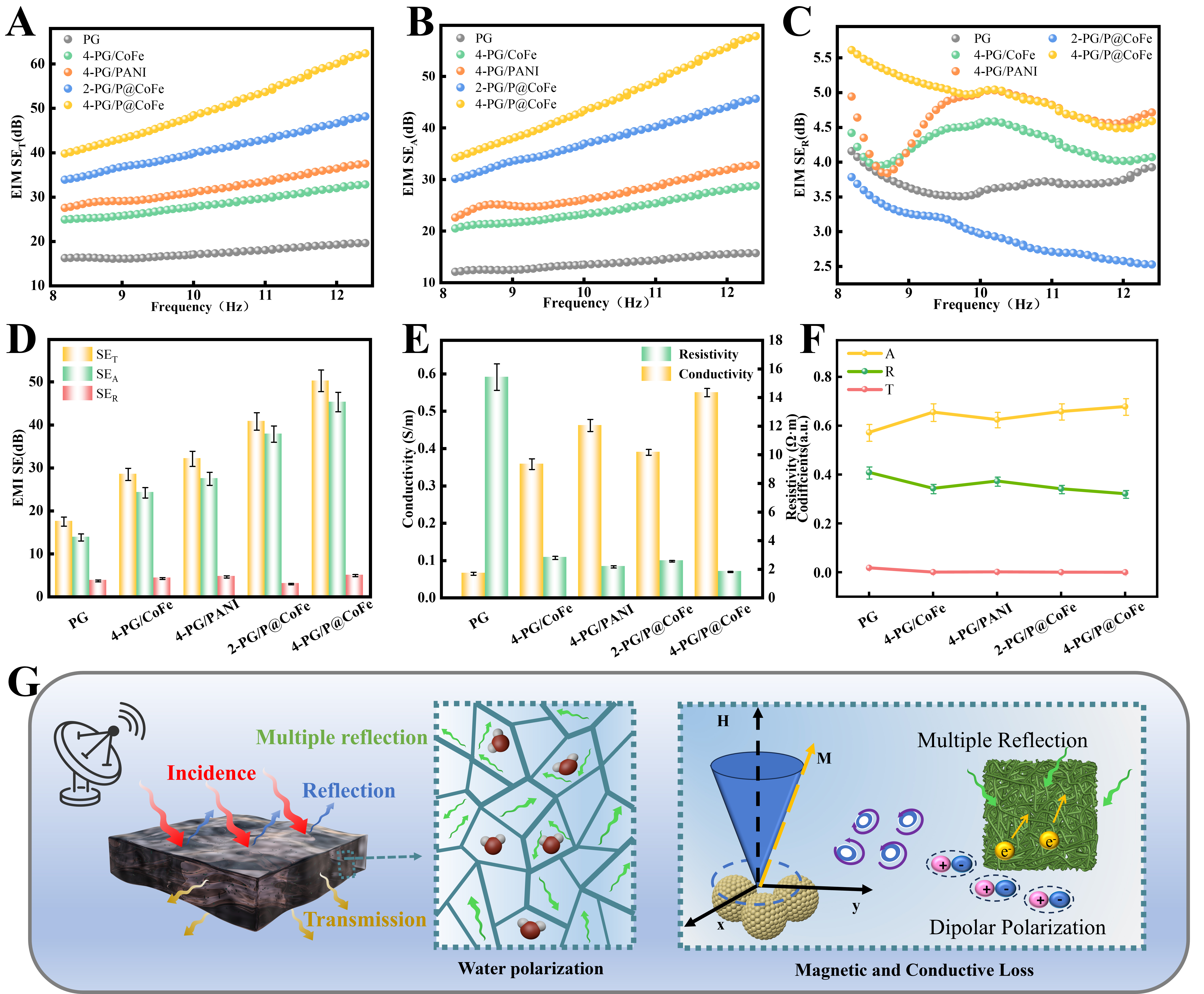
Figure 5. Electromagnetic shielding performance of the hydrogels. (A-C) Clearly illustrate the influence of frequency on the SET, SER, and SEA of the hydrogels; (D) Average SET, SER, and SEA values of hydrogels; (E) Electrical conductivity of the hydrogels; (F) T-R-A coefficients of the hydrogels; (G) Electromagnetic shielding mechanism of the hydrogels. Data are presented as mean ± SD (n = 3); error bars represent standard deviation. PG: Polyacrylamide/glycerol; SET: total shielding effectiveness; SER: reflection shielding effectiveness; SEA: absorption shielding effectiveness; SD: standard deviation.
Comparison of the EMI shielding performance of representative hydrogels
| Sample | Thick (mm) | EMI SE | References |
| MXene/CoFe2O4 hydrogel | 5 mm | 54.21 dB | [5] |
| MXene@COF hydrogel | 3 mm | 32.01 | [11] |
| Fe3O4@RGO/PAM hydrogel | 3 mm | 27.10 dB | [27] |
| MXene Organohydrogel | 4 mm | 32.8 dB | [66] |
| MXene/gelatin hydrogel | 3-5 mm | 35–50 dB | [67] |
| MXene /PAM-CMC hydrogel | 5 mm | 46.3 dB | [68] |
| PVA-ANF/MXene@Ga hydrogel | / | 35.7 dB | [69] |
| PVA/PAA@PEGDMA/ PEDOT:PSS hydroge | 4 mm | 40.61 dB | [70] |
| MXene/PEDOT:PSS hydrogels | 4.5 mm | 41 dB | [71] |
| ANE hydrogel | 4 mm | 31.5 dB | [72] |
| 4-PG/P@CoFe Organohydroge | 4 mm | 50.27 dB | This Work |
Infrared stealth performance of the hydrogel
To meet the demands of more complex environments, we further evaluated the infrared stealth performance of the hydrogels. Hydrogels containing different fillers were placed on an 80 °C heating plate for 20 min, and their surface temperatures were recorded at various time intervals using an infrared thermal imaging camera. As shown in Figure 6A, the surface temperature of the hydrogel gradually increases with time. After 15 min, the equilibrium radiation temperature of the PG hydrogel stabilizes at approximately 45 °C, which is about 35 °C lower than the heating plate. This indicates that hydrogel exhibits a noticeable thermal-insulation effect. This phenomenon may be attributed to the following factors. (1) The presence of glycerol in the hydrogel slows down the evaporation rate of water and promotes the formation of a dense and stable hydrogen-bonding network within the three-dimensional gel matrix. This significantly hinders heat transfer during conduction, thereby imparting the material with a low thermal conductivity[65,73]. (2) The three-dimensional microscopic network structure of the hydrogel suppresses convective heat transfer between the material and the surrounding air[73]. It is the synergistic effect of these factors that effectively suppresses heat conduction and convection, thereby slowing the temperature rise and enabling excellent infrared stealth performance. However, it is noteworthy that after the incorporation of fillers [Figure 6B-E], the heating rate of the hydrogels increases, and the surface reaches its equilibrium radiation temperature within approximately 10 min. This is because of the contact or close packing between fillers form thermal bridges, creating continuous heat-transfer pathways that allow heat to penetrate the material more easily. However, because the heat-source intensity and surface heat-dissipation conditions remain unchanged, the system ultimately reaches thermal equilibrium at the same heat-flux balance point. As a result, the equilibrium radiation temperature shows only minor variation.
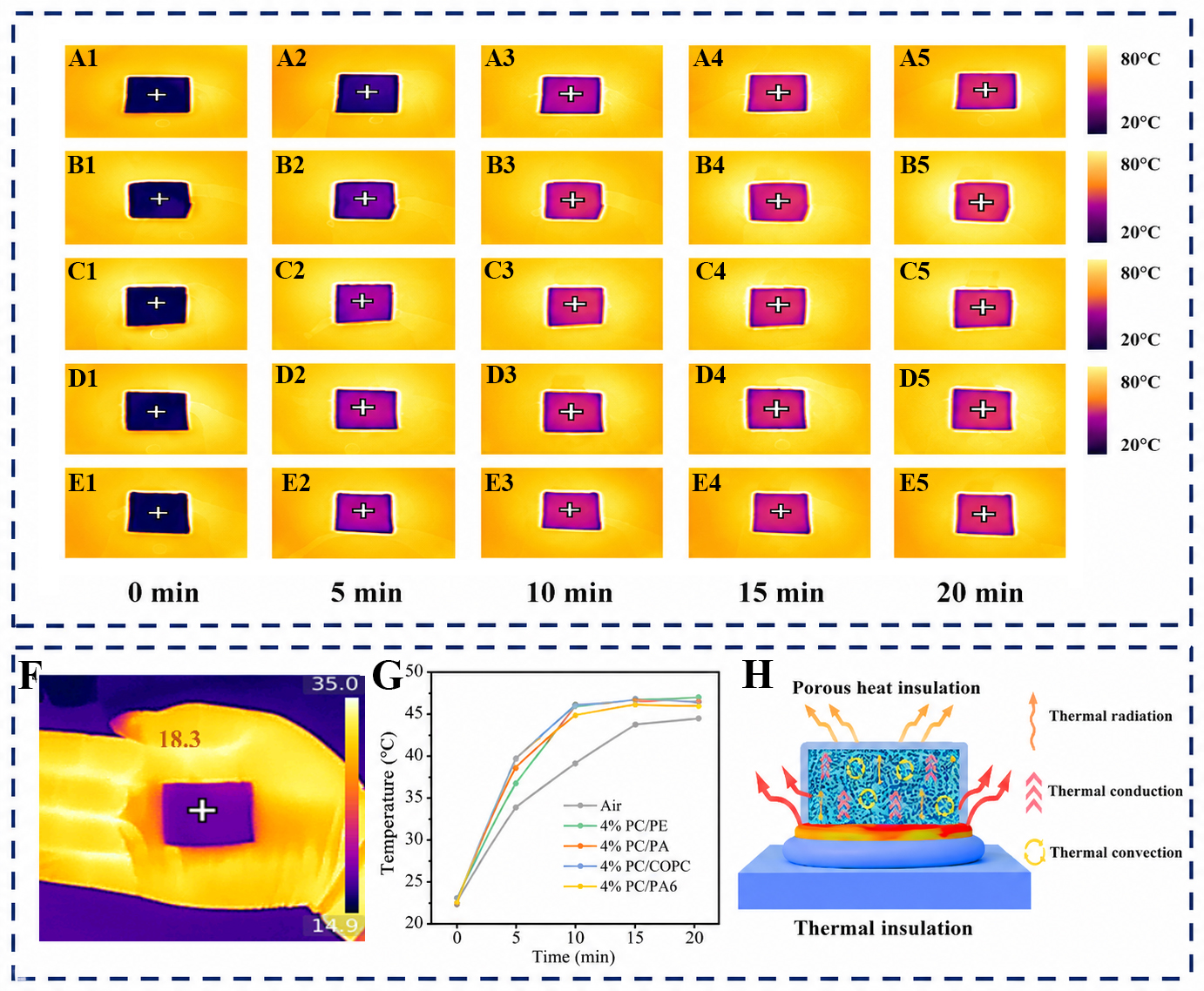
Figure 6. Evaluation of the samples’ infrared stealth capabilities. (A-E) Infrared thermal images of the hydrogel samples placed on a heating plate maintained at 80 °C. (F) Infrared thermal image of the 4-PG/P@CoFe hydrogel; (G) Temperature-time curves of the sample surfaces; (H) Thermal insulation mechanism of hydrogel. PG: Polyacrylamide/glycerol.
To better simulate the practical application scenario, the hydrogel was applied to the palm. As shown in Figure 6F, the infrared signal of the bare palm exhibited a distinct color contrast relative to the surrounding background. In contrast, the region covered by the hydrogel blended well with the environment and displayed a thermal signature similar to that of the surroundings, demonstrating the excellent infrared stealth capability of the hydrogel. Figure 6G and H respectively show the change in hydrogel surface temperature over time and the infrared stealth mechanism.
Sensing performance of the hydrogel
As shown in Supplementary Figure 4, the gauge factor (GF) of 4-PG/P@CoFe exhibits a value of 2.88 over a 0%-100% strain range, demonstrating excellent linearity (R2 = 0.997). This linear response is attributed to the PANI@CoFe2O4 nanoparticles, which, as conductive materials embedded within the organohydrogen network, effectively maintain the continuity of the conductive pathways under applied strain. The 4-PG/P@CoFe hydrogel, with its excellent mechanical properties, electrical conductivity, and adhesion, is highly suitable for real-time sensing and monitoring of human motion and health conditions. As shown in Figure 7, the 4-PG/P@CoFe hydrogel exhibits good linearity and sensitivity, enabling real-time detection of various strains and resistance signals generated under different motion states. It can capture subtle facial expressions in other areas, such as frowning [Figure 7A] and changes in mouth shape [Figure 7B]. When fixed on the throat [Figure 7C], the vibrations of the Adam’s apple can be detected as we shout the words ‘Bing Dun Dun’, resulting in a clear and regular waveform output. Due to the Poisson effect of the hydrogel, different bending amplitudes generate distinct and regular electrical signals, as varying degrees of stretching induce different levels of network contraction and resistance change[74]. The signal intensity correlates with the magnitude of movement, enabling precise motion detection. Furthermore, the hydrogel was used to track joint motion. Figure 7D-F shows the electrical signals obtained from finger, wrist, elbow, and knee bending at various angles. These results further confirm the rapid response capability and signal stability of the 4-PG/P@CoFe hydrogel sensor under dynamic, real-time monitoring conditions. The outstanding sensing performance of the 4-PG/P@CoFe hydrogel provides a solid functional foundation for its potential applications in human motion monitoring, health management, and gesture recognition.
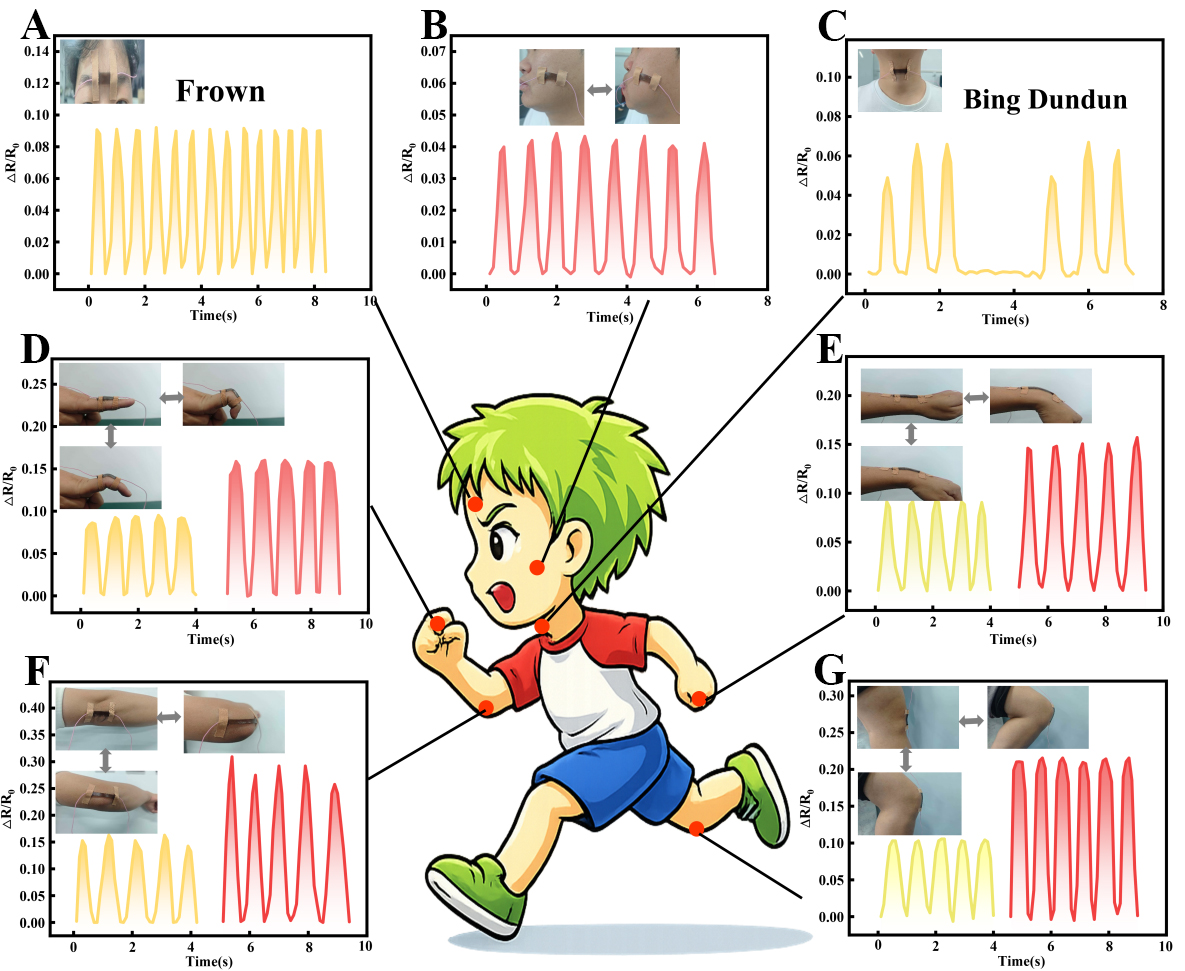
Figure 7. Real-time human-motion and physiological-signal monitoring using the 4-PG/P@CoFe hydrogel sensor. (A)Frowning; (B) Cheek puffing; (C) Throat vocalization; (D) Finger bending at different angles; (E) Wrist bending at different angles; (F) Elbow flexion at different angles; (G) Knee bending at different angles. All photos in the figure were taken by the author during the experiment. PG: Polyacrylamide/glycerol.
CONCLUSION
In summary, a multifunctional PG/P@CoFe organohydrogel was successfully fabricated by integrating conductive-magnetic PANI@CoFe2O4 nanoparticles into a PAM/Gly hydrogel network through a hydrothermal-assisted one-pot strategy. The obtained hydrogel exhibited excellent compressive properties and enhanced water-retention capability due to the incorporation of glycerol. Electromagnetic measurements revealed that, at a PANI@CoFe2O4 filler content of 4 wt.%, the 4 mm-thick hydrogels achieved an electrical conductivity of 0.55 ± 0.01 S/m and an average EMI shielding effectiveness of 50.27 ± 2.51 dB in the X-band. In addition, the hydrogel demonstrated excellent thermal insulation performance, together with favorable adhesion and rapid strain-responsive behavior for human-motion monitoring. This work provides an effective strategy for the development of integrated flexible materials combining strain sensing, electromagnetic shielding, and thermal management. With its multifunctionality and outstanding electromagnetic shielding performance, the hydrogel holds significant potential for applications in wearable electronic devices.
DECLARATIONS
Authors’ contributions
Validation: Lei, Z.
Writing - original draft: Lei, Z.; Lu, M.
Writing - review & editing: Lei, Z.; Zhang, D.; Wang, J.; Dong, W.
Data curation: Lu, M.; Liu, D.; Hu, Y.; Song, A.
Funding acquisition: Zhang, D.; Wang, J.; Dong, W.
Availability of data and materials
The data are available from the corresponding authors upon reasonable request.
AI and AI-assisted tools statement
The image of the running boy in Figure 7 was generated with the assistance of an AI-based tool and was further revised and optimized by the authors.
Financial support and sponsorship
This study was financially supported by the National Natural Science Foundation of China Project (52163001), Guizhou Provincial Science and Technology Plan Project (Qiankehe Platform Talent-GCC[2022]010-2, Qiankehe Zhongyindi [2024]042, Qiankehe Jichu-ZK[2024]YB488, Qiankehe Zhongyindi (2025)013, Qiankehe Results [2025]109,Qiankehe Talent XKBF(2025)005), Guizhou Provincial Scientist Workstation (Qiankehe Platform KXJZ[2024]022), Guizhou Provincial Department of Education ‘Hundred Universities, Thousand Enterprises Science and Technology Challenge Project’ (Qian Jiao Ji [2025] No. 007), Doctor Startup Fund of Guizhou Minzu University (Grant No.GZMUZK[2024]QD77).
Conflicts of interest
All authors declared that there are no conflicts of interest.
Ethical approval and consent to participate
This study only conducted non-invasive data collection through simply placing the device on the skin, and does not involve invasive procedures or human health risks. According to Article 32 of the “Measures for the Ethical Review of Life Science and Medical Research Involving Human Subjects (Trial)”, this study meets the conditions for exemption from review. All participants participated in the experiment with informed consent.
Consent for publication
Not applicable.
Copyright
© The Author(s) 2026.
Supplementary Materials
REFERENCES
1. He, M.; Zhong, X.; Lu, X.; et al. Excellent low-frequency microwave absorption and high thermal conductivity in polydimethylsiloxane composites endowed by hydrangea-like CoNi@BN heterostructure fillers. Adv. Mater. 2024, 36, 2410186.
2. Hao, Y.; Liu, C.; Keram, R.; Song, H.; Zhang, Y.; Ji, G. Machine-learning assisted novel insulation layer stripping technology for upgrading the transparent EMI shielding materials. Nano. Today. 2025, 61, 102660.
3. Panahi‐Sarmad, M.; Samsami, S.; Ghaffarkhah, A.; et al. MOF‐based electromagnetic shields multiscale design: nanoscale chemistry, microscale assembly, and macroscale manufacturing (Adv. Funct. Mater. 43/2024). Adv. Funct. Mater. 2024, 34, 2470254.
4. Li, Y.; Han, X.; Zhu, J.; Feng, Y.; Liu, P.; Chen, X. MOF‐derived Co/C‐anchored MoS2‐based phase change materials toward thermal management and microwave absorption. Electron 2024, 2, e56.
5. Wang, L.; Jiang, Y.; Liu, Y.; et al. Multifunctional hydrogels based on MXene/CoFe2O4 synergistically assisted rapid gelation for electromagnetic shielding, infrared stealth and wearable sensors. Chem. Eng. J. 2025, 521, 167172.
6. Xie, X.; Lu, M.; Li, G.; et al. Anti-impact electromagnetic shielding hydrogel with solvent-driven tunability. Chem. Eng. J. 2025, 505, 159114.
7. Feng, Y.; Qin, M.; Qin, J.; et al. Synergistic thermal management and electromagnetic wave absorption in core-sheath phase change composites. Adv. Funct. Mater. 2025, 36, e23075.
8. Liu, Q.; Wang, P.; Zhang, W.; et al. Multifunctional wood-derived cellulose/Ti3C2Tx composite films enhanced by densification strategy for electromagnetic shielding, Joule/solar heating, and thermal camouflage. Chem. Eng. J. 2024, 493, 152696.
9. Zhou, T.; Zhang, D.; Diao, K.; et al. Constructing PAM/PEG electromagnetic shielding hydrogels based on MWCNTs@TiO2. Mater. Today. Nano. 2025, 29, 100606.
10. Chen, Y.; Guo, W.; Chen, N.; et al. Skin-inspired MXene-based polyvinyl alcohol/gelatin organic hydrogel with good anti-drying, anti-swelling properties and high sensitivity. Sensor. Actuat. A-Phys. 2025, 383, 116231.
11. Diao, K. L.; Zhang, D. H.; Du, J. J.; Zhou, T.; Liu, D. J.; Qin, S. H. Electromagnetic shielding and thermal insulation hydrogels were constructed based on covalent organic skeleton COF and Ti3C2Tx MXene. Rare. Metals. 2025, 44, 7738-50.
12. Xu, Y.; Zhan, X.; Du, J.; Wu, Z.; Zhang, D. Fluorescent hydrogel with high toughness response based on lanthanide metals: material adhesion, multicolor modulation, information encryption. Chem. Eng. J. 2024, 489, 151303.
13. Ma, N.; Chen, Y.; Wang, L.; et al. Ag/AgCl@agar/P(AM-co-HEAA) hydrogel with ultra-stretchability, fatigue resistance, and freezing tolerance for human motion and electrophysiological signal monitoring. Int. J. Biol. Macromol. 2025, 331, 148239.
14. He, T.; Liu, C.; Chen, Z.; et al. Multi-layer alternating structured alginate hydrogels featuring exceptional flexibility and electromagnetic shielding performance. J. Colloid. Interface. Sci. 2025, 699, 138103.
15. Arunprasath, K.; Senthamaraikannan, P.; Suyambulingam, I.; et al. Comprehensive review of advances in natural fiber composites for conductive and EMI shielding applications: Materials, mechanisms, and future prospects. Int. J. Biol. Macromol. 2025, 320, 145892.
16. Chi, J.; Gu, S.; Shi, R.; et al. Extending PANI molecular chains into pores of hierarchical MIL-101 as flexible electrodes for supercapacitor applications. Chem. Eng. J. 2025, 510, 161764.
17. Cao, G.; Wu, A.; Wang, Z.; Zhong, S.; Cao, Z.; Zhang, H. Enhancing the conductivity and dispersion properties of polyaniline using ethyl orange. Colloid. Surface. A. 2025, 704, 135489.
18. Kandpal, R., Shahadat, M., Adnan, R., Ali, S. W., Ahammad, S. Z. Polyaniline-based flexible nanocomposite materials. In Biorenewable Nanocomposite Materials, Vol. 1: Electrocatalysts and Energy Storage; Pathania, D., Singh, L., Eds.; ACS Symposium Series, Vol. 1410; American Chemical Society, 2022; pp 367-95.
19. Zhao, L.; Tang, N.; Wang, X.; Li, M.; Hu, J. Conductive polyaniline hydrogel featuring high toughness and low hysteresis. Chin. J. Polym. Sci. 2025, 43, 581-7.
20. Mahdy, M. A.; Azab, A. A.; El Zawawi, I. K.; Turky, G. Tailoring ZnO/CoFe2O4 nanocomposites: structure, optical, dielectric and magnetic study. Phys. Scr. 2022, 98, 015806.
21. Gholipur, R. Preparation and electromagnetic waves absorption performance of novel peanut shell/CoFe2O4/(RGO)x/PVA nanocomposites. Sci. Rep. 2024, 14, 30699.
22. Abraime, B.; El Maalam, K.; Fkhar, L.; et al. Influence of synthesis methods with low annealing temperature on the structural and magnetic properties of CoFe2O4 nanopowders for permanent magnet application. J. Magn. Magn. Mater. 2020, 500, 166416.
23. Asandulesa, M.; Hamciuc, C.; Pui, A.; et al. Cobalt ferrite/polyetherimide composites as thermally stable materials for electromagnetic interference shielding uses. Int. J. Mol. Sci. 2023, 24, 999.
24. Bastianello, M.; Gross, S.; Elm, M. T. Thermal stability, electrochemical and structural characterization of hydrothermally synthesised cobalt ferrite (CoFe2O4). RSC. Adv. 2019, 9, 33282-9.
25. Saleem, S.; Irfan, M.; Naz, M. Y.; et al. Investigating the impact of Cu2+ doping on the morphological, structural, optical, and electrical properties of CoFe2O4 nanoparticles for use in electrical devices. Materials 2022, 15, 3502.
26. Afzia, M.; Khan, R. A.; Ismail, B.; et al. Correlation between magnetic and dielectric response of CoFe2O4:Li1+/Zn2+ nanopowders having improved structural and morphological properties. Molecules 2023, 28, 2824.
27. Zhou, T.; Zhan, X.; Diao, K.; et al. RGO loaded Fe3O4 strategy to construct high toughness PAM hydrogel for electromagnetic shielding. Prog. Org. Coat. 2024, 196, 108750.
28. Su, J.; Dong, X.; Zhao, H.; et al. Dual-loss mechanisms in low-filler CoFe@CoFe2O4/biomass carbon composites for enhanced microwave absorption. Colloid. Surface. A. 2025, 726, 137953.
29. Gao, Y.; Chen, X.; Jin, X.; et al. Multifunction integration within magnetic CNT-bridged MXene/CoNi based phase change materials. eScience 2024, 4, 100292.
30. Wang, J.; Wu, W.; Zhang, W.; et al. Synthesis, electrical conductivity, and wave-absorption performances of bamboo-based composites co-doped with graphene oxide and polyaniline. Polymers 2024, 17, 78.
31. Zhao, M.; Ran, S.; Guo, X.; et al. Magnetic-dielectric synergy in Fe3O4/MoS2@polyaniline composites for high-efficiency electromagnetic wave absorption and corrosion resistance. J. Alloys. Compd. 2025, 1048, 185300.
32. Almeida, A. I. D. R.; Carvalho, L. D. O.; Lopes, R. C.; et al. Enhanced polyacrylamide polymer hydrogels using nanomaterials for water shutoff: morphology, thermal and rheological investigations at high temperatures and salinity. J. Mol. Liq. 2024, 405, 125041.
33. Son, D.; Hwang, H.; Fontenot, J. F.; Lee, C.; Jung, J. P.; Kim, M. Tailoring physical properties of dual-network acrylamide hydrogel composites by engineering molecular structures of the cross-linked network. ACS. Omega. 2022, 7, 30028-39.
34. Li, G.; Liu, Y.; Chen, Y.; et al. Robust, self‐adhesive, and low‐contact impedance polyvinyl alcohol/polyacrylamide dual‐network hydrogel semidry electrode for biopotential signal acquisition. SmartMat 2023, 5, e1173.
35. Liaskovska, M. Adsorption properties of magnetic CoFe2O4 based spinel nanoparticles. In Nanomaterials and Nanocomposites, Nanostructures, and Their Applications; Fesenko, O., Yatsenko, L., Eds.; Springer Proceedings in Physics, Vol. 253; Springer Nature Switzerland, 2024; pp 171-84.
36. Yun, T.; Kim, H.; Iqbal, A.; et al. Electromagnetic shielding of monolayer MXene assemblies. Adv. Mater. 2020, 32, 1906769.
37. Xia, Y.; Gao, W.; Gao, C. A review on graphene-based electromagnetic functional materials: electromagnetic wave shielding and absorption. Adv. Funct. Mater. 2022, 32, 2204591.
38. Adamiak, K.; Sionkowska, A. State of innovation in alginate-based materials. Marine. Drugs. 2023, 21, 353.
39. Wurm, F.; Rietzler, B.; Pham, T.; Bechtold, T. Multivalent ions as reactive crosslinkers for biopolymers - a review. Molecules 2020, 25, 1840.
40. Sharma, D.; Kaith, B. S.; Rajput, J. Single step in situ synthesis and optical properties of polyaniline/ZnO nanocomposites. Sci. World. J. 2014, 2014, 1-13.
41. Butoi, B.; Groza, A.; Dinca, P.; Balan, A.; Barna, V. Morphological and structural analysis of polyaniline and poly(o-anisidine) layers generated in a DC glow discharge plasma by using an oblique angle electrode deposition configuration. Polymers 2017, 9, 732.
42. Zawrah, M.; El-Okr, M.; Ashery, A.; Abou Hammad, A. Characterization of sol-gel fabricated cobalt ferrite CoFe2O4 nanoparticles,. Middle. East. J. Appl. Sci. 2016, 6, 362-6. Available from: https://www.curresweb.com/mejas/mejas/2016/362-366.pdf.
43. To Loan, N. T.; Hien Lan, N. T.; Thuy Hang, N. T.; et al. CoFe2O4 nanomaterials: effect of annealing temperature on characterization, magnetic, photocatalytic, and photo-Fenton properties. Processes 2019, 7, 885.
44. Jamil, M.; Ahmad, J.; Bukhari, S.; et al. Effect on structural and optical properties of Zn-substituted cobalt ferrite CoFe2O4,. J. Ovonic. Res. 2017, 13, 45-53. Available from: https://chalcogen.ro/45_JamilMT.pdf.
45. Kumar, S.; Ahmed, F.; Shaalan, N. M.; et al. Structural, magnetic, and electrical properties of CoFe2O4 nanostructures synthesized using microwave-assisted hydrothermal method. Materials 2022, 15, 7955.
46. Peng, R.; Luo, Y.; Cui, Q.; Zhang, H.; Li, L. Covalent organic frameworks as efficient photoinitiators and cross-linkers to fabricate highly stretchable hydrogels. ACS. Appl. Mater. Interfaces. 2022, 14, 49254-63.
47. Sivaselvam, S.; Selvakumar, R.; Viswanathan, C.; Ponpandian, N. Rapid one-pot synthesis of PAM-GO-Ag nanocomposite hydrogel by gamma-ray irradiation for remediation of environment pollutants and pathogen inactivation. Chemosphere 2021, 275, 130061.
48. Liu, Q.; Kang, X.; Xing, L.; Ye, Z.; Yang, Y. A facile synthesis of nanostructured CoFe2O4 for the electrochemical sensing of bisphenol A. RSC. Adv. 2020, 10, 6156-62.
49. Jiang, H.; Feng, Z.; Liu, K.; Wang, H.; Lin, J. Constructing interconnected CoFe2O4/CoFe alloyed nanosheets for efficient oxygen evolution reaction. SSRN 2025.
50. Qu, Q.; Chen, Z.; Sun, G.; Qiu, L.; Zhu, M. CoFe2O4 nanoparticles as a bifunctional agent on activated porous carbon for battery-type asymmetrical supercapacitor. Chem. Synth. 2024, 4, 26.
51. Rehman, W.; Saeed, F.; Zhao, Y.; et al. Boosted photoelectrochemical water oxidation performance with a quaternary heterostructure: CoFe2O4/MWCNT-Doped MIL-100(Fe)/TiO2. Catalysts 2024, 14, 901.
52. Smolin, Y. Y.; Soroush, M.; Lau, K. K. S. Oxidative chemical vapor deposition of polyaniline thin films. Beilstein. J. Nanotechnol. 2017, 8, 1266-76.
53. Yang, J.; Yu, X.; Sun, X.; et al. Polyaniline-decorated supramolecular hydrogel with tough, fatigue-resistant, and self-healable performances for all-in-one flexible supercapacitors. ACS. Appl. Mater. Interfaces. 2020, 12, 9736-45.
54. Dellatolas, I.; Bantawa, M.; Damerau, B.; et al. Local mechanism governs global reinforcement of nanofiller-hydrogel composites. ACS. Nano. 2023, 17, 20939-48.
55. Zhou, H.; Cao, W.; Sun, N.; Jiang, L.; Liu, Y.; Pang, H. Formation mechanism and properties of NiCoFeLDH@ZIF-67 composites. Chin. Chem. Lett. 2021, 32, 3123-7.
56. Liu, C.; Zhu, L.; Zheng, S.; et al. A novel elastic dome array structure for precise pressure regulation toward tunable microwave absorption. Acta. Mater. 2025, 296, 121255.
57. Zeng, Z.; Jin, H.; Chen, M.; Li, W.; Zhou, L.; Zhang, Z. Lightweight and anisotropic porous MWCNT/WPU composites for ultrahigh performance electromagnetic interference shielding. Adv. Funct. Mater. 2015, 26, 303-10.
58. Feng, Y.; Hai, G.; Sun, G.; et al. Dual-functional phase change composites integrating thermal buffering and electromagnetic wave absorption via multi-interfacial engineering. Adv. Fiber. Mater. 2025, 7, 1873-87.
59. Song, W.; Ness, S.; Desai, M.; Yi, J. Visible light optical coherence tomography angiography (vis-OCTA) in human retina for small vessel blood oxygenation (Conference Presentation). In Ophthalmic Technologies XXX, San Francisco, United States, February 1-6, 2020; Manns, F., Söderberg, P. G., Ho, A., Eds.; SPIE, 2020, pp 9.
60. Ouyang, W.; Mei, L.; Liu, Q.; et al. Ultrathin-flexible multifunctional MXene composite hydrogels with good mechanical properties-high strain sensitivity and ultra-broadband EMI shielding performances. Chem. Eng. J. 2024, 494, 153068.
61. Saeedi, F.; Ansari, R.; Sahmani, S. Recent advances and comprehensive review of electromagnetic interference shielding materials and technologies. Mater. Today. Phys. 2025, 59, 101917.
62. Xiong, C.; Xiong, Q.; Zhao, M.; Wang, B.; Dai, L.; Ni, Y. Recent advances in non-biomass and biomass-based electromagnetic shielding materials. Adv. Compos. Hybrid. Mater. 2023, 6, 205.
63. Zeng, Z.; Wang, C.; Siqueira, G.; et al. Nanocellulose‐MXene biomimetic aerogels with orientation-tunable electromagnetic interference shielding performance. Adv. Sci. 2020, 7, 2000979.
64. Zhang, Y.; Ruan, K.; Zhou, K.; Gu, J. Controlled distributed Ti3C2Tx hollow microspheres on thermally conductive polyimide composite films for excellent electromagnetic interference shielding. Adv. Mater. 2023, 35, 2211642.
65. Liu, H.; Yang, Y.; Tian, N.; You, C.; Yang, Y. Foam-structured carbon materials and composites for electromagnetic interference shielding: design principles and structural evolution. Carbon 2024, 217, 118608.
66. Yu, Y.; Yi, P.; Xu, W.; et al. Environmentally tough and stretchable MXene organohydrogel with exceptionally enhanced electromagnetic interference shielding performances. Nano-Micro. Lett. 2022, 14, 77.
67. Zhou, X.; Ye, X.; Zhu, J.; Wang, G. Anti-drying, anti-freezing and super-elastic MXene/gelatin hydrogels for electromagnetic shielding and pressure sensing. Mater. Today. Phys. 2025, 53, 101709.
68. Li, Y.; Xuan, X.; Pan, Z.; et al. A robust and multifunctional conductive double-network hydrogel exhibiting self-healing, anti-freezing, antibacterial, and electromagnetic shielding properties for advanced wearable sensors and biofabrication. Chem. Eng. J. 2025, 522, 167264.
69. Shen, M.; Liang, C.; Xu, X.; et al. Liquid metal-enhanced PVA-ANF/MXene hydrogels for electromagnetic shielding and sensing. ACS. Appl. Nano. Mater. 2024, 7, 22158-68.
70. Zhang, Z.; Liu, G.; Wu, J.; Jiang, X.; Liu, H.; Li, Z. High-strength dual-network hydrogels with chain-growth enhancement for multifunctional flexible sensors, triboelectric nanogenerators, and EMI shielding. Chem. Eng. J. 2025, 519, 165710.
71. Li, P.; Wang, H.; Ju, Z.; et al. Ti3C2Tx MXene- and sulfuric acid-treated double-network hydrogel with ultralow conductive filler content for stretchable electromagnetic interference shielding. ACS. Nano. 2024, 18, 2906-16.
72. Hao, J.; Hu, S.; Liu, D.; et al. 3D-printed multifunctional hydrogel for integrated electromagnetic interference shielding, infrared stealth, and wearable sensing. ACS. Appl. Mater. Interfaces. 2025, 17, 68525-38.
73. Li, Y.; Cheng, Q.; Deng, Z.; et al. Recent progress of anti-freezing, anti-drying, and anti-swelling conductive hydrogels and their applications. Polymers 2024, 16, 971.
Cite This Article
 Open Access
How to Cite
Download Citation
Export Citation File:
Type of Import
Tips on Downloading Citation
Citation Manager File Format
Type of Import
Direct Import: When the Direct Import option is selected (the default state), a dialogue box will give you the option to Save or Open the downloaded citation data. Choosing Open will either launch your citation manager or give you a choice of applications with which to use the metadata. The Save option saves the file locally for later use.
Indirect Import: When the Indirect Import option is selected, the metadata is displayed and may be copied and pasted as needed.
About This Article
Special Topic
Copyright

Data & Comments
Data
0











Comments
Comments must be written in English. Spam, offensive content, impersonation, and private information will not be permitted. If any comment is reported and identified as inappropriate content by OAE staff, the comment will be removed without notice. If you have any queries or need any help, please contact us at [email protected].