

Preparation and application prospects of polymer-based thermally conductive self-healing composites
 0
Graphical Abstract
Abstract
Miniaturization and high integration of 5G electronics, aerospace components, and intelligent devices have caused severe heat accumulation, shortening the service life and degrading the reliability of devices. Traditional thermally conductive materials are inflexible, whereas most neat polymers are poor thermal conductors. Cyclic stress-induced structural cracks disrupt thermal pathways and increase interfacial thermal resistance. Combining high thermal conductivity, flexibility, and self-healing capability, polymer-based thermally conductive self-healing composites have emerged as promising thermal-interface materials. This review systematically summarizes extrinsic self-healing systems (microcapsules and microvascular networks) and intrinsic self-healing materials that mend through dynamic covalent bonds, supramolecular non-covalent interactions, and dual-dynamic crosslinking networks. The self-healing mechanisms, preparation strategies, and thermal management performance of self-healing materials are thoroughly discussed. Key bottlenecks, including the trade-off between high filler loading and self-healing efficiency, harsh repair conditions, unstable recovery of thermal conductivity, and insufficient validation in practical applications, are also analyzed. The review concludes with proposals for future research, covering multi-scale interface regulation, theoretical simulations of phonon transport, large-scale fabrication, and the development of multifunctional composites for electronic thermal management.
Keywords


 Download PDF
INTRODUCTION
The rapid development of 5G communication, artificial intelligence, aerospace systems, and highly integrated electronic devices has increased the power density and heat accumulation within electronic components. Excessive and localized heating can accelerate material degradation and limit the lifetime, reliability, and safety of electronic devices[1]. Therefore, effective thermal management is essential for maintaining stable device operation. Thermally conductive materials, which facilitate heat dissipation by transferring heat from heat-generating components to external thermal management systems, are widely used in thermal-interface and heat-spreading applications[2,3]. Conventional thermal conductors such as metals and inorganic ceramics are disadvantaged by high density, limited flexibility, or poor processability[4]. In contrast, polymer-based thermally conductive materials offer low density, excellent processability, mechanical flexibility, and good interfacial conformability. However, owing to the intrinsically low thermal conductivity of polymers (typically around 0.2-0.5 W·m-1·K-1), these materials are unlikely to meet the increasing thermal management demands of highly integrated devices[5]. Accordingly, polymer-based composites incorporating thermally conductive fillers have emerged as lightweight and flexible thermal management materials.
Heat transfer in practical thermal management systems is often limited by both the intrinsic thermal conductivity of the material and the thermal resistance at solid–solid interfaces. Surface roughness and insufficient interfacial conformability can generate microscopic air gaps between a thermal interface material (TIM) and the heat source or heat sink, which reduce the effective contact area and increase the interfacial thermal resistance. An ideal TIM should combine high thermal conductivity with low interfacial resistance, mechanical flexibility, and sufficient conformability to accommodate surface irregularities and thermal deformation. However, repeated thermal–mechanical loading causes mechanical damage, creep, or thermal aging in polymer-based thermally conductive composites. Crack formation or interfacial debonding can disrupt continuous heat-transport pathways and increase interfacial thermal resistance, irreversibly degrading the thermal management performance.
Self-healing is a promising strategy for mitigating such damage and extending the service lifetime of thermally conductive composites. When reversible dynamic bonds or supramolecular interactions are incorporated into the polymer matrix, damaged interfaces can mend through molecular rearrangement and network reconstruction under appropriate conditions. Dynamic polymer networks combined with thermally conductive fillers can potentially restore both structural integrity and heat-transfer pathways after mechanical or thermal damage. Although increasing the filler loading improves the efficiency of thermal-conduction networks, it undesirably restricts the polymer-chain mobility and hinders self-healing. This trade-off between thermal conductivity and healing capability fundamentally challenges the design of polymer-based thermally conductive self-healing composites. Therefore, the development of reliable thermal-management materials requires a systematic understanding of self-healing mechanisms, filler-network structures, interfacial thermal transport, and their mutual interactions.
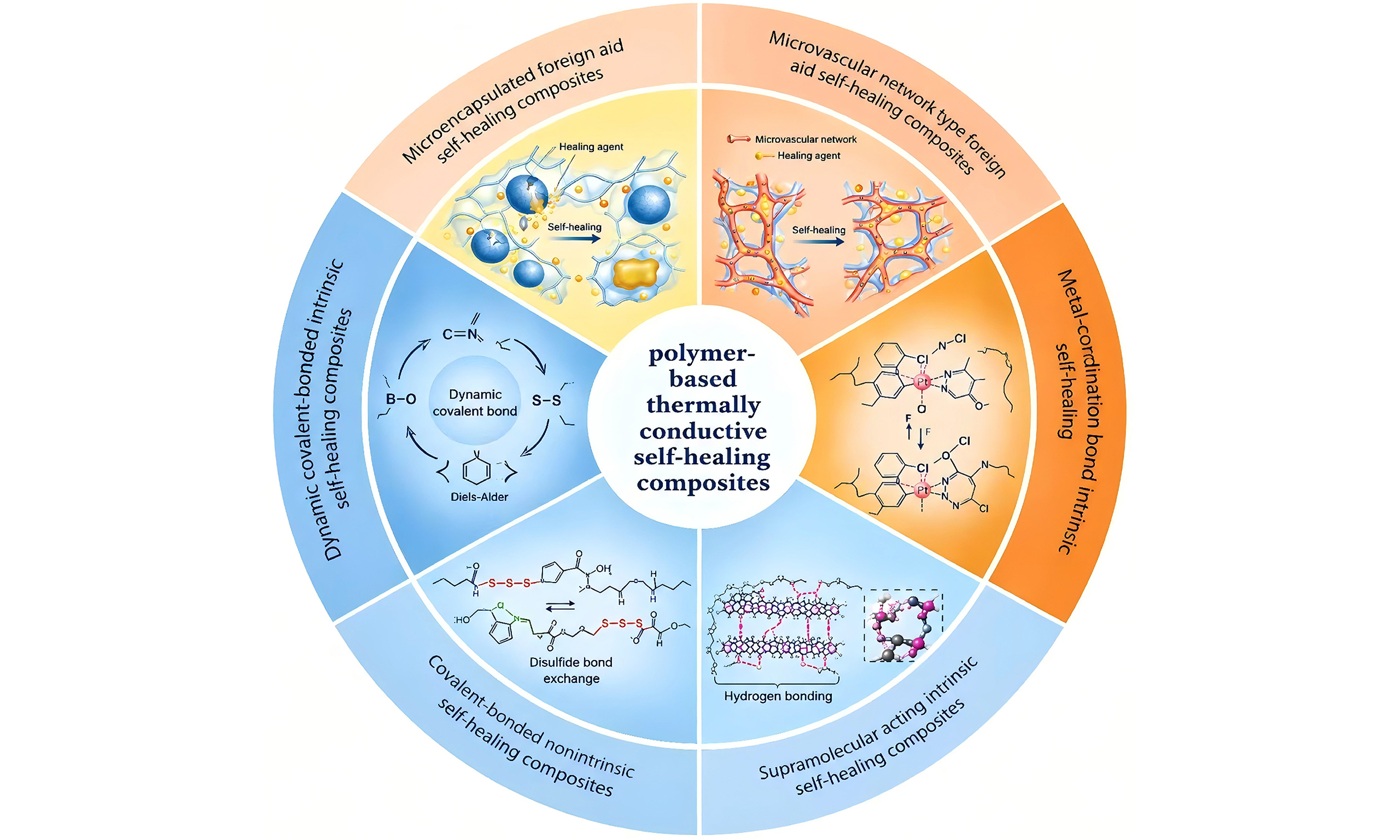
This review systematically overviews polymer-based thermally conductive self-healing composites, emphasizing their self-healing mechanisms, material design strategies, thermal transport characteristics, and application prospects. First, it introduces the fundamental mechanisms of polymer self-healing and the governing factors of healing efficiency. The discussion then moves to extrinsic self-healing systems based on microcapsules and microvascular networks, followed by intrinsic self-healing systems involving dynamic covalent bonds, supramolecular interactions, and dual-dynamic networks. Particular attention is given to the interplay between thermally conductive filler networks and polymer-chain mobility, and the evolution of thermal-transport pathways during damage and healing. Next, the review summarizes the major challenges limiting practical application, namely, the trade-off between filler loading and self-healing, the demanding healing conditions, incomplete recovery of thermal transport, and insufficient validation in realistic service environments. Finally, the review proposes future research directions to guide the development of high-performance, application-oriented self-healing thermal management materials.
POLYMER-BASED SELF-HEALING THERMALLY CONDUCTIVE COMPOSITE MATERIALS
Self-healing thermally conductive composite materials are a new type of thermally conductive material that can identify structural damage spontaneously or under external stimuli (such as water and heat) and restore its original properties[6]. In recent years, thermally conductive self-healing composites have emerged as a new concept in the field of thermal conductivity, achieving high thermal conductivity while also achieving structural and performance stability. Polymers are easy to modify, have good chain segment mobility, and strong interfacial compatibility. Therefore, polymer-based self-healing thermally conductive composite materials have become one of the most closely watched and rapidly developing research topics for thermally conductive materials. At the same time, depending on whether external repair agents are added to the polymer, self-healing thermally conductive composite materials can be further divided into externally aided self-healing thermally conductive materials and intrinsic self-healing thermally conductive materials[2,3]. The following discusses the mechanism, influencing factors, and classification of self-healing.
SELF-HEALING MECHANISMS AND INFLUENCING FACTORS
Regarding the understanding of self-healing theory, combined with chain segment diffusion theory, polymer self-repair can generally be divided into five stages: (i) surface rearrangement; (ii) surface proximity or contact; (iii) wetting process; (iv) diffusion process; and (v) segment randomization[7-9]. Self-healing involves the approach, wetting, interdiffusion, and rearrangement of polymer chains across the damaged interface. The peristaltic model of molecular diffusion and segment randomization at the interface is shown in Figure 1A.
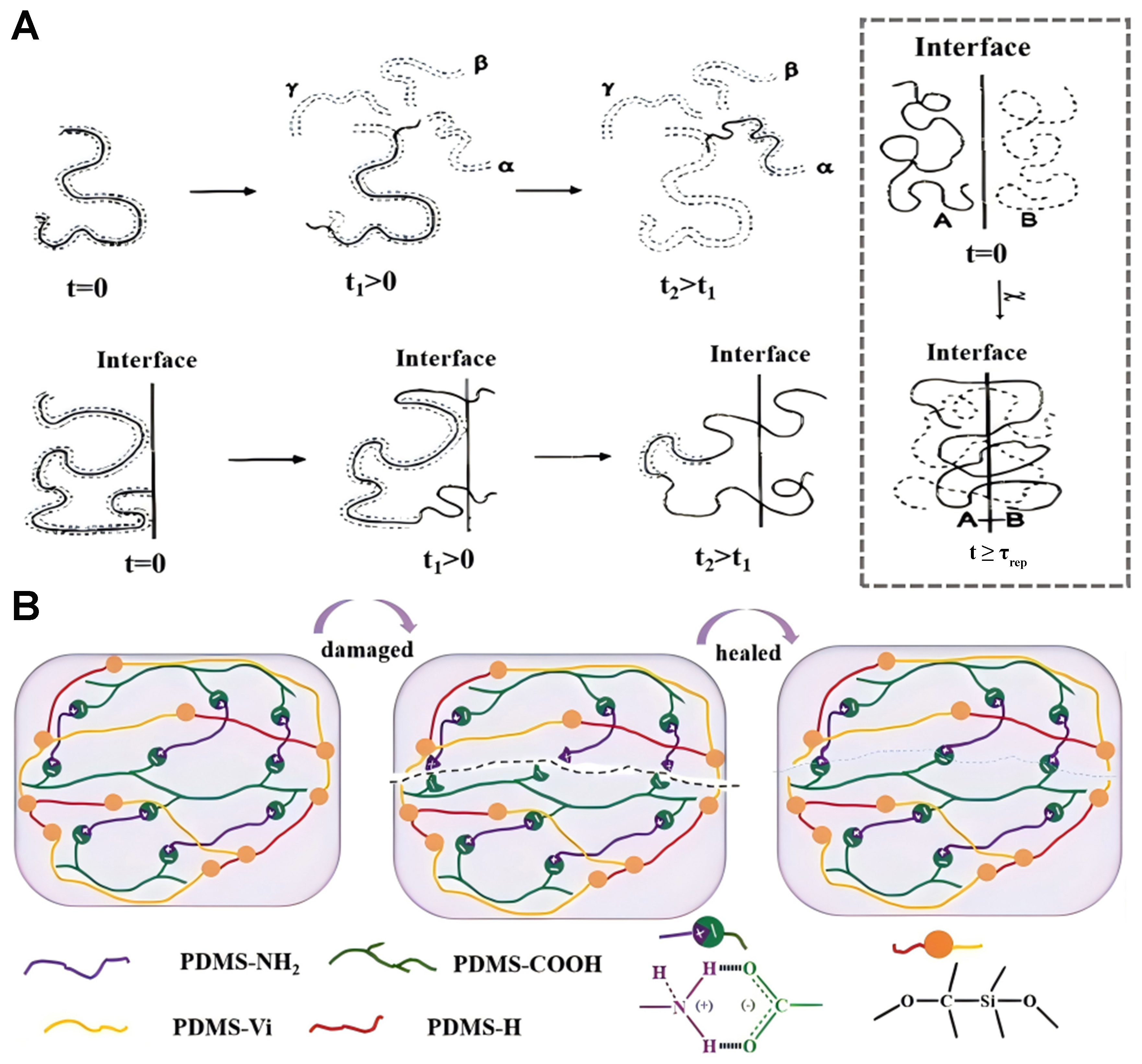
Figure 1. (A) Reptation model for molecular diffusion and randomization behavior across the interface during self-healing; (B) Schematic diagram of self-healing effect driven by dynamic reversibility of carboxyl-amine system. (B) is reprinted with permission from Ref.[9], Copyright © 2022 RSC. Licensed under CC BY-NC 3.0. PDMS: Polydimethylsiloxane.
Van der Zwaag proposed that damage localization, healing kinetics, and molecular mobility are essential for effective self-healing[10,11]. Damage localization refers to the surface or internal position of the damage and its extent. Such damage can be superficial (e.g., scratches, cracks, or cuts) or deep (e.g., surface damage propagation, fiber debonding or delamination, or damage to the thermal material network). Healing kinetics, describing the time required to complete the self-repair process, relies mainly on the diffusion time of the material’s internal repair agent or the recombination time required for broken chemical bonds. Reducing the repair time of transiently damaged material structures is a key research area. Molecular mobility refers to the ability of internal repair agents to diffuse within the matrix and the degree of movement of molecular chain segments in the intrinsic polymer. Higher molecular mobility facilitates chain diffusion and dynamic bond rearrangement, improving the efficiency of self-healing. On this basis, Utrera-Barrios et al. refined the mechanism of material self-healing and proposed that self-healing is mainly achieved through the presence of healing agents inside the material or dynamic reversible chemical interactions within molecular chain segments[12].
Figure 1B is a schematic diagram of the ideal damage-repair cycle evolution in polymer materials. Yang et al. believe that under external influence, molecular chains break or slip at the damaged site of the polymer network, forming reactive groups[7]. In an intrinsically self-healing material, reactive groups generated at the damaged interface can spontaneously react under suitable environmental conditions (ΔG = ΔH - TΔS < 0, where ΔG, H, T, and ΔS denote the Gibbs free-energy change, enthalpy, temperature, and entropy change, respectively), forming more stable oxidation products or polymer segments through restructuring or isomeric changes at damaged sites[13]. Therefore, the stability of reactive groups and their ability to react with the surrounding environment determine the effectiveness of material restoration. In addition, the movement of cleaved or displaced large-molecule fragments can also cause conformational changes, diffusion, and macroscopic network rearrangement in the polymer network/material matrix. At the same time, if chemical-physical processes are independent or spatially asynchronous, the chemical reactions of bond recombination are limited, inevitably reducing the likelihood of self-healing, which also applies to physical changes. Therefore, the interaction between chemical reactions and physical network reconstruction is crucial for the self-repair of material-damaged structures.
The five-stage polymer self-healing reptation model (surface rearrangement → contact → wetting → chain diffusion → segment randomization, Figure 1A) is entirely governed by the unconfined mobility of free polymer segments at crack interfaces. For filled thermally conductive composites, rigid inorganic/carbon fillers act as physical steric barriers that disrupt segment reptation, creating an intrinsic competitive relationship between thermal percolation and self-repair capacity, which can be mechanistically decomposed into two coupled parameters: filler percolation threshold (ϕc) and critical residual chain mobility (Mcrit).
Thermal filler percolation threshold ϕc: The minimum volume/mass fraction of thermally conductive fillers required to construct a continuous three-dimensional phonon transport skeleton.
Critical residual chain mobility Mcrit: The minimum proportion of unentangled, freely diffusable polymer chain segments required to complete crack self-healing. Mathematically, Mcrit quantifies the fractional free volume available for segment wetting and dynamic bond re-crosslinking at fracture surfaces. Without reaching Mcrit, polymer chains cannot cross the crack gap to re-establish reversible bonds, leading to irreversible loss of thermal conduction pathways and low healing efficiency.
Filler loading ϕ and residual chain mobility Mres follow a monotonic negative correlation:
Mres = M0 (1 - ϕ)α
Where M0 denotes chain mobility of unfilled neat self-healing polymer matrix; α = steric confinement coefficient, positively correlated with filler rigidity and aspect ratio. When ϕ < ϕc: Sufficient residual chain mobility (Mres > Mcrit) guarantees high self-healing efficiency, yet discontinuous filler skeletons yield unsatisfactory thermal conductivity; When ϕ = ϕc: Equilibrium critical point - continuous thermal network is just formed, and residual chain mobility barely meets Mcrit; a small increase in filler loading will push Mres below the repair threshold; When ϕ > ϕc (high filler loading): Dense percolation filler networks occupy most composite volume, rigid filler stacking severely restricts polymer segment movement, Mres < Mcrit. Crack interfaces lose sufficient free chains to reconstruct dynamic bonds and bridge broken thermal skeletons, resulting in irreversible attenuation of thermal conductivity recovery ratio, prolonged repair time, and degraded mechanical healing efficiency.
The relationship among filler percolation threshold, cross-linking network density, and residual polymer-chain mobility presented above belongs to a phenomenological conceptual framework. At present, the critical residual chain mobility Mcrit cannot be directly and quantitatively measured across diverse polymer-filler composite systems by existing experimental techniques. Quantitative experimental calibration of this key parameter remains an open challenge for future research.
Figure 2A shows the self-healing process of polymer-based thermally conductive composite materials[14]. As shown in the figure, under external environmental stimuli, stress concentration in polymer-based thermally conductive composite materials leads to structural fracture. Because polymers with excellent tensile and self-healing properties exist inside the composite matrix, relying on polymer chain movement and intermolecular dynamic interactions, the material can identify damage at room temperature, repair mechanical damage and cracks, and achieve stable mechanical and thermal conductivity.
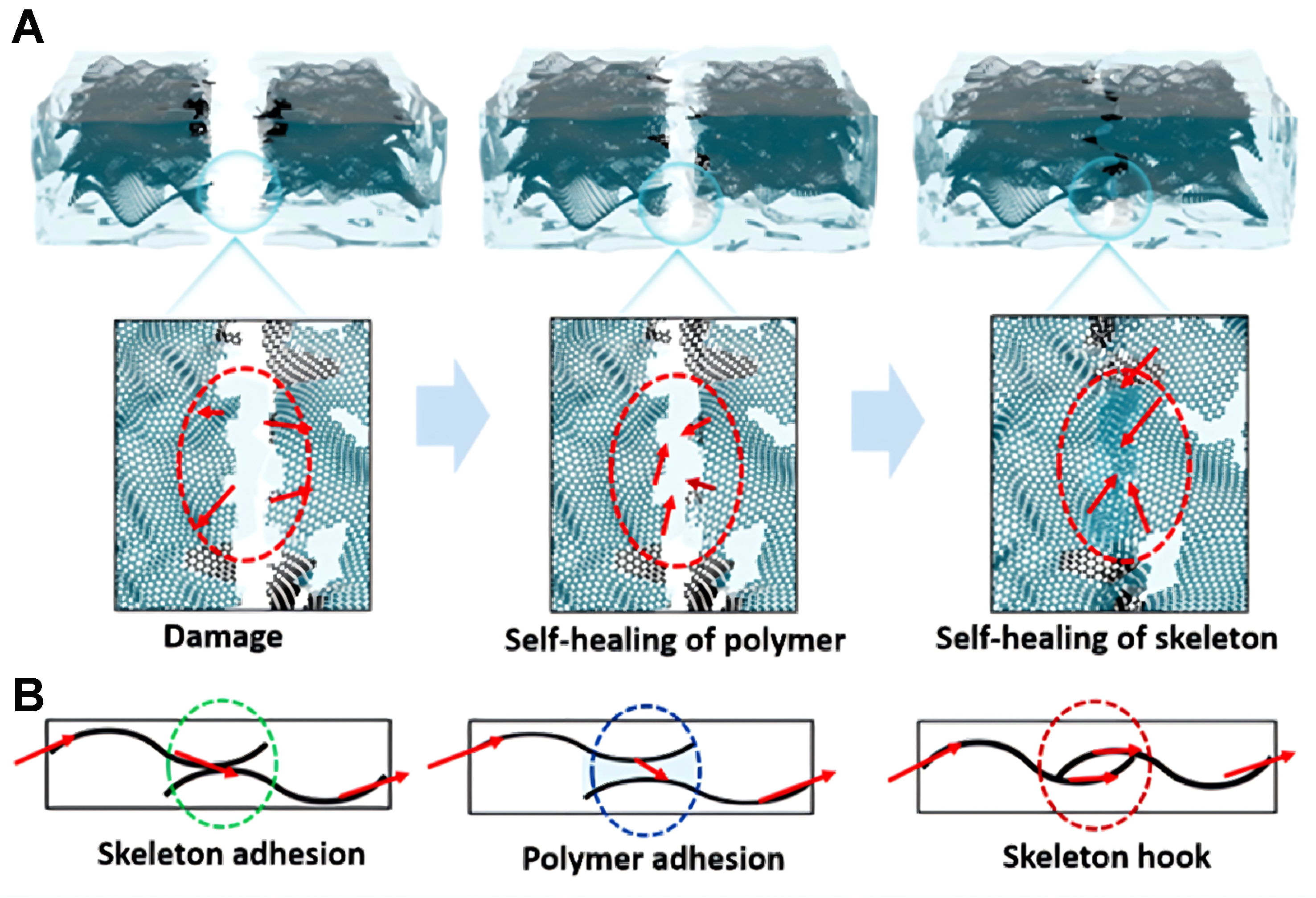
Figure 2. (A) Self-healing process diagram of polymer-based thermally conductive composite materials; (B) Diagram of the self-healing mechanism of the thermal conduction pathway. (A) and (B) are reprinted with permission from Ref.[14]. Copyright 2022. Licensed under CC BY 4.0.
Additionally, the composition of the material consists of a polymer matrix and a thermally conductive filler. Therefore, the restoration of composite materials includes the self-healing of polymers and thermal skeletons. From the perspective of polymer molecules, polymers are molecular fragments containing dynamic bonds, whose directionality and rapid molecular rearrangement can drive crack self-repair. However, compared to polymer matrices, thermally conductive fillers have stable structures, and defects after damage and fracture cannot achieve structural self-repair[15]. Generally, due to the presence of rigid thermally conductive fillers or templates, polymer movement and aggregation are restricted, resulting in poor self-healing performance of composites. However, for polymers that can rapidly self-heal, they easily diffuse across contact interfaces. The strong surface tension and the bonding force of polymer chains can effectively promote the proximity, rearrangement, and self-repair of polymer chains at the fracture interface with graphene. Therefore, the repair of the thermally conductive filler network mainly falls into three categories: (1) Connections between thermally conductive fillers; (2) Strong interfacial action between fillers; (3) Repair of packing structure relies on strong adhesion of polymers [Figure 2B]. Mechanical recovery only requires polymer interdiffusion and reformation of dynamic bonds to rebuild load-bearing networks, and tiny interfacial voids barely weaken tensile strength. In contrast, thermal transport depends on re-establishing continuous filler-filler contact pathways. Even if polymer surfaces fully re-adhere and mechanical strength is almost restored, nanoscale microcavities trapped at healed cracks produce prominent interfacial Kapitza resistance, which dominates residual thermal loss and causes thermal recovery to lag far behind mechanical restoration. The whole evolutionary process can be described as follows: when the composite suffers fracture damage, both the polymer matrix and interconnected filler thermal-conductive pathways are destroyed. During self-healing, polymer chain diffusion and reconstruction of dynamic bonds enable macroscopic crack closure, achieving nearly complete mechanical recovery. Nevertheless, numerous micro-nano cavities may still persist at the bonding interface even after the crack is visually closed. These residual voids prevent sufficient re-contact between adjacent filler particles, which interrupts the continuity of thermal-conduction pathways, introduces severe phonon scattering, and results in high Kapitza interfacial thermal resistance. Consequently, mechanical healing efficiency can approach 100%, whereas the reconstruction of the thermal transport network remains incomplete, leading to distinctly lower thermal healing efficiency.
In the past two years, multiple innovative strategies have greatly advanced the development of thermally conductive self-healing polymer composites. MXene with abundant surface functional groups can be introduced into dynamic cross-linking networks to fabricate multifunctional TIMs with balanced thermal transport and self-repairing properties[16]. To address the leakage risk of liquid-metal fillers, an encapsulation strategy has been proposed for constructing robust self-healing thermally conductive composites[17]. Beyond filler orientation regulation, rationally designing dynamic polymer matrices is another promising route, and liquid-crystalline epoxy vitrimers have been proven to integrate high thermal conductivity, reconfigurability, and self-healing capacity[18]. The construction of vertically oriented boron nitride networks provides an effective way to boost the out-of-plane thermal conduction while preserving the intrinsic self-healing performance of the polymer matrix[19]. Apart from experimental exploration, machine-learning-aided high-throughput screening also offers a rational guideline for component optimization, which can effectively reduce the trial-and-error cost in the development of thermal-management composite materials[20].
To address the core contradiction of high filler loadings suppressing polymer chain migration and difficulty in simultaneously achieving high thermal conductivity and efficient self-healing, a microstructure design strategy for prefabricated three-dimensional boron nitride aerogel skeleton composite polyurethane (PU) offers a feasible solution. Conventional blended boron nitride powders tend to agglomerate and accumulate, greatly restricting the diffusion and movement of polymer chain segments. The porous boron nitride aerogel obtained through freeze-drying and high-temperature calcination has a continuous thermal conduction channel. After hydroxylation modification on the NaOH surface, the PU matrix can evenly penetrate into the aerogel pores, where the hydroxyl group forms a covalent interface with isocyanate groups, effectively reducing interfacial phonon scattering and contact thermal resistance. After cyclic compression, the thermal conductivity pathway does not break, and the PU elastomer retains sufficient chain segment activity, balancing resilience and underwater adhesion properties, providing a typical experimental paradigm for simultaneously balancing thermal conductivity and damage repair potential[21].
EXTRINSIC SELF-HEALING THERMALLY CONDUCTIVE COMPOSITES
Externally aided self-healing thermally conductive materials do not require external stimulation (such as heating or pressure) and can spontaneously identify damage and achieve self-repair. It is an early and effective repair method. The basic principle is to first embed microcontainers containing repair agents inside the material. The material substrate is damaged under external pressure, causing the microcontainer at the damaged area to rupture, allowing the repair agent to flow out and fill the damaged area. Then, the restorative reacts chemically with the polymer, causing the injury to heal. Based on the method of implanting the healing agent, it can be divided into two types: microencapsulated type and microvascular network type[22].
Microencapsulated self-healing thermally conductive material
Microcapsule-based self-healing composites are mainly categorized into two mechanisms: autonomous and non-autonomous [Figure 3A][22]. In a typical autonomous system, two types of microcapsules containing a monomer and a polymerization initiator/catalyst, respectively, are dispersed within the matrix. When microcracks initiate and propagate within the material, the stress at the crack tip ruptures the capsules, releasing the reactive substances into the crack plane. Upon contact, they spontaneously initiate polymerization, filling the defect with a solid polymer. This entire process requires no external intervention, thereby achieving autonomous self-repair of the material. In a non-autonomous system, crack propagation similarly prompts capsule rupture and the release of healing agents; however, the initiation of polymerization relies on external environmental stimuli. Common triggers include heating, ultraviolet (UV) radiation (including sunlight), or contact with moisture and oxygen in the air.
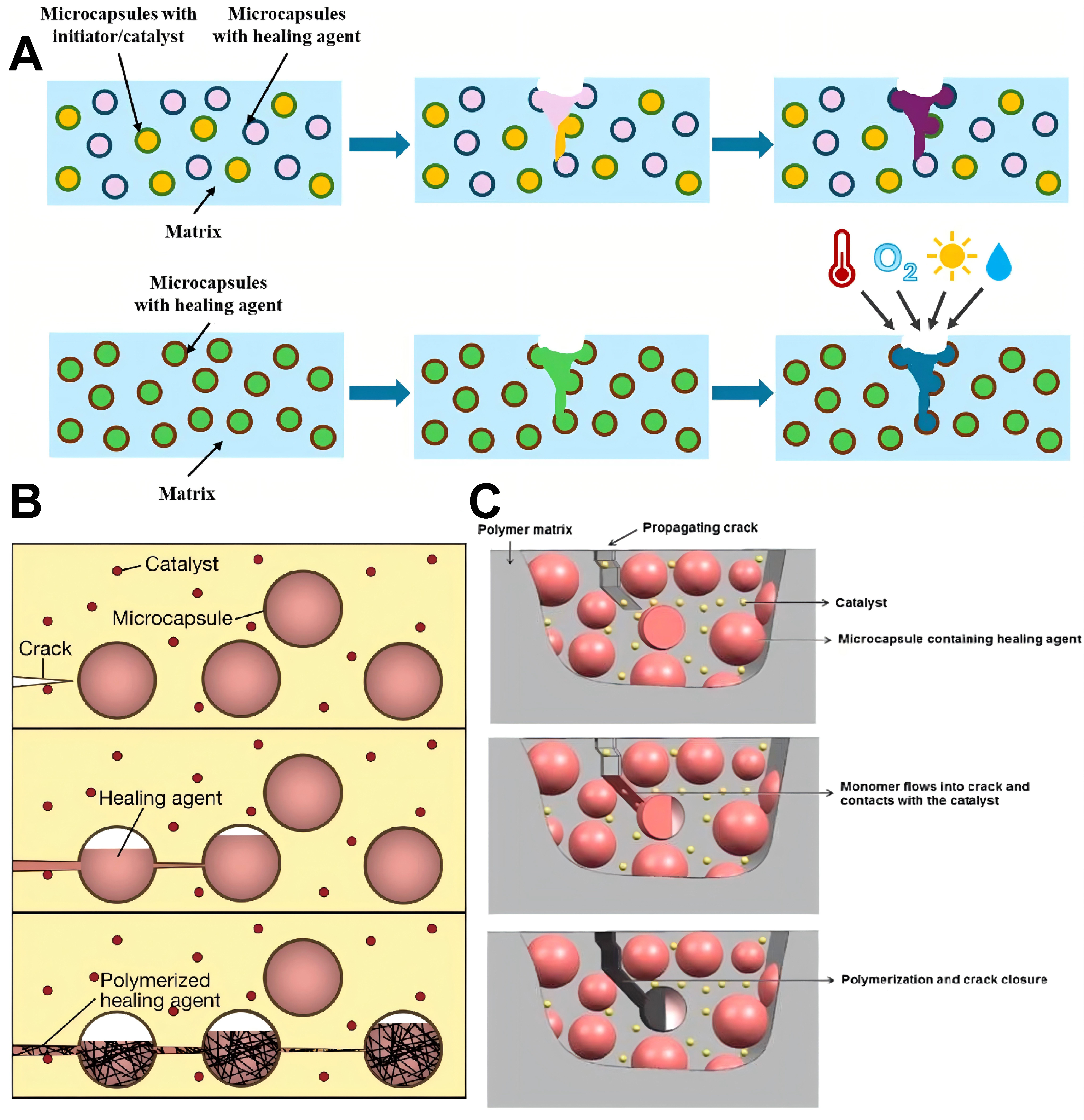
Figure 3. (A) This figure shows two basic mechanisms of microencapsulated self-healing composites: autonomous and non-autonomous; (B) Self-healing process of microcapsule/dispersion catalyst systems. (A and B) are reprinted with permission from Ref.[22]. Copyright 2025. Licensed under CC BY 4.0; (C) Self-healing process using microcapsules. (C) is reprinted with permission from Ref.[23]. Licensed under CC BY 4.0.
Furthermore, according to the compilation by Golonka and Laska[22], when the material structure fractured, the doping agent reacted with the matrix to achieve self-repair of the thermosetting plastic structure, with a toughness repair rate of 75% after repair [Figure 3B]. This work marks a new starting point for research on extrinsic self-healing, but the self-healing efficiency of the materials is relatively low.
In recent years, many domestic and international research institutions have carried out deeper innovations in microcapsule systems, making breakthroughs in developing various new types of microcapsule systems. The basic principle is that the two-phase material is evenly dispersed; after material damage, the capsule ruptures, causing internal and external materials to react and heal the damaged structure. During the development process, liquid ingredients such as dyes, monomers, hardeners, catalysts, and hollow channels are inserted into polymer-generated structures. These pools are ruptured in the event of a fracture, and the reactive agents are poured into fissures by capillary force, where they solidify in the presence of pre-dispersed catalysts to heal the crack [Figure 3C][23]. Xie et al. prepared self-healing microcapsules using polyvinyl alcohol as the emulsifier, urea-formaldehyde resin as the shell material, and alkyd resin as the core material, using in situ polymerization[24]. The average diameter of the resulting microcapsules was about 20 μm, and the encapsulation rate of alkyd resin was 50.7 wt%. A self-healing coating was prepared by adding 5 wt% microcapsules to pure PU coating, which was then applied onto AA2024-T3 substrate. Scanning electron microscopy was used to evaluate the self-healing effect, and electrochemical impedance spectroscopy and neutral salt spray tests confirmed that the self-healing coating exhibited excellent corrosion resistance. Xian used interfacial polymerization to prepare isocyanate microcapsules, adding montmorillonite to enhance the wall material, confirming the microcapsules’ excellent alkali resistance and compatibility with cement-based materials[25]. They determined that the ideal microcapsule concentration was 4%, and the compressive strength recovery rate of the self-healing mortar was increased to 117.38%. Wei et al. used in situ polymerization with melamine-urea-formaldehyde (MUF) as the shell material and E-51 (Ep) as the core material to synthesize MUF@Ep microcapsules[26]. Subsequently, microcapsules were incorporated into the polyimide (PI) matrix to prepare multifunctional composites with self-healing and self-lubricating properties.
Microcapsules have developed rapidly, and in recent years, five types of microcapsule system innovations have been developed: (1) Single capsule system: The capsule contains a single type of repair agent inside. When the material is damaged, the repair agent is released, which then initiates polymerization reactions with the matrix spontaneously or under external stimulus, achieving self-repair of defects; (2) Microcapsule/dispersion catalyst system: The capsule contains dispersible catalysts; if damaged, the catalyst ruptures to achieve healing of the material system; (3) Phase separation/microencapsulation system: Capsules contain one or more phase-separated capsules evenly dispersed in the matrix. After damage, the capsules rupture, reactions occur between capsules, and damage repair occurs; (4) Multi-capsule system: contains two or more healing agents, placed in different capsules and evenly dispersed in the matrix material, enabling multiple capsules to repair together; (5) Integrated microencapsulation system: This system continues the microcapsule/catalyst self-healing material, differing in that the repair agent and catalyst are placed in layers within the same capsule. When exposed to external damage, the capsule ruptures and the separation layer breaks, allowing the two to undergo a polymerization reaction to achieve repair. Although the microcapsule external aid self-repair strategy is simple and can achieve damage repair at room temperature, the system still has significant limitations. First, the capsule’s internal repair agent reserves are limited and can only repair a single injury; after multiple cracks, the repair function is lost. Second, the blending process of high-content thermally conductive fillers easily causes microcapsule shell damage, premature leakage of repair agents, and makes it difficult to improve thermal conductivity and self-healing ability synergistically. In addition, polymerization curing of repair agents causes volume shrinkage, leaving tiny gaps at the crack interface, which increases thermal resistance. How to protect microcapsule integrity under high packing conditions and achieve multiple damage repairs is an urgent scientific challenge for this route.
Microvascular network self-healing material
Self-healing polymer materials prepared using microcapsule types exhibit strong mechanical and self-healing properties, but the repair area is limited to locations containing capsule healing agents and cannot be restored in all areas. Additionally, capsule-type self-healing occurs when the capsule ruptures and the healing agent reacts with the matrix. The amount of healing agent in the base determines the number of times the material is repaired; when the healing agent is lost, the material’s self-healing performance is lost[27]. Ying et al. demonstrated that donor–acceptor (D–A) self-assemblies can impart high stretchability, toughness, thermal reparability, and self-healing capability to PU elastomers[28]. Reversible D–A interactions are temporarily dissociated (facilitating molecular rearrangement of the damaged interface) during heating and re-associate during cooling. This dynamic process recovers the mechanical integrity and underlies the muscle-like stretchability and self-healing behavior of elastomers [Figure 4]. Dry[29] were the first to coat epoxy onto insulating glass fibers filled with adhesives, obtaining microvascular materials and qualitatively testing the material’s repair ability.
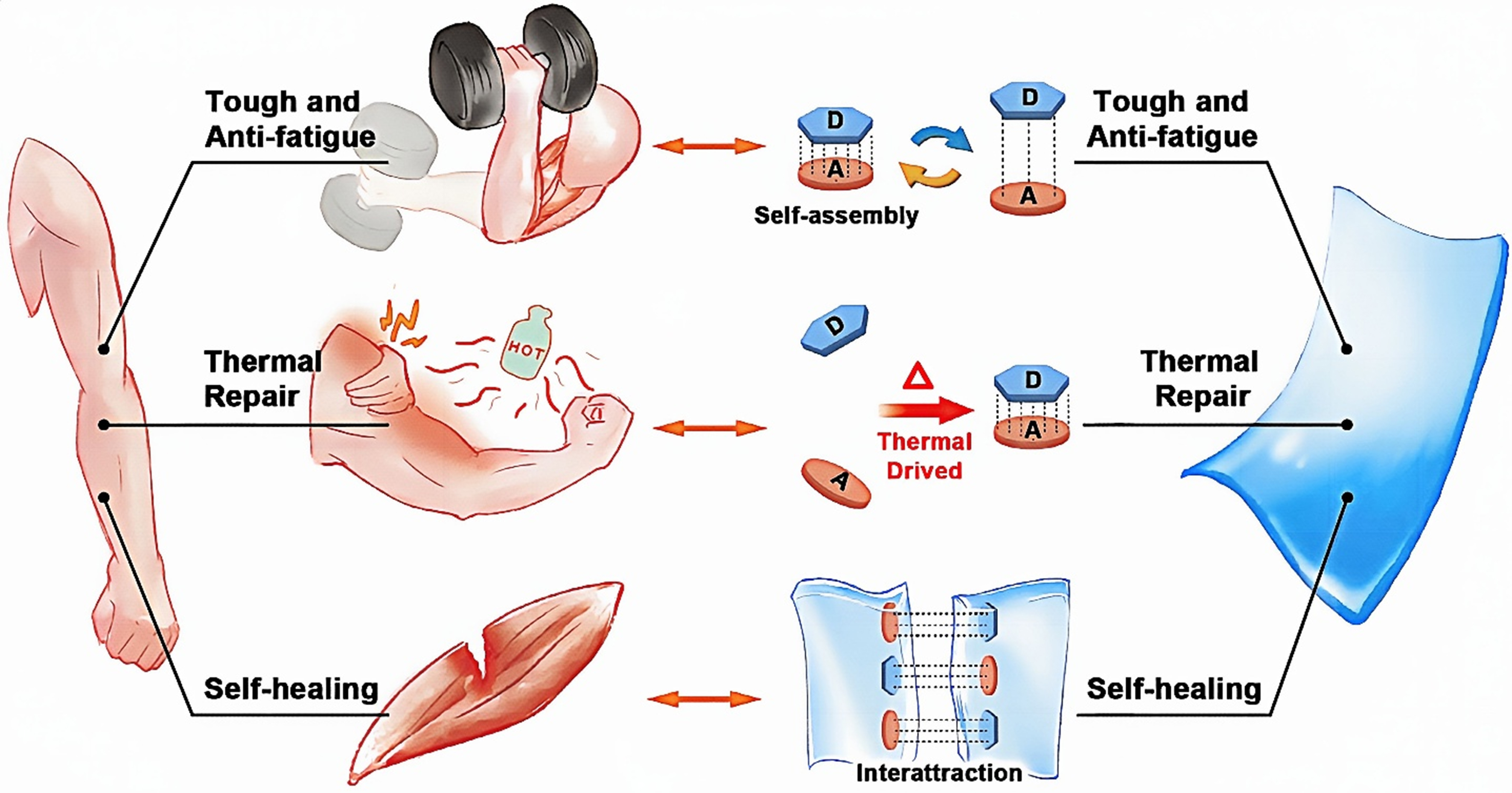
Figure 4. The schematic illustration of the muscle-like DA-PU elastomers with the capabilities of super-toughness, anti-fatigue, thermal repair, and self-healing based on the D–A self-assembly structure. Reprinted with permission from Ref.[28], Copyright © 2021 Wiley. DA-PU: Donor–acceptor polyurethane; D–A: donor–acceptor.
Subsequently, researchers further expanded the microvascular tube system, using various technologies such as 3D printing to construct 2D or 3D repair systems. The researchers also loaded various healing agents into different microtubing networks, further increasing the number of repairs and self-healing efficiency[30].
In principle, the self-repair principle of the microvascular network type is similar to that of the microcapsule type, requiring the repair agent to be pre-dispersed within the material matrix. However, in terms of repair effectiveness, microvessel tubular self-healing materials can achieve multiple stable repairs. However, in practical applications, the more repairs are done, the lower the self-healing efficiency of microvessel-type self-healing materials. This is because after damage repair, the defect microtubules are damaged, and with further damage, more serious and more severe damage is required to trigger new microtubule flow and achieve further repair. From an economic perspective, microcapsules require relatively low investment, while microvein tubing requires higher technical complexity and costs, severely limiting mass application of the process. From the perspective of practical applications, externally supplied self-healing materials have been widely used in structural materials, interface coatings, functional ceramics, and new energy materials. However, due to insufficient restorative supply and structural design technologies, the stability and effectiveness of material restoration lack sufficient research support, so further research is needed.
Microvascular networks can store large amounts of healing agents and support multiple repairs, but the three-dimensional connected vascular structure fabrication process is complex, making it difficult to process thin TIMs. At the same time, when the material suffers large-scale damage, the vascular pipeline itself may break, repairing the failure of the supply channel. This system still lags far behind practical applications in electronic heat dissipation, with most research focused on structural coatings and few reports on flexible thermally conductive composite materials.
INTRINSIC SELF-HEALING THERMALLY CONDUCTIVE COMPOSITES
In chemistry, introducing reversible interactions into the molecular structure of self-healing materials helps reconstruct polymer networks to realize self-repair functions. Distinct from extrinsic self-healing systems that rely on embedded healing agents, intrinsic self-healing materials are free of pre-doped restorers and enable repeated damage recovery via abundant in-situ reversible dynamic chemical bonds or weak intermolecular interactions, though their self-repair processes usually demand external stimuli including heat, light, and electromagnetic fields. Classified by the types of reversible bonding units, intrinsic self-healing composites are split into three consistent categories with unified taxonomy clarified herein to resolve ambiguous boundaries of dual dynamic systems represented by polyurethane composite material with a Diels-Alder structure (PUDA), ureidopyrimidinone-terminated polydimethylsiloxane (PDMS-UPy) and mussel-inspired poly(dimethylsiloxane-co-dopaminemethacrylate) (PDMS-DMA): first, pure dynamic covalent intrinsic materials, whose networks are crosslinked merely by reversible DA, boronate ester, disulfide and similar covalent bonds while non-covalent forces only serve as trivial auxiliary intermolecular attraction without independent crosslinking capacity; second, pure supramolecular intrinsic materials that achieve self-healing completely through hydrogen bonds, coordination bonds, ionic bonds, host-guest interactions, π–π stacking and other non-covalent supramolecular interactions, lacking dynamic covalent backbones; third, dual dynamic crosslinked composites where single polymer network integrates mutually synergistic dynamic covalent crosslink nodes and supramolecular crosslink sites, with both types of bonds jointly participating in crack reconstruction, to which PUDA, PDMS-UPy and mussel-inspired PDMS-DMA all belong. Recent research advances of each type are elaborated as follows.
Thermal self-healing materials based on dynamic covalent bonds
Figure 5A shows the single-point energy model of the PBC2-PBA1 system and the high-force double-stranded structure. Because intermolecular hydrogen bonds and boron ester bonds promote polymer chain segment rearrangement, this triggers self-repair of polymer structure and properties[31]. Figure 5B displays diverse temperature-reversible dynamic covalent bonds applied in covalent self-healing polymers, covering disulfide bonds, imine bonds, Diels-Alder (DA) adducts, transesterification ester linkages, ditelluride, diselenide, urea bonds, as well as boron-based structures including boroxine and boronic esters; these chemical bonds can reversibly cleave and reconstruct under thermal stimulation to facilitate polymer chain rearrangement, which effectively mends material cracks and recovers the original structural and mechanical performance, acting as fundamental dynamic motifs for fabricating thermally responsive self-repairing covalent polymer networks.
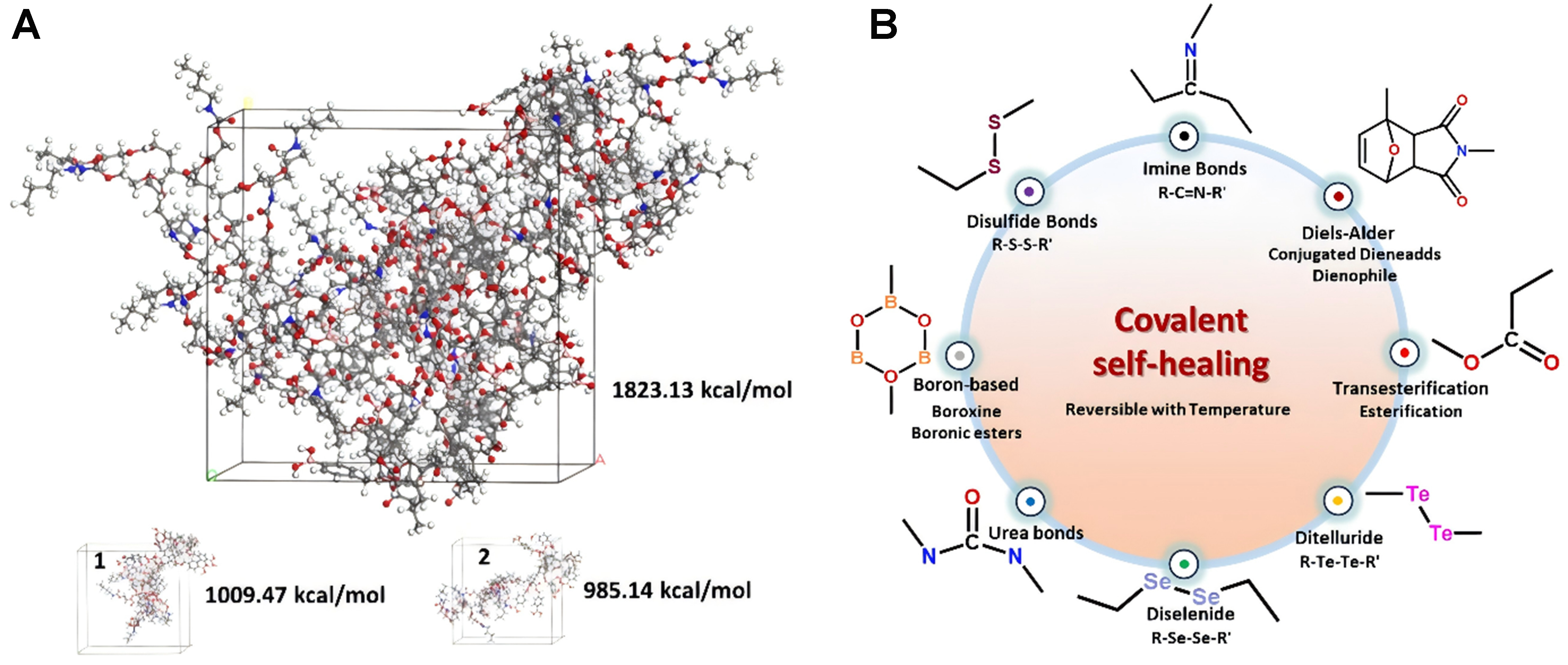
Figure 5. (A) Intermolecular bonds trigger chain rearrangement for polymer self-repair in PBC2-PBA1. (A) is reprinted with permission from Ref.[31]. Copyright 2025. Licensed under CC BY 3.0; (B) Based on the classification of self-healing materials based on dynamic covalent bonds.
DA bonds, borate ester bonds, disulfide bonds, acylhydrazone bonds, and others are the most commonly used chemical elements in intrinsic self-healing thermally conductive composite materials. They share common features: (1) bonds can undergo reversible dissociative reconstruction under external stimuli (heat, pH, light); (2) when the material is damaged, the broken dynamic covalent bonds can recombine, enabling crack repair and supporting multiple cycles; (3) repair performance highly depends on stimulus conditions, and dynamic bonds can affect the mechanical and thermal conductivity of polymer substrates to varying degrees. Different dynamic covalent bonds have significant differences in stimulation conditions, bond exchange kinetics, and chemical stability. The unique characteristics of each system are introduced below.
The DA response
The DA reaction mainly relies on a conjugated diene and a substituted olefin for reversible cyclization, making it one of the ideal choices for synthesizing self-healing plastic materials. The main mechanism is that during heating, the crosslinked products break at higher temperatures to form conjugated dienes and alkenynes; during cooling, a thermally reversible chemical crosslinking network regenerates, restoring the material to its initial properties.
The DA reaction strongly promotes the reuse of materials. Zhu et al. designed a microencapsulated/cross-linked polyethylene (XLPE) composite material based on the reversible DA reaction, solving the healing kinetics problem of XLPE cables during long-term operation through electric-water hybrid trees[32]. Under thermal trigger conditions, the dynamic reconstruction of reversible bonding enables the material to achieve dual repair of water tree and electrical tree damage, maintaining over 80% insulation performance even after three damage repairs, providing a new strategy for intelligent design and service life extension of high-voltage cable insulation materials. Liao et al. used the DA reaction to prepare high-performance bio-based cellulose nanofibers/PU (CNF/PU) composites, thereby achieving excellent broad temperature adaptability, self-healing, and multifunctionality[33]. The CNF/PU composites they developed have a simple preparation process and excellent performance, combining high-temperature strength with low-temperature toughness, while also adhering to the principles of green chemistry and sustainable development. Yu and Yang successfully synthesized a series of dynamic reversible polyurethane (DRPU) elastomers through the DA reaction and used them as TIM substrates[34]. DRPUs demonstrate highly efficient self-healing performance, with a self-healing efficiency as high as 87%, maintaining 78% even after multiple repair cycles. In terms of composite materials, Cao et al. used the DA reaction to combine maleimide-modified boron nitride (m-hBN-OH) with an epoxy resin matrix containing furfural amine, obtaining an m-hBN-OH/epoxy resin self-healing thermally conductive composite material[35]. When the m-hBN-OH content is 5 wt%, the thermal conductivity of the composite material is 0.44 W·m-1·K-1, and the self-healing efficiency at 140 °C reaches 70%. This system has a relatively low thermal conductivity and requires more stringent conditions for repair, but it points the way forward for the preparation of self-healing thermally conductive composite materials under two-phase composite systems. Under the same mechanism, Chen et al. selected acrylic acid and original graphite as diene and dienophile, respectively, modified the graphite surface using DA reactions, and then filled it into a polyvinyl alcohol matrix[36]. Good interfacial interactions improve material stability. When the filler content is 30 wt%, the thermal conductivity of the composite reaches 21.3 W·m-1·K-1, which is 44% higher than that of unmodified graphite composites with the same mass fraction [Figure 6A]. However, due to limited DA reactions within the material, its repair performance is poor. Zhao et al. prepared a self-healing organosiliconic/boron-nitride (BN) composite material with high thermal conductivity, high self-healing efficiency, and low electrical conductivity[37]. Organosilicon crosslinked by DA adducts serves as the polymer matrix, while BN is used as the thermally conductive filler. The self-healing silicone/BN composites exhibit over 90% self-healing efficiency and a 544% thermal conductivity enhancement at a BN content of 50 wt%. The self-healing composites exhibit excellent thermal management performance. The excellent self-healing performance is attributed to the thermal reversibility of the DA reaction and the flexibility of the siloxane molecules.
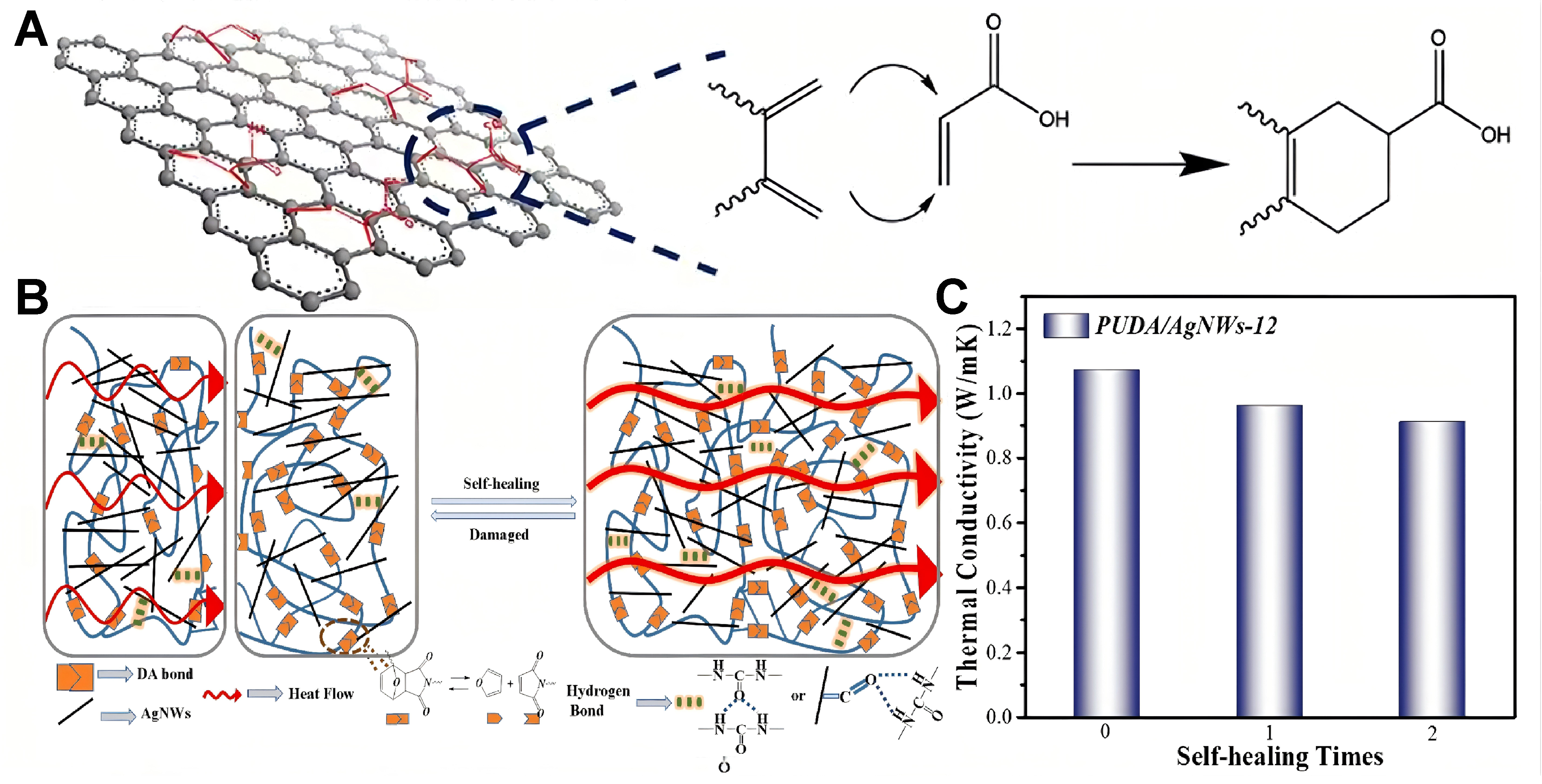
Figure 6. (A) Schematic of the interfacial chemical structure of AA@G. (A) is reprinted with permission from Ref.[36], Copyright © 2019 Elsevier; (B) Self-healing dual-function thermally conductive PUDA and AgNW; and their (C) thermal self-healing performance. (B and C) are reprinted with permission from Ref.[39], Copyright © 2024 Elsevier. PUDA: Polyurethane composite material with a Diels-Alder structure; AgNW: silver nanowires.
To improve the material’s self-healing performance, Fatahi et al. synthesized a series of crosslinked self-healing PU coatings as novel chain extenders and bismaleimide (BMI) polyetheramines as DA interactions using a tert-butyl cup containing furan groups [4] aromatic hydrocarbons (C4A-FA)[38]. Adding C4A-FA to PUs can improve their mechanical properties, thermal stability, and self-healing capabilities. By replacing 15% butanediol (BDO) with C4A-FA in pure PU, tensile strength increased from 1.69 to 5.14 MPa. Additionally, the addition of the DA key increases the tensile strength of the PU-C4A15-DA to 10.49 MPa. Materials obtained from the DA reaction have excellent mechanical properties, capable of repairing complete cuts and macroscopic damage, and have broad application prospects in military equipment, protective coatings, building materials, and more. However, due to the current high reaction temperatures, material decomposition at high temperatures, and harsh healing conditions, the development of the DA reaction is limited. To meet the non-detachable application needs of most integrated electronic products, it is necessary to develop polymer-based pack-healing kinetics materials that simultaneously possess excellent thermal conductivity and self-healing properties. However, due to the complexity of composite structures and compositions, self-healing remains a major challenge. Here, Jiang et al. designed a self-healing, thermally conductive, dual-function PUDA and silver nanowires (AgNW) [Figure 6B and C][39]. The hydrogen-bond network at the interface between AgNWs and PUDA promotes the dispersion of AgNWs within the matrix, thereby imparting ideal thermal conductivity to the composites. Incorporating 3, 6, 9, 12, and 15 wt% AgNW into PUDA increases thermal conductivity by 33%, 104%, 154%, 321%, and 371%, respectively. In particular, the new composite material doped with 12 wt% AgNW demonstrated the most effective balance between self-healing efficiency and thermal conductivity. PUDA/AgNWs with 12% AgNW content have a thermal conductivity of 1.01 W·m-1·K-1, which is 4.8 times that of PUDA (0.21 W·m-1·K-1). After two reconstruction cycles, the thermal conductivity of PUDA/AgNWs-12 was restored to 85%. Research shows that composites prepared based on the DA reaction have good thermal conductivity and self-healing capabilities, making them suitable for TIMs in various thermal management systems and flexible electronics applications. DA reaction dynamic covalent bonds can impart excellent mechanical strength to composites, but the system relies on high-temperature stimulation; excessively high repair temperatures limit its use in electronic devices that are not resistant to high temperatures. Repeated high-temperature cycling also accelerates the thermal healing kinetics of polymer substrates, and long-term service stability requires further research.
Boron ester bond function
Borates are reversible triangular plane compounds formed by the combination of boric acid and diol in the bulk or anhydrous organic solvent. Borate bonds are sensitive to pH and water stimulation and can be repaired in aquatic environments, but their hydrolysis resistance is insufficient, and they are prone to mechanical degradation in humid environments. It is often used to design self-healing, degradable, and convertible polymer materials[40].
Bao et al. synthesized a dynamic covalent crosslinking network with nitrogen coordination using triperic reactions of polypropylene glycol (PPG) oligomers (Bi-PBA-PPG and Tri-PBA-PPG) terminated by bi-(o-aminomethylphenylboric acid) and tri-(o-aminomethylphenylboric acid) ends[41]. Subsequently, by adjusting the molar ratio (1:2) of Tri-PBA-PPG and Bi-PBA-PPG to regulate crosslinking density, supramolecular thermosetting materials were prepared with a glass transition temperature of about 36 °C, tensile strength up to 31.96 MPa, a Young’s modulus of 298.5 MPa, and capable of repair and recovery under mild conditions [Figure 7A]. Lai et al. synthesized PDMS-Boroxine polymers containing dynamic boron-oxihexacyclic bonds based on the principle of dynamic reversible boron ester bond repair[42]. This polymer material has a tensile strength of 8 MPa, can withstand 450 times the load, and can be repaired for 12 h at 70 °C assisted by water, achieving a 100% repair rate. The above self-healing experiments use water, violet light, and similar conditions as auxiliary conditions, but in real life, it is difficult for all materials to fully meet these conditions. To address this prominent issue, Yu et al. constructed rapid self-healing polymer materials containing boron ester and hydrogen bonds by modulating intermolecular interactions based on dynamic covalent boron ester bonds[31]. Then, polymers were infiltrated into the gaps of carbon nanotube aerogel (CNTF) to obtain highly thermally conductive polymer composites with rapid self-healing [Figure 7B]. When the CNTF content is 13.4 wt%, the composite exhibits a high tensile strength of 5.5 MPa, which is 189% higher than the mechanical strength of PBC2-PBA1. Additionally, it shows self-healing performance in tensile strength (100%), thermal conductivity (98.7%), and conductivity (100%) at -20~100 °C. Additionally, composites can be recycled, and reassembled materials can restore 100% of their original mechanical properties. Delpierre et al. templated spontaneous moisture-sensitive repairable polymer networks around dynamic covalent B–O bonds using cycloboroxane derivatives based on iminoborate, and employed dynamic cycloboroxane/boric acid equilibrium and iminoborate chemistry to construct self-healing polymer materials without any energy-dependent external activation[43]. Therefore, in the future, boron bonds can be used to explore the design of high-strength, self-healing polymers and their thermally conductive composite materials, improving the material repair environment and promoting the application and promotion of boron bond polymers in composites and other fields.
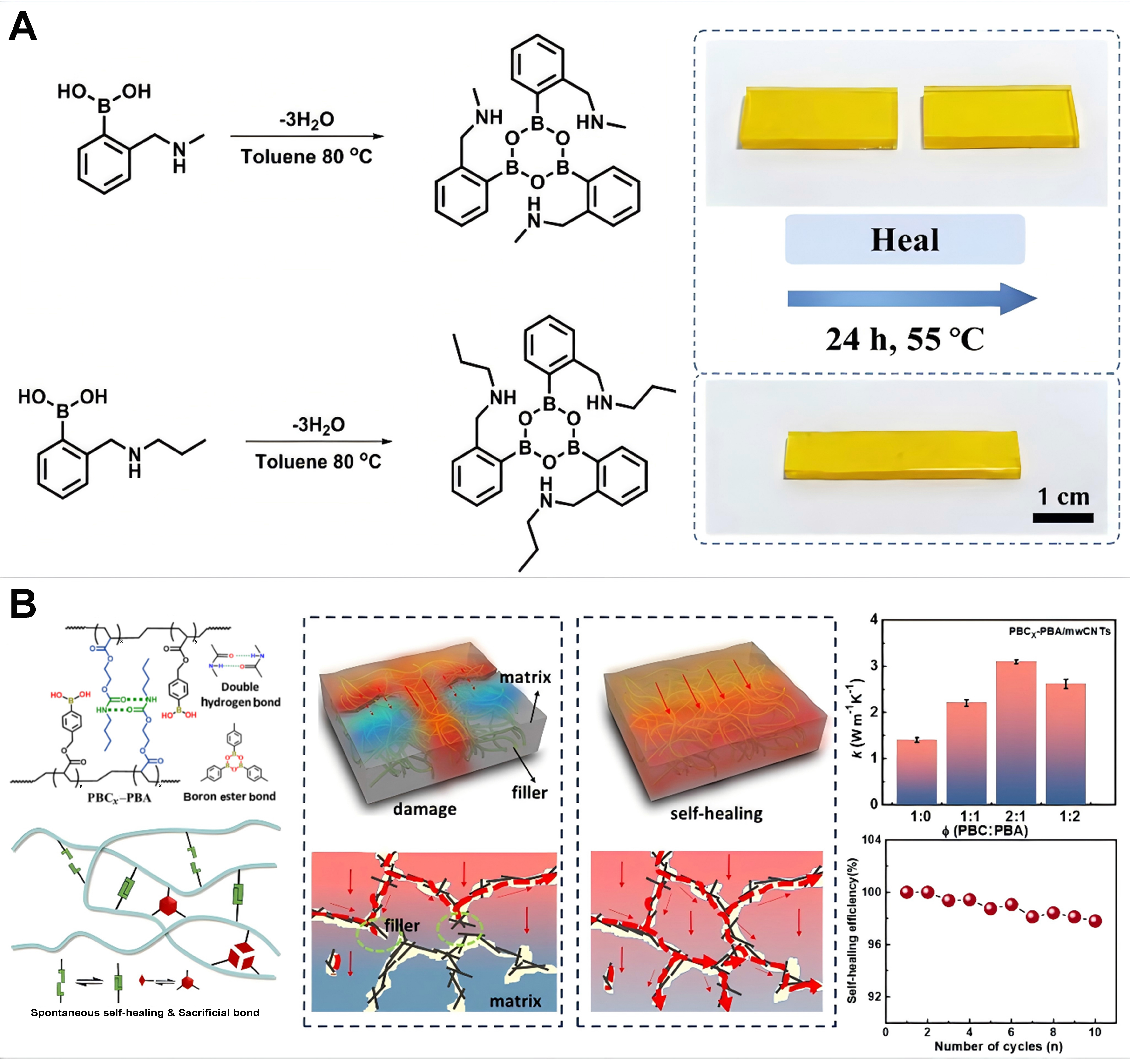
Figure 7. (A) Synthesis route and self-healing photos of N-boroxine-PPG polymer networks. (A) is reprinted with permission from Ref.[41], Copyright © 2019 ACS; (B) Dynamic dual-network polymer structure and thermal conductivity recovery performance of composites. (B) is reprinted with permission from Ref.[31], Copyright 2025. Licensed under CC BY 3.0. PPG: Polypropylene glycol; PBCx-PBA: dual dynamic network polymer; mwCNTs: multi-walled carbon nanotubes.
Role of acylhydrazone bonds
Acyl-hydrazone bonds are chemical bonds and functional groups unique to amide compounds, usually prepared by the condensation of acylhydrazide with aldehyde groups or ketones[43,44]. It is a pH-responsive, reversible dynamic key; its healing can be completed under mild conditions, but the system often requires trace catalyst assistance.
As illustrated in Figure 8A[45], this condensation reaction serves as the fundamental driving force for constructing the material’s three-dimensional network. Specifically, polymer backbones functionalized with hydrazide groups react with benzaldehyde-terminated crosslinkers, thereby introducing dynamic covalent bonds into the crosslinked network and establishing its basic framework. Regarding the dynamic rearrangement and self-healing mechanisms, the acylhydrazone linkage is characterized as a pH-responsive, reversible dynamic covalent bond. Figure 8B[45] further illustrates the dynamic rearrangement process of these linkages: the original crosslinking points undergo reversible cleavage, leading to the rearrangement of polymer chains and the subsequent re-formation of crosslinking points at new positions. It is precisely this dynamic equilibrium between reversible cleavage and re-formation that confers self-healing capability upon the material. The thermal conductivity is considerably lower in all three principal directions when the hydrogen bonds are broken due to tensile strain; as shown in the top panel of Figure 8C, the hydrogen-bonded organic framework (HOF) structure fractures at ~15% strain when tensile force is applied along the y-direction[46]. The application range of self-healing materials is mostly in waterless environments, so they cannot be used in thermal conductivity fields such as electronics or aerospace. Zhang et al. explored the repair mechanism of acylhydrazone bonds and obtained highly self-healing non-hydrogel materials[47]. Using a two-step synthesis, a tetraacylhydrazine-terminated PDMS was first synthesized, and then the product was polymerized with p-phthalene to obtain a PDMS self-healing elastomer containing acylhydrazone bonds. This material can achieve a healing rate of 85% after 48 h of healing under room-temperature acetic acid conditions, and complete restoration can be achieved in 2 h at 120 °C. Since acylhydrazone bond repair conditions are acidic, there has been no research on TIMs yet. In the future, structural optimization and functional group ratios can be used for promotion in biotechnology, electronics, and intelligent machinery.
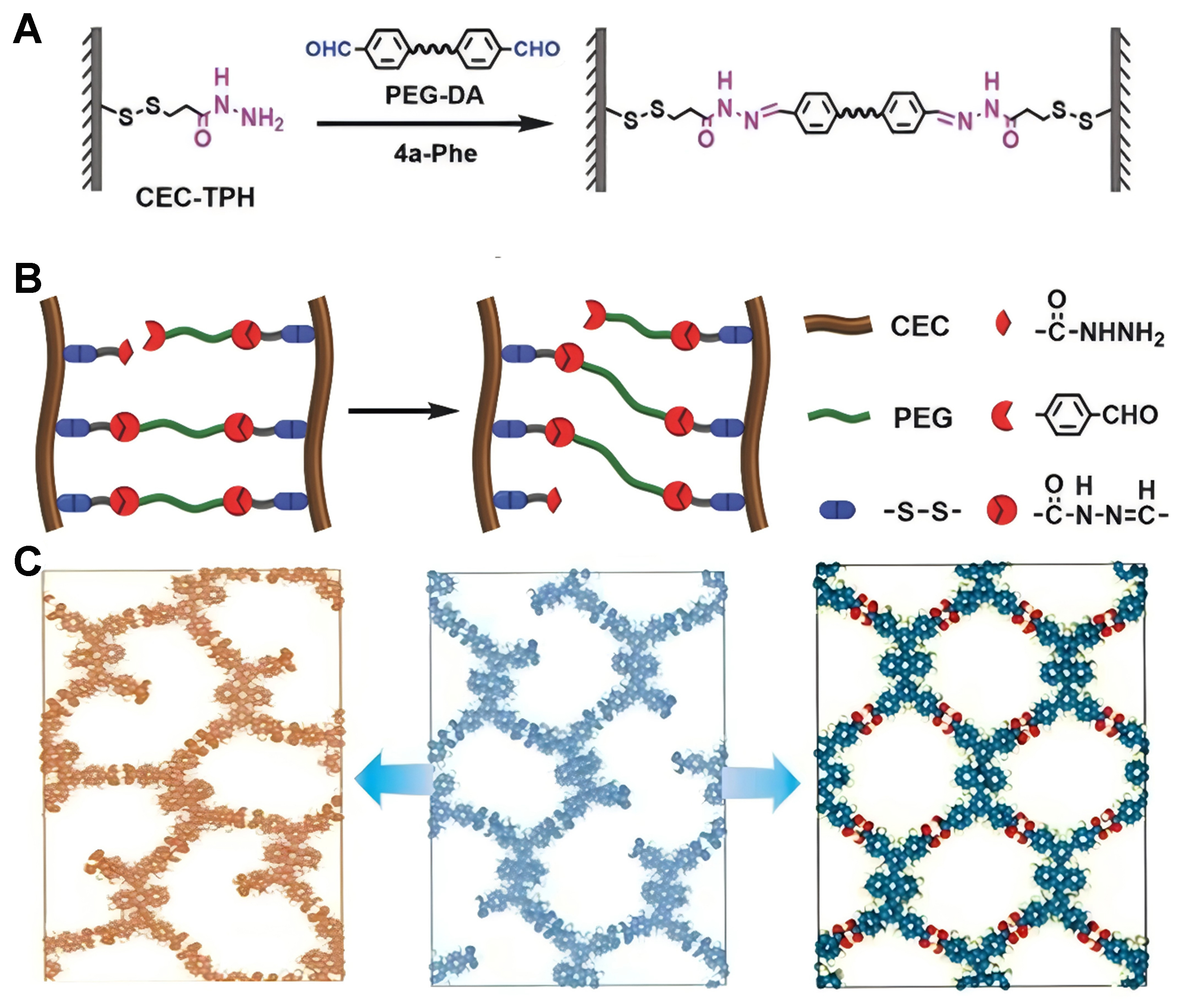
Figure 8. (A) The gelation mechanism of the hydrogels; and (B) The schematic diagram of dynamic rearrangement of the hydrogel network through reversible breakage and formation of acylhydrazone bonds. (A and B) are reprinted with permission from Ref.[45]. Copyright 2021. Licensed under CC BY 4.0; (C) The schematic diagram of this computational model illustrates the “self-healing” process when reverse strain is applied horizontally. (C) is reprinted with permission from Ref.[46]. Copyright © 2022 ACS. CEC-TPH: Carboxyethyl cellulose-graft-dithiodipropionate dihydrazide; PEG-DA: dibenzaldehyde-terminated poly (ethylene glycol).
Disulfide bonding effect
The disulfide bond has a basic structure R-S-S-R. It can achieve multi-mode stimulation repair using heat, visible light, and redox, with fast bond exchange rates and room-temperature self-repair, but its antioxidant capacity is limited. In terms of material processing and application, polymer materials based on disulfide bonds have excellent mechanical strength and machinability, making them widely used in fields such as biomedicine, polymer material synthesis, and functional polymers.
Li et al. synthesized a PU acrylate containing S–S bonds, and then used digital light processing 3D printing technology to prepare a PU elastomer with excellent self-healing capabilities [Figure 9A][48]. The material’s tensile strength and elongation at break were 3.39 ± 0.09 MPa and 400.38% ± 14.26%, respectively. After 12 h of repair at 80 °C, the self-healing efficiency could reach 95%. Zhao et al. prepared sustainable bio-based epoxy vitrimers from epoxidized soybean oil by introducing dynamic imine and disulfide bonds into the crosslinked network[49]. The synergistic exchange of these dynamic covalent bonds endowed the resulting materials with rapid and effective self-healing behavior, together with excellent solvent resistance and shape-memory properties. Additionally, Yang et al. used nucleophilic ring-opening reactions to prepare mercaptan epoxy elastomers, then introduced micron-scale boron nitride (mBN) packing into the elastomer by in situ polymerization, ultimately producing highly thermal, self-healing, and recoverable mBN/mercaptan epoxy elastomer composites[50]. When the mBN content is 60 wt%, the composite has a thermal conductivity of 1.058 W·m-1·K-1 and a self-healing efficiency of 85% [Figure 9B]. This report has promoted research on S–S bonds in thermal conductivity systems, but its drawback is that the self-healing process requires hot pressing, and the material’s interfacial thermal resistance and quality requirements cannot be guaranteed. Zhang et al. reported a self-healing and reprocessable high thermal conductivity graphene nanosheet/liquid crystal elastomer composite (GNP/SHLCE) based on S–S bonds[10]. When GNP content is 20%, the thermal conductivity of GNPs/SHLCE reaches 5.08 W·m-1·K-1, and the repaired tensile strength can be maintained above 93%. However, the self-healing process of GNPs/SHLCE composites requires relatively high temperatures (150 °C).
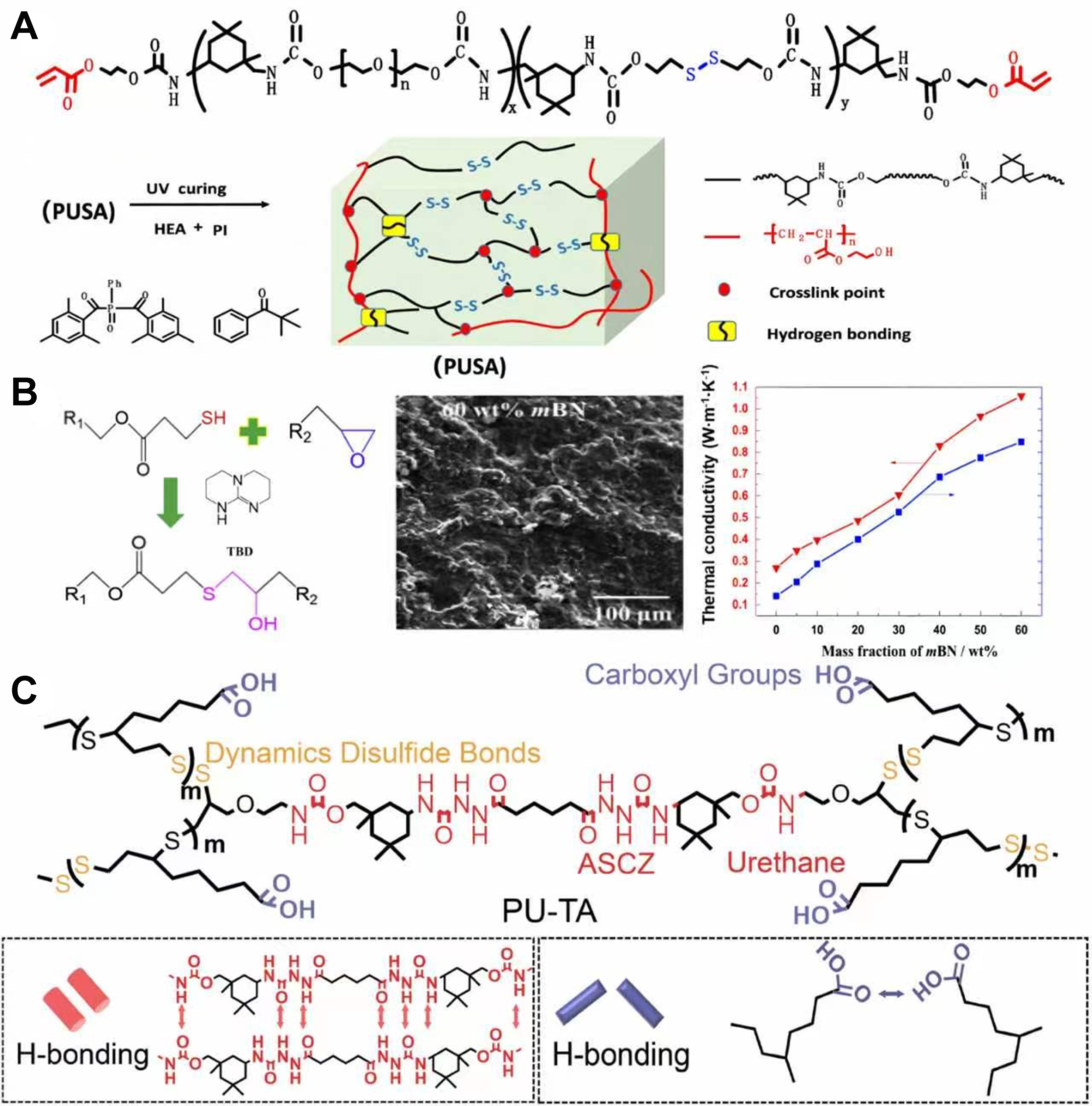
Figure 9. (A) Synthesis process of PUSA and structure of PUA-N1 elastomer. (A) is reprinted with permission from Ref.[48], Copyright © 2019 ACS; (B) Preparation process of polymer, morphology and thermal conductivity of composites. (B) is reprinted with permission from Ref.[50], Copyright © 2018 Elsevier; (C) The molecular structure formula of the PU-TA single chain, and multiple hydrogen bonds, disulfide bonds in the PU-TA copolymers. (C) is reprinted with permission from Ref.[54], Copyright © 2023 RSC. Licensed under CC BY-NC 3.0. PUSA: Polyurethane acrylate containing disulfide bonds; PUA: polyurethane acrylate; PU-TA: polyurethane and thioctic acid; UV: ultraviolet; HEA: 2-hydroxyethyl acrylate; PI: photoinitiator; TBD: 1,5,7-triazabicyclo[4.4.0]dec-5-ene; mBN: micron-scale boron nitride.
To improve the self-healing efficiency of the material and reduce the conditions for repair, researchers have combined disulfide bonds with other covalent bonds. Oxygen-doped rod-shaped boron nitride reported by Liu et al. provides another promising thermally conductive filler candidate for such composite systems[51]. This experiment once again demonstrated that by using an inherent self-healing rubber thermosolid containing reversible disulfide bonds and loading it with an inert thermally conductive filler, a multifunctional self-healing high thermal conductivity composite material capable of both rapid self-healing and high thermal conductivity was prepared. Dong et al. introduced aromatic disulfide bonds into PDMS through carboxylic acid aromatic disulfides, constructing a dynamic network with multiple hydrogen bonds[52]. The resulting elastomer exhibited high mechanical strength, efficient room-temperature self-healing, and excellent recyclability, achieving a mechanical self-healing efficiency of 96% after 12 h at room temperature while retaining 95% of its original toughness after three reprocessing cycles. Malik et al. reviewed Schiff base-based self-healing PU networks containing dynamic imine and disulfide bonds, which exhibited excellent dual-responsive self-healing behavior under heat and UV irradiation, with surface scratches being completely healed within approximately 50 min at 65 °C[53]. Therefore, achieving high thermal conductivity under rapid self-healing conditions is a fully feasible research concept. Currently, achieving both significant interfacial binding and weak phonon mismatch in polymer/metal interfaces remains a tough challenge. Here, Wang et al. successfully synthesized a novel polyurethane and thioctic acid (PU-TA) copolymer containing multiple hydrogen bonds and dynamic disulfide bonds, which can be used as TIMs [Figure 9C][54]. PU-TA can adapt to aluminum (Al) substrate surfaces, and due to its highly matched and bonded interface, it exhibits a thermal boundary conductance (TBC) of up to 99.9 MW·m-2·K-1, which is 2-5 times higher than that of traditional polymer/Al interfaces. Additionally, the correlation analysis demonstrates that interfacial binding has a greater impact than phonon mismatch on the TBC at a highly matched interface. When used as thermal management materials, this research is expected to provide practical guidance for optimizing thermal transport in polymer/metal composites and offer new insights for developing advanced, reliable thermal management materials.
Non-covalent bond-based thermally conductive self-healing materials
Non-covalent interactions, also known as supramolecular interactions, are weak interactions between different atoms or molecules [Figure 10]. Compared with self-healing materials based on covalent bonds, non-covalent bond-type self-healing materials have lower mechanical strength and are therefore unsuitable for use as high-strength, high-stability matrix materials[54,55]. However, non-covalent bond types have lower bond energy and are easier to achieve reversible polymer transformation, making them the best choice for thermally conductive substrates with high self-healing efficiency. Below, we will discuss common materials based on non-covalent bonds.
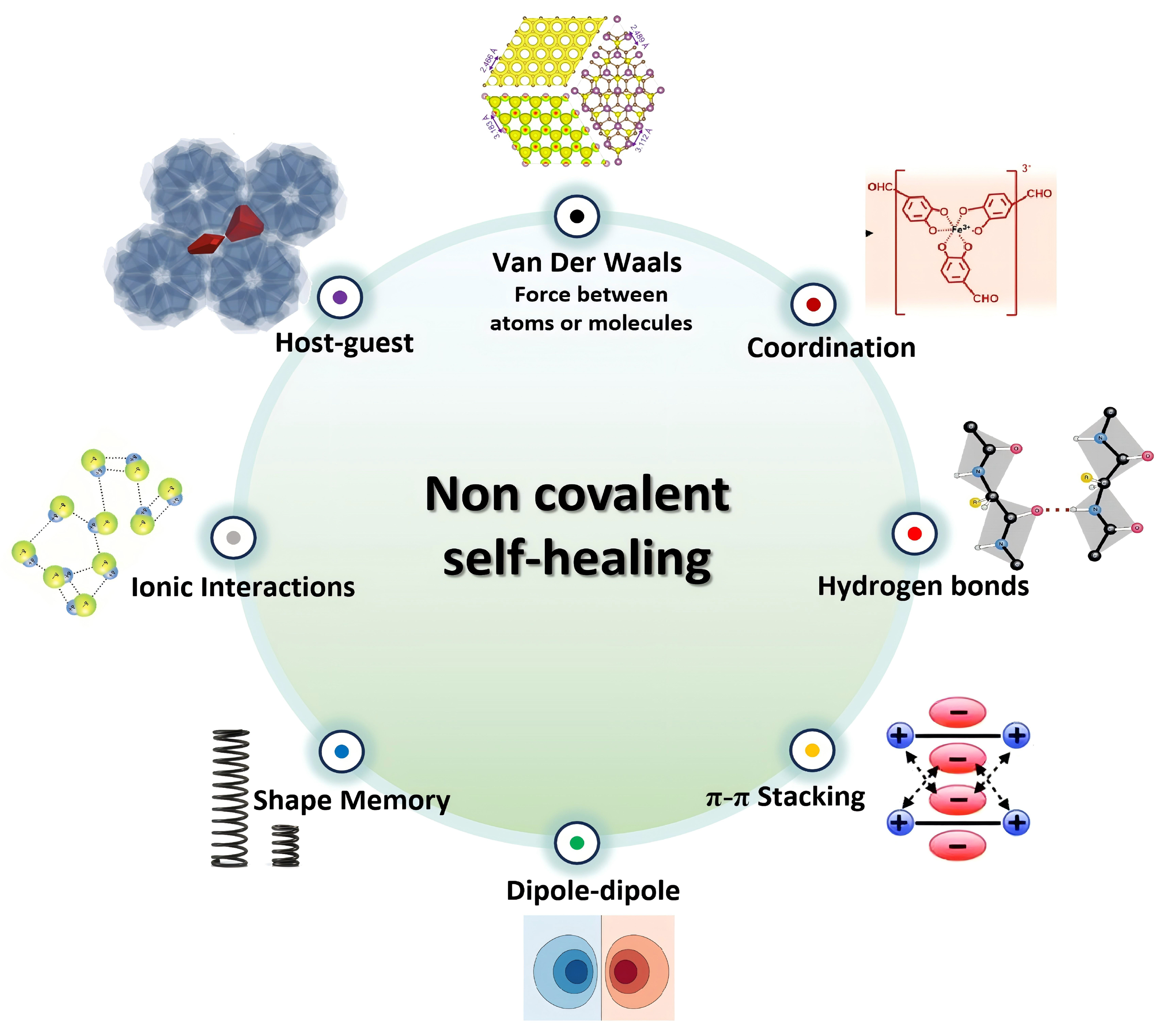
Figure 10. Non-covalent interactions, such as hydrogen bonding, ionic interactions, van der Waals forces, coordination, and π–π stacking, play key roles in the self-healing behavior of materials.
Metal-ligand interaction
Metal-coordination bonds exhibit bond energies ranging from 50 to 200 kJ·mol-1, rendering them one of the strongest categories of intermolecular non-covalent interactions[56]. Coordination bonds have directionality and dynamic reversibility. Researchers often use coordination bonds in molecular structures as a common means to achieve strong mechanical properties and self-healing properties of materials. In terms of ligand types, ligands with coordination bonds mainly include three types: single ligands, bidentate ligands, or multi-site ligands. Common organic ligands include carboxyl groups, ortho-phenyl hydroxyl, pyridine, and their derivatives. Common metal ions include Fe3+, Zn2+, Fe2+, and Cu2+. Because different ligands and metal ions have varying bonding strengths, adjusting the ligands and ions can achieve the goal of modulating the mechanical properties or self-healing properties of materials.
To combine good mechanical properties with spontaneous self-repair under environmental conditions, Mozhdehi et al. introduced a dynamic zinc-imidazole interaction network into the hard/soft biphase copolymer, controlling chain segment parameters and ligands/metal ion ratio, and a new self-healing composite multiphase polymer [Figure 11A] was developed[57]. This material possesses strong mechanical properties and self-healing at room temperature for 300 min, but the self-healing time is relatively long. The bond energy of coordination bonds is relatively small, so under external force, the coordination bond dissipates energy in the material, causing fracture and restructuring of damaged structures, enabling rapid self-repair. By applying coordination bonds at strong and weak binding sites to the 2,6-pyridinedicarbamide structure, self-healing materials based on ligand interactions can achieve autonomous rapid self-repair at room temperature [Figure 11B][58].
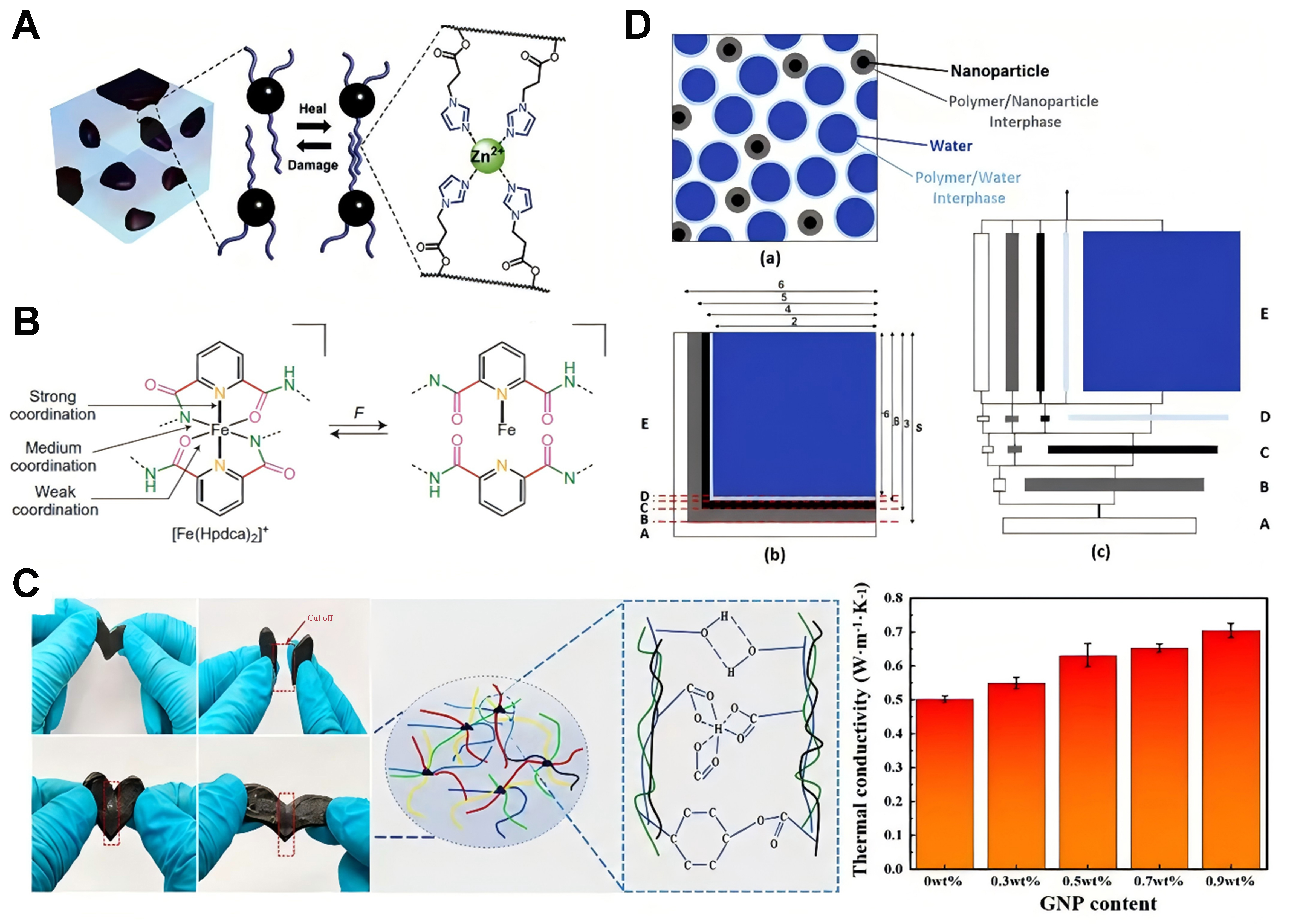
Figure 11. (A) Schematic diagram and mechanical strength of reversible reconfiguration. (A) is reprinted with permission from Ref.[57], Copyright © 2014 ACS; (B) Design mechanism before and after stretching. (B) is reprinted with permission from Ref.[58], Copyright 2019. Licensed under CC BY 4.0; (C) Self-healing properties, mechanism, and thermal conductivity of graphene/polyacrylate composites by Fe3+. (C) is reprinted with permission from Ref.[59], Copyright © 2021 Elsevier; (D) Schematic illustration of microstructural components including water microvessels, nanoparticles, dual matrix interfaces and polymer matrix; the whole domain is divided into five consecutive subregions A–E. (D) is reprinted with permission from Ref.[60], Copyright © 2023 Elsevier. GNP: Graphene nanoplatelet.
Coordination bond self-healing materials have mild repair conditions and excellent performance, which is why they have been promoted and applied in thermal conductivity. Yang et al. introduced graphene into polyacrylate-based hydrogels with Fe3+ as a ligand, obtaining a novel TIM with low contact thermal resistance, high thermal conductivity, excellent elasticity, and self-healing properties [Figure 11C][59]. Figure 11D illustrates the microvascular structure of water (deep-blue spheres), the interface between the matrix and water microvessels (light-blue region), nanoparticles (black dots), the interface between the matrix and nanoparticles (gray region), the polymer matrix (white region), as well as a composite image showing water, nanoparticles, both interfaces, and the matrix. The regions in the figure are further divided into five continuous subregions: A, B, C, D, and E[60]. Introducing graphene into hydrogels can improve the thermal conductivity of TIMs (the thermal conductivity at 0.9 wt% graphene content is 0.71 W·m-1·K-1), enhancing the tensile properties of the hydrogel. At the same time, the self-healing properties of the hydrogel matrix precisely meet the dynamic working conditions of TIMs. Wang et al. proposed a new strategy based on metal ligand-coordinated crosslinked supramolecular elastomers, embedding 3D interconnected nanohybrid networks to manufacture high-performance microrobots with ultra-high photothermal conversion efficiency, fast infrared and magnetic field response, robust mechanical properties, and excellent self-healing performance[61]. Metal bands improve the material’s heat-transfer performance with temperature, but because of the lower filler loading, thermal conductivity is poor. By using dynamic coordination bonds, they prepared highly elastic, self-healing, low-thermal-resistance composites, providing ideas for further developing novel TIMs.
Hydrogen bonding action
Hydrogen bonds, a weak non-covalent interaction with lower bond strength and bond energy, can achieve reversible association and cleavage under conditions such as room temperature or high temperature, while polymers with high-density hydrogen bonds can improve material stability[61-63]. Therefore, hydrogen bonds, as simple yet highly versatile noncovalent interactions, have been widely employed in the construction of dynamic polymeric materials and the regulation of their functional properties, providing new strategies for the design of high-performance functional materials[64]. More importantly, polymers containing intermolecular hydrogen bonds can form reversible interactions, giving materials self-healing functions in mechanics, thermal conduction, electrical conductivity, and other aspects. They are widely used in biomimetic polymers, biomedicine, functional electronics, and other fields.
For hydrogen bond self-healing materials, researchers have been striving to find novel polymer materials with lower repair temperatures, simpler conditions, and better mechanical strength. In interface and micromechanism design, Wang et al. constructed models of PU chains and polydopamine (PDA) molecules through molecular dynamics simulations [Figure 12A], and extracted hydrogen bond interactions between PU and PDA from equilibrium simulation units [Figure 12B], confirming that reversible hydrogen bond recombination helps enhance interface binding and damage repair[65]. Based on this microscopic design, they used mesoporous polydopamine-modified MXene (MPDA/Ti3C2Tx) as a photothermal conversion filler to enhance PU-urea coatings. Through the synergistic effect of hydrogen bonds and disulfide bonds, they achieved up to 94.33% self-healing efficiency under near-infrared (NIR) irradiation in just 5 min, perfectly balancing the material’s mechanical strength and long-lasting corrosion resistance. In terms of supramolecular network construction and multifunctional applications, Choi et al.[66] proposed a supramolecular network constructed from multiple hydrogen bonds, integrated inside epoxy natural rubber (ENR) latex microspheres and combined with a nanoconductive network formed by carbon nanotubes (CNTs) [Figure 12C]. This collaborative design of multi-scale dynamic bonding and conductive fillers not only endows the material with efficient self-healing capabilities and high mechanical strength, but also successfully expands its application in smart wearable devices such as flexible strain sensors. These latest studies not only address the demand for efficient repair of hydrogen-bond self-healing materials under mild conditions, but also, by introducing functional nano-fillers like MXene and CNT, break the bottleneck of the mutual constraint between mechanical strength and self-healing performance of traditional materials, achieving multifunctional integration in thermal conductivity, electrical conductivity, and corrosion resistance, and providing a new paradigm for the design of advanced self-healing materials. Yanagisawa et al. designed and prepared a novel hydrogen-containing bond polymer material with high mechanical strength and rapid self-healing at room temperature[67]. They used polyether thiourea as a raw material, with hydrogen bonds acting as crosslinked functional groups to obtain a series of polymer materials for room-temperature repair, with a maximum yield stress of 45 ± 8 MPa, achieving self-repair at room temperature in just 30 s. This demonstrates that new polyether thiourea materials containing high-density hydrogen bonds at room temperature can construct dense, disordered hydrogen bond networks, while hydrogen bonds at damaged sites can be rapidly reconstructed. This article designs a new high-strength polymer material that rapidly self-heals at room temperature by adjusting the conformation of hydrogen bonds, opening a new path for the promotion and application of self-healing materials in thermally conductive composite materials. Yu et al. constructed self-healing PDMS thermally conductive composites relying on multiple hydrogen-bond supramolecular networks[68]. Multiple types of hydrogen bonds serve as dynamic cross-linking sites within the PDMS matrix, endowing composites with desirable room-temperature self-healing capacity. Nevertheless, excessive addition of inorganic fillers will interfere with the formation of hydrogen-bond networks, weaken supramolecular interactions, and further decrease the self-healing efficiency. This work reveals the competing relationship between filler loading and hydrogen-bond reconstruction, providing a practical reference for balancing thermal conduction and self-healing performance of supramolecular polymer composites. Wang et al. prepared graphene thermoplastic polyurethane (G-TPU) flexible conductive films using blending methods, and systematically studied the electrical, thermal, and self-healing properties of G-TPU flexible conductive films using infrared and electrical methods[69]. Experiments found that when the graphene content is 4 wt%, the maximum thermal conductivity is 0.332 W·m-1·K-1. Repairing at 13 °C for 15 min can achieve complete restoration of the material structure. The material has relatively low thermal conductivity and requires a higher ambient temperature during repair. Therefore, its repair performance in applications is poor and cannot be widely promoted.
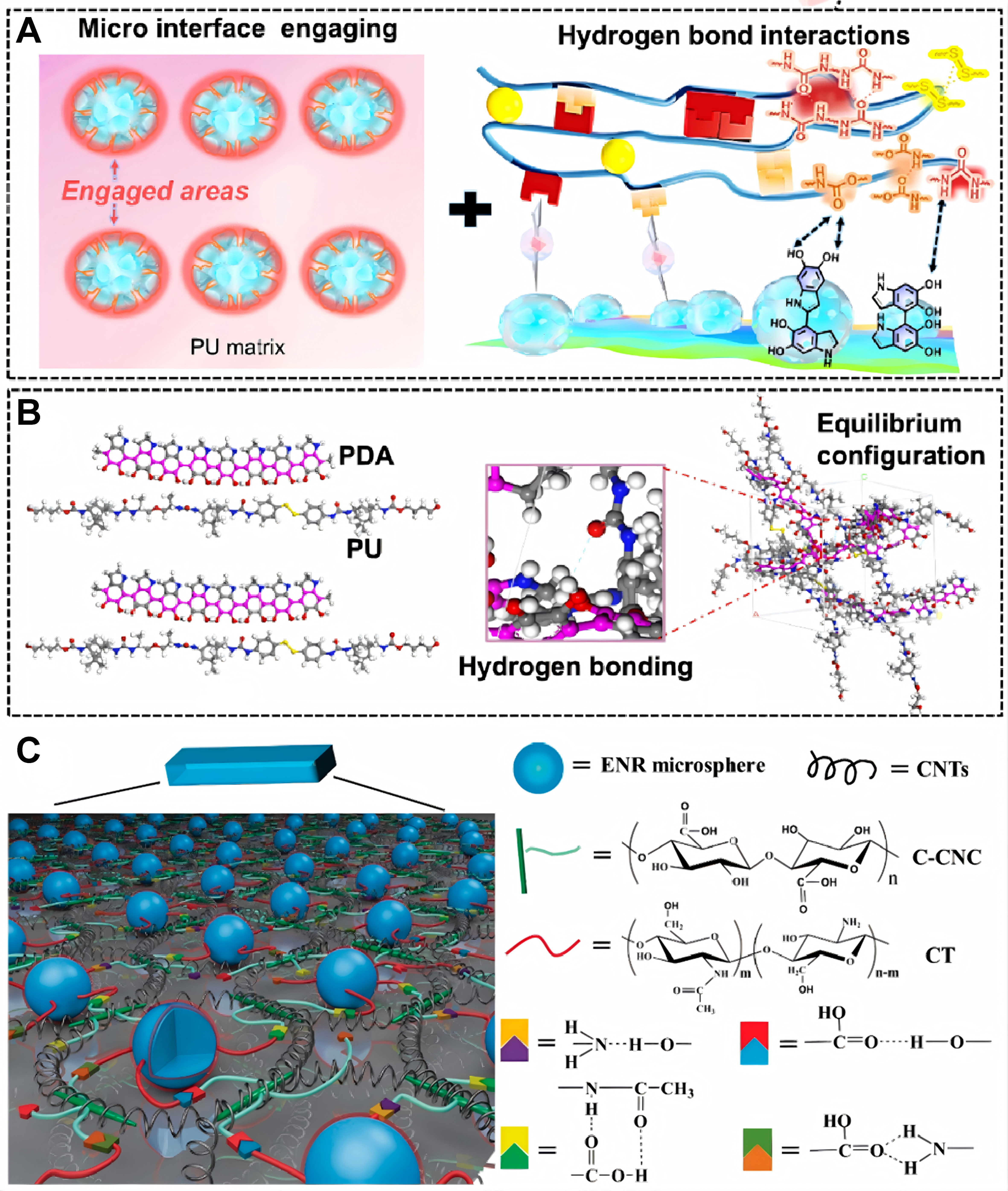
Figure 12. (A) Schematic diagram of biscaled, hierarchical interface interaction between PU and MPDA nanospheres; (B) Molecular chain model of PU and PDA, and visual representation of cells simulating equilibrium states of PU elastomers and PDA polymers. The marked dashed boxes indicate the hydrogen bond interactions extracted between PU and PDA. (A and B) are reprinted with permission from Ref.[65]. Copyright 2025. Licensed under CC BY 4.0; (C) Schematic illustration of proposed supramolecular networks formed by multiple hydrogen bonds, integrated with a nanostructured conductive network of CNTs within ENR latex microspheres. (C) is reprinted with permission from Ref.[66]. Copyright 2023. Licensed under CC BY 4.0. PU: Polyurethane; MPDA: mesoporous polydopamine; PDA: polydopamine; CNTs: carbon nanotubes; ENR: epoxy natural rubber; C-CNC: carboxylated cellulose nanocrystals; CT: chitosan.
In addition, to improve the thermal conductivity of self-healing thermally conductive composite materials, Xing et al. used a physical blending method to fill surface-functionalized BNNSs into hydrogen bond-based supramolecular polymers[70]. When the filler loading is 8 vol%, the thermal conductivity is about
Inorganic phase-change materials, due to their high energy storage density and stable phase-change temperatures, are promising materials for personal thermal therapy and thermal management of electronic devices. However, the poor flexibility and irreversible fracture of inorganic phase-change materials are long-term bottlenecks to achieving efficient thermal management. Li et al. proposed a method for preparing self-healing flexible sodium acetate trihydrate (SAT)/expanded graphite (EG)/borax/sodium carboxymethylcellulose (CMC) (labeled SEBC)-based polyacrylamide (PAM)/chitosan (CS)/thermal management by constructing a PAM/CS flexible dual-network hydrogel[71]. SEBC hydrogel composites possess self-healing ability and a certain degree of flexibility. SEBC encapsulated by PAM and CS forms a cross-linked dual network to prepare self-healing PAM/CS/SEBC hydrogel composites. A PAM/CS content of 50 wt% gives the composite excellent flexibility and 87.9% self-healing efficiency. Damaged and self-healing composites exhibit thermal/conductivity properties and thermal stability close to those of the original composites due to their excellent self-healing capabilities. Additionally, energy devices based on flexible PAM/CS/SEBC hydrogel composites have been developed to enable personal thermal therapy and efficient battery thermal management.
Therefore, designing new self-healing composites with high thermal conductivity is currently one of the main tasks for functional thermally conductive composite materials. Non-covalent interactions such as hydrogen bonding and metal coordination can achieve room-temperature self-repair, but the mechanical strength of the matrix relying solely on non-covalent crosslinking is generally low. When the amount of thermally conductive filler increases, molecular chain segment movement is constrained by the packing, and chain segment diffusion is hindered, resulting in a significant decrease in healing efficiency. How to balance room-temperature repair capability with mechanical and thermal conductivity is the core issue of this type of system.
Nevertheless, water-mediated hydrogen-bonded hydrogel systems (PDMS-COOH/graphene, PAM/CS/SEBC) face durability limitations for electronic devices running at high temperature and low humidity. Water molecules act as bridge units, activating reversible hydrogen bond reconstruction; long-term high-temperature operation accelerates water evaporation, breaking hydrogen bond networks, suppressing chain diffusion, and gradually reducing self-healing capacity. Low-humidity environments also trigger matrix shrinkage and interfacial void generation, drastically elevating bulk thermal resistance. The latent enthalpy of water dominates short-term repair performance, yet evaporative dehydration is an irreversible degradation pathway under cyclic thermal loads, restricting their long-cycle service life in dry high-temperature electronic environments.
Ionic bond function
Ionic bonds are reversible interactions formed between positive and negative ions[71,72]. Ionic bonds have strong forces, unsaturation, and non-directionality; their strength is similar to covalent bonds but stronger than hydrogen bonds. Ion-based bonding is one of the common methods for designing and preparing self-healing materials.
Wang et al. proposed a gelatin-based hydrogel grafted onto polypyrrole (PPy), featuring conductivity, self-healing capability, and injectability[73]. By grafting methacrylic anhydride onto gelatin, double-bond functional gelatin [gelatin methacryloyl (GelMA)] was produced, and then ordinary conductive polymer PPy was grafted onto gelatin (PPy-GelMA). Ultimately, PPy-grafted gelatin was mixed with iron through double-bond reactions to form a hydrogel (PPy-GelMA-Fe) [Figure 13A and B]. The results show that due to the reversible interaction between iron ions and gelatin and PPy, the hydrogel has good electrical conductivity and self-healing ability. Because ionic bonds are non-saturated and non-direct, their effect on temperature is minimal [Figure 13C]. Therefore, the self-healing efficiency is quite significant. Chaleshtari and Foudazi[74] used polymerized high-phase internal phase emulsions (polyHIPEs) as templates for synthesizing polypyridyl (PPy) monolithic composites. The resulting monolithic composites have larger surface areas and effective functional groups, making them suitable for removing hexavalent chromium from contaminated water. The attraction between Cr(VI) ions and positively charged nitrogen atoms in the PPy chain and Cr(VI) reduction on the composite surface are possible mechanisms for Cr(VI) removal using PPy@polyHIPE composites. The adsorption results show that Cr(VI) removal increases from neutral pH 7 to acidic pH 2, where the presence of sulfate anions in the solution does not have a significant effect on Cr(VI) removal. Due to the high sensitivity of ionic bonds to environmental acidity and alkalinity, there is currently no specific research on self-healing thermal conductivity. In the future, it is hoped that suitable application environments will be found to construct self-healing thermally conductive composite materials based on ionic bonds.
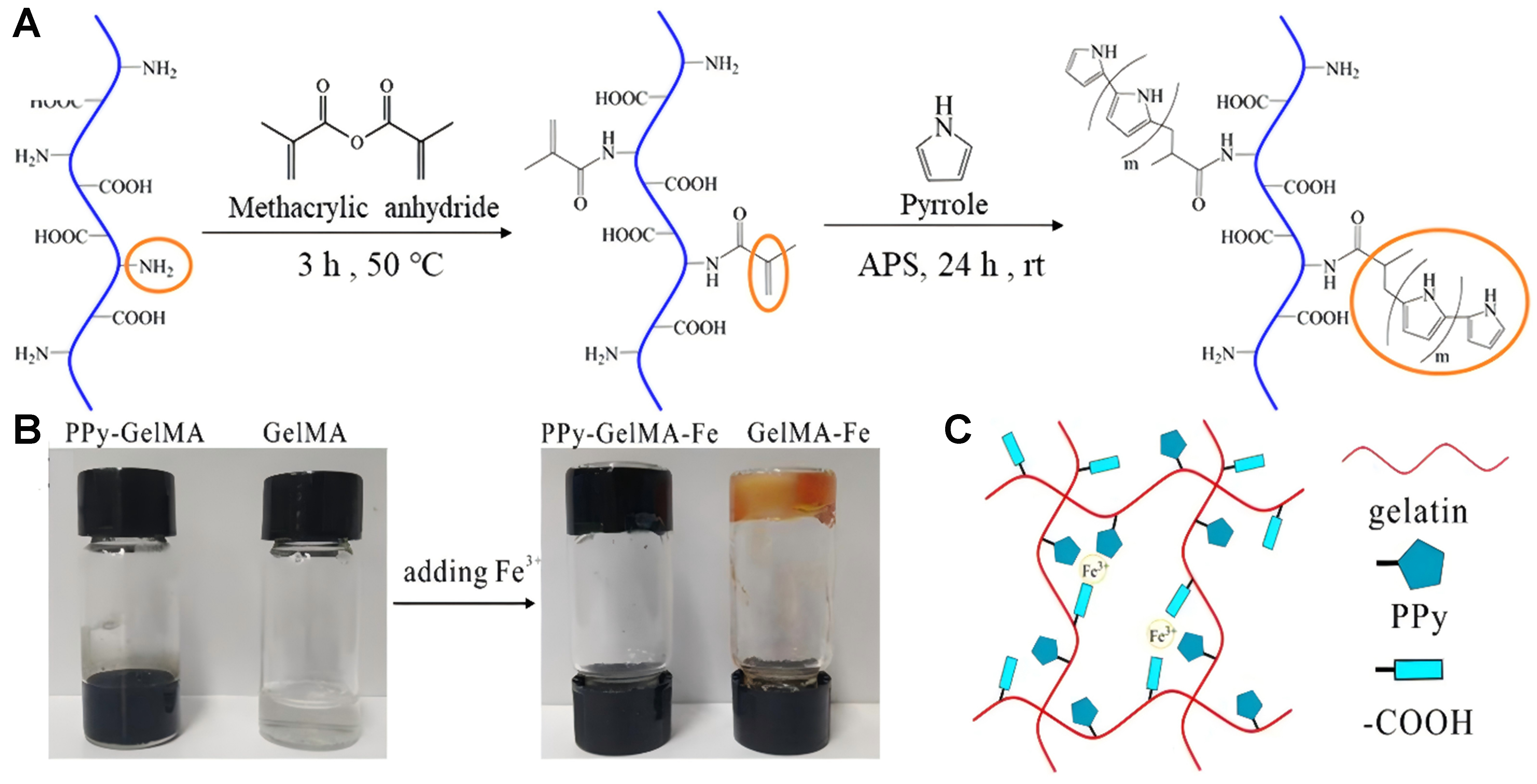
Figure 13. (A) Synthesis process of MA and PPy-GelMA; (B) Photographs of PPy-GelMA and GelMA; (C) Schematic diagram of PPy-GelMA-Fe network structure. (A-C) are reprinted with permission from Ref.[73]. Copyright © 2022 ACS. MA: Methacrylic anhydride; PPy: polypyrrole; GelMA: gelatin methacryloyl; APS: ammonium persulfate.
π–π action accumulation
π–π interaction is a dynamic weak interaction between aromatic rings[75]. In terms of composition, one part is a folded oligomer lacking π electrons, while the other part is an oligomer rich in π-electron groups. Where appropriate, rapid complexation between the two parts can form a dynamic polymer network structure stacked via π–π interactions, while imparting relatively sensitive self-healing properties to the material[75,76].
In addition to the π–π stacking mentioned above, hydrogen atoms on the aromatic ring can form weak hydrogen bonds with π electrons on other aromatic rings[77]. Mechanically, when the material is heated, the π–π stacking is disrupted, and lowering the temperature enables reconstruction of the π–π stacking effect[78]. Deriabin et al. provided a comprehensive review on self-healing silicone materials, highlighting that non-covalent interactions such as π–π stacking and metallophilic interactions are highly effective for creating autonomous self-healing elastomers [Figure 14A][79]. Burattini et al. used hydrogen bonding and π–π interactions to obtain PU materials with rapid self-healing capabilities, achieving a maximum self-healing efficiency of 80%[80]. High self-healing efficiency has led to the application and promotion of the material in thermal conduction. Piotr et al. synthesized self-healing PU nanocomposites modified with functionalized carbon nanotubes (CNT-OH) and short carbon fibers (CF)[81]. As shown in Figure 14B, the introduction of these fibrous carbon components significantly improved the thermal conductivity of the nanocomposites, with an increase of about 140% compared to neat PU, which facilitates the heat transfer from the environment to the interior necessary to initiate self-healing. Furthermore, Figure 14C illustrates the proposed healing mechanism, where the self-healing process involves both the rebuilding of hydrogen bonds between PU chains and the formation of new bonds between the functional groups on the carbon component surfaces and the PU matrix. The nanocomposites achieved up to 72% recovery of their initial strength after healing at 60 °C, demonstrating that the synergistic effect of carbon fillers enhances mechanical strength and thermal conductivity while maintaining effective self-healing capabilities.
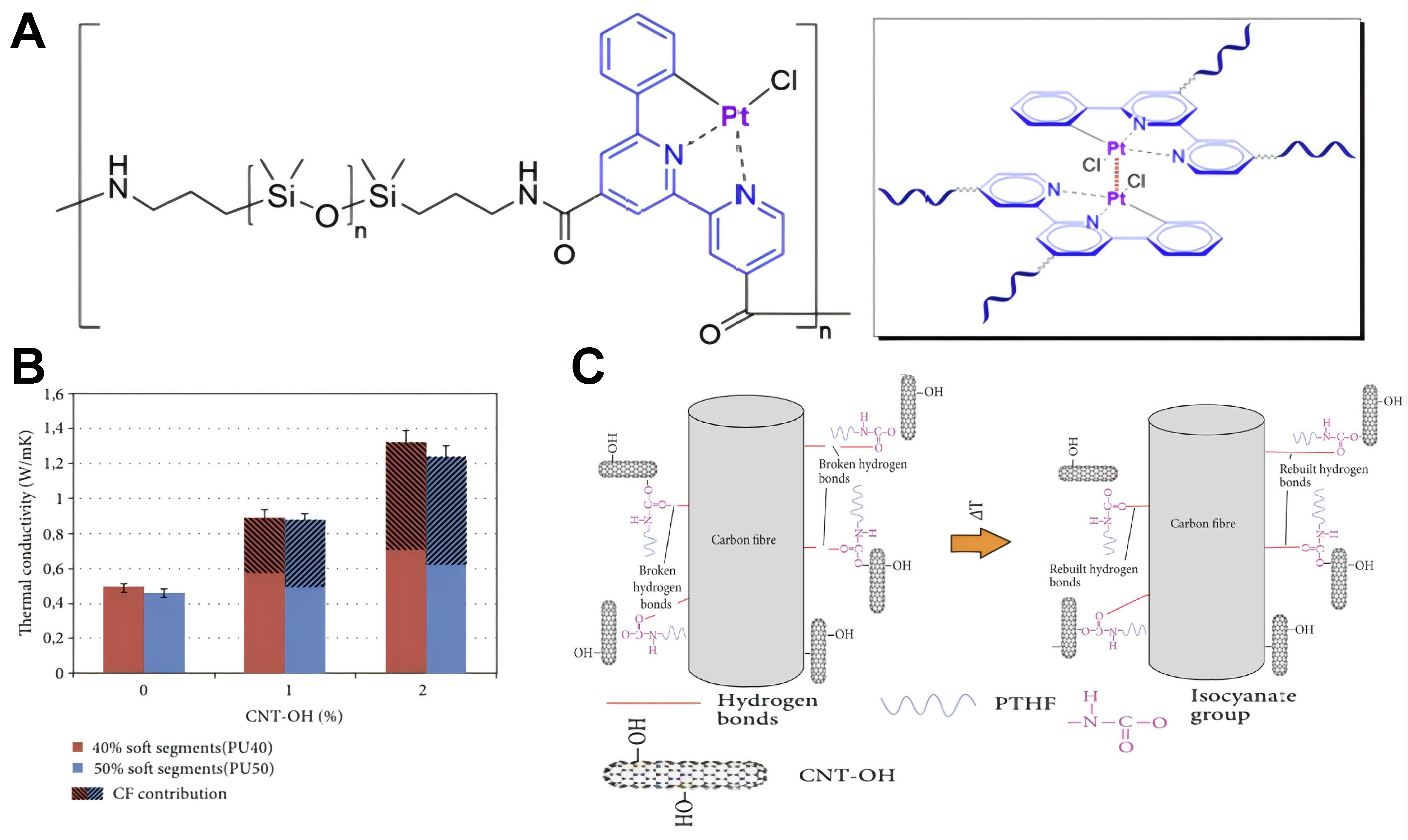
Figure 14. (A) Structure of SH polymer based on intermolecular metallophilic Pt–Pt interaction. (A) is reprinted with permission from Ref.[79]. Copyright 2023. Licensed under CC BY 4.0; (B) Thermal conductivity of neat PU and modified with CNT-OH and CF; (C) Scheme of healing mechanism in the PU matrix containing CNT-OH and CF. (B and C) are reprinted with permission from Ref.[81]. Copyright 2020. Licensed under CC BY 4.0. SH: Self-healing; PU: polyurethane; CNT-OH: functionalized carbon nanotubes; CF: carbon fibers; PTHF: poly (tetrahydrofuran).
Self-healing materials based on covalent and non-covalent bonds
As dynamic covalent bonds and dynamic non-covalent bonds continue to develop, researchers have combined reversible and non-covalent bonds to obtain multiple self-healing materials that combine self-healing and mechanical properties. Therefore, materials combining two covalent bonds are often referred to as fourth-generation self-healing materials.
Rekondo et al. designed and prepared a novel high-strength polyurea-PU self-healing material cross-linked with aromatic disulfides based on dynamic hydrogen and disulfide bonds, achieving a self-healing efficiency of about 97% at room temperature for 24 h[82]. Additionally, Cheng et al. used cis-1,4-polyisoprene to form disulfide bonds on the main chain, then introduced aromatic disulfides into the main chain, opening the ring to produce hydroxyl groups capable of forming hydrogen bonds[83]. Materials based on disulfide and hydrogen bonds have a maximum mechanical strength of 9.30 MPa, and a healing efficiency of up to 98% after 6 h at 120 °C. In addition to the combination of hydrogen bonds and disulfide bonds, Zhao et al. innovatively combined hydrogen bonds with DA reactions, resulting in PDMS-poly(ε-caprolactone) (PCL)-DA with a maximum tensile stress of 3.25 MPa and a self-healing efficiency of 83%[84]. Additionally, Hua et al. used disulfide bonds and coordination bonds to physically blend liquid metal (LM) with polysulfide rubber (PSR) to obtain high-tensile thermal conductivity materials - liquid metal self-healing composite (LM-SH) that combine high thermal conductivity and self-healing functions[85]. Under the action of dynamic disulfide bonds and metal-sulfhydryl reversible coordination bonds, when LM content is 50%, the thermal conductivity of the composite material is 0.70 W·m-1·K-1. After
In summary, combining dynamic covalent and non-covalent bonds greatly alleviates self-healing conditions, improves material self-healing efficiency, and significantly enhances mechanical properties and thermal conductivity recovery[84-86]. Therefore, developing dynamic and non-covalent bonds can achieve complementarity in multiple aspects such as mechanical strength, thermal stability, and processing performance of materials, achieving rapid self-healing. In addition, covalent-non-covalent dual-network strategies are considered effective solutions for balancing strength and repair performance, but the coupling mechanism among multiple dynamic bonds remains unclear. The temperature windows for dissociation and recombination of different dynamic bonds are difficult to match precisely. Most dual-dynamic system designs still rely on trial and error and lack molecular theoretical guidance, representing a research gap that requires focused exploration in the future.
Lin et al. found that easy fabrication of robust, thermally conductive, self-healing, and recyclable organosilicon composites remains a major challenge, so this paper proposes an asymmetric dynamic cross-linked chain strategy [Figure 15A][87]. Due to the better synergy between dynamic and non-covalent bonds, this cross-linked network design increases the tensile strength of the silicone elastomer by three times compared to traditional symmetrical cross-linked structures (1.7 MPa), reaching 5.1 MPa. Moreover, this composite material can be repeatedly self-healed and reprocessed, with tensile strength and thermal conductivity restored to 95%. This composite material can also be recycled into silicone substrates and fillers, and the recycled materials can be reshaped into new composites, thereby recycling electronic devices. Therefore, this work opens new avenues for intelligent thermal management in electronic devices. To address the rising power consumption of data center processors and the growing emphasis on environmental sustainability, Zhang et al. shift the anticipated from traditional air cooling to immersion liquid cooling requires multifunctional integration of polymer-based thermally conductive materials [Figure 15B and C][88]. Here, inspired by mussels, we demonstrate a copolymer, PDMS-DMA, which has multiple reversible molecular interactions and can be combined with LM (EGaIn) to produce flexible, waterproof, and electrically insulating thermally conductive composite materials. The resulting PDMS-DMA/EGaIn composite material demonstrates a harmonious combination of multiple properties, including low modulus (75.8 kPa), high thermal conductivity of 6.9 W·m-1·K-1, and rapid room-temperature self-healing capability, enabling complete repair within 20 min even underwater. Based on its electrical insulation and waterproof properties, PDMS-DMA/EGaIn has become a promising candidate for efficient and stable heat transfer in air and underwater thermal management. LM filled composites (LM/PSR, PDMS-DMA/EGaIn with
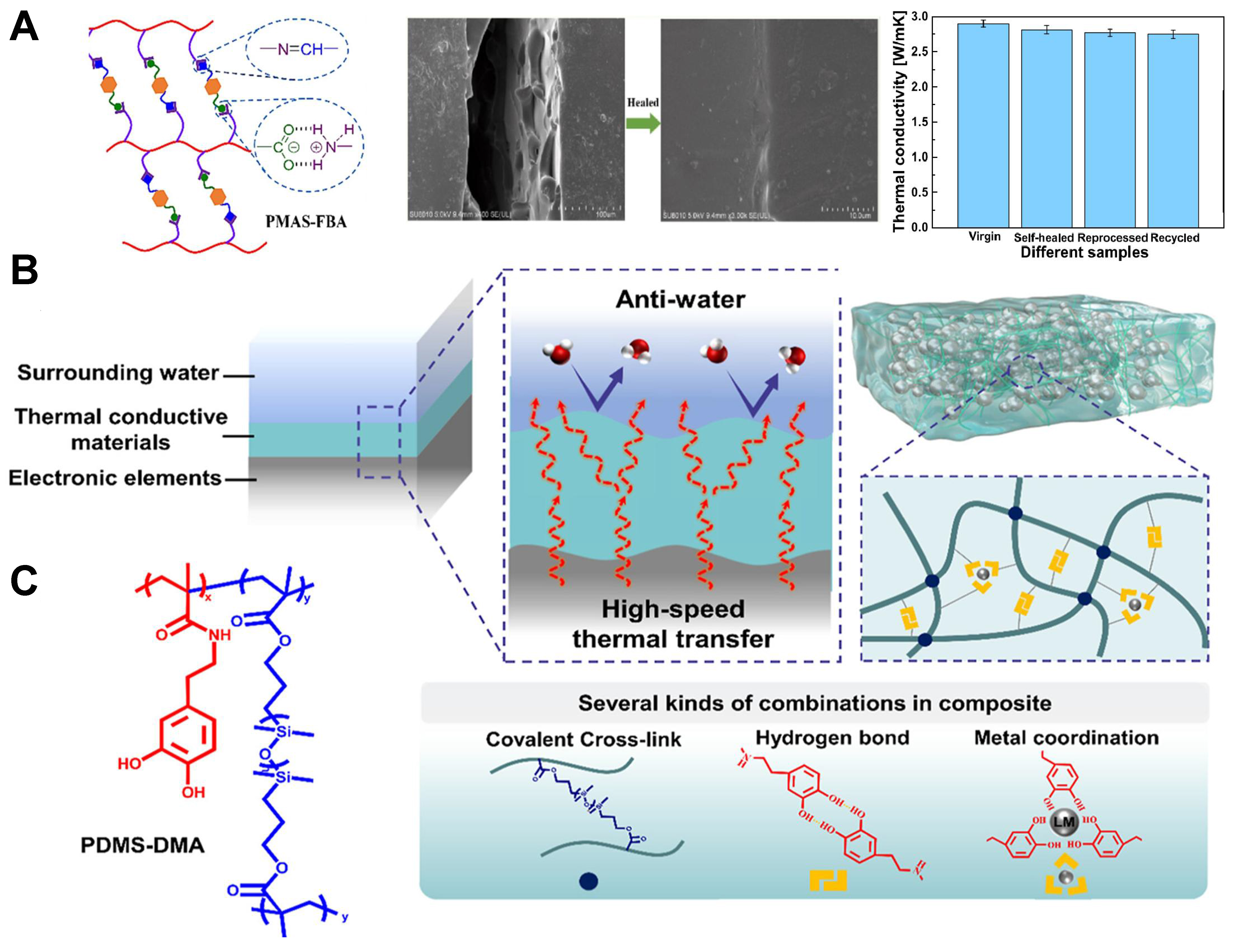
Figure 15. (A) Preparation of PMAS-FBA and its thermal conductivity. (A) is reprinted with permission from Ref.[87], Copyright © 2024 Elsevier; (B) Mussels inspired the preparation of thermally conductive composite materials; (C) Imitation mussel polymer structure. (B and C) are reprinted with permission from Ref.[88], Copyright © 2024 ACS. PMAS: Matrix aminopopyl polydimethylsiloxane; FBA: 4-formylbenzoic acid; PDMS: polydimethylsiloxane; DMA: dopamine methacrylate.
As shown in Table 1, a horizontal comparison of matrix, filler, repair mechanism, and overall performance of various typical polymer-based thermally conductive self-healing composites can visually demonstrate the advantages and shortcomings of different strategies.
Summary of typical polymer-based thermally conductive self-healing composites
| System classification | Polymer matrix | Thermal conductive fillers | Self-healing mechanism | Thermal conductivity /(W·m-1·K-1) | Healing efficiency (thermal conductivity/mechanics) | Healing conditions | Healing time | Mechanical properties | Practical application | Ref. |
| Microcapsule external support type | Epoxy resin | Graphite/BN microcapsules | Microcapsule rupture releases repair agent polymerization | 0.35-0.65 | 60%-75% | Room temperature | 10-40 min | 1.5-2.8 MPa | protective coatings; heat dissipation for low-power devices requires only a single repair | [22,23] |
| Microvascular external support type | Epoxy matrix | Boron nitride | Vascular network releases repair agents | 0.4-0.8 | 50%-70% (7 cycles) | Room temperature | 20-60 min | 2-3.5 MPa | Structural protective coatings; it is difficult to prepare thin TIMs | [22,29,30] |
| DA dynamic covalent keys | PU/epoxy | h-BN, AgNW | DA heat-reversible covalent reaction | 0.44-1.01 | 70%-85% | Heat at 120-140 °C | 30-120 min | 3-6 MPa | Thermal interfaces for medium- and high-temperature electronic devices; not resistant to low temperatures | [8,35] |
| Dynamic covalent disulfide bonds | PU | BN, graphene | Disulfide bonds undergo thermally reversible fracture recombination | 1.05-3.87 | 80%-90% | Heat at 60-100 °C | > 12h | 2.5-7 MPa | TIMs for power batteries and chips | [50,54] |
| Hydrogen-bonded supramolecules | Modified PDMS | BN, graphene | Multiple hydrogen bonds are non-covalent reversible associations | 0.48-2.58 | 54%-85% | Room temperature /60 °C | 30 s - 24 h | 0.8-2.2 MPa | Flexible wearable electronics; low-stress devices | [65,66] |
| Metal coordination bonds | Polyacrylate | Graphene | Metal-ligand coordination is reversible | 0.71 | 75%-88% | Room temperature | 3-5 h | 1.2-3.0 MPa | Flexible electronic hydrogel systems; limited temperature resistance | [59] |
| Covalent to non-covalent dual dynamics | Polyurea-PU | BN/LM | Disulfide bond + hydrogen bond/coordination synergistic dynamic network | 0.70-6.9 | 85%-98% | 50-90 °C/partial room temperature | 20-240 min | 3-8 MPa | 5G chips, immersion liquid cooling, aerospace thermal control - these offer the best overall performance but high process costs | [85,88] |
Distinct intrinsic self-healing polymer composites relying on varied reversible bonds exhibit unique merits apart from their disparate repair mechanisms, which are summarized and compared as follows: Dynamic covalent bond systems (DA, boronate ester, acylhydrazone, disulfide): Feature high matrix mechanical strength and structural stability after repair; their reversible bonds maintain stable thermal networks under medium-high temperature cycling. Among them, DA materials possess outstanding reprocessability, while disulfide elastomers realize room-temperature self-repair under mild stimulus. Their main advantage lies in balanced mechanical and thermal durability for high-load electronic thermal management. Single supramolecular systems (hydrogen, coordination, ionic, π–π stacking interactions): Low bond activation energy enables rapid, near-room-temperature self-repair without intense heating or UV irradiation; hydrogel-type supramolecular composites offer ultra-low interfacial contact resistance and excellent conformal fitting for microelectronic chips. However, their mechanical robustness is relatively weak. Dual dynamic crosslinked composites (covalent + supramolecular synergistic networks, e.g., PUDA, PDMS-UPy, mussel-inspired PDMS-DMA): Integrate the strengths of the above two categories. Supramolecular interactions guarantee fast, mild-condition repair, while dynamic covalent backbones provide high tensile modulus and cyclic stability. Especially LM-filled dual-network composites (PDMS-DMA/EGaIn) achieve ultrahigh thermal conductivity, together with underwater room-temperature self-healing, exhibiting outstanding comprehensive performance for immersion cooling and high-power devices. Extrinsic microcapsule/microvascular self-healing composites: Do not rely on molecular chain rearrangement of the matrix, so they impose no restriction on filler loading and can achieve ultrahigh thermal conductivity by doping massive conductive fillers. Microvascular structures support multiple repairs via continuous supplementary healing agents, suitable for thick-layer structural thermal interface coatings. The obvious drawback is limited repair times for microcapsule materials and complex preparation of microvascular networks. In short, single supramolecular materials fit low-power miniature electronics requiring fast room-temperature repair; dynamic covalent materials are suited for high-temperature stable service scenarios; dual dynamic crosslink composites represent a promising strategy for advanced thermal management; extrinsic microcapsule/microvascular systems are preferable for thick, large-area thermal protective coatings with ultrahigh filler content.
The balancing relationship between high packing volume and self-healing efficiency
Increasing the loading of inorganic/carbon-based thermally conductive fillers is the most direct strategy to improve the thermal conductivity of composites. Nevertheless, high-filler loading frequently impairs the self-healing performance of polymer matrices, creating a difficult-to-reconcile performance trade-off.
Mechanism of high-filling inhibition of molecular chain migration
A large quantity of rigid thermally conductive fillers dispersed within the polymer matrix physically constrains polymer molecular chains. Fillers act as physical cross-linking points, restricting the movement of molecular segments and reducing chain mobility. As filler content rises, the free volume of the polymer decreases, making it difficult for polymer chains at crack interfaces to diffuse and entangle across fracture gaps. At the filler-polymer interface, molecular-chain adsorption further immobilizes polymer segments and suppresses reptation behavior, which ultimately leads to a pronounced drop in healing efficiency. Even though dynamic reversible bonds can dissociate and recombine, inhibited chain mobility hinders crack closure.
Main strategies for resolving conflicts in interface engineering
Interface engineering through filler-surface modification can mitigate the trade-off between thermal conductivity and self-healing efficiency to a certain extent. The mainstream strategies fall into three categories:
(1) Grafting flexible polymer chains onto filler surfaces: Flexible polymer segments compatible with the matrix are grafted onto boron nitride, graphene, or other filler surfaces. On the one hand, this improves filler dispersion and reduces interfacial phonon-scattering losses. On the other hand, grafted flexible segments serve as buffer domains, reserving space for polymer-segment motion and alleviating steric confinement imposed by fillers.
(2) Introducing dynamic reversible groups onto filler surface: Modify filler surfaces with dynamic bonds such as hydrogen bonds and disulfide bonds. During damage-healing cycles, surface-tethered dynamic groups can directly participate in interface reconstruction, instead of relying purely on diffusion of matrix polymer chains, achieving synchronous restoration of thermal-conductive pathways and polymer networks at crack sites.
(3) Constructing pre-fabricated continuous three-dimensional filler networks: A pre-established interconnected filler framework serves as thermal-transport pathways. High thermal conductivity can be achieved without extremely high filler loading, which preserves sufficient molecular-chain mobility of the polymer matrix.
Analysis of the most promising plan
Among the above approaches, the composite strategy combining dynamic-group grafting on filler surfaces and pre-constructed three-dimensional filler networks appears most promising. Solely grafting ordinary flexible chains can only mitigate segment confinement without participating in interfacial bonding. Relying exclusively on pre-fabricated 3D networks brings weak filler-matrix interfacial adhesion; thermal networks readily disintegrate after cracking. Combining these two approaches enables high thermal conductivity at moderate filler fractions while retaining matrix chain mobility. Meanwhile, surface dynamic groups participate in reconstructing damaged interfaces, balancing both thermal-conductivity recovery and mechanical healing efficiency. Nevertheless, this strategy still faces practical bottlenecks: complex filler-functionalization workflows and high manufacturing costs for large-scale 3D networks require further process simplification.
CURRENT STATUS OF THERMALLY CONDUCTIVE MATERIAL RESEARCH
Practical TIMs for electronic thermal management impose stringent performance constraints beyond static laboratory-measured thermal conductivity, including low interfacial contact thermal resistance, sufficient compressive resilience, and reliable performance retention after thousands of thermal cycling events. These practical requirements have been well summarized in existing TIM-focused review articles. Nevertheless, most self-healing thermally conductive polymer composites reported to date are only characterized under ideal laboratory-scale test conditions, creating a notable performance gap between laboratory demonstrations and real-world engineering requirements.
Extension to thermoelectric and evaporative thermal energy harvesting
Beyond electronic thermal management, self-healing TIMs share identical interfacial regulation logic with thermal energy harvesting devices. Stable low-resistance contact and precise thermal impedance matching are core prerequisites to sustain effective temperature gradients for thermoelectric conversion and evaporative heat collection. Recent research[89] verified that self-repairable dynamic-bond interfacial layers maintain consistent thermal contact under cyclic deformation and avoid gradient attenuation caused by repeated interfacial delamination. The hydrogel and immersion-cooling self-healing composites summarized in this review are fully applicable to harvesting platforms: water-rich hydrogels provide conformal contact with thermoelectric legs, while high-conductivity self-healing polymer matrices serve as evaporation interface layers to stabilize heat transfer loops.
Comparison of typical application scenarios and industrial performance requirements
Thermally conductive self-healing polymer composites show great potential in TIMs, flexible electronics, wearable devices, thermal management of power batteries, and aerospace electronic devices. However, most current research only conducts performance tests in ideal laboratory environments, which still lag significantly behind the actual industrial operating conditions.
TIMs
Industrial-grade TIMs demand low interfacial contact thermal resistance, good compressive resilience, and long-term stability over wide temperature ranges; thermal resistance should not increase substantially after thousands of hot-cold cycles. Guo et al. reported flexible thermal interface composites for practical electronic service, focusing on their thermo-mechanical coupling behaviors[90]. Under cyclic compression and repeated thermal shock in an actual service environment, pre-established thermal conduction pathways are easily destroyed. This highlights that besides static laboratory healing efficiency, self-healing performance under complex thermo-mechanical coupled conditions deserves more attention for engineering translation. Most laboratory-scale studies only characterize room-temperature bulk thermal conductivity and static mechanical healing efficiency; evaluations of interfacial thermal resistance evolution after thermal cycling remain scarce. Even composites satisfying static laboratory benchmarks may suffer degraded thermal recovery capacity under repeated thermal shock, limiting practical deployment.
Flexible electronic products and wearable devices
Flexible electronic and wearable devices require materials combining high tensile resilience and simultaneous recovery of mechanical-thermal performance after damage. For skin-contact wearable scenarios, biosafety and sweat-corrosion resistance are additional practical constraints. Existing studies mostly focus on static damage-repair experiments, while systematic evaluation under coupled multiple bending-deformation damage remains insufficient and cannot fully satisfy long-term service requirements for wearable hardware.
Thermal management of power batteries
Battery thermal-management TIMs must simultaneously achieve high thermal conductivity, electrical insulation, electrolyte-corrosion resistance, and tolerance for periodic thermal shock generated during charge-discharge cycles. Self-healing capacity should be realized under realistic battery-service environments, not merely ambient laboratory air conditions. Presently, relevant repair performance testing under electrolyte immersion and alternating high-low-temperature environments is still insufficient.
Beyond thermal-conductive performance, filler selection introduces critical electrical-safety considerations for battery thermal-management scenarios. Several high-performance thermally conductive fillers reviewed in this manuscript, including metallic nanowires, carbon-based fillers, and liquid-metal phases, deliver outstanding thermal transport capability but are intrinsically electrically conductive. Once microcracks, filler migration, or local filler agglomeration occurs under cyclic thermal-mechanical loading inside battery packs, continuous conductive pathways may form within composites, raising potential risks of internal electrical leakage and short-circuit hazards. By contrast, BN-based filler systems represent a typical electrically insulating, thermally conductive solution. BN fillers possess high intrinsic thermal conductivity together with excellent electrical insulation, good electrolyte-corrosion resistance and chemical inertness, which better match the core safety prerequisites of battery thermal-interface materials. Nevertheless, BN-filled composites usually exhibit relatively lower through-plane thermal conductivity compared with carbon- or metal-based counterparts. Therefore, practical material design for battery thermal management requires deliberate trade-offs between high thermal-transport efficiency and electrical-insulation safety: electrically conductive fillers are more suitable for non-isolated heat-dissipation components where electrical short-circuit risk is strictly excluded, while BN-series insulating fillers are generally preferred for direct-contact thermal-interface layers attached to battery cells to eliminate potential electrical-safety threats.
Aerospace electronic products
Aerospace electronic components operate under extremely harsh conditions: besides thermal conduction and self-healing functionality, materials must resist vacuum environments, drastic temperature swings, and space irradiation. Microcrack formation not only degrades heat dissipation capability but also introduces potential device-safety risks. Nevertheless, systematic research evaluating vacuum- and radiation-resistance properties for self-healing thermally conductive composites remains limited and is still at an exploratory laboratory stage.
In summary, existing laboratory achievements are mostly obtained under ideal testing conditions, and a prominent performance gap persists relative to multi-dimensional industrial indicators for diverse application scenarios. Future research should prioritize performance validation under simulated real-service operating environments.
CONCLUSION AND OUTLOOK
Smart electronic devices must increasingly meet high-speed operation, reliability, and long-term stability demands. During service under complex or extreme conditions, devices are exposed to friction, deformation, thermal gradients, and cyclic mechanical loading that cause structural damage and accelerate the degradation of material performance. In particular, sudden temperature variations and localized heating can generate substantial thermal stresses, resulting in creep, inelastic deformation, and, ultimately, component failure. Therefore, reducing thermal gradients and stresses while improving self-detectability and self-repairability are essential for extending the service life of materials. Polymer-based thermally conductive self-healing composites have emerged as promising candidates in thermal management applications. Combining efficient heat transfer with mechanical damage recovery, these materials can potentially maintain stable operation under complex thermal–mechanical conditions involving temperature fluctuations, deformation, and interfacial pressure. Moreover, self-healing TIMs can improve interfacial thermal coupling, reduce temperature gradients and interfacial thermal resistance, and accommodate the mismatched thermal expansion between adjacent components, thereby improving the long-term stability and reliability of thermal management systems.
Despite considerable progress, several fundamental scientific and engineering challenges remain. The development of thermally conductive self-healing composites is particularly constrained by the intrinsic trade-off between the formation of efficient thermal-transport networks and the molecular mobility required for self-healing. Although a high filler loading generally facilitates the establishment of continuous thermal-conduction pathways, excessive filler content can restrict the polymer-chain mobility, hinder crack closure, and inhibit dynamic-bond reconstruction. Therefore, balancing the thermal conductivity, mechanical properties, interfacial compatibility, and self-healing efficiency remains a central challenge. The major challenges and potential directions of ongoing research are discussed below.
Structural design and mechanism of thermal conductivity self-repair
Structural damage during service can impair both the mechanical integrity and functional performance of polymer-based thermally conductive composites. Self-healing strategies extend service life by repairing cracks and restoring the material’s structural integrity. However, under prolonged high-temperature or cyclic-compression exposure or both, thermally conductive composites are susceptible to microcrack formation and interfacial damage, which can disrupt their thermal-transport pathways and increase their interfacial thermal resistance. Enhancing the self-healing capability of TIMs is therefore essential for long-term applications.
Such enhancement is fundamentally limited by the competing requirements of thermally conductive filler percolation and polymer-chain mobility. The filler loading must be sufficiently dense for constructing continuous thermal transport networks; however, excessively dense filler networks can impose strong steric constraints on polymer chains, reducing the molecular mobility required for self-healing. This trade-off is further complicated by the different healing capabilities of rigid thermally conductive fillers (e.g., CNTs and graphene) and dynamic-bond-rich polymer matrices. To satisfy both requirements - sufficient polymer-chain mobility and efficient thermal-transport pathways - future research should attempt rational regulation of dynamic bond chemistry, crosslinking density, filler loading, and filler-network architecture.
The proposed phenomenological framework considers the relationship among filler percolation, crosslinking density, and residual polymer-chain mobility, providing a basic conceptual understanding of the abovementioned trade-off. However, Mcrit cannot currently be directly and quantitatively determined across different polymer–filler systems. Furthermore, mechanical and thermal-conductivity recovery values are not directly comparable, as they are usually reported at different healing temperatures, healing times, contact pressures, filler morphologies, and testing protocols. Standardized reporting of the healing conditions and testing parameters would improve the comparability of future studies. Nevertheless, a single set of temperature, time, and pressure parameters cannot provide a universal evaluation criterion because the activation energies and triggering conditions vary among the healing mechanisms (DA reactions, hydrogen-bonded supramolecular networks, disulfide exchange, and water-mediated interactions). Therefore, the parameters in this review (60 °C, 2 h, and 10 psi) are proposed only as illustrative reference conditions for thermally triggered systems, not as a universal standard. The healing conditions should be selected according to the specific chemistry and structural characteristics of the target material system.
Elastic and thermally conductive interfaces
As electronic devices become continuously miniaturized and integrated, the requirements of TIMs become increasingly stringent. An ideal material should possess low density, high thermal conductivity, mechanical elasticity, good interfacial conformability, and reliable self-healing capability. However, high filler loading may improve thermal conductivity while restricting polymer-chain mobility, thereby compromising the elasticity, surface conformability, and self-healing performance of the material. Rational design of elastic and thermally conductive structures poses a critical challenge.
Efficient heat transfer requires intimate contact between the TIM and the heat source or heat sink. Surface roughness, interfacial gaps, insufficient filler–matrix compatibility, and poor mechanical conformability can reduce the effective contact area and increase the interfacial thermal resistance. This problem is exacerbated in materials with high filler loading, as the matrix cannot easily deform and conform to microscale surface irregularities under pressure. Therefore, future material designs should seek to minimize the interfacial thermal resistance while preserving sufficient residual polymer-chain mobility for effective self-healing.
Material preparation processes and strategies
The preparation strategy strongly influences the thermal conductivity, mechanical properties, self-healing capability, and processability of polymer-based thermally conductive composites. Current approaches can be broadly categorized by polymer matrix design, physical blending of thermally conductive fillers, and construction of continuous thermal-transport pathways.
The molecular structure of a polymer matrix can be modified by controlling the architecture, crystallinity, molecular orientation, and aggregation behavior of the molecular chains. Although polymer-chain orientation can improve the thermal transport and mechanical strength of the material, excessive structural ordering may reduce its flexibility and self-healing capability. The thermal conductivity and mechanical properties of a blended composite system are governed by the intrinsic properties of the matrix and fillers, filler loading, filler dispersion, network connectivity, and interfacial structure. Increasing the filler content can improve thermal conductivity while undesirably increasing viscosity, reducing processability, and restricting polymer-chain mobility.
Constructing continuous thermal-transport pathways through self-assembly, templating, external-field alignment, or extrusion can improve both filler utilization and thermal conductivity. Although 3D filler networks can establish continuous thermal pathways with less filler required compared with randomly dispersed fillers, interfacial sliding or structural rearrangement of inorganic fillers during deformation can increase interfacial thermal resistance. In addition, dense filler networks inhibit polymer infiltration, while excessively sparse networks may provide insufficient thermal conductivity. Therefore, rather than optimizing thermal conductivity alone, future preparation strategies should simultaneously consider thermal conductivity, self-healing efficiency, elasticity, mechanical durability, processability, and structural stability.
Heat transfer mechanism during damage repair
Most existing studies focus on the chemistry (dynamic reversible bonds and extrinsic healing systems) of self-healing; the evolution of heat-transfer pathways during the damage–healing cycle remains comparatively less understood. Heat transfer through polymer-based thermally conductive composites is primarily governed by phonon transport through the thermally conductive filler network and across the filler–matrix interfaces.
The interconnected filler network in an intact composite already provides efficient heat-transfer pathways. The orientation of the filler network can further regulate the direction of heat transfer, enhancing in-plane thermal conductivity. Meanwhile, the interfacial thermal resistance strongly depends on interfacial interactions between the thermally conductive fillers and the polymer matrix. Weak interfacial interactions can increase phonon scattering and reduce the overall thermal conductivity. Consequently, surface functionalization and interfacial engineering of thermally conductive fillers are important strategies for improving filler–matrix coupling and reducing interfacial thermal resistance.
Crack formation disrupts the continuity of the filler network and enables the development of air-filled gaps at the damaged interface. These defects interrupt the thermal-transport pathways and substantially increase interfacial thermal resistance. Macroscopic cracks can be closed through polymer-chain diffusion and dynamic-bond reconstruction, thereby restoring the mechanical integrity of the material, but these procedures may not completely reconstruct the original filler network. After apparent crack closure, residual nanoscale gaps and imperfect filler–filler contacts can continue to scatter phonons and raise thermal resistance. In such systems, mechanical recovery may substantially exceed thermal-conductivity recovery.
In most studies, thermal conductivity is characterized before and after healing, without directly monitoring the evolution of filler networks and heat-transport pathways using in situ techniques during the healing process. A more detailed understanding of heat transport throughout the damage–healing cycle would establish the relationship between structural reconstruction and thermal-conductivity recovery, guiding the design of composites that simultaneously achieve high thermal conductivity and efficient post-damage recovery.
Application and promotion
Materials research is ultimately intended for practical application. Although self-healing materials have been widely investigated for flexible electronics, sensing, biomedical devices, and protective coatings, practical applications of self-healing thermally conductive composites are not yet established. New material formulations and proof-of-concept demonstrations have been reported, but with limited systematic validation under realistic operating conditions.
Extrinsic and intrinsic self-healing systems have their own advantages and limitations. As extrinsic systems rely on stored healing agents, they are particularly suitable for infrequently damaged applications, but their healing capacity may be limited by the finite amount of available healing agent. Intrinsic systems, with reversible interactions integrated into their polymer networks, can potentially withstand multiple healing cycles but commonly involve trade-offs among healing conditions, mechanical performance, thermal conductivity, and long-term stability.
In addition, the post-damage reconstruction of thermal-transport pathways remains insufficiently understood. Macroscopic thermal conductivity is usually evaluated before and after healing, but direct microscopic evidence of the evolution of filler-network connectivity is lacking. Future research should therefore emphasize application-oriented evaluations, repeated damage–healing cycles, long-term thermal aging, and in situ characterization of thermal-transport pathways.
Conclusion and future perspectives
Despite notable progress in self-healing polymer-based thermally conductive materials, several fundamental issues have been overlooked. In particular, establishing new reversible bonds or supramolecular interactions provides additional opportunities for constructing such materials. Molecular and microstructural limitations have obstructed the construction of polymer-based elastomers with the dual functionalities of high thermal conductivity and rapid self-healing performance. Future research should therefore focus on the development of two types of material systems with different molecular and microstructural designs and different mechanisms for self-healing chemical bonds: 3D interconnected carbon-based thermally conductive networks and polymer networks containing self-healing chemical bonds. The polymer structures and compositions in such systems are regulated through multiple self-healing chemical bonds, conferring the requisite high thermal conductivity and rapid self-healing for recovery of thermal conductivity and structural integrity in different service environments. From a mechanistic perspective, future studies should also undertake rational design of molecular structures, microstructures, and self-healing chemical bonds to create continuous, directionally oriented thermally conductive 3D networks, self-healing polymer matrices, and multiple intermolecular interactions among these. It is especially important to identify the key structural features governing heat transport and self-healing and design polymer systems containing self-healing chemical bonds with different bond energies and temperature responses. Materials with simultaneous high thermal conductivity and rapid self-healing ability require polymer matrices with strong self-healing performance and good interfacial contact between the polymers and thermally conductive frameworks. Such studies may also help clarify the effects of strong, highly elastic, highly adhesive, self-healing multiscale interfaces on interfacial phonon scattering, facilitating preliminary applications of thermally conductive self-healing composite materials. Subsequent research is recommended in the following areas:
(1) Multiscale interface regulation to balance the filler percolation density against polymer chain mobility: The orientations and crosslinking degrees of polymers should be carefully controlled. In situ grafting or coating modifications on thermally conductive fillers can reduce steric confinement at the filler–matrix interface. Researchers should construct continuous thermally conductive frameworks with moderate percolation densities (ϕ ≈ ϕc) that retain residual polymer-chain mobility above the critical level (Mcrit). This strategy can reduce thermal resistance at the filler–polymer interface and improve the structural continuity of the composite. It may also enable quantification of the critical upper limit of filler percolation in different dynamic bonding systems, elucidate how filler percolation suppresses polymer-segment reptation, and refine our quantitative understanding of thermal-conductivity recovery through coupled percolation–reptation dynamics.
(2) Development of multiphysics frameworks for simulating coupled phonon–polymer-reptation: Future studies should integrate lattice-phonon scattering with molecular-chain diffusion into multiphysics simulation frameworks that quantitatively analyze the kinetics of dynamic-bond reconstruction under filler-induced steric confinement. These frameworks could predict the reduction in the polymer rearrangement window as the filler-percolation density increases and provide structural strategies for optimizing the trade-off between high filler loading and self-healing efficiency. In addition, the effects of bond cleavage and reformation on interfacial phonon scattering and Kapitza resistance should be quantified. Fracture can generate substantial conformational disorder and numerous phonon-scattering sites. Although dynamic bond reconnection can partially eliminate these barriers, it cannot undo irreversible residual chain disorder at the healed interface, which permanently lowers phonon transport. This effect may be more pronounced in single supramolecular networks than in dual-crosslink networks. Meanwhile, the complete damage–healing process can be visualized using in situ electron microscopy and phase-resolved atomic force microscopy, validating the dynamic evolution of filler percolation networks and polymer-chain mobility during healing.
(3) Investigation of molecular- and microscale changes during damage and self-healing: Clarifying the molecular- and microscale structural changes throughout damage and self-healing processes is vital. In general, polymer-based thermally conductive self-healing composites enter a nonequilibrium state when damaged, which transitions toward equilibrium during self-healing. Different diffusion mechanisms are reported to dominate at different self-healing stages; specifically, anomalous diffusion governs short-term healing, and jump diffusion of open-chain segments contributes to long-term healing. Therefore, future studies should employ models of non-entangled polymer networks and label the ends of polymer chains to facilitate direct tracking of their motion. Fluorescent molecules copolymerized onto polymer chains would allow monitoring of the self-healing process through fluorescence intensity changes. Such approaches would further elucidate the underlying molecular mechanisms of self-healing.
(4) Development of large-scale preparation and application technologies: The limited macroscopic areas and volumes of thermally conductive fillers have limited the size of polymer-based thermally conductive self-healing composites, which are currently prepared as small-sized samples. Effective processing technologies with improved filler incorporation and processing efficiency, enabling the fabrication of large-sized, high-performance thermally conductive materials, should be developed. These advances would further facilitate the application of such materials in electronics, aerospace, sensing, and other fields.
The development of polymer-based thermally conductive self-healing composites is closely associated with carbon neutrality and sustainable development goals. Such materials are expected to increase the service lifetime, recyclability, and reliability of devices. Accordingly, self-healing polymer systems are intended to introduce self-healing functionality into thermally conductive composite materials for practical applications. However, practical applications of intrinsically self-healing polymers are limited by several inherent challenges: dynamic-bond dissociation under external mechanical or thermal stimuli, large hysteresis loops after self-healing, insufficient elasticity, and poor retention of mechanical properties at elevated temperatures. At present, the development of polymer-based thermally conductive self-healing composites for practical applications remains a major challenge and will require continued efforts in molecular design, structural optimization, processing technology, and performance evaluation.
Future research outlook
Although polymer-based thermally conductive self-healing composites have markedly progressed, their performance, multifunctionality, scalability, and practical applicability remain limited. Based on current developments in this field, this section identifies several future research directions.
Development of intelligent adaptive thermal materials and multifunctional TIMs
Most current thermally conductive self-healing composites are functionally limited and primarily rely on passive damage recovery. Future materials could incorporate adaptive responses to temperature, mechanical pressure, or other environmental stimuli while maintaining efficient thermal transport and self-healing capability. Multifunctional thermal-interface materials integrating thermal conductivity, self-healing, electromagnetic interference shielding, flame retardancy, sensing, or other functions are particularly desired for highly integrated electronic devices. Such multifunctional integration should not overlook the fundamental requirements of thermal conductivity, mechanical durability, and interfacial reliability.
Development of autonomous room-temperature self-healing systems
Many existing high-performance intrinsic self-healing systems must be externally stimulated with heat, radiation, moisture, or solvents to activate effective repair. External stimuli are difficult to provide in applications such as sealed electronic devices. Thermally conductive composites that retain their high thermal conductivity and excellent mechanical properties after incorporating rapid and autonomous self-healing at or near room temperature pose a major developmental challenge, requiring the coordinated molecular design of dynamic reversible interactions, polymer-chain mobility, crosslinking density, and filler–matrix interfaces.
Recyclable and sustainable polymer-based composite systems
Advanced polymer composites are increasingly required to meet sustainability and resource-efficiency goals. Dynamically reversible chemical bonds provide opportunities for reprocessing, repairing, and recycling polymer-based thermally conductive composites. Future research should therefore investigate recyclable and reprocessable self-healing systems that maintain stable thermal conductivity and mechanical performance over multiple processing or recycling cycles. The evolution of filler network connectivity, dynamic bond density, interfacial interactions, and self-healing efficiency during repeated reprocessing deserves particular attention.
Scalable manufacturing processes oriented toward actual production
Most currently reported high-performance thermally conductive self-healing composites have been demonstrated in small laboratory-scale specimens that may not adequately represent the challenges of large-area manufacturing. Future work should establish simple, efficient, reproducible, and scalable processes for fabricating large-area or 3D components with uniform filler dispersion and controlled thermal-transport networks. Continuous processing, large-area molding, extrusion, and other scalable manufacturing technologies may translate laboratory formulations into practical products. Scale-up should be accompanied by systematic evaluations of defects, filler agglomeration, dimensional uniformity, and mechanical reliability.
Digital material design using artificial intelligence and high-throughput simulation
Traditional materials are often developed through trial-and-error experimentation, which can be time-consuming when multiple molecular and structural parameters must be optimized simultaneously. Polymer structures, thermally conductive fillers, filler loadings, network architectures, and dynamic bond chemistries can be rapidly screened through artificial intelligence technologies, machine learning, and high-throughput simulations, which can also predict thermal conductivity, dynamic bond exchange behavior, mechanical properties, and self-healing efficiency to improve the efficiency of data-driven material design. Combining computational predictions with high-throughput experiments may reduce the experimental workload and accelerate the development of optimized composite systems.
Commercialization bottlenecks and cost considerations
The commercial viability of thermally conductive self-healing composites depends not only on material performance but also on manufacturing cost. Relatively expensive fillers such as graphene and boron nitride, along with specialized chemical monomers and functional additives, substantially increase material costs. Future research should therefore consider the relationship between material performance, raw material cost, processing complexity, and service lifetime. The economic feasibility of these materials can be improved by developing lower-cost filler systems, efficient filler-network architectures, and scalable processing technologies.
In parallel, standardized testing and reliability evaluation protocols can facilitate meaningful comparison among different material systems. Long-term thermal aging, cyclic mechanical loading, repeated damage–healing cycles, environmental stability, and interfacial reliability tests can determine the practical performance of these systems. Finally, the establishment of consistent testing and reporting standards can help narrow the gap between laboratory-scale demonstrations and industrial implementation.
DECLARATIONS
Authors’ contributions
Literature collection, manuscript drafting, graphical abstract and schematic diagram design, data sorting and collation: Liu, Y.
Classification and summary of research progress, performance data comparison, reference sorting and partial manuscript revision: Wang, T.
Manuscript framework design, content revision, academic supervision and project administration: Hao, X.
Mechanism analysis, discussion polishing, future outlook writing and language revision: Wang, X.
Research conception, core content revision, manuscript review, funding support, final submission, and confirmation: Yu, H.
All authors have contributed significantly to this review manuscript and approved the final submission.
Availability of data and materials
Not applicable.
AI and AI-assisted tools statement
During the preparation of this manuscript, the authors used ChatGPT (version GPT-5.5 Instant, released 2026-09-12) for language editing, improving readability, grammar correction. In addition, ChatGPT was used to assist in generating graphical abstract element, which was subsequently reviewed, edited, and incorporated into the final figure by the authors. These AI tools did not influence the study design, data collection, analysis, interpretation, or the scientific content of the work. All authors take full responsibility for the accuracy, integrity, and final content of the manuscript.
Financial support and sponsorship
This work was financially supported by the National Natural Science Foundation of China (52303101), the Elite Talent Development Program for Outstanding Youth in Inner Mongolia (Q202507), and the Natural Science Foundation of Inner Mongolia Autonomous Region (2026QB033).
Conflicts of interest
Yu, H. is a Guest Editor of the Special Issue “Flexible Intelligent Sensing and Thermal Interface Materials” in Soft Science. Yu, H. was not involved in any stage of the editorial process for this manuscript, including reviewer selection, manuscript handling, or decision-making. The other authors declare no conflicts of interest.
Ethical approval and consent to participate
Not applicable.
Consent for publication
Not applicable.
Copyright
© The Author(s) 2026.
REFERENCES
1. Zhou, J.; Yao, J.; Song, Y. Storage life assessment method based on segmented nonlinear Arrhenius. J. Beijing. Univ. Aeronaut. Astronaut. 2015, 41, 744-50.
2. Carson, J. K.; Lovatt, S. J.; Tanner, D. J.; Cleland, A. C. Thermal conductivity bounds for isotropic, porous materials. Int. J. Heat. Mass. Transfer. 2005, 48, 2150-8.
3. Callaway, J. Model for lattice thermal conductivity at low temperatures. Phys. Rev. 1959, 113, 1046.
4. Shanker, A.; Li, C.; Kim, G. H.; Gidley, D.; Pipe, K. P.; Kim, J. High thermal conductivity in electrostatically engineered amorphous polymers. Sci. Adv. 2017, 3, e1700342.
5. Wang, Z.; Wu, Z.; Weng, L.; et al. A roadmap review of thermally conductive polymer composites: critical factors, progress, and prospects. Adv. Funct. Mater. 2023, 33, 2301549.
6. Li, G.; Xiao, P.; Hou, S.; Huang, Y. Graphene based self-healing materials. Carbon 2019, 146, 371-87.
9. Hu, Z.; Wu, W.; Chen, X.; Chen, Y.; Chen, J.; Hao, Z. Flexible thermal conductive Al2O3@siloxane composite with rapid self-healing property based on carboxyl-amine dynamic reversible bonds. RSC. Adv. 2022, 12, 6649-58.
10. Zhang, Q.; Chen, G.; Wu, K.; Shi, J.; Liang, L.; Lu, M. Self‐healable and reprocessible liquid crystalline elastomer and its highly thermal conductive composites by incorporating graphene via in‐situ polymerization. J. Appl. Polym. Sci. 2021, 138, 49748.
11. van der Zwaag, S.; Brinkman, E. Self-healing materials: pioneering research in the Netherlands. IOS Press; 2015. https://ebooks.iospress.nl/book/self-healing-materials-pioneering-research-in-the-netherlands. (accessed 2026-11-02).
12. Utrera-Barrios, S.; Verdejo, R.; López-Manchado, M. A.; Santana, M. H. Evolution of self-healing elastomers, from extrinsic to combined intrinsic mechanisms: a review. Mater. Horiz. 2020, 7, 2882-902.
13. Li, B.; Cao, P. F.; Saito, T.; Sokolov, A. P. Intrinsically self-healing polymers: from mechanistic insight to current challenges. Chem. Rev. 2023, 123, 701-35.
14. Yu, H.; Chen, C.; Sun, J.; et al. Highly thermally conductive polymer/graphene composites with rapid room-temperature self-healing capacity. Nanomicro. Lett. 2022, 14, 135.
15. Liu, Z.; Song, K.; Pu, G.; et al. Defect-engineered covalent heterostructures of carbon-based materials for synergistically enhanced thermal conductivity and mechanical properties in energetic composites. Carbon 2026, 247, 121071.
16. Zhang, Y.; Liu, A.; Tian, Y.; et al. Direct-ink-writing printed aerogels with dynamically reversible thermal management and tunable electromagnetic interference shielding. Adv. Mater. 2025, 37, e2505521.
17. Li, Z.; Zhang, Y.; Liu, S.; Lan, J.; Peng, Y.; Zhang, J. A universal strategy towards self-healing materials via dynamic interfacial liquid metal coordination. Nat. Commun. 2026, 17, 2815.
18. Zhang, F.; Zhang, J.; Zhang, K.; et al. Highly thermally conductive liquid crystalline epoxy resin vitrimers with reconfigurable, shape-memory, photo-thermal, and closed-loop recycling performance. Adv. Sci. 2025, 12, e2410362.
19. Zhong, X.; He, M.; Zhang, C.; Guo, Y.; Hu, J.; Gu, J. Heterostructured BN@Co-C@C endowing polyester composites excellent thermal conductivity and microwave absorption at C band. Adv. Funct. Mater. 2024, 34, 2313544.
20. Hu, Y.; Wang, Q.; Ma, H. Machine-learning-assisted searching for thermally conductive polymers: a mini review. J. Appl. Phys. 2024, 135, 120701.
21. Wang, X.; Yu, X.; Liu, Y.; Pan, G.; Yu, H.; Feng, W. Enhanced thermal conductivity of polyurethane composites via microstructural design of 3D interconnected boron nitride networks. Compos. Part. B. Eng. 2026, 324, 113910.
22. Golonka, M.; Laska, J. Microcapsules in self-healing materials: a review. Smart. Mater. Struct. 2025, 34, 113004.
23. Paladugu, S. R. M.; Sreekanth, P. S. R.; Sahu, S. K.; et al. A comprehensive review of self-healing polymer, metal, and ceramic matrix composites and their modeling aspects for aerospace applications. Materials 2022, 15, 8521.
24. Xie, B.; Shi, H.; Song, Y.; Han, E. Self‐healing polyurethane anticorrosive coatings based on alkyd resin microcapsules. Mater. Corros. 2024, 75, 1090-9.
25. Xian, Y. Preparation and properties of isocyanate self-healing microcapsule cement-based material. PLoS. One. 2025, 20, e0314696.
26. Wei, X.; Lu, H.; Zhang, L.; Yang, Z.; Yin, Z.; Li, T. Dual self‐healing and self‐lubricating properties of microcapsules/polyimide‐based composites. Polym. Compos. 2026, 47, 17432-48.
27. Du, W.; Yu, J.; Gu, Y.; Li, Y.; Han, X.; Liu, Q. Preparation and application of microcapsules containing toluene-di-isocyanate for self-healing of concrete. Constr. Build. Mater. 2019, 202, 762-9.
28. Ying, W. B.; Wang, G.; Kong, Z.; et al. A biologically muscle‐inspired polyurethane with super‐tough, thermal reparable and self‐healing capabilities for stretchable electronics. Adv. Funct. Mater. 2021, 31, 2009869.
29. Dry, C. Procedures developed for self-repair of polymer matrix composite materials. Compos. Struct. 1996, 35, 263-9.
30. Toohey, K. S.; Hansen, C. J.; Lewis, J. A.; White, S. R.; Sottos, N. R. Delivery of two-part self-healing chemistry via microvascular networks. Adv. Funct. Mater. 2009, 19, 1399-405.
31. Yu, H.; Chen, C.; Duan, Y.; Wang, L.; Qin, M.; Feng, W. Dual dynamic network polymer reinforced carbon nanotube foam with rapid self‐healing and reversible cycling capabilities. SmartMat 2025, 6, e70006.
32. Zhu, B.; Sun, X.; Feng, Y.; Liu, J.; Tao, X.; Yang, B. Based on the reversible diels-alder reaction of microcapsule/XLPE composites self-healing electrical and water mixed tree branches. Polymer 2025, 338, 129120.
33. Liao, Q.; Ren, H.; Zhou, Z.; et al. Fabrication of high-performance bio-based cellulose/polyurethane composites via Diels-Alder reaction: Wide temperature adaptability, self-healing, and sensing properties. Chem. Eng. J. 2025, 518, 164675.
34. Yu, Z.; Yang, Z. Fabrication of high-strength and self-healing polyurethane composites via Diels-Alder dynamic bonds for sustainable thermal management materials. RSC. Adv. 2026, 16, 16586-94.
35. Cao, Y.; Zhang, J.; Zhang, D.; et al. A novel shape memory-assisted and thermo-induced self-healing boron nitride/epoxy composites based on Diels–Alder reaction. J. Mater. Sci. 2020, 55, 11325-38.
36. Chen, W.; Wu, K.; Liu, Q.; Lu, M. Functionalization of graphite via Diels-Alder reaction to fabricate poly (vinyl alcohol) composite with enhanced thermal conductivity. Polymer 2020, 186, 122075.
37. Zhao, L.; Shi, X.; Yin, Y.; Jiang, B.; Huang, Y. A self-healing silicone/BN composite with efficient healing property and improved thermal conductivities. Compos. Sci. Technol. 2020, 186, 107919.
38. Fatahi, A.; Mohammadi, A.; Pournaghshaband Isfahani, A. Multifunctional, robust, and self‐healable polyurethane coatings cross‐linked by Diels–Alder reaction of calix[4] arenes containing furan groups. J. Appl. Polym. Sci. 2024, 141, e54825.
39. Jiang, Y.; Dong, Y.; Xiong, Y.; et al. Polyurethane/silver nanowire composites with Diels-Alder structure for self-healing and thermal conduction abilities. Colloids. Surf. A. Physicochem. Eng. Asp. 2024, 685, 133291.
40. Zhao, Y.; Li, Y.; Yang, S.; Zhang, Y.; Bai, X. Synergistic enhancement of polyurethane materials by dynamic borate bonds and inorganic nanoparticles. ACS. Appl. Polym. Mater. 2025, 7, 10778-88.
41. Bao, C.; Guo, Z.; Sun, H.; Sun, J. Nitrogen-coordinated boroxines enable the fabrication of mechanically robust supramolecular thermosets capable of healing and recycling under mild conditions. ACS. Appl. Mater. Interfaces. 2019, 11, 9478-86.
42. Lai, J. C.; Mei, J. F.; Jia, X. Y.; Li, C. H.; You, X. Z.; Bao, Z. A stiff and healable polymer based on dynamic‐covalent boroxine bonds. Adv. Mater. 2016, 28, 8277-82.
43. Delpierre, S.; Willocq, B.; De Winter, J.; Dubois, P.; Gerbaux, P.; Raquez, J. M. Dynamic iminoboronate-based boroxine chemistry for the design of ambient humidity-sensitive self-healing polymers. Chemistry 2017, 23, 6730-5.
44. Sun, C.; Jia, H.; Lei, K.; et al. Self-healing hydrogels with stimuli responsiveness based on acylhydrazone bonds. Polymer 2019, 160, 246-53.
45. Li, Z.; Lin, Z. Recent advances in polysaccharide‐based hydrogels for synthesis and applications. Aggregate 2021, 2, e21.
46. Rahman, M. A.; Dionne, C. J.; Giri, A. Thermally conductive self-healing nanoporous materials based on hydrogen-bonded organic frameworks. Nano. Lett. 2022, 22, 8534-40.
47. Zhang, D. D.; Ruan, Y. B.; Zhang, B. Q.; et al. A self-healing PDMS elastomer based on acylhydrazone groups and the role of hydrogen bonds. Polymer 2017, 120, 189-96.
48. Li, X.; Yu, R.; He, Y.; et al. Self-healing polyurethane elastomers based on a disulfide bond by digital light processing 3D printing. ACS. Macro. Lett. 2019, 8, 1511-6.
49. Zhao, Y.; Zhang, Y.; Bai, X.; Wang, Y.; Li, Y.; Yang, S. Sustainable epoxy vitrimer materials with imine and disulfide bonds prepared from epoxidized soybean oils. Ind. Crops. Prod. 2025, 225, 120435.
50. Yang, X.; Guo, Y.; Luo, X.; et al. Self-healing, recoverable epoxy elastomers and their composites with desirable thermal conductivities by incorporating BN fillers via in-situ polymerization. Compos. Sci. Technol. 2018, 164, 59-64.
51. Liu, D.; Yang, T.; Duan, Z.; et al. Controlled synthesis of oxygen-doped rod-shaped boron nitride and its thermal conductivity enhancement properties. J. Solid. State. Chem. 2023, 327, 124273.
52. Dong, H.; Yang, X.; Huang, W.; Gao, J.; Zha, J. High strength, recyclable, durable polydimethylsiloxanes based on carboxylic acid aromatic disulfides with highly efficient room-temperature self-healing. Polymer 2025, 320, 128125.
53. Malik, U. S.; Niazi, M. B. K.; Jahan, Z.; Zafar, M. I.; Vo, D. N.; Sher, F. Nano-structured dynamic Schiff base cues as robust self-healing polymers for biomedical and tissue engineering applications: a review. Environ. Chem. Lett. 2022, 20, 495-517.
54. Wang, S.; Ren, L.; Han, M.; et al. Molecular design of a highly matched and bonded interface achieves enhanced thermal boundary conductance. Nanoscale 2023, 15, 8706-15.
55. Bode, S.; Zedler, L.; Schacher, F. H.; et al. Self‐healing polymer coatings based on crosslinked metallosupramolecular copolymers. Adv. Mater. 2013, 25, 1634-8.
56. Li, C. H.; Zuo, J. L. Self-healing polymers based on coordination bonds. Adv. Mater. 2020, 32, e1903762.
57. Mozhdehi, D.; Ayala, S.; Cromwell, O. R.; Guan, Z. Self-healing multiphase polymers via dynamic metal-ligand interactions. J. Am. Chem. Soc. 2014, 136, 16128-31.
58. Sanka, R. V. S. P.; Krishnakumar, B.; Leterrier, Y.; Pandey, S.; Rana, S.; Michaud, V. Soft self-healing nanocomposites. Front. Mater. 2019, 6, 137.
59. Yang, J.; Yu, W.; Zhang, Y.; Liu, C.; Xie, H. Graphene double cross-linked thermally conductive hydrogel with low thermal contact resistance, flexibility and self-healing performance. Int. Commun. Heat. Mass. Transfer. 2021, 127, 105537.
60. Alamdarnejad, G.; Kokabi, M. Shape memory behavior of polyacrylate-based amorphous nanocomposite hydrogel under uniaxial tension: modeling and experimental. Compos. Part. B. Eng. 2023, 252, 110501.
61. Wang, Y.; Guo, Q.; Su, G.; Cao, J.; Liu, J.; Zhang, X. Hierarchically structured self‐healing actuators with superfast light‐ and magnetic‐response. Adv. Funct. Mater. 2019, 29, 1906198.
63. Karas, L. J.; Wu, C. H.; Das, R.; Wu, J. I. Hydrogen bond design principles. Wiley. Interdiscip. Rev. Comput. Mol. Sci. 2020, 10, e1477.
64. Deng, Y.; Zhang, Q.; Qu, D. H. Emerging hydrogen-bond design for high-performance dynamic polymeric materials. ACS. Materials. Lett. 2023, 5, 480-90.
65. Wang, W.; Jiao, D.; Cao, L.; Liu, C.; Cheng, L.; Deng, K. Photothermally accelerated self-healing poly(urethane-urea) coating reinforced by mesoporous polydopamine modified MXene towards intelligent corrosion protection. Nano. Mater. Sci. 2026, 8, 953-68.
66. Choi, K.; Noh, A.; Kim, J.; Hong, P. H.; Ko, M. J.; Hong, S. W. Properties and applications of self-healing polymeric materials: a review. Polymers 2023, 15, 4408.
67. Yanagisawa, Y.; Nan, Y.; Okuro, K.; Aida, T. Mechanically robust, readily repairable polymers via tailored noncovalent cross-linking. Science 2017, 359, 72-6.
68. Yu, H.; Feng, Y.; Gao, L.; Chen, C.; Zhang, Z.; Feng, W. Self-healing high strength and thermal conductivity of 3D graphene/PDMS composites by the optimization of multiple molecular interactions. Macromolecules 2020, 53, 7161-70.
69. Wang, K.; Zhou, Z.; Zhang, J.; et al. Electrical and thermal and self-healing properties of graphene-thermopolyurethane flexible conductive films. Nanomaterials 2020, 10, 753.
70. Xing, L.; Li, Q.; Zhang, G.; et al. Self‐healable polymer nanocomposites capable of simultaneously recovering multiple functionalities. Adv. Funct. Mater. 2016, 26, 3524-31.
71. Li, Y.; Wu, X.; Tang, L.; et al. Composite material with excellent thermal management and self-healing performance for battery temperature control and human thermal therapy. ACS. Appl. Polym. Mater. 2024, 6, 1460-9.
72. Lan, R.; Hu, X.; Chen, J.; et al. Adaptive liquid crystal polymers based on dynamic bonds: from fundamentals to functionalities. Responsive. Mater. 2024, 2, e20230030.
73. Wang, S.; Lei, J.; Yi, X.; et al. Fabrication of polypyrrole-grafted gelatin-based hydrogel with conductive, self-healing, and injectable properties. ACS. Appl. Polym. Mater. 2020, 2, 3016-23.
74. Chaleshtari, Z. A.; Foudazi, R. Polypyrrole@polyHIPE composites for hexavalent chromium removal from water. ACS. Appl. Polym. Mater. 2020, 2, 3196-204.
75. Xu, Z.; Peng, J.; Yan, N.; et al. Simple design but marvelous performances: molecular gels of superior strength and self-healing properties. Soft. Matter. 2013, 9, 1091-9.
76. Sukul, P. K.; Malik, S. Co(II) induced aggregation of chiral perylene derivatives and macroscopic formation of supramolecular networks. Chem. Lett. 2018, 47, 576-9.
77. Tian, Y.; Yang, J.; Gao, M.; et al. Organic microporous crystals driven by pure C-H…π interactions with vapor-induced crystal-to-crystal transformations. Mater. Horiz. 2022, 9, 731-9.
78. Cao, J.; Meng, L.; Zheng, S.; Li, Z.; Jiang, J.; Lv, X. Self-healing supramolecular hydrogels fabricated by cucurbit [8]uril-enhanced π–π interaction. Int. J. Polym. Mater. Polym. Biomater. 2016, 65, 537-42.
79. Deriabin, K. V.; Filippova, S. S.; Islamova, R. M. Self-healing silicone materials: looking back and moving forward. Biomimetics 2023, 8, 286.
80. Burattini, S.; Greenland, B. W.; Merino, D. H.; et al. A healable supramolecular polymer blend based on aromatic π–π stacking and hydrogen-bonding interactions. J. Am. Chem. Soc. 2010, 132, 12051-8.
81. Piotr, S.; Kinga, P.; Stanislaw, B. Self-healing polyurethane-based nanocomposites modified with carbon fibres and carbon nanotubes. Adv. Polym. Technol. 2020, 2020, 1-13.
82. Rekondo, A.; Martin, R.; Ruiz de Luzuriaga, A.; Cabañero, G.; Grande, H. J.; Odriozola, I. Catalyst-free room-temperature self-healing elastomers based on aromatic disulfide metathesis. Mater. Horiz. 2014, 1, 237-40.
83. Cheng, B.; Lu, X.; Zhou, J.; Qin, R.; Yang, Y. Dual cross-linked self-healing and recyclable epoxidized natural rubber based on multiple reversible effects. ACS. Sustainable. Chem. Eng. 2019, 7, 4443-55.
84. Zhao, J.; Xu, R.; Luo, G.; Wu, J.; Xia, H. Self-healing poly(siloxane-urethane) elastomers with remoldability, shape memory and biocompatibility. Polym. Chem. 2016, 7, 7278-86.
85. Hua, Q.; Yu, G.; Hong, W.; Li, C.; Guo, S. Stretchable thermal interface material with both thermal conduction and self-healing functions based on liquid metal/polysulfide rubber. Polym. Mater. Sci. Eng. 2021, 37, 153-61.
86. Zhang, L. M.; He, Y.; Cheng, S.; et al. Self-healing, adhesive, and highly stretchable ionogel as a strain sensor for extremely large deformation. Small 2019, 15, e1804651.
87. Lin, Z.; Jin, H.; Deng, H.; et al. Robust, self-healable, recyclable and thermally conductive silicone composite as intelligent thermal interface material. Compos. Struct. 2024, 332, 117932.
88. Zhang, H.; He, Q.; Yu, H.; Qin, M.; Feng, Y.; Feng, W. Mussel-inspired polymer-based composites for efficient thermal management in dry and underwater environments. ACS. Nano. 2024, 18, 21399-410.
89. Gong, Z.; Dong, J.; Aung, S. K. K.; et al. Evaporative hydrogels for high-performance ambient body heat harvesting via thermoelectric. Nano. Energy. 2026, 150, 111780.
Cite This Article
 Open Access
How to Cite
Liu, Y.; Wang, T.; Hao, X.; Wang, X.; Yu, H. Preparation and application prospects of polymer-based thermally conductive self-healing composites. Soft Sci. 2026, 6, 101. https://dx.doi.org/10.20517/ss.2026.182
Download Citation
If you have the appropriate software installed, you can download article citation data to the citation manager of your choice. Simply select your manager software from the list below and click on download.
Export Citation File
Type of Import
Tips on Downloading Citation
Citation Manager File Format
Type of Import
Direct Import: When the Direct Import option is selected (the default state), a dialogue box will give you the option to Save or Open the downloaded citation data. Choosing Open will either launch your citation manager or give you a choice of applications with which to use the metadata. The Save option saves the file locally for later use.
Indirect Import: When the Indirect Import option is selected, the metadata is displayed and may be copied and pasted as needed.
About This Article
Copyright

Data & Comments
Data
0












Comments
Comments must be written in English. Spam, offensive content, impersonation, and private information will not be permitted. If any comment is reported and identified as inappropriate content by OAE staff, the comment will be removed without notice. If you have any queries or need any help, please contact us at [email protected].