

Mechanochemical halide segregation enables interfacial engineering in solid-state lithium chalcogen batteries
 0
0 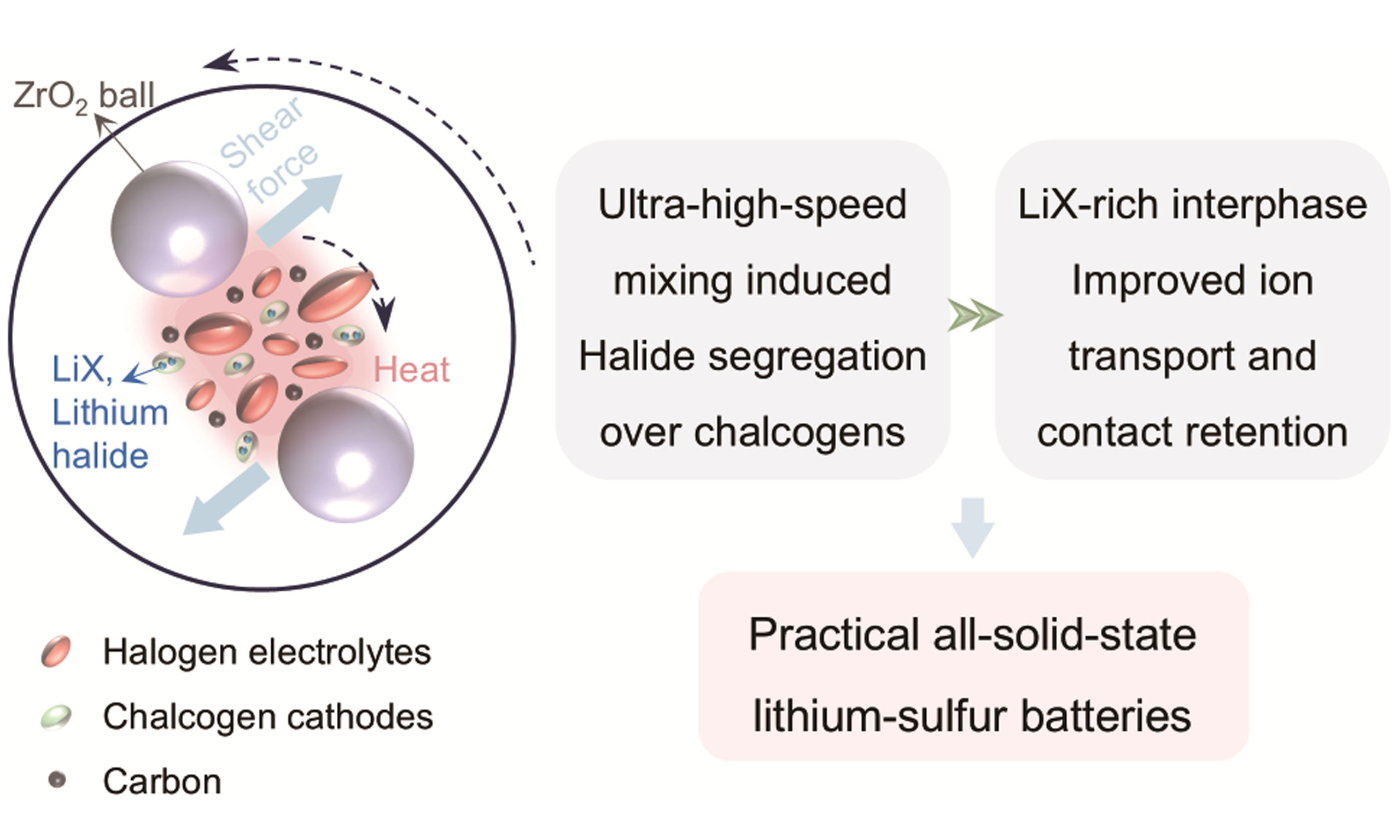


 Download PDF
All-solid-state lithium-sulfur batteries (ASSLSBs) combine a high theoretical energy density with the safety and resource advantages of sulfur[1-3], yet their practical performance is increasingly limited by the composite cathode rather than by bulk solid-state electrolyte (SSE) conductivity alone[4,5]. At high sulfur loading, sluggish ion transport, loss of solid-solid contact, and the large dimensional change associated with sulfur conversion produce strongly coupled electrochemical and mechanical failure[6-8]. A recent study by Lee et al.[9] published in Science offers an unconventional strategy to address these issues: rather than introducing an additional coating or functional component, it transforms electrode mixing itself into an interfacial reaction step[9].
Using ultrahigh-speed (UHS) mixing, Lee et al.[9] showed that halides can partially segregate from halogen-containing SSEs and redistribute onto chalcogen particles as nanoscale lithium-halide-rich interphases [Figure 1A]. The result changes the conventional view of composite preparation. Mixing sulfur, electrolyte, and carbon is normally treated as a physical operation intended to optimize particle contact, tortuosity, and component distribution[10,11]. Here, the processing history also determines local chemistry. Short or low-speed treatment produces little observable segregation, whereas sufficiently energetic mixing generates Cl-rich interfaces; excessive treatment, however, damages the parent electrolyte structure. Thus, the important variable is not mixing speed alone but a process window in which interfacial reconstruction occurs before bulk electrolyte degradation becomes dominant.
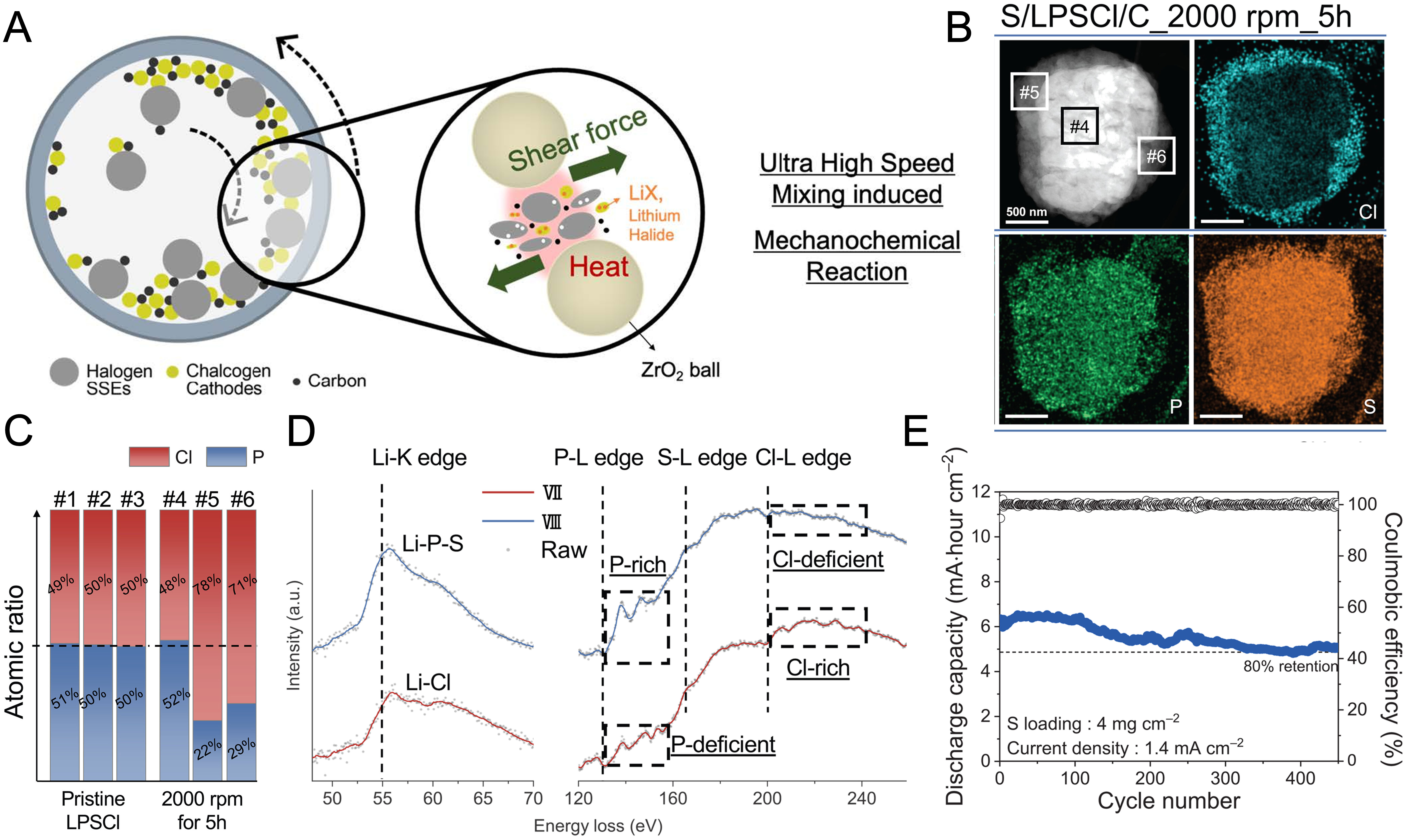
Figure 1. Mechanochemically induced halide segregation in composite chalcogen cathodes. (A) Schematic of mechanically and thermally assisted halide redistribution during ultrahigh-speed (UHS) mixing; (B) High-angle annular dark-field image and elemental maps of a composite S/Li6PS5Cl (LPSCl)/C cathode after mixing at 2,000 rpm for 5 h. All scale bars are 500 nm; (C) Cl-to-P atomic ratios in pristine LPSCl and the UHS-mixed composite cathode; (D) Electron energy loss spectra from selected regions of the composite Se/LPSCl/C cathode; (E) Long-term cycling of the optimized S/LPSCl/C cathode at a sulfur loading of 4 mg cm-2 at room temperature. This figure is adapted with permission[9]. Copyright 2025, The American Association for the Advancement of Science.
The evidence for this reconstruction is unusually diverse. Cryogenic electron microscopy and low-dose imaging overcome the severe beam sensitivity of sulfur and Li6PS5Cl (LPSCl), while elemental mapping and spectroscopy reveal halide enrichment at cathode interfaces [Figure 1B and C][9]. In Se-containing composites, electron energy loss spectra characterization reveals the formation of LiCl together with Li- and Cl-deficient Li-P-S phases at the interface [Figure 1D][9]. Complementary high-resolution imaging in the original study further directly resolves nanocrystalline LiCl alongside Se domains[9]. Halide segregation is observed across several chalcogen cathodes and in Cl-, Br-, and I-containing SSEs, supporting a broader halide-redistribution mechanism rather than a sulfur-specific reaction[9]. Heating experiments further reproduce LiCl formation, whereas shear-assisted particle fracture promotes intimate redistribution. Nonetheless, the mechanistic picture is still largely qualitative. Key parameters such as transient temperature, shear stress, defect generation, and halide diffusivity remain unquantified. Quantification of these variables is a prerequisite for generalizing a laboratory protocol (e.g., 2,000 rpm, 5 h) into a transferable mechanochemical design rule.
The electrochemical outcome is compelling. At a sulfur loading of 4 mg cm-2, the optimized cathode delivers an initial areal capacity of 6.35 mAh cm-2 [Figure 1E], corresponding to approximately 95% sulfur utilization, and retains 80% of its capacity after 450 cycles at room temperature[9]. At 2 mg cm-2, capacity retention reaches 93.2% after 450 cycles[9]. These figures are best viewed in the context of complementary advances rather than as an absolute performance record. Recent mixed-conductor cathodes have achieved sulfur conversion above 94% and cycle lives exceeding 1,000 cycles, whereas redox-mediating solid electrolytes have supported still higher sulfur loadings and exceptionally long cycling[8]. Other interface-engineered argyrodite cells have delivered 11.3 mAh cm-2 with 90% retention at 60 °C, but substantially lower areal capacity under room-temperature long-term cycling[12]. The distinctive feature of mechanochemical segregation is therefore the combination of high utilization, multi-mAh cm-2 capacity, extended cycling, and room-temperature operation without introducing a separate coating step.
The interphase also appears to serve a mechanical function. Online stack-pressure measurements and operando structural characterization indicate smaller pressure variation and limited electrode expansion when segregation is optimized[9]. X-ray absorption measurements show reversible solid-state sulfur conversion without detectable soluble polysulfide intermediates[9]. These results suggest that a nanoscale LiCl-rich region can improve effective ion transport while helping preserve interparticle contact during conversion. Whether the same interphase remains beneficial when external confinement is greatly reduced, however, remains unresolved.
This qualification is important for practical assessment. Most principal measurements were performed with a Li-In anode at approximately 70 MPa, although the original study also reports encouraging operation at 36 and 18 MPa. Practical cells will ultimately require substantially lower pressure, thin solid-electrolyte separators, and limited excess lithium. Evidence from other solid-state architectures shows that compliant interlayers, deformable electrolyte phases and contact-preserving electrode microstructures can support single-digit-MPa operation[13,14], but these solutions have not yet been validated together with high-loading UHS-mixed sulfur cathodes. Thin separators also increase sensitivity to cracking, thickness nonuniformity, local pressure gradients, and lithium penetration. Low pressure and separator thinning should therefore be evaluated as coupled design variables rather than independent targets.
The materials scope also requires careful definition. Current evidence establishes segregation in several halogen-containing electrolytes and chalcogen cathodes, but does not guarantee similar behavior in oxides, hydrides, or other electrolyte families. A viable candidate electrolyte must contain a species capable of kinetically accessible redistribution, form a chemically and ionically compatible interphase with the adjacent electrode, and retain sufficient bulk conductivity after partial segregation[15,16]. These criteria are more stringent than the mere presence of a mobile anion. Likewise, the cathode-side process should not be assumed to transfer directly to a Li-metal anode. Establishing whether mechanically or chemically driven segregation can yield a durable anode interphase will require direct studies of plating, stripping, void evolution, and interphase growth.
Manufacturing provides the final test of the concept. The laboratory optimum of 2,000 rpm for 5 h cannot be transferred directly to continuous equipment, as mixer geometry, batch size, and residence time alter the mechanical-energy distribution. Scale-up should instead be parameterized by specific mechanical energy, torque, motor power, residence-time distribution, and product temperature. These variables are measurable in-line and could be coupled with rapid downstream impedance or spectroscopic quality control. Recent advances in electrochemo-mechanical interface design and dry-electrode processing further suggest that mechanically active manufacturing steps can influence battery performance far beyond simple particle blending[14,17].
Mechanochemical halide segregation therefore matters beyond the specific performance numbers reported by Lee et al.[9] It shows that electrode manufacturing can be treated as a chemical design variable. The next advance will depend on converting this striking empirical observation into a quantitative process-structure-property relationship and demonstrating that its interfacial advantages survive under the low-pressure, thin-electrolyte, and practical anode conditions demanded by real solid-state batteries.
DECLARATIONS
Authors’ Contributions
Proposed and supervised the conceptualization and critical assessment of the literature: Shi, H.; Wu, Z. S.
Wrote the original draft: Ma, Y.
Discussed and commented on the manuscript: Shi, H.; Wu, Z. S.; Ma, Y.
Availability of data and materials
Not applicable.
AI and AI-assisted tools statement
During the preparation of this manuscript, the AI tool ChatGPT (version 5.6, released 2026-7-10) was used solely for language editing. The tool did not influence the study design, data collection, analysis, interpretation, or the scientific content of the work. All authors take full responsibility for the accuracy, integrity, and final content of the manuscript.
Financial support and sponsorship
This work was supported by the National Key R&D Program of China (Grant 2022YFA1504100), the National Natural Science Foundation of China (Grant Nos. 22579164, 22125903, 22309177), the Energy Revolution S&T Program of Yulin Innovation Institute of Clean Energy (Grants E412010508 and E411070316), DICP (DICP I2020032, DICP I202519), the Joint Fund of the Yulin University and the Dalian National Laboratory for Clean Energy (YLU-DNL Fund2025002), and S&T Program of Energy Shaanxi Laboratory (ESLB202403).
Conflicts of interest
All authors declared no conflicts of interest.
Ethical approval and consent to participate
Not applicable.
Consent for publication
Not applicable.
Copyright
© The Author(s) 2026.
REFERENCES
1. Ji, W.; Zhang, X.; Liu, M.; et al. High-performance all-solid-state Li-S batteries enabled by an all-electrochem-active prelithiated Si anode. Energy. Storage. Mater. 2022, 53, 613-20.
2. Zhou, J.; Holekevi Chandrappa, M. L.; Tan, S.; et al. Healable and conductive sulfur iodide for solid-state Li-S batteries. Nature 2024, 627, 301-5.
3. Ge, H.; Long, Y.; Huang, D.; et al. Exploiting deep sulfur conversion by tandem catalysis for all-solid-state lithium-sulfur batteries. Natl. Sci. Rev. 2026, 13, nwaf525.
4. Li, Y.; Song, S.; Kim, H.; et al. A lithium superionic conductor for millimeter-thick battery electrode. Science 2023, 381, 50-3.
5. Ma, Y.; Jin, D.; Shi, H.; et al. A Superionic Conductor Lithium Argyrodite Sulfide of Li7-x(GeSi)(1-x)/2SbxS5I toward all-solid-state lithium-ion batteries. ACS. Energy. Lett. 2025, 10, 1374-81.
6. Hou, L.; Yuan, H.; Zhao, C.; et al. Improved interfacial electronic contacts powering high sulfur utilization in all-solid-state lithium-sulfur batteries. Energy. Storage. Mater. 2020, 25, 436-42.
7. Song, H.; Münch, K.; Liu, X.; et al. All-solid-state Li-S batteries with fast solid-solid sulfur reaction. Nature 2025, 637, 846-53.
8. Wang, D.; Gwalani, B.; Wierzbicki, D.; et al. Overcoming the conversion reaction limitation at three-phase interfaces using mixed conductors towards energy-dense solid-state Li-S batteries. Nat. Mater. 2025, 24, 243-51.
9. Lee, J.; Zhou, S.; Ferrari, V. C.; et al. Halide segregation to boost all-solid-state lithium-chalcogen batteries. Science 2025, 388, 724-9.
10. Yang, X.; Doyle-davis, K.; Gao, X.; Sun, X. Recent progress and perspectives on designing high-performance thick electrodes for all-solid-state lithium batteries. eTransportation 2022, 11, 100152.
11. Wang, J.; Jia, L.; Du, Y.; et al. Space charge regulation for ultra-stable all-solid-state lithium batteries by engineering of argyrodite electrolyte. Natl. Sci. Rev. 2026, 13, nwag015.
12. Yu, Z.; Singh, B.; Yu, Y.; Nazar, L. F. Suppressing argyrodite oxidation by tuning the host structure for high-areal-capacity all-solid-state lithium-sulfur batteries. Nat. Mater. 2025, 24, 1082-90.
13. Wang, P.; Wang, Y.; Jiang, T.; et al. Electrochemically-triggered spin switching enables anti-passivation of active sites in lithium-sulfur catalytic chemistry. Angew. Chem. Int. Ed. 2026, 65, e8601873.
14. Kim, M.; Kim, J.; Choi, B.; et al. Electrochemical stabilization of polytetrafluoroethylene (PTFE) via electronic band engineering enables long-life, high-energy-density Li-ion batteries. Adv. Energy. Mater. 2026, 16, e70845.
15. Jung, J.; Park, J.; Lim, J.; et al. Electrochemo-mechanical effects of Co-free layered cathode on interfacial stability in all-solid-state batteries under high-voltage operation. EES. Batteries. 2025, 1, 1720-30.
16. Wu, X.; Liang, L.; Du, B.; et al. High-conductivity argyrodite electrolyte with self-passivating stability for single-electrolyte all-solid-state lithium batteries. Angew. Chem. Int. Ed. 2026, 65, e23225.
Cite This Article
 Open Access
How to Cite
Download Citation
If you have the appropriate software installed, you can download article citation data to the citation manager of your choice. Simply select your manager software from the list below and click on download.
Export Citation File
Type of Import
Tips on Downloading Citation
Citation Manager File Format
Type of Import
Direct Import: When the Direct Import option is selected (the default state), a dialogue box will give you the option to Save or Open the downloaded citation data. Choosing Open will either launch your citation manager or give you a choice of applications with which to use the metadata. The Save option saves the file locally for later use.
Indirect Import: When the Indirect Import option is selected, the metadata is displayed and may be copied and pasted as needed.
About This Article
Copyright

Data & Comments
Data
0











Comments
Comments must be written in English. Spam, offensive content, impersonation, and private information will not be permitted. If any comment is reported and identified as inappropriate content by OAE staff, the comment will be removed without notice. If you have any queries or need any help, please contact us at [email protected].