

Deformation mechanism differences of lamellar/core-shell FCC/B2 composites: atomic simulation study
 0
Graphical Abstract
Abstract
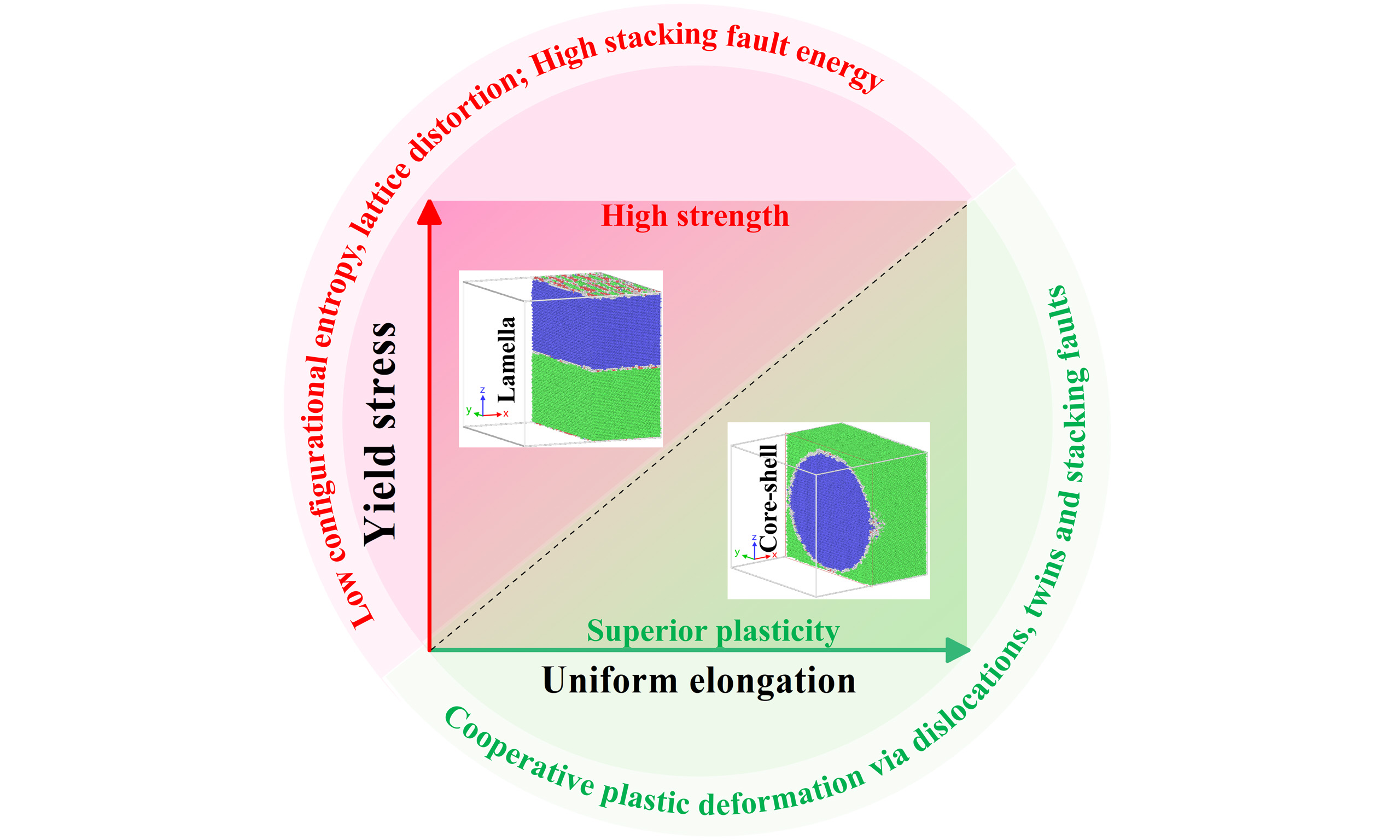
AlCoCrFeNi eutectic multi-principal element alloys exhibit remarkable application potential owing to their inherent heterostructures and outstanding mechanical properties. Their mechanical behaviors are governed by the synergistic deformation of non-uniformly distributed face-centered cubic (FCC) and B2 phases. Clarifying the synergistic deformation mechanisms of FCC/B2 composites is therefore essential. Herein, molecular dynamics simulations are employed to investigate the mechanical behaviors and deformation mechanisms of FCC/B2 composites with lamellar and core-shell structures in AlCoCrFeNi2.1, Fe20Co20Ni41Al19 (at.%), and Ni + NiAl alloys. The results demonstrate that the elastic modulus of all composites is nearly identical during the elastic deformation stage. Upon yielding, lamellar samples display a higher yield stress yet poorer plasticity compared with the core-shell samples. The B2-core structure exhibits excellent plastic deformation capability, which originates from the coordinated activation of abundant dislocations, twins, and stacking faults suppressing void expansion. For lamellar samples, decreasing elemental diversity enhances yield strength by stabilizing heterogeneous interfaces and elevating the stacking fault energy of the FCC phase. Nevertheless, the scarcity of deformation systems promotes defect accumulation and accelerated void growth along phase boundaries, thereby degrading the material ductility. Differently, the yield strength of the core-shell composite is less sensitive to element composition. Compared with multi-principal element alloys, pure Ni in the Ni + NiAl model exhibits higher stacking fault energy and milder lattice distortion, which hinders the activation of Shockley partial dislocations and reduces dislocation storage capacity, thereby leading to inferior plasticity. The present findings provide theoretical guidance for developing high-strength-ductility alloys with non-uniform structures.
Keywords


 Download PDF
REFERENCES
2. Sun, J.; An, X. Hierarchical heterogeneities engineering towards sustainable high-performing alloys. Mater. Today. Sustain. 2024, 25, 100694.
3. Zhang, X. Heterostructures: new opportunities for functional materials. Mater. Res. Lett. 2020, 8, 49-59.
4. Wu, X.; Jiang, P.; Chen, L.; Yuan, F.; Zhu, Y. T. Extraordinary strain hardening by gradient structure. Proc. Natl. Acad. Sci. U. S. A. 2014, 111, 7197-201.
5. Pan, Q.; Zhang, L.; Feng, R.; et al. Gradient cell-structured high-entropy alloy with exceptional strength and ductility. Science 2021, 374, 984-9.
6. Xu, X.; Li, X.; Gou, X.; Li, Y.; Ye, Q.; Tian, Y. Synergistic enhancement of strength, ductility, and toughness in a low carbon micro-alloy steel with an ultrafine-grained heterogeneous lamellar structure. Mater. Sci. Eng. A. 2023, 878, 145205.
7. Wu, X.; Yang, M.; Yuan, F.; et al. Heterogeneous lamella structure unites ultrafine-grain strength with coarse-grain ductility. Proc. Natl. Acad. Sci. U. S. A. 2015, 112, 14501-5.
8. Li, G.; Jiang, J.; Ma, H.; et al. Superior strength-ductility synergy in three-dimensional heterogeneous-nanostructured metals. Acta. Mater. 2023, 256, 119143.
9. Gu, L.; Meng, A.; Chen, X.; Zhao, Y. Simultaneously enhancing strength and ductility of HCP titanium via multi-modal grain induced extra <c+a> dislocation hardening. Acta. Mater. 2023, 252, 118949.
10. Zhu, Z.; Nguyen, Q.; Ng, F.; et al. Hierarchical microstructure and strengthening mechanisms of a CoCrFeNiMn high entropy alloy additively manufactured by selective laser melting. Scr. Mater. 2018, 154, 20-4.
11. Zhu, Z. G.; An, X. H.; Lu, W. J.; et al. Selective laser melting enabling the hierarchically heterogeneous microstructure and excellent mechanical properties in an interstitial solute strengthened high entropy alloy. Mater. Res. Lett. 2019, 7, 453-9.
12. Li, J.; Lu, W.; Chen, S.; Liu, C. Revealing extra strengthening and strain hardening in heterogeneous two-phase nanostructures. Int. J. Plast. 2020, 126, 102626.
13. Huang, J.; Liu, Y.; Xu, T.; et al. Dual-phase hetero-structured strategy to improve ductility of a low carbon martensitic steel. Mater. Sci. Eng. A. 2022, 834, 142584.
14. Wu, X.; Zhu, Y.; Lu, K. Ductility and strain hardening in gradient and lamellar structured materials. Scr. Mater. 2020, 186, 321-5.
15. Sun, Y.; Kong, X.; Wang, Z. Superior mechanical properties and deformation mechanisms of a 304 stainless steel plate with gradient nanostructure. Int. J. Plast. 2022, 155, 103336.
16. Zhu, Y. Creating multifunctionality with hierarchical heterostructures. Mater. Res. Lett. 2025, 13, 175-8.
17. Zhu, Y.; Ameyama, K.; Anderson, P. M.; et al. Heterostructured materials: superior properties from hetero-zone interaction. Mater. Res. Lett. 2021, 9, 1-31.
18. Dong, X.; Gao, B.; Xiao, L.; et al. Heterostructured metallic structural materials: research methods, properties, and future perspectives. Adv. Funct. Mater. 2024, 34, 2410521.
19. Wang, Z.; Bai, X.; Wang, J.; et al. Revisiting the development of eutectic high-entropy alloys over the past decade (2014-2024): design, manufacturing, and applications. Acta. Metall. Sin. 2025, 61, 1-11.
20. Sathiyamoorthi, P.; Kim, H. S. High-entropy alloys with heterogeneous microstructure: Processing and mechanical properties. Prog. Mater. Sci. 2022, 123, 100709.
21. Shi, P.; Li, R.; Li, Y.; et al. Hierarchical crack buffering triples ductility in eutectic herringbone high-entropy alloys. Science 2021, 373, 912-8.
22. Lu, Y.; Dong, Y.; Guo, S.; et al. A promising new class of high-temperature alloys: eutectic high-entropy alloys. Sci. Rep. 2014, 4, 6200.
23. Lu, Y.; Dong, Y.; Jiang, H.; et al. Promising properties and future trend of eutectic high entropy alloys. Scr. Mater. 2020, 187, 202-9.
24. Ren, J.; Zhang, Y.; Zhao, D.; et al. Strong yet ductile nanolamellar high-entropy alloys by additive manufacturing. Nature 2022, 608, 62-8.
25. Shi, P.; Ren, W.; Zheng, T.; et al. Enhanced strength-ductility synergy in ultrafine-grained eutectic high-entropy alloys by inheriting microstructural lamellae. Nat. Commun. 2019, 10, 489.
26. Shi, P.; Zhong, Y.; Li, Y.; et al. Multistage work hardening assisted by multi-type twinning in ultrafine-grained heterostructural eutectic high-entropy alloys. Mater. Today. 2020, 41, 62-71.
27. Shi, P.; Li, Y.; Jiang, X.; et al. Strong-yet-ductile eutectic alloys employing cocoon-like nanometer-sized dislocation cells. Adv. Mater. 2024, 36, e2405459.
28. Wang, L.; Lu, W.; Wang, X.; et al. Grain-boundary precipitation architected hard-shell heterostructure achieves extraordinary strain hardening in high-entropy alloys. Acta. Mater. 2026, 310, 122151.
29. Zhang, Q.; Chen, Z.; Dong, Y.; Li, C.; Wang, Y. High strength and ductility eutectic high entropy alloy with unique core-shell structure. J. Alloys. Compd. 2024, 976, 173141.
30. Kim, R. E.; Lee, J. H.; Haftlang, F.; et al. Hierarchical ferrous medium entropy with heterogeneous precipitates embedded in core-shell grain structure for superior mechanical properties. Acta. Mater. 2024, 281, 120397.
31. Fang, X.; He, G.; Zheng, C.; et al. Effect of heterostructure and hetero-deformation induced hardening on the strength and ductility of brass. Acta. Mater. 2020, 186, 644-55.
32. Yang, Y.; Liu, Y.; Jiang, S.; et al. Achieving exceptional strength and ductility combination in a heterostructured Mg-Y alloy with densely refined twins. J. Mater. Sci. Technol. 2024, 189, 132-45.
33. Jiang, S.; Peng, R. L.; He, Z.; et al. Mechanical behavior anisotropy of multilayered metallic composites revealed by in-situ synchrotron X-ray diffraction: example of Ti/Nb laminates processed by accumulative roll bonding. Acta. Mater. 2025, 287, 120815.
34. Pang, J.; Xiong, T.; Yang, W.; et al. Atomic scale structure dominated FCC and B2 responses to He ion irradiation in eutectic high-entropy alloy AlCoCrFeNi2.1. J. Mater. Sci. Technol. 2022, 129, 87-95.
35. Lu, Y.; Wu, X.; Fu, Z.; et al. Ductile and ultrahigh-strength eutectic high-entropy alloys by large-volume 3D printing. J. Mater. Sci. Technol. 2022, 126, 15-21.
36. Choudhuri, D.; Campbell, A. Interface dominated deformation mechanisms in two-phase fcc/B2 nanostructures: Nishiyama-Wasserman vs. Kurdjumov-Sachs interfaces. Comput. Mater. Sci. 2020, 177, 109577.
37. Ji, W.; Gao, S.; Jarlöv, A.; et al. Designing maximal strength in nanolamellar eutectic high-entropy alloys. Adv. Mater. 2025, 37, e2500149.
38. Yang, J.; Zhang, H.; Ji, H.; Jia, N. Molecular dynamics simulations of micromechanical behaviours for AlCoCrFeNi2.1 high entropy alloy during nanoindentation. Acta. Metall. Sin. 2025, 38, 218-32.
39. Zhang, H.; He, Z.; Zhang, M.; Jiang, S.; Jia, N.; Feng, Y. Orientation-dependent micromechanical behaviours of FCC/B2 dualphase AlCoCrFeNi2.1 high entropy nanopillars studied by atomic simulations. Mater. Today. Commun. 2025, 48, 113648.
40. Bian, J.; Yuan, W.; Ni, N.; Shao, Z.; Wang, G. Tunable mechanical properties of high-entropy alloy nanoparticles with core-shell structure. Mater. Today. Commun. 2025, 49, 113839.
41. Choudhuri, D.; Srinivasan, S. G.; Mishra, R. S. Deformation of lamellar FCC-B2 nanostructures containing Kurdjumov-Sachs interfaces: relation between interfacial structure and plasticity. Int. J. Plast. 2020, 125, 191-209.
42. Plimpton, S. Fast parallel algorithms for short-range molecular dynamics. J. Comput. Phys. 1995, 117, 1-19.
43. Farkas, D.; Caro, A. Model interatomic potentials for Fe-Ni-Cr-Co-Al high-entropy alloys. J. Mater. Res. 2020, 35, 3031-40.
44. Lin, K.; Tao, P.; Liu, R.; Huang, Z.; Xiong, Z. Effect of crystallographic orientation on mechanical properties of Al0.25CoCrFeNi high entropy alloy under tension. Mater. Today. Commun. 2024, 41, 110306.
45. Liu, X.; Yan, J. Atomistic simulations of tensile properties and deformation mechanisms in a gradient nanostructured Al0.3CrFeCoNi high-entropy alloy. Appl. Phys. A. 2024, 130, 7855.
46. Ren, J.; Gui, Y.; Gao, Q.; et al. Mechanical response and plastic deformation in single- and dual-phase polycrystalline FeNiAl alloys: molecular dynamics analysis. J. Mater. Sci. 2024, 59, 14405-19.
47. Yoon, S.; Kimura, Y.; Uchida, M.; Ju, Y.; Toku, Y. High temperature tensile and compressive behaviors of nanostructured polycrystalline AlCoCrFeNi high entropy alloy: a molecular dynamics study. J. Eng. Mater. Technol. 2024, 146, 021003.
48. Choudhuri, D.; Banerjee, R.; Srinivasan, S. G. Uniaxial deformation of face-centered-cubic(Ni)-ordered B2(NiAl) bicrystals: atomistic mechanisms near a Kurdjumov-Sachs interface. J. Mater. Sci. 2018, 53, 5684-95.
49. Stukowski, A. Visualization and analysis of atomistic simulation data with OVITO-the open visualization tool. Model. Simul. Mater. Sci. Eng. 2010, 18, 015012.
50. Stukowski, A.; Bulatov, V. V.; Arsenlis, A. Automated identification and indexing of dislocations in crystal interfaces. Model. Simul. Mater. Sci. Eng. 2012, 20, 085007.
51. Stukowski, A. Structure identification methods for atomistic simulations of crystalline materials. Model. Simul. Mater. Sci. Eng. 2012, 20, 045021.
52. Krone, M.; Stone, J. E.; Ertl, T.; Schulten, K. Fast visualization of gaussian density surfaces for molecular dynamics and particle system trajectories. In Eurographics Conference on Visualization (EuroVis), Vienna, Austria; 2012.
53. Yang, X.; Zhou, K.; Han, X.; et al. A Study on the mechanical properties of Ni-Al alloy based on molecular dynamics simulation. Coatings 2026, 16, 168.
54. Huang, C.; Wang, Y.; Ma, X.; et al. Interface affected zone for optimal strength and ductility in heterogeneous laminate. Mater. Today. 2018, 21, 713-9.
55. Sun, J.; Li, H.; Chen, Y.; An, X. Bidirectional phase transformations in multi-principal element alloys: mechanisms, physics, and mechanical property implications. Adv. Sci. 2024, 11, e2407283.
56. Wu, H.; Fan, G. An overview of tailoring strain delocalization for strength-ductility synergy. Prog. Mater. Sci. 2020, 113, 100675.
57. Zhang, Y.; Zuo, T. T.; Tang, Z.; et al. Microstructures and properties of high-entropy alloys. Prog. Mater. Sci. 2014, 61, 1-93.
58. Zhang, W.; Liaw, P. K.; Zhang, Y. Science and technology in high-entropy alloys. Sci. China. Mater. 2018, 61, 2-22.
59. Xu, B.; Huang, S.; Lu, W.; et al. Crossover from sluggish to accelerated diffusion in multi-principal element alloys induced by lattice distortion. Acta. Mater. 2026, 316, 122431.
60. Ghadami, F.; Davoudabadi, M. A. Si-induced lattice distortion and its role in enhancing the tribological performance of APS AlCoCrFeNiSix (0.1 ≤ x ≤ 0.5) high-entropy alloy coatings. Surf. Coat. Technol. 2026, 530, 133551.
61. Huang, G.; Zhang, X.; Zou, X.; et al. Roles of lattice distortion and chemical short-range order in dislocation drag and strain-rate sensitivity over wide strain rates. J. Mech. Phys. Solids. 2026, 215, 106723.
62. Meng, Y.; Zeng, X.; Liu, S.; et al. Effect of lattice distortion and chemical short-range order on the phase transformation behavior of high entropy alloys under high strain rates. Int. J. Plast. 2026, 197, 104584.
Cite This Article
 Open Access
How to Cite
Zhang, H.; Jia, N.; Wang, M.; Zheng, A.; Ji, H. Deformation mechanism differences of lamellar/core-shell FCC/B2 composites: atomic simulation study. Microstructures 2026, 6, 20260133. https://dx.doi.org/10.20517/microstructures.2026.156
Download Citation
If you have the appropriate software installed, you can download article citation data to the citation manager of your choice. Simply select your manager software from the list below and click on download.
Export Citation File
Type of Import
Tips on Downloading Citation
Citation Manager File Format
Type of Import
Direct Import: When the Direct Import option is selected (the default state), a dialogue box will give you the option to Save or Open the downloaded citation data. Choosing Open will either launch your citation manager or give you a choice of applications with which to use the metadata. The Save option saves the file locally for later use.
Indirect Import: When the Indirect Import option is selected, the metadata is displayed and may be copied and pasted as needed.
About This Article
Special Topic
Copyright

Data & Comments
Data
0











Comments
Comments must be written in English. Spam, offensive content, impersonation, and private information will not be permitted. If any comment is reported and identified as inappropriate content by OAE staff, the comment will be removed without notice. If you have any queries or need any help, please contact us at [email protected].