

Beyond the stratosphere: the ozone threat and potential health risks of chlorinated VSLSs
 0



 Download PDF
INTRODUCTION
The Montreal Protocol (MP) has successfully reduced the emissions of long-lived ozone-depleting substances (ODSs), but the chlorinated very short-lived substances (Cl-VSLSs), which generally have atmospheric lifetimes of less than 6 months, remain unregulated under the MP[1-4]. Despite their short atmospheric lifetimes, Cl-VSLSs can be efficiently transported to the stratosphere in regions with strong vertical transport capabilities, actively driving ozone destruction[5,6]. Satellite and balloon-based remote sensing observations, including atmospheric chemistry experiment Fourier transform spectrometer (ACE-FTS) measurements, indicate that the rate of decline in stratospheric inorganic chlorine has been slower than expected from the reductions in long-lived ODSs, suggesting that Cl-VSLSs have partially offset the hard-won benefits of the MP for ozone layer recovery[2,7].
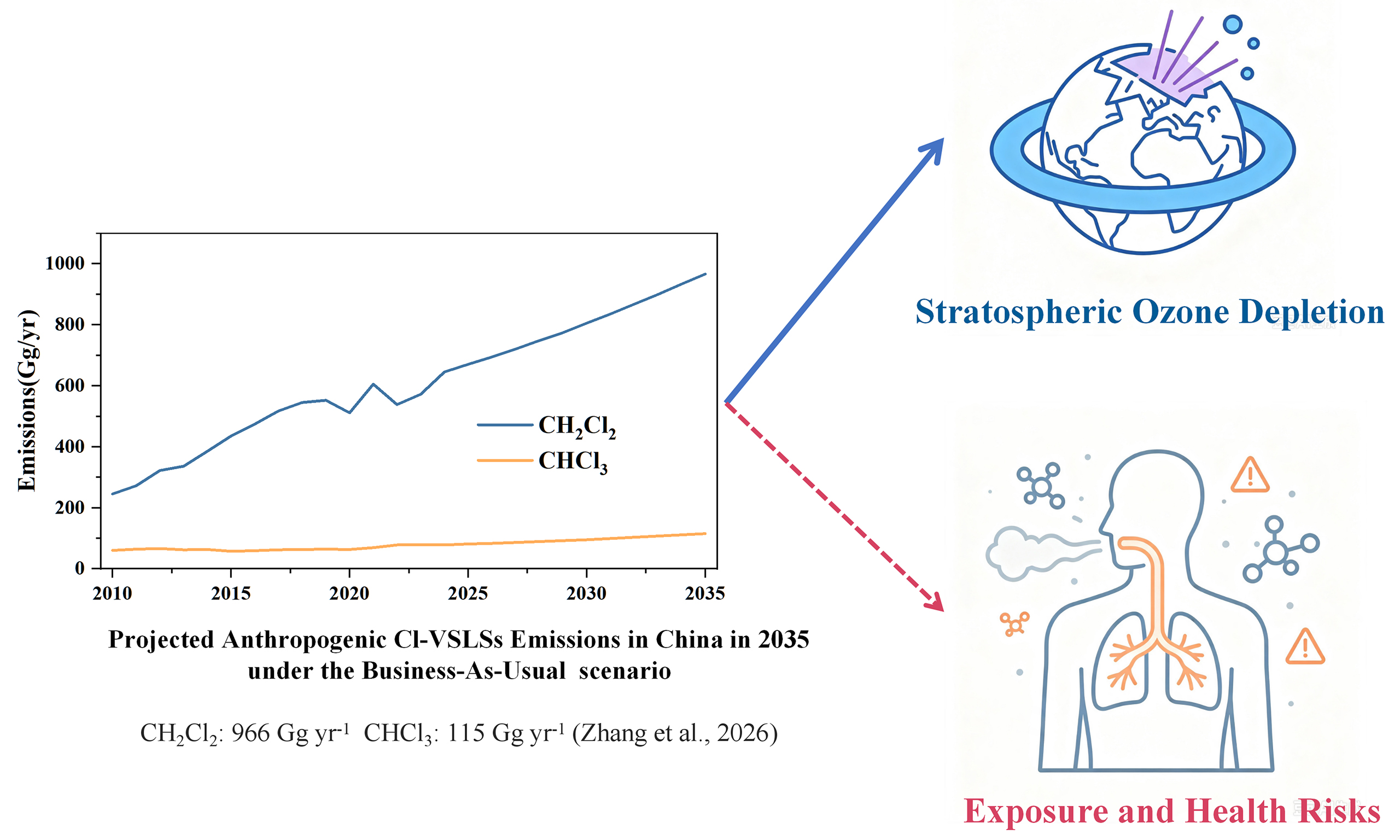
With the implementation of the MP, the role of Cl-VSLSs, especially CH2Cl2 and CHCl3, in stratospheric ozone recovery has become increasingly important[7,8]. Unlike CHCl3, which has substantial natural sources, global emissions of CH2Cl2 are overwhelmingly (approximately 90%) driven by anthropogenic activities, particularly industrial production and solvent use[7]. Long-term atmospheric observations combined with top-down inversion approaches have identified that China is a major global emitter, accounting for 30%-60% of global CH2Cl2 and 25%-50% of CHCl3 global emissions[9,10]. Building on this context, Zhang et al. developed a region- and sector-resolved emission inventory of CH2Cl2 and CHCl3 in China, weighting these fluxes by their regional stratospheric ozone depletion potentials (SODPs) to yield CFC-11-equivalent (trichlorofluoromethane-equivalent, CFC-11-eq) emissions[7]. Their findings indicate that by 2020, China’s CFC-11-eq emissions from CH2Cl2 were already comparable to those from domestic hydrochlorofluorocarbons (HCFCs), and under a business-as-usual scenario, they are projected to surpass aggregate HCFC emissions from 2024 onward. However, before they are lofted into the upper atmosphere, these high-volume Cl-VSLSs accumulate in the troposphere, where they act as potent chlorinated volatile organic compounds (cVOCs)[11]. The potential public health risks associated with chronic, low-dose inhalation exposure in densely populated emission hotspots remain severely underexplored.
MAJOR CONTRIBUTION AND DISCUSSION
The dual impacts of Cl-VSLSs on stratospheric ozone and human health both originate from Cl-VSLS emissions but follow different pathways after release[1,12]. The stratospheric ozone depletion pathway depends on the fraction of Cl-VSLSs transported into the stratosphere, thereby increasing stratospheric chlorine loading and contributing to ozone depletion. In contrast, their human health implications depend on actual concentrations in near-source ambient air and indoor environments, as well as the resulting human exposure. CH2Cl2 and CHCl3 are high-volume industrial solvents, feedstocks, blowing agents, and disinfection by-products with direct routes of human exposure. Therefore, Cl-VSLS emissions in regions with efficient vertical transport pathways, such as areas influenced by deep convection and the Asian summer monsoon (ASM), may make a greater contribution to ozone depletion, whereas densely populated and highly industrialized regions represent priority areas for assessing Cl-VSLS exposure and health risks[13]. These two pathways therefore operate across different spatial and temporal scales and require different types of evidence to support their assessment. In particular, emission inventories alone are insufficient to quantify population-level exposure or establish associated health risks.
CHCl3 is predominantly evaluated via the ingestion route as a trace-level trihalomethane in drinking water, where epidemiological evidence for bladder cancer is modest but consistent across chlorination cohorts[14]. CH2Cl2 is primarily characterized under high-dose inhalation and dermal exposures. IARC classifies CH2Cl2 and CHCl3 as Group 2A and Group 2B carcinogens, respectively[15]. Critically, these findings from high-dose occupational settings or experimental animal bioassays cannot be directly extrapolated to evaluate the risks of long-term, low-dose ambient inhalation exposure in the general population.
Under business as usual (BAU), national CH2Cl2 emissions nearly quadruple from 2010 to 2035[7]. Although an increase in emissions does not necessarily equate to proportional increases in population-level environmental concentrations, individual exposures, or health risks, the sheer magnitude of these projections warrants immediate scientific scrutiny. Indeed, empirical monitoring confirms that environmental concentrations can reach levels of regulatory concern. Ambient CH2Cl2 in typical Chinese chemical industrial zones produces non-carcinogenic hazard quotients exceeding 1[12], while the median estimated lifetime cancer risk for indoor airborne CHCl3 in UK residences exceeded the 10-6 benchmark[16].
We currently lack cohort studies, birth cohorts, and spatially matched exposure assessments to investigate whether living downwind of a projected 966 Gg·yr-1 CH2Cl2 economy could potentially elevate childhood leukemia risks, alter adult liver enzyme profiles, or adversely affect pregnancy outcomes. At present, these potential impacts represent urgent research hypotheses requiring validation, hampered by three critical knowledge gaps: translating regional emission fluxes into empirical ground-level exposures, establishing exposure-response thresholds at chronic low ambient levels, and characterizing susceptibility across sensitive developmental windows and genotypes [e.g., glutathione S-transferase theta 1 (GSTT1)-null variants].
FROM OZONE DEPLETION TO HUMAN HEALTH
Three research moves would close the loop between the inventory and public health.
First, couple emission inventories to exposure models that speak the language of epidemiologists. For example, the authors already allocate emissions by industrial value added, building area, and population; those proxies should be extended into exposure metrics rather than stopping at emission tonnage[7,17]. Although emission-to-exposure frameworks are established for volatile organics, validating Cl-VSLS indoor infiltration and multimedia transport requires targeted field measurements.
Second, prioritize toxicological research on realistic mixtures and life-stage windows. Most in vitro work treats CH2Cl2 or CHCl3 alone. However, in real exposure scenarios, such as occupational paint-stripping environments, CH2Cl2-based formulations may contain other solvents, including toluene or methanol[18]. The potential health effects of such mixed exposures require further evaluation through exposure assessments and epidemiological studies. In addition, GSTT1-related metabolic variability and age-dependent physiological differences warrant further investigation[19].
Third, build surveillance where emissions are growing. If the provinces of Jiangsu, Zhejiang, Shandong, and Guangdong contain the largest reducible CH2Cl2 burdens under best practicable technologies (BPT), they are also the natural locations for paired environmental and biomonitoring studies: exhaled breath CH2Cl2, urine trihalomethane (THM) metabolites, liver function panels, and cancer registry linkage. Zhang et al. showed that a BPT scenario could cut CFC-11-eq CH2Cl2 by ~80% by 2035[7]. If implemented, these measures could serve as a natural experiment whose effects on human exposure and health should be measured, not assumed[20].
CONCLUSION
The spatial granularity of this new inventory should serve as more than just an input for atmospheric chemistry models; it provides a direct roadmap for environmental epidemiologists to launch targeted biomonitoring and cohort studies in China’s industrial megaregions. Future governance should adapt to the dual threat through coordinated international assessments and source-oriented domestic mitigation strategies. Within the MP framework, further technical and economic assessments are needed to determine whether future control measures for anthropogenic Cl-VSLSs are warranted. Reductions in CH2Cl2 and CHCl3 emissions could provide co-benefits by decreasing their contributions to stratospheric ozone depletion while also reducing the risk of human exposure.
DECLARATIONS
Authors’ contributions
Conceptualization and supervision: Sun, J.
Data analysis and interpretation; manuscript preparation: Yan, M.
Both authors contributed to the manuscript and approved the final version.
Availability of data and materials
Not applicable.
AI and AI-assisted tools statement
During the preparation of this manuscript, ChatGPT (GPT-5.6, developed by OpenAI, released on 2026-07-09) was used for language editing and to assist in generating the illustrative elements representing “Stratospheric Ozone Depletion” and “Exposure and Health Risks” in the graphical abstract. These elements were designed by the authors and generated with AI assistance for illustrative purposes only. The tool did not influence the study design, data collection, analysis, interpretation, or scientific content. All authors take full responsibility for the accuracy, integrity, and final content of the manuscript.
Financial support and sponsorship
None.
Conflicts of interest
Sun, J. is an Editorial Board Member of the journal Journal of Environmental Exposure Assessment. Sun, J. was not involved in any steps of editorial processing, notably including reviewers’ selection, manuscript handling, and decision-making. The other author declares no conflicts of interest.
Ethical approval and consent to participate
Not applicable.
Consent for publication
Not applicable.
Copyright
© The Author(s) 2026.
REFERENCES
1. Bednarz, E. M.; Hossaini, R.; Chipperfield, M. P. Atmospheric impacts of chlorinated very short-lived substances over the recent past - Part 2: Impacts on ozone. Atmos. Chem. Phys. 2023, 23, 13701-11.
2. Dubé, K.; Tegtmeier, S.; Bourassa, A.; et al. Chlorinated very short-lived substances offset the long-term reduction of inorganic stratospheric chlorine. Commun. Earth. Environ. 2025, 6, 487.
3. WMO. Scientific assessment of ozone depletion: 2022 executive summary. 2022. https://csl.noaa.gov/assessments/ozone/2022/executivesummary/. (accessed 2026-11-10).
4. United Nations Environment Programme. Handbook for the Montreal Protocol on substances that deplete the ozone layer: seventh edition (2006). https://www.unep.org/resources/report/handbook-montreal-protocol-substances-deplete-ozone-layer-seventh-edition-2006. (accessed 2026-11-10).
5. Hossaini, R.; Chipperfield, M. P.; Saiz‐Lopez, A.; et al. Growth in stratospheric chlorine from short‐lived chemicals not controlled by the Montreal Protocol. Geophys. Res. Lett. 2015, 42, 4573-80.
6. Pan, L. L.; Atlas, E. L.; Honomichl, S. B.; et al. East Asian summer monsoon delivers large abundances of very short-lived organic chlorine substances to the lower stratosphere. Proc. Natl. Acad. Sci. U. S. A. 2024, 121, e2318716121.
7. Zhang, X.; An, M.; Chen, Z.; et al. Chlorinated VSLSs surpass HCFCs in CFC-11-equivalent emissions for ozone layer depletion in China. Nat. Commun. 2026, 17, 75080.
8. Claxton, T.; Hossaini, R.; Wilson, C.; et al. A synthesis inversion to constrain global emissions of two very short lived chlorocarbons: dichloromethane, and perchloroethylene. J. Geophys. Res. Atmos. 2020, 125, e2019JD031818.
9. An, M.; Western, L. M.; Hu, J.; et al. Anthropogenic chloroform emissions from China drive changes in global emissions. Environ. Sci. Technol. 2023, 57, 13925-36.
10. An, M.; Western, L. M.; Say, D.; et al. Rapid increase in dichloromethane emissions from China inferred through atmospheric observations. Nat. Commun. 2021, 12, 27592.
11. Roozitalab, B.; Emmons, L. K.; Hornbrook, R. S.; et al. Measurements and modeling of the interhemispheric differences of atmospheric chlorinated very short‐lived substances. J. Geophys. Res. Atmos. 2024, 129, e2023JD039518.
12. Chen, K.; Gu, X.; Cai, M.; et al. Emission characteristics, environmental impacts and health risk assessment of volatile organic compounds from the typical chemical industry in China. J. Environ. Sci. 2025, 149, 113-25.
13. Adcock, K. E.; Fraser, P. J.; Hall, B. D.; et al. Aircraft‐based observations of ozone‐depleting substances in the upper troposphere and lower stratosphere in and above the Asian summer monsoon. J. Geophys. Res. Atmos. 2021, 126, e2020JD033137.
14. Helte, E.; Söderlund, F.; Säve-Söderbergh, M.; Larsson, S. C.; Åkesson, A. Exposure to drinking water trihalomethanes and risk of cancer: a systematic review of the epidemiologic evidence and dose-response meta-analysis. Environ. Health. Perspect. 2025, 133, 16001.
15. International Agency for Research on Cancer. Agents classified by the IARC Monographs, Volumes 1-142. 2026. https://monographs.iarc.who.int/agents-classified-by-the-iarc/. (accessed 2026-11-10).
16. Warburton, T.; Hamilton, J. F.; Carslaw, N.; et al. Yearlong study of indoor VOC variability: insights into spatial, temporal, and contextual dynamics of indoor VOC exposure. Environ. Sci. Processes. Impacts. 2025, 27, 1025-40.
17. USEPA. AirToxScreen Technical Support Document. 2020 AirToxScreen - 2020 AirToxScreen Technical Support Document (TSD). https://www.epa.gov/AirToxScreen/airtoxscreen-technical-support-document. (accessed 2026-11-10).
18. Durrani, T.; Clapp, R.; Harrison, R.; Shusterman, D. Solvent‐based paint and varnish removers: a focused toxicologic review of existing and alternative constituents. J. Appl. Toxicol. 2020, 40, 1325-41.
19. Schlosser, P. M.; Bale, A. S.; Gibbons, C. F.; Wilkins, A.; Cooper, G. S. Human health effects of dichloromethane: key findings and scientific issues. Environ. Health. Perspect. 2015, 123, 114-9.
Cite This Article
 Open Access
How to Cite
Yan, M.; Sun, J. Beyond the stratosphere: the ozone threat and potential health risks of chlorinated VSLSs. J. Environ. Expo. Assess. 2026, 5, 36. https://dx.doi.org/10.20517/jeea.2026.49
Download Citation
If you have the appropriate software installed, you can download article citation data to the citation manager of your choice. Simply select your manager software from the list below and click on download.
Export Citation File
Type of Import
Tips on Downloading Citation
Citation Manager File Format
Type of Import
Direct Import: When the Direct Import option is selected (the default state), a dialogue box will give you the option to Save or Open the downloaded citation data. Choosing Open will either launch your citation manager or give you a choice of applications with which to use the metadata. The Save option saves the file locally for later use.
Indirect Import: When the Indirect Import option is selected, the metadata is displayed and may be copied and pasted as needed.
About This Article
Copyright

Data & Comments
Data
0










Comments
Comments must be written in English. Spam, offensive content, impersonation, and private information will not be permitted. If any comment is reported and identified as inappropriate content by OAE staff, the comment will be removed without notice. If you have any queries or need any help, please contact us at [email protected].