

Beyond moving more: physical activity intensity, physiological reserve, and cardiovascular aging
 0
0 


 Download PDF
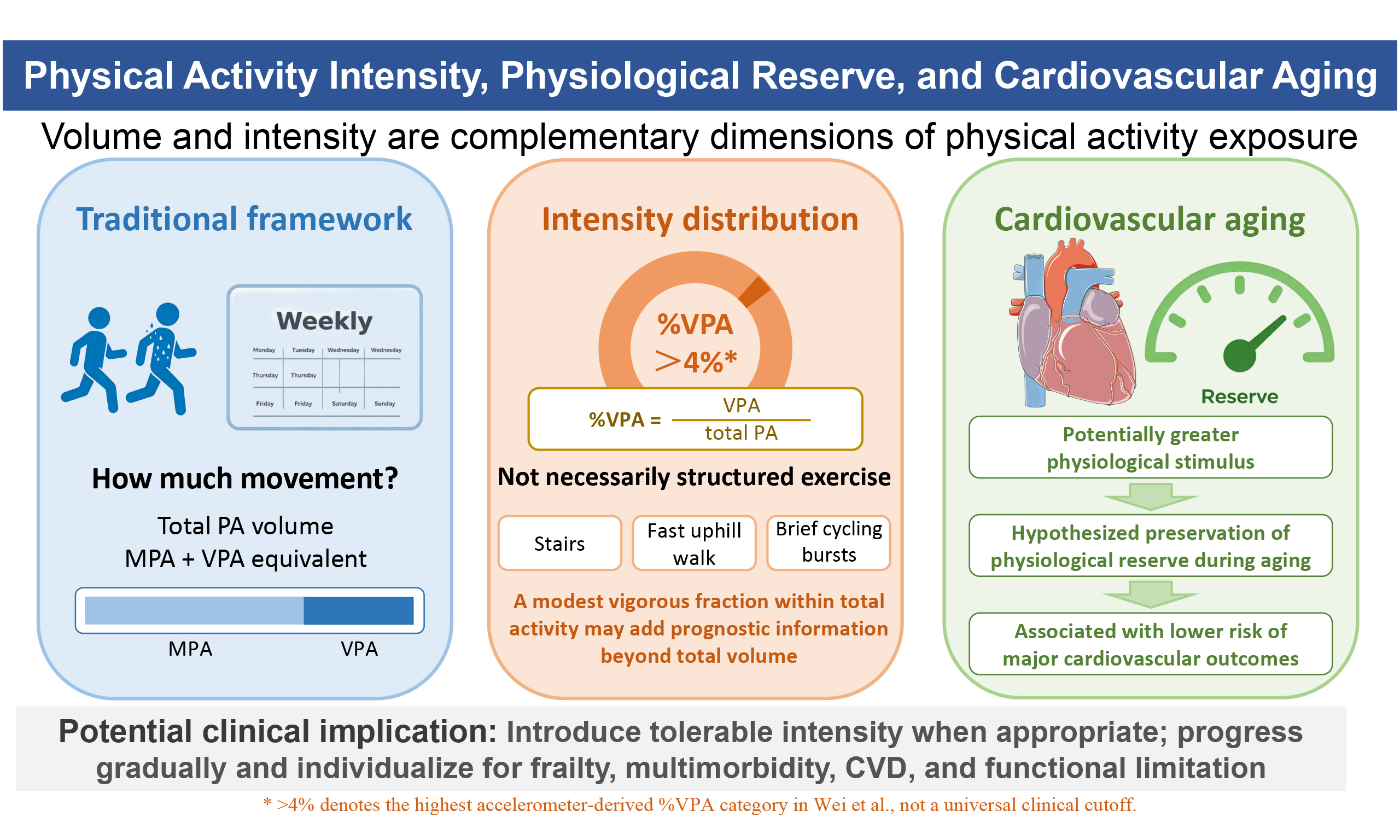
Physical activity (PA) has long been recognized as a cornerstone of chronic disease prevention and healthy aging. Current guidelines are largely structured around weekly volume, recommending specified durations of moderate physical activity (MPA), vigorous physical activity (VPA), or an equivalent combination of the two[1]. This volume-based framework has clear public health utility; however, it may overlook an important dimension of cardiovascular (CV) aging: does the intensity distribution of PA provide information beyond that captured by total accumulated volume? Physiological reserve refers to the capacity of integrated physiological systems to maintain homeostasis and functional performance when challenged by stressors, despite age-related decline. In the aging CV system, the preservation of this physiological reserve may depend not only on the quantity of movement, but also on whether the movement is sufficiently intense to elicit adaptive vascular, metabolic, and cardiorespiratory responses[2]. The study by Wei et al., Volume vs. intensity of PA and risk of cardiovascular and non-cardiovascular chronic diseases, offers a timely opportunity to revisit this question[3].
The central contribution of this study lies in conceptualizing PA volume and intensity as interrelated yet distinct exposure dimensions, rather than viewing VPA as a time-efficient substitute for MPA. Using data from the UK Biobank, the authors analyzed 96,408 participants with wrist-worn accelerometer measurements and 375,730 participants with self-reported PA[3]. In the device-measured cohort, the proportion of VPA (%VPA) was defined as VPA metabolic equivalent of task (MET) minutes per week (MET-min/week) divided by total PA MET-min/week. Importantly, the highest accelerometer-derived category, > 4% VPA, was a study-specific classification based on the observed distribution of PA intensity, rather than a prespecified clinical threshold. It should therefore not be interpreted as a minimum recommended proportion, an optimal cutoff, or a universal target for vigorous activity[3]. This distinction carries clinical relevance: the study does not suggest that only structured vigorous exercise matters, but rather that even a modest vigorous fraction within total activity may convey prognostic information. Although activities such as a long walk, a brisk stair climb, a short burst of cycling, and prolonged light occupational movement all contribute to energy expenditure, they may impose substantially different physiological demands in terms of hemodynamic load, autonomic activation, skeletal muscle recruitment, and metabolic requirements[2,4]. By examining both CV and non-cardiovascular outcomes, the authors position intensity at the center of a broader prevention framework[3].
Wei et al. found that a higher %VPA was associated with lower risks of multiple chronic disease outcomes, even after accounting for total PA volume[3]. These findings challenge the assumption that activity intensity can be fully reduced to minutes or metabolic-equivalent totals. Prior investigations have similarly suggested that both total PA and the fraction performed at higher intensity are associated with CV risk, mortality, and other major outcomes[4-6]. The present study extends this literature by systematically comparing the relative contributions of volume and intensity across a broad spectrum of cardiovascular diseases (CVD) and non-cardiovascular diseases.
A potentially important clinical and research implication of these findings concerns the biology of CV aging. Aging is accompanied by declining endothelial function, arterial stiffening, impaired mitochondrial capacity, reduced cardiorespiratory fitness, autonomic dysregulation, chronic low-grade inflammation, and diminished metabolic flexibility[2,7]. Compared with an equivalent volume of low-intensity activity, VPA may provide a more potent physiological stimulus, with potential relevance to endothelial adaptation, nitric oxide-dependent vascular function, oxidative stress regulation, inflammatory signaling, mitochondrial function, and cardiorespiratory reserve[2,7]. In this sense, intensity may not simply increase the “dose” of PA; it may also shape the biological quality of the stimulus imposed on an aging CV system. However, physiological reserve and the proposed biological pathways were not directly assessed in the study by
A further strength of the study is its disease-specific perspective. The authors reported that the relative contribution of %VPA and total PA volume differed across disease outcomes[3]. For example, in the device-measured cohort, participants with > 4% VPA had a 21.5% lower hazard of major adverse CV events and a 16.7% lower hazard of atrial fibrillation than those with 0% VPA. Consistent with these associations, the model-adjusted 5-year absolute risk of major adverse CV events decreased from 10.16% in the 0% VPA group to 6.41% in the > 4% VPA group, while that of atrial fibrillation decreased from 4.08% to 1.70%[3]. Beyond these CV outcomes, immune-mediated inflammatory diseases showed a stronger intensity-associated pattern, whereas metabolism-related outcomes, including type 2 diabetes, metabolic dysfunction-associated steatotic liver disease, and chronic kidney disease, appeared to benefit from both volume and intensity[3]. This heterogeneity argues against a universal dose-equivalence model. Instead, different disease pathways may respond to distinct features of PA: some may be more sensitive to cumulative energy expenditure, whereas others may depend more strongly on peak physiological challenge, inflammatory modulation, or vascular adaptation[3,4].
From a clinical perspective, these findings reported by Wei et al. have implications for exercise prescription, although their clinical translation into practice warrants caution and individualization[3]. Importantly, the
For sedentary adults with limited time, small increments of vigorous lifestyle activity, such as stair climbing, short uphill walks, fast walking intervals, or brief cycling bursts, may represent a feasible means of introducing higher-intensity stimuli, consistent with emerging evidence on vigorous intermittent lifestyle PA[5,10]. However, whether these activities constitute vigorous exertion depends on individual cardiorespiratory fitness, functional capacity, and baseline health status; the same activity may be moderate for one person yet vigorous for another. Therefore, the message should not be simplified to “vigorous activity for everyone”. For older adults and individuals with atrial fibrillation, established CVD, frailty, multimorbidity, or musculoskeletal limitations, intensity should be prescribed as a tolerable progression rather than a categorical mandate. Screening, gradual dose escalation, symptom monitoring, and shared decision-making remain essential[1,8]. For those for whom higher-intensity activity is not initially appropriate, reducing sedentary time, increasing total activity volume, improving strength, or enhancing balance and functional capacity may represent safer and more clinically appropriate initial goals[1,8].
Several methodological considerations warrant caution in interpretation. First, %VPA is a compositional measure representing the proportion of total PA volume accumulated at vigorous intensity. Accordingly, a higher %VPA does not necessarily equate to a greater absolute volume of VPA; it may reflect more vigorous activity, less activity at lower intensities, or a combination of both. When total PA volume is held constant, this contrast is best interpreted as a redistribution of activity toward vigorous intensity, that is, a larger proportion of total PA accumulated at vigorous rather than lower intensities, rather than as an independent increase in VPA. Second, the absence of vigorous activity may reflect more than behavioral preference; it may indicate subclinical disease, reduced physiological reserve, chronic symptoms, functional limitation, socioeconomic disadvantage, or early frailty. Although Wei et al. performed multivariable adjustment and sensitivity analyses, including analyses addressing frailty, residual confounding and reverse causation remain difficult to exclude in observational data[3]. Third, accelerometer measurements were obtained over a limited observation window and may not capture long-term trajectories of PA intensity, which are likely more relevant to CV aging than a single baseline measurement. Finally, relative risk estimates and population-attributable modeling should be interpreted alongside absolute risk, feasibility, safety, adherence, and equity considerations. Generalizability also warrants caution, as the healthy-volunteer characteristics of the UK Biobank population may limit the applicability of these findings to individuals who are frailer, socioeconomically disadvantaged, or from more ethnically diverse populations.
In summary, Wei et al. advance the field by shifting attention from how much people move to how movement is distributed across intensity levels. The study should not be interpreted as diminishing the importance of activity volume or suggesting that VPA is universally appropriate[3]. Rather, it supports a multidimensional view of PA as a behavioral exposure with distinct volume, intensity, and patterning components. Future research should clarify how volume and intensity interact across different diseases, populations, and levels of functional capacity, and whether intensity-specific associations can be replicated using repeated objective measurements, vascular and biological aging biomarkers, compositional modeling, and pragmatic randomized trials.
DECLARATIONS
Authors’ contributions
Conceived the commentary: Xi B, Wang J
Drafted the manuscript: Wang J
Critically revised the manuscript: Wang Y, Gong Z, Zhao M, Xi B
All authors read and approved the final version of the manuscript.
Availability of data and materials
Not applicable.
AI and AI-assisted tools statement
Not applicable.
Financial support and sponsorship
This work was supported by the Shandong Provincial Natural Science Foundation (2024CXPT080) and National Key Research and Development Plan: Real-Time Intelligent Active Intervention on Integration of Ten Important Chronic Diseases (2020YFC2003504-2).
Conflicts of interest
All authors declared that there are no conflicts of interest.
Ethical approval and consent to participate
Not applicable.
Consent for publication
Not applicable.
Copyright
© The Author(s) 2026.
REFERENCES
1. Bull FC, Al-Ansari SS, Biddle S, et al. World Health Organization 2020 guidelines on physical activity and sedentary behaviour. Br J Sports Med. 2020;54:1451-62.
2. Abdellatif M, Rainer PP, Sedej S, Kroemer G. Hallmarks of cardiovascular ageing. Nat Rev Cardiol. 2023;20:754-77.
3. Wei J, Shen M, Li S, et al. Volume vs intensity of physical activity and risk of cardiovascular and non-cardiovascular chronic diseases. Eur Heart J. 2026:ehag168.
4. Dempsey PC, Rowlands AV, Strain T, et al. Physical activity volume, intensity, and incident cardiovascular disease. Eur Heart J. 2022;43:4789-800.
5. Ahmadi MN, Clare PJ, Katzmarzyk PT, Del Pozo Cruz B, Lee IM, Stamatakis E. Vigorous physical activity, incident heart disease, and cancer: how little is enough? Eur Heart J. 2022;43:4801-14.
6. Wang Y, Nie J, Ferrari G, Rey-Lopez JP, Rezende LFM. Association of physical activity intensity with mortality: a national cohort study of 403 681 US adults. JAMA Intern Med. 2021;181:203.
7. El Assar M, Álvarez-Bustos A, Sosa P, Angulo J, Rodríguez-Mañas L. Effect of physical activity/exercise on oxidative stress and inflammation in muscle and vascular aging. Int J Mol Sci. 2022;23:8713.
8. Pelliccia A, Sharma S, Gati S, et al. 2020 ESC guidelines on sports cardiology and exercise in patients with cardiovascular disease. Eur Heart J. 2021;42:17-96.
9. Lloyd-Jones DM, Allen NB, Anderson CA, et al. Life’s essential 8: updating and enhancing the American Heart Association’s Construct of Cardiovascular Health: a presidential advisory from the American Heart Association. Circulation. 2022;146:e18-43.
Cite This Article
 Open Access
How to Cite
Download Citation
If you have the appropriate software installed, you can download article citation data to the citation manager of your choice. Simply select your manager software from the list below and click on download.
Export Citation File
Type of Import
Tips on Downloading Citation
Citation Manager File Format
Type of Import
Direct Import: When the Direct Import option is selected (the default state), a dialogue box will give you the option to Save or Open the downloaded citation data. Choosing Open will either launch your citation manager or give you a choice of applications with which to use the metadata. The Save option saves the file locally for later use.
Indirect Import: When the Indirect Import option is selected, the metadata is displayed and may be copied and pasted as needed.
About This Article
Copyright

Data & Comments
Data
0










Comments
Comments must be written in English. Spam, offensive content, impersonation, and private information will not be permitted. If any comment is reported and identified as inappropriate content by OAE staff, the comment will be removed without notice. If you have any queries or need any help, please contact us at [email protected].