


Circular RNA therapeutics: navigating the macrophage response in ischemic heart disease
 0
0 
INTRODUCTION
Myocardial infarction (MI) remains a leading global cause of morbidity and mortality, placing an immense burden on healthcare systems and necessitating the urgent development of novel therapies that go beyond acute revascularization to address chronic heart failure[1]. The clinical journey of a patient following MI is often dictated by the delicate balance between inflammation and resolution. In their recent study, Jung et al. provide a masterclass in translational science by identifying circHIPK2 as a pivotal epigenetic regulator of this balance[2]. While the immediate aftermath of an infarction requires a robust immune response to clear necrotic debris, a failure to transition from a pro-inflammatory to a reparative state leads to chronic adverse remodeling and eventual heart failure[3]. This research demonstrates that circHIPK2 is specifically upregulated in cardiac macrophages post-infarction, where it functions not merely as a bystander, but as a molecular scaffold that drives pathological inflammation. By bridging the gap between non-coding RNA biology and intracellular stress responses, the authors reveal a novel mechanism where circular RNA dictates the fate of the myocardial environment.
INTERPRETATION
Mechanistic insights into the circHIPK2-G3BP1 axis
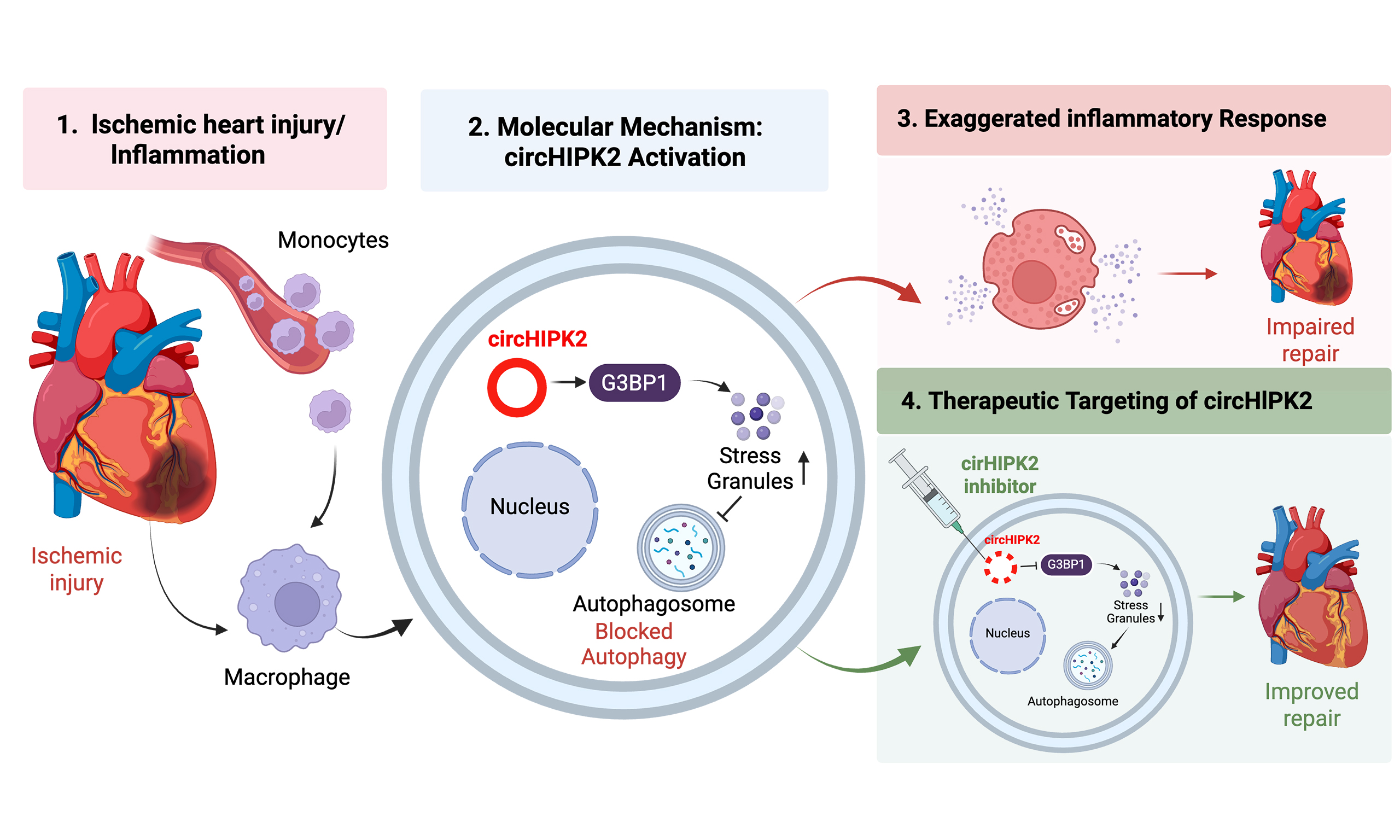
A major highlight of this work is the exploration of the interaction between circHIPK2 and the stress granule-associated protein G3BP1. The study demonstrates that circHIPK2 binds to G3BP1. This interaction could alter the functional availability of G3BP1, effectively changing a key regulator of stress granule assembly. Under normal conditions, G3BP1 facilitates the transient formation of stress granules to manage cellular stress[4]. However, circHIPK2 promotes the persistent formation of these granules. Emerging evidence across various cellular models indicates that persistent stress granules can act as inhibitory hubs for autophagy[5]. By trapping G3BP1 and sustaining stress granule presence, the axis dysregulates macrophage autophagy, preventing the necessary transition to a reparative phenotype and keeping the macrophage in a pro-inflammatory state. This precise operational dynamic of this circHIPK2-G3BP1/stress granule/autophagy axis specifically within cardiac macrophages remains a critical focus of ongoing validation.
The clinical implications of non-coding RNA networks
The cardiovascular field has long navigated the regulatory complexities of microRNAs and long non-coding RNAs, yet circular RNAs (circRNAs) present a distinct clinical frontier due to their inherent stability and resistance to exonuclease degradation[6]. This study elevates the status of circRNAs from a genomic aspect to highly specific immuno-therapeutic targets. Unlike many other biomarkers, circHIPK2 exhibits remarkable cell-type specificity, concentrated within the macrophage population rather than cardiomyocytes or fibroblasts. This provides a unique window for precision medicine; by modulating a circular RNA that is uniquely active in the immune cells of the damaged heart, clinicians may theoretically limit systemic side effects while maximizing local therapeutic efficacy. The research highlights that the circular structure of these molecules makes them ideal candidates for long-acting RNA-based therapies, potentially overcoming the stability issues that have historically hampered linear RNA drug development[2,7].
Immunological advances in cardiovascular medicine
By utilizing advanced imaging techniques like CCR2-targeted positron emission tomography (PET), the authors show that silencing this RNA axis effectively reduces the recruitment and activation of inflammatory monocytes[2,8]. This represents a shift in cardiovascular immunology from broad anti-inflammatory strategies, which often carry high risk, toward the precise phenotyping of immune cell behavior within the infarct zone.
It is critical to acknowledge that macrophage phenotypes exist on a dynamic spectrum rather than as a binary switch. While Jung et al. describe a shift between pro-inflammatory and reparative states, the reality involves a gradient of functional subtypes[2]. Modulating circHIPK2 likely influences this gradient, suggesting a more nuanced regulation of the macrophage response than simply flipping a switch between M1/M2.
Cardiovascular aging and inflammation
The discovery of the circHIPK2-G3BP1 axis also carries profound implications for our understanding of cardiovascular aging. Low-grade systemic inflammation could significantly impair the cardiovascular regenerative capacity. In the aging myocardium, macrophages often exhibit a baseline shift toward pro-inflammatory phenotypes and impaired autophagic flux[9], similar to the pathological state driven by circHIPK2 during acute MI. While the role of circHIPK2 in the aged immune environment remains to be fully elucidated, these findings provide a theoretical basis for future investigations into age-related cardiac susceptibility. By acting as a molecular scaffold that promotes stress granule formation and inhibits autophagy, circHIPK2 may serve as a critical driver of age-related cardiac dysfunction. However, this remains speculative as direct data from aged models are currently lacking. This identifies circHIPK2 not only as a response to injury but also as a potential key target for extending cardiovascular healthspan, pending further validation.
PROSPECTIVE
Current challenges and knowledge gaps
Despite the compelling evidence presented by Jung et al. regarding the therapeutic potential of circHIPK2[2], several critical challenges remain before these findings can be translated into clinical practice. While the study presents a promising proof-of-concept, the transition from murine and induced pluripotent stem cell (iPSC) models to human patients remains a significant limitation in the clinical setting[10].
First, the precision of delivery systems remains a major obstacle. Although circRNAs are uniquely stable, current research largely relies on viral vectors like adeno-associated virus (AAV)[11]. However, the immunogenicity of AAV vectors and their manufacturing scalability present substantial regulatory and production hurdles. Conversely, lipid nanoparticles offer a non-viral alternative but carry their own risks, including complement activation and potential endothelial barriers in ischemic heart disease. Ensuring that non-viral delivery systems could specifically target cardiac macrophages without triggering systemic off-target effects or unintended immune responses is essential.
Second, safety is a paramount concern. Despite the general stability of circRNAs, there is a potential for unintended immune activation, such as Toll-like Receptor activation. Additionally, the sponge activity of circRNAs carries the risk of off-target binding, which could disrupt necessary physiological processes. Rigorous toxicity profiling is required to ensure that inhibiting circHIPK2 does not impair the broader immune response or increase the risk of infection.
Third, while macrophages are often grouped into pro-inflammatory and reparative states, recent high-resolution mapping confirms this classification is an oversimplification[12]. The dynamic shifts of circHIPK2 within these newly defined, nuanced subpopulations (such as CCR2+ versus CCR2- resident macrophages) and its long-term impact on the myocardial micro-environment represent important frontiers that are not yet fully understood.
Future exploration
The circHIPK2-G3BP1 axis offers promising new directions for cardiovascular precision medicine. Beyond direct therapeutic inhibition, future research should explore the utility of circHIPK2 as a potential biomarker for tracking the localized macrophage response. Furthermore, because macro-environmental alterations in epicardial fat tissues are known to exert potent paracrine effects that influence fibroblast activation and cardiomyocyte survival[13], determining how local non-coding RNA pathways intersect with these secretome changes remains a compelling avenue for investigation. Future studies utilizing single-cell spatial transcriptomics will be crucial to map these spatial dynamics, clarifying exactly how silencing circHIPK2 alters the macrophage secretome to foster a pro-regenerative niche for neighboring cells.
On the therapeutic front, the evolution of delivery platforms remains a promising frontier. These platforms can be functionalized with ligands to target macrophage-specific receptors like CD163 or CCR2. However, this must be balanced against the practical realities of large-scale, good manufacturing practice (GMP)-compliant circRNA production. Specifically, challenges regarding circularization efficiency and purification must be overcome to ensure viable clinical translation.
CONCLUSION
To explore how non-coding RNAs coordinate the immune response to cardiac injury, this research marks a significant milestone in our understanding. By identifying circHIPK2 as a master regulator of macrophage polarization via stress granule dynamics, the study provides a compelling blueprint for the next generation of cardio-immunology treatments. As we move closer to an era of RNA-based medicine, targeting specific circular RNA pathways offers a sophisticated means to resolve inflammation and promote true myocardial regeneration, offering significant potential to improve the standard of care for patients surviving MI.
DECLARATIONS
Acknowledgement
We thank Faming Zhang for assistance with graphic abstract creation using BioRender.com (Created in BioRender. Zhang F. (2026) https://BioRender.com/5swipvx).
Authors’ contributions
Conceptualization, supervision, writing - review & editing: Li X
Visualization, writing - review & editing: Chen S
Conceptualization, writing - original draft, review & editing: Cheang I
Availability of data and materials
Not applicable.
AI and AI-assisted tools statement
Not applicable.
Financial support and sponsorship
This work was supported by the State Key Laboratory for Innovation and Transformation of Luobing Theory, General Program of National Natural Science Foundation of China (82370389, 81970339 to Li X), and the National High Technology Research and Development Program of China (2017YFC1700505 to
Conflicts of interest
All authors declared that there are no conflicts of interest.
Ethical approval and consent to participate
Not applicable.
Consent for publication
Not applicable.
Copyright
© The Author(s) 2026.
REFERENCES
1. Stark BA, Decleene NK, Desai EC, et al. Global, regional, and national burden of cardiovascular diseases and risk factors in 204 countries and territories, 1990-2023. JACC. 2025;86:2167-243.
2. Jung M, Schmidt A, Sansonetti M, et al. Macrophage-specific circular RNA circHIPK2, inflammation, and fibrosis after myocardial infarction. Eur Heart J. 2026;47:2831-47.
3. Frangogiannis NG. The inflammatory response in myocardial injury, repair, and remodelling. Nat Rev Cardiol. 2014;11:255-65.
4. Wang J, Gan Y, Cao J, Dong X, Ouyang W. Pathophysiology of stress granules: an emerging link to diseases (Review). Int J Mol Med. 2022;49:44.
5. Huang R, Cai L, Ma X, Shen K. Autophagy-mediated circHIPK2 promotes lipopolysaccharide-induced astrocytic inflammation via SIGMAR1. Int Immunopharmacol. 2023;117:109907.
6. Halabi N, Thomas B, Chidiac O, et al. Dysregulation of long non-coding RNA gene expression pathways in monocytes of type 2 diabetes patients with cardiovascular disease. Cardiovasc Diabetol. 2024;23:196.
7. Makkar SK. Advances in RNA-based therapeutics: current breakthroughs, clinical translation, and future perspectives. Front Genet. 2025;16:1675209.
8. Zhang X, Qiu L, Sultan DH, et al. Development of a CCR2 targeted 18F-labeled radiotracer for atherosclerosis imaging with PET. Nucl Med Biol. 2024;130-1:108893.
9. Liberale L, Badimon L, Montecucco F, Lüscher TF, Libby P, Camici GG. Inflammation, aging, and cardiovascular disease. J Am Coll Cardiol. 2022;79:837-47.
10. Caudal A, Snyder MP, Wu JC. Harnessing human genetics and stem cells for precision cardiovascular medicine. Cell Genom. 2024;4:100445.
11. Loan Young T, Chang Wang K, James Varley A, Li B. Clinical delivery of circular RNA: lessons learned from RNA drug development. Adv Drug Deliv Rev. 2023;197:114826.
12. Wang X, Chen L, Wei J, et al. The immune system in cardiovascular diseases: from basic mechanisms to therapeutic implications. Sig Transduct Target Ther. 2025;10:166.
Cite This Article
 Open Access
How to Cite
Download Citation
Export Citation File:
Type of Import
Tips on Downloading Citation
Citation Manager File Format
Type of Import
Direct Import: When the Direct Import option is selected (the default state), a dialogue box will give you the option to Save or Open the downloaded citation data. Choosing Open will either launch your citation manager or give you a choice of applications with which to use the metadata. The Save option saves the file locally for later use.
Indirect Import: When the Indirect Import option is selected, the metadata is displayed and may be copied and pasted as needed.
About This Article
Special Topic
Copyright

Data & Comments
Data
0










Comments
Comments must be written in English. Spam, offensive content, impersonation, and private information will not be permitted. If any comment is reported and identified as inappropriate content by OAE staff, the comment will be removed without notice. If you have any queries or need any help, please contact us at [email protected].