

Actuation, sensing, and integration in soft robotics: principles, progress, and future trends
 0
0 Graphical Abstract
Abstract
Soft robots, characterized by compliance, safety, and environmental adaptability, have shown great potential in healthcare, intelligent manufacturing, and human-machine interaction. Actuation technologies determine motion generation, workspace, and response capability, while sensing technologies provide the information required for perception, feedback, and control. Hence, the development of soft robots toward embodied intelligence raises the demand for both high-performance actuators and accurate multimodal sensors to enable robust control in complex environments. This review summarizes the major actuation strategies for soft robots, highlighting their working principles, advantages, and challenges. On the sensing side, flexible sensors based on different sensing mechanisms are discussed, with emphasis on their working principles, sensing characteristics, advantages, and limitations. Subsequently, recent advances in actuation–sensing integration are reviewed, including strategies for proprioception, exteroception, and multimodal information fusion, which collectively enable precise control and intelligent interaction. Current challenges in soft robots are also critically discussed, and future perspectives are provided for deeply coupled actuation–sensing systems. This review provides a comprehensive perspective on the development of actuation, sensing, and their integration, and is expected to serve as a useful reference for the design of next-generation intelligent soft robotic systems.
Keywords


 Download PDF
1. INTRODUCTION
With rapid advances in sensing technologies and artificial intelligence, embodied intelligence has emerged as a promising paradigm for enabling robots to perceive, adapt, and interact with complex environments. These improvements have expanded both the technical foundations and application domains of robots, making them increasingly important in future intelligent societies[1-3]. Conventional rigid robots are characterized by high structural stiffness and precise motion control, and thus they are adequate for predefined, repetitive tasks in structured environments[4]. To enhance flexibility and dexterity, soft robots inspired by biological structures, such as elephant trunks and octopus tentacles, have been invented to offer significantly higher degrees of freedom and compliance. These features allow them to operate effectively in unstructured environments while enabling safe interaction with delicate or fragile objects[5]. Thus, soft robots are regarded as a promising solution for applications beyond the reach of conventional rigid robots, such as drug delivery[6], search and rescue[7], and minimally invasive surgery[8,9]. Soft robots offer vast potential for technological innovation and human–robot interaction[10-13].
Actuation and sensing are two fundamental technologies in soft robotics. Owing to the highly integrated nature of soft robotic systems, actuators are often embedded directly into compliant structures to generate motion, while sensors provide real-time information about both the robot state and its surrounding environment[14]. Currently, soft robotic actuation has evolved from traditional cable- or motor-driven mechanisms to active deformation based on smart materials, while sensing technologies have expanded from single-modal detection to multimodal fusion to enhance environmental adaptability[15]. Despite these strategic advances, the overall performance of soft robots still falls far short of that of biological systems. After millions of years of natural evolution, organisms such as humans and higher animals have developed highly adaptive, multimodal, and dynamically regulated perception–action systems. In contrast, the inherent nonlinear, hysteretic, and viscoelastic behaviors of soft robots present major challenges for modeling and precise control[16,17]. Furthermore, compared with the extensive body of research on flexible sensors and actuators, cross-disciplinary studies on their integration are still relatively recent[18]. Representative demonstrations that achieve simultaneous actuation and sensing for functions such as stimulus detection, position monitoring, object recognition, and intelligent manipulation remain limited[19]. With coordinated progress in materials science, flexible electronics, and intelligent control, research on perception–actuation synergy in soft robotics is expected to accelerate, benefiting from emerging reconfigurable and programmable flexible structures[20,21]. More importantly, actuation and sensing should not be regarded as independent functionalities; rather, their close coupling ultimately determines the perception, motion generation, and control performance of soft robots. A systematic review of actuation technologies, sensing mechanisms, and their integrated design is therefore both timely and necessary to fully unlock the potential of this field.
Several excellent reviews have summarized important advances in soft robotics, including soft actuation, flexible sensing, robotic intelligence, and emerging integrated systems. These studies have provided valuable foundations for understanding individual technologies and their applications[22-24]. However, as soft robots continue to evolve toward highly adaptive and multifunctional systems, a comprehensive perspective focusing on the synergistic relationship among actuation, sensing, and system-level integration remains valuable. In this review, we establish a system-level framework connecting actuation principles, sensing capabilities, integration architectures, and robotic functions, as summarized in Figure 1. Rather than simply categorizing individual mechanisms, we analyze how different actuation and sensing strategies contribute to the development of adaptive soft robotic systems. Specifically, actuation technologies are reviewed from the perspectives of deformation capability, controllability, and practical limitations; sensing technologies are discussed according to their roles in proprioception, exteroception, and multimodal perception; and integrated actuation–sensing strategies are summarized to reveal how functional coupling enables perception–action loops and closed-loop robotic behaviors. Through this framework, this review provides a comprehensive understanding of the synergistic development of actuation and sensing technologies in soft robotics.
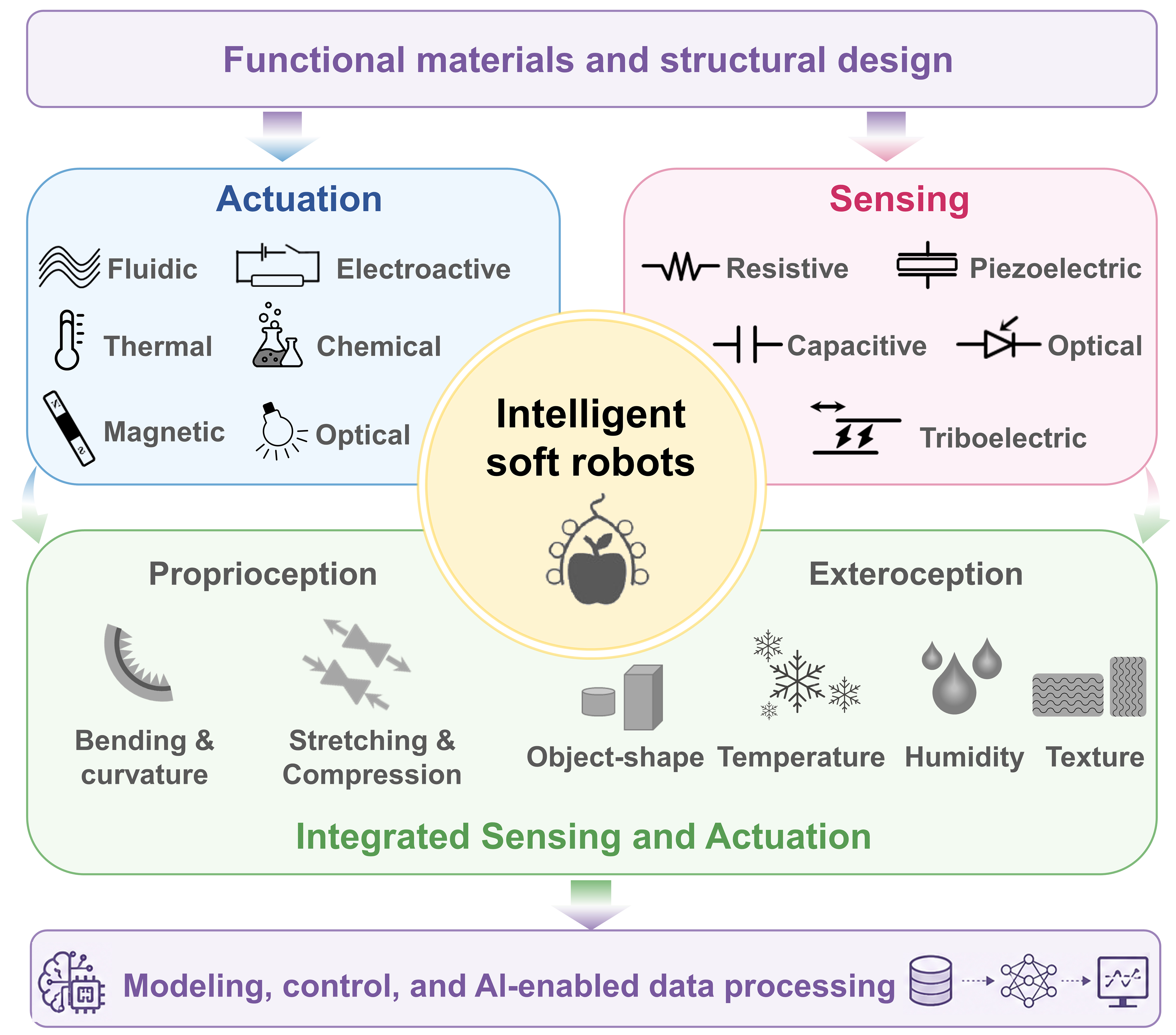
Figure 1. Schematic overview of representative actuation and sensing strategies and their integration in soft robotics.
Finally, future challenges and opportunities are discussed from the perspectives of predictable actuation, reliable perception, intrinsic integration, autonomous operation, and practical deployment. The depth of discussion for different technologies is determined by their maturity, research activity, and relevance to integrated soft robotic systems. Emerging approaches with limited demonstrations are briefly introduced, while more established technologies and integration strategies are discussed in greater detail to provide a comprehensive yet balanced overview.
2. REVIEW METHODOLOGY
This review was prepared through a systematic literature collection and screening process to provide a comprehensive overview of actuation, sensing, and integration strategies in soft robotics. Relevant publications were collected from major scientific databases, including Web of Science, Scopus, Google Scholar, IEEE Xplore, ScienceDirect, SpringerLink, and PubMed. The literature search mainly covered publications from 2012 to 2026, with particular attention to recent advances published within the past five years. Earlier representative studies were also included when they introduced fundamental concepts, landmark soft robotic systems, or widely adopted sensing and actuation mechanisms.
The search keywords included combinations of the following terms: “soft robotics”, “soft robot”, “soft actuator”, “artificial muscle”, “fluidic actuation”, “pneumatic actuator”, “hydraulic actuator”, “tendon-driven soft robot”, “electroactive actuator”, “thermal actuator”, “magnetic soft robot”, “optical actuation”, “chemical actuation”, “acoustic actuation”, “flexible sensor”, “soft sensor”, “piezoresistive sensor”, “capacitive sensor”, “piezoelectric sensor”, “triboelectric sensor”, “optical sensor”, “magnetic sensor”, “proprioception”, “exteroception”, “multimodal sensing”, “actuation–sensing integration”, “self-sensing actuator”, “closed-loop control”, and “embodied intelligence”.
The collected literature was screened according to its relevance to soft robotic systems, actuation mechanisms, flexible sensing technologies, and integrated actuation–sensing designs. Peer-reviewed research articles and review papers were prioritized. Studies were included when they provided clear demonstrations of soft robotic actuation, sensing mechanisms, proprioceptive or exteroceptive perception, multimodal sensing, or system-level integration. Papers focusing only on material synthesis without clear relevance to soft robotic functions, rigid robotic systems without compliant structures, or sensing devices without potential applicability to soft robotics were excluded. After title and abstract screening, the full texts of selected papers were further examined and categorized according to actuation type, sensing mechanism, integration strategy, application scenario, and reported performance characteristics. This process formed the basis for the organization and comparative discussion presented in this review.
3. ACTUATION TECHNOLOGIES FOR SOFT ROBOTICS
Designing and controlling machines with motion capabilities comparable to those of biological organisms has long been a major challenge in robotics. In soft robotics, actuation technologies are essential for enabling flexible motions and complex functionalities because soft actuators are primarily responsible for deformations such as bending, elongation, and twisting. Actuation strategies have therefore become a central research focus in this field[25].
Based on the connection mode between the robot body and the actuation system, soft robots can be broadly classified into tethered and untethered actuation. Tethered actuation relies on physical connections (e.g., cables, fluidic tubing) to transmit energy and control signals, providing fast response and stable output. In contrast, untethered actuation exploits external fields (such as magnetic or optical fields) or the intrinsic responsiveness of smart materials to achieve non-contact excitation, thereby endowing robots with greater freedom of motion and enhanced environmental adaptability[26]. This section systematically explores the working mechanism, representative systems, and typical applications of both tethered and untethered actuation approaches in soft robotics, as shown in Figure 2.
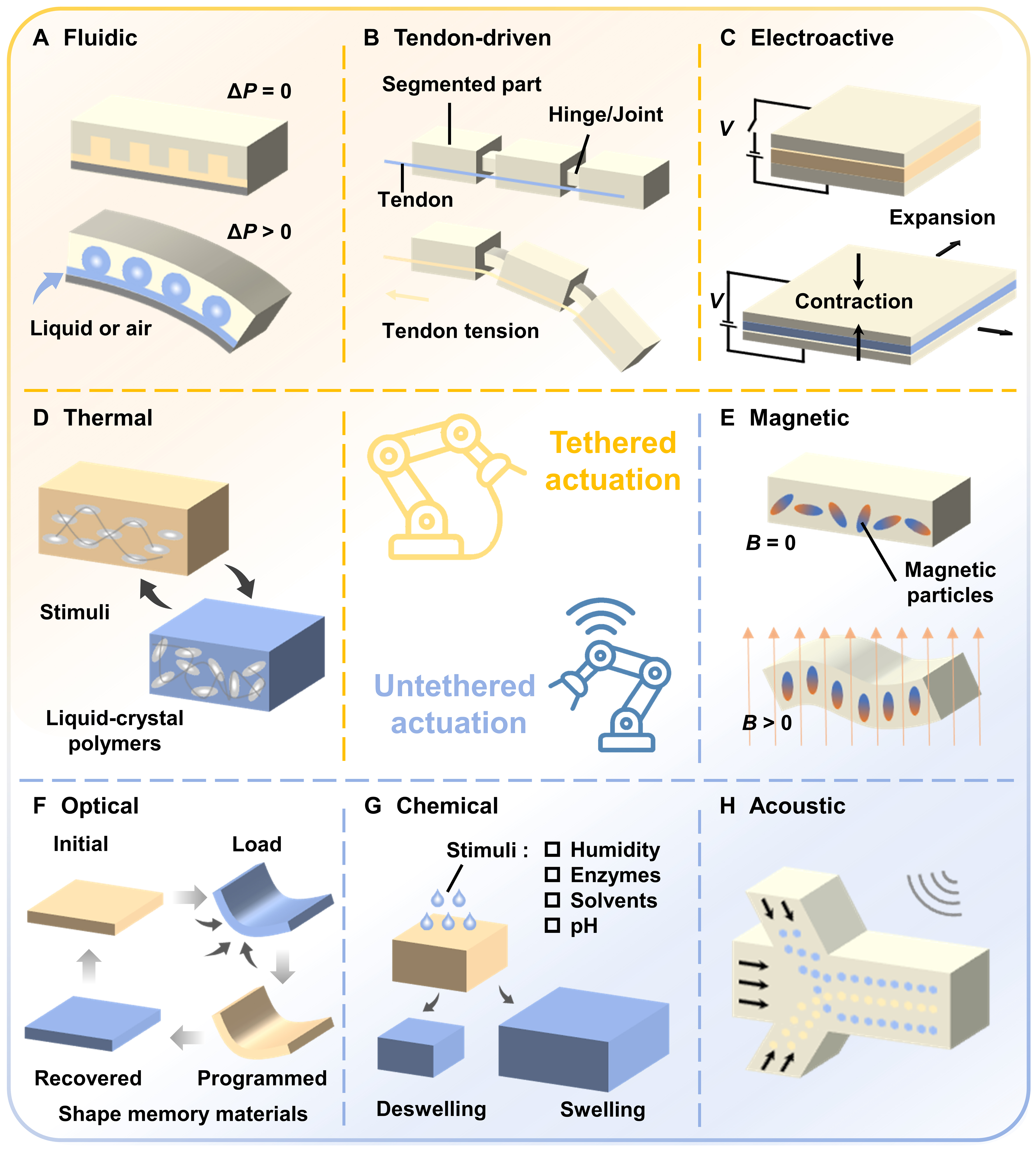
Figure 2. Schematic illustration of representative actuation approaches in soft robotics. (A) Fluidic actuation; (B) Tendon-driven actuation; (C) Electroactive actuation; (D) Thermal actuation; (E) Magnetic actuation; (F) Optical actuation; (G) Chemical actuation; (H) Acoustic actuation.
3.1. Tethered actuation
3.1.1. Fluidic actuation
Fluidic actuation, one of the earliest actuation strategies investigated in soft robotics, is inspired by the locomotion of soft-bodied animals such as octopuses and sea cucumbers. It controls deformation by modulating internal fluidic pressure and exhibits advantages such as fast response, tunable output force, simple structure, and low cost[27,28]. Fluidic actuation in soft robotics primarily includes pneumatic[29] and hydraulic approaches[30], which use gas and liquid as the driving medium, respectively.
Pneumatic actuation is the most widely adopted, owing to the low density of the working medium and ready availability. This approach typically employs elastomeric materials (e.g., silicone rubber[31]) to construct structures with inflatable chambers, while constraining layers made of fibers or fabrics are used to guide and constrain deformations[32]. Specific configurations, such as cylindrical or folded shapes, enable precise and controllable motions. However, reliance on external pumps increases system bulk, and the nonlinear behavior of elastomeric materials increases control complexity. Addressing these limitations remains a key focus for future research[33-37].
Traditional implementations typically involve compressed air storage combined with solenoid valves to control airflow. However, pneumatic systems are often constrained by the size of air supply equipment, limiting their deployment in spatially restricted or unstructured environments. To address challenges related to system complexity and control dependency, some studies have proposed structurally driven solutions that do not require electronic control. For instance, one study developed a self-oscillating pneumatic limb system composed of soft tubing, achieving high-frequency motion through structural design[38]. This system demonstrated the highest motion speed reported to date among pneumatic soft robots, while significantly simplifying the overall structure [Figure 3A]. The configurational diversity of pneumatic actuation continues to expand. For example, a “geometrically constrained contraction–extension” pneumatic artificial muscle was constructed from a single-material folded membrane without additional strain-limiting structures. This actuator can be rapidly fabricated using low-cost additive manufacturing for devices such as bioinspired hands, demonstrating excellent functional integration and manufacturability[39].

Figure 3. Representative tethered actuation technologies in soft robotics. (A) The tethered robot has four limbs connected to a 3D-printed monolithic body, with four inner coupling channels, scale bars: 1 cm. Adapted with permission from Ref.[38], Copyright © 2025, AAAS; (B) Upon inflation, an initially flat panel composed of programmed Gaussian cells self-shapes into a complex 3D structure. Adapted with permission from Ref.[42], Copyright © 2023, AAAS; (C) Hydraulic actuation-enabled soft robotic system with integrated sensing capability. Adapted from Ref.[44], under CC BY-NC 4.0 license; (D) A holistic design of the biomimetic rigid-soft finger with reduced complexity; (E) MIDI signal comparisons of the music played by the robotic hand, the human hand, and the standard notation. (D) and (E) were adapted with permission from Ref.[49], Copyright © 2025, AAAS; (F) Schematic diagram and photographs showing a robot navigating through a spiral pipe for inspection, scale bars: 10 mm; Adapted with permission from Ref.[52], Copyright © 2026, AAAS; (G) Design strategy of weaving LCE fiber soft actuators for multifunctional soft robotics. Adapted from Ref.[58], under CC BY-NC 4.0 license; (H) Electrothermal-driven amphibious insect-scale robot based on SMA actuators. Reprinted from Ref.[59], under CC BY-NC-ND 4.0 license. MIDI: Musical instrument digital interface; LCE: liquid crystal elastomer; MCP: metacarpophalangeal; IP: interphalangeal; DE: dielectric elastomer.
In terms of programmable configurations, another study proposed an origami-inspired pneumatic gripper capable of dynamically adjusting its grasping mode. The gripper can switch between bistable and monostable states after fabrication, enabling precise grasping across multiple forms and enhancing adaptability and performance in complex tasks. Such designs overcome the limitations of fixed traditional gripper geometries, providing soft grasping systems with increased flexibility[40]. Another strategy, termed net rolling-splicing (NRS), rapidly constructs multifunctional pneumatic units by curling and splicing two-dimensional mesh structures, enabling complex functions such as walking, climbing, load carrying, and stable rolling. This approach offers an efficient method for building stackable pneumatic structures[41]. Moreover, the environmental adaptability of pneumatic actuation can be further enhanced through bioinspired strategies. Inspired by bulliform cell structures in monocot leaves, one study developed a planar panel system with internally designed structures capable of programmable deformation. Under compressive conditions, the panel exhibits simultaneous in-plane deformation and bending, forming specific three-dimensional shell shapes. Using flexible polymers, the system demonstrates good manufacturability, rapid response, and tunable stiffness, offering new approaches for constructing large-area, multi-morphology shape-morphing robots [Figure 3B][42].
Hydraulic actuation employs liquid as the driving medium and exploits its incompressibility to achieve advantages in precision control, energy transmission, and output force. Compared with pneumatic actuation, hydraulic systems generally provide faster response and lower energy loss, making them suitable for applications that require high precision or heavy loads. For instance, one study developed a hydraulically actuated bioinspired soft robotic fish using an innovative four-cylinder piston pump and a self-sensing dual-joint actuator. Integrated with a closed-loop control system, the robot demonstrated efficient turning, diving, and long-distance swimming, exhibiting excellent posture control and adaptability in complex environments[43]. Hydraulic actuation also offers notable benefits in structural integration and control accuracy. Kashyap et al. developed a catheter-deployable soft robotic sensor array driven by hydraulic actuation, in which inflatable soft structures were integrated with stretchable electronics to achieve highly conformable cardiac mapping [Figure 3C][44]. Nevertheless, challenges persist, particularly due to the effects of fluid weight on system modeling and control strategies, which are especially critical in tasks involving rapid movements or posture stabilization. Therefore, enhancing miniaturization and integration of hydraulic systems, along with the development of adaptive control algorithms, remains a key focus in current research. With advances in material technologies and fluid control methods, hydraulic actuation has evolved from traditional rigid systems to diverse, highly flexible structures. Its integration with sensing and control systems is becoming increasingly tight, providing essential support for future applications of soft robots in precise manipulation, medical wearables, and underwater exploration.
3.1.2. Tendon-driven actuation
Tendon-driven deformation is a highly bioinspired approach in soft robotics, mimicking the mechanical transmission mechanisms of biological muscle–tendon systems. By coupling flexible tendons with various actuation sources (e.g., motors, pneumatic, or hydraulic systems)[45], it enables motion control that combines compliance with high precision. Tendon-driven systems exhibit strong biomimetic characteristics, diverse actuation modes, and structural adaptability, allowing submillimeter positioning and rapid response. They are widely applied in scenarios requiring high flexibility and safety, such as medical rehabilitation and bioinspired grasping[46]. For instance, a novel soft self-pumping actuator (SSPA) has been developed, in which tendon traction drives internal gas transfer to actuate joint bending. This design significantly improves actuation efficiency and response sensitivity. Under pre-pressurized conditions, the SSPA achieves up to a 45% increase in energy efficiency while substantially reducing the actuation force required for startup, demonstrating its potential for high-efficiency soft actuation units[47].
In practical applications, one study created a soft myoelectric prosthetic hand system comprising two tendon-driven soft fingers and three fin-like fingers, enabling upper-limb amputees to perform precise daily tasks, such as operating a standard computer mouse[48]. Another study employed a rigid–soft hybrid design with elastic tendon-driven mechanisms to construct a bioinspired robotic hand capable of playing the piano, grasping objects, and performing fine manipulation, further validating the practicality and scalability of tendon-driven systems [Figure 3D and E][49]. Current research emphasizes integrating self-sensing tendon materials, intelligent control strategies, and miniaturized structures to enhance energy efficiency and autonomy, while addressing challenges such as fatigue and control complexity. Despite their excellent compliance and precision, tendon-driven systems still rely on rigid motors, which limits overall miniaturization and flexibility, representing a key bottleneck for broader application.
3.1.3. Electroactive actuation
Electroactive actuation refers to a class of soft actuation methods in which material deformation is induced by an electric field to generate motion. Representative materials include dielectric elastomer actuators (DEAs) and ionic polymer-metal composites (IPMCs)[50]. These actuators offer fast response, high energy density, and compact structures, making them particularly suitable for integration with electronic sensing and control systems and providing strong potential for intelligent and multifunctional soft robots[51].
In highly challenging pipeline inspection applications, researchers integrated high-power DEAs with smart composite microstructures (SCM) to develop a soft robot capable of rapid traversal through subcentimeter pipelines. By precisely controlling actuation frequency and phase, the system achieves high-speed, multi-directional propulsion [Figure 3F][52]. To address the common issue of high driving voltage in conventional electroactive actuators, subsequent research proposed a hydraulic-amplified low-voltage electrostatic (HALVE) actuator. This system employs multilayer dielectric structures and an oil-mediated amplification mechanism, substantially reducing voltage requirements while enhancing response power and deformation rate. It also exhibits good tactile safety, self-cleaning capability, and wearable adaptability[53]. Recent studies have further optimized DEA-based structures through dielectric elastomer minimum energy structures (DEMES) and unequal biaxial pre-stretching, improving actuator deformation, blocking force, and locomotion performance in multifunctional soft robots[54].
Overall, electroactive actuators, owing to their excellent responsiveness and system integrability, are gradually becoming core components of intelligent soft robots. Nevertheless, challenges remain regarding driving voltage, safety, material durability, and long-term stability. Future advances are expected in low-power designs, novel electroactive materials, and integrated packaging technologies.
3.1.4. Thermal actuation
Thermal actuation is an important form of soft actuation, in which controlled material deformation induced by temperature changes generates mechanical output. Among thermal actuation approaches, electrothermal actuation is the most common, relying primarily on the Joule heating effect: electrical current produces localized temperature increases, which stimulate the material to produce shape memory effects, thermal expansion, or phase transitions to produce mechanical response. Typical materials include shape memory polymers (SMPs), liquid crystal elastomers (LCEs), carbon nanotube (CNT) composites, and shape memory alloys (SMAs)[55-57]. Such actuators generally offer high response precision, compact structures, and strong integrability, making them suitable for miniaturized or wearable systems.
To achieve programmable control of flexible deformation and functional structures, one study proposed a soft actuator design that combines traditional woven architectures with electrically driven LCE fibers. This design enables programmable deformation surfaces, bioinspired cardiac pumping devices, and flexible systems capable of multimodal locomotion, such as crawling and swimming, thereby significantly enhancing motion diversity and structural adaptability [Figure 3G][58]. At the microscale, recent studies have combined arc-heating structures with SMA wires to develop insect-scale electrothermal robots that can compress to 70% of their original height within 2.2 s. Remarkably, they can recover after sustaining compressive loads up to five million times their own weight, demonstrating efficient locomotion and environmental adaptability [Figure 3H][59]. Thermal actuation also enables intelligent response and environmental perception. For example, a soft robot integrating a three-dimensional flexible photodetector with an SMA actuator was able to sense light direction and respond via heating, achieving autonomous phototactic motion and demonstrating navigational capability in complex environments[60]. In hybrid actuation strategies, thermal actuation offers unique advantages. One study, inspired by the growth and attachment mechanisms of Parthenocissus quinquefolia, proposed a soft robotic system with “growth–climbing” functionality. The robot combines pneumatic actuation for structural extension, microstructured biofilm for reversible adhesion, and SMA springs for posture control through heating, enabling effective attachment and movement on complex or discontinuous surfaces. This multimodal integration enhances environmental adaptability and functional performance in challenging settings[61].
In summary, thermal actuation leverages the thermal response of materials to achieve high integrability and environmental adaptability. It is particularly advantageous for miniaturized, autonomously responsive, and multimodal actuation systems, providing an effective driving strategy for soft robots operating in complex environments.
3.2. Untethered actuation
3.2.1. Magnetic actuation
Magnetic actuation is a remote, non-contact method in which magnetic materials are embedded within the robot, and an external magnetic field induces forces or torques to achieve directional motion and shape control. To enable programmability, the magnetic domain structures of these materials can be erased and reprogrammed by heating above the Curie temperature after fabrication, enhancing structural diversity and functional flexibility. With advances in magnetic material design and magnetic field control, magnetically actuated soft robots can perform complex and flexible motion patterns, including rolling, crawling, undulating, and even flying. This technology offers remote and non-contact control, high compliance, and excellent biocompatibility, making it particularly suitable for operation in confined environments. Given the strong penetration of magnetic fields through human tissue, magnetic actuation is widely regarded as a promising approach for in vivo medical robots and minimally invasive surgical systems[62-64].
For example, one study employed a microfluidic fabrication platform to construct shape-morphable magnetic robots, enabling precise control of microscale structural configuration and function. These microrobots can be efficiently manipulated and rotated by external magnetic fields, with potential applications as active drug carriers, microreactors, or micromixers[65]. Another study demonstrated a subcentimeter-scale rotor robot driven by a uniaxial alternating magnetic field, capable of hovering, controlled flight, and impact recovery [Figure 4A and B]. It represents one of the lightest and smallest magnetically driven aerial robots to date, providing a novel design paradigm for wireless aerial robotics[66].
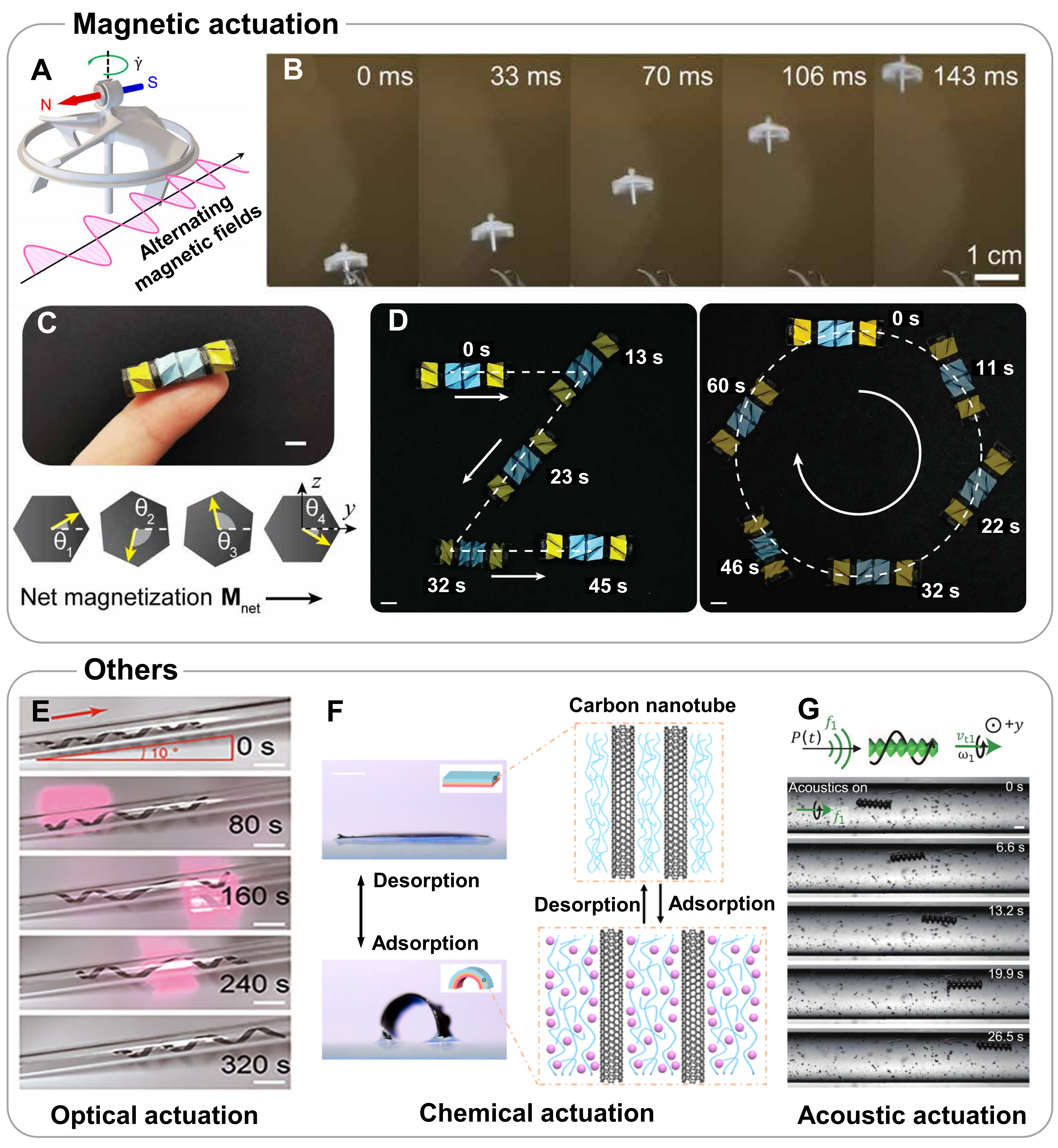
Figure 4. Representative untethered actuation technologies in soft robotics. (A) Working principle of the untethered subcentimeter-scale flying robot; (B) Optical images for the sustained upward flights. (A) and (B) were adapted from Ref.[66], under CC BY-NC 4.0 license; (C) Image of a fingertip holding the fabricated Kresling crawler and designed magnetization directions of the four magnetic plates for distributed torques, scale bars: 5 mm; (D) Steering and navigation of the Kresling crawler, scale bars: 5 mm. (C) and (D) were adapted from Ref.[67], under CC BY-NC 4.0 license; (E) Accordion crawling inside the inclined tube, scale bars: 10 mm. Adapted from Ref.[71], under CC BY 4.0 license; (F) Schematic of the actuating mechanism for strip-shaped actuators by reversible adsorption and desorption of solvents, scale bars: 2 mm. Adapted from Ref.[76], under CC BY 4.0 license; (G) Translational motion of the microrobot in a circular microchannel, scale bars: 100 μm. Adapted from Ref.[81], under CC BY-NC 4.0 license.
In bioinspired structural actuation, a magnetic origami robot inspired by earthworms and inchworms was developed to achieve planar contraction-based crawling. The system consists of bipolar dipole modules constructed from four-unit Kresling origami structures, generating anisotropic torque distributions under a magnetic field for tether-free, multi-degree-of-freedom motion [Figure 4C and D]. Its internal cavity can be utilized for drug storage and release, demonstrating multifunctional potential for minimally invasive medical applications[67]. To address mobility challenges in complex 3D environments, another study proposed a magnetically actuated soft robot featuring a “peel–load” mechanism. This system combines microstructured adhesive pads with bioinspired adhesive feet, enabling vertical and inverted climbing on complex geometries or soft, wet surfaces (e.g., porcine tissue) through coupled global deformation and magnetic field control. This multimodal adhesion mechanism significantly enhances the utility of soft robots for environmental sensing and minimally invasive interventions[68].
Despite these advantages, magnetic actuation still faces challenges in practical applications, including non-uniformity in controlled magnetic fields and interference from metallic environments, which can limit deployment in complex scenarios. Nevertheless, magnetically actuated soft robots continue to show broad potential in minimally invasive surgery, in vivo navigation, and targeted therapy, representing a key direction for the development of next-generation intelligent medical devices.
3.2.2. Optical actuation
Optical actuation is an advanced method for controlling soft robot motion through interactions between light and materials, primarily relying on photomechanical, photothermal, or photochemical effects[69]. By inducing deformation in photosensitive materials under illumination of specific wavelengths, this approach enables remote, non-contact actuation[70]. These actuators offer wireless control, high-precision positioning, and rapid response, making them particularly suitable for spatially constrained or microscale applications. Although challenges remain in light penetration depth and energy efficiency, advances in smart materials and multi-field-coupled design have expanded the potential of light-driven systems for small-scale, high-precision, and programmable deformation applications.
In material design, a recent study proposed an initial coiling structure soft robot (ICSBot) inspired by snakes. Using direct ink writing, MXene–cellulose nanofiber (CNF) ink was printed onto a pre-stretched polyethylene (PE) film. The resulting structure responds multimodally to light, humidity, and temperature. Under near-infrared illumination, the MXene–CNF layer converts light to heat and contracts, while the PE layer thermally expands, driving deformation; the structure recovers automatically once illumination ceases [Figure 4E]. Humidity and temperature changes can also trigger curling or expansion, demonstrating excellent environmental adaptability and stimulus-programmable control[71].
Light-driven systems based on LCEs have also attracted sustained interest. One study employed finite element modeling to construct an LCE microstructure array, revealing direction-controllable stepwise motion under strong illumination. The response is modulated by the geometric structure, light intensity and direction, and temperature, enabling programmable deformation and multimodal complex motion[72]. LCE materials have further been used to fabricate microscale artificial skin systems, where femtosecond laser activation induces artificial piloerection, microstructure disassembly, and controllable light reflection, demonstrating potential for information storage and microstructural manipulation[73]. In hydrogel-based light actuation, a dual-crosslinked supramolecular hydrogel network was developed using acid–ether hydrogen bonds, achieving high mechanical strength, rapid self-healing, and high sensitivity to visible light. By incorporating photoisomerizable spiropyran groups, a hydrogel actuator capable of self-regulating reverse deformation under constant illumination was designed, enabling complex temporary bidirectional shape changes and self-regulated rolling in wet or dry environments. This provides a novel material platform for adaptive soft systems[74].
Overall, optical actuation, with its non-contact operation, high precision, and multi-stimulus responsiveness, offers broad prospects for microscale manipulation, adaptive structures, and intelligent response in soft robotics. Despite limitations such as restricted penetration depth and low energy conversion efficiency, ongoing advances in photosensitive materials and system integration are expected to further expand the role of optical actuation in flexible electronics, medical microrobotics, and other cutting-edge applications.
3.2.3. Chemical actuation
Chemical actuation is a class of soft actuation strategies in which material deformation or motion is induced by chemical stimuli. Owing to their autonomous responsiveness, environmental adaptability, and high level of functional integration, chemically actuated systems are particularly attractive for soft robots operating in confined spaces, energy-limited environments, or applications requiring remote triggering. Through physicochemical processes such as swelling, shrinkage, molecular reconfiguration, and stimulus-responsive volume changes, these systems can generate diverse autonomous behaviors without external cables or bulky equipment[75]. Such characteristics provide significant potential for applications in drug delivery, environmental monitoring, and minimally invasive biomedical systems.
For example, multifunctional actuators with polydimethylsiloxane (PDMS)/CNT–PDMS–polyvinylidene fluoride (PVDF) sandwich structures have been designed to respond to multiple stimuli such as liquids, vapor, and light. These actuators exhibit versatile bioinspired behaviors, including grasping, crawling, and swimming, demonstrating excellent performance in energy-efficient grippers and biomimetic robots [Figure 4F][76]. Other studies have developed humidity-responsive actuators based on MXene, cellulose, and polystyrene sulfonate (PSSA), leveraging asymmetric hygroscopic expansion to drive motion while integrating energy harvesting and sensing via proton diffusion. These systems achieve high power density and output voltage, making them suitable for self-powered soft robots[77]. At the material level, asymmetric DNA hydrogel structures have been proposed, where distinct layers selectively respond to pH, ion concentration, thermal, or chemical stimuli, inducing reversible deformation and showing promise for bioengineering and intelligent medical devices[78].
Overall, chemical actuation provides a flexible, highly integrated, and passive driving strategy for soft robots. Despite challenges in response precision and material stability, advances in self-powered technologies and responsive material design are steadily expanding its applicability in extreme or resource-limited environments.
3.2.4. Acoustic actuation
Acoustic actuation is a flexible, non-contact method that harnesses acoustic energy to control motion, primarily through mechanisms such as acoustic radiation forces, acoustic streaming, and cavitation-induced deformation[79]. This approach offers strong penetration, biocompatibility, and high adaptability to complex environments. Its applications have expanded in recent years, particularly in minimally invasive medical procedures, liquid-phase manipulation, and intelligent microstructure control. For instance, one study developed an artificial muscle system based on ultrasound-activated microbubble arrays, achieving high force density, rapid response, and programmable actuation via ultrasonic resonance amplification. The system demonstrated efficient performance in soft grippers, biomimetic fish, and shape-transforming structures[80]. Acoustically driven helical microrobots are another example, where structural design and single-source modulation enable bidirectional spiral propulsion with tunable path control and frequency characteristics, suitable for mimicking natural microswimmers [Figure 4G][81]. Furthermore, ultrasound-activated synthetic cilia systems, inspired by ciliary bands in starfish larvae, can drive microscale fluid flow, integrating propulsion, mixing, and particle manipulation, providing new approaches for microfluidics and biomimetic transport[82].
In summary, acoustic actuation, combined with sound-field control and structural engineering, opens new avenues for remote, precise manipulation in soft systems. Although challenges remain in energy efficiency and system modeling, its potential for adaptive, miniaturized, and highly integrated soft robots continues to grow.
3.3. Comparative analysis of actuation technologies
This section reviews the major actuation strategies used in soft robotics, including fluidic, tendon-driven, electroactive, thermal, magnetic, optical, chemical, and acoustic actuation. These approaches exhibit distinct characteristics in terms of output capability, response speed, controllability, structural complexity, and environmental adaptability. Table 1 summarizes the performance characteristics of representative soft actuation technologies under different stimulation methods, including their key advantages, main limitations, output capability, and response speed.
Comparison of representative actuation technologies for soft robotics
| Approach | Working principle | Key advantages | Main limitations | Typical applications | Output capability | Response speed |
| Fluidic[27-30] | Pressure-driven deformation through pneumatic or hydraulic chambers | Large deformation, high force output, and good compliance | External pumps and tubing required; bulky systems; complex control | Grippers, manipulators, locomotion robots | High | Moderate |
| Tendon-driven[45,46] | Cable/tendon tension induces structural deformation | Precise motion control; biomimetic movement; simple actuation mechanism | Mechanical complexity; tendon friction and fatigue; limited scalability | Continuum robots, wearable robots, surgical robots | Moderate | Moderate |
| Electroactive[50,51] | Electrical stimulation induces deformation through electroactive materials | Fast response; compact structure; high integration potential | High driving voltage; material degradation; limited force output | Artificial muscles, micro/nano robots, soft actuators | Moderate | Fast |
| Thermal[55-57] | Temperature-induced phase transition, expansion, or molecular rearrangement | High energy density; programmable deformation; simple structure | Slow response; thermal management issues; low energy efficiency | Shape-changing robots, biomedical devices | Moderate | Slow |
| Magnetic[63,64] | External magnetic fields induce deformation or motion | Wireless control; rapid response; remote operation | Requires external magnetic field systems; limited workspace | Untethered robots, biomedical robots, micro-robots | Moderate | Fast |
| Optical[69,70] | Light-triggered deformation through photoresponsive materials | Wireless actuation; remote and spatially selective control | Limited penetration depth; low energy efficiency; environmental dependence | Micro-robots, biomedical systems | Low | Fast |
| Chemical[75-77] | Chemical stimuli induce swelling, shrinkage, molecular reconfiguration, or volume changes | Autonomous operation; environmental responsiveness | Slow response; limited controllability; difficult reversibility | Bio-inspired robots, environmental-responsive systems | Low | Slow |
| Acoustic[79-82] | Acoustic waves generate mechanical deformation or motion | Remote stimulation; non-contact operation; good biocompatibility | Energy attenuation; complex field control; limited practical implementation | Biomedical robots, remote manipulation systems | Moderate | Fast |
Although existing actuation technologies have enabled a wide range of deformation modes and locomotion behaviors, no single actuation strategy can simultaneously satisfy all requirements for output force, response speed, energy efficiency, controllability, miniaturization, and environmental adaptability[83]. Fluidic and tendon-driven systems generally provide large deformation and output force but often rely on external driving equipment, whereas electroactive and thermal actuators offer compact structures and high integration potential while facing challenges related to driving conditions, energy efficiency, and long-term stability[84]. Untethered actuation approaches, including magnetic, optical, chemical, and acoustic actuation, enable remote and non-contact operation, yet their practical deployment remains constrained by limitations in energy transfer, environmental dependence, and control complexity.
Future developments are expected to move beyond the optimization of individual actuation performance and instead focus on application-oriented co-design of smart materials, mechanical structures, energy supply, sensing feedback, and control strategies. Such integrated approaches will be essential for achieving soft robotic systems with predictable deformation, improved robustness, enhanced adaptability, and autonomous operation.
4. SENSING TECHNOLOGIES FOR SOFT ROBOTICS
Soft robots exhibit unique advantages in compliance and adaptability; however, their large deformations and complex material behaviors, including nonlinearity, hysteresis, and viscoelasticity, pose significant challenges for modeling and precise control. Flexible sensing technologies offer a promising solution to these challenges. By achieving high integration with the robot body, flexible sensors can provide real-time monitoring of intrinsic states, including deformation and position, while simultaneously detecting environmental parameters such as pressure, temperature, and pH. This capability significantly enhances the robot’s perception and interaction abilities[85,86]. Robotic sensing remains one of the most challenging research areas, with the overarching goal of developing robust and precise perception methods that can emulate - or even surpass - human sensory capabilities[87,88]. Compared to traditional rigid sensors, flexible sensors offer superior adaptability, sensitivity, and stretchability, making them particularly suitable for dynamic and complex environments[89]. Advances in novel materials and micro-/nano-fabrication technologies have further expanded their potential in multimodal perception, adaptive control, and safe human–robot interaction, positioning flexible sensors as key enablers of intelligence in soft robots[90,91]. Currently, designing flexible sensing systems requires careful balancing of mechanical properties, electrical performance, and integration density to meet the complex and diverse demands of soft robotic applications, ensuring safe interaction with delicate objects or human skin.
Due to the diverse deformation modes, operating conditions, and task requirements in soft robotics, it is difficult for a single sensing technology to satisfy all application demands. Different sensor technologies exhibit distinct performance characteristics in terms of target detection, deformation modes, nonlinearity, and hysteresis, which determine their suitability for specific applications and environments. Therefore, exploring sensors based on different operating principles is essential to select devices that match the desired performance goals. At present, flexible sensors can be categorized by their transduction mechanisms into resistive (piezoresistive)[92,93], capacitive[94,95], triboelectric[96,97], piezoelectric[98,99], optical[100,101], and magnetic sensing approaches[102,103]. In this section, we summarize these sensor types, briefly introduce their working principles, analyze their respective advantages and limitations, and discuss their applicability. Figure 5 summarizes the operating principles of the major sensing mechanisms discussed in this review.
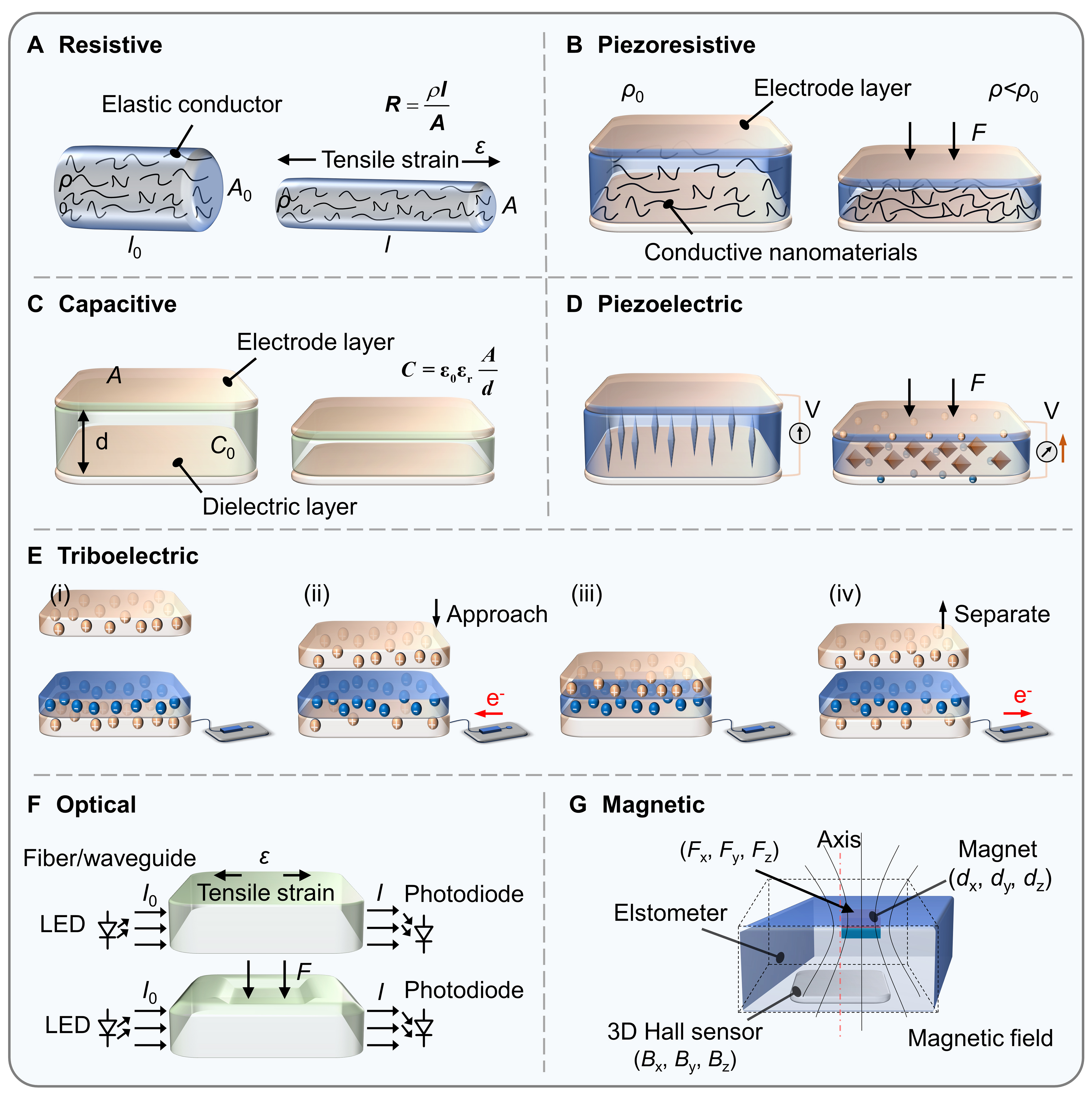
Figure 5. Working principles of major flexible sensing technologies for soft robotics. (A) Resistive sensor; (B) Piezoresistive sensor; (C) Capacitive sensor; (D) Piezoelectric sensor; (E) Triboelectric sensor; (F) Optical sensor; (G) Magnetic sensor.
4.1. Resistive and piezoresistive sensors
Resistive and piezoresistive sensors primarily rely on changes in electrical resistance to detect mechanical stimuli, including force, pressure, strain, and deformation, and represent one of the most widely studied sensing approaches in flexible electronics and soft robotics. When subjected to stretching, compression, or bending, the conductive networks within the sensing material may be disrupted, reconfigured, or brought into closer contact, resulting in measurable resistance variations[104]. For conductive materials obeying Ohm’s law, the resistance can be expressed as:
where ρ is the material resistivity, L is the length, and A is the cross-sectional area[105]. According to this relationship, the resistance is proportional to the conductor length and inversely proportional to its cross-sectional area. Flexible resistive and piezoresistive sensors often exhibit nonlinear response behavior owing to structural heterogeneity, conductive network evolution, and microcrack formation during deformation. As the applied pressure increases, different sensing mechanisms may dominate the resistance response, resulting in distinct low-, medium-, and high-pressure regimes with varying sensitivities. To improve sensing performance, various surface microstructures, such as hemispherical, honeycomb, and pyramidal architectures, have been introduced to increase effective contact area and optimize stress distribution, thereby enhancing pressure and strain sensitivity[106-108].
It should be noted that resistive and piezoresistive sensing are closely related but not identical. In general resistive sensing, the measured resistance change can arise from geometric variations, contact resistance changes, conductive pathway reconstruction, or crack opening and closure during deformation. This mechanism is commonly observed in flexible composite sensors based on conductive fillers, liquid metals, conductive polymers, carbon nanomaterials, or metallic networks. By contrast, piezoresistive sensing more specifically refers to the intrinsic change in the electrical resistivity of a material under mechanical stress or strain, which is particularly evident in semiconductor-based sensing materials. In practical flexible sensors, especially composite or microstructured systems, these two effects often coexist and jointly contribute to the output signal[109]. Therefore, resistive and piezoresistive sensors are discussed together in this section because both are widely used to convert mechanical deformation into resistance-based electrical signals in soft robotic systems; however, their distinct physical origins should be considered when evaluating sensitivity, linearity, hysteresis, temperature dependence, and long-term stability.
Leveraging these structural optimization strategies, flexible resistive and piezoresistive sensors have achieved significant improvements in sensitivity, detection range, and mechanical adaptability. For example, a wearable piezoresistive sensor constructed from carbon nanofiber and PDMS composites exhibited a linear force sensitivity of approximately 1.82 kN-1 under forces below 20 N, while maintaining sewability and mechanical adaptability[110]. With further research, these sensors have expanded from simple pressure detection to multimodal recognition, enabling differentiation between touch, sliding, and other tactile modes [Figure 6A][111]. Such capabilities further broaden the applicability of resistive sensing technologies in flexible and soft robotic systems[112,113].
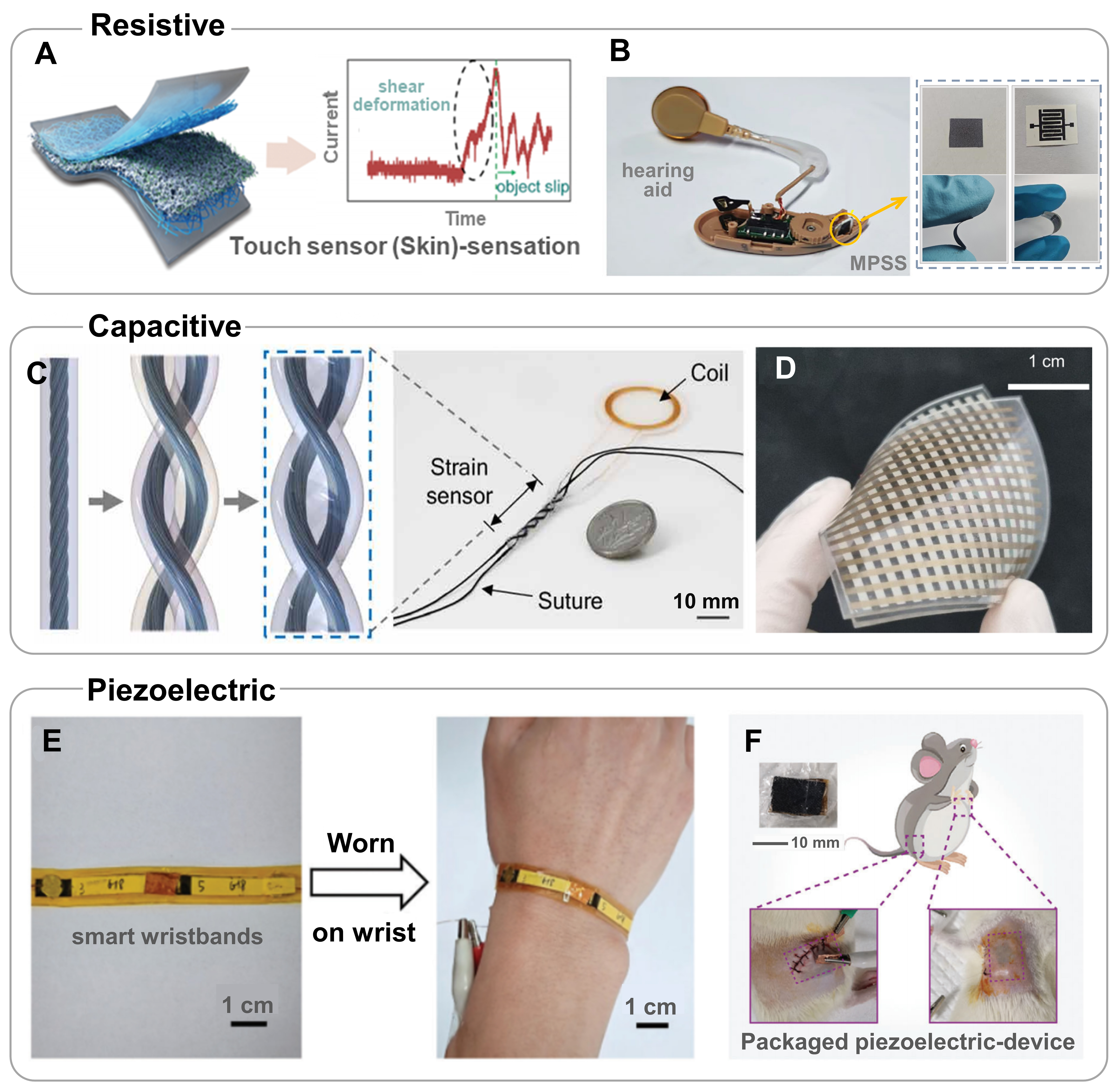
Figure 6. Representative examples of resistive, capacitive, and piezoelectric sensors for flexible sensing applications. (A) Different sensing signals for tactile and slip sensing of objects are captured using ultrasensitive touch sensors. Adapted with permission from Ref.[111], Copyright © 2024 Wiley-VCH GmbH; (B) Schematic diagram of the MPSS sensor to be applied in hearing aid. Adapted from Ref.[114], under CC BY 4.0 license; (C) Fabrication process and photograph of the strain sensor. Adapted from Ref.[121], under CC BY-NC 4.0 license; (D) Image displaying the fabricated 15 × 15 flexible capacitive pressure sensor array. Reprinted from Ref.[125], under CC BY-NC-ND 4.0 license; (E) Optical images and physical photos of smart wristbands based on flexible piezoelectric ion sensors. Adapted with permission from Ref.[131], Copyright © 2025 Wiley-VCH GmbH; (F) Schematic image and digital photographs of the implantation of packaged piezoelectric-device in the thigh and chest areas of rats. Adapted with permission from Ref.[132], Copyright © 2025 Wiley-VCH GmbH. MPSS: MXene/polyvinyl alcohol sound sensor.
Beyond tactile sensing, resistive and piezoresistive technologies have also been extended to acoustic and vibration sensing. For example, a piezoresistive hearing aid was reported to detect sound pressures as low as 60 dB with a frequency response of 20-4,000 Hz [Figure 6B][114]. In addition, sensors incorporating porous inclined hollow-cone microstructures achieved ultrahigh sensitivity and were successfully integrated into artificial tympanic membrane systems for acoustic signal detection[115]. Recent developments have further demonstrated the capability of resistive sensing platforms to capture voice-induced vibrations and complex human motions, enabling advanced signal recognition and decoding through data-processing algorithms[116,117]. These advances highlight the versatility of resistive sensing technologies and broaden their potential for intelligent perception systems.
In general, resistive and piezoresistive sensors require relatively simple signal-conditioning circuits and offer excellent design flexibility, making them adaptable to a wide range of sensing requirements. However, they remain subject to limitations such as baseline drift, hysteresis, and dependence on external power supplies, which may affect measurement accuracy and long-term stability. In addition, commonly used sensing materials, including conductive polymers, carbon-based nanomaterials, metallic conductors, and composite materials, are often sensitive to temperature variations, particularly under extreme environmental conditions, introducing additional signal noise and reducing reliability[118]. Nevertheless, owing to their mature fabrication processes, structural adaptability, and design versatility, resistive and piezoresistive sensors have demonstrated strong capabilities in detecting strain, pressure, and complex deformation states. As sensing materials and structural designs continue to advance, these sensors are expected to remain important components in soft robotics, wearable electronics, and intelligent perception systems, while ongoing efforts focus on improving signal stability, environmental robustness, and long-term reliability.
4.2. Flexible capacitive sensors
Flexible capacitive sensors represent another widely used sensing modality in soft robotics. Their typical structure consists of two flexible electrodes sandwiching a dielectric layer, forming a capacitor structure, most commonly in a parallel-plate configuration. The capacitance C can be expressed as:
where ε0 is the vacuum permittivity, εr is the relative dielectric constant of the dielectric layer, A is the effective electrode area, and d is the separation distance between the two electrodes[119]. When subjected to external stimuli such as pressure, stretching, or bending, one or more of these parameters change, resulting in measurable variations in capacitance. Capacitive sensors offer fast response, high sensitivity, wide dynamic range, and stable signal output, making them particularly suitable for high-resolution, reliable detection of physical quantities.
Thanks to their structural flexibility, low power consumption, and compatibility with soft materials, capacitive sensors are widely integrated into wearable and bio-integrated platforms. For example, a smart contact lens combining a Kirigami-inspired design with an ionic capacitive sensing array demonstrated the capability of conformal pressure monitoring on curved ocular surfaces[120]. In medical applications, capacitive strain sensors integrated with communication coils in surgical sutures enabled simultaneous strain sensing and wireless signal transmission, highlighting their potential for minimally invasive monitoring [Figure 6C][121]. Furthermore, capacitive sensing has been incorporated into flexible textile-based interfaces, where high spatial resolution and stable signal output support accurate detection of human motions and interaction inputs[122].
Despite these strengths, capacitive sensors face several challenges. Environmental factors such as temperature, humidity, and electromagnetic interference can affect signal stability[123]. The proximity of conductive objects may induce false triggers, while sensitivity to both pressure and strain can lead to multi-source signal coupling. Furthermore, achieving flexibility and stretchability requires precise electrode design and encapsulation, increasing integration complexity and cost. To address these limitations, various structural and material innovations have been proposed. For instance, a capacitive sensor based on a polyimide porous layered ionic fiber network with high-adhesion interfaces demonstrated significantly improved signal stability and mechanical durability. The optimized structure achieved a high sensitivity of 156.6 kPa-1, a broad sensing range of up to 4,000 kPa, and stable operation over more than 150,000 loading cycles[124]. These results highlight the effectiveness of interface engineering and porous structural design in enhancing the reliability and long-term performance of capacitive sensing systems. Another study identified edge fields as the primary source of capacitive interference and developed a sensor architecture that concentrates the electric field between electrodes, eliminating the need for shielding [Figure 6D]. By introducing a nanoscale electrode-gap structure (~900 nm spacing), crosstalk between adjacent sensing units was significantly reduced, enabling spatial resolution comparable to human tactile perception while mitigating bending-induced signal interference[125]. In addition to improving sensing performance, recent advances in flexible conductive fabrics, ionic hydrogels, and nanocomposite electrodes have expanded the functional scope of capacitive sensing systems. For example, capacitive sensors incorporating magnetically responsive microstructures can simultaneously detect pressure, proximity, and magnetic stimuli[126]. Similarly, ionic hydrogel- and nanocomposite-based electrode designs have enabled distributed tactile sensing, deformation monitoring, and multifunctional sensing capabilities, further enhancing the versatility of capacitive sensing technologies.
In summary, flexible capacitive sensors offer several advantages, including high sensitivity, fast response, low power consumption, and excellent structural compatibility. However, challenges such as environmental susceptibility, signal coupling, and fabrication complexity remain. Continued advances in microstructured dielectric layers, electrode materials, and device integration strategies are expected to further improve sensing reliability and multifunctionality, supporting broader applications in soft robotics, wearable electronics, and intelligent sensing systems.
4.3. Piezoelectric sensors
Piezoelectric sensors operate based on the piezoelectric effect, in which certain materials generate electrical charges when subjected to external mechanical stimuli such as pressure, vibration, or deformation. Common piezoelectric materials include piezoelectric ceramics, such as lead zirconate titanate (PZT) and barium titanate (BTO), as well as piezoelectric polymers, including PVDF and its copolymers[127]. Upon mechanical loading, these materials generate a potential difference proportional to the applied stimulus, producing measurable electrical signals. Because electrical outputs are generated directly from mechanical inputs, piezoelectric sensors can operate in a self-powered manner without continuous external power supply. Their high sensitivity, rapid response, and excellent capability for detecting dynamic mechanical stimuli make them particularly suitable for pressure, vibration, acoustic, and tactile sensing applications[128-130].
For example, a piezoelectric ionic sensor based on CNT and graphene nanocomposite electrodes exhibited high sensitivity to dynamic deformation and was capable of detecting subtle facial and body motions [Figure 6E][131]. In another study, a piezoelectric silk fibroin thin film generated sufficient electrical output under mechanical stimulation, highlighting the potential of piezoelectric materials for self-powered bioelectronic systems [Figure 6F][132]. Furthermore, piezoelectric nanofiber-based sensing platforms have been applied to acoustic signal detection, where the combination of high-frequency response and advanced signal-processing algorithms enabled accurate sound-source localization[133].
However, piezoelectric sensors also exhibit several intrinsic limitations. Because the piezoelectric effect generates transient electrical outputs, continuous measurement of static forces remains challenging. In addition, piezoelectric materials are susceptible to fatigue, and long-term operation may result in sensitivity degradation. Material selection therefore plays a critical role in device performance. Piezoelectric ceramics generally exhibit strong electromechanical coupling and high piezoelectric performance but suffer from intrinsic brittleness and limited mechanical compliance, which restrict their use in highly deformable systems[134,135]. In contrast, polymer-based piezoelectric materials, such as PVDF and its copolymers, offer superior flexibility, processability, and biocompatibility owing to their molecular dipole orientation mechanisms, making them attractive candidates for next-generation flexible piezoelectric sensors[136]. Recent work combining PVDF piezoelectric microspheres with a PDMS elastomer matrix produced a flexible composite sensor with a sensitivity of up to 540 mV·N-1 and a broad response range of 5-40 N, highlighting the advantages of polymer-based piezoelectric materials in achieving both mechanical flexibility and effective electromechanical conversion[137].
Unlike resistive and capacitive sensors, piezoelectric sensors can directly convert mechanical stimuli into electrical signals, enabling self-powered sensing without continuous external power input. They are particularly well suited for detecting dynamic and high-frequency mechanical stimuli, although their ability to continuously monitor static forces remains inherently limited. To address these challenges, ongoing research focuses on advanced piezoelectric materials, composite structures, and flexible device architectures to improve durability and sensing performance. Owing to their unique combination of self-powered operation, rapid response, and high sensitivity, piezoelectric sensors are expected to remain key components in next-generation flexible sensing systems.
4.4. Triboelectric sensors
Since the introduction of triboelectric nanogenerators (TENGs) in 2012, this technology has injected new momentum into the field of flexible electronics with its unique energy self-supply mechanism and has shown significant advantages in building smart sensing systems without external power supply[138,139]. TENG operates on the principles of triboelectrification and electrostatic induction: when two materials with differing electron affinities contact and separate, charge transfer occurs at the surfaces, generating a potential difference and an induced current. Its self-powered nature, structural simplicity, and high energy conversion efficiency have facilitated broad applications in biomedical monitoring[140-145], acoustic detection[146], and noise suppression[147,148], energy harvesting[149-153], and flexible sensing platforms[154-157].
Owing to their high sensitivity to weak mechanical stimuli, TENG-based sensors have shown great potential in wearable motion monitoring and physiological signal detection[158,159]. For example, a drum-structured TENG (DS-TENG) was developed to detect subtle pressure variations with high sensitivity, enabling accurate acquisition of biomechanical and physiological signals[160]. Similarly, flexible TENG sensors based on hierarchically reduced graphene oxide (rGO) demonstrated excellent motion-sensing and deformation-monitoring capability, enabling precise detection of joint movements and other dynamic mechanical stimuli[161]. TENG-based sensors have also demonstrated strong capabilities in physiological signal monitoring. For example, triboelectric stethoscopes achieved a signal-to-noise ratio of 36 dB and a recognition accuracy of 97%, outperforming conventional piezoelectric counterparts in acoustic signal acquisition [Figure 7A][146]. Similarly, a fully nanofiber-based TENG respiratory sensor enabled real-time and long-term monitoring of respiratory activity[162]. Further studies have also explored TENG-based sensing systems for rehabilitation monitoring, where triboelectric sensing has been shown to support recovery assessment of hand sensory functions after stroke[163]. Beyond single-parameter sensing, TENG technology has gradually evolved toward multifunctional sensing and intelligent information processing. Flexible sensing patches integrating non-contact triboelectric layers with hydrogel-based pressure and temperature sensors enabled simultaneous detection of pressure, temperature, and proximity signals without cross-interference[164]. Likewise, TENG-driven smart neckbands provided continuous monitoring of neck motion and deformation[165]. When coupled with embedded electronics and deep-learning algorithms, triboelectric sensing systems further expanded from signal acquisition to intelligent behavioral analysis, enabling functions such as fall detection, behavior recognition, and non-contact navigation[166,167].
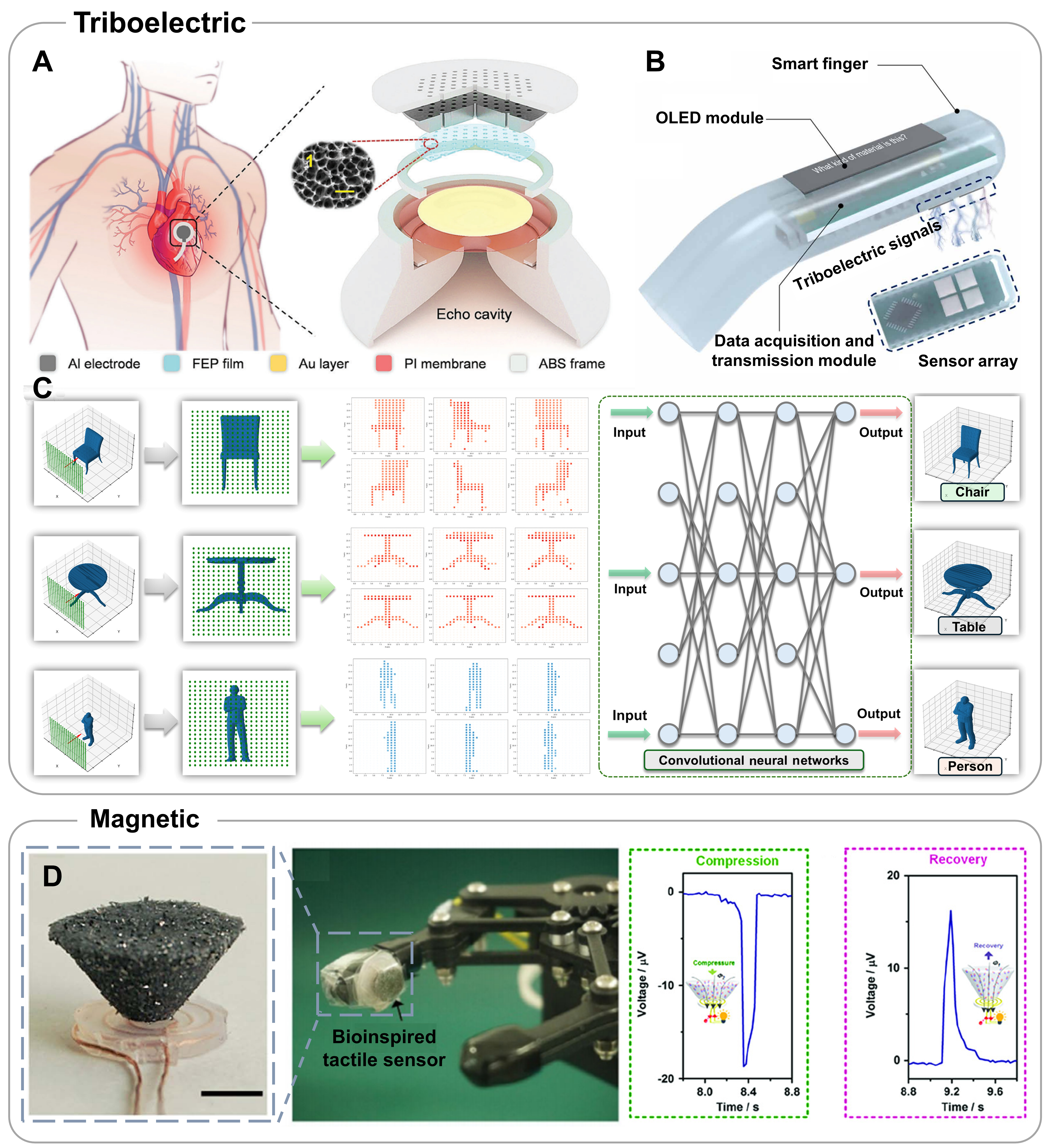
Figure 7. Representative examples of triboelectric and magnetic sensors for flexible sensing applications. (A) Schematic illustration of cardiac sounds sensing using the triboelectric stethoscope and exploded view diagram of the overall design structure. Adapted with permission from Ref.[146], Copyright © 2024 Wiley-VCH GmbH; (B) Structure of the triboelectric tactile perception smart finger. Adapted from Ref.[169], under CC BY-NC 4.0 license; (C) The 3D object tele-perception system based on the bionic electroreceptor matrix (20 × 20 units) and the CNN. Adapted from Ref.[172], under CC BY 4.0 license; (D) Optical images of the prepared magnetoelectric tactile sensor and the sensor installed at the tip of the robot arm. Adapted from Ref.[195], under CC BY 4.0 license. CNN: Convolutional neural networks; Al: aluminium; FEP: fluorinated ethylene propylene; PI: polyimide; ABS: acrylonitrile butadiene styrene; OLED: organic light-emitting diode.
Compared with many other flexible sensing technologies, TENGs exhibit exceptional sensitivity to contact electrification signals, enabling the extraction of rich information beyond conventional force and deformation measurements[168]. This capability allows triboelectric sensors to distinguish material properties, surface textures, contact conditions, and spatial characteristics of external objects. By combining triboelectric sensing with machine-learning algorithms, researchers have further enhanced the ability of TENG-based systems to interpret complex tactile information. For example, an intelligent finger system integrated triboelectric outputs with deep-learning models to extract and classify subtle differences in material-dependent triboelectric signals, enabling rapid identification of complex material properties [Figure 7B][169]. Another study reported a bio-inspired finger-shaped triboelectric tactile sensor capable of simultaneously perceiving multidirectional forces and surface-dependent triboelectric signatures, achieving material discrimination among 12 different materials with an accuracy of 98.33%[170]. These studies demonstrate the potential of triboelectric sensing for advanced tactile information acquisition and intelligent perception.
The application of TENGs in non-contact sensing has further expanded the scope of tactile perception[171]. For instance, a non-contact triboelectric sensor achieved a remote sensitivity of 14.2 (ΔV/Δd) and a material recognition accuracy of 99.56%, enabling simultaneous extraction of spatial and material information for three-dimensional object reconstruction and material identification [Figure 7C][172]. Other studies have demonstrated that non-contact TENGs can reliably capture spatial position, proximity variation, motion trajectory, and dynamic interaction information under continuously changing conditions, highlighting their robustness in dynamic sensing scenarios[173-177]. These advances indicate that the strength of triboelectric sensing lies not only in identifying static material properties, but also in acquiring rich spatial and dynamic interaction information. As a result, TENG-based sensing systems are evolving from conventional contact detection platforms toward advanced perception systems capable of extracting multidimensional environmental information. Beyond sensing, the self-powered nature of TENGs enables simultaneous energy harvesting and signal generation, distinguishing them from most conventional flexible sensing technologies and providing opportunities for autonomous soft robotic systems[178,179].
In summary, TENGs have emerged as an important class of flexible sensing technologies owing to their self-powered operation, structural versatility, and high sensitivity. From physiological signal monitoring and advanced tactile perception to non-contact sensing and multimodal information acquisition, TENG-based sensors have demonstrated capabilities that extend beyond conventional flexible sensing approaches. Particularly in soft robotic systems, TENGs enable real-time detection of environmental stimuli and motion-related information while simultaneously harvesting mechanical energy from the surroundings. These unique characteristics provide a promising foundation for the development of next-generation flexible intelligent systems featuring self-powered operation, multimodal perception, and enhanced environmental adaptability.
4.5. Other sensors
In addition to the sensor types discussed above, a variety of other sensing technologies, including optical, magnetic, chemical, and acoustic sensors, have also been explored for soft robotic perception. Among them, optical sensors are particularly attractive due to their high sensitivity, immunity to electromagnetic interference, and capability for distributed sensing. Optical sensors detect external stimuli by monitoring changes in light intensity, phase, wavelength, or transmission characteristics induced by mechanical deformation[180]. Traditional optical tactile sensing systems often rely on rigid optical configurations. For example, TacTip[181] and GelSight[182] employ camera-based imaging to capture deformation of compliant interfaces, enabling high-spatial-resolution tactile sensing. However, their bulky structures and rigid optical components limit integration into highly deformable soft robotic systems. To address these limitations, fiber Bragg grating (FBG) technology has been introduced for strain and pressure sensing in soft robots, enabling distributed and multipoint sensing along a single optical fiber without requiring local electronic components[183]. Nevertheless, FBG sensors still face challenges including complex fabrication processes, high cost, and limited stretchability, which restrict their broader deployment in soft robotic applications. More recently, flexible and stretchable optical fiber sensors have demonstrated rapid and stable responses, large-deformation compatibility, and good cyclic durability, providing promising alternatives for distributed sensing in highly deformable systems[184]. Recent studies have further demonstrated that soft optical waveguide sensors combined with intelligent decoding algorithms can reconstruct complex three-dimensional deformations from a limited number of optical signals, highlighting the potential of optical sensing for high-density proprioceptive perception with reduced sensing complexity[185]. Furthermore, integrating polymer optical fibers with artificial intelligence algorithms has expanded the capabilities of intelligent optical sensing, enabling more efficient interpretation of complex deformation and interaction information[186,187].
The adoption of rigid–flexible hybrid architectures has further improved the interference resistance and mechanical robustness of optical sensing systems, enhancing their reliability under complex deformation conditions[188]. In parallel, emerging optical sensing strategies have continued to push the performance limits of conventional systems. For example, exceptional point enhanced optical sensing has demonstrated significantly improved sensitivity, providing a promising route toward high-performance flexible sensing platforms[189]. Furthermore, by exploiting multi-wavelength encoding mechanisms induced by graded structures in flexible optical fibers, researchers have achieved efficient decoupling of pressure and stress signals while enabling spatially distributed sensing, highlighting the potential of optical sensors for multidimensional information acquisition and high-density perception[190]. These advantages have also facilitated the adoption of optical sensing technologies in demanding scenarios such as wearable monitoring and biomedical diagnostics[191-193]. Overall, optical sensing technologies provide unique advantages in high-resolution tactile perception, distributed deformation monitoring, and electromagnetic-interference-free operation. Although challenges remain in terms of stretchability, system complexity, and manufacturing cost, ongoing advances in flexible optical materials, intelligent signal processing, and distributed sensing architectures continue to expand their potential for soft robotic perception and intelligent sensing systems.
Magnetic sensors detect external stimuli by monitoring variations in magnetic field distributions generated by magnetic materials or permanent magnets. Owing to their non-contact sensing capability, high sensitivity, and compatibility with soft structures, magnetic sensing has emerged as an attractive approach for monitoring force, displacement, deformation, and orientation in soft robotic systems. Furthermore, magnetic signals can penetrate non-magnetic encapsulation materials, enabling distributed and remote sensing in complex or confined environments. However, susceptibility to environmental magnetic interference and the complexity of signal processing remain important challenges that limit sensing accuracy and system integration[194]. Recent advances in flexible magnetic sensing have focused on both structural design and material engineering. For example, self-powered flexible magnetic sensing architectures have been developed to improve device autonomy and system-level integration, providing new opportunities for intelligent sensing platforms [Figure 7D][195]. In parallel, bioinspired magnetic cilia structures integrated into flexible magnetic sensing arrays have enabled simultaneous detection of force magnitude and direction, significantly improving multidimensional tactile perception and spatial sensing resolution[196]. Furthermore, the combination of flexible magnetic materials with amorphous magnetic wires has led to wide-range magnetic sensing structures capable of maintaining low detection limits, high stability, and broad dynamic response ranges, thereby expanding the capability of magnetic sensors for multidimensional and long-range perception[197]. Despite these advances, magnetic sensors continue to face challenges in interference suppression, signal interpretation efficiency, and scalable manufacturing. Further progress in structural optimization, magnetic material development, and integrated sensing architectures will be essential for improving reliability and practical applicability. Nevertheless, their unique advantages in non-contact sensing, distributed perception, and multidimensional force detection suggest considerable potential for future soft robotic perception and intelligent sensing systems.
Acoustic and chemical sensing technologies have been explored as complementary sensing modalities for soft robotic perception, providing capabilities beyond conventional mechanical stimulus detection[198]. Acoustic sensors exploit the propagation and reflection characteristics of sound waves to achieve non-contact sensing, offering strong penetration capability and high sensitivity to subtle structural variations. These characteristics make them attractive for applications such as structural state monitoring and remote perception[199]. However, challenges associated with environmental noise, signal attenuation, and integration with highly deformable materials continue to limit their broader adoption in soft robotic systems. Chemical sensors, in contrast, enable direct detection of environmental parameters such as gas composition, ion concentration, and pH variation, thereby expanding the perception capabilities of soft robots toward chemical and biological environments[200]. Recent efforts have focused on incorporating flexible functional films, nanomaterials, and bioinspired sensing materials to improve sensitivity, selectivity, and response speed. Nevertheless, achieving simultaneous flexibility, long-term stability, and high integration density remains a significant challenge for practical deployment. Overall, acoustic and chemical sensors provide additional perceptual dimensions beyond force, deformation, and motion sensing, enabling soft robots to acquire information from complex physical, chemical, and biological environments. Although their current applications remain relatively limited compared with mainstream flexible sensing technologies, continued advances in material design, sensing mechanisms, and system-level integration are expected to further expand their role in future intelligent soft robotic systems.
4.6. Multimodal sensing technologies
In addition to single-modality sensing mechanisms, multimodal sensing technologies have attracted increasing attention in soft robotics because they enable simultaneous acquisition of multiple types of physical and environmental information. By integrating different sensing mechanisms, multimodal sensors can detect pressure, strain, bending, torsion, temperature, humidity, proximity, slip, and material-related information within a single device or sensing system[201]. This capability is particularly important for soft robots operating in unstructured environments, where deformation, contact, and environmental stimuli often occur simultaneously[202].
Multimodal sensing can be realized through several strategies. One approach is to integrate multiple sensing units with different transduction mechanisms onto a shared flexible substrate. Another approach is to design multifunctional materials or microstructures that generate distinguishable electrical, optical, or magnetic responses to different stimuli[203]. In addition, signal processing and machine learning methods are increasingly used to decouple overlapping signals and identify complex interaction states. Compared with single-modality sensors, multimodal sensing systems can provide richer perceptual information and improve the robustness of robotic perception in tasks such as object recognition, human–robot interaction, manipulation, locomotion, and confined-space exploration[204].
Despite these advantages, multimodal sensing still faces several challenges. The simultaneous integration of multiple sensing mechanisms increases structural complexity and fabrication difficulty. Signal coupling among different stimuli can cause cross-sensitivity, making accurate signal decoupling and calibration difficult[205]. In addition, the increased number of sensing channels may lead to more complicated wiring, higher data acquisition requirements, and greater computational burden. Therefore, future multimodal sensing systems for soft robotics should focus not only on increasing the number of detectable stimuli, but also on improving signal independence, mechanical compatibility, long-term stability, scalable fabrication, and intelligent data interpretation. Table 2 summarizes the representative sensing technologies discussed in this section by comparing their sensing principles, sensing functionalities, advantages, and limitations in soft robotic perception.
Comparison of representative sensing technologies for soft robotic perception
| Sensing technology | Sensing functionality | Key advantages | Main limitations | Representative performance |
| Resistive/piezoresistive[104-108] | Pressure, strain, bending, tactile sensing | Simple structure, low cost, high flexibility, easy fabrication | Hysteresis, baseline drift, temperature dependence | High sensitivity and large deformation compatibility; suitable for continuous tactile and proprioceptive sensing |
| Capacitive[119-123] | Pressure, strain, proximity sensing | High sensitivity, fast response, low power consumption | Electromagnetic interference, parasitic capacitance, signal coupling | Fast response and high stability; suitable for dynamic tactile and proximity perception |
| Piezoelectric[127-130] | Dynamic pressure, vibration, acoustic sensing | Self-generated signals, fast dynamic response | Difficult for static sensing, material fatigue | High-frequency response capability; effective for dynamic force and vibration detection |
| Triboelectric (TENG)[140-157] | Contact, pressure, sliding, motion sensing | Self-powered, multifunctional, high sensitivity | Environmental dependence, output fluctuation, signal processing complexity | High sensitivity with multimodal sensing capability; suitable for self-powered interactive perception |
| Optical[186,187] | Strain, deformation, distributed sensing | High spatial resolution, electromagnetic immunity | Complex interrogation system, high cost | Distributed sensing capability with high spatial resolution; enables shape reconstruction and proprioception |
| Magnetic[194-197] | Force, displacement, orientation sensing | Non-contact sensing, remote detection | Magnetic interference, calibration complexity | Remote position and orientation tracking with large sensing range |
| Chemical[198] | Gas, ion, pH sensing | High selectivity, biochemical perception | Slow response, limited flexibility | High chemical selectivity; suitable for environmental and biochemical monitoring |
| Acoustic[198,199] | Structural monitoring, remote perception | Non-contact sensing, strong penetration capability | Noise sensitivity, integration difficulty | Long-range perception and structural state monitoring capability |
4.7. Comparative analysis of sensing technologies
The sensing technologies discussed above have significantly expanded the perceptual capabilities of soft robots, enabling deformation monitoring, tactile perception, environmental recognition, and closed-loop control. However, each sensing mechanism exhibits inherent advantages and limitations, and no single sensing technology can simultaneously achieve high sensitivity, large deformation compatibility, fast response, long-term stability, low complexity, and seamless integration. Resistive and piezoresistive sensors remain widely adopted due to their simple structures, low cost, and compatibility with large-area fabrication, but their performance can be affected by hysteresis, drift, temperature variation, and mechanical fatigue. Capacitive sensors provide fast response, low power consumption, and stable electrical signals, while requiring careful consideration of parasitic capacitance, electromagnetic interference, and structural coupling effects. Piezoelectric and triboelectric sensors offer high sensitivity to dynamic stimuli and, in some cases, self-powered operation, but their applications are limited by static sensing capability, environmental dependence, and signal stability. Optical and magnetic sensing approaches provide advantages in remote perception, distributed sensing, and immunity to electrical interference, although they usually require more complex signal-processing systems and integration strategies[206].
Therefore, the selection of sensing technologies for soft robotic systems should be determined by specific sensing tasks, deformation characteristics, and operating environments rather than by a single performance metric. For proprioceptive sensing, key requirements include mechanical compatibility, repeatability, low hysteresis, and stable responses under large deformation. For exteroceptive perception, high spatial resolution, sensitivity, response speed, and environmental robustness become more critical[207]. Meanwhile, multimodal sensing represents an emerging direction for overcoming the limitations of individual sensing mechanisms by combining complementary information from different modalities. However, future developments should focus not only on integrating more sensing elements, but also on achieving effective signal decoupling, scalable sensor networks, intelligent data interpretation, and reliable perception under complex operating conditions. The combination of advanced materials, structural design, multiplexed sensing architectures, and data-driven algorithms will be essential for developing next-generation soft robotic systems with robust and adaptive perception capabilities[208].
5. INTEGRATED ACTUATION AND SENSING
Although substantial progress has been achieved in both actuation and sensing technologies, the realization of intelligent soft robotic systems requires their effective integration. Real-time sensing feedback is essential for achieving closed-loop control and adaptive behaviors in soft robots. To execute tasks with the fluidity and adaptability of biological systems, soft robots must incorporate both proprioception and exteroception[209]. Proprioception, or self-sensing, allows the robot to perceive its internal state and configuration, including joint angles, shape, and deformation. This capability enables more precise task execution, collision avoidance, and adaptive responses to varying environments and operational demands. In contrast, exteroception involves sensing external stimuli, particularly tactile information, allowing the robot to detect object position, shape, and texture. Such environmental perception supports effective interaction with surroundings and facilitates complex behaviors such as terrain adaptation, object recognition, and grasping[210]. Both proprioceptive and exteroceptive sensing are essential for enhancing the intelligence, versatility, and functional performance of soft robots. In this section, we categorize reported integrated actuation-sensing systems according to proprioceptive and exteroceptive sensing capabilities and discuss recent advances in systems that combine both sensing modalities.
From a system-level perspective, actuation–sensing integration in soft robotics can be understood through several representative strategies. The first strategy is surface-mounted integration, in which flexible sensors are attached to the surface of soft actuators or robotic skins to monitor contact, strain, pressure, or environmental stimuli[211]. This strategy is relatively simple and compatible with existing soft robotic platforms, but interfacial adhesion, mechanical mismatch, and signal stability under large deformation remain important challenges. The second strategy is embedded integration, in which sensing elements are incorporated inside soft robotic structures during fabrication[212]. This approach provides more direct access to internal deformation states and can improve structural compactness, but it often increases fabrication complexity and may affect the mechanical compliance of the robot. The third strategy is intrinsic self-sensing actuation, where the actuator material or driving element itself also functions as a sensing component[213]. Examples include resistance-based self-sensing in conductive artificial muscles, optical transmission changes in stretchable waveguides, or capacitance variations in DEAs. This strategy offers a promising route toward highly compact and deeply coupled soft robotic systems, although signal decoupling and long-term reliability remain challenging. The fourth strategy is multimodal and data-driven integration, in which multiple sensing modalities are combined with signal-processing or machine-learning algorithms to interpret complex robot states and environmental interactions[214]. These strategies provide a useful framework for understanding the representative proprioceptive, exteroceptive, and multimodal systems discussed below.
5.1. Proprioception in soft robotics
Proprioception in soft robots is considerably more challenging than in rigid robots due to their theoretically infinite degrees of freedom and the complex deformations that can arise from both internal actuation and external loads. To achieve effective self-sensing, soft robots have integrated various types of sensors, often complemented by computational approaches such as machine learning and deep learning to enhance proprioceptive capabilities[215]. Here, we review representative sensing strategies that enable proprioception in soft robots.
Among various sensing strategies, resistive sensing has become one of the most widely adopted approaches for proprioception in soft robots owing to its high flexibility, fast response, simple structure, and ease of integration. By embedding resistive sensing elements directly into soft robotic structures, continuous monitoring of strain and deformation can be achieved, providing essential feedback for shape estimation, motion-state perception, and closed-loop control. To improve the capability of soft robots to perceive complex deformations and motion states, a variety of integrated resistive sensing schemes have been developed, many of which employ conductive materials such as CNTs, MXene, and liquid metals to construct flexible sensing structures[216].
For instance, Banerjee et al. integrated a carbon nanotube-reinforced natural rubber (CNT/NR)-based strain sensor onto a pneumatic soft arm to achieve continuous monitoring of actuator deformation during motion. The sensor enabled real-time perception of complex deformation states and provided proprioceptive feedback for closed-loop control, thereby enhancing motion accuracy during multi-degree-of-freedom operations[217]. Kim et al. integrated SCP (self-coagulating conductive Pickering)-based conductive sensing structures into soft balloons, grippers, and artificial muscle actuators, enabling synchronous self-sensing of structural deformation during actuation [Figure 8A][218]. Wang et al. integrated a MXene/CNT/fluoroelastomer-based strain sensor into a caterpillar-inspired soft robot, enabling continuous shape perception and self-monitoring throughout locomotion. Benefiting from its wide sensing range and high sensitivity, the system provided reliable feedback on structural deformation and body configuration during movement[219]. Additionally, Wang et al. developed a liquid-metal-based resistive strain sensor and applied it to movement-state monitoring in a crawling soft robot. Owing to its high stretchability and self-healing capability, the sensor continuously tracked large deformations during locomotion and provided real-time feedback on the robot’s movement state[220].
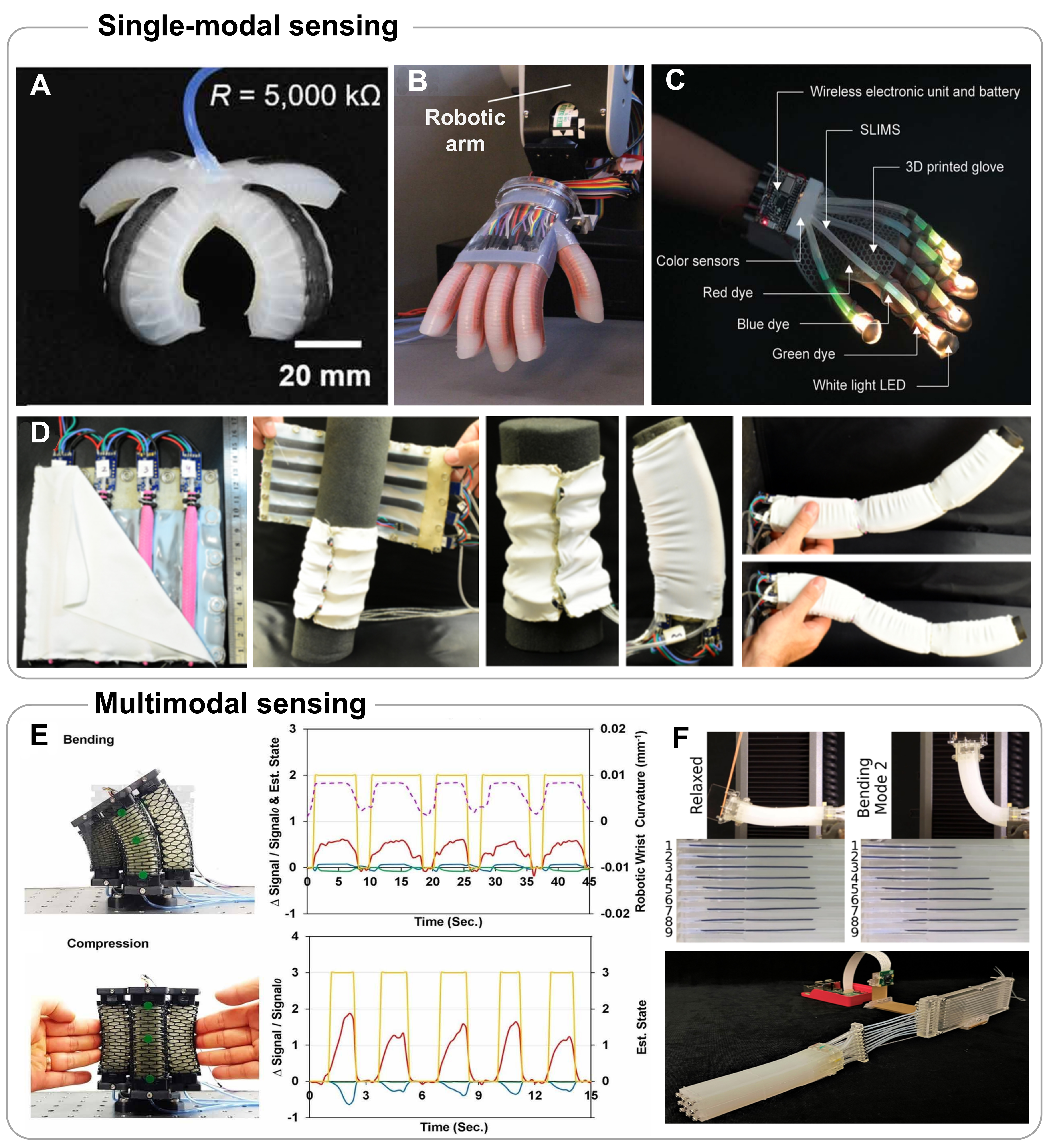
Figure 8. Application of flexible sensors in the proprioception of soft robot. (A) A silicone rubber four-legged gripper, onto which SCP emulsion traces are printed. Adapted with permission from Ref.[218], Copyright © 2020, AAAS; (B) Image of the fabricated hand mounted on a robotic arm with each finger. Adapted with permission from Ref.[229], Copyright © 2016, AAAS; (C) Image of the SLIMS-integrated soft glove with LED light source and electronics module. Adapted with permission from Ref.[230], Copyright © 2020, AAAS; (D) Robotic skins embed distributed actuation and sensing into a conformable substrate to produce different forms of motion effects. Adapted with permission from Ref.[234], Copyright © 2018, AAAS; (E) Different deformation modes by self-actuation as well as human inputs and corresponding sensor data. Adapted with permission from Ref.[235], Copyright © 2020, AAAS; (F) Fiber-based deformation sensors, relaxed and bent states. Adapted from Ref.[236], under CC BY 4.0 license. SCP: Self-coagulating conductive Pickering; SLIMS: stretchable lightguide for multimodal sensing; LED: light emitting diode.
To further enhance the perception of complex deformation states in soft robots, sensing systems capable of directional strain recognition and curvature estimation have been developed. For example, Mousavi et al. integrated a 3D-printed anisotropic resistive sensor into a soft robotic system to detect and quantify multi-axis bending angles and deformation degrees[221]. By combining heterogeneous conductive fillers with tailored sensor geometries, the sensor achieved a high directional response ratio of up to 31.4, enabling more accurate discrimination of deformation directions. In addition, Liu et al. developed a helically wound conductive fiber sensor for curvature estimation in soft robotic components such as soft grippers. With a wide strain range and high response linearity, the sensor can accommodate large-curvature deformation and different structural configurations. When integrated into flexible grasping tasks, it enabled continuous posture monitoring and dynamic motion control[222].
To further simplify the structure and functionality of soft robots, researchers have actively explored the deep integration of sensors with actuators, enabling direct perception of the robot’s state through changes in material resistance. Cao et al. developed a thermally actuated soft actuator[223], in which internal heating wires serve both as actuators and as self-sensing elements, detecting deformation through resistance changes. This design establishes a closed-loop control mechanism without the need for additional sensors. Similarly, Yang et al. constructed modular actuation units based on shape-changing polymer artificial muscle (SCPAM) wires. The resistance response of the wires during deformation was used to estimate bending angles, and this approach was applied in caterpillar-inspired robots and soft manipulators, achieving direct coupling of sensing and motion at the material level[224].
To extend proprioception from individual sensing units to robot-level state awareness, researchers have explored distributed and system-level sensing architectures for soft robots. These approaches enable continuous monitoring of robot configurations across multiple locations, thereby improving adaptability and control precision in complex environments. Goldoni et al. integrated a stretchable CNT–silicone sensing system with flexible circuits to achieve wireless monitoring of soft robot motion states[225]. By tracking strain variations across different segments during movement, the system provided distributed proprioceptive feedback and supported operation in confined or remote environments. Alatorre et al. embedded stretchable ionic-liquid-based resistive sensors into soft robotic arms to enable proprioception of joint angles and curvature in continuum structures[226]. The system provided reliable state feedback during deformation, supporting closed-loop control. Truby et al. developed a distributed proprioceptive system for a pneumatic soft robotic arm using plasma-modified flexible electronic skins. The system enabled continuous real-time monitoring of actuator shapes and could further predict future deformations, providing enhanced state awareness[227].
Beyond resistive sensing, alternative sensing strategies have been explored to provide higher-resolution proprioceptive information, particularly for shape reconstruction and complex deformation perception in soft robots. Optical fiber sensors, in particular, have shown significant potential for shape sensing applications. Galloway et al. first embedded a monolithic multi-core fiber optic shape sensor (FOSS) into a fiber-reinforced soft actuator, achieving submillimeter real-time position feedback and enabling detection of actuator shape changes, collision locations, and external object stiffness. Although this sensing scheme operates in an open-loop configuration, it has demonstrated effectiveness in complex morphology monitoring tasks[228]. In 2016, the Shepherd group integrated stretchable optical waveguides into fiber-reinforced soft prostheses, constructing a proprioceptive system based on changes in light transmission. The optical strain sensors exhibit high compliance, low hysteresis, and stable output, allowing real-time monitoring of soft structure bending, stretching, and applied forces. They were successfully applied to prosthetic perception tasks, such as discriminating the shape and firmness of different tomatoes, enabling human-like active sensing and interactive control [Figure 8B][229]. Building on this work, the team further developed a stretchable distributed fiber optic sensing system (stretchable DFOS) in 2020, incorporating continuous or discrete chromatic patterns. By analyzing light color and intensity, the sensor can simultaneously detect bending and pressure at different finger joints, enabling real-time decoupling of multiple positions and multi-modal deformations [Figure 8C][230]. Yang et al. developed a plant-inspired soft helical gripper that performs automatic wrapping under a single pneumatic input. This system integrates a high-birefringence optical fiber torsion sensor to provide feedback on wrapping angle and external disturbances, achieving a sensitivity of up to 0.03 nm. Such performance supports applications in small-object manipulation and operations within confined spaces[231].
Beyond resistive and optical sensing approaches, other sensing mechanisms have also been employed to enhance proprioception in soft robots. These systems provide complementary capabilities, including vibration perception, shape reconstruction, and embedded state awareness. Wang et al. proposed a 0.1 mm-thick Kirigami-structured triboelectric e-skin, fabricated using screen printing and liquid metal particles (LMP), which can conform to the soft robot surface to passively monitor vibration signals generated by its own motion[232]. Hu et al. reported a high-resolution shape reconstruction technique for soft robots based on stretchable capacitive sensors. Integration of this sensor with machine learning techniques enables accurate reconstruction of soft gripper geometry[233]. Booth et al. from Yale University designed a deformable sheet embedding both actuators and high-deformation capacitive strain sensors, which can be integrated onto any soft object surface to achieve proprioception and realize various motion modes such as grasping, locomotion, and wearable applications [Figure 8D][234].
To further enhance the capability of soft robots to perceive complex deformation states, multimodal sensing systems have been developed to simultaneously capture and decouple multiple types of proprioceptive information. For example, Kim et al. developed a multi-modal soft sensor integrating optical, microfluidic, and piezoresistive mechanisms. This system can decouple multiple deformation types, including stretching, bending, and compression, while maintaining a compact form, and can recognize eight different deformation modes with an accuracy exceeding 95% using neural network algorithms. Such sensors not only improve robot state discrimination but also provide possible pathways for flexible human–machine interface applications [Figure 8E][235]. Moreover, Lin et al. developed a hybrid sensing network composed of electronic-free fiber-optic sensors and microfluidic pressure sensors, combined with digital cameras and dye-responsive units to achieve remote reading of soft robot states. This system has enabled visual monitoring of bending, twisting, and pressure states in elastic fingers, representing an exploration into low-power, highly integrated proprioception [Figure 8F][236].
5.2. Exteroception in soft robotics
Although soft robots can passively adapt to object interactions through their compliant bodies, passive mechanical adaptation alone is insufficient for perceiving external environments and performing precise manipulation tasks. Therefore, exteroception plays a critical role in enabling soft robots to actively acquire information about their surroundings. Tactile perception allows soft robots to detect contact forces, identify object shapes and surface textures, and recognize environmental interactions in real time[237,238]. Such capabilities provide essential information for tasks ranging from object grasping and manipulation to environmental exploration and navigation[239,240]. To achieve exteroception, flexible sensing systems are commonly integrated into soft robotic structures, enabling continuous monitoring of interactions between the robot and its environment and providing key sensory feedback for closed-loop control and intelligent decision-making.
In tactile systems based on single-modality sensors, various actuation–sensing co-design strategies have been developed to endow soft robots with environmental perception capabilities. For example, Gu et al. developed a bioinspired pneumatically actuated soft prosthetic hand capable of perceiving fingertip contact pressure during grasping tasks[241]. By integrating capacitive tactile sensors with an electrical stimulation feedback pathway, the system provided real-time tactile information to users and enabled a preliminary closed loop for tactile perception and interactive response. Inspired by lobster tails, Li et al. developed a soft pneumatic rehabilitation actuator capable of perceiving tensile forces during human–robot interaction through integrated triboelectric sensing. The system enabled force monitoring, spasm assessment, and rehabilitation assistance, demonstrating the potential of tactile perception for interactive rehabilitation applications [Figure 9A][242]. Alshawabkeh et al. developed a capacitive proximity tactile sensor that can conform to the free motion of a soft robot. The sensor enabled simultaneous perception of nearby objects and contact forces, allowing the robot to identify different materials and interact more effectively with unstructured environments[243]. To further enrich environmental perception, Li et al. integrated a flexible piezoresistive sensor based on dual-size microspheres (DMS) into a soft gripper. The system was capable of simultaneously perceiving pressure and temperature stimuli, enabling automatic contact detection and responsive grasping behaviors. Such multimodal tactile feedback supported interactive manipulation tasks, including object grasping and environmental interaction[244].
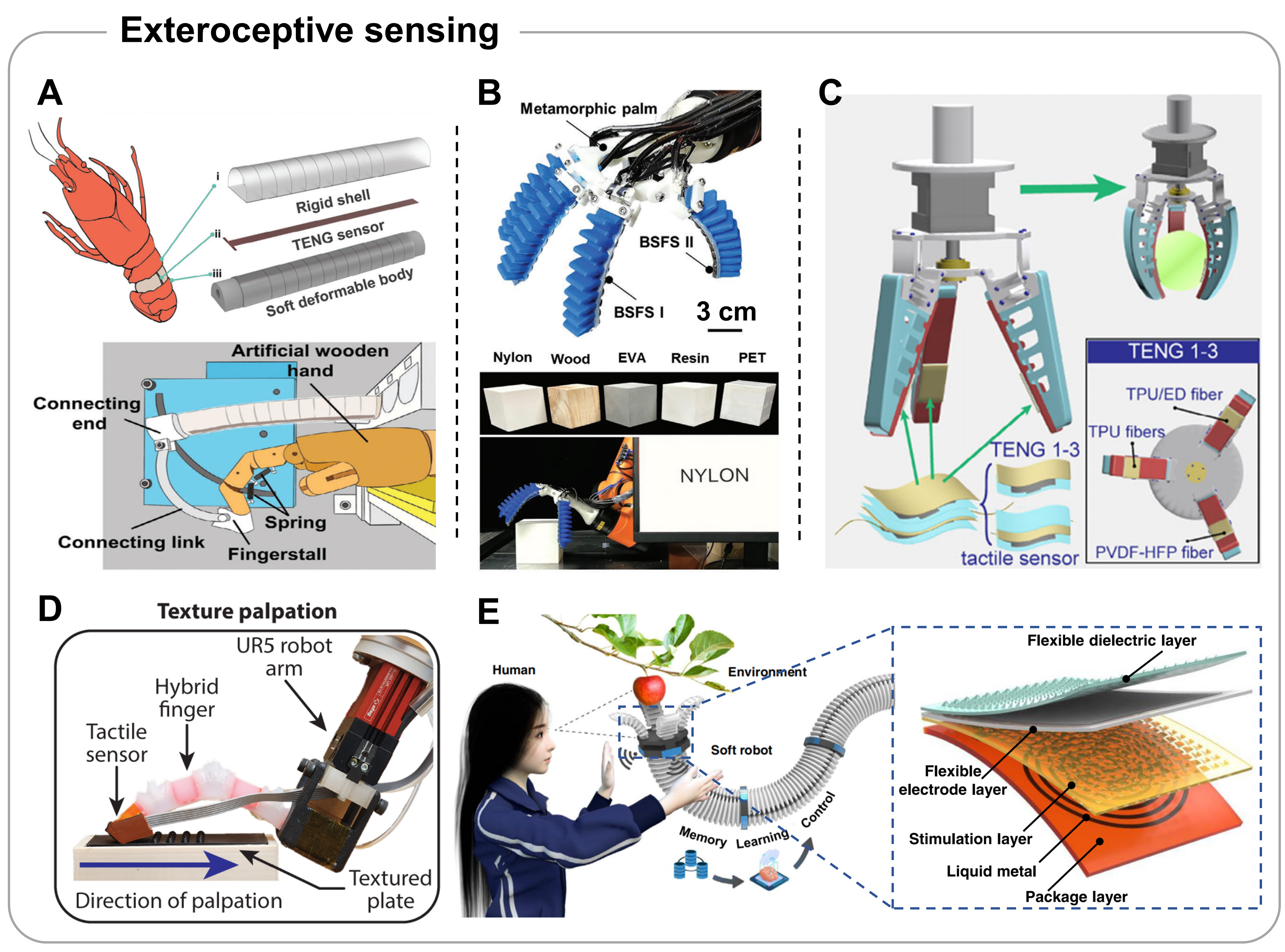
Figure 9. Representative exteroceptive sensing systems for soft robots. (A) Bioinspired TENG-SPA design and performance evaluation. Adapted with permission from Ref.[242], Copyright © 2025 Wiley-VCH GmbH; (B) The soft robotic hand identifies the material and roughness of different objects. Adapted with permission from Ref.[248], Copyright © 2023 Wiley-VCH GmbH; (C) Schematic of the mechanical gripper mounted with three sets of single-electrode TENGs and tactile sensors. Adapted with permission from Ref.[249], Copyright © 2025 Wiley-VCH GmbH; (D) Experimental setup of texture discrimination using the hybrid finger. Adapted from Ref.[250], under CC BY 4.0 license; (E) A depiction of the principle of touchless human-soft robot interaction based on flexible smart skin. Adapted from Ref.[251], under CC BY 4.0 license. TENG: Triboelectric nanogenerator; SPA: soft pneumatic actuator.
In addition, Lu et al. developed a self-powered tactile sensing system for soft grippers to monitor gripping forces during fruit and vegetable harvesting. By providing real-time feedback on grasping forces, the system enabled adaptive manipulation and non-destructive handling of delicate agricultural products[245]. Exteroceptive sensing has also been extended to underwater soft robotic systems. For example, triboelectric sensing units have been integrated into octopus-inspired dorsal membranes and tentacle structures, enabling simultaneous underwater grasping and environmental perception[246]. This design allowed soft robots to interact with surrounding objects while continuously acquiring information about the external environment, demonstrating the potential of integrated sensing for underwater operations.
To further enhance environmental perception in complex scenarios, researchers have explored multimodal sensing strategies that enable soft robots to simultaneously acquire different types of external information. For example, Zhou et al. developed an intelligent soft gripper integrating a photothermal actuator with triboelectric sensing functions. The system was capable of simultaneously perceiving temperature and material characteristics while performing grasping tasks. By combining multimodal sensing information with neural-network-based analysis, the robot achieved accurate identification of different targets, demonstrating enhanced environmental awareness and object recognition capability[247].
Liu et al. developed a bimodal self-powered sensor combining triboelectric and giant magnetoelastic (GME) effects. When integrated into a soft gripper, the sensor enabled simultaneous detection of non-contact and tactile interactions, allowing the robot to identify object shapes, materials, and surface textures with high accuracy (97%), demonstrating enhanced multimodal environmental perception [Figure 9B][248]. Similarly, Zhou et al. proposed a multifunctional soft gripper system integrating capacitive and triboelectric sensing mechanisms. This system achieved high-precision perception of subtle grasping motions and material properties, supporting accurate object manipulation and differentiation in complex environments [Figure 9C][249]. Furthermore, to overcome the limitations of fully soft structures in terms of gripping force and sensing accuracy, Sankar et al. developed a rigid–soft hybrid robotic hand integrating piezoresistive and piezoelectric sensors. By combining the precision of rigid mechanisms with the compliance of soft structures, the system enhanced texture recognition and dexterous grasping capabilities [Figure 9D][250]. Additionally, Liu et al. designed a flexible bimodal smart skin (FBSS) based on triboelectric and piezoresistive sensing principles. This system could simultaneously detect proximity and contact, enabling contactless teaching and manipulation of soft robotic arms [Figure 9E][251].
5.3. Integration of proprioception and exteroception sensing
As discussed above, proprioception enables soft robots to perceive their internal states, including deformation, posture, and motion, whereas exteroception provides information about external objects and environmental interactions. Although significant progress has been achieved in both sensing modalities, practical robotic tasks often require the simultaneous acquisition and interpretation of both internal and external information. In real-world scenarios, proprioceptive and exteroceptive information are intrinsically coupled. For example, during grasping, a soft robot must not only perceive its own deformation and configuration but also identify contact locations, interaction forces, and object properties. Similarly, in navigation and environmental exploration tasks, the robot needs to continuously monitor its body configuration while sensing surrounding obstacles and environmental conditions. Therefore, relying on a single sensing modality is often insufficient to fully characterize the robot’s dynamic behavior and interaction states. To address this challenge, researchers have increasingly explored integrated sensing systems that combine proprioception and exteroception within the same robotic platform. Such systems enable soft robots to simultaneously perceive their internal states and external environments, providing richer sensory information for adaptive control, intelligent decision-making, and complex task execution[252-255].
For example, Shen et al. developed a conductive polymer hydrogel strain sensor and integrated it into a soft robotic gripper. By monitoring strain variations during grasping, the system could simultaneously estimate the gripper’s bending state and identify the size of grasped objects [Figure 10A][256]. Wang et al. proposed an expected–actual perception–action framework and demonstrated it on a soft continuum robot equipped with resistive sensors. By comparing expected and measured shapes, the system could distinguish whether deformation originated from internal actuation or external contact [Figure 10B][257]. Homberg et al. developed a soft robotic gripper integrating bending and force sensors to simultaneously monitor gripper configuration and object interaction. The system enabled robust grasping and recognition of objects with uncertain geometries and poses [Figure 10C][258]. To simultaneously perceive robot motion and environmental stimuli, Lai et al. developed a self-powered active robotic skin capable of detecting proximity, contact, and pressure information without requiring an external power source. Integrated with soft actuators, the system enabled active perception and responsive interaction, demonstrating potential for applications such as medical monitoring, infant care, and robotic palpation [Figure 10D][259]. Similarly, to simultaneously monitor robot posture and object characteristics during manipulation, Xu et al. proposed a Kirigami-structured sensing system that could estimate gripper bending angles while identifying the size of grasped objects. Through the coordinated arrangement of multiple sensing units, the system achieved high-precision posture monitoring and object recognition[260]. Shu et al. developed a sensing electronic skin based on a differential piezoelectric matrix for soft robots. The system reconstructs the surface shape with high precision and fast response during motion, providing proprioceptive information. Combined with machine learning algorithms, it can also recognize different terrains and obstacles, extending to exteroceptive perception and supporting autonomous task execution in complex environments [Figure 10E][261].
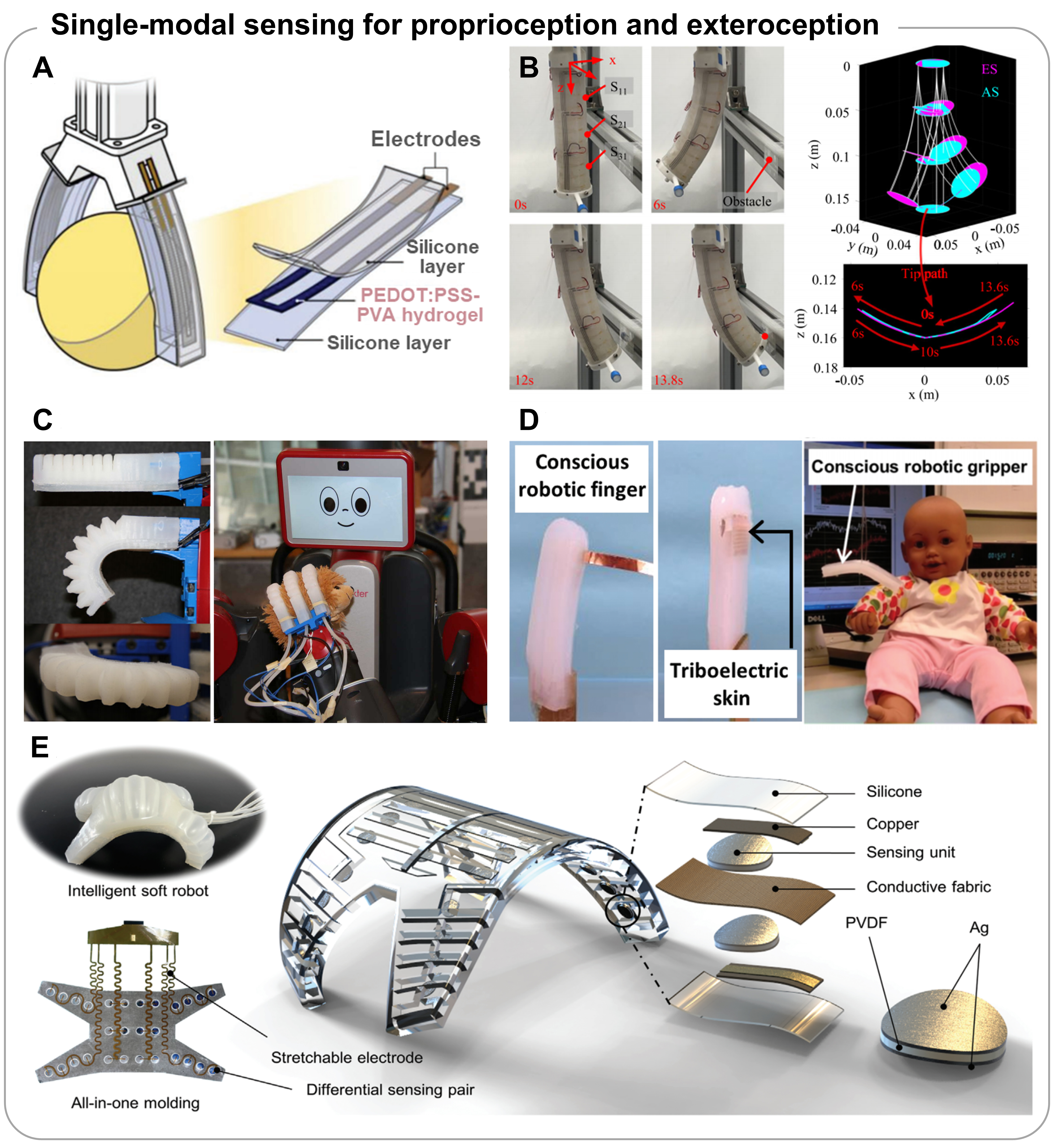
Figure 10. Representative single-modality sensing systems for integrated proprioception and exteroception in soft robots. (A) Soft gripper with integrated hydrogel strain sensor for bending monitoring. Adapted with permission from Ref.[256], Copyright © 2025 Wiley-VCH GmbH; (B) Proprioception and simultaneous contact detection during motion. Reprinted from Ref.[257], under CC BY-NC-ND 4.0 license; (C) Soft robotic hand performing object grasping. Adapted from Ref.[258], under CC BY 4.0 license; (D) Image of conscious gripper to hold the doll’s hand. Adapted with permission from Ref.[259], Copyright © 2018 Wiley-VCH GmbH; (E) Illustration of the SSES-mediated soft robot assembly. Adapted with permission from Ref.[261], Copyright © 2023 Wiley-VCH GmbH. SSES: Shape-sensing electronic skin; PEDOT:PSS: poly(3,4- ethylenedioxythiophene):poly(styrenesulfonate); PVA: poly(vinyl alcohol); PVDF: polyvinylidene fluoride.
The studies discussed above demonstrate that, through appropriate sensing architectures and integration strategies, a single sensing modality can simultaneously provide information about both robot states and environmental interactions. Such systems offer a simple and effective route toward integrated proprioception and exteroception in soft robots. However, these approaches often rely on specific sensing mechanisms, structural designs, or task scenarios. In complex environments, it remains challenging to reliably distinguish between internal actuation-induced responses and externally induced stimuli, which may limit sensing accuracy, robustness, and general applicability. To address these limitations, recent research has increasingly focused on multimodal sensing systems that combine complementary sensing mechanisms. By simultaneously acquiring and fusing multiple sources of information, these systems enable more comprehensive and reliable perception of both robot states and environmental conditions during task execution.
For example, Zhou et al. developed a soft gripper capable of simultaneously perceiving object interaction and gripper deformation during grasping. By combining multimodal sensing information with deep-learning-based analysis, the system achieved highly accurate object recognition under both room-temperature and freezing conditions. Furthermore, the gripper could detect object slippage and automatically adjust the grasping force in real time, enabling more stable and adaptive manipulation[262]. Similarly, Diao et al. developed a multimodal perception system that simultaneously monitored grasping force and gripper bending state during operation. By continuously tracking the interaction between the gripper and the target object, the system could identify the minimum force required for stable grasping and prevent slippage of fragile objects, thereby improving manipulation reliability[263].
Wang et al. developed an intelligent soft robotic system capable of simultaneously perceiving robot deformation and object interaction during manipulation. By fusing information from multiple sensing modalities, the system achieved reliable bending perception and adaptive grasping control, while enabling cross-modal object recognition through feature-level information integration. Such multimodal perception significantly enhanced the robot’s ability to understand and interact with target objects[264]. Similarly, Jin et al. developed a smart soft gripper capable of simultaneously acquiring continuous motion information and tactile feedback during operation. By combining multimodal sensory information with machine-learning-based analysis, the system achieved accurate object recognition while maintaining continuous awareness of the gripper state and contact conditions, reaching a recognition accuracy of 98.1% [Figure 11A][265].
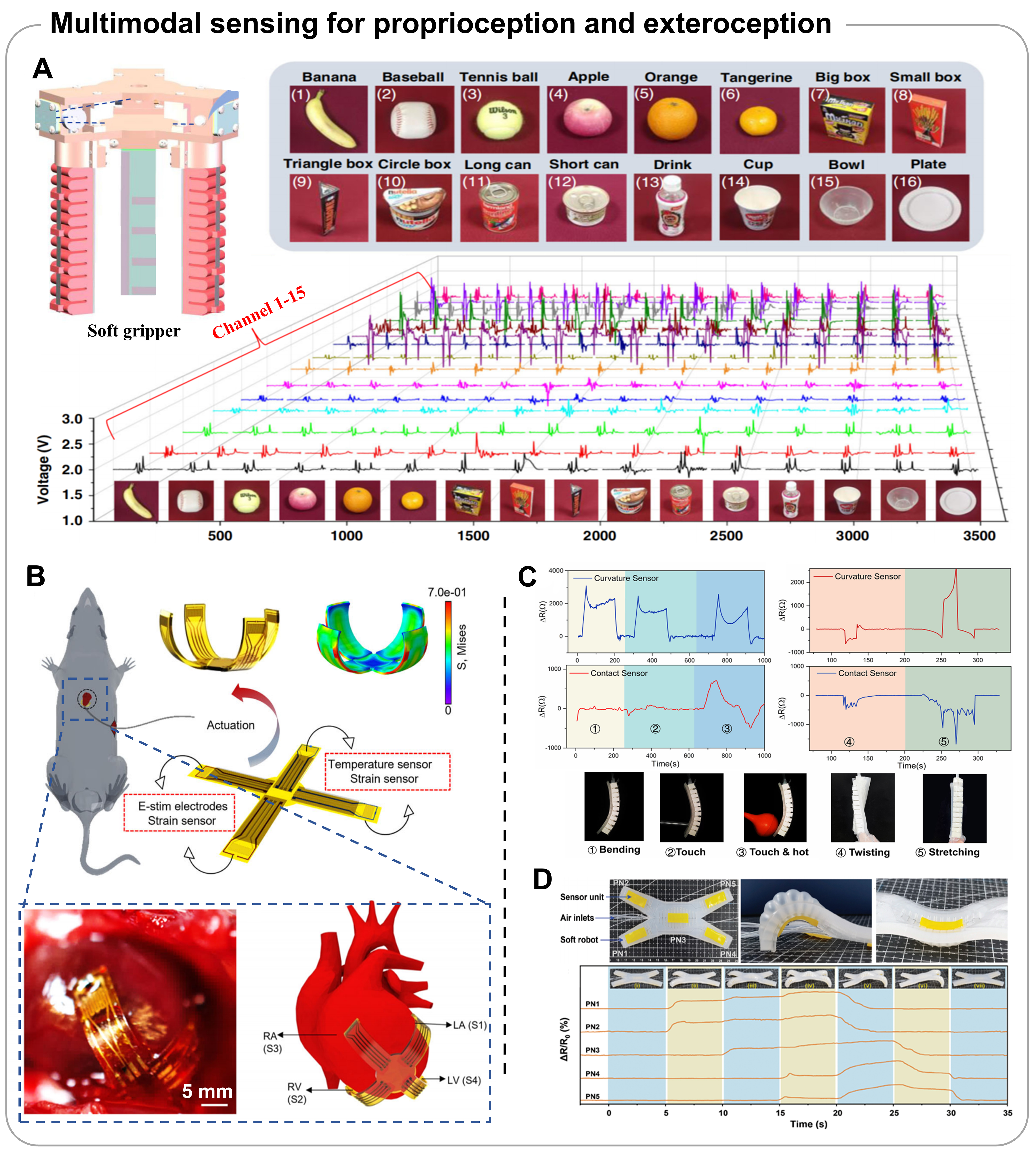
Figure 11. Representative multimodal sensing systems for integrated proprioception and exteroception in soft robots. (A) Enhanced object recognition system via machine learning technology. Adapted from Ref.[265], under CC BY 4.0 license; (B) In vivo validation of a soft robotic thera-gripper for epicardial sensing and electrical stimulation (E-stim). Adapted from Ref.[266], under CC BY 4.0 license; (C) Two flexible sensors detect the contact events and mechanical deformation of the soft actuator. Adapted from Ref.[267], under CC BY 4.0 license; (D) Demonstration of the sensors integrated with the soft robot for motion and material recognition. Adapted with permission from Ref.[268], Copyright © 2023 Wiley-VCH GmbH.
Beyond object manipulation tasks, multimodal sensing has also been explored in soft robotic systems for biomedical applications. For example, Zhang et al. developed a soft robotic platform capable of simultaneously perceiving multiple environmental and physiological stimuli, including touch, pressure, temperature, and pH, while maintaining adaptive actuation capability. By integrating multimodal perception with wireless motion functions, the system supported a variety of medical applications, including blood pressure monitoring, bladder volume measurement, digestive system monitoring, drug delivery, and cardiac therapy, demonstrating the broad potential of multimodal sensing in medical soft robotics [Figure 11B][266].
To further improve the perception capabilities of soft robots in unstructured environments, recent studies have explored higher-dimensional multimodal sensing. Sun et al. demonstrated a soft robotic system capable of simultaneously sensing strain, temperature, and mechanical stimuli, and, with deep learning analysis, accurately recognized posture changes including bending, twisting, and stretching, as well as thermal events [Figure 11C][267]. Dai et al. developed a self-healing multimodal sensing system that monitors strain, temperature, and material properties, enabling real-time characterization of both robot posture and environmental state when integrated into a pneumatic quadruped robot [Figure 11D][268]. To enhance positioning accuracy and overcome limitations of camera- or optical-sensor-based guidance, Chengkuo Lee’s team implemented a multimodal sensing system combining ultrasonic and triboelectric signals, achieving integrated perception of objects position, size, hardness, and material, with deep learning algorithms enabling nearly 100% recognition accuracy[269]. Similar learning-based perception frameworks have also been explored in robotic systems, where heterogeneous feature fusion networks improve the extraction and integration of multi-source sensory information for accurate robotic perception and manipulation[270].
Despite notable progress in integrating actuation and sensing within soft robotic systems, most developments remain at the proof-of-concept stage. Critical challenges - including system stability, long-term durability, and reliable operation in real-world environments - still need to be fully addressed. Achieving highly integrated designs, improving energy efficiency, and ensuring robust performance in unstructured settings remain key barriers to wider application. Looking forward, the convergence of multifunctional materials, advanced manufacturing strategies, and intelligent control algorithms is expected to further advance the integration of actuation and sensing, enabling more coordinated, autonomous, and adaptive soft robotic systems.
5.4. Comparative analysis of integrated actuation–sensing strategies
The integration of actuation and sensing represents an important transition from conventional soft robots with separated functional modules toward adaptive robotic systems capable of perception and feedback control. Existing integration strategies can generally be classified into modular integration, embedded integration, and intrinsic actuation–sensing coupling based on the degree of functional coupling between actuators and sensors[271]. Modular integration provides a practical approach by combining mature actuators and flexible sensors, enabling relatively straightforward fabrication and system implementation. However, the mechanical mismatch between sensing components and soft structures, interface reliability, and additional wiring complexity remain major challenges[272]. Embedded integration improves structural compactness and mechanical compatibility by incorporating sensing elements within soft bodies, but fabrication complexity and sensor replacement remain limiting factors[273].
Intrinsic actuation–sensing coupling represents a more advanced direction, where the actuator itself generates sensing signals through changes in electrical, optical, magnetic, or mechanical properties during deformation[274]. Such approaches can reduce system complexity and provide more direct feedback information, but they require precise material design, signal decoupling, and long-term stability. In addition, the increasing demand for adaptive soft robotic systems has promoted the development of multimodal integration, where multiple sensing mechanisms are combined with data-driven algorithms to achieve comprehensive perception and adaptive responses.
Overall, integrated actuation–sensing systems have progressed from simple combinations of independent functional modules toward more compact and intrinsically coupled architectures. However, achieving reliable perception–action loops remains challenging due to issues including mechanical compatibility, signal decoupling, fabrication scalability, and long-term stability. These challenges highlight the need for coordinated optimization of materials, structures, sensing mechanisms, and control strategies, which will be further discussed in the Outlook section.
6. OUTLOOK: CHALLENGES AND FUTURE DIRECTIONS
In recent years, soft robots have advanced in flexible actuation, diversified sensing mechanisms, and integrated actuation–sensing designs, demonstrating potential for adaptation to complex environments, autonomous perception, and human–robot interaction[275]. Nevertheless, transitioning from laboratory prototypes to practical applications remains challenging. As summarized in Figure 12, future soft robotic systems should be developed along five key directions: predictable and controllable deformation, reliable multimodal sensing and signal interpretation, intrinsic actuation–sensing coupling, autonomous energy systems, and robust real-world deployment. In Figure 12, robust real-world deployment is further represented by two closely related practical dimensions, namely manufacturing and standardization.
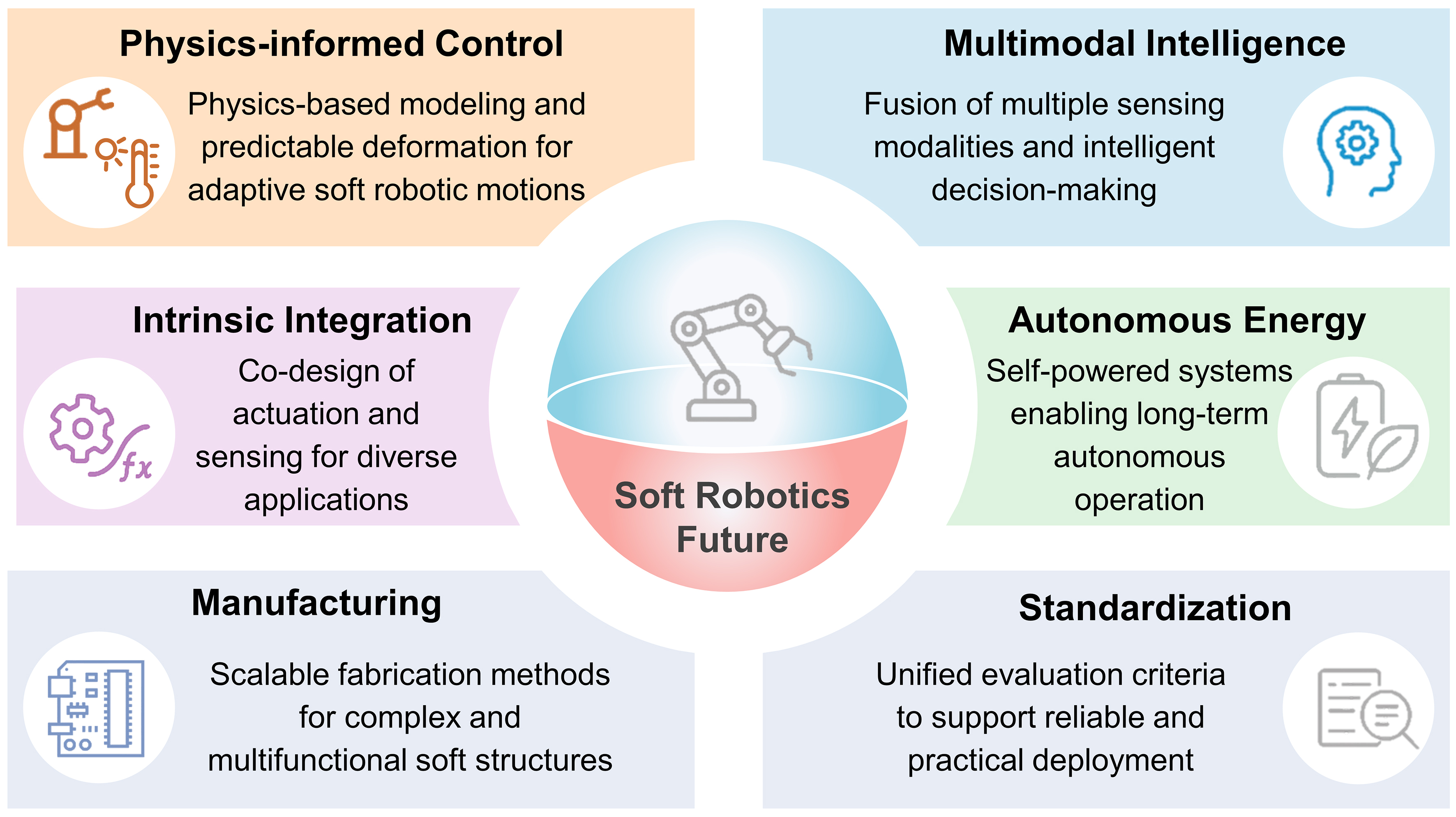
Figure 12. Summary of future development considerations of soft robotic systems.
(1) From flexible actuation to physics-informed and predictable deformation (Physics-informed Control)
A central challenge in soft robotic actuation is the contradiction between large, compliant deformation and precise, repeatable control. Unlike rigid robots with relatively predictable kinematic relationships, soft robots exhibit complex physical behaviors arising from nonlinear material deformation and coupled interactions between materials, structures, and external stimuli. Fluidic, tendon-driven, electroactive, thermal, magnetic, optical, chemical, and acoustic actuation strategies have enabled diverse deformation modes, but their outputs are often influenced by nonlinear material behavior, viscoelasticity, hysteresis, environmental disturbances, and fabrication variability. These factors make it difficult to establish accurate relationships among external stimuli, material responses, structural deformation, and robotic motion. As a result, many soft robots still rely on empirical calibration or open-loop control, which limits their robustness and adaptability in complex environments[276].
Future progress requires a closer coupling between material design, structural mechanics, and control strategies[277,278]. On the material side, soft actuators with reduced hysteresis, improved fatigue resistance, and more stable stimulus–response behaviors are needed. On the structural side, programmable architectures, mechanical metamaterials, origami/kirigami designs, and anisotropic reinforcement strategies can be used to guide deformation and improve motion predictability[279]. From a modeling perspective, developing accurate constitutive models that can describe large deformation, rate-dependent behavior, viscoelasticity, hysteresis, and damage evolution remains a fundamental challenge for soft robotic design and control. Purely empirical models or data-driven approaches without physical constraints are often insufficient for highly nonlinear soft robotic systems, especially when operating conditions deviate from training scenarios. Therefore, physics-based modeling, data-driven modeling, and physics-informed learning should be integrated to capture complex material behaviors, dynamic responses, and long-term degradation processes[280]. By combining material innovation, structural design, mechanics-informed modeling, sensing feedback, and intelligent control, soft robotic actuation is expected to evolve from flexible but unpredictable deformation toward physics-informed, predictable, and task-oriented motion generation. Such developments will be essential for bridging the gap between laboratory demonstrations and reliable soft robotic systems capable of operating in dynamic and unstructured environments.
(2) From multimodal sensing to reliable signal decoupling and interpretation (Multimodal Intelligence)
Multimodal sensing is essential for soft robots operating in unstructured environments, where deformation, contact, temperature, humidity, proximity, slip, and material properties may need to be perceived simultaneously. Compared with single-modality sensors, multimodal sensing systems can provide richer information for object recognition, human–robot interaction, manipulation, locomotion, and environmental exploration. However, increasing the number of sensing modalities does not automatically lead to more reliable perception. Different stimuli often produce coupled or overlapping signals, especially when sensors are integrated into highly deformable soft bodies. Mechanical deformation may interfere with tactile, thermal, or chemical signals, while environmental factors such as humidity, temperature, electromagnetic interference, and surface contamination can further reduce sensing reliability. Therefore, signal coupling, cross-sensitivity, calibration complexity, and long-term drift remain major barriers to practical multimodal perception in soft robotics[281].
Future multimodal sensing systems should shift from simply stacking multiple sensors toward mechanism-level decoupling and intelligent information interpretation. At the device level, orthogonal sensing mechanisms, multilayer structural designs, spatially separated sensing units, and material systems with stimulus-selective responses can be used to reduce cross-interference. At the circuit and system levels, multiplexed readout, wireless acquisition, and distributed sensing networks can help reduce wiring complexity and improve scalability. At the algorithmic level, machine learning, deep learning, and physics-informed data analysis can be used to extract meaningful information from high-dimensional and coupled signals[282]. However, these algorithms should not be treated as black boxes only for classification; they should also be combined with physical understanding of materials, structures, and sensing mechanisms to improve generalization and interpretability. In the future, reliable multimodal perception will require coordinated advances in sensor design, signal decoupling, data fusion, and closed-loop control, enabling soft robots to move from simple stimulus detection toward robust state awareness and environmental understanding.
(3) From modular integration to intrinsic actuation–sensing coupling (Intrinsic Integration)
The integration of actuation and sensing is a key step toward highly adaptive soft robotic systems. In many current demonstrations, sensors are attached to or embedded within soft actuators to provide feedback on deformation, contact, or environmental interactions. Although this modular integration strategy is effective and relatively easy to implement, it often introduces mechanical mismatch, interfacial instability, wiring complexity, and signal drift under repeated large deformation. In addition, externally integrated sensors may affect the original compliance and deformation behavior of soft actuators, while sensor failure or delamination can reduce the reliability of closed-loop control. These issues indicate that simple assembly of actuators and sensors is insufficient for achieving robust and long-term operation in complex environments.
Future actuation–sensing integration should move toward more intrinsic and deeply coupled designs, in which materials, structures, and functional mechanisms are co-designed from the beginning[283]. One promising direction is self-sensing actuation, where the same material or structural component simultaneously generates motion and provides feedback signals. Examples include conductive artificial muscles with resistance-based deformation monitoring, DEAs with capacitance-based self-sensing, liquid-metal-based soft actuators with strain-dependent resistance, and optical or magnetic structures capable of both deformation and state perception[284]. Another direction is multifunctional material design, where conductive, dielectric, ionic, magnetic, or triboelectric components are incorporated into soft matrices to enable simultaneous actuation, sensing, and energy harvesting. At the system level, intrinsic integration should also be combined with closed-loop control, adaptive algorithms, and compact electronics to form reliable perception–action loops. Such deeply coupled actuation–sensing architectures can reduce structural complexity, improve signal relevance, and enhance robustness, providing an important pathway toward autonomous and intelligent soft robotic systems.
(4) From external power supply to autonomous energy systems (Autonomous Energy)
Energy supply remains a fundamental constraint for the practical deployment of soft robots. Many soft robotic systems still depend on external pumps, compressors, power cables, rigid batteries, or bulky control modules, which reduce system portability and limit operation in confined, wearable, biomedical, and field environments. Although untethered actuation strategies, such as magnetic, optical, chemical, and acoustic actuation, can reduce physical connections, they often rely on external field-generation systems or specific environmental conditions. Similarly, self-powered sensing technologies, such as triboelectric and piezoelectric sensors, can generate electrical signals from mechanical stimuli, but their output power, stability, and energy management capability are often insufficient for fully autonomous robotic operation[285]. Therefore, achieving long-term autonomy requires not only energy harvesting, but also efficient energy storage, power management, low-power electronics, and task-dependent energy optimization.
Future soft robotic energy systems should be developed through the co-design of actuation, sensing, control, and power management. At the device level, energy-harvesting mechanisms based on mechanical motion, environmental vibration, light, heat, chemical gradients, or biological fluids can be integrated with soft robotic bodies to recover energy from the robot itself or its surroundings[286]. At the system level, flexible batteries, stretchable supercapacitors, wireless power transfer, and compact power-management circuits should be combined to support continuous sensing, communication, and actuation. In addition, energy-efficient actuation strategies and event-driven sensing architectures can reduce power consumption by activating functional modules only when needed. For future autonomous soft robots, energy systems should no longer be treated as external accessories, but as integral components of the robotic body. Such integration will be essential for developing soft robots capable of long-term operation in wearable devices, implantable systems, environmental monitoring, and confined-space exploration.
(5) From laboratory demonstrations to robust real-world deployment (Manufacturing + Standardization)
Although soft robots have demonstrated remarkable potential in laboratory settings, their transition toward real-world deployment remains challenging. Many reported systems are validated under well-controlled conditions, where environmental variables, loading conditions, and task requirements are relatively simple. In practical scenarios, however, soft robots may encounter unpredictable contact, surface contamination, humidity, temperature variation, mechanical impact, long-term fatigue, and complex interactions with humans or biological tissues. These factors can significantly affect actuation performance, sensing accuracy, material durability, and system reliability. Therefore, the practical deployment of soft robots requires not only improved materials and devices, but also system-level robustness, repeatability, and safety[287].
Future research should place greater emphasis on engineering-oriented evaluation and application-specific design. First, standardized testing methods are needed to compare soft actuators and sensors under consistent conditions, including deformation range, output force, response time, fatigue life, sensing drift, hysteresis, and environmental stability[288]. Second, scalable fabrication and packaging strategies should be developed to ensure device reproducibility and long-term mechanical integrity. Third, soft robotic systems should be designed according to the requirements of specific application scenarios, such as wearable assistance, minimally invasive surgery, rehabilitation, underwater exploration, agriculture, and confined-space inspection. For example, biomedical soft robots require biocompatibility, sterilizability, and precise motion control, whereas field-deployed soft robots require environmental tolerance, mechanical robustness, and autonomous operation. Finally, safety, reliability, and user acceptance should be considered from the early design stage, especially for systems intended for human–robot interaction or clinical use. By moving beyond proof-of-concept demonstrations and toward standardized, reliable, and application-driven system design, soft robotics can better bridge the gap between scientific innovation and practical deployment.
7. CONCLUSION
Soft robotics has developed rapidly owing to its inherent compliance, adaptability, and safety in human–robot interaction. As two fundamental components of soft robotic systems, actuation and sensing determine not only how soft robots generate motion, but also how they perceive their own states and interact with external environments. This review systematically summarized representative actuation strategies, including fluidic, tendon-driven, electroactive, thermal, magnetic, optical, chemical, and acoustic actuation. Their working principles, advantages, limitations, and application potentials were discussed to clarify how different actuation mechanisms support diverse deformation modes and robotic functions.
In parallel, this review examined major flexible sensing technologies for soft robotics, including resistive and piezoresistive, capacitive, piezoelectric, triboelectric, optical, magnetic, acoustic, chemical, and multimodal sensing approaches. These sensing mechanisms provide essential information for deformation monitoring, tactile perception, environmental recognition, and closed-loop feedback. By further reviewing integrated actuation–sensing systems, this article highlighted how proprioception, exteroception, and multimodal information fusion enable soft robots to move beyond passive compliance toward more adaptive and interactive behaviors.
Despite these advances, several key challenges remain. Soft robotic systems still face difficulties in achieving predictable deformation, reliable multimodal signal decoupling, intrinsic actuation–sensing coupling, autonomous energy supply, and robust operation in real-world environments. Addressing these challenges requires a progressive transition from individually optimized functional components toward fully integrated and self-aware robotic systems. In this evolution, a clear roadmap can be established through three interconnected directions: physics-informed design for predictable mechanical behavior, intrinsically integrated actuation–sensing architectures for embodied perception, and autonomous system-level platforms combining energy management, intelligent control, and scalable manufacturing. Future research should therefore focus on the coordinated development of smart materials, programmable structures, physics-based and data-driven modeling, scalable fabrication, compact electronics, and intelligent control strategies. Rather than treating actuation, sensing, control, and energy supply as separate modules, next-generation soft robots should be designed as integrated systems in which materials, structures, sensors, actuators, and algorithms are jointly optimized. Such system-level integration will be essential for translating soft robots from laboratory prototypes into reliable platforms for healthcare, rehabilitation, industrial automation, environmental exploration, and human–machine interaction.
DECLARATIONS
Authors’ contributions
Conceptualization, methodology, investigation, formal analysis, data curation, writing - original draft: Bu, X.
Investigation, data curation, visualization and editing: Yao, S.; Zhang, C.
Investigation, data curation: Gao, S.; Lin, Y.
Investigation: Zhang, Q.; Tian, Y.
Conceptualization, supervision, project administration, review and editing: Li, L.
Conceptualization, supervision, project administration, writing - review and editing, funding acquisition: Jin, T.
Availability of data and materials
Not applicable.
AI and AI-assisted tools statement
During the preparation and revision of this manuscript, ChatGPT (GPT-5.6 Sol, OpenAI, released 2026-07-09) was used solely for language editing and improvement of English expression. The tool did not influence the study design, literature selection, analysis, interpretation, or scientific content of the work. In addition, ChatGPT with GPT-4o image generation (OpenAI, released 2025-03-25) was used to generate selected graphical elements incorporated into Figure 1 and the graphical icons used in Figure 12. The central soft robot illustration in the graphical abstract was generated using ChatGPT Images 2.0 (OpenAI, released 2026-04-21), and Microsoft PowerPoint (version 2024) was used for the layout and graphical assembly of the schematic figures and graphical abstract. The AI-generated elements were used solely as graphical/illustrative components of these schematics and did not contribute to the underlying scientific concepts, data, analysis, interpretation, or conclusions.
Financial support and sponsorship
This work was supported in part by the National Natural Science Foundation of China (grant Nos. 62273222, 62303291, and 62473244), in part by the Foundation of Science and Technology Commission of Shanghai Municipality (grant Nos. 24511103800 and 24TS1402300), and in part by the Shanghai Pujiang Program (grant No. 24PJD031).
Conflicts of interest
All authors declared that there are no conflicts of interest.
Ethical approval and consent to participate
Not applicable.
Consent for publication
Not applicable.
Copyright
The Author(s) 2026.
REFERENCES
1. Aubin, C. A.; Gorissen, B.; Milana, E.; et al. Towards enduring autonomous robots via embodied energy. Nature 2022, 602, 393-402.
2. Zhou, X.; Li, D.; He, S.; et al. MEMS: the sensory nervous system for embodied AI robots. SmartBot 2025, 1, e70004.
3. Wang, D.; Wei, R.; Zhang, J.; et al. Universal bioinspired adhesives for arbitrary unknown surfaces toward dexterous robotic manipulation. Microsyst. Nanoeng. 2026, 12, 213.
4. Urrea, C.; Kern, J. Recent advances and challenges in industrial robotics: a systematic review of technological trends and emerging applications. Processes 2025, 13, 832.
5. Yasa, O.; Toshimitsu, Y.; Michelis, M. Y.; et al. An overview of soft robotics. Annu. Rev. Control. Robot. Auton. Syst. 2023, 6, 1-29.
6. Hu, W.; Lum, G. Z.; Mastrangeli, M.; Sitti, M. Small-scale soft-bodied robot with multimodal locomotion. Nature 2018, 554, 81-5.
7. Wen, T.; Hu, J.; Zhang, J.; Li, X.; Kang, S.; Zhang, N. Design, performance analysis, and experiments of a soft robot for rescue. J. Mech. Robot. 2024, 16, 071011.
8. Abidi, H.; Gerboni, G.; Brancadoro, M.; et al. Highly dexterous 2-module soft robot for intra-organ navigation in minimally invasive surgery. Int. J. Med. Robot. 2018, 14, e1875.
9. Gorissen, B.; De Volder, M.; Reynaerts, D. Chip-on-tip endoscope incorporating a soft robotic pneumatic bending microactuator. Biomed. Microdevices. 2018, 20, 73.
10. Li, M.; Pal, A.; Aghakhani, A.; Pena-Francesch, A.; Sitti, M. Soft actuators for real-world applications. Nat. Rev. Mater. 2022, 7, 235-49.
11. Hegde, C.; Su, J.; Tan, J. M. R.; He, K.; Chen, X.; Magdassi, S. Sensing in soft robotics. ACS. Nano. 2023, 17, 15277-307.
12. Zhang, J.; Wang, P.; Xie, W.; Wang, H.; Zhang, Y.; Zhou, H. Cephalopod-inspired nanomaterials for optical and thermal regulation: mechanisms, applications and perspectives. ACS. Nano. 2024, 18, 24741-69.
13. Yin, S.; Yao, D. R.; Song, Y.; et al. Wearable and implantable soft robots. Chem. Rev. 2024, 124, 11585-636.
14. Sarker, A.; Ul Islam, T.; Islam, M. R. A review on recent trends of bioinspired soft robotics: actuators, control methods, materials selection, sensors, challenges, and future prospects. Adv. Intell. Syst. 2025, 7, 2400414.
15. Yang, S.; Li, J. MEMS microrobots: components, applications, design challenges and perspectives. Intell. Robot. 2025, 5, 864-91.
16. Wang, W.; Jiang, Y.; Zhong, D.; et al. Neuromorphic sensorimotor loop embodied by monolithically integrated, low-voltage, soft e-skin. Science 2023, 380, 735-42.
17. Gao, H.; Zhao, F.; Liu, J.; Meng, Z.; Han, Z.; Liu, Y. What exactly can bionic strategies achieve for flexible sensors? ACS. Appl. Mater. Interfaces. 2024, 16, 38811-31.
18. Qin, J.; Tang, Y.; Zeng, Y.; Liu, X.; Tang, D. Recent advances in flexible sensors: from sensing materials to detection modes. TrAC. Trends. Anal. Chem. 2024, 181, 118027.
19. Zhou, S.; Li, Y.; Wang, Q.; Lyu, Z. Integrated actuation and sensing: toward intelligent soft robots. Cyborg. Bionic. Syst. 2024, 5, 0105.
20. He, Q.; Yin, R.; Hua, Y.; et al. A modular strategy for distributed, embodied control of electronics-free soft robots. Sci. Adv. 2023, 9, eade9247.
21. Tian, J.; Cao, W. Reconfigurable flexible metasurfaces: from fundamentals towards biomedical applications. PhotoniX 2024, 5, 116.
22. Yi, Z.; Gong, S.; Fang, F.; et al. Sensor-actuator integration for intelligent devices. Device 2025, 3, 100717.
23. López-Díaz, A.; Vázquez, A. S.; Vázquez, E. Hydrogels in soft robotics: past, present, and future. ACS. Nano. 2024, 18, 20817-26.
24. Qin, L.; Peng, H.; Huang, X.; Liu, M.; Huang, W. Modeling and simulation of dynamics in soft robotics: a review of numerical approaches. Curr. Robot. Rep. 2024, 5, 1-13.
25. Yao, D. R.; Kim, I.; Yin, S.; Gao, W. Multimodal soft robotic actuation and locomotion. Adv. Mater. 2024, 36, e2308829.
26. Jung, Y.; Kwon, K.; Lee, J.; Ko, S. H. Untethered soft actuators for soft standalone robotics. Nat. Commun. 2024, 15, 3510.
27. Zhang, C.; Duan, Y.; Jiao, Z.; et al. Functional fluid-based soft robotic actuation. Adv. Mater. 2025, 37, e2502669.
28. Li, G.; Wong, T. W.; Shih, B.; et al. Bioinspired soft robots for deep-sea exploration. Nat. Commun. 2023, 14, 7097.
29. Walker, J.; Zidek, T.; Harbel, C.; et al. Soft robotics: a review of recent developments of pneumatic soft actuators. Actuators 2020, 9, 3.
30. Gao, F.; Chen, Y.; Zhou, C.; Yang, X. Design of water hydraulic-driven soft joint and stiffness-posture integrated control for underwater snake robots. J. Bionic. Eng. 2026, 23, 2045-64.
31. Xavier, M. S.; Fleming, A. J.; Yong, Y. K. Finite element modeling of soft fluidic actuators: overview and recent developments. Adv. Intell. Syst. 2021, 3, 2000187.
32. Yao, S.; Gao, S.; Lin, Y.; et al. Soft pneumatic actuators with multiple constraint layers for simplified robotic control. Sens. Actuators. A. Phys. 2026, 402, 117662.
33. Zhu, M.; Do, T. N.; Hawkes, E.; Visell, Y. Fluidic fabric muscle sheets for wearable and soft robotics. Soft. Robot. 2020, 7, 179-97.
34. Galloway, K. C.; Becker, K. P.; Phillips, B.; et al. Soft robotic grippers for biological sampling on deep reefs. Soft. Robot. 2016, 3, 23-33.
35. Yuk, H.; Lin, S.; Ma, C.; Takaffoli, M.; Fang, N. X.; Zhao, X. Hydraulic hydrogel actuators and robots optically and sonically camouflaged in water. Nat. Commun. 2017, 8, 14230.
36. Gorissen, B.; Reynaerts, D.; Konishi, S.; Yoshida, K.; Kim, J. W.; De Volder, M. Elastic inflatable actuators for soft robotic applications. Adv. Mater. 2017, 29, 1604977.
37. Feng, M.; Yang, D.; Ren, L.; Wei, G.; Gu, G. X-crossing pneumatic artificial muscles. Sci. Adv. 2023, 9, eadi7133.
38. Comoretto, A.; Schomaker, H. A. H.; Overvelde, J. T. B. Physical synchronization of soft self-oscillating limbs for fast and autonomous locomotion. Science 2025, 388, 610-5.
39. De Pascali, C.; Naselli, G. A.; Palagi, S.; Scharff, R. B. N.; Mazzolai, B. 3D-printed biomimetic artificial muscles using soft actuators that contract and elongate. Sci. Robot. 2022, 7, eabn4155.
40. Zhang, C.; Yang, H.; Garziera, R.; Xu, Y.; Jiang, H. Reprogrammable gripper through pneumatic tunable bistable origami actuators. Int. J. Mech. Sci. 2025, 286, 109889.
41. Guan, Q.; Liu, L.; Sun, J.; et al. Multifunctional soft stackable robots by netting-rolling-splicing pneumatic artificial muscles. Soft. Robot. 2023, 10, 1001-14.
42. Gao, T.; Bico, J.; Roman, B. Pneumatic cells toward absolute Gaussian morphing. Science 2023, 381, 862-7.
43. Liu, S.; Liu, C.; Wei, G.; Ren, L.; Ren, L. Design, modeling, and optimization of hydraulically powered double-joint soft robotic fish. IEEE. Trans. Robot. 2025, 41, 1211-23.
44. Kashyap, V.; Caprio, A.; Doshi, T.; et al. Multilayer fabrication of durable catheter-deployable soft robotic sensor arrays for efficient left atrial mapping. Sci. Adv. 2020, 6, eabc6800.
45. Incekara, S.; Kwon, S.; Kwon, G.; Ha, J. Tendon-driven compliant wheel-less snake robot for undulatory locomotion using conformable ground contacts. Adv. Intell. Syst. 2026, 8, e202501183.
46. Kim, Y.; Cha, Y. Soft pneumatic gripper with a tendon-driven soft origami pump. Front. Bioeng. Biotechnol. 2020, 8, 461.
47. Ren, T.; Li, Y.; Xu, M.; Li, Y.; Xiong, C.; Chen, Y. A novel tendon-driven soft actuator with self-pumping property. Soft. Robot. 2020, 7, 130-9.
48. Chen, Z.; He, Y.; Li, B.; et al. A robotic prosthetic hand for computer mouse operations. Adv. Intell. Syst. 2025, 7, 2500126.
49. Zhang, N.; Zhou, P.; Yang, X.; et al. Biomimetic rigid-soft finger design for highly dexterous and adaptive robotic hands. Sci. Adv. 2025, 11, eadu2018.
50. Lai, J.; Zeng, B.; Liu, J.; et al. Current research status of ionic polymer–metal composites in applications of low-voltage actuators. Mater. Adv. 2024, 5, 4601-17.
51. Evenchik, A. L.; Kane, A. Q.; Oh, E.; Truby, R. L. Electrically controllable materials for soft, bioinspired machines. Annu. Rev. Mater. Res. 2023, 53, 225-51.
52. Tang, C.; Du, B.; Jiang, S.; et al. A pipeline inspection robot for navigating tubular environments in the sub-centimeter scale. Sci. Robot. 2022, 7, eabm8597.
53. Gravert, S. D.; Varini, E.; Kazemipour, A.; et al. Low-voltage electrohydraulic actuators for untethered robotics. Sci. Adv. 2024, 10, eadi9319.
54. Yu, H.; Xiao, C.; Duan, T.; et al. An ant-inspired dielectric elastomer soft robot with unequal biaxial pre-stretching for fast locomotion and versatile applications. Adv. Funct. Mater. 2026, 36, e74880.
55. Wu, S.; Hong, Y.; Zhao, Y.; Yin, J.; Zhu, Y. Caterpillar-inspired soft crawling robot with distributed programmable thermal actuation. Sci. Adv. 2023, 9, eadf8014.
56. Feng, W.; He, Q.; Zhang, L. Embedded physical intelligence in liquid crystalline polymer actuators and robots. Adv. Mater. 2025, 37, e2312313.
57. Liu, H.; Tian, H.; Li, X.; et al. Shape-programmable, deformation-locking, and self-sensing artificial muscle based on liquid crystal elastomer and low-melting point alloy. Sci. Adv. 2022, 8, eabn5722.
58. Yang, H.; Yin, X.; Zhang, C.; Chen, B.; Sun, P.; Xu, Y. Weaving liquid crystal elastomer fiber actuators for multifunctional soft robotics. Sci. Adv. 2025, 11, eads3058.
59. Che, J.; Yang, X.; Peng, J.; Li, J.; Liu, Z.; Qi, M. Arc-heating actuated active-morphing insect robots. Nat. Commun. 2025, 16, 3014.
60. Cheng, J.; Zhang, R.; Li, H.; et al. Soft crawling microrobot based on flexible optoelectronics enabling autonomous phototaxis in terrestrial and aquatic environments. Soft. Robot. 2025, 12, 45-55.
61. Qin, K.; Tang, W.; Zong, H.; et al. Parthenocissus-inspired soft climbing robots. Sci. Adv. 2025, 11, eadt9284.
62. Kim, J.; Yoo, J.; Seo, H.; et al. Magnetically driven triboelectric nanogenerator for a wireless, versatile energy transfer system. Sci. Adv. 2025, 11, eadu5919.
63. Min, H.; Bae, D.; Jang, S.; et al. Stiffness-tunable velvet worm-inspired soft adhesive robot. Sci. Adv. 2024, 10, eadp8260.
64. Zhang, M.; Yang, L.; Yang, H.; et al. A magnetically actuated microcatheter with soft rotatable tip for enhanced endovascular access and treatment efficiency. Sci. Adv. 2025, 11, eadv1682.
65. Huang, Y.; Yin, S.; Li, H.; Liu, S.; Wong, T. N. One-step fabrication of moon-shaped microrobots through in situ solidification of magnetic Janus droplets in microchannels. Droplet 2023, 2, e56.
66. Sui, F.; Yue, W.; Behrouzi, K.; Gao, Y.; Mueller, M.; Lin, L. Untethered subcentimeter flying robots. Sci. Adv. 2025, 11, eads6858.
67. Ze, Q.; Wu, S.; Nishikawa, J.; et al. Soft robotic origami crawler. Sci. Adv. 2022, 8, eabm7834.
68. Wu, Y.; Dong, X.; Kim, J. K.; Wang, C.; Sitti, M. Wireless soft millirobots for climbing three-dimensional surfaces in confined spaces. Sci. Adv. 2022, 8, eabn3431.
69. Xiong, J.; He, Z.; Zhu, G.; et al. Photonic nanojet-regulated soft microalga-robot with controllable deformation and navigation capability. PhotoniX 2024, 5, 158.
70. Han, D.; Wang, Q.; Chen, Z.; et al. Light-propelled photocatalytic evaporator for robotic solar-driven water purification. PhotoniX 2025, 6, 169.
71. Chen, H.; Chen, Z.; Liu, Z.; et al. From coils to crawls: a snake-inspired soft robot for multimodal locomotion and grasping. Nanomicro. Lett. 2025, 17, 243.
72. Li, S.; Lerch, M. M.; Waters, J. T.; et al. Self-regulated non-reciprocal motions in single-material microstructures. Nature 2022, 605, 76-83.
73. Zhang, M.; Pal, A.; Lyu, X.; Wu, Y.; Sitti, M. Artificial-goosebump-driven microactuation. Nat. Mater. 2024, 23, 560-9.
74. Guo, K.; Yang, X.; Zhou, C.; Li, C. Self-regulated reversal deformation and locomotion of structurally homogenous hydrogels subjected to constant light illumination. Nat. Commun. 2024, 15, 1694.
75. Villeda-Hernandez, M.; Baker, B. C.; Romero, C.; Rossiter, J. M.; Dicker, M. P. M.; Faul, C. F. J. Chemically driven oscillating soft pneumatic actuation. Soft. Robot. 2023, 10, 1159-70.
76. Wang, M.; Zhou, L.; Deng, W.; et al. Ultrafast response and programmable locomotion of liquid/vapor/light-driven soft multifunctional actuators. ACS. Nano. 2022, 16, 2672-81.
77. Li, P.; Su, N.; Wang, Z.; Qiu, J. A Ti3C2Tx MXene-based energy-harvesting soft actuator with self-powered humidity sensing and real-time motion tracking capability. ACS. Nano. 2021, 15, 16811-8.
78. Fusi, G.; Del Giudice, D.; Skarsetz, O.; Di Stefano, S.; Walther, A. Autonomous soft robots empowered by chemical reaction networks. Adv. Mater. 2023, 35, e2209870.
79. Kaynak, M.; Dirix, P.; Sakar, M. S. Addressable acoustic actuation of 3D printed soft robotic microsystems. Adv. Sci. 2020, 7, 2001120.
80. Shi, Z.; Zhang, Z.; Schnermann, J.; et al. Ultrasound-driven programmable artificial muscles. Nature 2025, 646, 1096-104.
81. Deng, Y.; Paskert, A.; Zhang, Z.; Wittkowski, R.; Ahmed, D. An acoustically controlled helical microrobot. Sci. Adv. 2023, 9, eadh5260.
82. Dillinger, C.; Nama, N.; Ahmed, D. Ultrasound-activated ciliary bands for microrobotic systems inspired by starfish. Nat. Commun. 2021, 12, 6455.
83. Ahmed, F.; Waqas, M.; Jawed, B.; et al. Decade of bio-inspired soft robots: a review. Smart. Mater. Struct. 2022, 31, 073002.
84. Ye, Z.; Zheng, L.; Chen, W.; Wang, B.; Zhang, L. Recent advances in bioinspired soft robots: fabrication, actuation, tracking, and applications. Adv. Mater. Technol. 2024, 9, 2301862.
85. Liu, T.; Liu, L.; Gou, G. Y.; et al. Recent advancements in physiological, biochemical, and multimodal sensors based on flexible substrates: strategies, technologies, and integrations. ACS. Appl. Mater. Interfaces. 2023, 15, 21721-45.
86. Xu, Y.; Sun, Z.; Bai, Z.; et al. Bionic e-skin with precise multi-directional droplet sliding sensing for enhanced robotic perception. Nat. Commun. 2024, 15, 6022.
87. Linghu, C.; Liu, Y.; Yang, X.; et al. Versatile adhesive skin enhances robotic interactions with the environment. Sci. Adv. 2025, 11, eadt4765.
88. Zhan, Z.; Yang, Y.; Zuo, W.; Xie, M.; Ning, M. Recent advances and challenges of tactile sensing for robotics: from fundamentals to applications. Mater. Today. Phys. 2025, 54, 101740.
89. Wang, X.; Wang, C.; Chen, S.; et al. Imitating human tactile: intelligent material perception technology empowered by flexible sensors. Mater. Today. 2026, 97, 103343.
90. Liu, W.; Wang, Y.; Duo, Y.; et al. Recent progress of soft robot interaction based on flexible sensing. Robot 2024, 46, 195-218.
91. Qu, J.; Cui, G.; Li, Z.; et al. Advanced flexible sensing technologies for soft robots. Adv. Funct. Mater. 2024, 34, 2401311.
92. Shang, J.; Ma, X.; Zou, P.; et al. A flexible catheter-based sensor array for upper airway soft tissues pressure monitoring. Nat. Commun. 2025, 16, 287.
93. Zheng, X.; Zhang, S.; Zhou, M.; et al. MXene functionalized, highly breathable and sensitive pressure sensors with multi-layered porous structure. Adv. Funct. Mater. 2023, 33, 2214880.
94. Li, Y.; Yang, Y.; Wang, C.; et al. Massively parallel in-sensor skinomorphic computing. Nat. Commun. 2026, 17, 4971.
95. Xing, D.; Wang, Z.; Zhang, M.; et al. Machine learning-enhanced smart interactive glove utilizing flexible gradient ridge architecture iontronic capacitive sensor. Adv. Funct. Mater. 2026, 36, e29907.
96. Xu, G.; Wang, H.; Zhao, G.; et al. Self-powered electrotactile textile haptic glove for enhanced human-machine interface. Sci. Adv. 2025, 11, eadt0318.
97. An, S.; Liu, S.; Zhou, X.; et al. Self-powered triboelectric wireless sensor for robotic arm control via enhanced electromagnetic induction. Nat. Sens. 2026, 1, 341-9.
98. Hong, L.; Zhang, H.; Kraus, T.; Jiao, P. Ultra-stretchable kirigami piezo-metamaterials for sensing coupled large deformations. Adv. Sci. 2024, 11, e2303674.
99. Cao, Z.; Wu, D.; Yuan, Y.; et al. A corrugated PVDF-based flexible piezoelectric sensor for physiological signal detection. ACS. Sens. 2026, 11, 2731-40.
100. Luo, Y.; Wang, S.; Chang, J.; et al. A self-powered optical fiber tactile sensor with mechanoluminescent transduction for robotic grasping and hardness detection. Laser. Photonics. Rev. 2026, 20, e01845.
101. Zhong, L.; Tian, X.; Wang, J.; et al. Calibration-free optical waveguide bending sensor for soft robots. Soft. Sci. 2025, 5, 3.
102. Yang, Y.; Gu, M.; Xie, J. S.; et al. Precise perception of surface tackiness enabled by a soft single-sensing-element tactile sensor. Sci. Bull. 2026, 71, 2767-79.
103. Xu, J.; Duan, C.; Wan, X.; et al. A soft magnetoelastic sensor to decode levels of fatigue. Nat. Electron. 2025, 8, 709-20.
104. Pierre Claver, U.; Zhao, G. Recent progress in flexible pressure sensors based electronic skin. Adv. Eng. Mater. 2021, 23, 2001187.
105. Chen, W.; Yan, X. Progress in achieving high-performance piezoresistive and capacitive flexible pressure sensors: a review. J. Mater. Sci. Technol. 2020, 43, 175-88.
106. Jin, Y.; Xue, S.; He, Y. Flexible pressure sensors enhanced by 3D-printed microstructures. Adv. Mater. 2025, 37, e2500076.
107. Lee, S.; Lee, Y.; Park, C.; et al. Shape-reconfigurable crack-based strain sensor with ultrahigh and tunable sensitivity. Adv. Funct. Mater. 2025, 35, 2421812.
108. Fan, X.; Hu, H.; Liao, B.; Zhang, Y.; Zhang, F. Optimization of microstructure design for enhanced sensing performance in flexible piezoresistive sensors. J. Adv. Ceram. 2024, 13, 711-28.
109. Zhu, Y.; Liu, Y.; Sun, Y.; Zhang, Y.; Ding, G. Recent advances in resistive sensor technology for tactile perception: a review. IEEE. Sensors. J. 2022, 22, 15635-49.
110. Sengupta, D.; Romano, J.; Kottapalli, A. G. P. Electrospun bundled carbon nanofibers for skin-inspired tactile sensing, proprioception and gesture tracking applications. npj. Flex. Electron. 2021, 5, 126.
111. Liu, Y.; Tao, J.; Mo, Y.; Bao, R.; Pan, C. Ultrasensitive touch sensor for simultaneous tactile and slip sensing. Adv. Mater. 2024, 36, e2313857.
112. Li, J.; Chen, S.; Ding, Z.; Wang, X.; Moita, A. S. O. H.; Liu, Y. Bioinspired flexible piezoresistive sensor with cross-gradient architecture for high-performance tactile sensing. Biosens. Bioelectron. 2025, 291, 118023.
113. Jiang, M.; Jin, C.; Bai, Z. Omnidirectional bending sensor with bianisotropic structure for wearable electronics. ACS. Sens. 2025, 10, 448-59.
114. Gao, M.; Liu, W.; Chen, K.; et al. Piezoresistive effect: a new concept for hearing aids. Adv. Sci. 2025, 12, e2501227.
115. Li, S.; Tian, J.; Li, K.; et al. Intelligent song recognition via a hollow-microstructure-based, ultrasensitive artificial eardrum. Adv. Sci. 2024, 11, e2405501.
116. Xiao, Y.; Li, H.; Gu, T.; et al. Ti3C2Tx composite aerogels enable pressure sensors for dialect speech recognition assisted by deep learning. Nanomicro. Lett. 2024, 17, 101.
117. Wu, X.; Luo, X.; Song, Z.; Bai, Y.; Zhang, B.; Zhang, G. Ultra-robust and sensitive flexible strain sensor for real-time and wearable sign language translation. Adv. Funct. Mater. 2023, 33, 2303504.
118. Duan, L.; D’Hooge, D. R.; Cardon, L. Recent progress on flexible and stretchable piezoresistive strain sensors: from design to application. Prog. Mater. Sci. 2020, 114, 100617.
119. Wang, H.; Li, Z.; Liu, Z.; et al. Flexible capacitive pressure sensors for wearable electronics. J. Mater. Chem. C. 2022, 10, 1594-605.
120. Chen, W.; Chen, S.; Zhao, X.; et al. Kirigami design smart contact lens for highly sensitive eyelid pressure measurement. ACS. Sens. 2025, 10, 814-24.
121. Yang, G.; Lin, R.; Li, H.; et al. Implantable wireless suture sensor for in situ tendon and ligament strain monitoring. Sci. Adv. 2025, 11, eadt3811.
122. Cheng, A.; Li, X.; Li, D.; et al. An intelligent hybrid-fabric wristband system enabled by thermal encapsulation for ergonomic human-machine interaction. Nat. Commun. 2025, 16, 591.
123. Qin, J.; Yin, L. J.; Hao, Y. N.; et al. Flexible and stretchable capacitive sensors with different microstructures. Adv. Mater. 2021, 33, e2008267.
124. Li, W.; Zou, K.; Guo, J.; et al. Integrated fibrous iontronic pressure sensors with high sensitivity and reliability for human plantar pressure and gait analysis. ACS. Nano. 2024, 18, 14672-84.
125. Yang, J. S.; Chung, M. K.; Yoo, J. Y.; et al. Interference-free nanogap pressure sensor array with high spatial resolution for wireless human-machine interfaces applications. Nat. Commun. 2025, 16, 2024.
126. Song, M.; Liu, Q.; Xu, X.; et al. A fabric-based multimodal flexible tactile sensor with precise sensing and discrimination capabilities for pressure-proximity-magnetic field signals. Adv. Funct. Mater. 2025, 35, 2420445.
127. Ju, M.; Dou, Z.; Li, J. W.; et al. Piezoelectric materials and sensors for structural health monitoring: fundamental aspects, current status, and future perspectives. Sensors 2023, 23, 543.
128. Wang, X.; Song, W. Z.; You, M. H.; et al. Bionic single-electrode electronic skin unit based on piezoelectric nanogenerator. ACS. Nano. 2018, 12, 8588-96.
129. Park, H.; Gbadam, G. S.; Niu, S.; Ryu, H.; Lee, J. Manufacturing strategies for highly sensitive and self-powered piezoelectric and triboelectric tactile sensors. Int. J. Extrem. Manuf. 2025, 7, 012006.
130. Yan, C.; Wang, L.; Li, X.; et al. Spider web-inspired flexible pressure sensors with high sensitivity and adjustable sensing range. Adv. Funct. Mater. 2026, 36, e05555.
131. Yu, X.; Zhang, X.; Lu, C. Skin-inspired and self-powered piezoionic sensors for smart wearable applications. Small 2025, 21, e2410594.
132. Lv, Q.; Chen, S.; Luo, D.; et al. An implantable and degradable silk sericin protein film energy harvester for next-generation cardiovascular electronic devices. Adv. Mater. 2025, 37, e2413610.
133. Chang, J.; Maltby, T.; Moineddini, A.; et al. Piezoelectric nanofiber-based intelligent hearing system. Sci. Adv. 2025, 11, eadl2741.
134. Chen, L.; Liu, H.; Qi, H.; Chen, J. High-electromechanical performance for high-power piezoelectric applications: fundamental, progress, and perspective. Prog. Mater. Sci. 2022, 127, 100944.
135. Tang, T.; Shen, Z.; Wang, J.; et al. Stretchable polymer composites with ultrahigh piezoelectric performance. Natl. Sci. Rev. 2023, 10, nwad177.
136. Li, Y.; Zhang, S.; Gu, H.; et al. Ultrasensitive piezoelectric-like film with designed cross-scale pores. Sci. Adv. 2025, 11, eadt4003.
137. Zhang, W.; Yang, J.; Sun, Q.; et al. Microspheres trigged-stress concentration regulating piezoelectric properties of PVDF/elastomer composites. Sci. China. Chem. 2025, 68, 2605-14.
138. Duan, S.; Zhang, H.; Liu, L.; et al. A comprehensive review on triboelectric sensors and AI-integrated systems. Mater. Today. 2024, 80, 450-80.
139. Fan, F.; Tian, Z.; Lin, Wang. Z. Flexible triboelectric generator. Nano. Energy. 2012, 1, 328-34.
140. Zhong, S.; Zhang, Z.; Zhao, Q.; et al. Lattice expansion in ruthenium nanozymes improves catalytic activity and electro-responsiveness for boosting cancer therapy. Nat. Commun. 2024, 15, 8097.
141. Qiu, R.; Zhang, X.; Song, C.; et al. E-cardiac patch to sense and repair infarcted myocardium. Nat. Commun. 2024, 15, 4133.
142. Zhang, W.; Qin, X.; Li, G.; et al. Self-powered triboelectric-responsive microneedles with controllable release of optogenetically engineered extracellular vesicles for intervertebral disc degeneration repair. Nat. Commun. 2024, 15, 5736.
143. Zhou, Q.; Xu, W.; Wang, L.; et al. Triboelectric nanogenerator-based self-powered urinary protein detection utilizing triboelectric material with colorimetric function. ACS. Nano. 2025, 19, 1566-76.
144. Zahed, M. A.; Rana, S. M. S.; Faruk, O.; et al. Self-powered wireless system for monitoring sweat electrolytes in personalized healthcare wearables. Adv. Funct. Mater. 2025, 35, 2421021.
145. Liu, Z.; Hu, Y.; Qu, X.; et al. A self-powered intracardiac pacemaker in swine model. Nat. Commun. 2024, 15, 507.
146. Hui, X.; Tang, L.; Zhang, D.; et al. Acoustically enhanced triboelectric stethoscope for ultrasensitive cardiac sounds sensing and disease diagnosis. Adv. Mater. 2024, 36, e2401508.
147. Li, J.; Yousry, Y. M.; Lim, P. C.; Ramakrishna, S.; Yao, K. Mechanism of airborne sound absorption through triboelectric effect for noise mitigation. Nat. Commun. 2024, 15, 9408.
148. Haji Bagheri, M.; Rajabi-Abhari, A.; Gibbs, O.; et al. Sustainable live sound monitoring and classification system enabled by a triboelectric nanogenerator and machine learning techniques. Energy. Environ. Mater. 2026, 9, e70044.
149. Wu, H.; Shan, C.; Fu, S.; et al. Efficient energy conversion mechanism and energy storage strategy for triboelectric nanogenerators. Nat. Commun. 2024, 15, 6558.
150. Lee, G.; Kang, H.; Yun, J.; et al. Integrated triboelectric nanogenerator and radiative cooler for all-weather transparent glass surfaces. Nat. Commun. 2024, 15, 6537.
151. Wang, Y.; Du, H.; Yang, H.; et al. A rolling-mode triboelectric nanogenerator with multi-tunnel grating electrodes and opposite-charge-enhancement for wave energy harvesting. Nat. Commun. 2024, 15, 6834.
152. Gao, Y.; He, L.; Liu, D.; et al. Spontaneously established reverse electric field to enhance the performance of triboelectric nanogenerators via improving Coulombic efficiency. Nat. Commun. 2024, 15, 4167.
153. He, J.; Wang, X.; Nan, Y.; Zhou, H. Research progress of triboelectric nanogenerators for ocean wave energy harvesting. Small 2025, 21, e2411074.
154. Zheng, T.; Gao, M.; Wang, Y.; et al. Ultra-wide frequency response and high-resolution triboelectric acoustic sensors for constructing multifunctional speech aided system. Nano. Energy. 2025, 135, 110640.
155. Zhao, Y.; Li, L.; Zhang, J.; et al. A high-accuracy facial expression recognition system combining triboelectric hydrogel sensors with deep learning. Adv. Funct. Mater. 2025, 35, 2418265.
156. Lee, J. P.; Jang, H.; Jang, Y.; et al. Encoding of multi-modal emotional information via personalized skin-integrated wireless facial interface. Nat. Commun. 2024, 15, 530.
157. Peng, W.; Zhu, R.; Ni, Q.; et al. Functional tactile sensor based on arrayed triboelectric nanogenerators. Adv. Energy. Mater. 2024, 14, 2403289.
158. Yang, S.; Goncharenko, D. V.; Ji, P.; et al. A carbon nanotube-doped polyurethane nanocomposite-based triboelectric nanogenerator: a platform for efficient mechanical energy harvesting and self-powered motion sensing. ACS. Appl. Mater. Interfaces. 2025, 17, 38469-80.
159. Wang, Y.; Gao, Z.; Wu, W.; et al. TENG-boosted smart sports with energy autonomy and digital intelligence. Nanomicro. Lett. 2025, 17, 265.
160. Guo, M.; Xia, Y.; Liu, J.; Zhang, Y.; Li, M.; Wang, X. Wearable pressure sensor based on triboelectric nanogenerator for information encoding, gesture recognition, and wireless real-time robot control. Adv. Funct. Mater. 2025, 35, 2419209.
161. Liu, S.; Qing, W.; Zhang, J.; et al. Hierarchical rGO-based triboelectric sensors enable motion monitoring and trajectory tracking. Adv. Funct. Mater. 2025, 35, 2419459.
162. Chen, X.; Peng, X.; Wei, C.; et al. A moisture-proof, anti-fouling, and low signal attenuation all-nanofiber triboelectric sensor for self-powered respiratory health monitoring. Adv. Funct. Mater. 2025, 35, 2415421.
163. Yang, B.; Yang, L.; Zhao, H.; et al. A visual-tactile synchronized stimulation ring system for sensory rehabilitation integrating triboelectric sensing and pneumatic feedback. Nano. Energy. 2025, 135, 110638.
164. Wang, P.; Wang, G.; Sun, G.; et al. A flexible-integrated multimodal hydrogel-based sensing patch. Nanomicro. Lett. 2025, 17, 156.
165. Qu, B.; Mou, Q.; Zhou, Z.; Xie, Y.; Li, Y.; Chen, B. Triboelectric sensors based on glycerol/PVA hydrogel and deep learning algorithms for neck movement monitoring. ACS. Appl. Mater. Interfaces. 2025, 17, 12862-74.
166. Yang, Y.; Jia, L.; Zhang, X.; et al. Stretchable and flexible triboelectric sensors with a wide measurement range for human pulse monitoring, motion recognition, and human–computer interaction. Chem. Eng. J. 2025, 513, 162861.
167. Anaya, D. V.; Zhan, K.; Tao, L.; Lee, C.; Yuce, M. R.; Alan, T. Contactless tracking of humans using non-contact triboelectric sensing technology: enabling new assistive applications for the elderly and the visually impaired. Nano. Energy. 2021, 90, 106486.
168. Ji, M.; Wang, Z.; Wu, J.; et al. Machine learning-assisted triboelectric nanogenerator technology for intelligent sports. Sci. Adv. 2025, 11, eadz3515.
169. Qu, X.; Liu, Z.; Tan, P.; et al. Artificial tactile perception smart finger for material identification based on triboelectric sensing. Sci. Adv. 2022, 8, eabq2521.
170. Han, C.; Cao, Z.; An, Z.; Zhang, Z.; Wang, Z. L.; Wu, Z. Multimodal finger-shaped tactile sensor for multi-directional force and material identification. Adv. Mater. 2025, 37, e2414096.
171. Guo, J.; Du, Y.; Wang, Z.; Wei, D. A paradigm shift from traditional non-contact sensors to tele-perception. J. Mater. Chem. A. 2025, 13, 8939-67.
172. Du, Y.; Shen, P.; Liu, H.; et al. Multi-receptor skin with highly sensitive tele-perception somatosensory. Sci. Adv. 2024, 10, eadp8681.
173. Wen, F.; Sun, Z.; He, T.; et al. Machine learning glove using self-powered conductive superhydrophobic triboelectric textile for gesture recognition in VR/AR applications. Adv. Sci. 2020, 7, 2000261.
174. Wang, M.; Yan, Z.; Wang, T.; et al. Gesture recognition using a bioinspired learning architecture that integrates visual data with somatosensory data from stretchable sensors. Nat. Electron. 2020, 3, 563-70.
175. Tang, Y.; Zhou, H.; Sun, X.; et al. Triboelectric touch-free screen sensor for noncontact gesture recognizing. Adv. Funct. Mater. 2020, 30, 1907893.
176. Du, Y.; Shen, P.; Liu, H.; et al. Conformal self-powered inertial displacement sensor with geometric optimization for in situ noninvasive data acquisition. Adv. Funct. Mater. 2024, 34, 2409602.
177. Jiang, Y.; Dong, K.; An, J.; et al. UV-protective, self-cleaning, and antibacterial nanofiber-based triboelectric nanogenerators for self-powered human motion monitoring. ACS. Appl. Mater. Interfaces. 2021, 13, 11205-14.
178. Zheng, Q.; Xin, L.; Zhang, Q.; et al. Leech-inspired amphibious soft robot driven by high-voltage triboelectricity. Adv. Mater. 2025, 37, e2417380.
179. Li, F.; Sun, S.; Wan, X.; Sun, M.; Zhang, S. L.; Xu, M. A self-powered soft triboelectric-electrohydrodynamic pump. Nat. Commun. 2025, 16, 1315.
180. Cheng, H.; Fang, S.; Li, Y.; et al. Mechano-electro-optical conversion dynamics in mechanoluminescence and its application in remote human–robot interaction. PhotoniX 2025, 6, 210.
181. Ward-Cherrier, B.; Pestell, N.; Cramphorn, L.; et al. The tactip family: soft optical tactile sensors with 3D-printed biomimetic morphologies. Soft. Robot. 2018, 5, 216-27.
182. Abad, A. C.; Ranasinghe, A. Visuotactile sensors with emphasis on GelSight sensor: a review. IEEE. Sensors. J. 2020, 20, 7628-38.
183. Qu, J.; Mao, B.; Li, Z.; et al. Recent progress in advanced tactile sensing technologies for soft grippers. Adv. Funct. Mater. 2023, 33, 2306249.
184. Zhou, H.; Wang, X.; He, Y.; et al. Distributed strain sensor based on self-powered, stretchable mechanoluminescent optical fiber. Adv. Intell. Syst. 2023, 5, 2300113.
185. Mak, C.; Li, Y.; Wang, K.; et al. Intelligent shape decoding of a soft optical waveguide sensor. Adv. Intell. Syst. 2024, 6, 2470007.
186. Wang, Z.; Chen, Z.; Ma, L.; et al. Optical microfiber intelligent sensor: wearable cardiorespiratory and behavior monitoring with a flexible wave-shaped polymer optical microfiber. ACS. Appl. Mater. Interfaces. 2024, 16, 8333-45.
187. Wang, K.; Mizuno, Y.; Dong, X.; et al. Multimode optical fiber sensors: from conventional to machine learning-assisted. Meas. Sci. Technol. 2024, 35, 022002.
188. Li, Z.; Cheng, L.; Liu, Z.; Wei, J.; Wang, Y. FOCERS: an ultrasensitive and robust soft optical 3D tactile sensor. Soft. Robot. 2025, 12, 445-54.
189. Mao, W.; Fu, Z.; Li, Y.; Li, F.; Yang, L. Exceptional-point-enhanced phase sensing. Sci. Adv. 2024, 10, eadl5037.
190. Yan, X.; Yan, X.; Zhang, T.; et al. Soft and stretchable optical fibers with gradient color coding for multipoint bending and tactile perception in dexterous hands. ACS. Sens. 2025, 10, 4832-40.
191. Jha, R.; Mishra, P.; Kumar, S. Advancements in optical fiber-based wearable sensors for smart health monitoring. Biosens. Bioelectron. 2024, 254, 116232.
192. Rasheed, S.; Kanwal, T.; Ahmad, N.; Fatima, B.; Najam-ul-Haq, M.; Hussain, D. Advances and challenges in portable optical biosensors for onsite detection and point-of-care diagnostics. TrAC. Trends. Anal. Chem. 2024, 173, 117640.
193. Wang, Y.; Zhou, Y.; Qi, L.; Zhang, Y. Soft optical fibers for biomedical and wearable technologies: current trends and future prospects. Adv. Funct. Mater. 2025, 35, 2507712.
194. Kwon, H.; Yang, Y.; Kim, G.; Gim, D.; Ha, M. Anisotropy in magnetic materials for sensors and actuators in soft robotic systems. Nanoscale 2024, 16, 6778-819.
195. Ma, Z.; Ai, J.; Zhang, X.; et al. Merkel’s disks bioinspired self-powered flexible magnetoelectric sensors toward the robotic arm’s tactile perceptual functioning and smart learning. Adv. Intell. Syst. 2020, 2, 1900140.
196. Man, J.; Jin, Z.; Chen, J. Magnetic tactile sensor with bionic hair array for sliding sensing and object recognition. Adv. Sci. 2024, 11, e2306832.
197. Li, S.; Wu, Y.; Asghar, W.; et al. Wearable magnetic field sensor with low detection limit and wide operation range for electronic skin applications. Adv. Sci. 2024, 11, e2304525.
198. Zhou, J.; Guo, Y.; Wang, Y.; et al. Flexible and wearable acoustic wave technologies. Appl. Phys. Rev. 2023, 10, 021311.
199. Joshi, S. V.; Sadeghpour, S.; Kuznetsova, N.; Wang, C.; Kraft, M. Flexible micromachined ultrasound transducers (MUTs) for biomedical applications. Microsyst. Nanoeng. 2025, 11, 9.
200. Ding, Q.; Wang, H.; Zhou, Y.; et al. Self-powered switchable gas-humidity difunctional flexible chemosensors based on smart adaptable hydrogel. Adv. Mater. 2025, 37, e2502369.
201. Wu, T.; Li, Y. T.; Zhao, L.; et al. Recent progress on flexible multimodal sensors: decoupling strategies, fabrication and applications. Adv. Mater. 2026, 38, e21375.
202. Wang, Z.; Tang, Y.; Yao, P.; et al. Bioinspired flexible tactile sensors for smart soft robotics. ACS. Appl. Mater. Interfaces. 2026, 18, 4568-89.
203. Zhang, C.; Liu, C.; Li, B.; et al. Flexible multimodal sensing system based on a vertical stacking strategy for efficiently decoupling multiple signals. Nano. Lett. 2024, 24, 3186-95.
204. Mao, Q.; Liao, Z.; Yuan, J.; Zhu, R. Multimodal tactile sensing fused with vision for dexterous robotic housekeeping. Nat. Commun. 2024, 15, 6871.
205. Yang, R.; Zhang, W.; Tiwari, N.; Yan, H.; Li, T.; Cheng, H. Multimodal sensors with decoupled sensing mechanisms. Adv. Sci. 2022, 9, e2202470.
206. Ilami, M.; Bagheri, H.; Ahmed, R.; Skowronek, E. O.; Marvi, H. Materials, actuators, and sensors for soft bioinspired robots. Adv. Mater. 2021, 33, e2003139.
207. Lin, Z.; Wang, Z.; Zhao, W.; et al. Recent advances in perceptive intelligence for soft robotics. Adv. Intell. Syst. 2023, 5, 2200329.
208. Cao, Y.; Xu, B.; Li, B.; Fu, H. Advanced design of soft robots with artificial intelligence. Nanomicro. Lett. 2024, 16, 214.
209. Jin, H.; Zhu, Z.; Li, H.; Kang, N.; Mansori, M. E.; Zhang, W. Exploiting mechanical sensing in deformed surface and interface towards soft robots. Adv. Colloid. Interface. Sci. 2025, 344, 103600.
210. Liang, T.; Liu, Z.; Zhang, H.; Zhou, X.; Liang, Y. The structure, material and performance of multi-functional tactile sensor and its application in robot field: a review. Mater. Today. 2025, 86, 452-81.
211. Ham, J.; Han, A. K.; Cutkosky, M. R.; Bao, Z. UV-laser-machined stretchable multi-modal sensor network for soft robot interaction. npj. Flex. Electron. 2022, 6, 225.
212. Zhu, Z.; Wang, D.; Zhang, M.; et al. Multimaterial 3D printed soft robots with embedded actuation and sensing. Sci. Adv. 2025, 11, eadz2928.
213. Pan, X.; Pu, W.; Liu, Y.; et al. Self-perceptional soft robotics by a dielectric elastomer. ACS. Appl. Mater. Interfaces. 2024, 16, 26797-807.
214. Tao, K.; Yu, J.; Zhang, J.; et al. Deep-learning enabled active biomimetic multifunctional hydrogel electronic skin. ACS. Nano. 2023, 17, 16160-73.
215. Li, S.; Wang, Y.; Qin, W.; et al. Spider-inspired helically engineered fiber-based artificial muscle with coupled actuation and self-sensing capabilities. Adv. Fiber. Mater. 2026, 8, 1653-65.
216. Mostaghniyazdi, D.; Nodehi, S. E. Resistive sensing in soft robotic grippers: a comprehensive review of strain, tactile, and ionic sensors. Electronics 2025, 14, 4290.
217. Banerjee, S. S.; Arief, I.; Berthold, R.; et al. Super-elastic ultrasoft natural rubber-based piezoresistive sensors for active sensing interface embedded on soft robotic actuator. Appl. Mater. Today. 2021, 25, 101219.
218. Kim, S. Y.; Choo, Y.; Bilodeau, R. A.; et al. Sustainable manufacturing of sensors onto soft systems using self-coagulating conductive Pickering emulsions. Sci. Robot. 2020, 5, eaay3604.
219. Wang, Y.; Qin, W.; Hu, X.; et al. Hierarchically buckled Ti3C2Tx MXene/carbon nanotubes strain sensor with improved linearity, sensitivity, and strain range for soft robotics and epidermal monitoring. Sens. Actuators. B. Chem. 2022, 368, 132228.
220. Wang, Y.; Qin, W.; Yang, M.; et al. High linearity, low hysteresis Ti3C2Tx MXene/AgNW/liquid metal self-healing strain sensor modulated by dynamic disulfide and hydrogen bonds. Adv. Funct. Mater. 2023, 33, 2301587.
221. Mousavi, S.; Howard, D.; Zhang, F.; Leng, J.; Wang, C. H. Direct 3D printing of highly anisotropic, flexible, constriction-resistive sensors for multidirectional proprioception in soft robots. ACS. Appl. Mater. Interfaces. 2020, 12, 15631-43.
222. Liu, R.; Wang, S.; Yang, H.; Shi, C. Highly stretchable strain sensor with spiral fiber for curvature sensing of a soft pneumatic gripper. IEEE. Sensors. J. 2021, 21, 23880-8.
223. Cao, Y.; Dong, J. Self-sensing and control of soft electrothermal actuator. IEEE/ASME. Trans. Mechatron. 2021, 26, 854-63.
224. Yang, Y.; Zhu, H.; Liu, J.; Lu, H.; Ren, Y.; Wang, M. Y. A proprioceptive soft robot module based on supercoiled polymer artificial muscle strings. Polymers 2022, 14, 2265.
225. Goldoni, R.; Ozkan-Aydin, Y.; Kim, Y. S.; et al. Stretchable nanocomposite sensors, nanomembrane interconnectors, and wireless electronics toward feedback-loop control of a soft earthworm robot. ACS. Appl. Mater. Interfaces. 2020, 12, 43388-97.
226. Alatorre, D.; Axinte, D.; Rabani, A. Continuum robot proprioception: the ionic liquid approach. IEEE. Trans. Robot. 2022, 38, 526-35.
227. Truby, R. L.; Santina, C. D.; Rus, D. Distributed proprioception of 3D configuration in soft, sensorized robots via deep learning. IEEE. Robot. Autom. Lett. 2020, 5, 3299-306.
228. Galloway, K. C.; Chen, Y.; Templeton, E.; Rife, B.; Godage, I. S.; Barth, E. J. Fiber optic shape sensing for soft robotics. Soft. Robot. 2019, 6, 671-84.
229. Zhao, H.; O’Brien, K.; Li, S.; Shepherd, R. F. Optoelectronically innervated soft prosthetic hand via stretchable optical waveguides. Sci. Robot. 2016, 1, eaai7529.
230. Bai, H.; Li, S.; Barreiros, J.; Tu, Y.; Pollock, C. R.; Shepherd, R. F. Stretchable distributed fiber-optic sensors. Science 2020, 370, 848-52.
231. Yang, M.; Cooper, L. P.; Liu, N.; Wang, X.; Fok, M. P. Twining plant inspired pneumatic soft robotic spiral gripper with a fiber optic twisting sensor. Opt. Express. 2020, 28, 35158-67.
232. Wang, Z.; Lei, K.; Tang, H.; et al. Stretchable liquid metal E-skin for soft robot proprioceptive vibration sensing. IEEE. Sensors. J. 2024, 24, 18327-35.
233. Hu, D.; Giorgio-Serchi, F.; Zhang, S.; Yang, Y. Stretchable e-skin and transformer enable high-resolution morphological reconstruction for soft robots. Nat. Mach. Intell. 2023, 5, 261-72.
234. Booth, J. W.; Shah, D.; Case, J. C.; et al. OmniSkins: robotic skins that turn inanimate objects into multifunctional robots. Sci. Robot. 2018, 3, eaat1853.
235. Kim, T.; Lee, S.; Hong, T.; Shin, G.; Kim, T.; Park, Y. L. Heterogeneous sensing in a multifunctional soft sensor for human-robot interfaces. Sci. Robot. 2020, 5, eabc6878.
236. Lin, K.; Gamboa-Gonzalez, A.; Wehner, M. Soft robotic sensing, proprioception via cable and microfluidic transmission. Electronics 2021, 10, 3166.
237. Cao, Y.; Peng, Y.; Ren, W.; et al. Intrinsically soft and fully recyclable robotic sensors with quadruple sensing functions for reliable human-robot interactions. Sci. Bull. 2025, 70, 2784-96.
238. Gao, L.; Liu, K.; Wang, W.; et al. Intelligent soft robotic system for sensing and recognition via triboelectric-based multi-sensor fusion. Adv. Funct. Mater. 2026, 36, e17158.
239. Del Dottore, E.; Adhami, R.; Shahabi, E.; et al. Peripheral control enabled by distributed sensing in an octopus-inspired soft robotic arm for autonomous underwater grasping. Nat. Mach. Intell. 2026, 8, 708-21.
240. Zhou, J.; Zhou, W.; Lee, S. J.; Wu, S.; Akbari, A.; Zhu, Y. Armadillo-inspired active morphing skeletons for soft machines. Sci. Adv. 2026, 12, eaed2516.
241. Gu, G.; Zhang, N.; Xu, H.; et al. A soft neuroprosthetic hand providing simultaneous myoelectric control and tactile feedback. Nat. Biomed. Eng. 2023, 7, 589-98.
242. Li, W.; Luo, F.; Liu, Y.; et al. Bioinspired smart triboelectric soft pneumatic actuator-enabled hand rehabilitation robot. Adv. Mater. 2025, 37, e2419059.
243. Alshawabkeh, M.; Alagi, H.; Navarro, S. E.; et al. Highly stretchable additively manufactured capacitive proximity and tactile sensors for soft robotic systems. IEEE. Trans. Instrum. Meas. 2023, 72, 1-10.
244. Li, X.; Zhang, J. M.; Duan, H. Enhanced sensitivity and versatile detection: dual-sized microsphere-type pressure sensors for soft robotics and wearable electronics. ACS. Appl. Mater. Interfaces. 2025, 17, 11268-77.
245. Lu, M.; Sun, L.; Wang, J.; et al. Self-powered flexible force-sensing sensor based on triboelectric nanogenerator: practical applications in non-destructive harvesting of fresh fruits and vegetables. Nano. Energy. 2025, 138, 110860.
246. Chen, H.; Li, Y.; Xu, P.; et al. Octopus-inspired soft gripper with embedded triboelectric tactile sensor for underwater target recognition and grasp. Nano. Energy. 2025, 140, 111007.
247. Zhou, J.; Chen, H.; Wu, Z.; et al. 2D Ti3C2Tx MXene-based light-driven actuator with integrated structure for self-powered multi-modal intelligent perception assisted by neural network. Nano. Energy. 2025, 134, 110552.
248. Liu, W.; Duo, Y.; Chen, X.; et al. An intelligent robotic system capable of sensing and describing objects based on bimodal, self-powered flexible sensors. Adv. Funct. Mater. 2023, 33, 2306368.
249. Zhou, Y.; Dai, X.; Shi, X.; et al. Artificial tactile perception for object recognition and grab via multifunctional ionic fiber-based sensor system. Adv. Funct. Mater. 2025, 35, 2504314.
250. Sankar, S.; Cheng, W. Y.; Zhang, J.; et al. A natural biomimetic prosthetic hand with neuromorphic tactile sensing for precise and compliant grasping. Sci. Adv. 2025, 11, eadr9300.
251. Liu, W.; Duo, Y.; Liu, J.; et al. Touchless interactive teaching of soft robots through flexible bimodal sensory interfaces. Nat. Commun. 2022, 13, 5030.
252. Gao, Z.; Liao, Z.; Li, C. Better interaction experience: human-machine interface for soft robotic systems. Intell. Robot. 2025, 5, 520-40.
253. Yang, L.; Dong, Y.; Li, K.; Jing, C.; Wang, B.; Xu, L. A multimodal magnetically driven soft robot with integrated actuation-sensing based on photothermal reprogramming technology. Adv. Sci. 2026, 13, e75817.
254. Goh, G. L.; Yu, C.; Watanabe, K.; et al. A 3D printing-enabled soft continuum robot with integrated sensing for multi-purpose predictions with machine learning. npj. Flex. Electron. 2026, 10, 589.
255. Wang, D.; Hu, H.; Li, S.; et al. Sensing-triggered stiffness-tunable smart adhesives. Sci. Adv. 2023, 9, eadf4051.
256. Shen, Z.; Zhang, Z.; Zhang, N.; et al. High-stretchability, ultralow-hysteresis conductingpolymer hydrogel strain sensors for soft machines. Adv. Mater. 2022, 34, e2203650.
257. Wang, P.; Xie, Z.; Xin, W.; et al. Sensing expectation enables simultaneous proprioception and contact detection in an intelligent soft continuum robot. Nat. Commun. 2024, 15, 9978.
258. Homberg, B. S.; Katzschmann, R. K.; Dogar, M. R.; Rus, D. Robust proprioceptive grasping with a soft robot hand. Auton. Robot. 2019, 43, 681-96.
259. Lai, Y. C.; Deng, J.; Liu, R.; et al. Actively perceiving and responsive soft robots enabled by self-powered, highly extensible, and highly sensitive triboelectric proximity- and pressure-sensing skins. Adv. Mater. 2018, 30, e1801114.
260. Xu, J.; Pan, X.; Xu, B.; et al. Buckling-inspired triboelectric sensor for multifunctional sensing of soft robotics and wearable devices. Nano. Energy. 2024, 130, 110141.
261. Shu, S.; Wang, Z.; Chen, P.; Zhong, J.; Tang, W.; Wang, Z. L. Machine-learning assisted electronic skins capable of proprioception and exteroception in soft robotics. Adv. Mater. 2023, 35, e2211385.
262. Zhou, Z.; Zuo, R.; Ying, B.; et al. A sensory soft robotic gripper capable of learning-based object recognition and force-controlled grasping. IEEE. Trans. Automat. Sci. Eng. 2024, 21, 844-54.
263. Diao, W.; Wang, X.; Shi, W.; Cao, Y.; Liu, G. A tribo-piezoelectric coupled sensor for force and slip detection in soft grippers. Nano. Energy. 2025, 136, 110697.
264. Wang, T.; Jin, T.; Lin, W.; et al. Multimodal sensors enabled autonomous soft robotic system with self-adaptive manipulation. ACS. Nano. 2024, 18, 9980-96.
265. Jin, T.; Sun, Z.; Li, L.; et al. Triboelectric nanogenerator sensors for soft robotics aiming at digital twin applications. Nat. Commun. 2020, 11, 5381.
266. Zhang, L.; Xing, S.; Yin, H.; et al. Skin-inspired, sensory robots for electronic implants. Nat. Commun. 2024, 15, 4777.
267. Sun, Z.; Wang, S.; Zhao, Y.; Zhong, Z.; Zuo, L. Discriminating soft actuators’ thermal stimuli and mechanical deformation by hydrogel sensors and machine learning. Adv. Intell. Syst. 2022, 4, 2200089.
268. Dai, X.; Wu, Y.; Liang, Q.; et al. Soft robotic-adapted multimodal sensors derived from entirely intrinsic self-healing and stretchable cross-linked networks. Adv. Funct. Mater. 2023, 33, 2304415.
269. Shi, Q.; Sun, Z.; Le, X.; Xie, J.; Lee, C. Soft robotic perception system with ultrasonic auto-positioning and multimodal sensory intelligence. ACS. Nano. 2023, 17, 4985-98.
270. Zhang, Y.; Zhang, J.; Yi, S.; et al. Two-stage heterogeneous fusion network for 6D pose estimation in robotic docking. Measurement 2026, 267, 120568.
271. Li, L.; Zhang, W.; Ren, Z.; Chang, L.; Xu, X.; Hu, Y. Endowing actuators with sensing capability: recent progress on perceptive soft actuators. Chem. Eng. J. 2024, 479, 147550.
272. Yang, H.; Ding, S.; Wang, J.; et al. Computational design of ultra-robust strain sensors for soft robot perception and autonomy. Nat. Commun. 2024, 15, 1636.
273. Truby, R. L.; Chin, L.; Zhang, A.; Rus, D. Fluidic innervation sensorizes structures from a single build material. Sci. Adv. 2022, 8, eabq4385.
274. Zhou, Y.; Zhao, Y.; Zhao, D.; et al. Sensing-actuating integrated asymmetric multilayer hydrogel muscle for soft robotics. Microsyst. Nanoeng. 2025, 11, 40.
275. Laschi, C.; Wen, L.; Iida, F.; et al. Soft robotics: what’s next in bioinspired design and applications of soft robots? Bioinspir. Biomim. 2026, 21, 011501.
276. Della Santina, C.; Duriez, C.; Rus, D. Model-based control of soft robots: a survey of the state of the art and open challenges. IEEE. Control. Syst. 2023, 43, 30-65.
277. Carton, M.; Kowalewski, J. F.; Guo, J.; et al. Bridging hard and soft: mechanical metamaterials enable rigid torque transmission in soft robots. Sci. Robot. 2025, 10, eads0548.
278. Huang, H.; Wang, H.; Fang, C.; et al. Grasping by spiraling: reproducing elephant movements with rigid-soft robot synergy. npj. Robot. 2025, 3, 38.
279. He, Q.; Ferracin, S.; Raney, J. R. Programmable responsive metamaterials for mechanical computing and robotics. Nat. Comput. Sci. 2024, 4, 567-73.
280. Liu, J.; Borja, P.; Della Santina, C. Physics-informed neural networks to model and control robots: a theoretical and experimental investigation. Adv. Intell. Syst. 2024, 6, 2300385.
281. Wu, W. Anti-crosstalk materials and structural decoupling strategies for multimodal flexible sensors. Adv. Funct. Mater. 2026, 36, e24222.
282. Yang, Q.; Li, B.; Wang, M.; et al. Machine learning-enhanced modular ionic skin for broad-spectrum multimodal discriminability in bidirectional human-robot interaction. Adv. Mater. 2025, 37, e08795.
283. Fang, Z.; Tang, S.; Su, Y.; et al. 3D printed multi-cavity soft actuator with integrated motion and sensing functionalities via bio-inspired interweaving foldable endomysium. Adv. Sci. 2025, 12, e2409060.
284. Cho, J.; Lee, M.; Park, T.; et al. Bio-inspired artificial muscle-tendon complex of liquid crystal elastomer for bidirectional afferent-efferent signaling. Adv. Mater. 2026, 38, e03094.
285. Srujan Kumar, A.; Avinash, B.; Yugandhar Rao, M.; et al. Triboelectric self-powered soft robotics: paving the way towards a sustainable future. Mater. Horiz. 2025, 12, 9509-36.
286. Mariani, S.; Tu, R.; Cikalleshi, K.; et al. Soft robots powered by sustainable energy. Chem. Rev. 2026, 126, 4948-5027.
287. Aygül, C.; Güven, C.; Frunzi, S. A.; Katz, B. J.; Nemitz, M. P. A framework for soft mechanism driven robots. Nat. Commun. 2025, 16, 1426.
Cite This Article
 Open Access
How to Cite
Bu, X.; Yao, S.; Zhang, C.; Gao, S.; Lin, Y.; Zhang, Q.; Tian, Y.; Li, L.; Jin, T. Actuation, sensing, and integration in soft robotics: principles, progress, and future trends. Intell. Robot. 2026, 6(3), 678-728. https://dx.doi.org/10.20517/ir.2026.31
Download Citation
If you have the appropriate software installed, you can download article citation data to the citation manager of your choice. Simply select your manager software from the list below and click on download.
Export Citation File
Type of Import
Tips on Downloading Citation
Citation Manager File Format
Type of Import
Direct Import: When the Direct Import option is selected (the default state), a dialogue box will give you the option to Save or Open the downloaded citation data. Choosing Open will either launch your citation manager or give you a choice of applications with which to use the metadata. The Save option saves the file locally for later use.
Indirect Import: When the Indirect Import option is selected, the metadata is displayed and may be copied and pasted as needed.
About This Article
Copyright

Data & Comments
Data
0










Comments
Comments must be written in English. Spam, offensive content, impersonation, and private information will not be permitted. If any comment is reported and identified as inappropriate content by OAE staff, the comment will be removed without notice. If you have any queries or need any help, please contact us at [email protected].