

Triboelectric nanogenerators for battery charging
 0
0 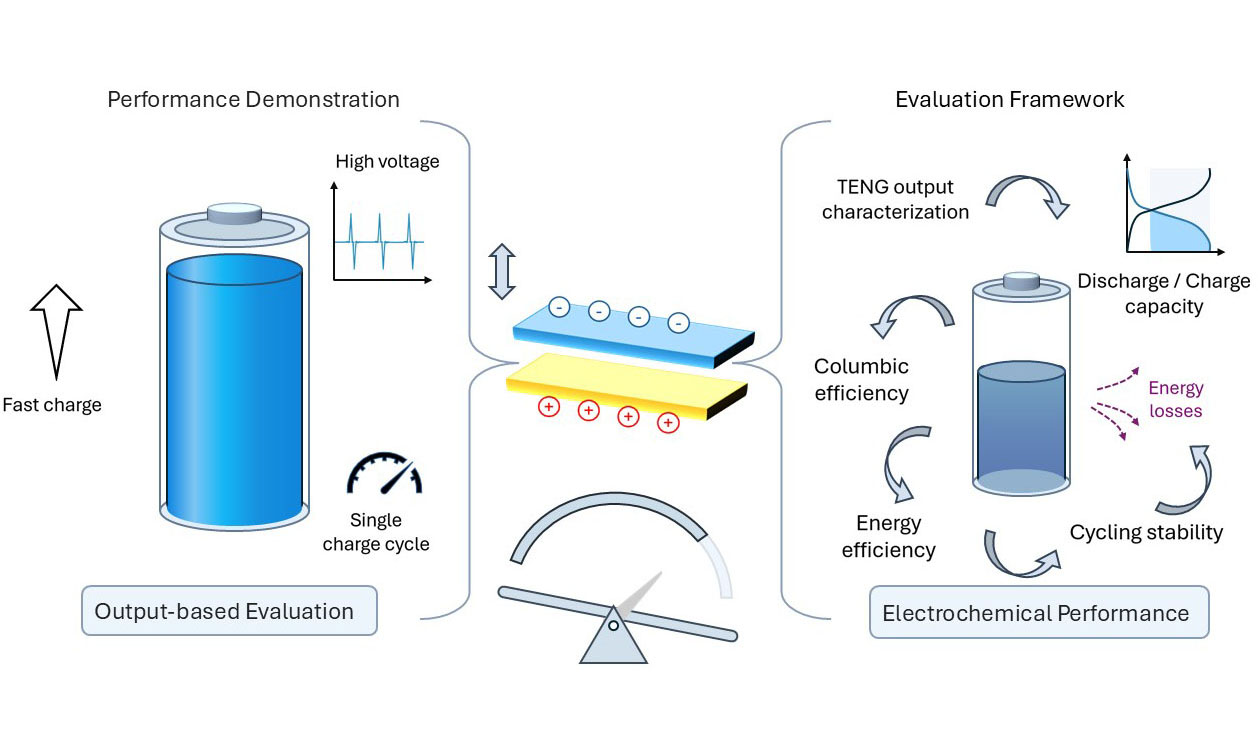
INTRODUCTION
Portable electronics, wearable devices, and wireless sensor networks increasingly require reliable, sustainable power sources[1]. As these systems become smaller and more widely deployed, the limitations of conventional batteries, particularly the need for periodic replacement or recharging, become more evident[2]. Consequently, energy-harvesting technologies have attracted growing attention for their ability to convert ambient mechanical energy into usable electrical power and support autonomous operation[3,4].
Triboelectric nanogenerators (TENGs) have emerged as an attractive approach for harvesting this energy by converting irregular mechanical input into electrical output through contact electrification and electrostatic induction.5 Their simple fabrication, broad material selection, low cost, and ability to operate under diverse excitation conditions make them promising candidates for self-powered electronics and wireless sensing systems[6]. Numerous studies have demonstrated battery and capacitor charging using TENGs, often highlighting high open-circuit voltages, voltage increases, stored charge, or the ability to power small electronic devices[7-10]. Although these demonstrations establish feasibility, they do not necessarily reflect effective electrochemical energy storage[11]. This commentary emphasizes the need for system-level, battery-relevant evaluation to assess TENG-driven battery charging.
OUTPUT METRICS VS. PRACTICAL CHARGING CAPABILITY
In TENG-based charging studies, performance is commonly characterized by using electrical metrics such as open-circuit voltage (VOC), short-circuit current (ISC), transferred charge, and charge density, often reported alongside mechanical parameters including excitation frequency, applied force, displacement, and contact area[12,13]. However, translating these metrics into effective battery charging is not straightforward. Although TENGs can generate high voltages, these outputs are typically accompanied by low currents and high internal impedance [Figure 1][14]. Reported VOC values commonly range from tens to hundreds of volts, with some devices reaching the kilovolt range, whereas ISC generally falls within the microampere to low milliampere range. Corresponding optimal load impedances are often on the order of 10-100 MΩ, several orders of magnitude higher than those of batteries and capacitors[11]. Consequently, the high VOC measured under near-open-circuit conditions does not directly correspond to high stored energy[15]. This gap widens further once rectification and power conditioning are introduced. Impedance-matching circuits may operate at efficiencies approaching ~ 80%, while synchronized switching can significantly reduce charge leakage during capacitor charging[16]. Even optimized PMCs show experimentally measured efficiencies (~ 48%) below theoretical values (~ 76%) because of non-ideal diode, inductor, and leakage losses.11 Without dedicated power management, direct charging can underperform managed systems. As a result, a substantial fraction, often the majority, of the electrical energy represented by VOC and ISC may be lost before reaching the storage device. Batteries impose additional constraints[17]. A typical lithium-ion cell operates within a narrow voltage window (~ 3.0-4.2 V) and is generally charged using constant-current/constant-voltage protocols, with charging currents ranging from tens of milliamperes for microcells to several amperes for commercial cells, depending on capacity and design[18]. In contrast, TENG outputs are intermittent and dynamic, requiring further conditioning beyond rectification and impedance matching to achieve compatibility with battery charge-acceptance behavior. Several studies have demonstrated measurable energy storage under conditions including stable mechanical excitation, optimized Power Management Cirucits (PMCs), and low-capacity storage devices such as microbatteries[11]. These PMCs commonly incorporate alternating current (AC)-direct current (DC) rectification, impedance matching, synchronized or charge-extraction switching, voltage multipliers, and intermediate energy buffers such as capacitors or supercapacitors. However, the level of evaluation varies considerably across the literature, from proof-of-concept demonstrations to comprehensive analyses of charge storage and recovery[11,19]. To accurately assess TENG-based charging performance, the entire charging process should be evaluated using consistent battery-relevant metrics, including recovered discharge capacity, coulombic efficiency, energy efficiency, charge-acceptance rate, and post-charge cycling behavior. Importantly, testing conditions and key system parameters, including mechanical excitation, rectification architecture, buffering circuitry, delivered current, battery state-of-charge, and environmental conditions, should also be clearly reported because they directly affect energy transfer and storage[20]. For example, high humidity can reduce triboelectric charge density through charge dissipation, whereas temperature influences battery kinetics and internal resistance[10]. Consistent evaluation and reporting will improve reproducibility and enable more meaningful comparison of TENG-based battery charging systems[21].
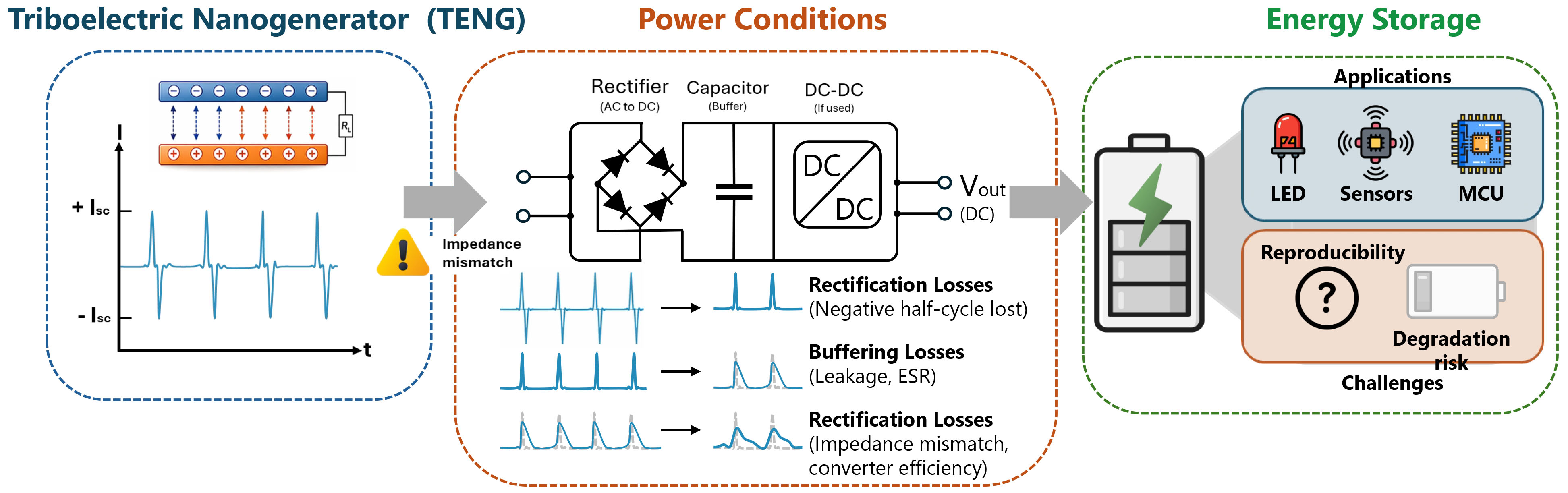
Figure 1. Schematic of TENG-powered battery charging. Mechanical energy is converted into a pulsed electrical output, which passes through a rectifier, capacitor, and optional DC-DC converter before charging a battery. Energy losses occur during rectification, capacitor leakage, and impedance mismatch, reducing overall charging efficiency. The stored energy can power low-power electronics, while reproducibility and battery degradation remain key challenges. TENG: Triboelectric nanogenerator; DC-DC: direct current to direct current converter; LED: light-emitting diode; MCU: microcontroller unit; ESR: equivalent series resistance.
DEGRADATION RISK AND ELECTROCHEMICAL COMPATIBILITY
One of the less straightforward aspects of TENG-battery systems is how pulsed electrical inputs interact with electrochemical storage. In the literature, pulsed or intermittent charging has, in some cases, been reported to improve electrochemical behavior, including enhanced ion transport, more uniform charge distribution, and reduced polarization compared to strictly constant-current charging. This suggests that pulsed inputs are not intrinsically detrimental and may, under controlled conditions, offer electrochemical advantages[18,22].
The impact of pulsed charging depends primarily on three parameters: amplitude, frequency, and duty cycle. High-amplitude pulses produce large instantaneous currents at the electrode interface, increasing polarization and, in lithium-based systems, potentially driving the anode potential below 0 V vs. Li/Li+, thereby promoting lithium plating and possible dendrite formation. Pulse frequency governs how much time the system has to relax between pulses[18]. At low frequencies, insufficient relaxation leads to cumulative polarization and concentration gradients, whereas higher frequencies can partially smooth the response through capacitive effects. Duty cycle determines the duration of each charging interval and overall charge input, influencing both charging rate and the accumulation of interfacial stress. Taken together, pulse profiles combining high amplitude, low frequency, and long duty cycles tend to increase degradation risk, whereas shorter, moderate-amplitude pulses at higher frequencies with sufficient relaxation periods are generally less damaging[7,23].
In practical systems, TENG outputs are rarely connected directly to the battery; instead, they are conditioned through power management circuits such as rectifiers, buffering elements (e.g., capacitors or supercapacitors), and voltage regulation stages[24]. These components reshape the TENG waveform into a more usable signal for the battery. As a result, the electrochemical impact depends not only on the intrinsic pulse characteristics of the TENG, but also on how effectively the power management system regulates amplitude, frequency, and current delivery[15]. From a practical perspective, these limitations highlight the need to define a “safe” pulse charging window, where pulse amplitude remains within the battery voltage limits, frequency allows sufficient ion redistribution, and duty cycle avoids prolonged high-current stress. Such a window is inherently chemistry-dependent. For example, lithium–sulfur systems, which involve sequential reactions such as the reduction of sulfur to long-chain and short-chain polysulfides (S8 → Li2S6 → Li2S4 → Li2S2/Li2S), may be sensitive to transient increases or drops in applied voltage beyond their typical operating window. Such deviations can shift the balance between these reactions, promote incomplete conversion, and increase the loss of active material through polysulfide dissolution[10,25]. In contrast, sodium-ion systems, often limited by slower Na⁺ diffusion and intercalation kinetics, may be more susceptible to polarization and increased overpotential under high instantaneous currents[21,26].
In this context, the key issue is not whether charging is pulsed, but whether the effective pulse characteristics after power conditioning remain within conditions that the specific battery chemistry can tolerate[24].
FUTURE DIRECTIONS: SYSTEM-LEVEL DESIGN AND STANDARDIZED EVALUATION
TENG-based battery charging has progressed to systems capable of measurable energy storage, shifting the challenge toward consistent system-level evaluation [Figure 2]. We therefore propose a minimum evaluation framework for TENG-battery systems, based on a coupled mechanical-electrical-electrochemical approach, in which energy flow is tracked from mechanical input through to electrochemical storage. At the mechanical stage, parameters such as force, displacement, and excitation frequency should be reported to estimate input energy. At the electrical stage, TENG performance should be characterized under open-circuit and load conditions, including VOC, ISC, and transferred charge[13,24]. In parallel, the performance of the power management circuit should be reported, including rectification efficiency, voltage conversion behavior, and energy losses across the various conditioning stages and electronic components. At the battery stage, performance should be evaluated using electrochemical metrics rather than battery voltage charge alone. These include discharge capacity following charging, coulombic efficiency, energy efficiency, charge-acceptance behavior under pulsed input, and cycling stability over repeated charge-discharge cycles[8,17]. Importantly, evaluation should extend beyond single charging events to multi-cycle testing under clearly defined conditions selected. When commercial cells are used, their nominal capacity, voltage window, manufacturer, format, and recommended rates should be specified, together with the applied pulse characteristics after conditioning (amplitude, frequency, duty cycle), cutoff conditions, and any rest steps. The electrochemical methods employed (e.g., galvanostatic cycling, cyclic voltammetry, electrochemical impedance spectroscopy), along with instrumentation and software, should also be reported to ensure reproducibility. Although these recommendations may appear straightforward, their consistent implementation would improve comparability across TENG-battery studies. The proposed framework links mechanical input, electrical conditioning, and electrochemical storage, enabling clearer assessment of overall performance and distinguishing true energy storage from transient voltage responses using battery-relevant metrics.
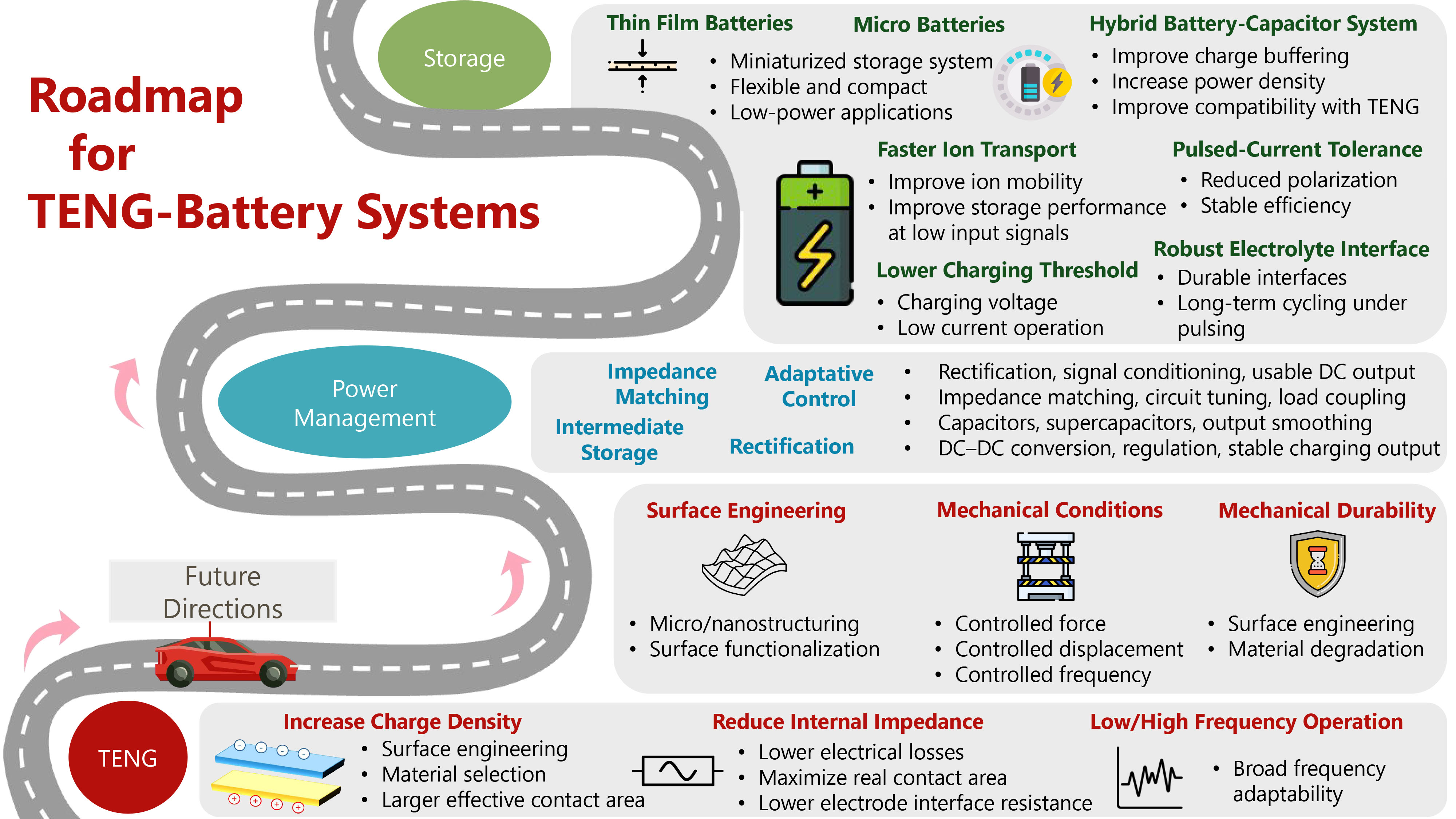
Figure 2. Future directions roadmap for TENG-battery systems. The figure summarizes key improvement strategies across three interconnected areas: TENG optimization, power management, and storage design, along with standardized evaluation as a common requirement across all subsystems. TENG: Triboelectric nanogenerator; DC-DC: Direct current to direct current converter.
CONCLUSION
In conclusion, TENG-enabled battery charging remains a highly promising research direction for portable and wearable electronics. However, progress toward application-ready systems will likely depend less on maximizing peak electrical output and more on achieving compatibility between mechanical energy harvesting, power-management electronics, and electrochemical storage behavior. As highlighted in this work, future advances will require not only optimized device performance, but also consistent and system-level evaluation of energy transfer and storage, supported by clearly defined experimental conditions and battery-relevant metrics. Establishing such quantitative and reproducible assessment frameworks will be essential to translate proof-of-concept demonstrations into reliable and scalable charging strategies.
DECLARATIONS
Authors’ contributions
Preparation of the manuscript: Vargas Perdomo N.
Supervision and funding of the project: Li, X.; Cuccia, L. A.
Availability of data and materials
Not applicable.
AI and AI-assisted tools Statement
Not applicable.
Financial support and sponsorship
We thank the support from the Natural Sciences and Engineering Research Council of Canada (NSERC RGPIN/04105-2021, RGPAS/00041-2021), Canada First Research Excellence Fund (Concordia Volt-Age Seed and Volt-Age Impact), Fonds de recherche du Québec Nature et technologies (FRQNT 327052, FRQNT 203321), and Concordia University Research Chair Program (CURC).
Conflicts of interest
All authors declared that there are no conflicts of interest.
Ethical approval and consent to participate
Not applicable.
Consent for publication
Not applicable.
Copyright
© The Author(s) 2026.
REFERENCES
1. Yin, L.; Wang, J. Wearable energy systems: what are the limits and limitations? National. Science. Review. 2023, 10, nwac060.
2. Kang, M.; Yeo, W. Advances in energy harvesting technologies for wearable devices. Micromachines 2024, 15, 884.
3. Wang, Y.; Wang, N.; Cao, X. From triboelectric nanogenerator to hybrid energy harvesters: a review on the integration strategy toward high efficiency and multifunctionality. Materials 2023, 16, 6405.
4. Wang, Z. L.; Jiang, T.; Xu, L. Toward the blue energy dream by triboelectric nanogenerator networks. Nano. Energy. 2017, 39, 9-23.
5. Zi, Y.; Guo, H.; Wang, J.; Zhang, C.; Chen, X.; Zhao, Q. Triboelectric nanogenerators: technology, applications and commercialization; Wiley-VCH: Weinheim, Germany, 2025.
7. Pu, X.; Liu, M.; Li, L.; et al. Efficient charging of Li-ion batteries with pulsed output current of triboelectric nanogenerators. Adv. Sci. 2016, 3, 1500255.
8. Zhang, X.; Du, X.; Yin, Y.; et al. Lithium-ion batteries: charged by triboelectric nanogenerators with pulsed output based on the enhanced cycling stability. ACS. Appl. Mater. Interfaces. 2018, 10, 8676-84.
9. Xu, W.; Wang, J.; Ding, F.; et al. Lithium metal anodes for rechargeable batteries. Energy. Environ. Sci. 2014, 7, 513-37.
10. Yin, Y.; Zhang, X.; Du, X.; et al. Efficient charging of lithium-sulfur batteries by triboelectric nanogenerator based on pulse current. Adv. Mater. Technol. 2019, 4, 1800326.
11. Dien, X.; Ramli, N.; Thio, T. H. G.; Yang, Z.; Hu, S.; He, X. Energy storage, power management, and applications of triboelectric nanogenerators for self-powered systems: a review. Micromachines 2025, 16, 1170.
12. Wang, Y.; Jin, X.; Wang, W.; Niu, J.; Zhu, Z.; Lin, T. Efficient triboelectric nanogenerator (TENG) output management for improving charge density and reducing charge loss. ACS. Appl. Electron. Mater. 2021, 3, 532-49.
13. Wang, Z. L.; Lin, L.; Chen, L. J.; Niu, S.; Zi, Y. riboelectric Nanogenerators; Springer International Publishing: Cham, Switzerland, 2016.
14. Wang, J.; Zi, Y.; Li, S.; Chen, X. High-voltage applications of the triboelectric nanogenerator - opportunities brought by the unique energy technology. MRS. Energy. &. Sustainability. 2020, 6, 17.
15. Zhou, H.; Liu, G.; Zeng, J.; et al. Recent progress of switching power management for triboelectric nanogenerators. Sensors 2022, 22, 1668.
16. Vasandani, P.; Gattu, B.; Mao, Z.; Jia, W.; Sun, M. Using a synchronous switch to enhance output performance of triboelectric nanogenerators. Nano. Energy. 2018, 43, 210-8.
17. Wen, J.; Pan, X.; Fu, H.; Xu, B. Advanced designs for electrochemically storing energy from triboelectric nanogenerators. Matter 2023, 6, 2153-81.
18. Guo, J.; Xu, Y.; Exner, M.; et al. Unravelling the mechanism of pulse current charging for enhancing the stability of commercial LiNi0.5Mn0.3Co0.2O2/graphite lithium-ion batteries. Adv. Energy. Mater. 2024, 14, 2400190.
19. Xi, F.; Pang, Y.; Li, W.; et al. Universal power management strategy for triboelectric nanogenerator. Nano. Energy. 2017, 37, 168-76.
20. Li, S.; Wu, Q.; Zhang, D.; et al. Effects of pulse charging on the performances of lithium-ion batteries. Nano. Energy. 2019, 56, 555-62.
21. Lu, Y.; Lu, L.; Qiu, G.; Sun, C. Flexible quasi-solid-state sodium battery for storing pulse electricity harvested from triboelectric nanogenerators. ACS. Appl. Mater. Interfaces. 2020, 12, 39342-51.
22. Liu, J.; Wang, X. Experimental study of the effect of different pulse charging patterns on lithium-ion battery charging. J. Power. Sources. 2024, 610, 234700.
23. Song, W.; Wang, C.; Gan, B.; et al. High performance lithium-sulfur batteries for storing pulsed energy generated by triboelectric nanogenerators. Sci. Rep. 2017, 7, 425.
24. Handbook of Triboelectric Nanogenerators; Wang, Z. L., Yang, Y., Zhai, J., Wang, J., Eds.; Springer International Publishing, 2023.
25. Yin, Y. X.; Xin, S.; Guo, Y. G.; Wan, L. J. Lithium-sulfur batteries: electrochemistry, materials, and prospects. Angew. Chem. Int. Ed. 2013, 52, 13186-200.
Cite This Article
 Open Access
How to Cite
Download Citation
Export Citation File:
Type of Import
Tips on Downloading Citation
Citation Manager File Format
Type of Import
Direct Import: When the Direct Import option is selected (the default state), a dialogue box will give you the option to Save or Open the downloaded citation data. Choosing Open will either launch your citation manager or give you a choice of applications with which to use the metadata. The Save option saves the file locally for later use.
Indirect Import: When the Indirect Import option is selected, the metadata is displayed and may be copied and pasted as needed.
About This Article
Copyright

Data & Comments
Data
0





Comments
Comments must be written in English. Spam, offensive content, impersonation, and private information will not be permitted. If any comment is reported and identified as inappropriate content by OAE staff, the comment will be removed without notice. If you have any queries or need any help, please contact us at [email protected].