
Learning-based robust control of modular robot manipulators: an experimental investigation
 0
0 Abstract
This paper proposes a learning-based robust control method for modular robot manipulators (MRMs).The dynamic model of MRMs is deployed by using a joint torque estimation method. In contrast to conventional methods, this study tackles the uncertainty inherent in the robot model by accounting not only for friction modeling inaccuracies and interconnection dynamic coupling (IDC), but also for the torque transmission error of the harmonic drive and the measurement deviation. Each of these model uncertainties is individually compensated through a purposefully designed robust neural network controller. The asymptotic stability of the proposed robotic control strategy is rigorously established. A comprehensive series of experiments is carried out to verify the effectiveness and superiority of the presented control approach.
Keywords
INTRODUCTION
With the ongoing evolution of Industry 5.0[1-3] the scope of robotic applications has broadened considerably, encompassing domains such as rehabilitation, motion assistance, and industrial operations. In recent years, modular robot manipulators (MRMs) have garnered significant research attention, owing to their superior structural characteristics and enhanced adaptability relative to conventional robotic manipulators. MRMs consist of joint modules equipped with standardized electromechanical interfaces, which can be configured into diverse assemblies to accommodate varying operational environments and task requirements, without necessitating adjustments to the control parameters of any other subsystem within the robotic platform[4]. By virtue of their flexible configurability and ease of assembly, MRMs are frequently deployed in hazardous and unpredictable settings, including space exploration, disaster response, and extreme-temperature operations[5].
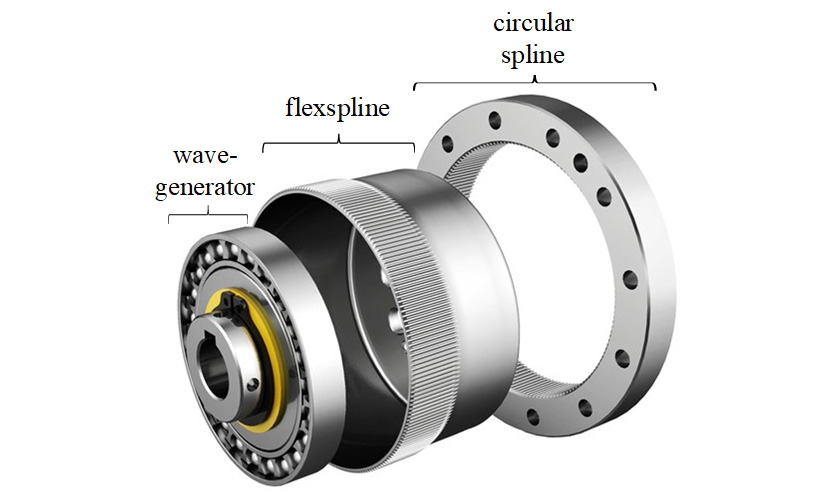
Beyond modularity, lightweight robot manipulators capable of handling substantial payloads have drawn growing interest from both robotic system designers and industrial manufacturers. In[6], a direct-drive, lightweight, and optimized hand exoskeleton prototype was introduced, designed to rest on the dorsal aspect of the hand to keep the palm free for interaction with real or virtual objects. Harmonic drives (HDs) are widely utilized in the development of such manipulators due to their favorable attributes, including high reduction ratios, compact form factors, low weight, and coaxial architecture[7]. A conventional harmonic drive comprises a wave generator, a circular spline, and a flexspline positioned between the two. Over the past several years, substantial efforts have been directed toward the analytical modeling of HDs, with the resulting insights subsequently adopted and refined to address challenges in torque estimation[8,9] and position control[10-13] for HD-based robots. Traditional approaches generally presume that the input angle of the flexspline (corresponding to the gear-toothed circumference) is identical to the output angle of the wave generator (associated with the outer rim of the ball bearing). In practice, however, perfect coaxial alignment between the inner race axis of the wave generator and the flexspline axis is not consistently maintained due to the presence of the ball bearing[14]. As a result, a small angular discrepancy arises between the empirically measured flexspline output and the theoretical prediction - the latter being defined as the wave generator displacement multiplied by the gear ratio. This discrepancy, referred to as kinematic error, can induce localized torque ripple in HD transmission. Nonetheless, neither the kinematic error nor the resulting torque ripple can be measured in real time, and isolating their effects from the overall deformation or torque signal remains a formidable challenge[15]. Therefore, there is a pressing need to develop a comprehensive harmonic drive model that incorporates kinematic inaccuracies and facilitates the effective mitigation of torque ripple.
To mitigate the coupling effect, Liu et al. proposed a distributed control strategy for MRMs equipped with torque sensing[16]. In this framework, each module is furnished with an integrated joint torque sensor, and the corresponding sensor readings are utilized to automatically compensate for the coupling effect. This approach markedly reduces the complexity associated with modular manipulator modeling. Nevertheless, it does not take into account the measurement error within the manipulator system. Since the feedback of such measurement errors into the control loop degrades overall control performance, these errors should be minimized to the greatest extent possible in order to enhance control accuracy.
In robotic systems, the deployment of an appropriate controller constitutes a critical factor in ensuring satisfactory operational performance[17]. To enhance control accuracy, learning-based control methodologies have been introduced. Several representative studies are outlined below. Shen et al. developed a neural-network-based adaptive iterative learning control strategy for strict-feedback nonlinear systems subject to unknown state delays and input saturation[18]. Wang et al. examined the passivity and dissipativity properties of discrete-time fractional generalized delayed Cohen-Grossberg neural networks[19]. Brief [20] investigated the iterative learning control problem for constrained multi-input multi-output nonlinear systems under state alignment conditions with varying trial lengths. The aforementioned works have substantially inspired the present research.
To address this issue, the present paper develops a dynamic model that incorporates not only friction modeling errors and interconnection dynamic coupling (IDC), but also the torque transmission error of the harmonic drive and the measurement deviation. Drawing upon an analysis of model uncertainty, a robust neural network controller is devised for the manipulator. Specifically, the controller compensates for friction modeling errors through robust control, while simultaneously employing a neural network to approximate and compensate for the remaining model uncertainties - comprising the IDC term, the torque transmission deviation of the harmonic drive, and the measurement disturbance - and concurrently suppressing controller chattering. The asymptotic stability of the resulting closed-loop system is rigorously established via Lyapunov theory. Subsequently, a two-degree-of-freedom robotic experimental platform is constructed to validate the effectiveness of the proposed controller.
The main innovations of this article are reflected in the following two aspects:
A Joint torque estimation method based on the harmonic transmission flexibility model is adopted instead of using a joint torque sensor. Moreover, a learning-based robust control method is utilized to handle friction modeling error, interconnection dynamic coupling, and torque transmission error.
Unlike traditional learning control methods based on neural networks, which can only prove the system is uniformly ultimately bounded. The stability proof ensures that the closed-loop system is asymptotically stable, and the proposed method has been verified to be effective through experiments.
DYNAMIC MODELING OF MODULAR ROBOT MANIPULATOR WITH HARMONIC DRIVE
Harmonic drive model
Consider a class of MRMs consisting of
where subscript “
where the variables
Nevertheless, empirical data characterizing the input–output relationship exhibit a pronounced departure from linearity; specifically, the output does not scale proportionally with the input. Potential sources of this nonlinear behavior include frictional torques, torsional compliance within the harmonic drive components, and kinematic inaccuracies. By first establishing the ideal kinematic constraints that govern motion and force transmission in a harmonic drive, these additional dynamic effects can be systematically incorporated through the introduction of friction, compliance, and kinematic error terms. The resulting compliant response of an MRM joint actuated by a harmonic drive is considered, which references the established compliance model of HD.
Upon incorporating frictional losses within harmonic drive transmission, Equation (2) transforms into the following form
where
It is worth noting from Equations (4) and (5) that only the wave generator input position
By adding and subtraction
where
As reported in the literature, achieving higher accuracy in joint torque estimation necessitates accounting for the torque transmission deviation and kinematic error of the harmonic drive, and establishing an error model to compensate for these inaccuracies[23]. The error model is defined as follows:
where
System parameters
| Name | Value | Name | Value |
| 108 gcm | 80 s | ||
| 101 | 3.0 Nm | ||
| 0.1 | 100 | ||
| 8.9 | 305 | ||
| 1.33 Nm/rad | 0.01 | ||
| 8.3 | 0.05 | ||
| 1.2 Nms/rad | 90 | ||
| 4 Nm | 85 | ||
| 45 mNms/rad | 3 | ||
| 72 mNm | 2.5 | ||
| 85 mNm | 10 Nm | ||
| 55 | 12 Nm |
Given that the typical stiffness and hysteretic characteristics of an HD, as reported in the literatur[24], indicate that the local elastic coefficient increases with the flexspline torque, this relationship governs the following definition of the coefficient:
Given the symmetry inherent in the stiffness characteristics of HD, local elastic coefficient can be approximated as
where
Moreover, the deformation range of the harmonic drive contracts sharply, approaching zero at the rated torque, which indicates a pronounced increase in the stiffness of the wave generator. To characterize the hysteretic behavior arising from this stiffness profile, the local elastic coefficient of the wave generator is expressed as follows:
where
where
Thus, the overall torsional angle of the harmonic drive is derived by substituting Equations (12) and (14) into Equation (7).
Substitution of measured link-side and motor-side position values into Equation (6) provides HD torsional angle
where
Dynamic model formulation
Based on the robot modeling method with torque feedback technique reported in the literature, the dynamics of the MRM system are formulated as a synthesis of individual joint subsystems. Among them, the dynamic model of the
We consider that the friction term
where
Substituting Equation (20) into Equation (19),
where
Term
where
where
In addition,
where
Model uncertainty analysis
Reference model Equation (23), IDC are represented as
Property 1. The vector product between
Remark 1. When joints
Remark 2. Unlike existing scholars who consider interconnected coupling, including Coriolis force, centrifugal force, and gravity, it is about all robot joints. In this study, because of
Property 2. Base on Equation (19) and its approximation Equation (20), because
Property 3.
Property 4. Most of the torque transmission disturbances
Property 5. The disturbance
State space description
Rewriting the dynamic model of
where
where
LEARNING-BASED ROBUST CONTROL VIA NEURAL NETWORK
Control design
First, define the overall control torque for each joint subsystem
where
where
where
For the uncertainties of friction modeling for the
where
According to the decomposition control design method proposed in the literature[16], an adaptive compensation control term is designed to compensate constant parameter uncertainty
where
where
After we completed the compensation design of
Neural networks are widely recognized for their capacity to approximate arbitrary functions. Their intrinsic self-learning capability eliminates the need for the complex mathematical analyses that are central to conventional adaptive control theory. For highly nonlinear control problems that remain intractable via traditional approaches, the hidden-layer neurons of a multilayer neural network employ activation functions with nonlinear mapping properties, thereby enabling the approximation of any nonlinear function and offering an effective solution to such challenges. Whereas traditional adaptive control methods depend on prior model information - such as a mathematical description of the plant - to design the control scheme, neural-network-based controllers, by virtue of their self-learning ability, require minimal information about the system model or its parameters. As a result, neural network controllers are broadly applicable to control problems involving model uncertainties. Moreover, owing to the massively parallel processing architecture of neural networks, damage to a subset of network nodes does not compromise the overall performance of the entire network, which substantially enhances the fault tolerance of the control system. The radial basis function (RBF) network is structured as a three-layer feedforward architecture that realizes a nonlinear input-output mapping. Since the transformation from the hidden layer to the output layer is linear, the RBF network is recognized as a local function approximator within the broader class of neural networks. Consequently, adopting an RBF network can accelerate learning while circumventing the local minimum problem. A neural network control scheme built upon RBF networks can therefore effectively improve system accuracy, robustness, and adaptability. Because of the IDC
According to the Properties 1, 4 and 5, the uncertainty terms
where
According to the expression of the neural network in Equations (40) and (41), one has
The estimates are updated by
Then, combining with Equations (29), (31), (34) and (44), controller of MRM system is
The expression governing the closed-loop behavior of the
where
Remark 3. Sign function induces chattering in the system because of dealing with the friction effect. Fortunately, the developed learning-based robust control can solve the chattering phenomenon for favorable tracking performance.
Theorem 1. For an
Proof: Choosing the Lyapunov candidate as
where
For the
when
For the neural network terms there is
when
From Properties 1,4 and 5, we know that
Because the term Equation (52) reaches its maximum at
According to Equation (57), we can know that Lyapunov functions can only be found if the following relations are satisfied
Define
Then, on the surface of
Denote
According to Equation (30), the boundedness of
Remark 4. According to the Lyapunov stability proof, it can be seen that the system can achieve stability as time approaches infinity. Finite-time and exponential stability will be the focus of our next research work. Additionally, through the experimental verification in the next section, it can be observed that the system can maintain stability within a very short period of time, ensuring good real-time performance.
EXPERIMENTAL
An experimental setup comprising a 2-degree-of-freedom modular robotic system is assembled to evaluate the performance of the proposed decentralized robust neural network controller, as illustrated in Figure 1. The actuation unit consists of a brushed DC motor (Maxon 218014) with a maximum rated torque of 190 mN·m and a torque constant of 0.321 N·m/A. Motor driving is accomplished via a linear power amplifier (LPA, Quanser Inc.), and experimental data acquisition is performed using a QPIDe data acquisition board from the same manufacturer. A harmonic drive with a transmission ratio of 101:1 couples the motor output to the joint mechanism. Motor-side position feedback is obtained from a 500-line incremental encoder supplied with the Maxon motor, while link-side torque measurements are acquired through torque estimation. In the experiment process, a torque sensor is not used. A torque sensor is supplied for verifying the correctness of the harmonic drive estimation. The QUARC software suite (Quanser Inc.) integrates natively with Simulink and communicates with the QPIDe board, thereby supporting both the logging of data from external instrumentation and its subsequent manipulation within the Simulink environment. The upper bounds of the module and controller parameters and uncertainty used in the experiment are given in Table 1.
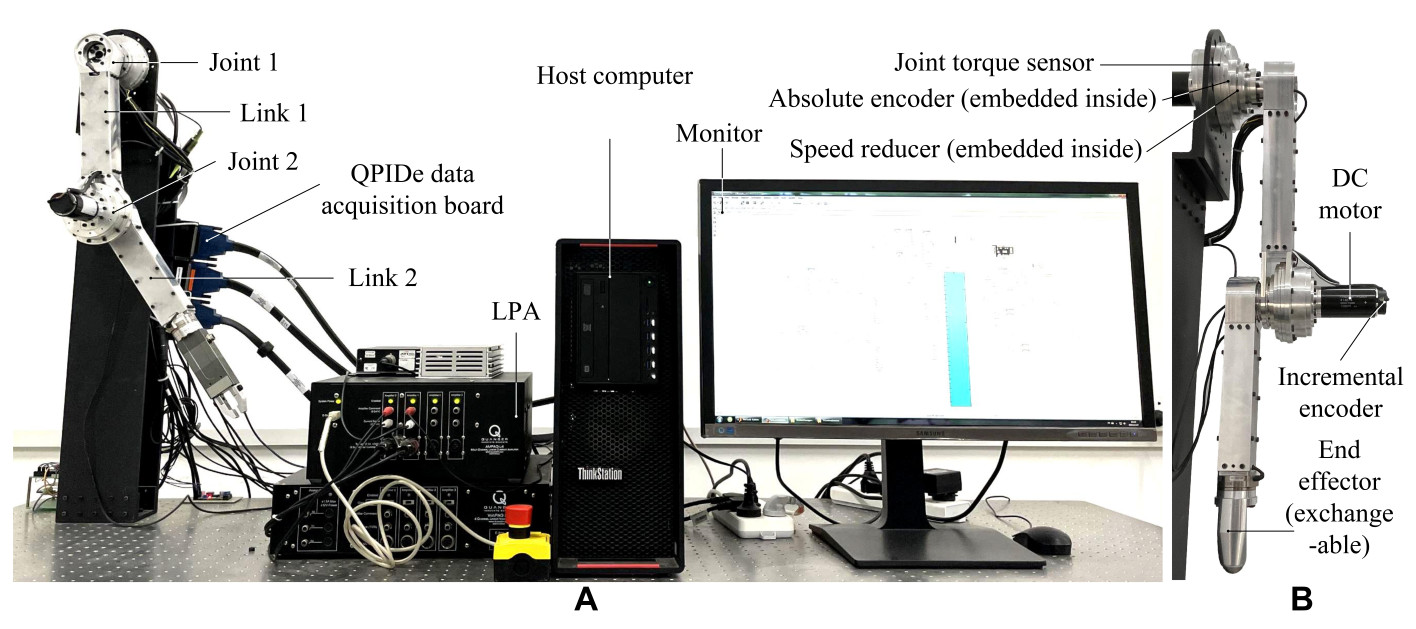
Figure 1. Experimental setup (A) platform (B) moudle. LPA: Linear power amplifier.
The reference trajectory prescribed for joint 1 is given by
The reference trajectory prescribed for joint 2 is given by
RESULTS AND DISCUSSION
Trajectory tracking
Figures 2 and 3 present the trajectory tracking curves of the modular robot. This part of the experiment compares the trajectory-tracking performance of the conventional robust control method [26-28] with that of the proposed robust neural network control method. The experimental curves indicate that, while both control methods are capable of tracking the desired trajectory reasonably well, the conventional robust control method still exhibits relatively large tracking errors at certain points along the trajectory. In contrast, the robust neural network-based control method achieves superior trajectory-tracking performance, owing to its ability to more accurately approximate the MRM model and compensate for model uncertainties.
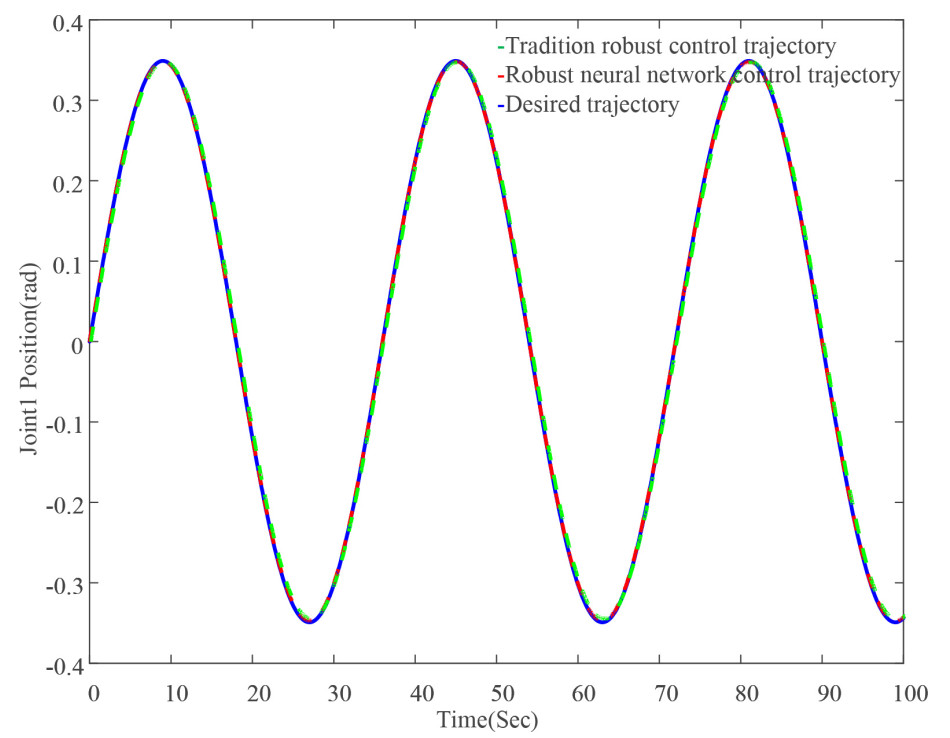
Figure 2. Joint 1 trajectory tracking.
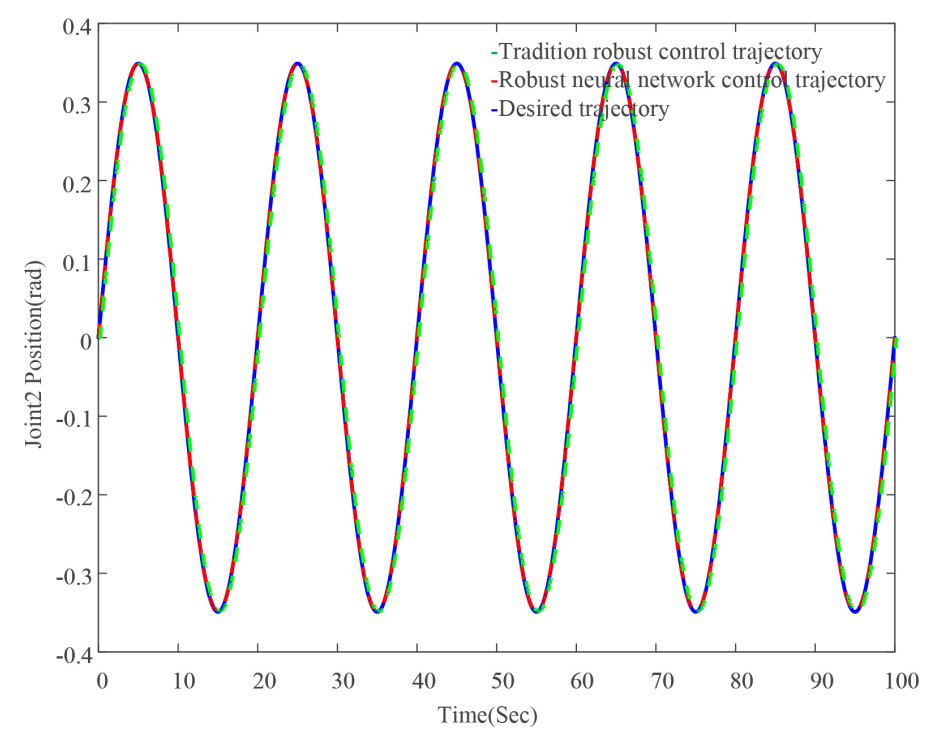
Figure 3. Joint 2 trajectory tracking.
Trajectory tracking error
Figures 4 and 5 present the trajectory tracking error curves of the modular robot. This segment of the experiment compares the tracking errors obtained using the conventional robust control method with those achieved by the robust neural network control method proposed in this paper. The experimental curves clearly indicate that a pronounced chattering effect is evident in the error profile when the conventional robust control method is employed. By contrast, owing to the neural network's capacity to approximate and compensate for model uncertainties and coupling terms, the proposed robust neural network control method accomplishes accurate compensation of model uncertainties, thereby effectively suppressing joint chattering, reducing control error, and yielding superior control accuracy. As a result, the trajectory tracking performance of both joints is substantially enhanced.
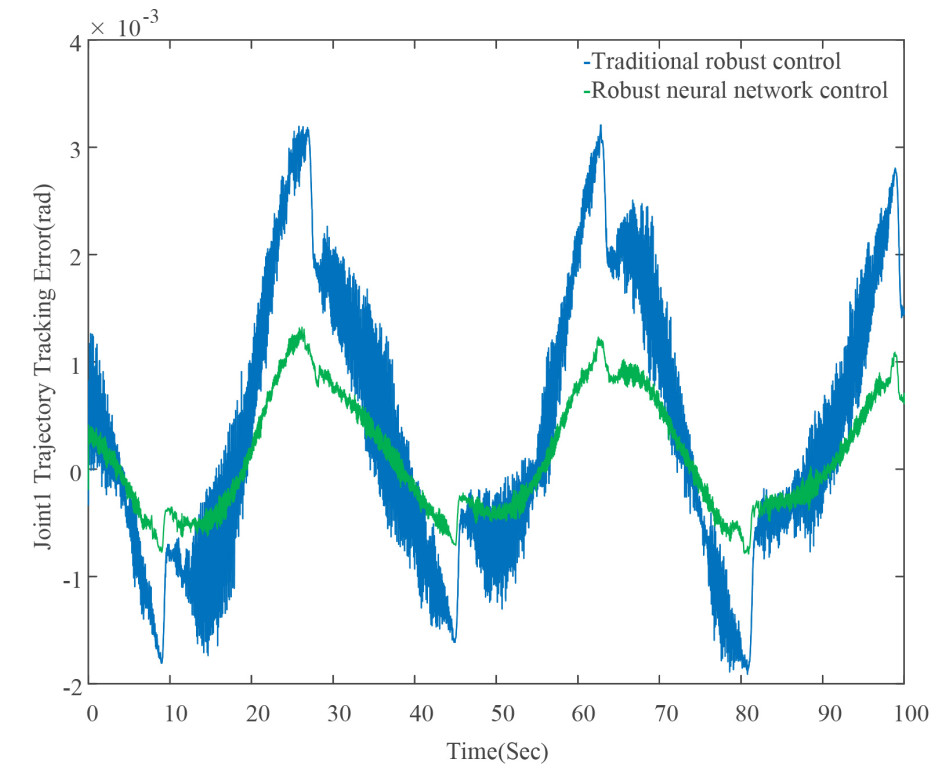
Figure 4. Joint 1 trajectory tracking error.
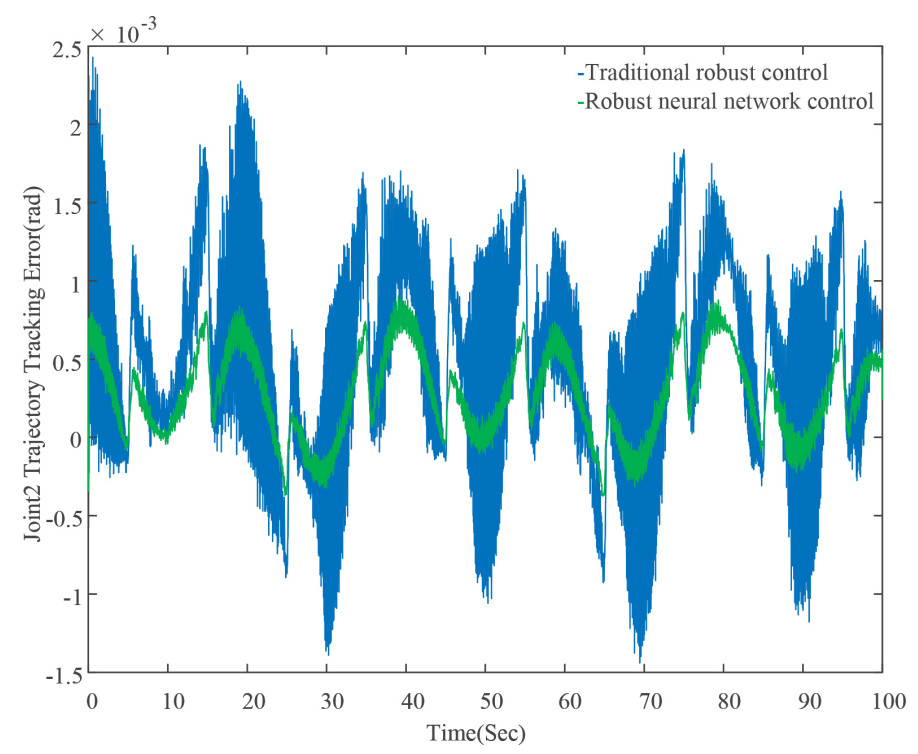
Figure 5. Joint 2 trajectory tracking error.
Motor output torque
Figures 6 and 7 present the motor output torque curves of the modular robot. This part of the experiment compares the motor output torque obtained using the traditional robust control method with that obtained using the robust neural network control method proposed in this paper. It can be observed from the experimental curves that the motor output torque under the traditional robust control method exhibits a pronounced chattering effect, whereas the motor output torque under the proposed robust neural network control method is relatively smooth. The control torque root mean square of the joint 1’s existed method is 0.18, and the developed method is 0.12. The control torque root mean square of the joint 2’s existed method is 0.2, and the developed method is 0.12. The value of root mean square is suppressed by about 35%. The calculate method is as follows:
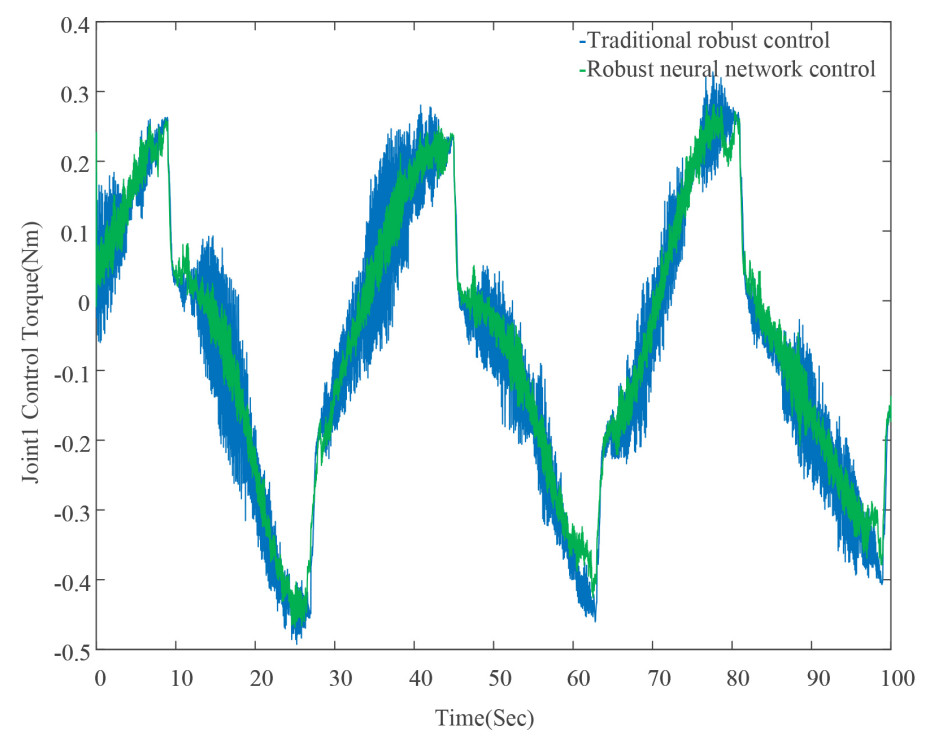
Figure 6. Joint 1 control torque.
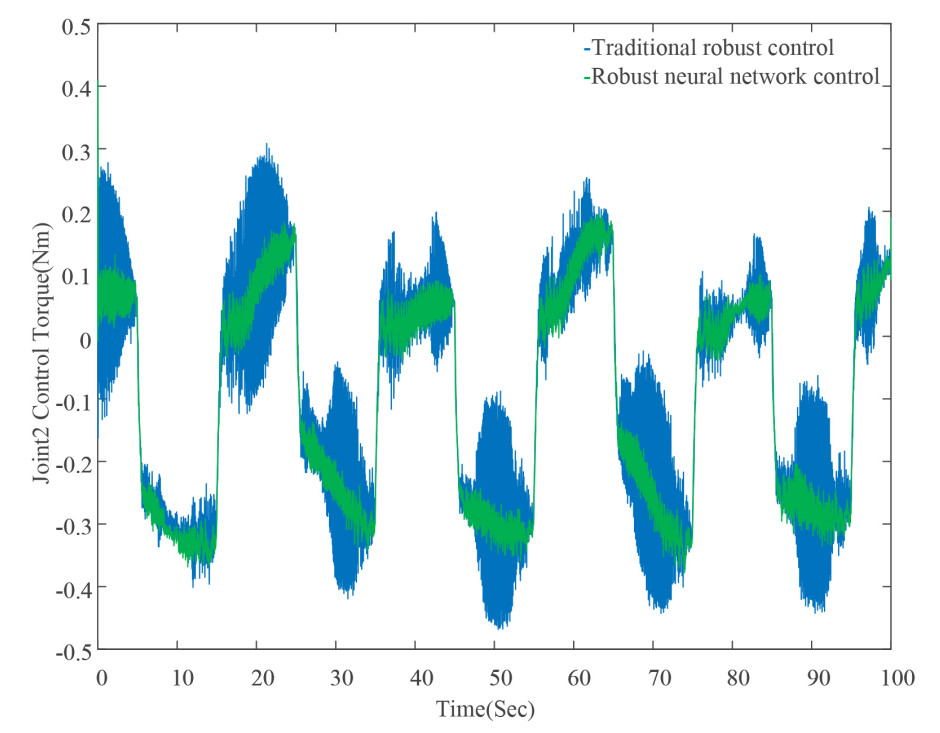
Figure 7. Joint 2 control torque.
NN weight
Figures 8 and 9 depict the weight variation curves of the neural network for joint 1 and joint 2 of the modular robot, respectively. In this experiment, five neural nodes were configured to approximate the model uncertainties of the robot. As can be observed from the experimental curves, the neural network weights oscillate in a regular manner within a bounded range.
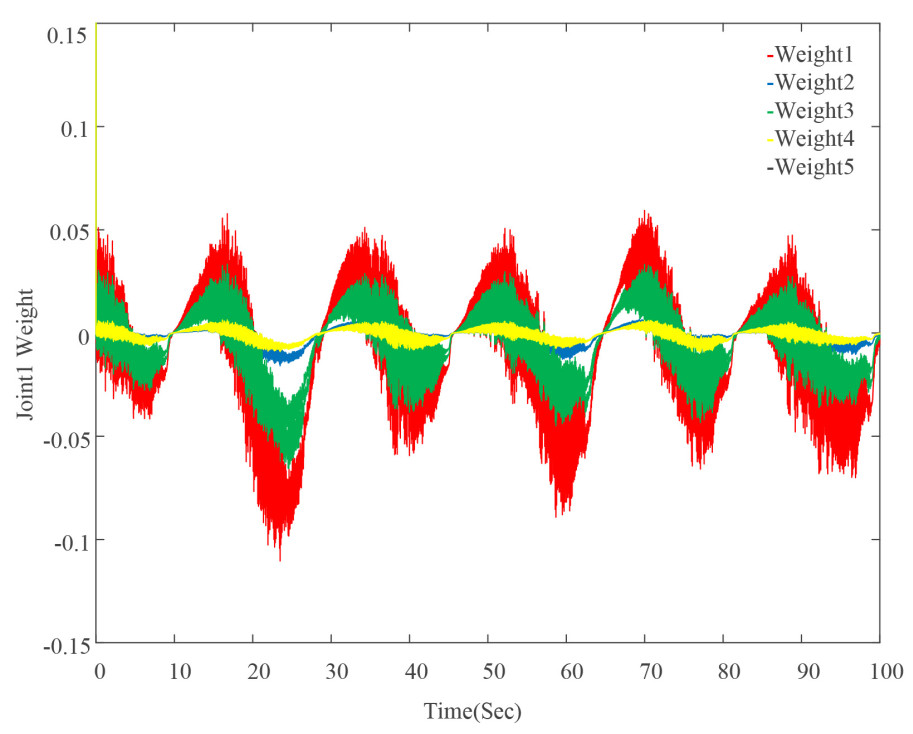
Figure 8. Joint 1 Weight.
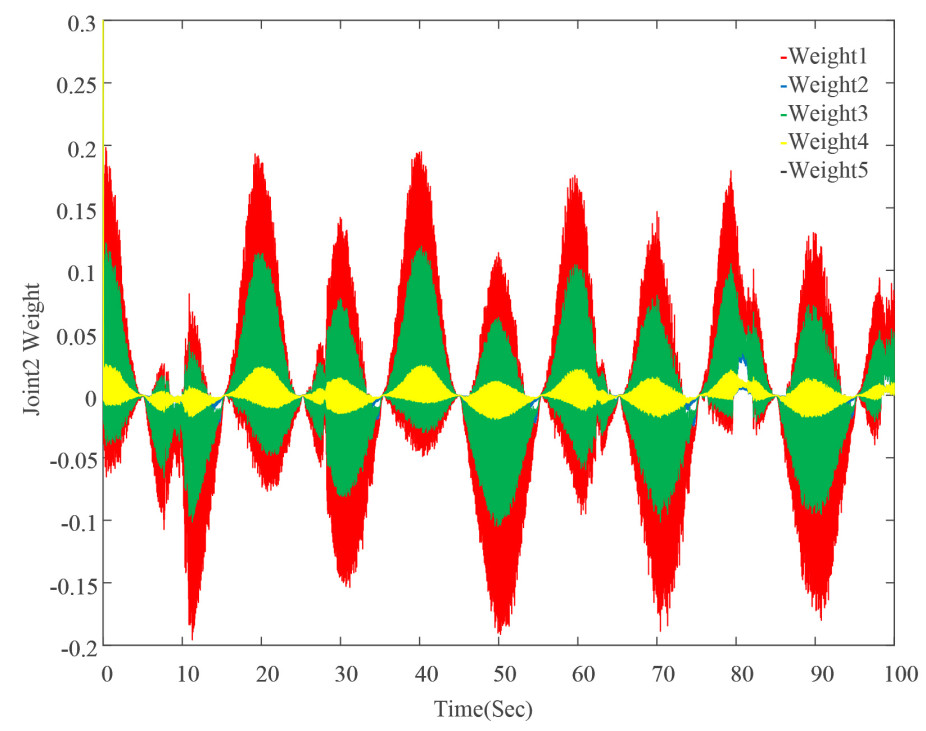
Figure 9. Joint 2 Weight.
CONCLUSIONS
This paper presents a robust neural network-based control method for modular robot manipulators. The controller compensates for friction modeling errors through robust control, while a neural network is employed to simultaneously approximate and compensate for the remaining model uncertainties - including the IDC term, the torque transmission deviation of the harmonic drive, and the measurement disturbance, and to mitigate controller chattering. The asymptotic stability of the resulting closed-loop system is rigorously established via Lyapunov analysis, and the efficacy of the proposed robotic control strategy is substantiated by experimental results.
The proposed control method is based on a time-triggered approach with a fixed cycle. Once the system reaches a stable state, the periodic triggering will waste communication resources. Therefore, an event-triggered control method that varies with time for sampling will be our future research direction.
DECLARATIONS
Authors' contributions
Made substantial contributions to conception and design of the study and performed data analysis and interpretation: Ji, Z.
Performed data acquisition, as well as provided administrative, technical, and material support: An, T.
Availability of data and materials
The data presented in this study are available on request from the corresponding author because the experimental data were generated by the experimental platform and cannot be used independently.
AI and AI-assisted tools statement
Not applicable.
Financial support and sponsorship
The work is supported by the Scientific Technological Development Plan Project in Jilin Province of China (20260602029RC).
Conflicts of interest
All authors declared that there are no conflicts of interest.
Ethical approval and consent to participate
Not applicable.
Consent for publication
Not applicable.
Copyright
The Author(s) 2026.
REFERENCES
1. Lei, Z.; Shi, J.; Luo, Z.; Cheng, M.; Wan, J. Intelligent manufacturing from the perspective of industry 5.0: application review and prospects. IEEE. Access. 2024, 12, 167436-51.
2. Xiang, W.; Yu, K.; Han, F.; Fang, L.; He, D.; Han, Q. L. Advanced manufacturing in industry 5.0: a survey of key eenabling technologies and future trends. IEEE. Trans. Ind. Inf. 2024, 20, 1055-68.
3. Lou, S.; Hu, Z.; Zhang, Y.; Feng, Y.; Zhou, M.; Lv, C. Human-cyber-physical system for industry 5.0: a review from a human-centric perspective. IEEE. Trans. Automat. Sci. Eng. 2025, 22, 494-511.
4. Uno, K.; Neppel, E.; Diaz, G. H.; et al. MoonBot: modular and on-demand reconfigurable robot toward moon base construction. IEEE. Trans. Field. Robot. 2025, 2, 847-74.
5. Ji, Z.; Ma, B.; Jiang, H.; Liang, J.; Dong, B.; An, T. Event-triggered-based optimal control for reconfigurable robot via mixed nonzero-sum game. IFAC-PapersOnLine 2025, 59, 332-7.
6. Iqbal, J.; Ahmad, O.; Malik, A. HEXOSYS Ⅱ - towards realization of light mass robotics for the hand. In: 2011 IEEE 14th International Multitopic Conference (INMIC), Karachi, Pakistan, November 22-24, 2011. IEEE; 2011, 115-119. DOI: 10.1109/INMIC.2011.6151454.
7. An, T.; Wang, Y.; Liu, G.; Li, Y.; Dong, B. Cooperative game-based approximate optimal control of modular robot manipulators for human–robot collaboration. IEEE. Trans. Cybern. 2023, 53, 4691-703.
8. Taghirad, H.; Belanger, P. Intelligent built-in torque sensor for harmonic drive systems. IEEE. Trans. Instrum. Meas. 1999, 48, 1201-7.
9. Zhang, H.; Ahmad, S.; Liu, G. Modeling of torsional compliance and hysteresis behaviors in harmonic drives. IEEE/ASME. Trans. Mechatron. 2015, 20, 178-85.
10. Zhang, H.; Ahmad, S.; Liu, G. Torque estimation for robotic joint with harmonic drive transmission based on position measurements. IEEE. Trans. Robot. 2015, 31, 322-30.
11. Jung, B. j.; Kim, B.; Koo, J. C.; Choi, H. R.; Moon, H. Joint torque sensor embedded in harmonic drive using order tracking method for robotic application. IEEE/ASME. Trans. Mechatron. 2017, 22, 1594-9.
12. Berghuis, H.; Nijmeijer, H. Robust control of robots via linear estimated state feedback. IEEE. Trans. Automat. Contr. 1994, 39, 2159-62.
13. Dong, B.; An, T.; Zhou, F.; Liu, K.; Yu, W.; Li, Y. Actor-critic-identifier structure-based decentralized neuro-optimal control of modular robot manipulators with environmental collisions. IEEE. Access. 2019, 7, 96148-65.
14. Li, X.; Song, C.; Yang, Y.; Zhu, C.; Liao, D. Optimal design of wave generator profile for harmonic gear drive using support function. Mech. Mach. Theory. 2020, 152, 103941.
15. Megalingam, R. K.; Vadivel, S. R. R.; Manoharan, S. K.; Pula, B. T.; Sathi, S. R.; Gupta, U. S. C. Reduced kinematic error for position accuracy in a high-torque, lightweight actuator. Actuators. 2024, 13, 218.
16. Liu, G.; Abdul, S.; Goldenberg, A. A. Distributed control of modular and reconfigurable robot with torque sensing. Robotica 2008, 26, 75-84.
17. Iqbal, U.; Samad, A. N. A.; Nlssa, Z.; Iqbal, J. Embedded control system for AUTAREP - a novel AUTonomous articulated robotic educational platform. Teh. Vjesn. 2014, 21, 1255-61. https://www.researchgate.net/publication/280641667_Embedded_control_system_for_AUTAREP_-_A_novel_AUTonomous_Articulated_Robotic_Educational_Platform [Last accessed on 15 July 2026].
18. Shen, M.; Wang, Z.; Zhu, S.; Zhao, X.; Zong, G.; Wang, Q. G. Neural network adaptive iterative learning control for strict-feedback unknown delay systems against input saturation. IEEE. Trans. Neural. Netw. Learning. Syst. 2025, 36, 13460-9.
19. Wang, C.; Zhang, H.; Wen, D.; Shen, M.; Li, L.; Zhang, Z. Novel passivity and dissipativity criteria for discrete-time fractional generalized delayed Cohen-Grossberg neural networks. Commun. Nonlinear. Sci. 2024, 133, 107960.
20. Shen, M.; Wu, X.; Park, J. H.; Yi, Y.; Sun, Y. Iterative learning control of constrained systems with varying trial lengths under alignment condition. IEEE. Trans. Neural. Netw. Learning. Syst. 2023, 34, 6670-6.
21. Dong, B.; An, T.; Zhou, F.; Liu, K.; Li, Y. Decentralized robust zero-sum neuro-optimal control for modular robot manipulators in contact with uncertain environments: theory and experimental verification. Nonlinear. Dyn. 2019, 97, 503-24.
22. Dong, B.; Liu, K.; Li, Y. Decentralized control of harmonic drive based modular robot manipulator using only position measurements: theory and experimental verification. J. Intell. Robot. Syst. 2017, 88, 3-18.
23. Wang, Y.; An, T.; Cui, Y.; Li, Y.; Dong, B. Decentralized position/torque control of modular robot manipulators via interaction torque estimation-based human motion intention identification. Int. J. Control. Autom. Syst. 2024, 22, 1585-600.
24. Dong, B.; Wang, Y.; An, T.; Cui, Y.; Zhu, X. Adaptive torque estimation-based nonlinear H $$\infty$$ control of modular robot manipulators with uncertain environments. Neural. Comput. &. Applic. 2024, 37, 1617-31.
25. Ma, B.; Dong, B.; Zhou, F.; Li, Y. Adaptive dynamic programming-based fault-tolerant position-force control of constrained reconfigurable manipulators. IEEE. Access. 2020, 8, 183286-99.
26. Daş, E.; Burdick, J. W. Robust control barrier functions using uncertainty estimation with application to mobile robots. IEEE. Trans. Automat. Contr. 2025, 70, 4766-73.
27. Zeng, D.; Jiang, Y.; Wang, Y.; Zhang, H.; Feng, Y. Robust adaptive control barrier functions for input-affine systems: application to uncertain manipulator safety constraints. IEEE. Control. Syst. Lett. 2024, 8, 279-84.
Cite This Article
 Open Access
How to Cite
Download Citation
Export Citation File:
Type of Import
Tips on Downloading Citation
Citation Manager File Format
Type of Import
Direct Import: When the Direct Import option is selected (the default state), a dialogue box will give you the option to Save or Open the downloaded citation data. Choosing Open will either launch your citation manager or give you a choice of applications with which to use the metadata. The Save option saves the file locally for later use.
Indirect Import: When the Indirect Import option is selected, the metadata is displayed and may be copied and pasted as needed.
About This Article
Special Topic
Copyright

Data & Comments
Data
0





Comments
Comments must be written in English. Spam, offensive content, impersonation, and private information will not be permitted. If any comment is reported and identified as inappropriate content by OAE staff, the comment will be removed without notice. If you have any queries or need any help, please contact us at [email protected].