

Low-carbon control of heavy metals in industrial flue gas
 0

Graphical Abstract
Abstract
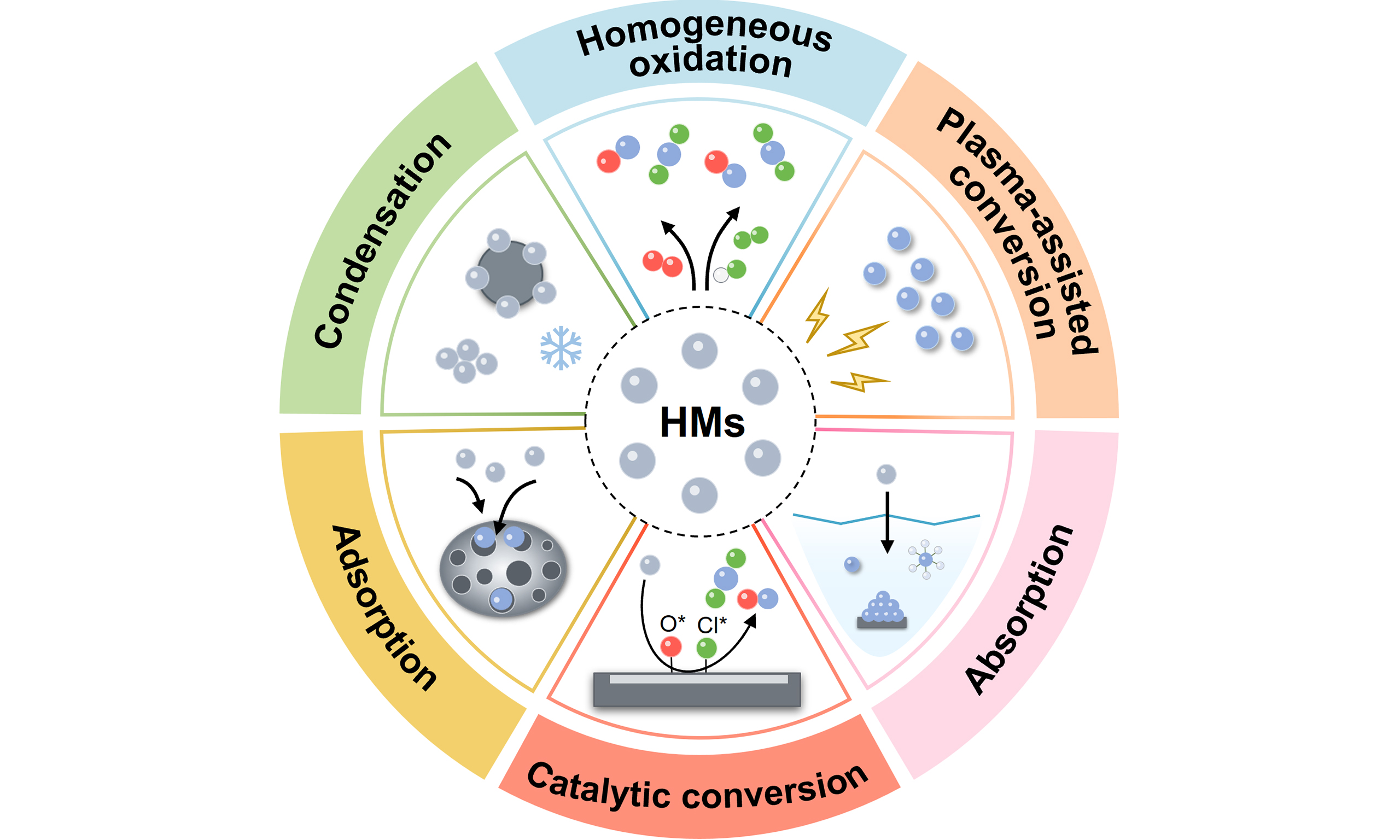
Heavy metals emitted from industrial sectors represent a class of recalcitrant atmospheric pollutants with severe ecotoxicological hazards even at trace levels. Their control is complicated by temperature-dependent volatilization, chemical transformation, phase redistribution, and interactions with reactive flue-gas components. This Mini Review examines heavy-metal control from the physicochemical basis of release and speciation to gas-phase regulation, interfacial capture, and removal in conventional air-pollution-control devices. Particular attention is given to low-carbon control strategies, which aim to reduce additional energy and material inputs by lowering energy consumption, implementing co-benefit control, and utilizing flue-gas components, while avoiding placing an excessive burden on downstream treatment processes. Controlled cooling, adsorption, catalytic or chemical speciation conversion, wet absorption, and plasma-assisted activation can effectively regulate heavy-metal fate, but their overall benefit depends on energy demand, reagent consumption, and the stability of the resulting metal-containing residues. Current technologies also face three persistent limitations: high energy and material inputs, secondary release from unstable captured metals, and difficulties in resource recovery from complex residues. Future development should therefore couple efficient removal with lower process burden and a defined final endpoint, directing recoverable streams toward resource recovery and other residues toward durable stabilization. This system-level perspective positions low-carbon heavy-metal control as an important direction for cleaner industrial flue-gas management.
Keywords


 Download PDF
INTRODUCTION
Heavy metals emitted from high-temperature industrial sectors, such as coal combustion, waste-to-energy incineration, nonferrous smelting, and cement production, represent a notoriously recalcitrant class of atmospheric pollutants[1-4]. Unlike conventional pollutants (SO2, NOx, and particulate matter) that are easily captured by mature, process-specific control units, heavy metals exhibit highly complex behaviors. During thermal processes and subsequent flue-gas cooling, they undergo consecutive volatilization, heterogeneous chemical transformation, and gas-particle redistribution[5,6]. Because their ecotoxicological hazards are profoundly severe even at trace concentrations, achieving near-zero emissions is imperative[7,8]. However, their highly dynamic nature means that effective abatement can no longer rely on simple physical filtration or non-reactive scavenging. Instead, designing efficient mitigation strategies requires a molecular-level understanding of metal volatility, thermodynamic speciation, and interfacial reactions with flue-gas constituents[2,3].
The transport and environmental fate of heavy metals are initially dictated by their thermodynamic volatility. Highly volatile metals (such as Hg) bypass conventional particulate traps by remaining predominantly in the vapor phase across an extensive temperature range[9]. Conversely, moderately volatile metals evaporate in the high-temperature zone but subsequently undergo gas-to-particle conversion via homogeneous nucleation or heterogeneous condensation onto fine ash. While less volatile metals are preferentially retained in solid residues such as bottom ash or slag, their migration pathways can still be chemically altered[10,11]. Crucially, elemental volatility alone cannot fully predict heavy metal behavior under realistic industrial conditions. The co-existence of reactive flue-gas components (O2, HCl/Cl2, SO2/H2S), coupled with the steep thermal gradient from furnace to tail-end cleaning devices, triggers chemical reactions that transform metallic vapors into diverse oxides and chlorides, with sulfate or sulfide formation depending on the sulfur source and local redox conditions[12-14]. These dynamic shifts in chemical speciation ultimately determine whether a metal escapes as a fugitive gas, enriches on fly ash surfaces, partitions into wet scrubbers, or stabilizes within solid residues.
Understanding these speciation pathways allows heavy-metal control to be organized around coordinated phase regulation and interfacial chemistry rather than a single end-of-pipe step. Adsorption sequesters vapor-phase or semi-volatile species on porous or reactive surfaces[15], heterogeneous catalysis converts poorly capturable species into more reactive forms[16], and wet absorption transfers soluble metal species into liquid phases for subsequent treatment[17]. In industrial systems, these functions are often integrated with existing air-pollution-control devices (APCDs), including cooling sections, particulate collectors, selective catalytic reduction (SCR) units, and wet scrubbers[9]. In this review, low-carbon control is used in a qualitative system-level sense to describe approaches that limit additional energy consumption, reagent and material inputs, and dedicated treatment units through process integration and co-benefit removal. It does not imply that every low-temperature or waste-derived process is intrinsically low-carbon; rather, the relevant objective is to achieve effective heavy-metal control with a lower incremental process burden and without disproportionate downstream treatment requirements[18,19].
Despite this progress, current technologies still face system-level bottlenecks. Some catalytic and adsorptive routes operate within restrictive thermal windows, while dedicated polishing steps can also add energy and material demand. More fundamentally, many routes rely on cross-media transfer, shifting metals from the gas phase into fly ash, spent sorbents, gypsum, wastewater, or sludge without necessarily ensuring long-term stability[7,20-22]. Recovery from these heterogeneous secondary streams is also difficult, so captured metals may ultimately remain in hazardous residues rather than return to productive use[23]. These challenges make low-carbon control a system-level problem: removal efficiency must be considered together with incremental energy and material demand and the final stability or recoverability of the captured metals.
To address these challenges, this Mini Review examines heavy-metal control in industrial flue gas from the perspectives of physicochemical behavior, control pathways, and system-level sustainability. We first summarize the process-dependent volatilization, phase partitioning, and chemical transformation of heavy metals under complex flue-gas conditions, with particular attention to their interactions with reactive O-, Cl-, S-, and CO2-containing components. We then discuss major control pathways, including gas-phase speciation and phase regulation, interfacial capture and conversion, and co-benefit removal through existing APCDs. Finally, the opportunities and remaining challenges for developing more energy-efficient and integrated heavy-metal control strategies are discussed, with durable stabilization or resource recovery considered according to the characteristics of the resulting metal-containing streams.
PHYSICOCHEMICAL BASIS OF HEAVY METAL RELEASE AND FATE IN FLUE GAS
Heavy metals are initially locked within the complex matrices of raw ores, fossil fuels, and solid wastes. During high-temperature industrial processes, thermal decomposition, oxidation-reduction reactions, and mineral transformations disrupt their original chemical and mineralogical associations, releasing metal-containing species through vaporization and particle entrainment[24-27]. Once released, their subsequent migration is governed by the combined effects of temperature, gas composition, ash or mineral matrices, residence time, and heterogeneous reactions[6,25-27]. These factors determine the chemical forms that enter the gas phase and their subsequent redistribution among gaseous species, fine particles, coarse solids, and downstream liquid phases.
Process-dependent release and phase partitioning
The migration behavior of heavy metals within flue-gas streams is primarily governed by their volatilization-condensation dynamics. However, the relevant volatility under industrial conditions is determined by the stability and partial pressure of the actual metal-containing species present at a given temperature and gas composition. Consequently, the same element can exhibit markedly different release behavior when its initial occurrence, redox environment, chlorine or sulfur availability, and surrounding mineral matrix change[25-27].
As the flue gas cools, decreasing vapor pressure can drive gas-to-particle conversion through two distinct routes. Homogeneous nucleation occurs when supersaturated vapors form new ultrafine particles, whereas heterogeneous condensation and surface reaction occur on pre-existing fly ash, mineral aerosols, or reactor surfaces[6,28,29]. These pathways are particularly important for semi-volatile elements because they control both particle-size enrichment and the subsequent efficiency of particulate capture devices.
Mercury (Hg) serves as the prototypical highly volatile metal. Elemental Hg0 can remain in the gas phase over much of the downstream temperature range, but its actual speciation is strongly affected by halogen chemistry, sulfur-containing gases, particulate matter, catalytic surfaces, and temperature[30-33]. In chlorine-rich atmospheres, oxidative and chlorination pathways can increase the fraction of Hg(II)-containing species, whereas Hg0 can remain important when such conversion is limited. Thus, Hg speciation can differ substantially between coal-derived and chlorine-rich waste-incineration flue gases even at comparable downstream temperatures.
Arsenic (As), cadmium (Cd), lead (Pb), thallium (Tl), antimony (Sb) and zinc (Zn) can undergo appreciable high-temperature release followed by substantial redistribution during cooling[28,29,34,35]. Their behavior is particularly sensitive to chemical form. For example, chlorine can enhance the vapor-phase transfer of Pb and Cd through the formation of chloride species, whereas reactions with mineral matrices or reduced sulfur species can favor condensed or particle-associated forms under suitable conditions[25,28,36]. By contrast, chromium (Cr), nickel (Ni), copper (Cu), manganese (Mn), cobalt (Co), aluminum (Al) and tin (Sn) are generally more strongly associated with solid residues under typical thermal-treatment conditions, although their partitioning also varies with feed composition and process atmosphere[2,24,26,27].
In real flue gas, heavy metals exist as oxides, chlorides, sulfides, or particle-bound species, whose volatility can differ sharply from that of the elemental form. The thermal behavior of these species also differs fundamentally: some compounds undergo conventional melting and boiling, whereas others sublime, decompose, or transform before a normal boiling transition is reached. Selected phase-transition data for representative elemental forms, oxides, chlorides, and sulfides are summarized in Table 1. These data provide useful thermophysical context for interpreting metal release and condensation, while actual flue-gas partitioning remains dependent on species partial pressures, gas composition, redox conditions, and mineral or particulate interactions.
Selected phase-transition data of heavy metals and representative compounds relevant to flue-gas behavior
| Element | Elemental form (°C) | Oxide | Thermal behavior (°C) | Chloride | Thermal behavior (°C) | Sulfide | Thermal behavior (°C) |
| Hg | -38.3 (m.p.) 356.73 (b.p.)[37] | HgO | 500 (decomp.; atm. NR)[37] | HgCl2 | 277 (m.p.) 302 (b.p.)[39] | HgS | 386 (α-β trans.) 446 (subl., β-HgS) 583 (subl., α-HgS)[39] |
| As* | 817 (m.p., ~ 28 atm) 613 (subl., 1 atm)[40] | As2O3 | 312.3 (m.p.) ~ 465 (subl./vap.)[40] | AsCl3 | -16 (m.p.) 130.2 (b.p.)[37] | As2S3 | 310 (m.p.)[37] 707 (b.p.)[41] |
| Cd | 321.07 (m.p.) 767 (b.p.)[37] | CdO | 1,559 (subl.; decomp. also reported; atm. NR)[37] | CdCl2 | 568 (m.p.) 960 (b.p.)[42] | CdS | 980 (subl., N2, 1 atm) 1,750 (m.p., 100 atm)[42] |
| Tl | 304 (m.p.) 1,473 (b.p.)[37] | Tl2O | ~ 300 (m.p., WHO)[43] 596 (m.p., CRC)[37] ~ 1,080 (decomp.; atm. NR)[43] | TlCl | 430 (m.p.) 720 (b.p.)[43] | Tl2S | 448.5 (m.p.)[43] - |
| Pb | 327.46 (m.p.) 1,749 (b.p.)[37] | PbO | 887 (m.p.) 1,470 (b.p.)[37] | PbCl2 | 501 (m.p.) 950 (b.p.)[37] | PbS | 1,113 (m.p.) 1,281 (subl.)[37] |
| Zn | 419.53 (m.p.) 907 (b.p.)[37] | ZnO | 1,975 (m.p.) 2360 (b.p.)[37] | ZnCl2 | 290 (m.p.) 732 (b.p.)[37] | ZnS | 1,020 (β-α trans.) ~1,180 (subl., β-ZnS)[37] |
| Sb* | 630.63 (m.p.) 1,587 (b.p.)[37] | Sb2O3 | 655 (m.p.)[44] 1,425-1,550 (vap./subl.)[37] | SbCl3 | 73.4 (m.p.) 220.3 (b.p.)[37] | Sb2S3 | 550 (m.p.)[37] - |
| Co | 1,495 (m.p.) 2,927 (b.p.)[37] | Co3O4 | 905-925 (decomp. to CoO, air)[38] | CoCl2 | 735 (m.p.) 1,049 (b.p.)[37] | CoS | 1,117 (m.p.)[37] - |
| Cr | 1,907 (m.p.) 2,671 (b.p.)[37] | Cr2O3 | 2,435 (m.p.) 4,000 (b.p.)[37] | CrCl3 | 1,152 (m.p.) 1,300 (decomp.; atm. NR)[37] | Cr2S3 | 1,350 (m.p.)[37] - |
| Cu | 1,084.62 (m.p.) 2,562 (b.p.)[37] | CuO | ~ 1,026-1,030 (decomp.; atm. NR)[37] | CuCl2 | > 300 (progressive decomp.; atm. NR) ~ 993 (decomp.; atm. NR)[37] | CuS | ~220 (decomp.; atm. NR)[37] |
| Mn | 1,246 (m.p.) 2,061 (b.p.)[37] | MnO | 1,840 (m.p.)[37] - | MnCl2 | 650 (m.p.) 1,190 (b.p.)[37] | MnS | ~ 1,655 (m.p.)[46] - |
| Ni | 1,455 (m.p.) 2,913 (b.p.)[37] | NiO | 1,955 (m.p.)[37] - | NiCl2 | 1,001 (m.p., sealed tube) 993 (subl., 760 mmHg)[38] | NiS | 797 (m.p.)[37] - |
| Sn | 231.93 (m.p.) 2,602 (b.p.)[37] | SnO2 | 1,630 (m.p.)[47] 1,800-1,900 (subl.)[37] | SnCl2 | 247 (m.p.) 623-652 (decomp.; atm. NR)[47] | SnS | 880 (m.p.) 1,210 (b.p.)[47] |
Interactions between heavy metals and reactive flue-gas components
The environmental fate and chemical transformation of heavy metals in flue gas are strongly governed by their interactions with reactive nonmetal components, including O2, HCl, SO2, CO2 and H2O. These gaseous species regulate a series of heterogeneous and homogeneous reactions, such as oxidation, chlorination, sulfation/sulfidation, and mineralization, thereby determining the distribution of metals among the gas phase, fine particulate matter, wet scrubbing solutions, and stabilized solid residues[48,49].
Oxygen chemistry plays a critical role in controlling the redox conversion and oxide formation of heavy metals in flue gas. The presence of O2 can promote the oxidation of elemental and low-valence metal species into higher oxidation states or oxide phases, resulting in changes in volatility, polarity, surface affinity, and interaction with particulate matter or sorbents.
For Hg, oxidation of Hg0 to oxidized Hg(II) species, such as HgCl2 or surface-bound Hg-O/Cl species, generally enhances downstream capture efficiency due to their higher water solubility and stronger adsorption affinity[16,50]. For As, changes in oxidation state influence its interaction with Fe- and Ca-containing mineral phases, and oxidized As species can be incorporated into condensed mineral phases through heterogeneous reactions[51,52]. For Pb and Cd, oxide formation may enhance their association with fly ash and mineral surfaces; however, the stability and retention efficiency of these oxide species depend strongly on temperature, gas composition, and subsequent heterogeneous reactions. Importantly, oxidation does not necessarily lead to permanent immobilization, because metal oxides may undergo further chlorination, sulfidation, hydration, or surface-mediated redistribution during cooling and post-combustion processes[48,49].
Chlorine-containing species represent one of the most influential factors controlling heavy-metal volatility and migration behavior. HCl, Cl2, alkali chlorides, and chloride-rich fly ash can promote the transformation of metals or metal oxides into chlorides through gas-phase reactions and solid-gas interactions. For mercury, chlorination is generally considered beneficial because oxidized Hg-Cl species are more readily captured by downstream sorbents or wet-cleaning processes than Hg0[31,53]. In contrast, chlorination of semi-volatile metals, including Pb, Cd, Sb, and As, may increase their volatility by generating mobile chloride-containing species, thereby facilitating vapor-phase transport and enrichment[28,29,54]. Consequently, chlorine exhibits a dual regulatory role: it can promote downstream Hg capture when suitable conversion and collection pathways are available, but may simultaneously enhance the volatilization or fine-particle enrichment of other metals.
Sulfur-containing chemistry is more complex because sulfidation, sulfation, and sulfur-functionalized chemisorption represent distinct mechanisms. Sulfidation requires a sufficiently low oxygen potential and an available reduced sulfur source; under these conditions, metal sulfides such as HgS, CdS, or PbS can form or become stabilized[25,36,55]. In an oxidizing flue gas dominated by O2 and SO2, however, bulk sulfide formation is not necessarily thermodynamically favored, and sulfate formation or sulfur-induced modification of surface chemistry can become more important. Sulfur-functionalized sorbents provide a further pathway in which reactive surface sulfur species directly bind or transform gaseous metals without requiring precipitation of a bulk sulfide phase[55]. SO2 can additionally modify catalyst and sorbent performance by occupying active sites, altering surface redox chemistry, or competing with chlorine-mediated reactions[56]. Thus, sulfur can either promote retention or suppress capture depending on its chemical form, oxygen potential, and the nature of the reaction surface.
In addition to O2, HCl, and SO2, CO2 and H2O also participate in the transformation and stabilization of heavy metals. Water vapor can promote hydrolysis reactions, surface hydroxylation, and aqueous-phase transfer during wet scrubbing, whereas CO2 may facilitate carbonate formation and mineralization of certain metals, particularly in alkaline ash or sorbent systems[57,58]. Meanwhile, nitrogen oxides (NOx) may indirectly affect metal transformation by altering oxidation pathways, radical chemistry, and catalyst-mediated reactions[32,33]. Collectively, these metal-nonmetal interactions establish a dynamic chemical network that governs the persistence, partitioning, and stabilization of heavy metals in flue gas [Figure 1]. The same gas component may promote capture under one set of conditions but enhance volatilization, competitive adsorption, or secondary redistribution under another. This condition-dependent chemistry provides the mechanistic basis for the phase regulation and interfacial control strategies discussed in Section CONTROL PATHWAYS ALONG THE HEAVY-METAL FATE CHAIN.
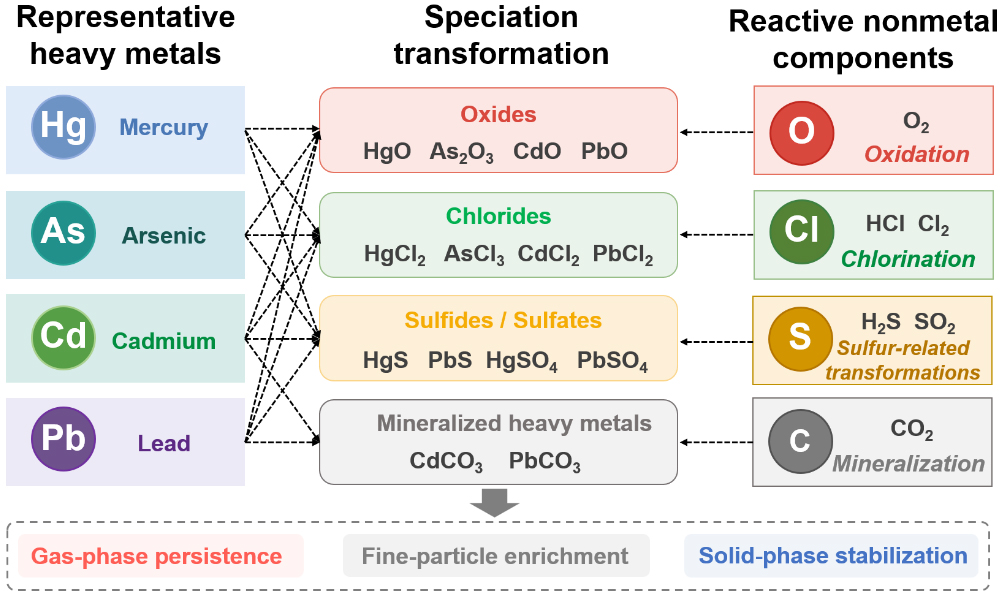
Figure 1. Interaction network between heavy metals and reactive nonmetal components in flue gas. The figure illustrates representative components and processes; additional effects of H2O and NOx are discussed in Section Interactions between heavy metals and reactive flue-gas components. Representative metals including Hg, As, Cd, and Pb interact with O-, Cl-, S-, and C-containing components to form oxides, chlorides, sulfides, sulfates, and particle-associated species. O2 promotes oxidation; HCl, Cl2, and Cl-containing species drive chlorination; SO2 in oxidizing gas contributes to surface sulfation and sulfate formation, whereas H2S and other reduced sulfur sources can drive sulfide formation at sufficiently low oxygen potential; and CO2 contributes indirectly through mineralization and carbonate-related capture. These transformations determine three major fates: gas-phase persistence, fine-particle enrichment, and solid-phase stabilization.
CONTROL PATHWAYS ALONG THE HEAVY-METAL FATE CHAIN
Heavy-metal control from flue gas should be regarded as an integrated process involving speciation regulation, phase redistribution, interfacial capture, and subsequent stabilization or recovery. Because Hg, As, Cd, Pb, and other trace metals exhibit substantially different volatility, chemical reactivity, and phase-transition behaviors, no single technology can provide a universal solution for their simultaneous control[2,6,26,27]. Instead, effective strategies generally rely on two interconnected principles: 1) regulating metal speciation in the gas phase or through external fields to transform volatile species into condensable, soluble, oxidized, or chemically reactive forms; and 2) employing interfacial processes, including adsorption, absorption, catalysis, and mineral stabilization, to achieve subsequent capture, phase transfer, and stabilization. This concept is consistent with the operational principles of existing air pollution control devices, including cooling sections, dust collectors, wet scrubbers, selective catalytic reduction (SCR) units, and sorbent-injection systems. The following discussion organizes control technologies according to their function along the heavy-metal fate chain, from upstream speciation and phase regulation to interfacial capture and downstream stabilization.
Gas-phase speciation and phase regulation
Gas-phase regulation occurs before heavy metals are ultimately transferred to sorbents, liquid phases, particulate matter, or catalytic surfaces. Its primary function is not necessarily direct removal, but rather the transformation of metal species and regulation of their partitioning among gaseous, particulate, and condensed phases. Representative approaches include controlled cooling and condensation, homogeneous chemical oxidation, and field-assisted activation [Figure 2].
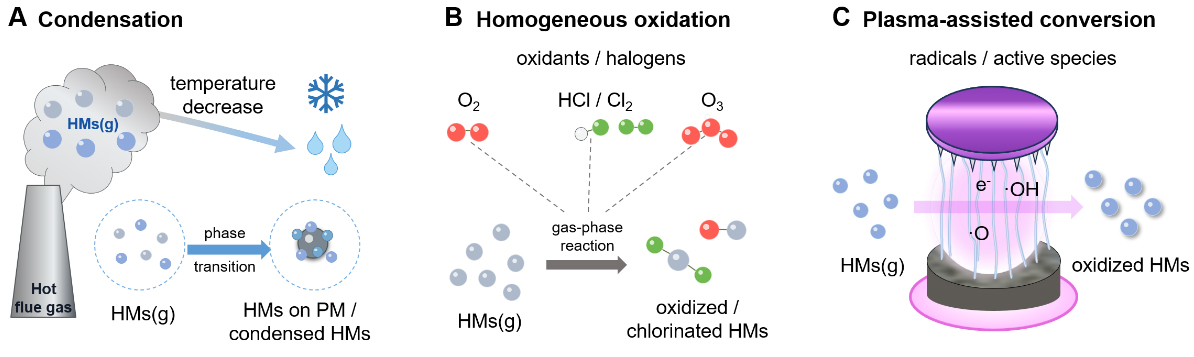
Figure 2. Gas-phase speciation and phase regulation of heavy metals before downstream capture. (A) Condensation, (B) Homogeneous oxidation and (C) Plasma-assisted conversion. HM: Heavy metal; PM: particulate matter.
Controlled condensation represents one of the most straightforward physical approaches for regulating the phase partitioning of semi-volatile metals. During flue gas cooling, supersaturation of metal-containing vapors may induce nucleation, condensation, or deposition onto fly ash particles and reactor surfaces [Figure 2A]. This pathway is particularly important for As, Cd, Pb, and Sb, which volatilize under high-temperature conditions and subsequently undergo enrichment on fine particles during cooling[59,60]. Because cooling can be integrated with existing heat-exchange, quenching, particulate-removal, or wet-cleaning processes, it may reduce the need for an additional dedicated treatment step in some process configurations. However, condensation itself represents a phase-transfer process rather than complete removal. The condensed species may remain in the form of submicron particles, soluble chlorides, or weakly bound surface deposits, requiring subsequent filtration, absorption, or stabilization[61]. For Hg0, simple cooling is generally insufficient because of its high volatility and low condensation tendency under typical downstream conditions[62].
Homogeneous oxidation regulates heavy-metal behavior through gas-phase oxidants, halogen species, or reactive radicals [Figure 2B]. Hg0 is the representative target, whereas Hg(II) species, particularly HgCl2 and other oxidized compounds, are more reactive and more easily removed downstream[63]. Halogen chemistry plays a central role in this process. Bromine-containing species generally exhibit higher oxidation activity toward Hg0 than chlorine-containing species, whereas chlorine remains highly relevant in HCl-rich flue gases and catalyst-assisted oxidation systems[64]. More recently, machine-learning analysis has provided a quantitative perspective on how flue-gas composition and operating conditions jointly regulate homogeneous Hg0 oxidation. Using gas composition and operating parameters as model inputs, Zhang et al. identified Cl2, HCl, initial Hg0 concentration, temperature, HBr, and SO2 among the most influential variables governing predicted Hg0 oxidation[65]. These outputs reinforce the view that homogeneous oxidation is a coupled multivariable process governed by oxidant identity, temperature, reactant concentration, and competing flue-gas constituents. In addition, advanced oxidation approaches based on ozone, photochemical activation, and other reactive oxygen species have demonstrated potential for enhancing Hg0 conversion while simultaneously affecting NOx and organic pollutants[66]. Although homogeneous oxidation can be effective, its low-carbon performance should be assessed together with oxidant consumption, corrosion risk, halogen slip, residual oxidants, and the possible formation of volatile chloride species from semi-volatile metals such as Pb, Cd, As, or Sb[10,67]. Future low-carbon design should therefore minimize additional chemical input while retaining sufficient pre-conversion to improve downstream capture and avoid secondary metal migration.
Plasma-assisted conversion provides a field-driven approach for low-temperature heavy-metal speciation regulation [Figure 2C]. Nonthermal plasma generates energetic electrons, excited molecules, O·, OH·, O3, and other reactive species without requiring bulk heating of the entire flue-gas stream[68]. These reactive species can promote oxidation and may also participate in the simultaneous transformation of multiple pollutants under O2-, H2O-, HCl-, NO-, and SO2-containing atmospheres[69,70]. Unlike conventional activation by bulk-gas heating, nonthermal plasma uses energetic electrons to generate reactive species at relatively low gas temperatures[68,69,71]. However, its practical application remains limited by energy efficiency, byproduct formation, humidity effects, and scale-up challenges. Plasma-catalyst coupling can partially address these limitations because catalysts may improve reaction selectivity and reduce the required energy input, whereas plasma supplies reactive intermediates that are difficult to generate under mild conditions. Xie et al. coupled nonthermal plasma oxidation with downstream dynamic-wave wet scrubbing for the simultaneous control of Hg0, NO, and SO2[71]. The integrated process achieved removal efficiencies of 98% for SO2, 50.9% for NO, and 51.3% for Hg0[71]. The markedly lower direct removal of NO and Hg0 compared with SO2 reflects their poor aqueous solubility and the need for prior oxidative conversion. Plasma-generated reactive species first transformed these poorly captured pollutants into more reactive and water-accessible forms, after which the dynamic-wave scrubber intensified gas-liquid contact and transferred the oxidized products from the gas phase into the scrubbing liquid. In the optimized plasma-catalyst-scrubbing system using M(Ce,Cu)-Mn/13X, the reported removal efficiencies of SO2, NO, and Hg0 reached 100%, 98.7%, and 96%, respectively[71]. These results indicate that effective plasma-assisted control depends on the sequential coupling of gas-phase activation, catalytic conversion, and downstream phase transfer, rather than on plasma oxidation alone. The energy requirement of plasma-assisted systems should also be considered when evaluating their practical applicability. In a separate plasma-only Hg0/O2/N2 experiment in the same study, approximately 63% Hg0 conversion was obtained at an inlet Hg0 concentration of 100 μg m-3, O2 and N2 flow rates of 250 and 700 mL min-1, respectively, and a discharge frequency of 300 Hz, at an specific energy input (SEI) of 640 J L-1 (~ 0.178 kWh m-3)[71]. The 51.3% and 96% Hg0 values both describe overall removal through the scrubbing stage, whereas the 63% value measures conversion in the plasma reactor alone under the Hg0/O2/N2 feed. The 640 J L-1 benchmark therefore applies to this separate plasma-only test; the energy demand of the optimized 96% removal configuration requires an energy inventory for its reported operating conditions. However, the reported SEI represents only the electrical energy delivered to the discharge zone and does not include additional inputs associated with power-supply losses, auxiliary power, catalyst production, scrubbing reagents and pumping, and treatment of Hg-containing residues. Therefore, the advantage of catalyst-assisted plasma processes should be evaluated based on the reduction in total energy and material requirements needed to achieve a given removal target, together with the downstream management of captured mercury-containing streams.
Interfacial capture and conversion
The removal of volatile heavy metals is primarily governed by reactions occurring at gas-solid or gas-liquid interfaces. From an interfacial perspective, major removal pathways can be categorized into three fundamental processes: adsorption and catalytic conversion at gas-solid interfaces, and absorption at gas-liquid interfaces [Figure 3][72,73]. These processes perform different functions along the heavy-metal fate chain: adsorption transfers metals onto solid surfaces, catalytic conversion modifies their chemical speciation, and absorption transfers soluble or reactive species into the liquid phase.
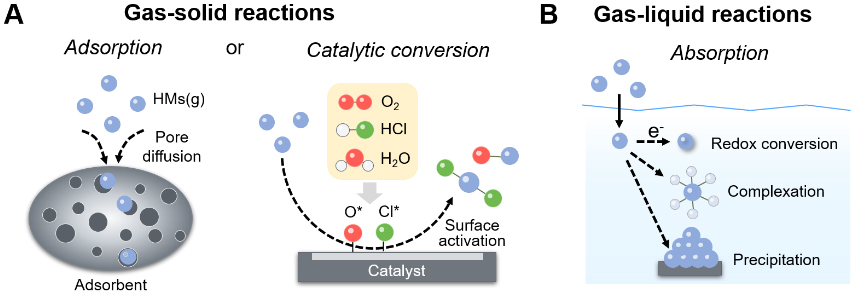
Figure 3. Interfacial pathways governing heavy-metal capture and conversion. (A) Gas-solid reactions and (B) Gas-liquid reactions. HM: Heavy metal.
In gas-solid adsorption, gaseous or condensable heavy-metal species are transferred to solid surfaces through external mass transfer and pore diffusion, followed by physical adsorption, chemisorption, or surface reaction. Porous carbon materials provide large surface areas and accessible transport pathways, whereas sulfur-, halogen-, oxygen-, and metal-containing functional groups can strengthen metal-surface interactions or promote transformation into less mobile surface species[74]. Beyond carbonaceous materials, mineral sorbents, metal oxides, metal sulfides, fly ash-derived materials, and waste-derived porous materials provide additional platforms for heavy-metal capture[75,76]. Li et al. designed a carbon material, hydrogen-substituted graphdiyne (HsGDY), featuring a hexagonal pore structure (16.3 Å) and an extended π-conjugated carbon skeleton composed of aromatic rings and acetylene linkages[77]. HsGDY enables highly efficient gaseous Hg0 capture via an in situ adsorption-coupled oxidation process, benefiting from its large hexagonal pores and uneven surface charge. These features promote rapid Hg0 diffusion and effective electron transfer to form strongly bonded Hg, with a reported adsorption capacity of 0.71 μg/m2, which is 23.66 and 17.75 times those of graphdiyne (GDY) and activated carbon (AC), respectively. In the laboratory fixed-bed experiment, the mass-normalized uptake was 113.5 μg g-1 over 90 min under nitrogen containing 340 μg m-3 Hg0[77]. The practical sorbent requirement depends on mass-normalized breakthrough capacity, contact time, and gas composition. The study also examined temperature effects, SO2 exposure, and eight adsorption-desorption cycles; these results establish laboratory performance, while continuous operation in a complete flue-gas mixture and production-scale synthesis remain to be demonstrated.
Multielement surface chemistry can further strengthen Hg fixation: Se-halogen systems can form highly stable Hg3Se2X2 (X = Cl, Br, or I) phases, while SO2-driven selenite-chloride surfaces have been shown to promote rapid Hg0 deposition and stable Hg3Se2Cl2 formation[78,79]. For semi-volatile metals such as As, Cd, Pb, and Sb, adsorption commonly occurs together with condensation and enrichment on particulate surfaces. Potential process-level advantages of adsorption include relatively simple reactor configurations and compatibility with existing particulate-control systems. Biomass- and waste-derived carbons provide additional feedstocks for this adsorption strategy[80,81].
In gas-solid catalytic conversion, solid materials function primarily as reaction platforms rather than passive storage media. Catalysts activate O2, HCl, H2O, lattice oxygen, or other flue-gas components to convert poorly capturable metal species into more oxidized, chlorinated, or otherwise capturable forms. Catalytic surfaces can activate O2 and HCl and promote the participation of surface or lattice oxygen in converting poorly capturable metal species into oxidized or chlorinated forms[16,31,50,53]. H2O can modify interfacial chemistry and the availability of adsorption sites, with its effect depending on the catalyst and gas composition[48,57]. Hg0 oxidation over SCR catalysts and transition-metal oxides is a representative example because the resulting Hg(II) species can subsequently be captured through wet scrubbing or retained by downstream solids[82]. Yang et al. developed a single-atom Fe-decorated N-doped carbon catalyst for the simultaneous conversion of NO and Hg0[83]. The Fe1-N4-C sites exhibited favorable adsorption and activation of NO and O2 while maintaining catalytic activity in the presence of SO2 under the reported conditions[83]. In addition, catalytic conversion alone does not constitute permanent removal: the products must ultimately be immobilized on solids, transferred into liquids, or separated with particulate matter. Catalyst poisoning, competitive adsorption, product accumulation, and loss of active surface species must therefore be considered together with apparent conversion efficiency. This single-atom system provides laboratory evidence for site-specific activation and sulfur tolerance, while industrial maturity requires sustained conversion under representative space velocities, combined impurities, and repeated regeneration. Relevant engineering comparisons must also include catalyst preparation and replacement, pressure loss, the downstream Hg(II) capture step, and the final mercury balance.
In gas-liquid absorption, heavy-metal species cross the gas-liquid interface and undergo dissolution, complexation, oxidation-reduction reactions, or precipitation. This pathway is particularly effective for water-soluble oxidized species such as HgCl2 and can be integrated with wet flue-gas desulfurization and other existing scrubbing systems[84]. The overall efficiency of absorption depends not only on gas-liquid mass transfer but also on liquid-phase reaction kinetics and product stability. For example, absorbed Hg(II) may be reduced by sulfite or other reductive components and regenerated as volatile Hg0, resulting in secondary emission[85]. Similarly, dissolved As, Cd, and Pb require subsequent conversion into stable precipitates, concentrated products, or recoverable resources[86,87]. From a low-carbon perspective, absorption systems should also be evaluated according to reagent demand, pumping energy, wastewater generation, sludge production, re-emission control, and downstream treatment requirements.
Collectively, gas-solid adsorption, gas-solid catalytic conversion, and gas-liquid absorption constitute a continuous reaction network rather than isolated treatment technologies. Adsorption provides direct capture, catalytic processes regulate metal speciation and reactivity, and absorption enables transfer into the liquid phase for subsequent chemical treatment. Their effective integration determines whether heavy metals are merely redistributed among different phases or are ultimately stabilized, recovered, or directed toward a controlled final sink within the treatment system.
Co-benefit control in conventional air-pollution-control devices
Co-benefit heavy-metal control is achieved not through a single dedicated device, but through the sequential matching of heavy-metal speciation with the conversion and capture functions already available in conventional air-pollution-control systems. Figure 4 represents a functional sequence: source release, controlled cooling, catalytic conversion, optional sorbent injection, particulate control, wet scrubbing, and residue management, rather than a universal equipment configuration. Although the specific arrangement varies among coal combustion, waste incineration, and nonferrous smelting, the underlying principle remains consistent: volatile metal species are first transformed into more condensable, adsorbable, or soluble forms, subsequently transferred into solid or liquid sinks, and finally stabilized or recovered from the resulting residues[11,88]. This integrated strategy may reduce additional energy and material requirements by maximizing the utilization of existing APCDs instead of introducing independent energy-intensive units specifically for trace-metal removal.
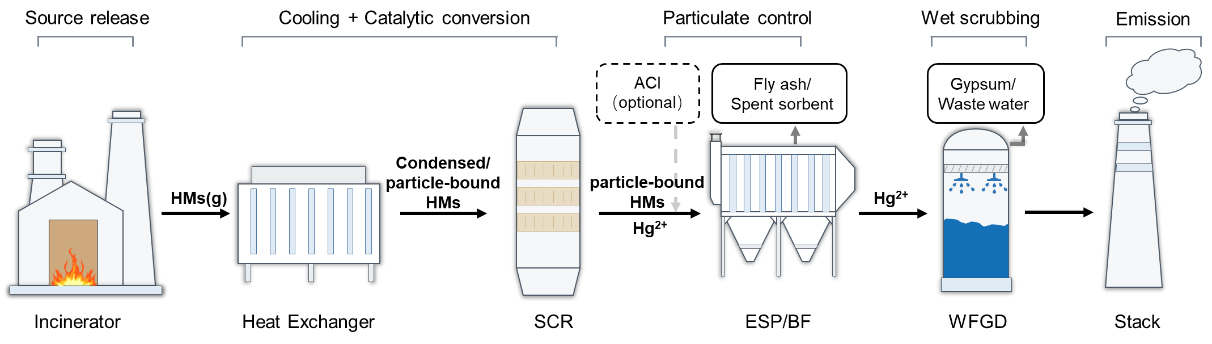
Figure 4. Co-benefit heavy-metal removal along a representative flue-gas treatment train. Gaseous metals released from the incinerator undergo condensation and particle association during cooling, while SCR promotes Hg0 oxidation. Optional ACI enhances adsorption before ESPs or BFs collect fly ash, condensed metal species, and spent sorbents. WFGD captures soluble Hg(II) species and remaining particles, transferring metals into gypsum- and wastewater-associated streams before the treated gas reaches the stack. The solid and liquid outputs require further management. The diagram summarizes representative control functions; the equipment sequence varies with the industrial process and plant design. ACI: Activated-carbon injection; SCR: selective catalytic reduction; ESP: electrostatic precipitator; BF: fabric filter; WFGD: wet flue-gas desulfurization; HM: heavy metal.
At the emission source, heavy metals are released in substantially different chemical forms depending on their volatility, feedstock composition, and combustion or thermal-processing conditions. Less volatile metals are preferentially retained in bottom ash or slag, whereas semi-volatile metals may vaporize as elemental, oxide, or chloride species and subsequently redistribute during cooling[11]. The heavy-metal control pathway should be considered as comprising multiple interconnected streams, including particle-associated metals, semi-volatile metal vapors, and gaseous mercury. Downstream control devices do not remove elements independently of their chemical form; rather, they capture the specific species generated and delivered by upstream thermal processes.
Controlled cooling provides the first opportunity for phase redistribution and partial capture. As temperature decreases, supersaturation promotes nucleation, condensation, and adsorption of semi-volatile metals onto entrained ash particles. As, Cd, Pb, Zn, and related elements may therefore shift from the vapor phase toward fine particulate fractions that are accessible to dust collectors[59,60]. However, cooling should be regarded as a phase-regulation step rather than as complete removal. Metal enrichment frequently occurs on ultrafine particles, while volatile chlorides and condensable species may remain difficult to collect.
Laboratory and field studies show that SCR-mediated Hg0 oxidation can facilitate downstream capture by particulate-control and wet-desulfurization units[88-90]. Nevertheless, SCR should be considered a speciation-conversion unit rather than a final mercury sink. Its co-benefit performance depends on flue-gas composition, catalyst condition, and operating temperature[82]. NH3, SO2, and H2O can modify Hg0 conversion through competitive adsorption and changes in surface chemistry[32,82,89].
Sorbent injection combined with particulate control represents the primary solid-phase capture pathway. Activated carbon, functionalized carbon materials, mineral sorbents, or recycled fly ash can be injected upstream of electrostatic precipitators (ESPs) or fabric filters to enhance the adsorption of Hg and other volatile metals[91,92]. The subsequent dust-collection stage removes fly ash, condensed metal species, and spent sorbents. In a field study of six municipal solid waste (MSW) incinerators, Li et al. estimated that achieving 90% overall Hg removal required increasing activated-carbon injection from approximately 100 mg Nm-3 to 135 mg Nm-3 for grate furnaces and 170 mg Nm-3 for circulating fluidized-bed furnaces[91]. The corresponding additional sorbent demands of approximately 35 and 70 mg Nm-3 illustrate how a higher removal target can increase material consumption and metal-bearing solid waste.
Wet scrubbers and wet flue gas desulfurization (WFGD) systems provide the final liquid-phase capture pathway for water-soluble heavy-metal species. Soluble metal chlorides and entrained fine particles can be transferred into the liquid through dissolution, complexation, precipitation, and droplet capture processes[93].
The ultimate goal of co-benefit heavy-metal control is therefore not simply removal from the gas stream, but effective residue management. Fly ash, spent sorbents, gypsum, scrubber sludge, and wastewater concentrates containing captured metals may remain environmentally mobile or thermally remobilizable if not appropriately treated[94,95]. Consequently, the optimal APCD configuration should not maximize the performance of individual units independently. Instead, it should minimize total energy consumption, pressure loss, reagent demand, wastewater generation, and secondary waste formation while maintaining a closed heavy-metal mass balance[18,96].
LOW-CARBON AND FATE-ORIENTED ASSESSMENT
Heavy-metal control should be evaluated beyond the decrease in stack concentration. As discussed above, conventional APCD trains can remove substantial fractions of Hg, As, Cd, Pb, and other metals through cooling-induced phase transfer, catalytic conversion, particulate collection, and wet absorption. However, these processes do not destroy the metals; they redistribute them into fly ash, spent sorbents, gypsum, sludge, wastewater, or other secondary streams. From a low-carbon perspective, the key question is therefore not whether a technology operates at low temperature or uses a nominally “green” material, but what additional energy, reagent, and material inputs are required to achieve the desired control and how much downstream treatment is subsequently needed. Process integration and co-benefit use of existing APCDs are particularly important because they can reduce the incremental burden associated with dedicated heavy-metal treatment.
Assessment should report both greenhouse-gas emissions per volume of gas treated and, where a complete metal balance is available, per mass of metal captured at the specified removal target. Electricity and heat supply, sorbent and oxidant production, pumping and pressure loss, regeneration, material replacement, and waste treatment should be included within the stated boundary. Techno-economic assessment follows the same inventory: annualized equipment costs, operating costs, service life, and residue-management costs determine the expense per mass of metal controlled. For existing APCDs, the incremental costs and emissions attributable to additional metal control are particularly relevant. Loss of activity in wet, acidic, or particle-laden gas can increase regeneration and replacement frequency and therefore alter both cost and carbon performance.
Available quantitative evidence illustrates this system dependence. For the same annual Hg0-removal target of 78 kg, Park and Hong reported aggregated life-cycle impacts of 0.027 kPt for SCR-assisted control and 0.483 kPt for activated-carbon injection (ACI), mainly because the sorbent-based route required greater material and energy inputs[18]. These kPt values are aggregated environmental-impact scores rather than carbon footprints; they quantify the overall burden for the cited study’s annual removal target. The field-scale ACI evidence in the section of "Co-benefit control in conventional air-pollution-control devices and the plasma discharge benchmark" in the section of "Gas-phase speciation and phase regulation" provide complementary inventories expressed per gas volume. Using the plasma discharge demand reported by Xie et al.[71], unit conversion gives 640 J L-1 = 0.178 kWh m-3 (1 kWh = 3.6 MJ). For a specified electricity supply, the corresponding electricity-related contribution is approximately 0.178 × EFelec kg CO2-equivalent m-3 before accounting for power-supply losses, where EFelec is the electricity emission factor in kg CO2-equivalent kWh-1. A numerical estimate requires a factor documented for the supply location and reference year. The cited experiment does not specify such a factor, so this expression remains conditional. Auxiliary power, catalyst and reagent production, and residue treatment require additional inventory data. These inputs should be recorded together with inlet metal concentration, removal efficiency, operating duration, and the downstream metal sink so that their accounting boundaries remain explicit.
Carbon-specific evidence is also available for downstream residue management. For the treatment and disposal of 1 Mg of municipal solid waste incineration (MSWI) fly ash, Huber et al. reported climate-change impacts of approximately 1,400 kg CO2-equivalent for thermal treatment in a dedicated furnace, 550 kg CO2-equivalent for cement stabilization, and 260 kg CO2-equivalent for thermal co-treatment with combustible hazardous waste[19]. In the co-treatment scenario, the burden of the reference hazardous-waste disposal process was subtracted to allocate the impact to fly ash treatment. The same study reported a net climate-change impact of approximately -1 kg CO2-equivalent per Mg of fly ash for the FLUREC metal-recovery scenario (acidic fly ash extraction with integrated zinc recovery), after credits for avoided primary-metal production and reduced quicklime use[19]. This result reflects the study’s substitution assumptions and residue-treatment boundary. These results locate the carbon burden within a defined residue-management boundary and show why the final treatment route must be included in assessments of flue-gas metal control.
Supplementary Table 1 compiles quantitative evidence along the heavy-metal control and residue-management chain. The operating conditions, study scale, reported indicators, assessment boundaries, and missing inventory items are specified for plasma conversion, activated-carbon injection, process-level life-cycle assessment, and fly ash treatment. These considerations lead directly to the three system-level limitations summarized in Figure 5. The left panel represents the additional energy and material burden associated with catalyst or adsorbent preparation, plasma or oxidant consumption, and energy-intensive reaction conditions. The central panel highlights re-release or desorption, acid-driven leaching, and the generation of metal-bearing secondary wastes, emphasizing that capture alone does not ensure a stable final sink. The right panel concerns the limited circularity of many captured-metal streams, where complex composition, low target-metal concentrations, and difficulties in selective separation reduce the feasibility and economic value of recovery. These three limitations are interconnected rather than independent. Increasing the intensity of front-end capture may raise material and energy demand; unstable products create additional stabilization requirements; and complex secondary residues make recovery more difficult. Figure 5 therefore links the control pathways discussed above with the downstream environmental and resource consequences that ultimately determine whether a high-removal process is also compatible with low-carbon control.
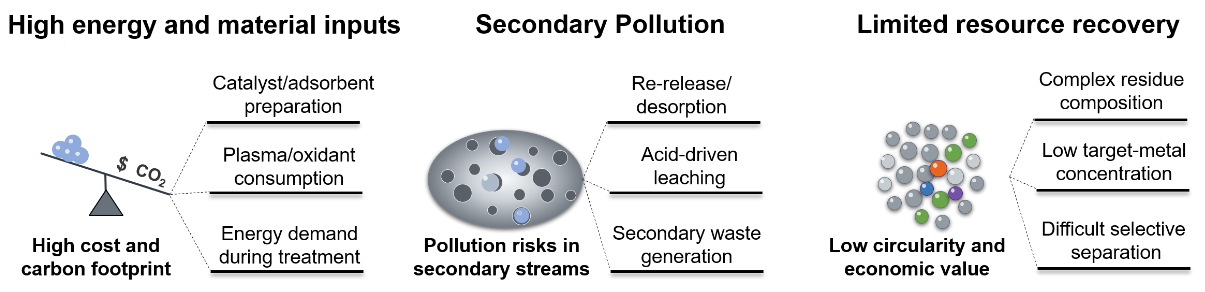
Figure 5. System-level limitations of current heavy-metal control technologies. Energy and material inputs associated with catalyst/sorbent preparation and operation (left); secondary pollution risks associated with re-release/desorption, acid-driven leaching, and metal-bearing secondary waste generation (center); and barriers to selective metal recovery from dilute, complex residues (right).
Cross-media redistribution is particularly important in this assessment. Full-scale MSWI measurements show that effective stack control can transfer Hg, Cd, Pb, Cu, and Cr into bottom ash and downstream APC residues rather than eliminate them[97]. Wet scrubbing also generates metal-bearing gypsum and wastewater streams that require further treatment or disposal[86,87]. The environmental significance of this transfer depends on the stability of the resulting chemical forms. Metals retained in fly ash or spent sorbents may still leach or remobilize during disposal[98,99], and Hg(II) captured in wet flue-gas-desulfurization systems can be reduced and re-emitted as volatile Hg0 under unfavorable solution conditions[85,100,101]. These processes can offset the apparent benefit of high stack removal by introducing additional stabilization, wastewater treatment, or disposal requirements. Consequently, residue stability and re-release potential should be considered together with removal efficiency when judging the overall burden of a control route.
The final management pathway should therefore depend on both residue characteristics and treatment demand. For dilute or heterogeneous streams, durable stabilization may be more realistic than resource recovery. CO2-assisted carbonation and related mineralization routes are attractive because they can combine carbon utilization with reduced mobility of some metal species, although the response remains element- and matrix-dependent[102,103]. For streams containing recoverable Cu, Zn, or other valuable metals, hydrometallurgical treatment is an option when metal concentrations and separation selectivity support recovery[104,105]. Integrated processes have demonstrated the technical feasibility of recovering valuable metals from MSWI fly ash, but they commonly require leaching, selective extraction, purification, adsorption, and wastewater treatment[104-108]. Recovery is therefore not intrinsically lower-carbon than stabilization; its benefit depends on whether the avoided resource and disposal burdens exceed the additional chemical and energy inputs required for separation.
Overall, low-carbon heavy-metal control should be understood as a system-level direction rather than a label attached to any single technology. Future development should combine effective removal with lower incremental energy and material demand, stronger integration with existing APCDs, and deliberate management of the captured-metal stream. Where recovery is technically and environmentally justified, concentrated residues can be directed toward selective separation and resource recovery; where it is not, the priority should be durable chemical or mineral stabilization with minimal secondary treatment. Such an approach is consistent with the broader objective of reducing atmospheric heavy-metal emissions without transferring an excessive energy, material, or environmental burden to downstream processes.
CONCLUSION AND OUTLOOK
Heavy-metal control in industrial flue gas should be understood as a continuous fate-regulation process rather than as an isolated removal step. The volatility and chemical speciation established during high-temperature processing determine subsequent condensation, adsorption, catalytic conversion, and absorption, while conventional APCDs redistribute the captured metals into fly ash, spent sorbents, gypsum, sludge, and wastewater. Accordingly, high stack-removal efficiency is only one component of effective control. The additional energy and material inputs required for removal, together with the stability and final destination of the transferred metals, determine whether an apparently efficient process provides a genuine environmental benefit. Existing life-cycle studies already demonstrate that both the choice of front-end control route and the downstream treatment of metal-bearing residues can substantially alter the overall environmental burden[18,19].
Future control strategies should therefore integrate emission reduction with deliberate regulation of the final metal-containing stream. Where existing APCDs provide sufficient phase conversion and capture, maximizing these co-benefit functions can limit additional energy and material consumption. Where further intensification is required, sorbent, reagent, and external-energy inputs should be justified by the additional removal achieved and by their effects on downstream residue generation. More importantly, capture should be coupled to a defined endpoint. Concentrated and selectively separable streams may support regeneration and metal recovery, whereas dilute or compositionally complex residues may require conversion into low-mobility mineral or chemical forms[21,106,107]. The appropriate pathway will therefore vary with metal concentration, speciation, toxicity, recoverability, and the energy and reagent requirements of downstream treatment.
To translate this fate-oriented framework into practical decision-making, future studies should establish evaluation protocols that bridge controlled laboratory experiments and realistic operating environments. Validation should progressively move from simplified gas mixtures toward pilot-scale conditions incorporating representative H2O, SO2, HCl, NOx, and particulate components, because these species can simultaneously influence metal speciation, surface reactivity, and phase transfer. Long-term operation should be evaluated not only by removal efficiency but also by breakthrough behavior, catalyst or sorbent deactivation, corrosion, and redistribution of metals across the treatment train. For regeneration-based processes, the recovered capacity, energy and reagent requirements, metal release during regeneration, and material replacement frequency should be quantitatively assessed. Meanwhile, the stability of final metal-containing streams, including fly ash, spent sorbents, gypsum, sludge, and wastewater concentrates, should be verified through leaching and aging assessments. Integrating these measurements with closed metal balances and energy/material inventories will be essential for linking laboratory-scale performance with operational burden, carbon demand, and the ultimate environmental fate of captured metals.
Ultimately, the next stage of heavy-metal control should move from maximizing removal at individual unit operations toward minimizing the combined burden of emission control and final metal management. A low-carbon and fate-oriented system should use the least additional energy and material necessary to transfer metals from flue gas into either a recoverable product or a demonstrably stable sink. Establishing this connection between speciation, capture, cross-media transfer, and final environmental endpoint provides a more meaningful basis for designing heavy-metal control systems compatible with increasingly stringent emission and carbon-reduction targets.
DECLARATIONS
Authors’ contributions
Writing original draft: Qi, H.; Hong, Q.
Methodology: Qi, H.; Hong, Q.; Qu, Z.; Huang, W.; Yan, N.
Drawing the figure: Qi, H.; Hong, Q.
Writing outlook: Xu, H.
Conceptualization: Qu, Z.; Huang, W.; Yan, N.; Xu, H.
Review and editing: Xu, H.
Project administration: Xu, H.; Qu, Z.; Yan, N.
Funding acquisition: Hong, Q.; Xu, H.; Yan, N.
Availability of data and materials
Not applicable.
AI and AI-assisted tools statement
Not applicable.
Financial support and sponsorship
This work was partly supported by the National Key R&D Program of China (2024YFC3907902), Excellent Young Scientists Fund of the National Natural Science Foundation of China (No. 22522608), National Natural Science Foundation of China (Nos. 22476125, 22506116), and the Key Program of National Natural Science Foundation of China (No. 22436004). Science and Technology Cooperation Program of Shanghai Jiao Tong University in Inner Mongolia Autonomous Region—Action Plan of Shanghai Jiao Tong University for "Revitalizing Inner Mongolia through Science and Technology" (2025XYJG0001-01-17).
Conflicts of interest
Xu, H. is an Editorial Board Member of the journal Greenverse Science, but is not involved in any steps of editorial processing, notably including reviewer selection, manuscript handling, or decision-making. The other authors declare that there are no conflicts of interest.
Ethical approval and consent to participate
Not applicable.
Consent for publication
Not applicable.
Copyright
© The Author(s) 2026.
Supplementary Materials
REFERENCES
1. Ouyang, D.; Wu, Q.; Wang, S.; et al. Multimedia mercury emissions from key industries in China and implications for mercury control. Environ. Sci. Technol. 2025, 59, 22544-53.
2. Chuai, X.; Xiao, R.; Chang, L.; et al. Fate and emission behavior of heavy metals during hazardous chemical waste incineration. J. Hazard. Mater. 2022, 431, 128656.
3. Senior, C.; Granite, E.; Linak, W.; Seames, W. Chemistry of trace inorganic elements in coal combustion systems: a century of discovery. Energy. Fuels. 2020, 34, 15141-68.
4. Oberschelp, C.; Pfister, S.; Raptis, C. E.; Hellweg, S. Global emission hotspots of coal power generation. Nat. Sustain. 2019, 2, 113-21.
5. Ji, P.; Song, G.; Xu, W.; Song, Q. Transformation characteristics of arsenic and lead during coal combustion. Energy. Fuels. 2019, 33, 9280-8.
6. Jiao, F.; Cheng, Y.; Zhang, L.; Yamada, N.; Sato, A.; Ninomiya, Y. Effects of HCl, SO2 and H2O in flue gas on the condensation behavior of Pb and Cd vapors in the cooling section of municipal solid waste incineration. Proc. Combust. Inst. 2011, 33, 2787-93.
7. Sun, X.; Gingerich, D. B.; Azevedo, I. L.; Mauter, M. S. Trace element mass flow rates from U.S. coal fired power plants. Environ. Sci. Technol. 2019, 53, 5585-95.
8. Bai, X.; Tian, H.; Zhu, C.; et al. Present knowledge and future perspectives of atmospheric emission inventories of toxic trace elements: a critical review. Environ. Sci. Technol. 2023, 57, 1551-67.
9. Li, Y.; Yu, J.; Liu, Y.; Huang, R.; Wang, Z.; Zhao, Y. A review on removal of mercury from flue gas utilizing existing air pollutant control devices (APCDs). J. Hazard. Mater. 2022, 427, 128132.
10. Lane, D. J.; Jokiniemi, J.; Heimonen, M.; et al. Thermal treatment of municipal solid waste incineration fly ash: Impact of gas atmosphere on the volatility of major, minor, and trace elements. Waste. Manag. 2020, 114, 1-16.
11. Liu, H.; Li, S.; Guo, G.; et al. Ash formation and the inherent heavy metal partitioning behavior in a 100 t/d hazardous waste incineration plant. Sci. Total. Environ. 2022, 814, 151938.
12. Li, W.; Ma, Z.; Yan, J. Chemical speciation distribution and thermal stability of heavy metals along flue gas cleaning systems in a hazardous waste incinerator. Energy. Fuels. 2023, 37, 9257-68.
13. Shen, W.; Zhu, N.; Xi, Y.; et al. Effects of medical waste incineration fly ash on the promotion of heavy metal chlorination volatilization from incineration residues. J. Hazard. Mater. 2022, 425, 128037.
14. Wolffers, M.; Kulik, D. A.; Miron, G. D.; Eggenberger, U.; Churakov, S. V. Thermodynamic model of MSWI flue gas cooling path: effect of flue gas composition on heavy metal binding forms. Waste. Manag. Res. 2024, 42, 273-84.
15. Li, H.; Zheng, J.; Zheng, W.; et al. In situ acid etching boosts mercury accommodation capacities of transition metal sulfides. Nat. Commun. 2023, 14, 1395.
16. Shi, J.; Chen, J.; Xiong, S.; et al. Structure-directing role of support on Hg0 oxidation over V2O5/TiO2 catalyst revealed for NOx and Hg0 simultaneous control in an SCR reactor. Environ. Sci. Technol. 2022, 56, 9702-11.
17. Schuetze, J.; Kunth, D.; Weissbach, S.; Koeser, H. Mercury vapor pressure of flue gas desulfurization scrubber suspensions: effects of pH level, gypsum, and iron. Environ. Sci. Technol. 2012, 46, 3008-13.
18. Park, J. H.; Hong, Y. LCA-based comparative assessment of ACI and SCR for gaseous elemental mercury emission control in coal-fired power plants. Env. Prog. Sustain. Energy. 2026, 45, e70256.
19. Huber, F.; Laner, D.; Fellner, J. Comparative life cycle assessment of MSWI fly ash treatment and disposal. Waste. Manag. 2018, 73, 392-403.
20. Thorneloe, S. A.; Kosson, D. S.; Sanchez, F.; Garrabrants, A. C.; Helms, G. Evaluating the fate of metals in air pollution control residues from coal-fired power plants. Environ. Sci. Technol. 2010, 44, 7351-6.
21. Fernández-Miranda, N.; Lopez-Anton, M. A.; Torre-Santos, T.; Díaz-Somoano, M.; Martínez-Tarazona, M. R. Impact of oxy-fuel conditions on elemental mercury re-emission in wet flue gas desulfurization systems. Environ. Sci. Technol. 2016, 50, 7247-53.
22. Han, S.; Chen, K.; Meng, F.; et al. Mitigating heavy metal volatilization during thermal treatment of MSWI fly ash by using iron(III) sulfate as a chlorine depleting agent. J. Hazard. Mater. 2024, 465, 133185.
23. Han, Q.; Liu, H.; Gong, Y.; et al. Strengthening pollutant control and resource recovery can enhance sustainable waste incineration in China. Commun. Earth. Environ. 2025, 6, 2859-63.
24. Zhang, J.; Sun, X.; Deng, J.; et al. Emission characteristics of heavy metals from a typical copper smelting plant. J. Hazard. Mater. 2022, 424, 127311.
25. Zhang, Y.; Chen, Y.; Meng, A.; Li, Q.; Cheng, H. Experimental and thermodynamic investigation on transfer of cadmium influenced by sulfur and chlorine during municipal solid waste (MSW) incineration. J. Hazard. Mater. 2008, 153, 309-19.
26. Belevi, H.; Moench, H. Factors determining the element behavior in municipal solid waste incinerators. 1. Field studies. Environ. Sci. Technol. 2000, 34, 2501-6.
27. Belevi, H.; Langmeier, M. Factors determining the element behavior in municipal solid waste incinerators. 2. Laboratory experiments. Environ. Sci. Technol. 2000, 34, 2507-12.
28. Wang, X.; Huang, Y.; Liu, C.; Zhang, S.; Wang, Y.; Piao, G. Dynamic volatilization behavior of Pb and Cd during fixed bed waste incineration: effect of chlorine and calcium oxide. Fuel 2017, 192, 1-9.
29. Wang, C.; Liu, H.; Zhang, Y.; Zou, C.; Anthony, E. J. Review of arsenic behavior during coal combustion: volatilization, transformation, emission and removal technologies. Prog. Energy. Combust. Sci. 2018, 68, 1-28.
30. Zhao, S.; Pudasainee, D.; Duan, Y.; Gupta, R.; Liu, M.; Lu, J. A review on mercury in coal combustion process: content and occurrence forms in coal, transformation, sampling methods, emission and control technologies. Prog. Energy. Combust. Sci. 2019, 73, 26-64.
31. Qi, H.; Fan, Y.; Ma, Y.; et al. Triggering low-temperature chlorine activation via interfacial Ru-O-Mn coordination bridges for robust waste incineration flue gas mercury oxidation. Environ. Sci. Technol. 2026, 60, 21354-63.
32. Li, C.; Brewe, D.; Lee, J. Effects of impregnation sequence for Mo-modified V-based SCR catalyst on simultaneous Hg0 oxidation and NO reduction. Appl. Catal. B-Environ. 2020, 270, 118854.
33. Fernández-Miranda, N.; Lopez-Anton, M. A.; Díaz-Somoano, M.; Martínez-Tarazona, M. R. Effect of oxy-combustion flue gas on mercury oxidation. Environ. Sci. Technol. 2014, 48, 7164-70.
34. Wei, J.; Sun, L.; Ding, Z.; Lin, W.; Li, H.; Liu, J. Reshaping heavy metal pathways: A long-term field study on emissions and partitioning in municipal solid waste (MSW) incineration before and after MSW classification. J. Hazard. Mater. 2026, 510, 142103.
35. López-Antón, M.; Alan Spears, D.; Díaz-Somoano, M.; Diaz, L.; Rosa Martínez-Tarazona, M.; Liu, J. Enrichment of thallium in fly ashes in a Spanish circulating fluidized-bed combustion plant. Fuel 2015, 146, 51-5.
36. Liu, C.; Huang, Y.; Wang, X.; et al. Dynamic experimental investigation on the volatilization behavior of lead and cadmium in the simulated municipal solid waste (MSW) influenced by sulfur compounds during incineration. Energy. Fuels. 2017, 31, 847-53.
37. Rumble, J. R.; Bruno, T. J.; Burgess, D. R. Jr.; McEwen, L. R. CRC Handbook of Chemistry and Physics, 106th ed.; CRC Press, 2025. https://ndlsearch.ndl.go.jp/en/books/R100000136-I1970304959903570573 (accessed 2026-11-03).
38. Brauer, G. Editor. Handbook of preparative inorganic chemistry, 2nd ed.; Academic Press, 1965; pp. 1520-44.
39. Agency for Toxic Substances and Disease Registry. Toxicological Profile for Mercury; U.S. Department of Health and Human Services, Public Health Service, 2024. https://www.atsdr.cdc.gov/toxprofiles/tp46.pdf (accessed 2026-11-03).
40. Davis, J. A.; Lee, J. S.; Druwe, I. L.; et al. IRIS toxicological review of inorganic arsenic (CASRN 7440-38-2); EPA/635/R-25/005Fa; U.S. Environmental Protection Agency, 2025. https://iris.epa.gov/static/pdfs/0278tr.pdf (accessed 2026-11-03).
41. World Health Organization. Inorganic Arsenic Compounds Other Than Arsine; Health and Safety Guide No. 70; World Health Organization: Geneva, 1992. https://www.inchem.org/documents/hsg/hsg/hsg070.htm (accessed 2026-11-03).
42. Occupational Safety and Health Administration. Appendix B to 29 CFR 1910.1027 - Substance Technical Guidelines for Cadmium; U.S. Department of Labor, 1992. https://www.osha.gov/laws-regs/regulations/standardnumber/1910/1910.1027AppB (accessed 2026-11-03).
43. World Health Organization. Thallium; Environmental Health Criteria 182; World Health Organization, 1996. https://www.inchem.org/documents/ehc/ehc/ehc182.htm (accessed 2026-11-03).
44. Orman, R.; Holland, D. Thermal phase transitions in antimony (III) oxides. J. Solid. State. Chem. 2007, 180, 2587-96.
45. Grimsey, E.; Reynolds, K. Equilibrium oxygen pressure of (Co3O4 + CoO) from 1173 to 1228 K. J. Chem. Thermodyn. 1986, 18, 473-6.
47. World Health Organization. Tin and Inorganic Tin Compounds; Concise International Chemical Assessment Document 65; World Health Organization, 2005. https://www.inchem.org/documents/cicads/cicads/cicad65.htm (accessed 2026-11-03).
48. Wang, C.; Xie, F.; Chang, S.; Ding, Z.; Mei, J.; Yang, S. Novel counteraction effect of H2O and SO2 toward HCl on the chemical adsorption of gaseous Hg0 onto sulfureted HPW/γ-Fe2O3 at low temperatures: mechanism and its application in Hg0 recovery from coal-fired flue gas. Environ. Sci. Technol. 2022, 56, 642-51.
49. Yu, S.; Zhang, C.; Ma, L.; Tan, P.; Fang, Q.; Chen, G. Deep insight into the effect of NaCl/HCl/SO2/CO2 in simulated flue gas on gas-phase arsenic adsorption over mineral oxide sorbents. J. Hazard. Mater. 2021, 403, 123617.
50. Zhao, H.; Ezeh, C. I.; Yin, S.; et al. MoO2-adjusted δ-MnO2 nanosheet for catalytic oxidation of Hg0 to Hg2+. Appl. Catal. B-Environ. 2020, 263, 117829.
51. Song, B.; Yuan, K.; Wei, Y.; et al. In-furnace control of arsenic vapor emissions using Fe2O3 microspheres with good sintering resistance. Environ. Sci. Technol. 2021, 55, 8613-21.
52. Fu, B.; Hower, J. C.; Li, S.; et al. The key roles of Fe-bearing minerals on arsenic capture and speciation transformation during high-As bituminous coal combustion: experimental and theoretical investigations. J. Hazard. Mater. 2021, 415, 125610.
53. Yang, Y.; Liu, J.; Wang, Z.; Ding, J.; Yu, Y. Charge-distribution modulation of copper ferrite spinel-type catalysts for highly efficient Hg0 oxidation. J. Hazard. Mater. 2021, 402, 123576.
54. Klein, J.; Dorge, S.; Trouvé, G.; Venditti, D.; Durécu, S. Behaviour of antimony during thermal treatment of Sb-rich halogenated waste. J. Hazard. Mater. 2009, 166, 585-93.
55. Hong, Q.; Xu, H.; Liao, Y.; Huang, W.; Qu, Z.; Yan, N. Insight into the interfacial stability and reaction mechanism between gaseous mercury and chalcogen-based sorbents in SO2-containing flue gas. J. Colloid. Interface. Sci. 2020, 577, 503-11.
56. Zhu, Y.; Li, C.; Lyu, Y.; et al. Insight into the effect of SO2 on the Hg0 removal performance over a 1V-8Ce/AC sorbent at low temperatures. J. Hazard. Mater. 2021, 402, 123502.
57. Jassar, M.; Yao, Q.; Siro Brigiano, F.; Chen, W.; Pezzotti, S. Chemistry at oxide/water interfaces: the role of interfacial water. J. Phys. Chem. Lett. 2024, 15, 11961-8.
58. Chen, J.; Zhu, W.; Lin, X.; Li, X.; Liu, S.; Yan, J. A novel method for MSWI fly ash resource based on calcium component regulation and CO2 mineralization. Chem. Eng. J. 2024, 492, 152320.
59. Bergman, F.; Rissler, J.; Janhäll, S.; Strand, M.; Elmroth, E.; Karlfeldt, Fedje. K. Physicochemical properties of fine and coarse fly ash aerosol particles from waste incineration. ACS. Environ. Au. 2026, 6, 654-64.
60. Huang, Y.; Hu, H.; Fu, B.; et al. Fine particulate-bound arsenic and selenium from coal-fired power plants: formation, removal and bioaccessibility. Sci. Total. Environ. 2022, 823, 153723.
61. Tong, Y.; Gao, J.; Yue, T.; Zhang, X.; Liu, J.; Bai, J. Distribution, chemical fractionation, and potential environmental risks of Hg, Cr, Cd, Pb, and As in wastes from ultra-low emission coal-fired industrial boilers in China. J. Hazard. Mater. 2023, 446, 130606.
62. Zou, R.; Sun, T.; Luo, G.; et al. Ultra-low temperature removal of element mercury in coal-fired flue gas by activated carbon. Fuel 2025, 389, 134582.
63. Krishnakumar, B.; Helble, J. J. Understanding mercury transformations in coal-fired power plants: evaluation of homogeneous Hg oxidation mechanisms. Environ. Sci. Technol. 2007, 41, 7870-5.
64. Auzmendi-Murua, I.; Bozzelli, J. W. Gas phase mercury oxidation by halogens (Cl, Br, I) in combustion effluents: influence of operating conditions. Energy. Fuels. 2016, 30, 603-15.
65. Zhang, W.; Chen, J.; Huang, G.; et al. Machine learning-assisted prediction and exploration of the homogeneous oxidation of mercury in coal combustion flue gas. Environ. Sci. Technol. 2025, 59, 11073-82.
66. Lin, F.; Wang, Z.; Zhang, Z.; et al. Flue gas treatment with ozone oxidation: an overview on NOx, organic pollutants, and mercury. Chem. Eng. J. 2020, 382, 123030.
67. Ma, W.; Wenga, T.; Frandsen, F. J.; Yan, B.; Chen, G. The fate of chlorine during MSW incineration: Vaporization, transformation, deposition, corrosion and remedies. Prog. Energy. Combust. Sci. 2020, 76, 100789.
68. Li, Y.; Wang, Y.; Wu, P.; Liu, Y.; Xu, H.; Zhao, Y. Application of plasma technology in Hg0 removal from flue gas: recent advances and future perspectives. Sep. Purif. Technol. 2024, 336, 126259.
69. Cun, M.; Wang, K.; Yin, Z.; et al. Research progress on elemental mercury (Hg0) removal in flue gas using non-thermal plasma technology. Environ. Pollut. 2024, 361, 124806.
70. Yuan, B.; Mao, X.; Wang, Z.; Hao, R.; Zhao, Y. Radical-induced oxidation removal of multi-air-pollutant: a critical review. J. Hazard. Mater. 2020, 383, 121162.
71. Xie, W.; Zhu, T.; Yuan, B.; et al. Plasma-catalyzed combined dynamic wave scrubbing: a novel method for highly efficient removal of multiple pollutants from flue gas at low temperatures. J. Hazard. Mater. 2024, 461, 132518.
72. Xu, H.; Yan, N.; Qu, Z.; et al. Gaseous heterogeneous catalytic reactions over Mn-based oxides for environmental applications: a critical review. Environ. Sci. Technol. 2017, 51, 8879-92.
73. Liu, T.; Xiong, Z.; Ni, P.; et al. Review on adsorbents in elemental mercury removal in coal combustion flue gas, smelting flue gas and natural gas. Chem. Eng. J. 2023, 454, 140095.
74. Sano, A.; Takaoka, M.; Shiota, K. Vapor-phase elemental mercury adsorption by activated carbon co-impregnated with sulfur and chlorine. Chem. Eng. J. 2017, 315, 598-607.
75. Zheng, W.; Li, H.; Yang, Z.; et al. Advances in flue gas mercury abatement by mineral chalcogenides. Chem. Eng. J. 2021, 411, 128608.
76. Liu, H.; Chang, L.; Liu, W.; Xiong, Z.; Zhao, Y.; Zhang, J. Advances in mercury removal from coal-fired flue gas by mineral adsorbents. Chem. Eng. J. 2020, 379, 122263.
77. Li, H.; Pan, C.; Peng, X.; et al. In-situ adsorption-coupled-oxidation enabled mercury vapor capture over sp-hybridized graphdiyne. Nat. Commun. 2025, 16, 2439.
78. Cai, X.; Fan, Y.; Hong, Q.; et al. Unveiling the halogenation-induced formation of Hg3Se2X2 (X = Cl, Br, and I) compounds for multiphase mercury cycling. Environ. Sci. Technol. 2023, 57, 20431-9.
79. Hong, Q.; Cai, X.; Li, J.; et al. Sulfur dioxide promoted mercury fast deposition over a selenite-chloride-induced surface from wet flue gas. Environ. Sci. Technol. 2023, 57, 10882-90.
80. He, H.; Zhang, R.; Zhang, P.; et al. Functional carbon from nature: biomass-derived carbon materials and the recent progress of their applications. Adv. Sci. (Weinh). 2023, 10, e2205557.
81. Yang, J.; Zhao, Y.; Ma, S.; Zhu, B.; Zhang, J.; Zheng, C. Mercury removal by magnetic biochar derived from simultaneous activation and magnetization of sawdust. Environ. Sci. Technol. 2016, 50, 12040-7.
82. Zhu, Y.; Hou, Y.; Wang, J.; Guo, Y.; Huang, Z.; Han, X. Effect of SCR Atmosphere on the removal of Hg0 by a V2O5-CeO2/AC catalyst at low temperature. Environ. Sci. Technol. 2019, 53, 5521-7.
83. Yang, W.; Liu, X.; Chen, X.; et al. A sulfur-tolerant MOF-based single-atom Fe catalyst for efficient oxidation of NO and Hg0. Adv. Mater. 2022, 34, e2110123.
84. Wang, Y.; Liu, Y.; Wu, Z.; Mo, J.; Cheng, B. Experimental study on the absorption behaviors of gas phase bivalent mercury in Ca-based wet flue gas desulfurization slurry system. J. Hazard. Mater. 2010, 183, 902-7.
85. Hsu, C. J.; Atkinson, J. D.; Chung, A.; Hsi, H. C. Gaseous mercury re-emission from wet flue gas desulfurization wastewater aeration basins: a review. J. Hazard. Mater. 2021, 420, 126546.
86. Zhang, K.; Wang, C.; Wang, P.; Zhang, K. Effect of Fe3+ concentration and pH on arsenic removal, migration and speciation transformation in lab-scale wet flue gas desulfurization system. Fuel 2021, 295, 120633.
87. Wang, Q.; Wilfong, W.; Kail, B.; Ji, T.; Shi, F.; Gray, M. Effective removal of trace-level toxic metals from flue gas desulfurization wastewater using SiO2 supported hydrogel sorbent. Mater. Today. Sustainability. 2023, 21, 100324.
88. Pudasainee, D.; Seo, Y.; Sung, J.; Jang, H.; Gupta, R. Mercury co-beneficial capture in air pollution control devices of coal-fired power plants. Int. J. Coal. Geol. 2017, 170, 48-53.
89. Eswaran, S.; Stenger, H. G. Understanding mercury conversion in selective catalytic reduction (SCR) catalysts. Energy. Fuels. 2005, 19, 2328-34.
90. Teng, Y.; Li, P.; Wang, G.; et al. Effects of SCR catalyst breakage on mercury emission properties in coal-fired power plant: field testing and laboratory evaluation. Appl. Catal. A-Gen. 2023, 650, 118962.
91. Li, G.; Wu, Q.; Wang, S.; et al. Improving flue gas mercury removal in waste incinerators by optimization of carbon injection rate. Environ. Sci. Technol. 2018, 52, 1940-5.
92. Huang, T.; Duan, Y.; Luo, Z.; et al. Influence of flue gas conditions on mercury removal by activated carbon injection in a pilot-scale circulating fluidized bed combustion system. Ind. Eng. Chem. Res. 2019, 58, 15553-61.
93. Xing, Y.; Wang, M.; Lu, P.; Yan, B.; Li, L.; Jiang, B. Effects of operational conditions, anions, and combustion flue gas components in WFGD systems on Hg0 removal efficiency using a H2O2/Fe3+ solution with and without CaSO3. Fuel 2018, 222, 648-55.
94. Yao, G.; Xu, R.; Liang, Z.; et al. Evolution of physicochemical and leaching characteristics of municipal solid waste incineration fly ash in China under ultra-low emission standard. J. Environ. Manage. 2024, 364, 121432.
95. Heidel, B.; Klein, B. Reemission of elemental mercury and mercury halides in wet flue gas desulfurization. Int. J. Coal. Geol. 2017, 170, 28-34.
96. Zheng, T.; Wang, H.; Zhou, R.; et al. Ultrafast carbothermal process of municipal solid waste incineration fly ash for purification and valuable elements recovery. ACS. EST. Eng. 2024, 4, 2756-67.
97. Song, G. J.; Kim, K. H.; Seo, Y. C.; Kim, S. C. Characteristics of ashes from different locations at the MSW incinerator equipped with various air pollution control devices. Waste. Manag. 2004, 24, 99-106.
98. Li, W.; Gu, K.; Yu, Q.; et al. Leaching behavior and environmental risk assessment of toxic metals in municipal solid waste incineration fly ash exposed to mature landfill leachate environment. Waste. Manag. 2021, 120, 68-75.
99. Liu, Q.; Wang, X.; Gao, M.; et al. Heavy metal leaching behaviour and long-term environmental risk assessment of cement-solidified municipal solid waste incineration fly ash in sanitary landfill. Chemosphere 2022, 300, 134571.
100. Chang, L.; Zhao, Y.; Li, H.; et al. Effect of sulfite on divalent mercury reduction and re-emission in a simulated desulfurization aqueous solution. Fuel. Process. Technol. 2017, 165, 138-44.
101. Cheng, C.; Cao, Y.; Kai, Z.; Pan, W. Co-effects of sulfur dioxide load and oxidation air on mercury re-emission in forced-oxidation limestone flue gas desulfurization wet scrubber. Fuel 2013, 106, 505-11.
102. Ni, P.; Xiong, Z.; Tian, C.; et al. Influence of carbonation under oxy-fuel combustion flue gas on the leachability of heavy metals in MSWI fly ash. Waste. Manag. 2017, 67, 171-80.
103. Ecke, H. Sequestration of metals in carbonated municipal solid waste incineration (MSWI) fly ash. Waste. Manag. 2003, 23, 631-40.
104. Tang, J.; Su, M.; Peng, H.; et al. Assessment of heavy metals mobility and correlative recovery and decontamination from MSWI fly ash: mechanism and hydrometallurgical process evaluation. Sci. Total. Environ. 2021, 768, 145050.
105. Tang, J.; Su, M.; Wu, Q.; et al. Highly efficient recovery and clean-up of four heavy metals from MSWI fly ash by integrating leaching, selective extraction and adsorption. J. Clean. Prod. 2019, 234, 139-49.
106. Huang, X.; Wang, L.; Bi, X.; Yan, D.; Wong, J. W.; Zhu, Y. A novel combined process for enhancing soluble salt recovery and reducing pollutant diffusion in municipal solid waste incineration fly ash. J. Clean. Prod. 2024, 450, 141892.
107. Tang, J.; Su, M.; Wei, L.; et al. Comprehensive evaluation of the effectiveness on metals recovery and decontamination from MSWI fly ash by an integrating hydrometallurgical process in Guangzhou. Sci. Total. Environ. 2020, 728, 138809.
Cite This Article
 Open Access
How to Cite
Qi, H.; Hong, Q.; Huang, W.; Qu, Z.; Yan, N.; Xu, H. Low-carbon control of heavy metals in industrial flue gas. Greenverse Sci. 2026, 1, 17. https://dx.doi.org/10.20517/greenvsci.2026.18
Download Citation
If you have the appropriate software installed, you can download article citation data to the citation manager of your choice. Simply select your manager software from the list below and click on download.
Export Citation File
Type of Import
Tips on Downloading Citation
Citation Manager File Format
Type of Import
Direct Import: When the Direct Import option is selected (the default state), a dialogue box will give you the option to Save or Open the downloaded citation data. Choosing Open will either launch your citation manager or give you a choice of applications with which to use the metadata. The Save option saves the file locally for later use.
Indirect Import: When the Indirect Import option is selected, the metadata is displayed and may be copied and pasted as needed.
About This Article
Copyright

Data & Comments
Data
0








Comments
Comments must be written in English. Spam, offensive content, impersonation, and private information will not be permitted. If any comment is reported and identified as inappropriate content by OAE staff, the comment will be removed without notice. If you have any queries or need any help, please contact us at [email protected].