



Rethinking Li dendrites as strong brittle solids in Li metal batteries
 0
0 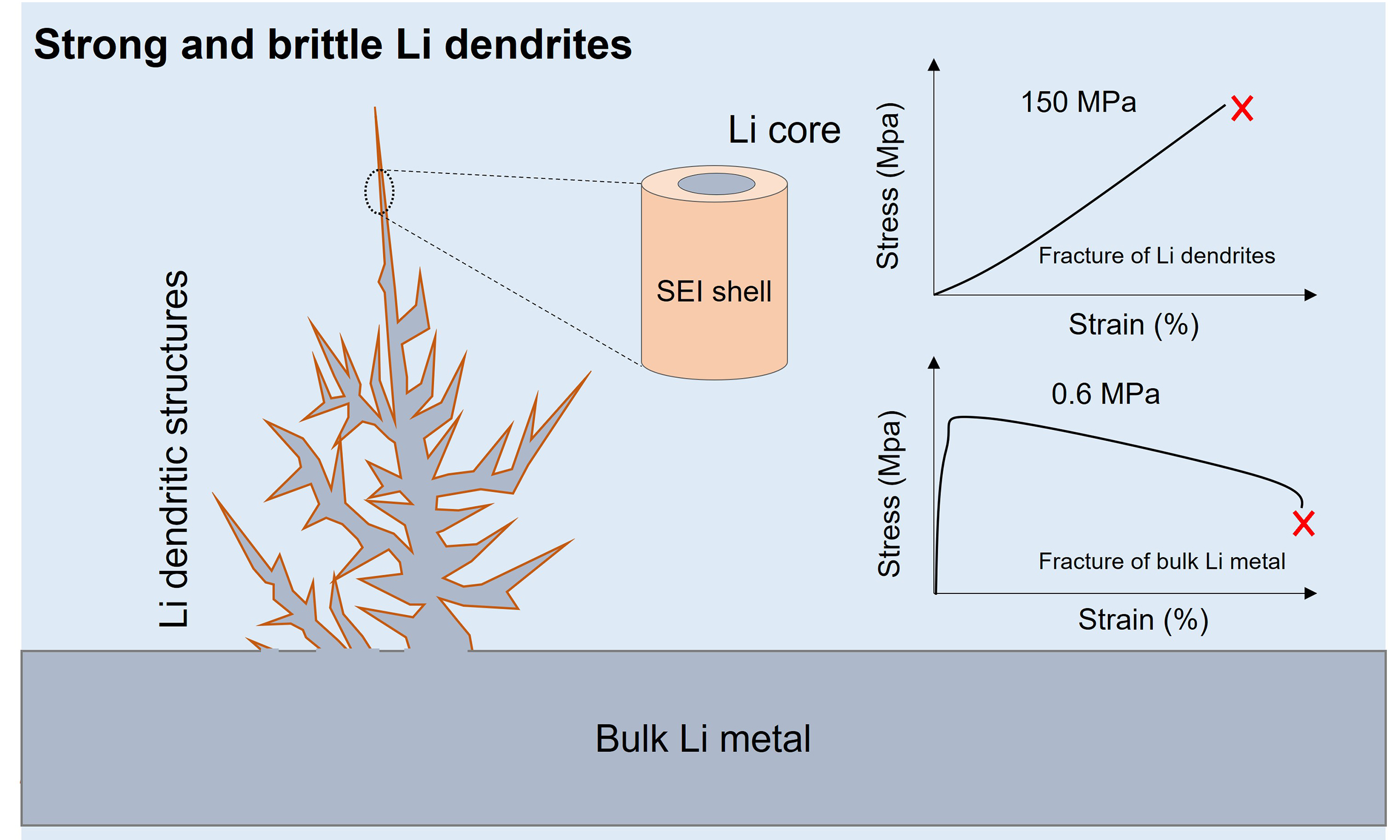
The microscale is challenging to probe, inherently heterogeneous, and fundamentally important. Lithium-metal batteries are widely regarded as one of the most promising candidates for next-generation energy storage systems[1]. However, the uncontrolled growth of lithium dendrites has long remained a critical obstacle, leading to internal short circuits, electrolyte decomposition, safety hazards, and rapid capacity decay. For decades, the field has been guided by a central assumption: bulk lithium is a soft and ductile metal, and therefore rigid solid electrolytes with sufficiently high shear modulus can physically suppress dendrite penetration. Yet, extensive studies have demonstrated that even stiff inorganic solid electrolytes, such as garnet-type lithium lanthanum zirconate[2,3], fail to prevent dendrite propagation. This key contradiction has puzzled researchers worldwide. Recently,
Ai et al.[4] employed advanced micro-and nanoscale experimental techniques, including custom-designed air-free transfer systems, in situ scanning electron microscope (SEM) nanomanipulators, icro-electro-mechanical systems (MEMS)-based micro-mechanical testing chips, and Pt e-beam deposition [Figure 1A]. The e-beam in SEM enables direct observation of dendrite fracture during tensile testing. Interestingly, however, the e-beam itself can influence the measurement results [Figure 1B]. Beam irradiation may alter the physical properties of the sample, thereby affecting the measured fracture stress. Moreover, the thermal effects induced by e-beam exposure can even lead to partial recovery of fractured lithium dendrites
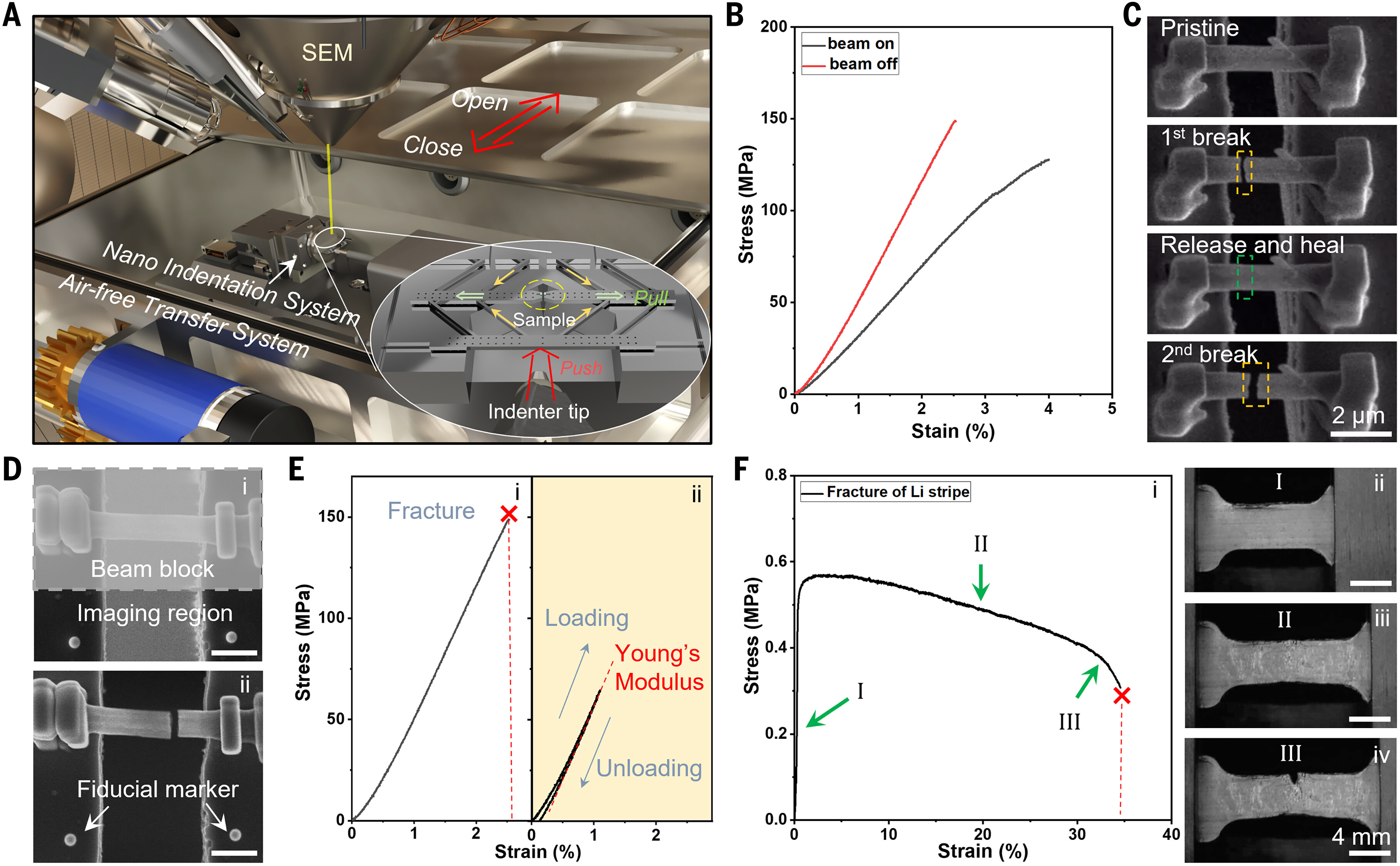
Figure 1. Mechanical properties of Li dendrites and bulk Li strips[4]. (A) Schematic illustration of a Li dendrite tensile test conducted in a scanning electron microscope (SEM). (B) Stress-strain curves of a Li dendrite with the electron beam (e-beam) turned on and off during the tensile test. (C) SEM images showing the e-beam healing effect on a Li dendrite: the first fracture was completely healed after e-beam treatment, while the second fracture occurred at a different location. (D) Typical tensile test of a Li dendrite; (i) and (ii) show the SEM snapshots of the Li dendrite before and after fracture, respectively. Scale bar: 1 μm. (E) Typical stress-strain curves of the fracture test and the loading-unloading test of Li dendrites, where Young’s modulus is derived from the unloading segment. (F) Typical tensile test of a Li strip; (i) shows the typical stress-strain curve of the bulk Li strip, and (i-iv) illustrate the optical snapshots of the Li strip at different stages, as marked in (i).
Through cryogenic transmission electron microscopy (cryo-TEM) and multiscale mechanical modeling, the authors uncover the structural origin of this anomalous mechanical behavior. Lithium dendrites exhibit a unique core-shell architecture, consisting of a nanoscale single-crystalline lithium core surrounded by a
Mechanistic origins of mechanical behavior in bulk lithium vs. lithium dendrites
| Mechanism category | Bulk lithium | Lithium dendrites |
| Dislocation sources | Abundant (grain boundaries, defects) | Extremely limited (“dislocation-starved”) |
| Dislocation mobility | Enables easy plastic deformation | Strongly suppressed |
| Size effect | Negligible | Pronounced nanoscale strengthening |
| Surface/Interface | Free surface | Constrained by SEI shell |
| Role of SEI | Not applicable | Acts as a stiff confining layer |
| Dominant mechanism | Dislocation-mediated plasticity | dislocation nucleation-controlled and interface confinement-controlled |
| Fracture behavior | Ductile (void nucleation and growth) | Brittle (negligible plasticity) |
In the experiments by Ai et al.[4], tensile loading was applied to lithium dendrites, which effectively reflects their intrinsic mechanical properties. However, in practical battery systems, dendrite formation is more likely governed by compressive stresses and bending during electrochemical deposition. Therefore, incorporating additional loading modes, such as compression and bending, may provide a more comprehensive understanding of the mechanical behavior of lithium dendrites. Preventing dislocation in lithium dendrites requires the shell to possess sufficient strength. Therefore, this study indirectly demonstrates that the SEI layer itself has relatively high stiffness and mechanical strength, enabling it to effectively act as a grain-boundary-like barrier, thereby suppressing dislocation activity. Furthermore, the work involves SEI formed in liquid electrolytes as well as passivation layers formed at solid-state electrolyte interfaces. Previous studies have shown that these two types of interphases differ significantly in structure, indicating the need for further investigation into their respective microscale mechanical properties.
In summary, this landmark study by Ai et al. redefines the mechanical behavior of lithium dendrites in batteries. It not only provides a fundamental resolution to a long-standing contradiction in the field but also opens up new research directions and prompts deeper reflection on the relationship between characterization methods and intrinsic material behavior.
DECLARATIONS
Author’ contributions
Collected literature, organized viewpoints and wrote the original draft: He, X.
Put forward critical comments, guided the writing and polished the manuscript: Tan, P.
Availability of data and materials
Not applicable.
AI and AI-assisted tools statement
Not applicable.
Financial support and sponsorship
This work was supported by National Natural Science Foundation of China (52561145238).
Conflicts of interest
Tan, P. is a Guest Editor of the Special Issue “Quasi/all-Solid-State Electrolytes for Advanced Batteries”in Energy Materials. He was not involved in any stage of the editorial process for this manuscript, including reviewer selection, manuscript handling, or decision-making. He, X. has declared that he has no conflicts of interest.
Ethical approval and consent to participate
Not applicable.
Consent for publication
Not applicable.
Copyright
© The Author(s) 2026.
REFERENCES
1. Tikekar, M. D.; Choudhury, S.; Tu, Z.; Archer, L. A. Design principles for electrolytes and interfaces for stable lithium-metal batteries. Nat. Energy. 2016, 1, 16114.
2. Kinzer, B.; Davis, A. L.; Krauskopf, T.; et al. Operando analysis of the molten Li|LLZO interface: understanding how the physical properties of Li affect the critical current density. Matter 2021, 4, 1947-61.
3. Xu, Y.; Peng, Y.; Xiong, X.; et al. Electrochemically active materials as critical components for next-generation solid-state electrolytes. Energy. Z. 2025, 1, 100004.
4. Ai, Q.; Zhang, B.; Liu, X.; et al. Strong and brittle lithium dendrites. Science 2026, 391, 1125-9.
5. Chu, S.; Liu, P.; Zhang, Y.; et al. In situ atomic-scale observation of dislocation climb and grain boundary evolution in nanostructured metal. Nat. Commun. 2022, 13, 4151.
6. He, X.; Zheng, S.; Sun, K.; et al. Operando electrode-scale stress characterization revealing the Li+ insertion mechanism of graphite anode. Energy. Storage. Mater. 2025, 82, 104629.
7. Joós, B.; Duesbery, M. S. The peierls stress of dislocations: an analytic formula. Phys. Rev. Lett. 1997, 78, 266-9.
8. Monroe, C.; Newman, J. The impact of elastic deformation on deposition kinetics at lithium/polymer interfaces. J. Electrochem. Soc. 2005, 152, A396.
Cite This Article
 Open Access
How to Cite
Download Citation
Export Citation File:
Type of Import
Tips on Downloading Citation
Citation Manager File Format
Type of Import
Direct Import: When the Direct Import option is selected (the default state), a dialogue box will give you the option to Save or Open the downloaded citation data. Choosing Open will either launch your citation manager or give you a choice of applications with which to use the metadata. The Save option saves the file locally for later use.
Indirect Import: When the Indirect Import option is selected, the metadata is displayed and may be copied and pasted as needed.
About This Article
Special Topic
Copyright

Data & Comments
Data
0











Comments
Comments must be written in English. Spam, offensive content, impersonation, and private information will not be permitted. If any comment is reported and identified as inappropriate content by OAE staff, the comment will be removed without notice. If you have any queries or need any help, please contact us at [email protected].